
e-Literate

Present is Prologue

Tag: resiliency

  • The Resilience Network Supply Chain

    This post is part of a series on building a lasting resilience network to support the continuity of quality higher education during times of crisis. In the web version of this post, a table of contents for the series is included at the top of the post.

    In my most recent post in this series, I wrote about the kinds of resources that are necessary to create, curate, and distribute during a continuity crisis such as the one we are experiencing now with COVID-19 and made the analogy to the supply chain for healthcare. As the crisis unfolds, we are learning about not just the materials that are needed but how they need to be found or created, vetted for quality, and distributed to where they are needed. Sometimes those resources already exist. A store of N95 masks may be sitting in the crypt of a cathedral. Somebody might invent a way to convert a snorkel mask into a ventilator part, which will need to be tested for efficacy and safety. Or they may develop and test a new ventilator hardware design and release those specifications as open-source, but the plans still need to get into the hands of organizations that are capable of making the device. Maybe thousands of former military personnel volunteer to help, but those volunteers must be matched to hospitals that need them. If we produce needed resources while ignoring the logistical challenges of distributing them effectively, we may end up with serious problems like bidding wars for life-saving supplies. We have a similar problem with educational resilience resources.

    Not all resources are the same. We need to think through our supply chain challenges differently for different kinds of resources.

    A content resource supply chain

    In my most recent post in the series, I broke down the different content resources into four different categories:
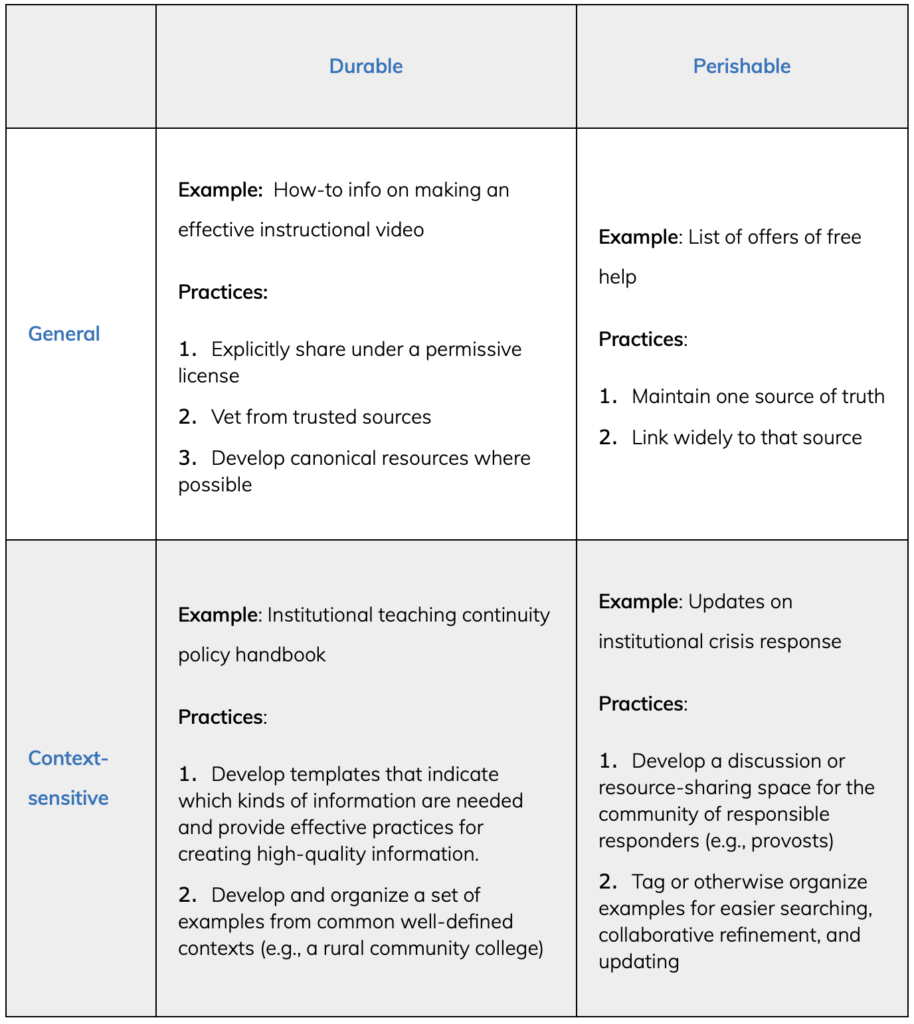
    There are basically two types of resources here: (1) content that should be easily shareable and adaptable for point-of-use applications and (2) canonical copies of information that should be maintained in one place by a trusted curator.

    To understand how we can improve the supply chain, let’s return to the overlapping Google Sheets mentioned in my first post in the series: the POD list of university continuity web sites (which has 420 entries as of this writing) and Bryan Alexander’s list of universities that are going online during the crisis, including links to each institution’s documentation (which has 279 entries so far). Assuming no overlap, that would give us 679 URLs of web sites that contain a mix of the various types of information and that probably link out to other sites that also contain relevant information resources. Both POD and Bryan’s Future Forum have been effective networks for gathering links to useful information. But sorting through all that information is labor-intensive even within a given network. If we add the goal of sharing information and sorting through the overlap between these networks—and others that may be doing similar aggregation work—the task quickly becomes daunting.

    But it is also one that lends itself to technological aid. For example, somebody could create a crawler that indexes all of these sites and applies machine learning to provide a preliminary categorization of resources. “These pages look like policy documents, while these other pages look like instructions on how to teach using webconferencing software.” That information could be cross-referenced with basic IPEDS data like whether the document comes from a community college or a research university.

    This preliminary categorization could then be surfaced to human curators, who could verify the labeling by the algorithm, correct any errors, and add relevant metadata that would be important for people interested in using the content that might not be detectable by an algorithm. These curators could be hand-picked for their expertise, or editing could be Wikipedia-style, relying on the wisdom of the crowds. Either way, there needs to be a collaborative online space for reviewing the results of the search and enriching the resulting records. The result would be a single searchable database with a wide range of high-quality machine-sorted and human-curated resources.

    We then would need to get those resources to points-of-use, which will be different for different people. It might be a web site of an association like EDUCAUSE. Or an individual university’s web site. Or it might be distributed by vendors. Vendors are a particularly important distribution vector because they are generally very good at reaching particular types of educational stakeholders with targeted messages. One way to do this would be through a faceted search interface like Amazon’s, where you can refine your search results by checking boxes on the sidebar related to different parameters. People could search for what they need and link or embed the resources where they need them. Another approach would be to create a chatbot interface that can be embedded at the point-of-use and scoped according to the same parameters available in the faceted search. For example, you might want to tell the chatbot that it should only display resources related to teaching online when embedded in a web site where that’s what people are most likely to be looking for. These two approaches aren’t mutually exclusive.

    A people resource supply chain

    One of the interesting aspects of creating a content resource supply chain in this way is that it also enables us to identify experts by attribution. Who authored this particular resource? Who curated it? Who edited it? We can use these connections to enable people who want to help build profiles that make them more findable. And again, we can use machine learning algorithms to make helpful suggestions. “It looks like you have contributed three content resources related to active learning techniques in online courses. Would you like to include that as an area of expertise in your public profile?” In other words, we can back into a kind of LinkedIn for resilience-related help expertise simply by taking advantage of attribution. People become findable—and build their reputations for expertise—based on their contributions.

    Mass volunteering is an interesting hybrid case. Suppose, for example, you want to make a list of instructional designers who want to volunteer to help faculty convert their courses in a hurry. The list itself is a content resource. But each name will be linked to a profile. If we really want to go crazy here, we can make it possible for people to issue profile endorsements (or badges) based on the help that the volunteer provided.

    All of the technology pieces for this network exist in the world today and could be assembled with a small fraction of the effort that is being put by many well-meaning organizations and individuals that are currently tossing their offerings into the ether and hoping that somebody finds their messages in a (digital) bottle. Furthermore, since these are all resources that people want to publicly contribute, privacy issues should be easy to navigate. (“Would you like to add this to your profile?”) We can create a resilience supply chain if we choose to organize ourselves.
  • Resilience Network: Resources

    I have organized my last two posts into the beginning of a series, which allows me to create a running table of contents on the relevant blog posts. This post is the third in a series focused on the creation of an education resilience network that can respond more effectively in times of crisis, whether the crisis is a pandemic, a hurricane, a war, or some other disaster that disrupts the normal functioning of educational institutions. I will have at least one announcement to make regarding the formation of such a network very soon. In the meantime, I will be using this series to lay out a vision for what such a network could look like and how it could function. In the context of the current COVID-19 crisis, my goal is to organize a better response for next term while providing some tips to the people and organizations that are working on an immediate response regarding how to increase their impact (e.g., putting an explicit and permissive license for re-use on any resources that are intended as donations or contributions to the community).

    As a community, we’re learning a lot about what a good (or bad) disaster response looks like by watching our governments and health systems. The logistical challenges are daunting. We have to produce good information resources for everyone, like what hygiene measures work and how to practice social distancing (or how to use a web conference system or develop a rhythm for working in an online class). We have to make sure the information about such effective practices is accurate and gets to everyone. We also need to get more specialized information to caregivers, like how to protect themselves and prevent disease transmission in hospitals (or how to create an effective online lesson). Then there’s information that needs to go to people who run care-giving institutions, like how to get test kits (or access to increased online teaching infrastructure). All of this needs to be accomplished consistently, accurately, and efficiently to reach everyone who needs accurate and useful knowledge. Some of that knowledge, like proper hand-washing technique (or how to create an effective instructional video) has a long shelf-life, while other knowledge, like how healthcare workers (or educators) should respond to local needs based on changes in available resources and supplies, is continually evolving.

    Beyond creating and distributing information resources that are helpful—and combatting the spread of misinformation that is harmful—we also have to identify and distribute other resources. Help, either in the form of consultative expertise or supplemental front-line workers, is a crucial one. We need to match available resources with current needs quickly and effectively, all while providing some means for vetting the help to make sure that the people, however well-intentioned they may be, are qualified to offer help. And then there are non-informational resources, whether they are N95 masks or web conference accounts. Some of these will be new resources that people need for the first time, while others will be providing financial relief to prevent the loss of ongoing access to current resources.

    How well we respond to the current crisis can make an enormous difference that differentially impacts more vulnerable populations. In an epidemic, the homeless, prisoners, and people without health insurance are among those who are least likely to be protected by our existing response mechanisms. Likewise, we know that first-generation students are more likely to struggle in online education programs even when those programs are carefully designed and not thrown together in haste. Our response to the current crisis can also put us in either a better or a worse position after the immediate crisis has passed. We can pass emergency economic legislation that protects workers and preserves jobs, or we can pass legislation that enables companies to use bailout money for stock buybacks and executive bonuses. Likewise, we can engage with educators on how to serve their students more effectively online, or we can just start spending money on a whole lot of Zoom accounts and robot tutors when the free offers run out.

    I don’t intend to denigrate the efforts or good intentions of anyone’s current response to the COVID-19 situation when I write this, but if our crisis response capability does not evolve past Google Sheets, webinars, and limited-time free product offers, then we are going to fail to support the people with the greatest need during this extended crisis while also failing to learn how to respond better to the next one.

    In this blog post, I’m going to write about the different kinds of resources for which we need to develop a supply chain in an education resilience network. In the next post, I will write about the challenges of creating, vetting, and distributing those resources.

    Content

    By content, I mean information that can be broadcast one-to-many rather than person-to-person expertise sharing. This encompasses a vast array of information resources targetted at distinct but overlapping audiences, including (but not limited to) the following:

    • Curriculum-specific information, like how to teach your dance class online
    • Technical information, like how to post an announcement in your LMS
    • Learning design information, like how to make better use of formative assessments in an online context
    • Policy information, like guidelines for what instructors can and cannot expect their students to be able to do during the crisis
    • Logistical information, like where to seek help for particular kinds of problems

    These resources can be either durable or not and either general or context-specific. Different characteristics call for different responses:

    [wptb id=11021]

    We should be mindful during this time of massive change that now is the time when new practices—either good or bad—take hold. For example, we know that instructors only tend to redesign their courses substantially when there is an extrinsic driver forcing them to rethink how they teach. We are currently experiencing the mother of all extrinsic drivers. We should be taking the opportunity to make sure we are teaching them about evidence-based effective practices. This is, in part, an equity issue. Disadvantages students are disproportionately vulnerable in the move to online. We lose them more easily. As a sector, we have an ethical responsibility to ensure that we are applying everything we have learned about educating well in order to help these students. That is even more important at a time when these very same students are particularly vulnerable in the rest of their lives, such as during a global pandemic that is shutting down the economy.

    Resources

    In an educational resilience response to a crisis, where the emphasis is on moving students to online, there will be a need for technology as well as information. People should have defined resource centers where they can go to find what they need and get advice about how to use it. I’ll offer one example. I am getting inundated with messages about COVID-19 resources and offers of help that various folks want me to help them promote. While I could easily turn e-Literate into a running announcement board for such offers, I have resisted that temptation. It’s not what e-Literate does best, and I see no point in duplicating work that others are already doing. For example, ISTE and EdSurge include a directory of vendor offers on their Learning Keeps Going web site. They have the resources to maintain such a directory and are a natural home for it. We should just use that rather than creating something else (or 100 something elses).

    I would love to see them include guidance to both schools and vendors about topics like how to design and vet such offers to address student data privacy concerns. In other words, there is a whole set of practice knowledge that attaches to this kind of a list. To the degree that one organization, network, or community becomes a hub for a resource (whatever that resource may be), it should also become a community hub for sharing information about the effective use of that resource.

    In this way, an education resilience network isn’t a hub-and-spoke kind of centralized response but rather a network consisting of multiple nodes of expertise concentration that are coordinating with each other as needed. I’ll have more to say about this in my next post.

    People

    This is an extension of my previous paragraph—including my comment about having more to say about this in my next post—but the most precious resource we need to coordinate is humans who can help. Many organizations are stepping up to play a role in matching helpers with need, but (a) a lot of companies and universities are just tossing information out into the ether without the benefit of coordination, and (b) the associations and other community nodes that are coordinating with their constituents are not coordinating with each other. This is the hardest part of the education resilience network to optimize, but it is also the most important. Ultimately, we will find that effective content and resource production and distribution in an emergency are second-order effects of the ways in which we organize ourselves—or don’t—for a whole-sector response to the crisis.

    Resource needs are also dynamic. At this moment in the midst of a crisis for which the education sector has not been well prepared, I find that most people I talk to fall into one of two categories. Either they are about to drop from exhaustion because they are frantically working the front line or they are climbing the walls trying to find some way to be useful because the work that they normally do to help has ground to a halt. We are doing a very poor job of coordinating those imbalances at the moment. And they will change as we finish the current term and people start preparing for the next one. We need organizational structures that enable us to balance human resource utilization—matching people who need help with people who can offer help—more dynamically.

    That challenge will be the topic of my next post.

  • Please License Your COVID-19 Resources CC-BY or Public Domain


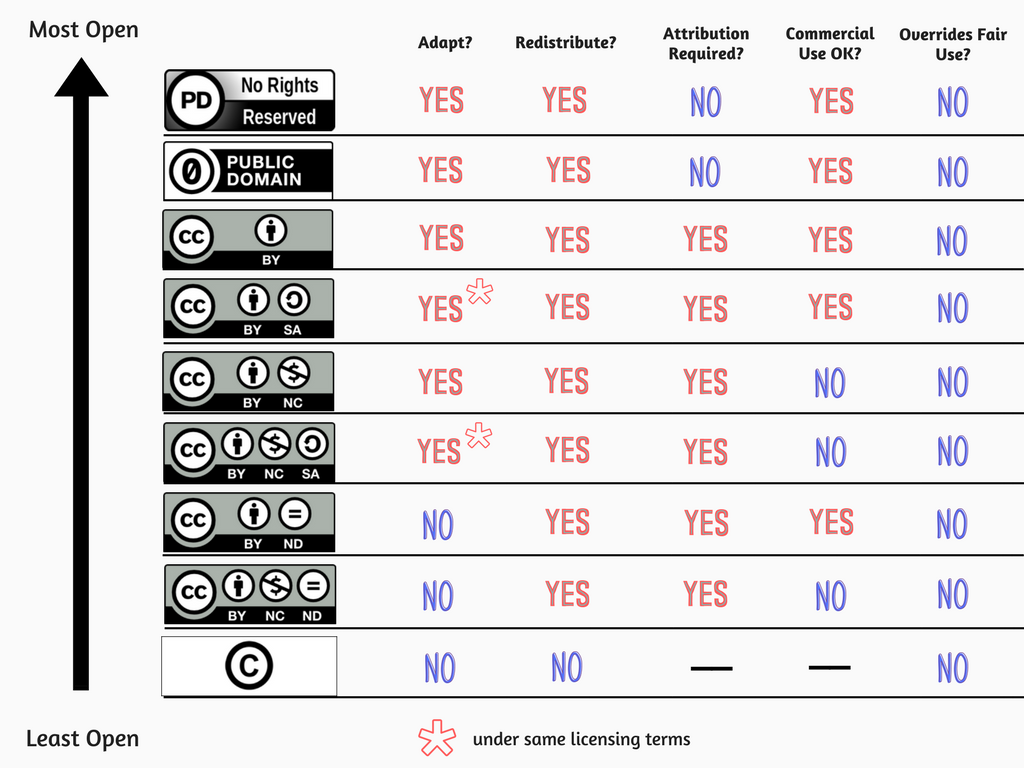
    CC BY Aaron McCollough (adapted from a table by Anita Walz)

    I’ve started sorting through the generous mess that is the COVID-19 educational resource sharing with an eye toward a lasting resiliency network that I wrote about yesterday. One good place to start (of many, I’m finding) is Lumen Learning’s list of recommended resources. ((Disclosure: Lumen is a sponsor of the Empirical Educator Project.)) While Lumen is sharing their curation free with everybody online, one of the strengths that the commercial providers offer during this time of crisis is that they also often have fairly direct lines of communication with their customers. Their survival depends on their ability to cut through the noise and reach particular people with well-targeted messages. In times like these, their communications and marketing teams can be turned into information distribution networks. We need to reach educators efficiently with high-quality information. We need these distribution networks.

    Right now, a lot of EdTech companies are doing what Lumen is doing. They are curating their own lists of content and getting them out to their customers. Many of these resources are being produced by and for academics. The companies are curating and distributing. Ideally, we would be working as a sector consistently, over time, to create and organize educational resiliency content that organizations with effective distribution capabilities. These could be commercial providers, universities, or professional associations. The most important thing is to get high-quality information to people who need it at their moment of need.

    In this kind of situation, we should reduce the friction of sharing as much as possible. One source of friction is licensing. People that want to share high-quality content created by others need to consider whether the creator has granted them the right to do so. That is the law, and it is also the right thing to do. But it is a source of friction to sharing. If your top priority is to create content that will reach and help as many people as possible, then you should reduce that friction as much as possible.

    There is a simple way to do that. First, make sure that your content bears an explicit license that grants sharing rights. Don’t make people come to you and ask for permission. Second, choose the most permissive license that you can justify. The most permissive license possible would be a public domain mark. This simply says, “I am giving this to the world and don’t need credit or payment. Please use it.” The second-most permissive option would be the Creative Commons Attribution license (CC-BY). This license says, “I am giving this to the world, and all I ask in return is that you give me credit for my work.” Either of these licenses will enable the broadest range of distribution networks to pick up your contribution with as little friction as possible.

    I do not recommend Creative Commons license conditions such as Non-Commercial or Share-Alike for this kind of resource. Non-Commercial (CC-BY-NC) is the worst. If a commercial entity shares your CC-BY-NC-licensed resource to their customers and they don’t charge for it, is that commercial use? Nobody knows. So commercial entities have both legal and ethical reasons to be cautious about sharing CC-BY-NC resources. Share-Alike (CC-BY-SA) is not quite as bad but also problematic. Again, if a commercial entity, or even a professional association, wanted to bundle your resources with some of their copyrighted material in order to help educators in their time of crisis, could they do it under this license? Do you want to prohibit that use?

    The Non-Derivatives clause (CC-BY-ND) if you’re worried about a piece of information with your name on it being chopped up in ways that you don’t approve. But every restriction clause creates a trade-off in terms of broadest use. Please think carefully about potential trade-offs with the ones that you impose.

    I am not making the blanket argument that all educational resources should be licensed CC-BY or public domain (although the argument could be made). I am urging my readers—both academic and commercial—to explicitly contribute as much of your crisis support content as possible under as permissive a sharing license as possible.