e-Literate

Present is Prologue

Tag: Sakai

  • UC Davis LMS Back Online: Update on what we know about Scriba Sakai outage

    I’ve been told by two sources that the UC Davis LMS outage I described in this post may be over, and the SmartSite LMS is back online (SmartSite is UC Davis’ implementation of Sakai, hosted by Scriba). I would like to update what we know about the overall situation while we wait for additional confirmation. The following is based on my conversations with a Scriba inside source who asked to remain anonymous, a student at UC Davis, the LISTedTECH team whose database powers our new LMS subscription service, some commenters from the blog post, and a more thorough review of the UC Davis IT status site. And I should point out that UC Davis team has done an excellent job in communications – timely messages with no defensiveness, and full transparency.

    The Outage

    On Thursday, May 19, Scriba notified UC Davis and several other schools that it would perform emergency maintenance starting Friday, May 20 at 9pm PDT and ending Monday, May 23 at 11am PDT. The outage was not caused by software applications but data center issues. I’ve asked what this means, and I’ve been told that Scriba will describe the outage in the next week. (more…)

  • Scriba Disaster: Sakai-based LMS for UC Davis is down with no plans for recovery

    In what might shape up as one of the worst LMS outages in recent history, UC Davis has been working without an LMS for the past week and does not expect their vendor to fix the problems before the end of the term. UC Davis uses a version of Sakai hosted by the LMS remnants of rSmart. In 2013 rSmart sold it’s Sakai-supporting LMS business to Asahi Net International, and in 2015 a private equity firm – Vert Capital – bought ANI and renamed it Scriba. Scriba hosts the Sakai LMS for UC Davis which has branded it as SmartSite.

    UC Davis is on the quarter system, with the last week of class next week (May 31) and finals the week of June 6. A few months ago UC Davis announced their intention to migrate to Canvas as their LMS. SmartSite subsequently went down on May 19th, and all signs are pointed to a complete and final outage. Scriba will not answer the phones (you get a message that the mailbox is full), and UC Davis staff are making a heroic attempt to in-house recreate LMS tools and even to recover grades that had been entered on SmartSite.

    UC Davis staff have replaced the smartsite.ucdavis.edu portal with a page telling faculty some methods to replace the LMS or go to Canvas early.
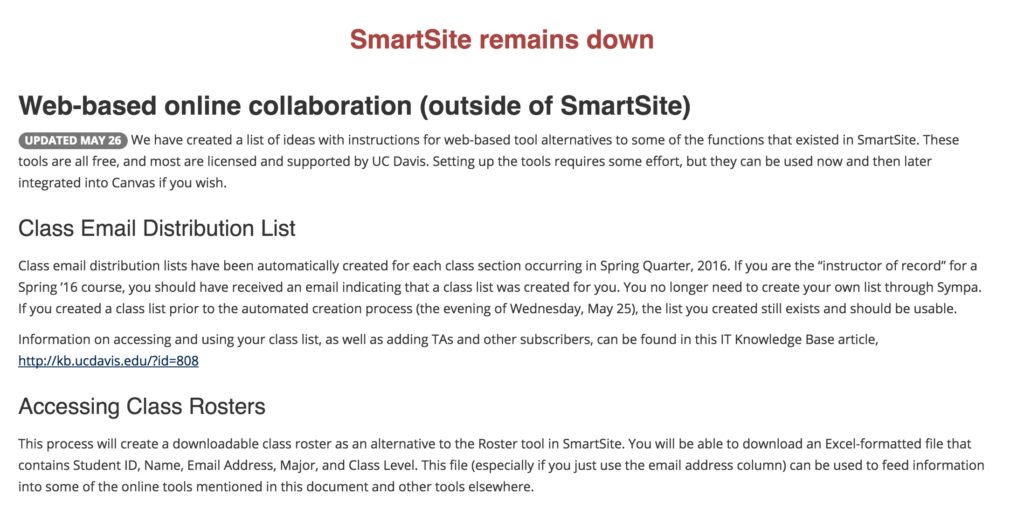
    UC_Davis_Smartsite

    There is no expectation for a repair by the vendor.

    On May 24th the UC Davis internal team sent this message to faculty and staff:

    We are working on extracting data from the SmartSite database. Our priority is to retrieve gradebook data for this quarter, and to make that information available to instructors as soon as possible. We are providing support for faculty to use alternatives to manage course materials for the rest of the quarter.

    This, folks, is a disaster. There is an interesting angle here in that Sakai is open source yet data is not easily recoverable. We will share more here at e-Literate as we find out new information.

    Update: Removed Buzzfeed post as unverified and not necessary for story.

    Update: Clarified that no expectation of repair by the vendor and that branding comes from UCD. Also adding the update from evening of May 26th.

    Progress continues on the Web interface to access grades. We expect that it will be available Friday (May 27).

    In addition, we have had a team working to build a local instance of SmartSite. This evening, the campus is completing internal testing on this limited version. A small group of selected faculty members will begin testing this version Friday morning. Depending on their results, we anticipate having this version available to spring 2016 instructors of record over the weekend. All of the content faculty have in SmartSite should be available to them.

    Please note that students will not have SmartSite access. While our goal remains to restore full access, this initial limited, local instance will only have capacity to support faculty access.

    Update: See this post for update on what happened and unconfirmed restoration of the system.

    I’ve been told by two sources that the UC Davis LMS outage I described in this post may be over, and the SmartSite LMS is back online (SmartSite is UC Davis’ implementation of Sakai, hosted by Scriba). I would like to update what we know about the overall situation while we wait for additional confirmation. The following is based on my conversations with a Scriba inside source who asked to remain anonymous, a student at UC Davis, the LISTedTECH team whose database powers our new LMS subscription service, some commenters from the blog post, and a more thorough review of the UC Davis IT status site. And I should point out that UC Davis team has done an excellent job in communications – timely messages with no defensiveness, and full transparency.

  • Previous LMS For Schools Moving to Canvas in US and Canada

    During the most recent quarterly earnings call for Instructure, an analyst asked an interesting question (despite starting off from the Chris Farley Show format).

    Corey Greendale (First Analysis Securities Corporation):  Awesome. A couple of other things on the, primarily on the Higher Ed space but I guess on education space, there’s a whole lot of couple questions about the competitive environment. When you’re and I don’t know if you will ever get into this level of granularity but when you got competitive wins against the Blackboard, are those predominantly from legacy ANGEL, are you getting those wins as much from Learn as well.

    Josh Coates (CEO of Instructure):  A lot of them are from Learn. Most, you know I don’t have the stats right off the top of my head. A lot of the ANGEL and WebCT stuff is been mopped up in the previous years and so, what’s left the majority of what’s left is Learn and our win rate against Blackboard it continues to be incredibly high, not just domestically but internationally as well.

    In fact, I think most of three out of the four international schools that we announced in this earnings where Blackboard Learn replacements, so yes Learn’s getting it.

    The question gets to the issue of whether Canvas is just picking up higher education clients coming off of discontinued LMSs (Angel, WebCT, etc) or if they are picking up clients from ongoing platforms such as Blackboard Learn. Beyond the obvious interest of investors and other ed tech vendors, this issue in general affects higher education institutions going through a vendor selection – for the system in consideration, are there many other schools considering the same migration path?

    Thanks to the work we’ve been doing with LISTedTECH and our new subscription service, we can answer this question in a little more detail. One of the charts we share shows higher education migrations over the past five years in the US and Canada. (more…)

  • State of Higher Ed LMS Market for US and Canada: Spring 2016 Edition

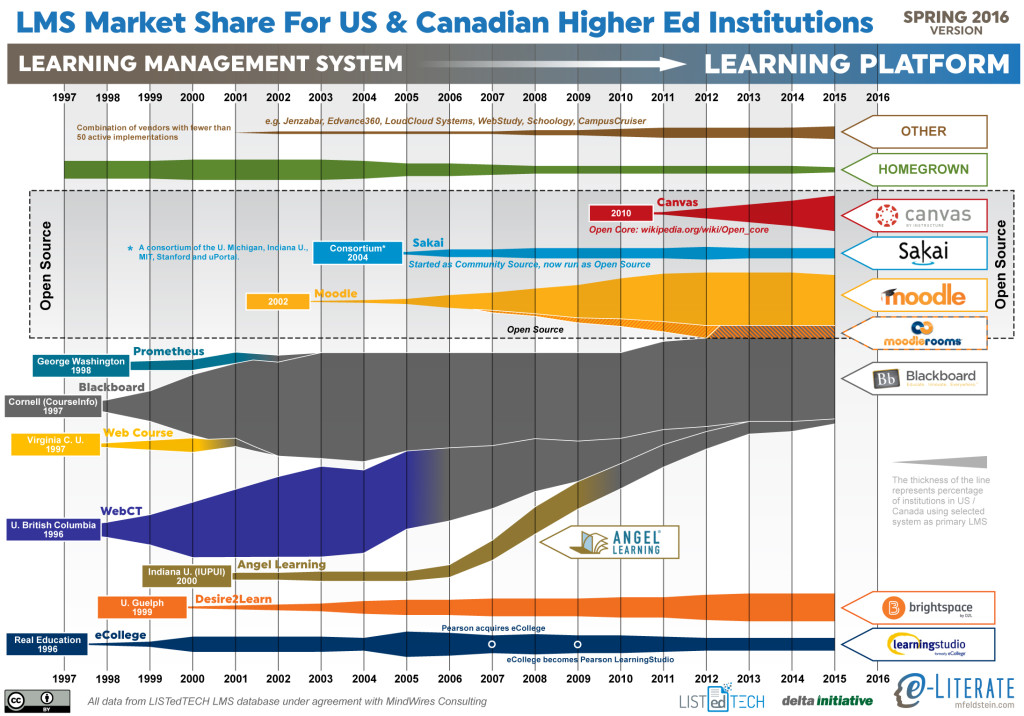
    This is the eighth year I have shared the LMS market share graphic, commonly known as the squid graphic, for (mostly) US higher education. The original idea remains – to give a picture of the LMS market in one page, highlighting the story of the market over time. The key to the graphic is that the width of each band represents the percentage of institutions using a particular LMS as its primary system.

    This year marks a significant change based on our upcoming LMS subscription service. We are working with LISTedTECH to provide market data and visualizations. This data source provides historical and current measures of institutional adoptions, allowing new insights into how the market has worked and current trends. This current graphic gets all of its data from LISTedTECH. Where previous versions of the graphic used an anchoring technique, combining data from different sources in different years, with interpolation where the data was unavailable. Now, every year’s data is based on this single data source.

    This graphic has been in the public domain for years, however, and we think it best to keep it that way. In this way we hope that the new service will provide valuable insight for subscribers but also improve what we continue to share here on the e-Literate blog.

    Since we have data over time now and not just snapshots, we have picked the end of each year for that data. For this reason, the data goes through the end of 2015. We have 2016 data but chose not to share partial-year results in an effort to avoid confusion.

    LMS_MarketShare_20160316

    A few items to note:

    • As noted in previous years, the fastest-growing LMS is Canvas. There is no other solution close in terms of matching the Canvas growth.
    • Blackboard continues to lose market share, although the vast majority of that reduction over the past two years has been from customers leaving ANGEL. Blackboard Learn lost only a handful of clients in the past year.
    • While the end-of-life occurs next year, Pearson’s has announced LearningStudio’s end-of-life for the end of 2017.
    • With the new data set, the rapid rise and market strength of WebCT becomes much more apparent than previous graphics.
    • There is a growing line for “Other”, capturing the growth of those systems with less than 50 active implementations as primary systems; systems like Jenzabar, Edvance360, LoudCloud Systems, WebStudy, Schoology, and CampusCruiser.
    • While we continue to show Canvas in the Open Source area, we have noted a more precise description as an Open Core model.

    For a better description of the upcoming LMS subscription service, read this post and / or sign up for more information here.

  • Solving the Ed Tech Patent Problem

    You may have heard that Khan Academy has filed for several patents. Audrey Watters has written a really strong piece providing the details of the filings in the context of the history of ed tech patents and showing why some academics feel that the patent system clashes with the values upon which academia was built. In the process, she excavates some of my personal history in the Blackboard patent war. While I am sympathetic to arguments against ed tech or software patents on principle, my own personal reasons for getting involved with that fight were more utilitarian. I believed then, as I do now, that patents threaten to kill innovation in educational technology due to the specific characteristics of the market. The outcome of Blackboard v. Desire2Learn did not end that threat, although it did temporarily reduce it. The conversation being provoked by Khan Academy’s filings offers a new opportunity to come up with a more permanent solution. (more…)

  • New Visual From LISTedTECH Shows LMS Market By New Implementations

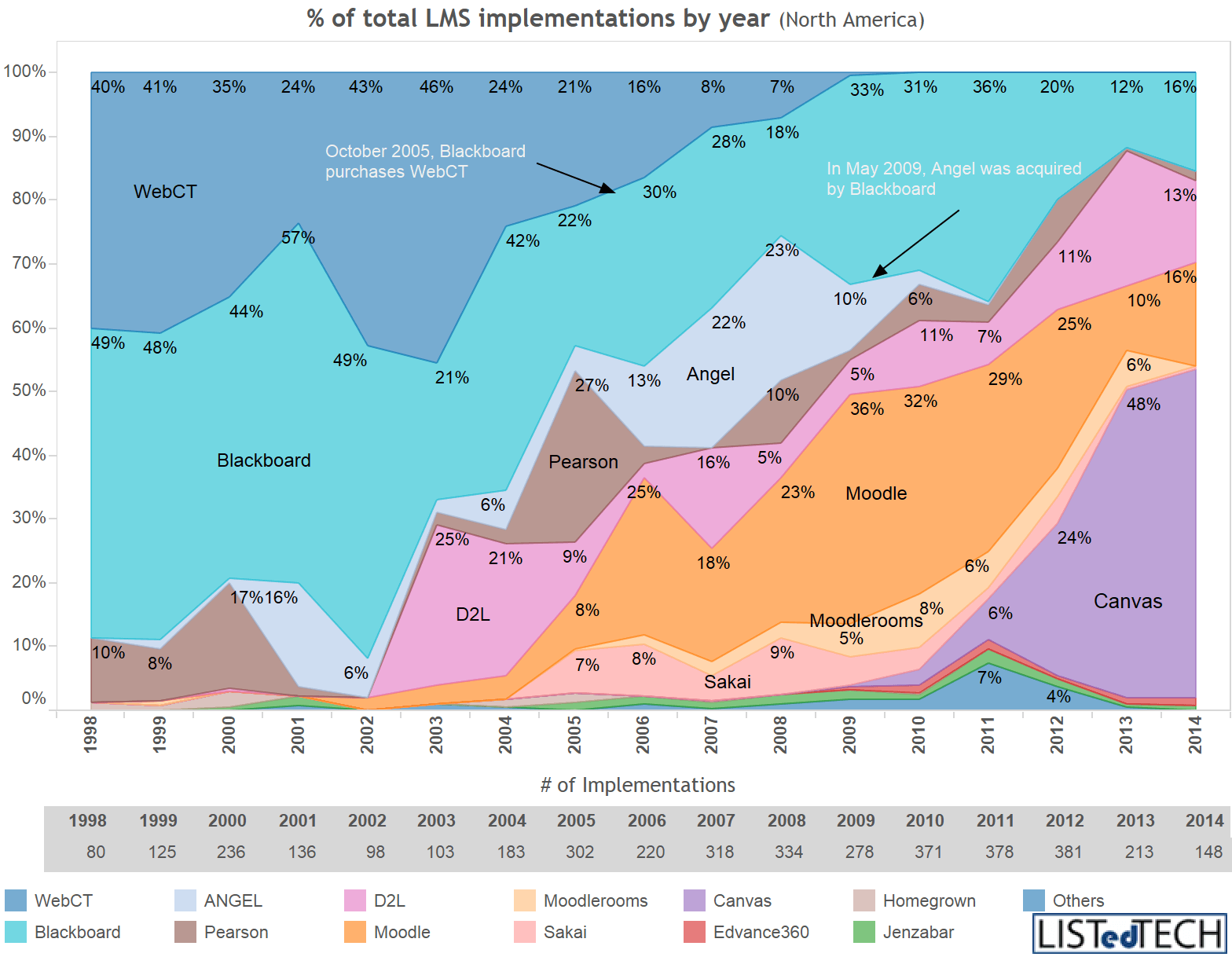
    Justin Menard and his team at ListEdTech have produced a great new visual on the LMS market in North America. Using his wiki-based data with 4,000+ institutions, he shows the percentage of LMS implementations per year (scaled to 100% for each year). While we are used to seeing LMS market share in terms of number or percentage of institutions using each LMS as primary system, this view highlights the dynamics of the market – which systems are getting adopted. See original post for full chart and additional description.

    LMS-Providers-Market-Share-by-Year1

    A few notes: (more…)

  • What Schoology’s Venture Funding Means for the LMS Market

    LMS vendor Schoology just raised $32 million in Series D venture capital funding, bringing the total that they’ve raised to just over $57 million. If you’ve never heard of them, that’s because they have mostly been focused on K12, where they are doing very well. But they have turned their attention to US higher ed recently. They had a surprisingly big presence at EDUCAUSE, where CEO Jeremy Friedman told me that they are prepared to make an aggressive push. Their ability to get major funding was probably helped by Instructure going to market, and possibly by the leak that Blackboard is putting itself on the block as well. I don’t generally take money guys too seriously in their ability to predict ed tech, but they may be lucky on this one. I think there may be an opening the US higher ed LMS market for a new entrant.

    LMS selection for schools often works a little like the selection process that high school students typically go through when picking a college. Students looking at colleges usually have a favorite going in. Maybe their friends are going there. Or their big brother or sister. Or maybe they just heard that it’s cool. But they don’t apply to just one college, in case it doesn’t work out for one reason or another. So they have a second tier of schools that might be OK too. Generally, they don’t know much about your favorite school going in and they know even less about the “might be OK” schools. Depending on how cautious they are, they might throw in one or two “safety” schools that they really don’t want to go to but that they feel (or their parents feel) should be included for the sake of completeness.

    Likewise, colleges and universities frequently go into an LMS evaluation process with a favorite. Because the selection is generally done by a committee of stakeholders rather than just one person, there might be conflicting opinions on what the favorite is. But more often than not, there is a nascent majority or a consensus opinion about the likely winner, at least among the core selection committee. Back in the early to mid-aughts, the default favorite was usually Blackboard because it was considered to be the safe alternative that everybody was using. When Blackboard faltered, the favorite began to split between D2L and Moodle—and occasionally Sakai, particularly for larger public universities—with type of school and geography having a big influence on which one was likely to be the frontrunner. These days, the schools that Phil and I talk to report Instructure as the starting frontrunner at least four times out of five, across school types or geographies.

    But LMS selection processes still need their “might be OK” candidates. For one thing, most of them are mandated by policy or by law to do a real multi-vendor evaluation. And most evaluation committees genuinely do want to look at alternatives. Just because they have a sense going in of which alternative is most likely to be the best doesn’t mean that they are closed-minded. The trouble is that there aren’t many alternatives that selection committees feel hopeful about these days. Increasingly, Sakai and Moodle aren’t even making it to the serious evaluation stage in US higher ed evaluations; and even when they do, they are often treated like safety schools. Blackboard never fully recovered from reputational damage done under Michael Chasen and their failure to deliver on Ultra this year was a huge setback. At the moment, they are being treated like a safety school as often as not. If Ultra slips further—and maybe even if it doesn’t—they could start losing significant numbers of customers again. And we haven’t run into many schools that are particularly excited about D2L either. Probably the best I can say for them is that they are the least likely of the LMS companies that are not Instructure to be dismissed out-of-hand.

    I think there’s an opportunity for a new entrant to get a fair hearing from selection committees that want a real horse race but aren’t excited about any of the incumbents. Ironically, the rise and success of Instructure has probably reduced risk aversion among schools to go with a scrappy start-up. I don’t know if Schoology is going to be the one that gets a foothold in the market because of this opening, but their timing is definitely good.