e-Literate

Present is Prologue

Tag: Sakai

  • Academic LMS Market Share By Enrollments, Part I

    Since the earliest days of Campus Computing and EDUCAUSE measurement of LMS market data up through recent analysis by Edutechnica and LISTedTECH (the latter our partners for the LMS market analysis service and data behind our LMS graphics), the most common measurement used has been “number of institutions adopting system X as their primary LMS”. But that is only one view, and like any view it has limitations. Sweet Briar College with 900 students is treated with the same metric as Ohio State University with 55,000. I’m sorry, The Ohio State University.

    Based on our recent publication of market share data and graphics, we have had multiple requests to share similar data by enrollment. Both Edutechnica and LISTedTECH have provided such views here and there in the past, but given our recent analysis expansion along with LISTedTECH to cover non-North American regions, we thought it would be worth sharing LMS market data based on enrollments.

    What we cannot do is look at how many students actually use the LMS. But for North America (US and Canada in this case) and Europe, we have sufficient coverage of official enrollment figures that we can scale each institution by its enrollment data. This is how most LMS companies determine their prices for each school, so it is a much better measurement to correlate with market revenues. Not a perfect measure, but a better one.

    In addition, this view gives additional insights into the market and likely future direction of the LMS providers.

    Hey Phil, will you just get to the damn graphics? Let us judge the importance.

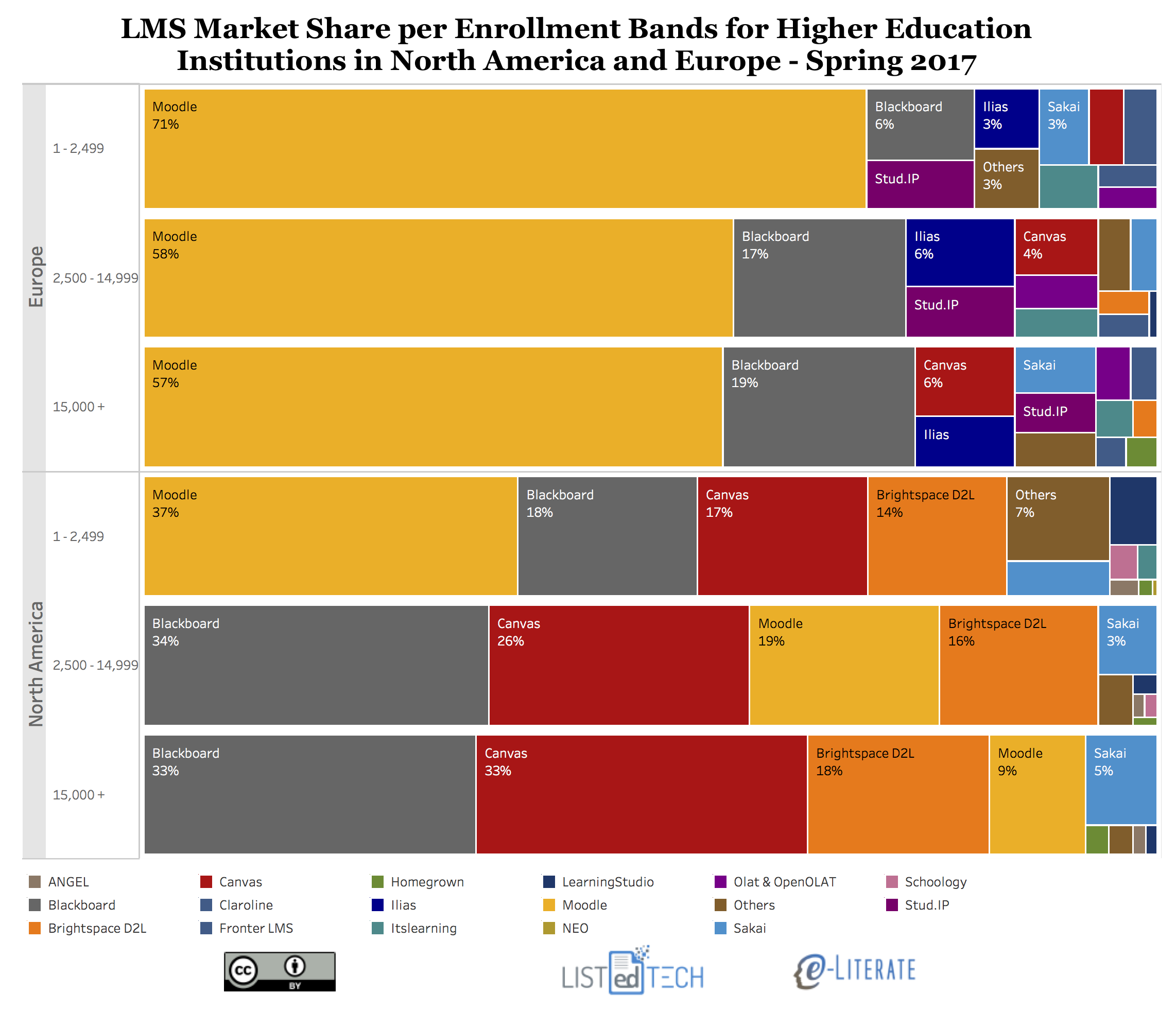
    OK, OK – for our first view, we group all institutions into separate bands of total enrollment and show market share for each band for each region (North America and Europe). Percentage of institutions adopting each LMS within each enrollment band of Small (1 – 2,499), Medium (2,500 – 14,999) and Large (15,000+) enrollments. Update: Clarified language.
    Some Notes:

    • The LMS with the greatest enrollment variation is Moodle, particularly in North America. For small schools below 2,500 students, Moodle is #1 at 37%, but for medium schools it’s #3 at 19% and for large it’s #4 at 9%. A huge difference. In Europe, Moodle market share also inversely correlates with enrollment but to a far smaller degree (71%, 58%, 57%) and it is still #1 in all bands.
    • Blackboard Learn and Canvas vary in North America the opposite direction – larger enrollment sizes equals larger market share – but not quite as dramatically as Moodle’s inverse relationship. Blackboard is #1 with roughly 33% market share for both large and medium institutions but is #2 with 18% for small institutions. Canvas goes from 33% for large to 26% for medium to 17% for small institutions. And note that Canvas and Blackboard Learn are virtually tied for first place for large institutions in North America.
    • D2L Brightspace has the most even distribution, with 18% of large, 16% of medium, and 14% of small institutions. That’s interesting.
    • In Europe, the overall distributions are more consistent with less variation between enrollment bands. While Moodle has smaller market share for larger enrollment bands, the general shape of the market does not change that much – just scaled a bit and with minor variations.
    • In what might be a surprise given its roots in larger research universities, Sakai (like D2L) has a fairly even distribution and similar market share across small, medium and large institutional bands.

    Coming soon – combining data not in enrollment bands but as scaled by each institution’s enrollment numbers.

    Update: See second post here.

  • Follow-Up From Future Trends Forum Discussion On Learning Platforms

    Follow-Up From Future Trends Forum Discussion On Learning Platforms

    Last Thursday I participated in a Future Trends Forum, hosted on the Shindig platform, with host Bryan Alexander on the topic of “What’s next with the LMS?”. I have to admit this was one of the best virtual discussions I’ve had, and more than half of the session was driven by audience questions. You can check out the Twitter discussion, Storified , or listen to an audio recording of the whole session, thanks to Roxanne Riskin. Update: See YouTube video of event posted at end.

    As Bryan described in his blog post:

    Yet maybe the conversation won’t stop there, at 3:05 pm EDT on June 29th. Because when we broke we had more than thirty (!) unanswered questions remaining from the Forum community. I’d like to share those now, so that Phil can respond, but also so that anyone can dive in, whether or not you participated yesterday.

    I don’t have enough time to address all the of the questions, but I would like to tackle a few. We’re also talking about having a part 2 and bringing in Michael in late August. In the meantime . . .

    • Competitiveness – Is the lack of competitiveness due to a lack of innovation or because IT decision makers are looking for consistency/ease of support?

    This question refers to the point I made in this blog post that in four global regions we have two companies dominating the installed base (Moodle, Blackboard), one dominating new implementations (Canvas) with one gaining recent momentum (D2L Brightspace). That’s four solutions dominating across the globe for higher education, hence the “lack of competitiveness” in the question.

    While I think the market needs more innovation, I don’t think that’s the primary cause of this emerging four-way oligopoly. One issue more important than pure innovation is that ed tech is a difficult market in terms of scaling a business, and it is difficult to remain profitable. Canvas is growing fastest, and Instructure (parent company) plans to be cash-flow positive in 2018. As in, Instructure is not profitable yet. Just two years ago Moody’s changed their outlook on Blackboard to negative due to very high debt to EBITDA ratios and “stagnating revenues”.  We have little public information on D2L, but I have pointed out company layoffs occurring after the large investment rounds. Moodle is open source and not directly a system with profits. This comes at a time when the expectations for competitive LMS offerings is rising in terms of cloud hosting and interoperability and intuitive user experience. This is not an easy business.

    • What are your thoughts about competency-based education (CBE)? In particular, with Elliucian leaving the space, do you see a market for a CBE-targeted LMS? And, which products do you see as leaders? or potential leaders?
    • CBE – You’ve brought up CBE a few times. Do you feel there is slower than expected growth for colleges/univ for CBE. Hence, the sun setting of Ellucian’s platform. Or, perhaps, are they force fitting the current LMS to be their CBE LMS?

    See this post describing the very slow growth of CBE platforms. If you think the institutional LMS market is difficult, try the CBE platform market. We do not have the same level of market data for CBE as we do for LMS, but anecdotally I believe that Sagence Learning (formerly FlatWorld) has won the greatest number of CBEN platform selections in the past year or two.

    • Have you seen any trends in terms of schools with more than one LMS – are places consolidating or fracturing? (always surprised by number of institutions that have more than one)

    There is a general, low-level trend in higher education to have fewer cases of secondary LMS usage. Mostly consolidating while aiming to increase the number of third-party apps working alongside the primary system.

    • hosted vs. not hosted – For those LMSs that aren’t open source, do you have any thoughts on how institutions are managing systems – are they choosing to host themselves or are they choosing to use vendor hosting (or other options)?

    In all four global regions we have covered (North America, Europe, Latin America, Oceania), there is a move towards managed and cloud hosting and away from self-hosting. In North America, more than 90% of new LMS selections are going straight to managed or cloud hosting. Europe trends the same direction but is roughly 50 / 50 for new implementations. And I should point out that these trends exist for open source solutions – maybe not to the same level, but in the same direction.

    • K-12 – following up on Schoology and google classroom, what force is K-12 going to be in the future of higher ed LMS? can the teaching energy and innovation of K-12 energize higher ed teaching…?

    I have written several posts on Google Classroom, although I need to do an update. The general answer is that neither Google Classroom or Facebook Classroom show significant signs of affecting the higher ed market. There is some interest in both platforms, but mostly from a small number of individual faculty. And neither platform is designed to solve the gradebook or system integration needs of higher ed. Yet.

    We have several posts on Schoology, which has a bigger potential impact on higher ed for a K-12 based system.

    • Finally, we partially discussed a set of question from Fred Beshears, summarized in this new post. The general topic is around CBE platforms and whether LMS systems are moving to support “massive student information profiles” (across courses for large numbers of students) or whether this is being relegated to student record systems. We partially address these questions in the Future Trends Forum, but not entirely. Hopefully we’ll see others jumping into the online discussion. Update: See discussion thread at Bryan’s post for discussion on this topic.
    • (Update: Finally, finally) I answered two questions in the session about the potential of the LMS as an integration hub, bringing in third-party apps rather than being monolithic systems. The answers were admittedly aspirational. George Station made a good point on Twitter that there is another side to the LMS impact on pedagogy:

    I do agree that this has happened, as covered further in replies to that tweet.

  • Whither Moodle?

    Whither Moodle?

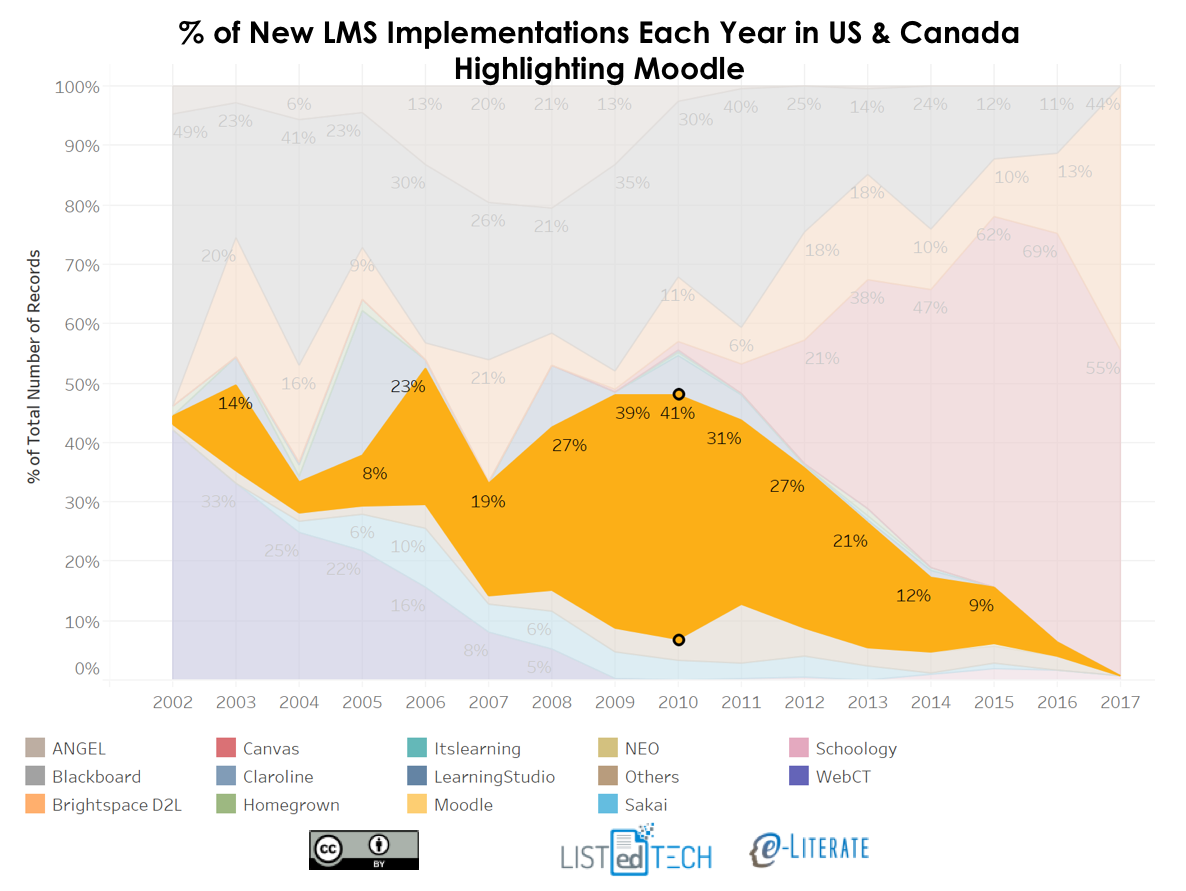
    On e-Literate and even more so with our LMS market analysis service, we have called out many times the broad dominance of Moodle in terms of active installations worldwide. In every region outside of North America (US and Canada), Moodle has largest market share by far, and it is second place in North America.

    But the trajectory of Moodle new implementations (higher education degree-granting institutions moving from another LMS to Moodle as the primary LMS) is striking, especially in the US and Canada as seen below, with Moodle highlighted (all data is from our partner LISTedTECH). (Update: Image link fixed – wasn’t showing in some areas)

    (more…)

  • State of Higher Ed LMS Market for US and Canada: Spring 2017 Edition

    State of Higher Ed LMS Market for US and Canada: Spring 2017 Edition

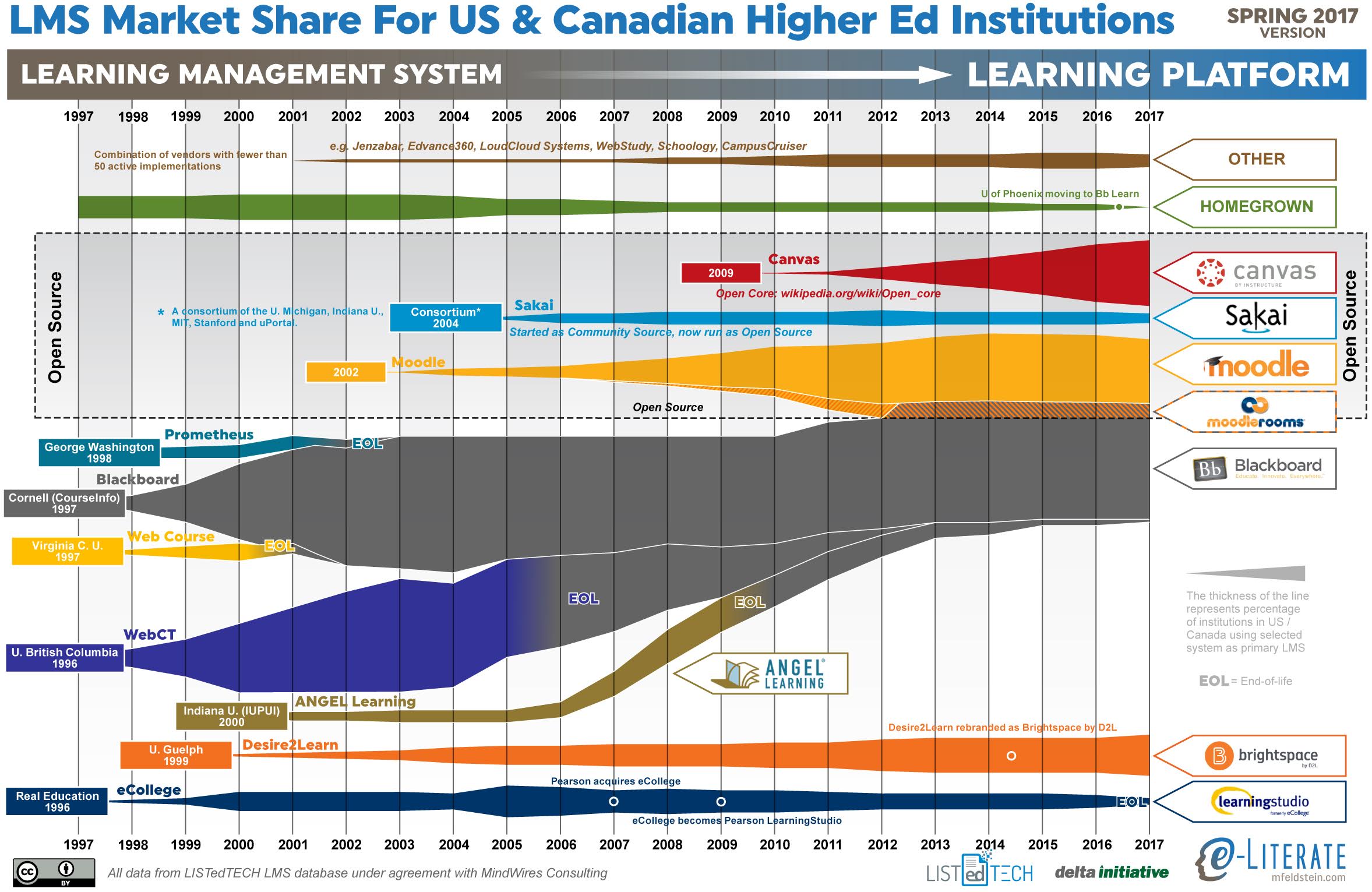
    This is the ninth year I have shared the LMS market share graphic, commonly known as the squid graphic, for US and Canadian higher education. The original idea remains – to give a picture of the LMS market in one page, highlighting the story of the market over time. The key to the graphic is that the width of each band represents the percentage of institutions using a particular LMS as its primary system.

    Last year we made a big shift based on our LMS market analysis service – we are working with LISTedTECH to provide market data and visualizations. This data source provides historical and current measures of institutional adoptions, allowing new insights into how the market has worked and current trends. Our spring report for subscribers will be released this month. Data for 2017 goes through April 1 of this year.

    (more…)

  • Vert Capital and Scriba Corp: Institutions losing course data in company’s death throes

    Vert Capital and Scriba Corp: Institutions losing course data in company’s death throes

    After last year’s disastrous outage at UC Davis due to Scriba Corp’s change of data center for the Sakai LMS (branded as SmartSite at UC Davis), it turns out that there is more damage to be done as the company slowly disappears. What appears to have happened in the past few months is that Scriba has not been paying this new data center provider (IO Data Centers), and that company is withholding the data on its servers until the issue is resolved. The end result is that several remaining Scriba customers have lost not just a live Sakai site but also the underlying current and historic course data. In at least one case, this dispute has caused a distance education program to be halted until the school figures out how to set up a new LMS site and to recreate their course content.

    Based on two people familiar with Scriba’s recent operations, despite several remaining schools continuing to pay hosting fees, Scriba was not fully paying IO Data Centers. While I have no information on whether there was a legitimate complaint or whether this was simply non-payment to save cash while Scriba died, I will point out that last Spring Scriba’s contract with the Apereo Foundation to remain a commercial affiliate was cancelled under similar circumstances. Scriba simply stopped paying Apereo until the foundation’s board voted to terminate their contract. (more…)

  • New Release of European LMS Market Report

    New Release of European LMS Market Report

    Our Spring 2016 LMS Market Report from our new LMS subscription service focused mostly on the United States and Canada. The LMS market, however is increasingly global in nature. LMS suppliers rely on markets outside of US and Canada for growth, and Moodle in particular has a long history of global adoption. Maintaining a US/Canadian view without additional data can be misleading when forecasting the roadmaps and future states of various LMS solutions.

    What we haven’t had until now is a view of the LMS market in Europe. Thanks to our partnership with LISTedTECH, we can now share data from more than 1,600 higher education institutions throughout Europe and provide the first independent market analysis for this region. While this report and future analysis is part of the LMS subscription service, we are sharing the initial version freely with a CC-BY license. (more…)

  • Update: LMS Usage In Large Online Programs (Top 50 in US)

    By: Phil Hill and Justin Menard. Cross-posted at LISTedTECH

    Three and a half years ago Phil wrote a post “Snapshot of LMS Market for Large Online Programs in the US” giving a view into this growing segment of higher education.  Large online enrollment institutions typically mean a centrally-coordinated provision of online courses, often with duplicate course sections, and these programs tend to use more of the LMS than ad hoc online courses or blended courses. Further, these programs are dynamic – they are far more likely to grow significantly or shrink significantly than face-to-face or blended programs. As such, this segment can have different usage patterns than the broader market. Thanks to the partnership between e-Literate and LISTedTECH for our LMS subscription service, we have a much richer data set now. One of our subscribers asked a question over the weekend about this subject, so it seemed time to update this view.

    What we are showing below are the 50 institutions with the greatest number of students taking at least one online class based on the IPEDS database, for graduate and undergraduate combined. The most recent enrollment data set was for Fall 2014, so the enrollment data is slightly out of date. But the LMS listings should be up-to-date. In fact, we are showing some leading data, such as the University of Phoenix usage of Blackboard Learn and Kaplan University usage of D2L Brightspace – neither school has fully transitioned to the new LMS, but they have made official decisions and begun deployment. We have grouped the schools by sector, as well. (more…)