e-Literate

Present is Prologue

Tag: SNHU

  • Fall 2017 Top 30 Largest Online Enrollments In US – With LMS Usage and Trends Since 2012

    Fall 2017 Top 30 Largest Online Enrollments In US – With LMS Usage and Trends Since 2012

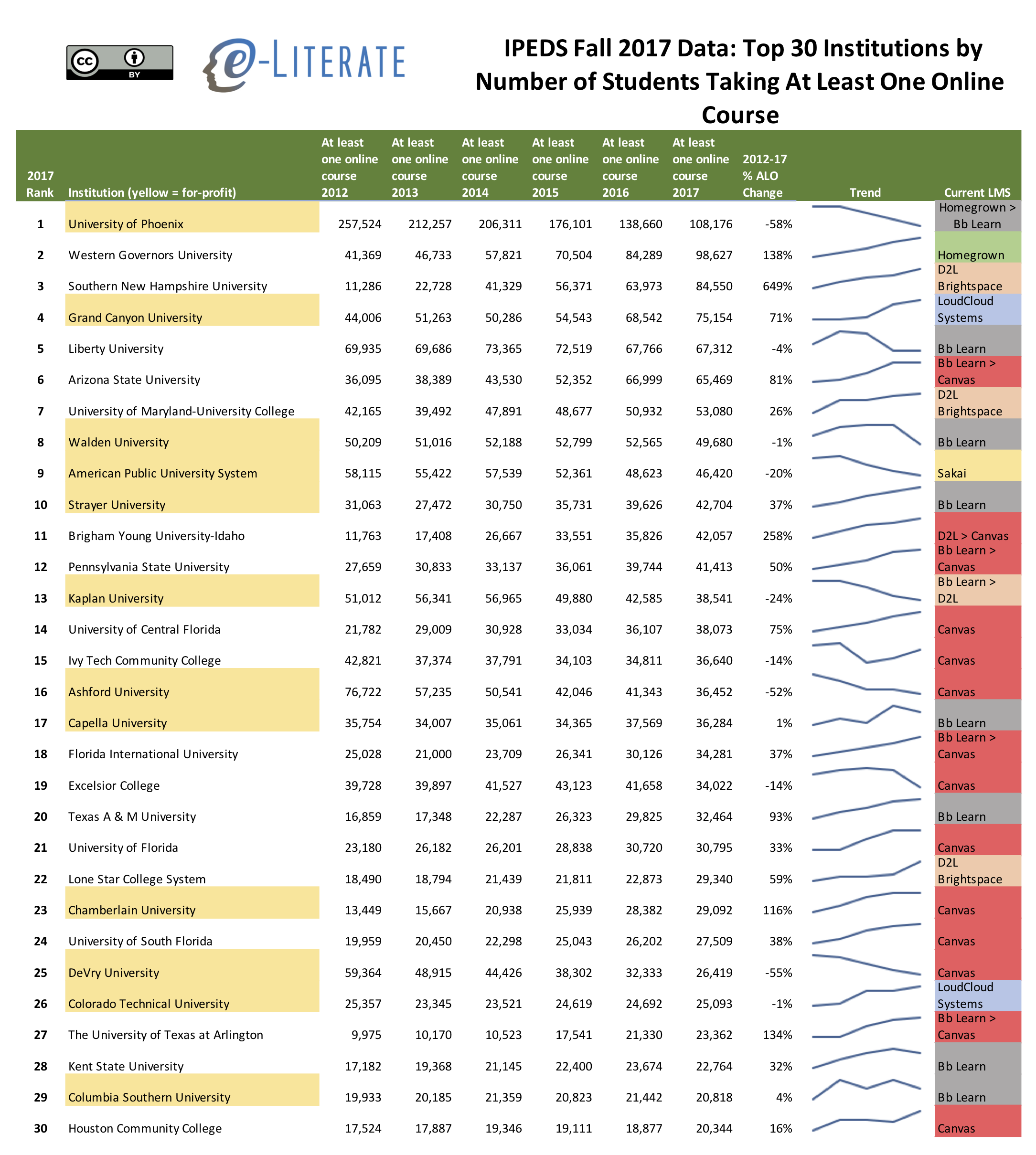
    The National Center for Educational Statistics (NCES) and its Integrated Postsecondary Education Data System (IPEDS) provide the most official data on colleges and universities in the United States. This is the sixth year of data on distance education enrollments, and we have an opportunity to view trends over time.

    Let’s look at the top 30 online programs for Fall 2017 (in terms of total number of students taking at least one online course for grad and undergrad levels combined) in the US. Some notes on the data:

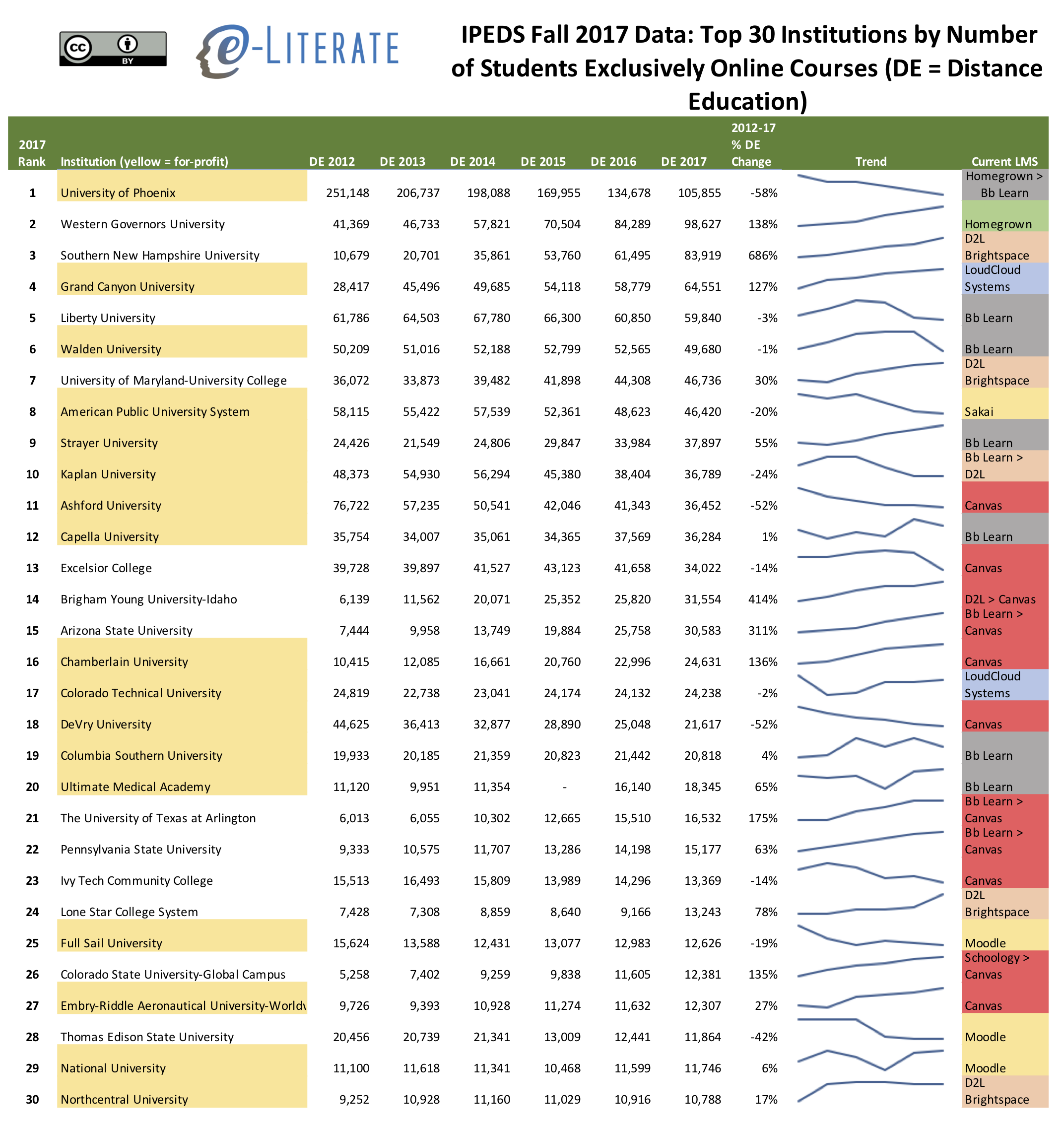
    • The first view combines the categories ‘students exclusively taking distance education courses’ and ‘students taking some but not all distance education courses’ to obtain the ‘at least one online course’ category; the second view shows just the ‘students exclusively taking distance education courses’.
    • Note that IPEDS captures distance education enrollment data based on Fall 20xx reports using a census date of October 15; this approach does not fully capture programs with multiple start dates throughout the year.
    • IPEDS tracks data based on the accredited body, which can differ for systems – this data has combined most for-profit systems into one institution entity as well as Arizona State University and a handful of not-for-profit systems that operate as one entity.
    • There is a new column this year showing changes in enrollment in each case between Fall 2012 and Fall 2017 data.
    • Both views highlight for-profit institutions in yellow and added sparklines to help visualize trends. There has been a wave of for-profits converting in one form or another of not-for-profit institutions (e.g. Grand Canyon University, Kaplan / Purdue Global), but these conversions for the most part had not taken place as of the Fall 2017 reporting period.
    • There is another new column this year showing which LMS is currently in usage at each of the schools listed, and in cases where there is a transition in 2018, both systems are shown with a direction > sign.
    • See this post for Fall 2017 profile by sector and state.

    Largest 30 online enrollments in US

    Looking at the case where students exclusively take online courses in a distance education (DE) mode, we see some differences in the list with a greater concentration of for-profit schools.

    Top 30 distance ed institutions

    Finally, it’s worth looking at the top 30 trend over time. Obviously the University of Phoenix is no longer the 800 pound gorilla in distance education, with two not-for-profits – Western Governors University and Southern New Hampshire University – poised to overtake Phoenix in the next year or two. This view also shows the tendency for most institutions to top out at approximately 60,000 students, but this may be changing with the three counter-examples above as well as Grand Canyon University.

    IPEDS Top 30 trend 2012-17

    Based on a reader request, I have added a Google Sheet for the data used above. There are tabs for Top 200 and Top 30 listings for each category (ALO and DE), but the LMS data was added manually and only available in Top 30.

    Update 11/26: Fixed mistake in 2012-17% calculations, updated first two images. Added downloadable Google Sheet for data access.

  • Enrollment Implications Regarding Directive for Online Community College in California

    A month ago Governor Jerry Brown directed Eloy Oakley, Chancellor of the California Community College System (CCCS) ((Disclosure: The Online Education Initiative from CCCS is a client of MindWires. The views in this and future posts represents my independent views and not OEI’s.)) to “take whatever steps are necessary” to establish a fully-online college. At first glance this directive appears to be a solution in search of a problem, so it is worth looking beyond the headline see what is motivating this move.

    In an article from Community College Daily:

    Noting that the system has significantly expanded the number of online courses, Brown said, “I believe it is time now for our community colleges to increase even further the availability of online courses and degree programs – and make college far more accessible and affordable.”

    Reaching more students

    “The governor has been interested in realizing the promise of online education for a number of years,” Oakley said in an interview with CCDaily. He added that Brown also wants a way to reach more nontraditional students.

    “We have literally tens of thousands of working adults with some college and no credentials and a couple of million working adults who are unemployed or underemployed,” Oakley said. “This is a wonderful opportunity to reach a population that really needs a community college to achieve economic mobility.”

    The details are not yet worked out, and Oakley is pulling together a group to advise on the options available to make this directive a reality, with the recommendations due in November. Oakley’s comments clearly establish access for nontraditional students to be the ultimate driver. In an interview with Inside Higher Ed, Oakley commented further:

    “Part of this is the governor’s desire to reach more students in California through a technology platform,” said Eloy Ortiz Oakley, chancellor of the California Community College system. “The 114 campuses are designed in a traditional manner, so we’re reaching a traditional population that is students coming out of high schools.”

    But a new online-only college could reach students those traditional brick-and-mortar campuses are currently missing — adults who are unemployed or underemployed, he said.

    To achieve these goals of reaching more working adult students, there are some real challenges to address.

    View of CCCS Enrollment Mix

    It is worth viewing the historical headcount numbers available from the Chancellor’s office, focusing on age group to get a better understanding of the status quo.

    The headcount for CCCS peaked in 2009 at 2.93 million students and has since dropped to the current 2.36 million level, a reduction of 19%. Across the state, colleges are looking for ways to increase, or at least slow the decrease, in overall enrollment.

    What is most striking in the data, however, is the shift from older students (age 25 and above, or “adults”) to younger students (age 24 and blow, or “traditional”) for the community college system, with the mix roughly reversed from 25 years ago. Chancellor Oakley and Governor Brown are right to note that the older student population is not being served well, at least if we use actual enrollment as a proxy. And the situation is getting worse, not better. However, while the majority of students in CCCS are 24 or younger, there are also a large number of older adult students. In other words, there appears to be an overlap between the students in the current 114 colleges and the target students for the new fully-online college. This will present quite a challenge for Oakley and other planners to make the following statement from the IHE interview a reality.

    “We don’t want to cannibalize the system, and we wouldn’t want to create a college to take enrollment from other colleges,” Oakley said. “Any solution would have to complement what we do, and it has to have an opportunity to share revenue with the colleges and really enhance their ability to serve students.”

    This statement is sounds good on paper and will be crucial in terms of getting at least tacit support from the current colleges to the creation of a new, full-online college. But the data shows there is not a clear and easy path to serve adult, non-traditional students without affecting existing colleges.

    National Trends

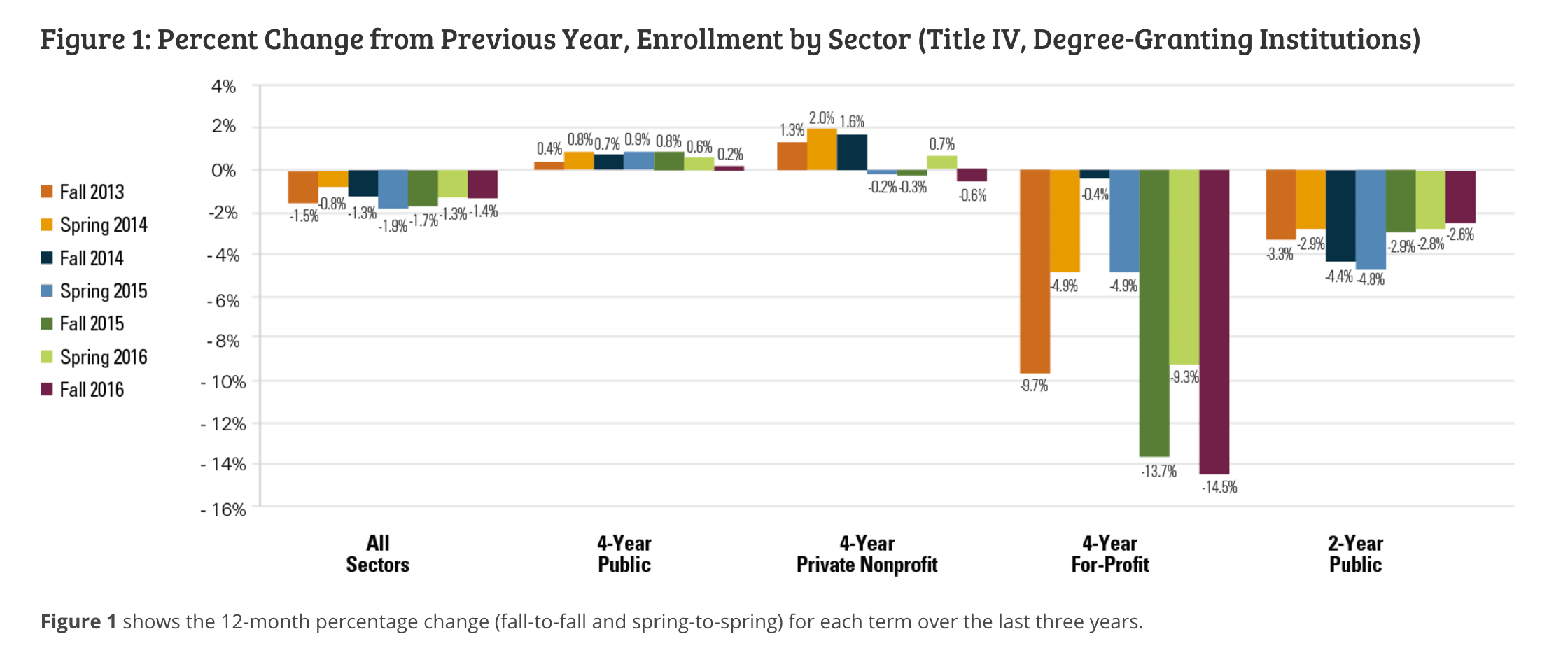
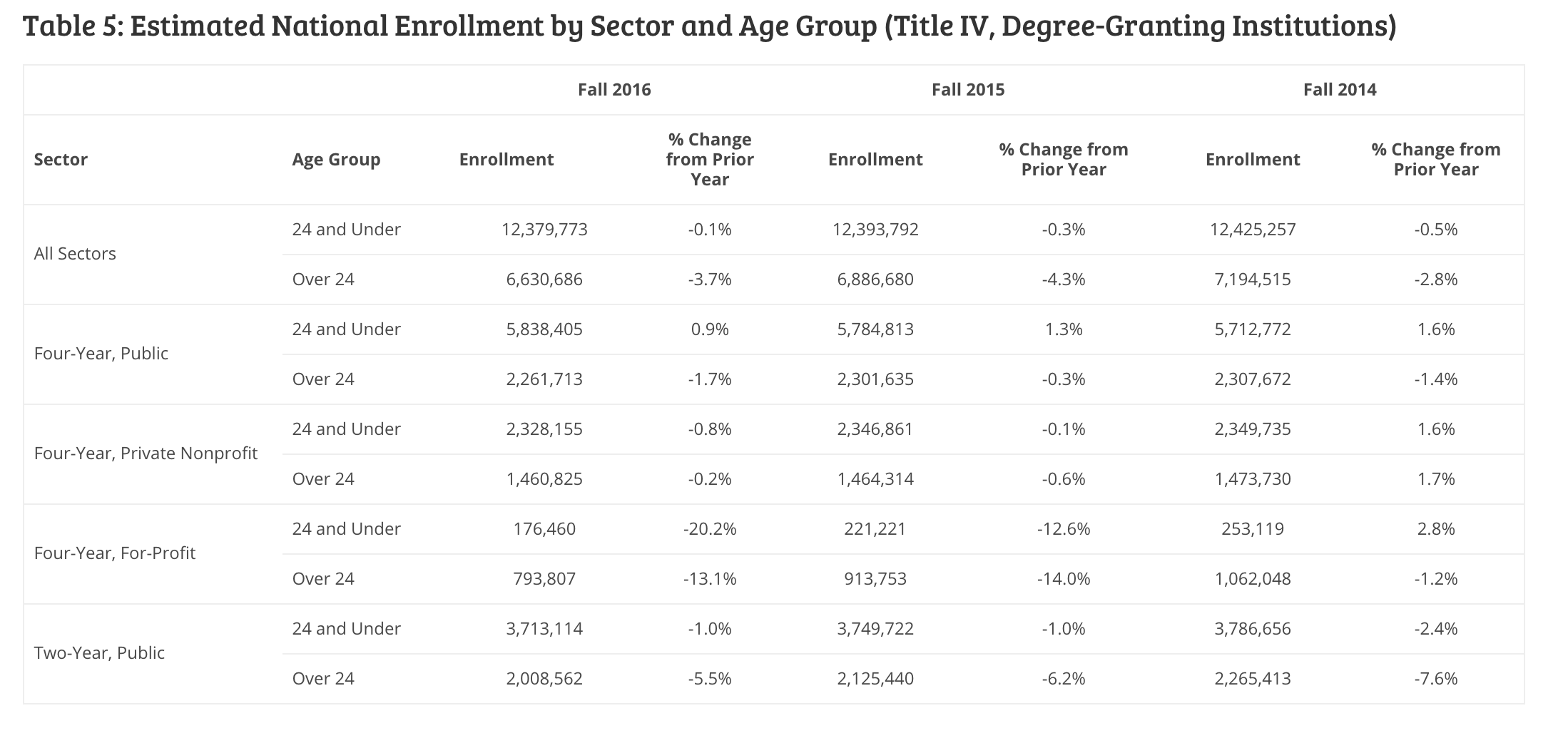
    In this situation California is not alone. The National Student Clearinghouse research for Fall 2016 shows first that community college (2-year public) enrollments have been dropping nationwide.
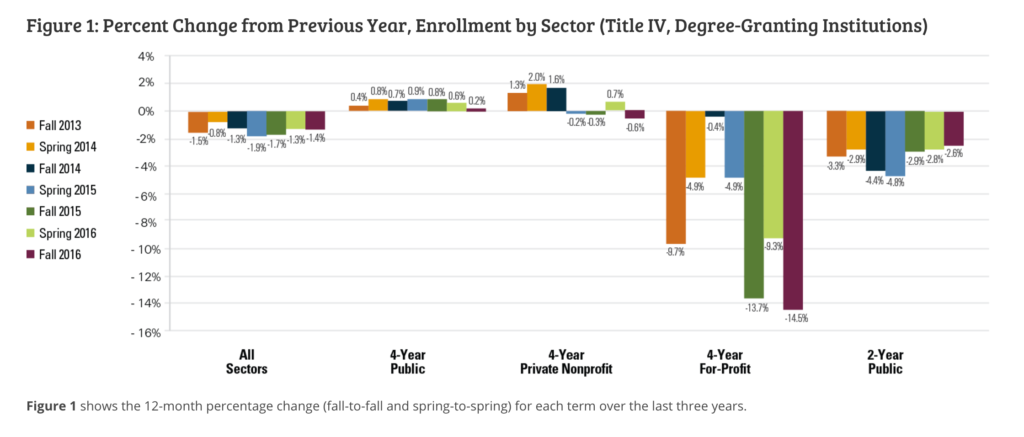
    And just like in California, adult student enrollment has been dropping much faster than 18-24 year old enrollment. 24 and under groups have dropped 1.0 – 2.4% per year while 25 and above groups have dropped 5.5 – 7.6% per year (see bottom two rows).
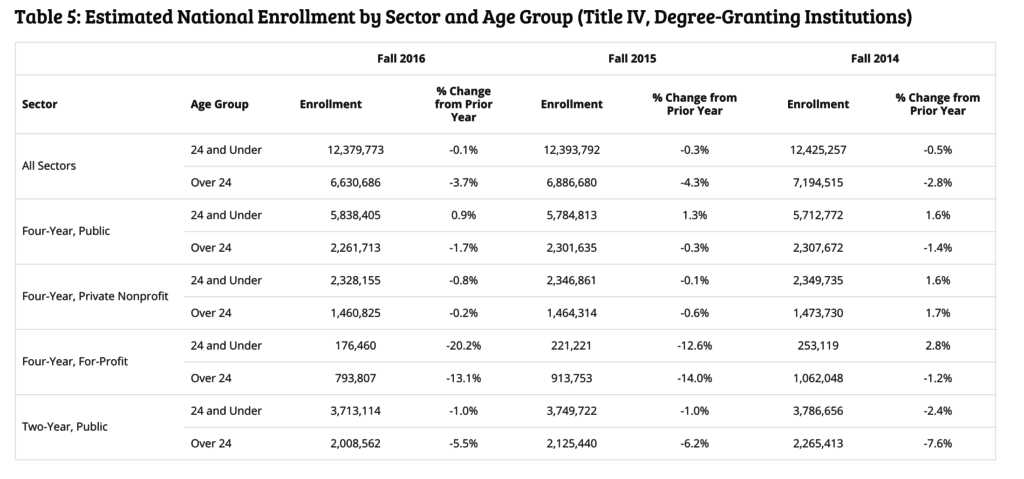
    This will be another challenge for the CCCS planning team, as there is no indication that California is screwing up while other states have the same problem figured out – the reduction in community college enrollments, particularly for adult students, appears to be a nationwide demographic trend.

    Comparison Colleges

    Assuming that the plan works out and they find new enrollment opportunities that don’t cannibalize existing college student groups, it is also worth considering how large this college might become. I pulled together the IPEDS data for several of the top-growing online undergraduate colleges ((The comparison colleges might not be exclusively online, but they have become at least predominantly online.)) to get some idea of what the best-case scenario might be in terms of enrollment growth. This data looks at fall enrollment numbers which will be lower than full-year headcount numbers.
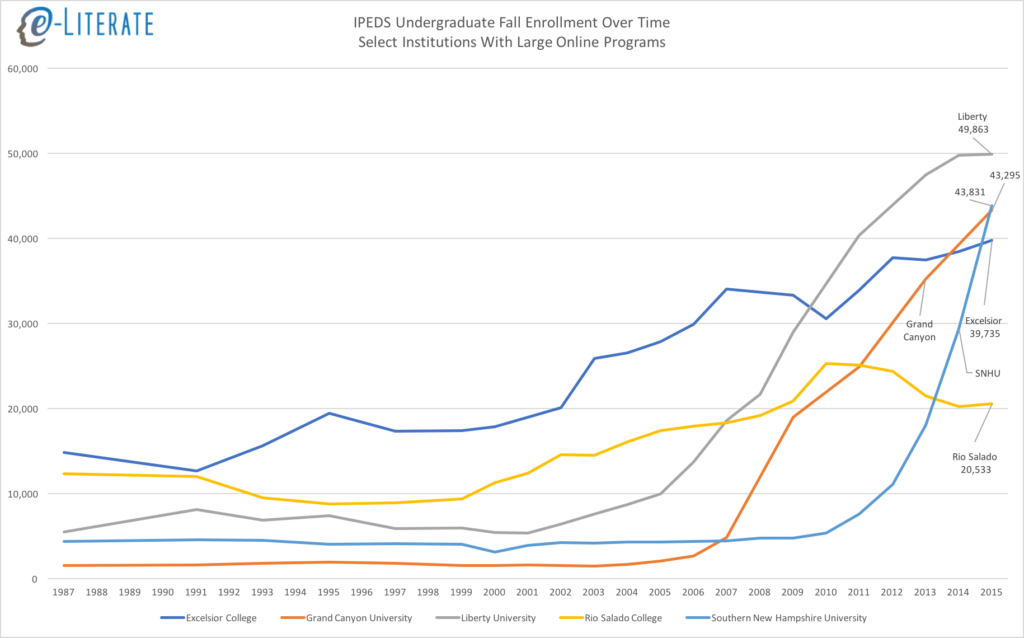
    Once we get past the “holy crap, look at Southern New Hampshire University’s (SNHU) growth”, there are a few observations to make.

    • We’ll have to see where SNHU goes, but there has traditionally been a ceiling to the size of online enrollment per institution of around 80,000 – 100,000. The primary exception has been the University of Phoenix that reached a quarter of a million online students back in 2010, but their enrollment has been dropping since then and are more of the exception that proves the rule. All others have peaked well under 100,000 students. Just this spring Liberty University experienced their first recent enrollment drop, leading to staff layoffs.
    • The maximum growth rate of these cherry-picked successful schools ranges from ~1,200 / year for Excelsior to ~7,700 / year for SNHU (note that Rio Salado at ~1,400 / year is the only public institution). Add to this the fact that all of these schools have been around for decades. No accreditation issues, no time-consuming establishment of core leadership team, etc.
    • There is a big difference in dealing with institutional issues and statewide issues, particularly in California. One in five US community college students in the US do so in California, and the statewide issues tend to come in large numbers. Statewide issues tend to come in hundreds of thousands while institutional issues tend to come in tens of thousands.

    What this points to is that for a new fully-online institution to get to some meaningful level of enrollment (let’s say 20,000) in the same ballpark as these comparison schools, I estimate it would take a full decade at the least. This is the reason, by the way, that Mitch Daniels and Purdue University made the Kaplan University deal even though Kaplan’s enrollments are dropping. Daniels did not want to wait a decade to get to meaningful enrollment numbers for an online college serving working adults – if everything works out, within a year Purdue will have a fully-online institution serving 30,000+ working adults. That is a big if, by the way.

    None of this analysis is to argue that CCCS should not try to establish a fully-online college. The goal of better serving nontraditional populations – adult students with and without jobs – is worth pursuing on its own merits.

    The numbers do argue, however, for a realistic view on the challenges they face:

    • Fighting against national demographic trends for adult students of community colleges;
    • Trying to avoid cannibalizing enrollment from existing California Community Colleges;
    • Having the patience to support the schools while it take years to grow to a size with meaningful enrollment levels; and
    • Accepting that best case this approach probably recovers less than 10% of the enrollment drop since 2009.

    I would hope that the CCCS planning efforts take the hard numbers into consideration when searching for different options to satisfy the governor’s directive.

  • Historical Survey Of Competency-Based Education

    I have previously written a primer on competency-based education (CBE) using SPT Malan’s seminal article as the basis for understanding the key elements. Chris Mallett, formerly associate provost at Western Governors University (WGU) and currently VP for online programs at Northeastern University, has just posted a broader historical survey on CBE that is well worth reading. His extensive first-hand knowledge of the development of CBE in higher ed adds another reason to read the article.

    In “What’s old is new again . . . a CBE long read”, Chris traces the origins of CBE back further than does Malan.

    The earliest American competency-based education initiatives are said to have emerged through the development of the training programs used to quickly prepare soldiers, airmen, and others who were needed in support of the nation’s efforts in World Word II (Joyce, 1971). The ability to deliver “precise and rapid training which considered the learner chiefly in terms of his capacity to respond to the training” was of paramount concern at the time (Joyce, 1971, p. 21). According to Gagne (as cited in Joyce, 1971), training programs deployed for these purposes were developed in four phases: (more…)

  • The University As Ed Tech Startup: UMUC, Global Campus, Texas, and SNHU roll their own

    Today the University of Maryland University Campus (UMUC) announced its plans to spin off their Office of Analytics into a separate for-profit ed tech company.

    The University System of Maryland Board of Regents today approved a University of Maryland University College (UMUC) plan to spin off its Office of Analytics into a new company, HelioCampus, that will provide business intelligence products and services to universities nationwide. [snip]

    The new company will provide a foundational analytics platform and data analysis services. This comprehensive offering will include all the tools needed to support or jumpstart an analytics program. HelioCampus will host a secure platform in the cloud that will include flexible data models and best-in-class visual analytics to accelerate analysis.

    The technology will be complemented by a team of higher-education and business-intelligence experts. Each institution will be assigned a dedicated analyst that will partner with key stakeholders to interpret the data and highlight key trends.

    The Chronicle quotes two UMUC execs – CIO Pete Young (staying at UMUC) and VP for Analytics Darren Catalano (leaving UMUC to become HelioCampus’ chief executive). It is worth noting, as Stephen deFilipo did on Twitter, that both Pete Young and Darren Catalano come from Rosetta Stone. (more…)

  • Competency-Based Education: Not just a drinking game

    Ray Henderson captured the changing trend of the past two EDUCAUSE conferences quite well.

    The drinking game: sure inebriation in 13 from vendor claims of “mooc” “cloud” or “disrupting edu”. In 2014: “competency based.”

    Two years ago, the best-known competency-based education (CBE) initiatives were at Western Governors University (WGU), Southern New Hampshire University’s College for America (CfA), and SUNY’s Excelsior College. In an article this past summer describing the US Department of Education’s focus on CBE, Paul Fain noted [emphasis added]:

    The U.S. Department of Education will give its blessing — and grant federal aid eligibility — to colleges’ experimentation with competency-based education and prior learning assessment.

    On Tuesday the department announced a new round of its “experimental sites” initiative, which waives certain rules for federal aid programs so institutions can test new approaches without losing their aid eligibility. Many colleges may ramp up their experiments with competency-based programs — and sources said more than 350 institutions currently offer or are seeking to create such degree tracks.

    One issue I’ve noticed, however, is that many schools are looking to duplicate the solution of CBE without understanding the the problems and context that allowed WGU, CfA and Excelsior to thrive. By looking at the three main CBE initiatives, it is important to note at least three lessons that are significant factors in their success to date, and these lessons are readily available but perhaps not well-understood.

    Lesson 1: CBE as means to address specific student population

    (more…)

  • Notes from Paul LeBlanc keynote address at WCET13

    Two weeks ago I attended the WCET Conference in Denver. While much smaller than EDUCAUSE and some others, I find these conferences to be great learning experiences, especially as WCET supports open dialogue between academic leaders (provosts, deans, etc), academic IT and edtech support, and industry leaders. The combination of mindsets – especially the combination of academic and technology – leads to very strategic discussions.

    This year the keynote was presented by Dr. Paul LeBlanc, the president of Southern New Hampshire University, which has made quite a name for itself with the College for America (CfA) program. College for America is probably the second best-known example of competency-based education (CBE) after Western Governors University (WGU), and in fact the CfA program was the first to gain Department of Education approval using the “direct assessment” rule that completely avoids seat time. See my previous post for a primer on CBE.

    While you can see the entire keynote here (using the mediasite player), I wanted to highlight four key points that help illuminate the reality of competency-based education today. As CBE becomes more hotly debated, it is useful to have real examples to evaluate. I have very roughly paraphrased and taken notes on what I heard in the keynote on these points, not as a defense or endorsement of CfA, but as a real-world early example of CBE.

    1) Competency-based education is typically targeted at working adults (14:11 – 20:40)

    (more…)

  • Competency-Based Education: An (Updated) Primer for Today’s Online Market

    There has been a significant amount of progress and interest in competency-based education, as Wisconsin has launched its Flexible Option program, federal legislators are pushing the concept, ‘patient zero’ has graduated from College for America, and resistance is emerging to the concept. I thought it might be useful to update and re-share the primer that was originally posted in August, 2012.

    I’m not an expert in the academic theory and background of outcomes and competencies, so in this post I’ll summarize the key points from various articles as they relate to the current market for online programs. Links are included for those wanting to read in more depth.

    What is Competency-Based Education?

    SPT Malan wrote in a article from 2000 about the generally-accepted origins:

    Competency-based education was introduced in America towards the end of the 1960s in reaction to concerns that students are not taught the skills they require in life after school.

    Competency-based education (CBE) is based on the broader concept of Outcomes-based education (OBE), one that is familiar to many postsecondary institutions and one that forms the basis of many current instructional design methods. OBE works backwards within a course, starting with the desired outcomes (often defined through a learning objectives taxonomy) and relevant assessments, and then moving to the learning experiences that should lead students to the outcomes. Typically there is a desire to include flexible pathways for the student to achieve the outcomes.

    OBE can be implemented in various modalities, including face-to-face, online and hybrid models.

    Competency-based education (CBE) is a narrower concept, a subset or instance of OBE, where the outcomes are more closely tied to job skills or employment needs, and the methods are typically self-paced. Again based on the Malan article, the six critical components of CBE are as follows: (more…)