
e-Literate

Present is Prologue

Tag: Udacity

  • SJSU Plus / Udacity Update: Different student populations

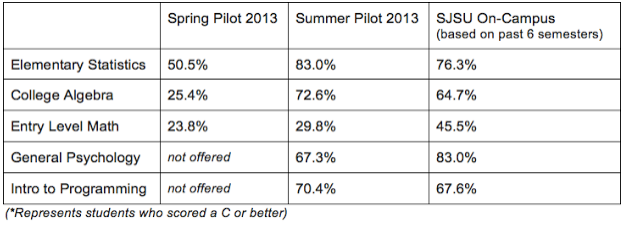
    San Jose State University (SJSU) and Udacity have announced the results of their summer pilot, and the headlines cover the big improvements (text from IHE article, table from Udacity blog).

    Thrun recently hinted that the summer pilot’s results would be more positive, and that Udacity was getting close to finding the “magic formula” to deliver high-quality, low-cost education.

    The lone holdout among the SJSU Plus courses is entry-level math, which saw the smallest increase in students who received a passing grade, from 23.8 to 29.8 percent. That places the pass rate almost 40 percentage points below the closest SJSU Plus course, and about 15 percentage points below the pass rate of the on-campus course.
    Thrun Blog

    I am not trying to throw cold water here, but it is very important to look at the student populations. To his credit, Sebastian Thrun describes the big differences in his blog post.

    This summer, we ran the second instance of our pilot. While in the Spring, we actively sought out underserved high schools from low-income areas in California, this time we simply opened up enrollment to anyone. As predicted, with 2,091 students who enrolled, we mainly reached students who would not ordinarily attend college. Only 11% of the summer students who took the for-credit courses from SJSU were matriculated students in one of the California State Universities. 71% of our students came from out of state or foreign countries. And while the total number of high school students went up, their proportion in the total student body went down. [snip]

    One key difference between Spring and Summer was that we opened our Summer session to everyone. This led to a substantial difference in student body. Among the student body, 53% reported that they already hold a post-secondary degree (5% Associate, 28% Bachelor’s, 16% Master’s, and 4% Doctorate). Only 12% of the students had a high school graduate diploma or equivalent, and 15% were active high school students. This is very different from the Spring Pilot, in which approximately 50% of the student body were active high school students, and the other 50% were matriculated SJSU students. [emphasis added]

    One of the key success factors of online education is to target student populations who can succeed in this environment. If you target groups (remedial students, underserved students, high school students), then there must be tremendous student support.

    Pay attention to the student populations – this might be the real story. If you ignore the difference in student populations, you might draw the wrong conclusions.

  • You know what would help MOOC articles? Getting the facts and goals right before analyzing

    Keith Devlin has an article at Huffington Post today titled “MOOC Mania Meets the Sober Reality of Education”. The premise is that the halting of the San Jose State University (SJSU) / Udacity pilot project and of SB 520 show that naive assumptions on the power of MOOCs to disrupt higher education are insufficient in reality – education is too complex. While the overall article has some good points, the very foundation of the article is flawed.

    I have written about both issues – SJSU program and SB 520 – and agree that there were flaws in both. Michael and I co-wrote a position paper for 20 Million Minds Foundation making recommendations to change and improve California legislation, and we have been critical of overly-simplistic views of higher education disruption. But authors should at least characterize the goals of each program accurately before drawing conclusions. The HuffingtonPost article has three glaring problems that undercut its entire message.

    Problem 1: Getting the explicit goals wrong

    Devlin begins:

    Politicians who saw MOOCs as a means to cut the cost of higher education are having to think again after two high-profile initiatives in California recently came to a crashing halt.

    Did politicians see “MOOCs as a means to cut the cost of higher education” in both of these programs? Let’s look at the stated goals for the SJSU program:

    This marks the first time that a broad and diverse range of students, not just matriculated students, will have access to online college classes for credit from an accredited university at a very affordable price of $150 per course, about the same as a course at the California Community Colleges.

    The pilot’s target population includes underserved groups such as high school students who will earn college credit, waitlisted students at California Community Colleges who would otherwise face out-of-state or private options, and members of the armed forces and veterans. [emphasis original]

    (more…)

  • SJSU and Udacity: The Obvious Problems and Value of Report

    SJSU has announced via an official blog post that they are studying the results of the SJSU Plus program using Udacity.

    First, news coverage and much commentary have been based on very preliminary and unanalyzed data from a spring 2013 pilot of three SJSU Plus courses with Udacity. We are currently awaiting a more comprehensive National Science Foundation data analysis and report that will be available in August (spring semester courses ended and final grades were submitted only seven weeks ago). We look forward to discussing these results next month.

    I mentioned in my post last night that I believe this is a good move.

    How often do we get the chance to review the results of traditional college courses and see institutions publicly study the learning outcomes in order to improve the course effectiveness? This open review is one innovation from the SJSU Plus program that should be extended to other courses.

    There are plenty of people who do not share my optimism of the reporting process, partially due to the expectation that we already know most of the lessons learned and there should be no real surprise. Indeed, if you read the news coverage of SJSU pausing the Udacity program, there are several findings that are already fairly obvious.

    Findings to Date

    The following summary is based on several articles and blogs directly based on first-hand experience.

    Finding 1) The program was rushed, and the courses were still being developed while students started the courses:

    IHE: But, because of the haste, faculty were building the courses on the fly. Not only was this a “recipe for insanity,” Junn said, but faculty did not have a lot of time to watch how students were doing in the courses because the faculty were busy trying to finish them. It took about 400 hours to build a course, though the courses are designed to be reused.

    (more…)

  • SJSU and Udacity: Poor Planning and Support, but Valuable Reviewing of Results

    A couple of weeks ago I was interviewed for an article in the NY Times about recent pushback against MOOCs.

    Jonathan Rees, a history professor at Colorado State University at Pueblo, who has written critically about MOOCs, said their spread is likely to lead to a three-tiered world, with a few high-status “super professors” for whom the courses provide both status and royalties; a larger pool of tenured professors who continue to teach their regular in-person classes until they retire; and “a huge army of adjuncts and teaching assistants,” whose jobs will be vulnerable to online competition.

    “The problem with this MOOC-as-labor-issue argument is that it has no place for students and learning,” said Phil Hill, an education technology consultant. “Our starting point ought to be what students need and whether this is an effective form of learning.”

    Perhaps to the dismay of Jonathan’s Aunt Nancy, my comments were positioned as refuting his comments. In the context of the NY Times article, that positioning was accurate; however, in Jonathan’s follow-up blog post, he misinterprets my meaning.

    MOOCification is about power too. If people with access to power want to convince recalcitrant professors to accept MOOCs, arguing that they must be because this must be is a terrible idea. Yet this is precisely what the two quotes following mine in that New York Times article from last week try to do. [snip]

    Whenever Phil makes that infuriating argument, I usually respond with some variation of “profs gotta eat.” Not surprisingly that argument works really well on other profs, but not so well on Phil. However, I want to point out to Phil’s clients that they can’t just wish the class divide away. Since profs gotta eat, they’re going to worry about eating whether you tell them they’re allowed to or not. Moreover, plenty of us believe that by looking out for our interests we are looking out for students and learning. Therefore, making this kind of argument simply serves as a way to shut down all discussion of the subject, which will only breed resentment. [emphasis added]

    While I enjoy reading Jonathan’s blog and appreciate his real concern with student learning and the profession of teaching, he is incorrect in his assertion that I want to “convince recalcitrant professors to accept MOOCs” or that I don’t believe that “by looking out for [professors] interests we are looking out for students and learning”. I am not making “this kind of argument”.

    Focus on Students and Learning First

    What I meant to say is, ironically, what I said: “Our starting point ought to be what students need and whether [MOOC] is an effective form of learning”. The lens of MOOC-as-labor-issue tends to create an us-versus-them, you’re either pro-MOOC or anti-MOOC, mentality that leads to, well, nowhere except arguments. The lens of MOOC-as-teaching-method to be explored should lead us to critically look at learning outcomes and exploration of how to apply or refine the teaching method.

    Michael made this same point in a more elegant fashion in his commentary on the SJSU Philosophy Department rejection of edX:

    Rather than thinking of MOOCs as products to be bought or rejected, they could have approached them as experiments in teaching methods that can be validated, refuted, or refined through the collective efforts of a scholarly community.

    SJSU Plus and Udacity

    And this is where the story comes to San Jose State University and the recent announcement that they were “pausing” the Udacity MOOC-for-credit pilot program (SJSU Plus), as described at Inside Higher Education:

    (more…)

  • MOOCs Beyond Professional Development: Coursera’s Big Announcement in Context

    One aspect of last week’s Coursera announcement was the acknowledgement that MOOCs to date have primarily served as a mechanism for professional development, not as a mechanism for serving higher education per se. In the Chronicle article:

     Daphne Koller, a co-founder of Coursera, acknowledged that the company was venturing into new terrain. After studying their MOOC users, the company realized that most of them had already earned college degrees, said Ms. Koller. That was well and good, but it suggested to Coursera’s founders that MOOCs would not be sufficient to achieve their ambitions.

    “If you’re looking to really move the needle on fundamental educational problems, inside and outside the United States, you’re going to need to help people reach the first milestone, which is getting their degrees to begin with,” Ms. Koller said.

    and from the New York Times:

    “Our first year, we were enamored with the possibilities of scale in MOOCs,” said Daphne Koller, one of the two Stanford computer science professors who founded Coursera. “Now we are thinking about how to use the materials on campus to move along the completion agenda and other challenges facing the largest public university systems.”

    These statements can be understood by looking at the demographic data for students that have been taking xMOOCs (i.e. from Coursera, Udacity and edX) in their first year.

    (more…)

  • MOOCs Explained: Radio Interview with University of Delaware

    Just over a week ago I had the opportunity to participate in a radio interview for the University of Delaware’s local station WVUD, with the Campus Voices interview airing on May 17th. The interview was in advance of Delaware’s summer faculty institute, where I will be speaking in just over a week. I really enjoyed the interview, and this is an area that needs more attention – local educational technology support for faculty innovation, with an emphasis on faculty sharing best practices. The summer institute is May 28th – 31st.

    I was interviewed by Richard Gordon and Paul Hyde, and some of the key topics we explored:

    • Not everyone is a reader of the Chronicle of Higher Education – what the heck is a MOOC?
    • How do MOOCs affect faculty teaching in a bricks-and-mortar university?
    • What are the completion rates of MOOCs and what are the student types?
    • Are there applications beyond higher education?
    • Why is there such significant pushback against MOOCs lately?
    • What disciplines beyond science and engineering are using MOOCs?

    Here is link to the U Delaware radio interview – audio only. It’s about a half hour in length, but with some cool NPR-sounding music to kick it off.

    I have also added some graphics and created a video of the interview.

  • Big 3 MOOC Providers Turning One Year Old

    We are in the middle of the first anniversary of the creation of the big 3 MOOC providers (Coursera, Udacity, edX).

    • Sebastian Thrun announced the creation of Udacity on January 23, 2012 as described by Reuters.
    • Daphne Koller and Andrew Ng announced the creation of Coursera on April 18, 2012 in this NY Times article.
    • MIT and Harvard announced the creation of edX on May 2, 2012 in this MIT article.

    And what a year it’s been, especially in terms of the engagement of national media, university presidents and boards on the topic of MOOCs, online education and the future of higher education in general. I doubt there is a higher education conference this year that doesn’t mention MOOCs in one form or another.

    But one year is a seriously short time period for higher education and educational technology, which are just not used to changes on this time scale. To give some perspective, consider the following:

    • There are quite a few ed tech products that have been or will have been in beta or introductory mode for at least a year when fully released.
    • This time one year ago, few people outside of Virginia knew what a Rector or how a board of them might force a president to resign partially based on discussions about MOOCs.
    • Many LMS and almost all student information system / ERP selection processes (not even including implementation) take more than a year.