
e-Literate

Present is Prologue

Tag: Udacity

  • Proposed California Legislation for Statewide Online Education Courses – The Basics

    Outside of the Vatican, the big news this week in higher education is the proposed legislation in California that would identify and approve a set of up to 50 online courses that the three public systems would accept as credit for admitted students. Senate President Pro Tem Darrell Steinberg is co-authoring SB520 that addresses popular, introductory courses for which students cannot get access from their University of California, California State University, or California Community College campus. The pre-coverage of the event included the following:

    As described in the NY Times:

    Legislation will be introduced in the California Senate on Wednesday that could reshape higher education by requiring the state’s public colleges and universities to give credit for faculty-approved online courses taken by students unable to register for oversubscribed classes on campus.

    If it passes, as seems likely, it would be the first time that state legislators have instructed public universities to grant credit for courses that were not their own — including those taught by a private vendor, not by a college or university.

    “We want to be the first state in the nation to make this promise: No college student in California will be denied the right to move through their education because they couldn’t get a seat in the course they needed,” said Darrell Steinberg, the president pro tem of the Senate, who will introduce the bill. “That’s the motivation for this.”

    Update 3/14: Text of bill here

    Senate President Pro Tem Steinberg held a press conference today via Google Hangout and video streaming (archive available soon on site) to announce the package of legislation. I have attempted to summarize the press conference below (any mistakes in note-taking are my own, and I’ll update as needed). While Michael and I will both have analysis of this proposal soon, I wanted to first share the information directly.
    (more…)

  • The Most Thorough Summary (to date) of MOOC Completion Rates

    How many times have you heard the statement that ‘MOOCs have a completion rate of 10%’ or ‘MOOCs have a completion rate of less than 10%’? The meme seems to have developed a life of its own, but try to research the original claim and you might find a bunch of circular references or anecdotes of one or two courses. Will the 10% meme hold up once we get more data?

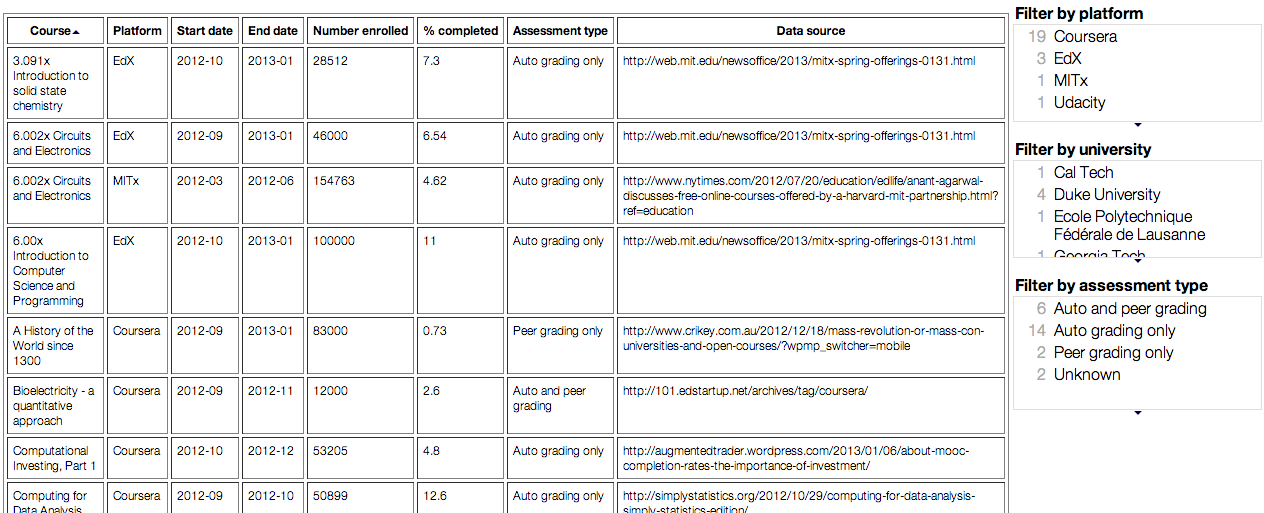
    While researching this question for an upcoming post, I found an excellent resource put together by Katy Jordan, a graduate student at The Open University of the UK. In a blog post from Feb 13, 2013, Katy described a new effort of hers to synthesize MOOC completion rate data – from xMOOCs in particular and mostly from Coursera.

    Via a combination of thinking about ‘what makes a successful MOOC?’, and looking for a topic for my final project on the Infographics MOOC, I decided to try to pull together the various statistics floating around online about MOOC completion rates. I’m trying to see if any differences emerge on the basis of platform or the assessment methods used.

    My draft graph synthesising everything I’ve found so far can be found here: http://www.katyjordan.com/MOOCproject.html

    What Katy has done so far is compile completion rate data from 24 MOOCs – 19 from Coursera, 3 from edX, 1 from Udacity and 1 from MITx (a precursor to edX). The data is available in a table format or in a graph.

    table


    (more…)

  • Is Coursera Facebook, Amazon, or Pets.com?

    Before I get started, let me just say that Phil can vouch for the fact that I had already planned to use “Pets.com” in the title of this post before MIT Technology Review used it in their article on Minerva. As we’ll see, there are reasons to reach for that particular analogy at this particular moment in educational technology.

    Anyway, it’s an uncomfortable truth for educational folks that one of the principal innovations of the xMOOC is the store front. It is the ability to find courses in a catalog. If you look at what Coursera is right now from a platform perspective, it is primarily a store front on top of an LMS. The same could be said of edX. And as Phil and I have both written about recently, this is also the primary innovation in Instructure’s Canvas Network. I don’t expect that innovations in MOOC platforms to stay confined to the store front in the long run; for example, Daphne Koller, the co-CEO of Coursera, is also a leading expert in Bayesian machine learning. I think the scale of usage will drive other innovations. But right now, it’s the store front that is the most obvious differentiator between an LMS and a MOOC platform. As we game out which of the various xMOOC entrants will be successful, it’s important to understand how the store front works and the degree to which the growth of one dominant platform could impact the ways that colleges and universities function. I think there are at least three possibilities.

    (more…)

  • Canvas Network – Are the LMS and MOOC Markets Colliding?

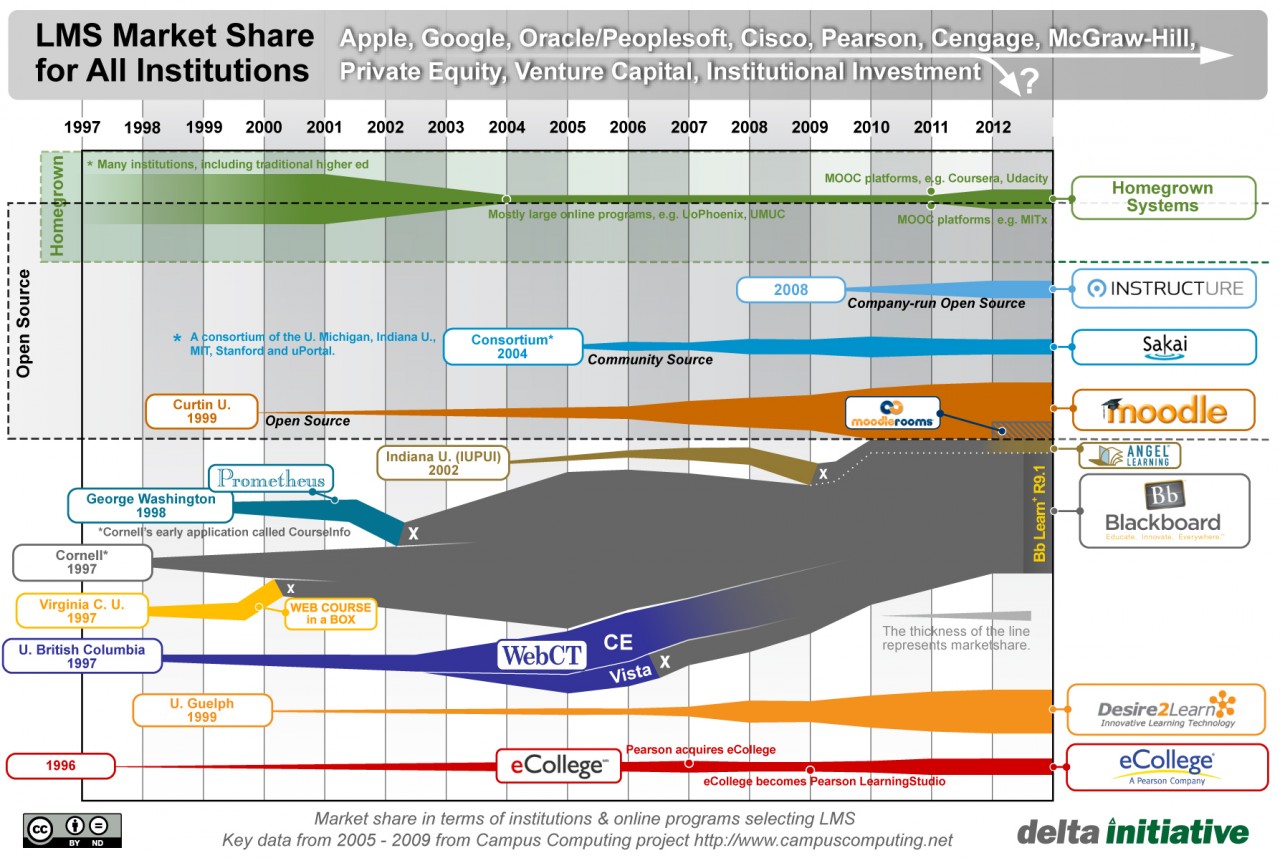
    Six weeks ago I posted a new graphic on the LMS market which included MOOCs in the same view as traditional LMS solutions.

    In the comments to the post there was an interesting note from Josh Coates (Instructure CEO) in response to whether MOOCs should be so closely aligned with the LMS market:

    i agree with you [fellow commenter Bob Puffer] that MOOCs aren’t the same thing as an LMS and should be accounted for differently.

    With the recent news of the Coursera / Antioch partnership as well as Instructure’s release of the Canvas Network, I believe we are starting to see the LMS market overlap with the MOOC market, although I do not see them completely merging. After offering to fix Josh’s broken shift key, I’d like to explore the prospects for the Canvas Network to compete in the MOOC marketplace.

    (more…)

  • Everybody Wants to MOOC the World

    You may have seen this week’s announcement from Instructure of their new Canvas Network to support MOOCs and other open courses. Blackboard has already been dipping its toe in this water, having had Curtiss Bonk run a MOOC on CourseSites. I also find it significant that Blackboard (somewhat awkwardly) made an attempt to remind the market of this fact on the same day as Instructure’s announcement. I predict that “MOOC” will reach the same level of hype at this year’s EDUCAUSE conference that “open” did last year.

    But hype aside, it’s worth asking what it means for the traditional LMS players to be marketing themselves as platforms for MOOCs and other open courses.

    (more…)

  • Google Introduces Course Builder, an Open Source Project Targeted at MOOCs (but the Real Competitor Might Be Amazon)

    Google quietly made an educational technology announcement yesterday about the release of Course Builder, an “open source project” targeted at massive open online courses (MOOCs). This platform follows on the heels of Google’s own MOOC this summer. We should find out more information over the coming months, but here are my initial observations after reading the Research Blog on Google’s site:

    In July, Research at Google ran a large open online course, Power Searching with Google, taught by search expert, Dan Russell. The course was successful, with 155,000 registered students. Through this experiment, we learned that Google technologies can help bring education to a global audience. So we packaged up the technology we used to build Power Searching and are providing it as an open source project called Course Builder. We want to make this technology available so that others can experiment with online learning.

    We really shouldn’t be surprised at Google’s interest in the MOOC movement, since Peter Norvig, their Director of Research making the announcement, was one of the two professors at Stanford, alongside Sebastian Thrun, to develop and teach the influential Artificial Intelligence course (CS221). This course started the Stanford branch of MOOCs (also known as xMOOCs). Coursera and Udacity spun out as venture-funded startup companies based on the internal Stanford MOOC courses.

    (more…)

  • Four Barriers That MOOCs Must Overcome To Build a Sustainable Model

    Given the hype of national media coverage of massive open online courses (MOOCs), it is refreshing to see more recent analysis looking at important attributes such as revenue models, dropout rates, and instructional design. Steve Kolowich at Inside Higher Ed wrote a revealing and important article looking at early demographic data. Jeff Young at the Chronicle wrote an excellent article about Coursera’s contract with the University of Michigan, along with key insights into Coursera’s and the university’s motivations. Audrey Watters, in response to an article in the Atlantic, asks the tough question of whether we should care about the high dropout rates of current courses offered in this new model.

    When analyzing the disruption potential of MOOCs, it is easy to forget that the actual concept is just 4 or 5 years old. Furthermore, the actual definition of the concept has undergone a significant change in the past 12 months as an entirely new branch has emerged.

    While the current examples of massive online courses are interesting, the real potential of MOOCs will be revealed in future generations. (more…)