e-Literate

Present is Prologue

Tag: University of Florida

  • UF Online’s New Corporate Partner: Discover Financial joins Walmart with Online Education benefit

    UF Online’s New Corporate Partner: Discover Financial joins Walmart with Online Education benefit

    Last week Walmart announced a new education benefit for its employers, subsidizing undergraduate college degrees at select online programs at the University of Florida (through UF Online), Brandman University, or Bellevue University.

    The company said it estimates as many as 68,000 of its employees initially could sign up for the new college program. Walmart employs 1.5 million in the U.S. The company declined to comment on how much this initiative will cost it.

    Employees will contribute $1 per day, for 365 days every year, toward their education, so long as they’re enrolled. Walmart will cover the rest of the tab. Workers will be able to choose from the three nonprofit schools and have the option of taking classes online with the flexibility to study during the evenings or on weekends.

    Today UF Online announced another partner: Discover Financial Services, issuers of the Discover Card and Diners Club International, with its 14,000 employees.

    Discover announced a significant new education assistance benefit that provides all eligible U.S.-based employees the opportunity to earn a bachelor’s degree online from an accredited public or non-profit private university at no cost.

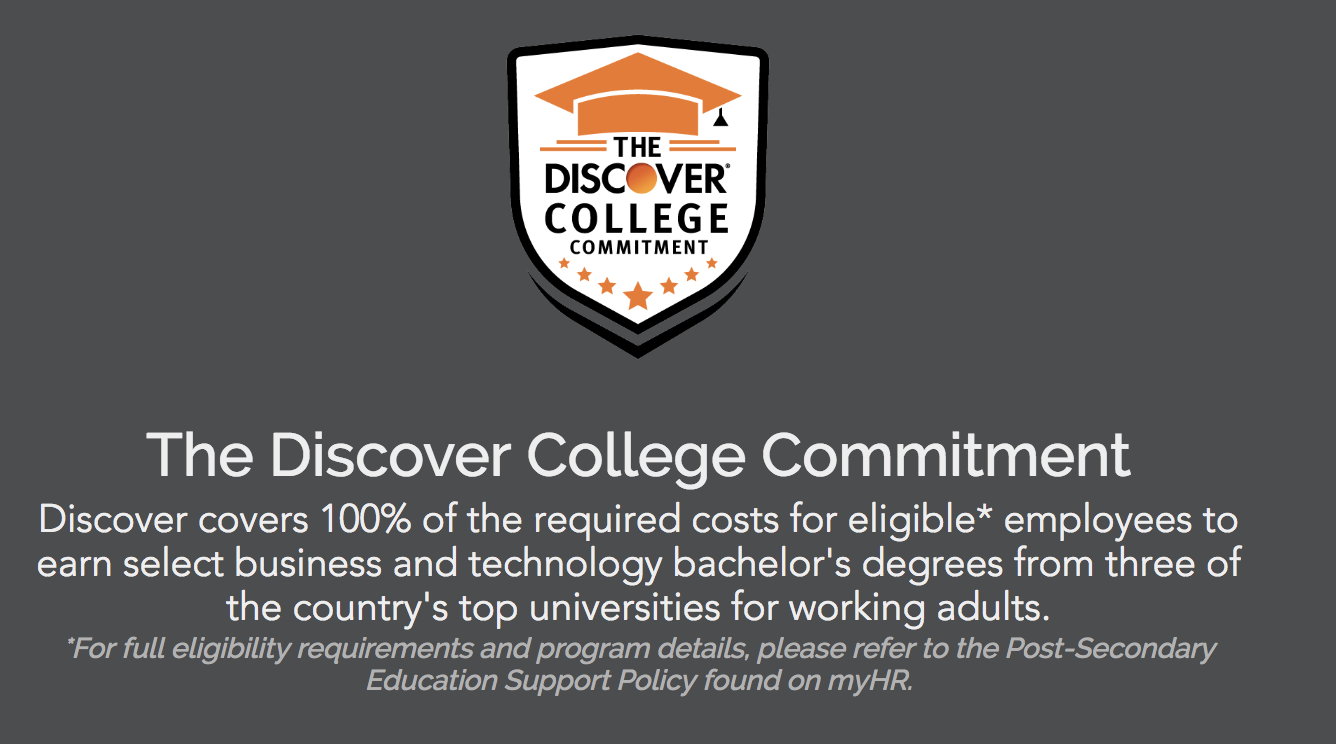
    Known as The Discover College Commitment, the benefit covers tuition and required fees, books and supplies needed to complete select online degrees at one of three schools – the University of Florida (via UF Online), Wilmington University and Brandman University. The benefit has no tenure requirement so employees can start participating as soon as they want regardless of how long they have been with the company, including new employees on their first day.

    The two partnerships are part of what UF Online calls their Employer Pathways, and in the process seem to be defining an alternate method of marketing and enrollment management, in contrast with most Online Program Management (OPM) assumptions.

    Employees from Walmart and Discover Financial Services have expanded opportunities to earn a bachelor’s degree from the University of Florida (UF) thanks to a new and significant investment in their education from their employers. This remarkable step by these and other large employers demonstrates the value of a UF degree and the accessibility of UF Online, UF’s online undergraduate experience. Employers will provide a robust support package covering tuition, fees, plus access to life coaching and college readiness programs.

    Discover is offering this new benefit to select programs at UF Online, Wilmington University, and Brandman University.

    Discover is covering 100% of cost for select bachelor’s degrees. Discover is proud to offer “The Discover College Commitment” program – an innovative full-ride college education benefit, providing US-based employees the opportunity to participate in one of several select high-quality, fully paid, online bachelor’s degrees.
    Both packages of education benefits is managed by Guild Education, “a tuition reimbursement and education platform that helps large employers extend education benefits, including tuition reimbursement, to workers”.

    I think these moves are more significant than just individual benefits. What we are seeing is UF Online, along with a handful of others, defining a different approach to marketing and finding potential online students, at least for undergraduate degrees. Historically, there is a common assumption that to enable a scalable online program there is a need for traditional digital marketing as the primary approach – Google AdWords, call centers, social media campaigns – with a partnership or two thrown in on the side. The origin of the OPM market is centered on providing these services in exchange for a percentage of tuition revenue, and for the majority of cases, the OPM’s spending on this marketing and enrollment management category is the most expensive service in the package. The Employer Pathways approach by UF Online has the potential to flip the student acquisition assumptions – primarily driven by employer partnerships with traditional digital marketing channels as a secondary approach.

    Walmart and Discover already have potential students identified, and the companies have the incentive to internally market these education benefits to employees. UF Online needs to support that internal marketing and feed applicants into the same application process, but they have a reduced need for general-purpose marketing. UF Online started out with Pearson Online Learning Services (formerly known as Embanet) to be their OPM partner, but in late 2015 they pushed Pearson out and decided to take over this management internally.

    I talked to Evangeline (Evie) Cummings, Associate Provost and Director of UF Online, at WCET’s Leadership Summit last week, and she described how UF Online is trying to reduce their marketing spend and instead invest more in faculty and course development. Part of that move is to spend less trying to get out-of-state students, which may pay higher tuition but still cost much more per student in acquisition costs. But the other move is to decrease the need to spend on traditional marketing channels.

    We can think of Guild Education in this case as a derivative of the unbundling version of OPM, enabling the front-end services with an alternative approach and what appears to be a lower revenue share.

    Rather than charge a transaction fee per student to the employer, Guild takes a cut of the tuition revenue from the universities it works with. This revenue-share model is an “elegant” solution for institutions that want to grow their enrollment online but don’t want to spend more on marketing, said Carlson. It’s also an attractive proposition for employers, who don’t have to pay any additional charges on top of the contribution they make to their employees’ tuition. The tuition fees are not discounted for the employers and will be charged at in-state or out-of-state rates depending on the location of the student. Neither Guild nor the three universities involved in the Walmart offer would disclose what percentage of tuition revenue Guild will take.

    The bulk of the OPM market serves master’s programs, and UF Online is centered on bachelor’s degrees with a handful of master’s, so this approach might not work across the board. But I’ll bet that there will be plenty of undergraduate online initiatives that will be looking to UF Online and wondering if they should develop similar degree pathway partnerships as the centerpiece of their student acquisition plans. The online education space is maturing and becoming a lot more interesting.

  • WCET: Clarity into the successful transition of UF Online

    WCET: Clarity into the successful transition of UF Online

    At this year’s annual meeting for WCET, I was on a panel, along with EdSurge’s Jeff Young, moderated by Saint Leo University’s Jeff Borden. Kicking off the panel, Borden framed the discussion partially as learning from those outside academia. Even though I am not an academic, I have found myself making the mistake of a bias against outsiders. Almost two and a half years ago I described the emerging disaster of University of Florida Online (UF Online) – reality was exposing fundamentally flawed enrollment estimates based on institutional and vendor hubris. In this post I described another challenge:

    In the midst of the challenging startup, UF Online had to deal with the premature departure of the initial executive director. After a one-year search process, UF Online chose a new leader who has absolutely no experience in online education.

    That was probably the fifth edit of a paragraph that started closer to “UF Online somehow thought a bureaucrat from EPA should be its new leader. Next up: filling the VP of student support with DMV veteran.” I was wrong – it turns out that choosing an outsider was just what the program needed.

    Further down in the post I noted:

    At this point, it might have been worth stepping back and challenging some of the original assumptions.

    By late 2016, however, I noted a “remarkable transformation at UF Online” and how the unit shed the hubris of the initial plans and really did challenged original assumptions and came up with a new strategy.

    At another WCET session, this same UF Online executive director Evie Cummings provided more insight into the mindset that led to this transformation. Prior to coming to UF Online, Cummings was instrumental in creating and establishing the EPA Information Quality Guidelines and much of the focus was on transparency and accuracy of information shared with the public. This mindset has been brought to the University of Florida, not only leading to an honest reevaluation of original assumptions but also to what I consider exemplary public reporting on program and student outcomes at UF Online.

    Another mindset described in the session was the acceptance of those who control funding – board of governors and state legislators in this case – and figuring out how to use data and communication to bring them along into healthier decision-making.

    These approaches are evident in the UF Online annual report released earlier in the week.

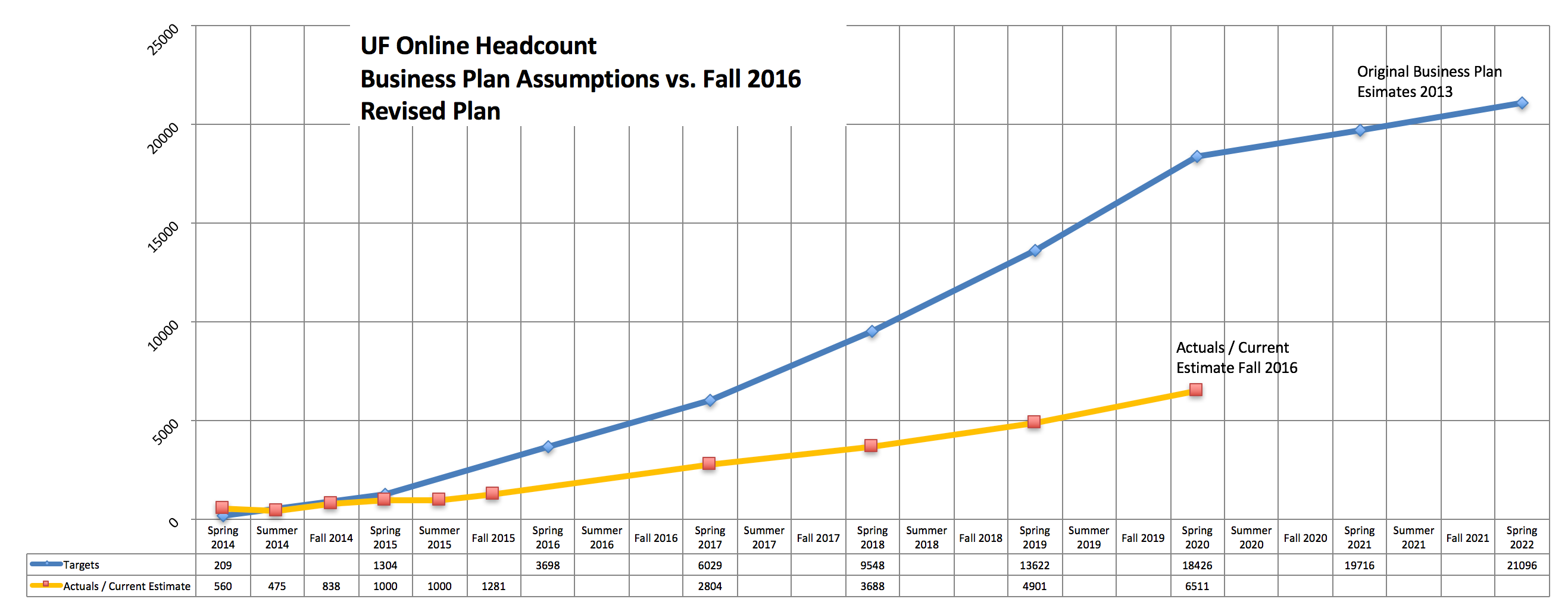
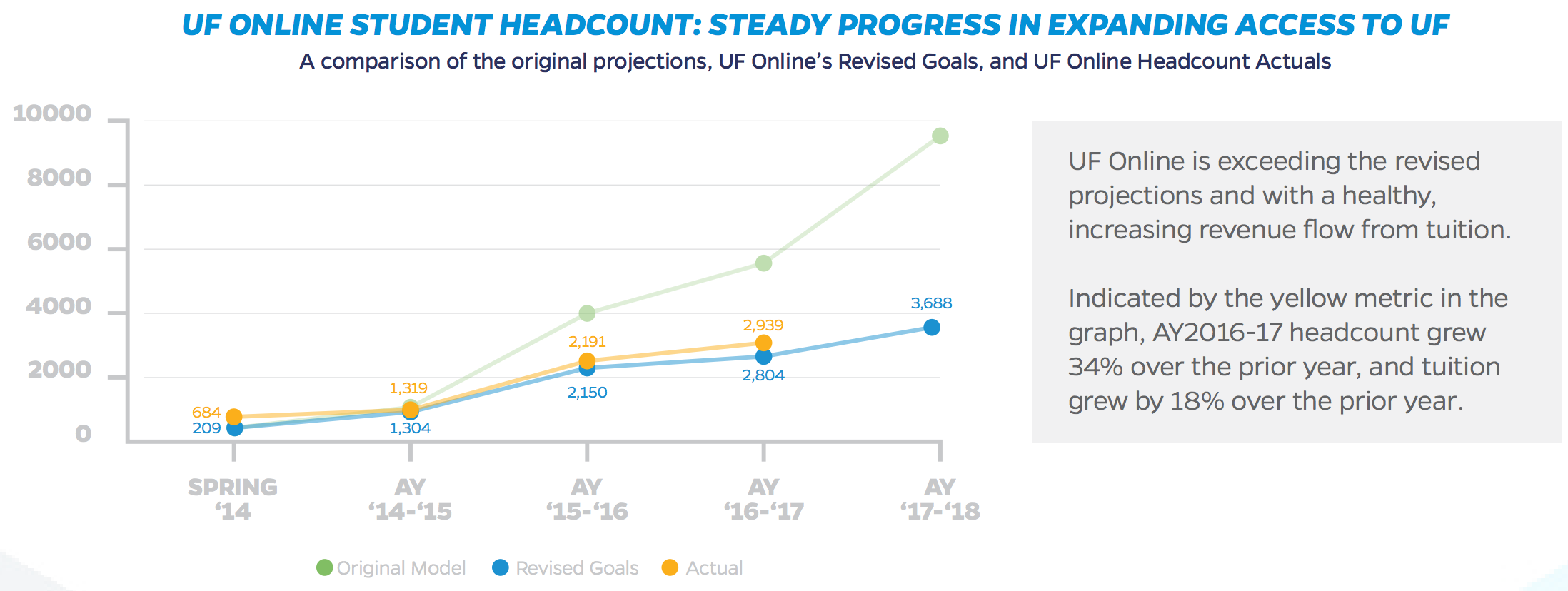
    In terms of enrollment, UF Online not only reports current status and plans, but they choose not to whitewash the past. Their report shows the original plan, the revised plan, and current results with a healthy 34% year-over-year enrollment growth.

    One side benefit – I no longer need to update the spreadsheet I had been using to describe the same information.

    Further in the report, there is a description of UF Online’s new emphasis on creating community among online students and graduates.

    Launched in 2017, the UF Online Connections Program works to foster a thriving learning community across all online students, faculty, academic advisors, and staff. Coupled with strong academic programs, a vibrant and engaged online student experience assures UF Online students not only gain the skills they need but also the connections and network to support them after they graduate. This past year, the Connections program emphasized providing community and networking opportunities with key strategic in-person events.

    They have also launched what they call UF Plaza, a virtual campus to help create social engagement, peer collaboration, and general support groups. Structures outside of the classroom focused on helping online students feel connected.

    One of my previous criticisms was the creation of Pathway to Campus Enrollment (PaCE) – automatic enrollment offers for qualified students who did not get into the main University of Florida as traditional students, with option to transition from online to campus for upper division coursework. When PaCE kicked off, the effort seemed focused mostly on institutional rather than student needs, and students were unprepared for the offer and decision. There was no provision to explain the program and help students decide if they should consider the online option.

    Now UF Online offers a mandatory PaCE Preview:

    This consists of a full day of informational sessions followed by one-on-one sessions with an advisor and concluding with first semester registration.

    They have also added remote site visits:

    We Come to You help sessions: For the first time, in March 2017, UF provided a local site visit in Coral Gables, FL to answer questions about PaCE and help students and their families to make an informed decision.

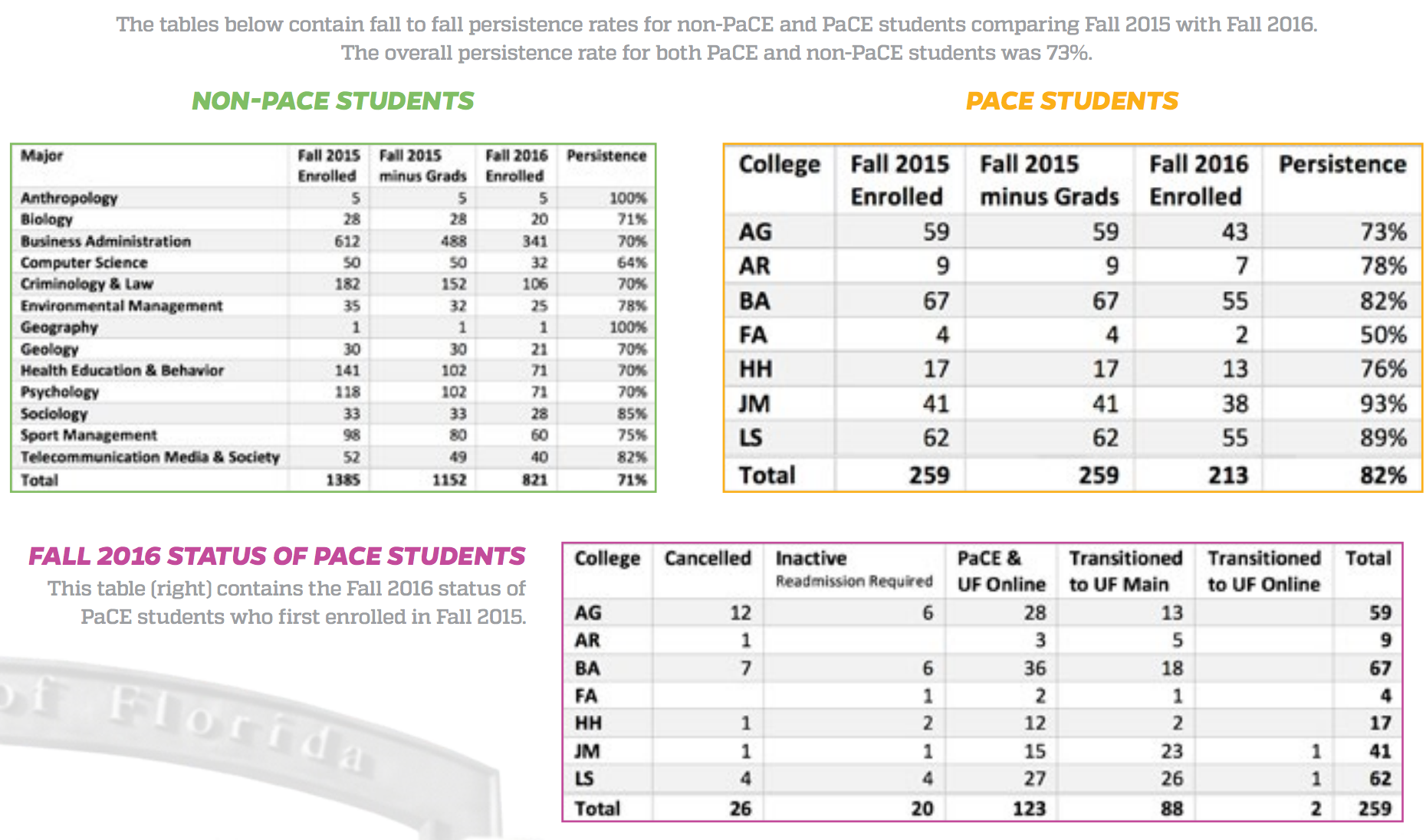
    Given that PaCE students are a different group – they did not initially apply to be an online student – it makes sense that UF Online now reports fall-to-fall persistence data for non-PaCE and PaCE student groups. And they even give a breakdown by academic program and updated status of the PaCE students who enrolled in 2015.

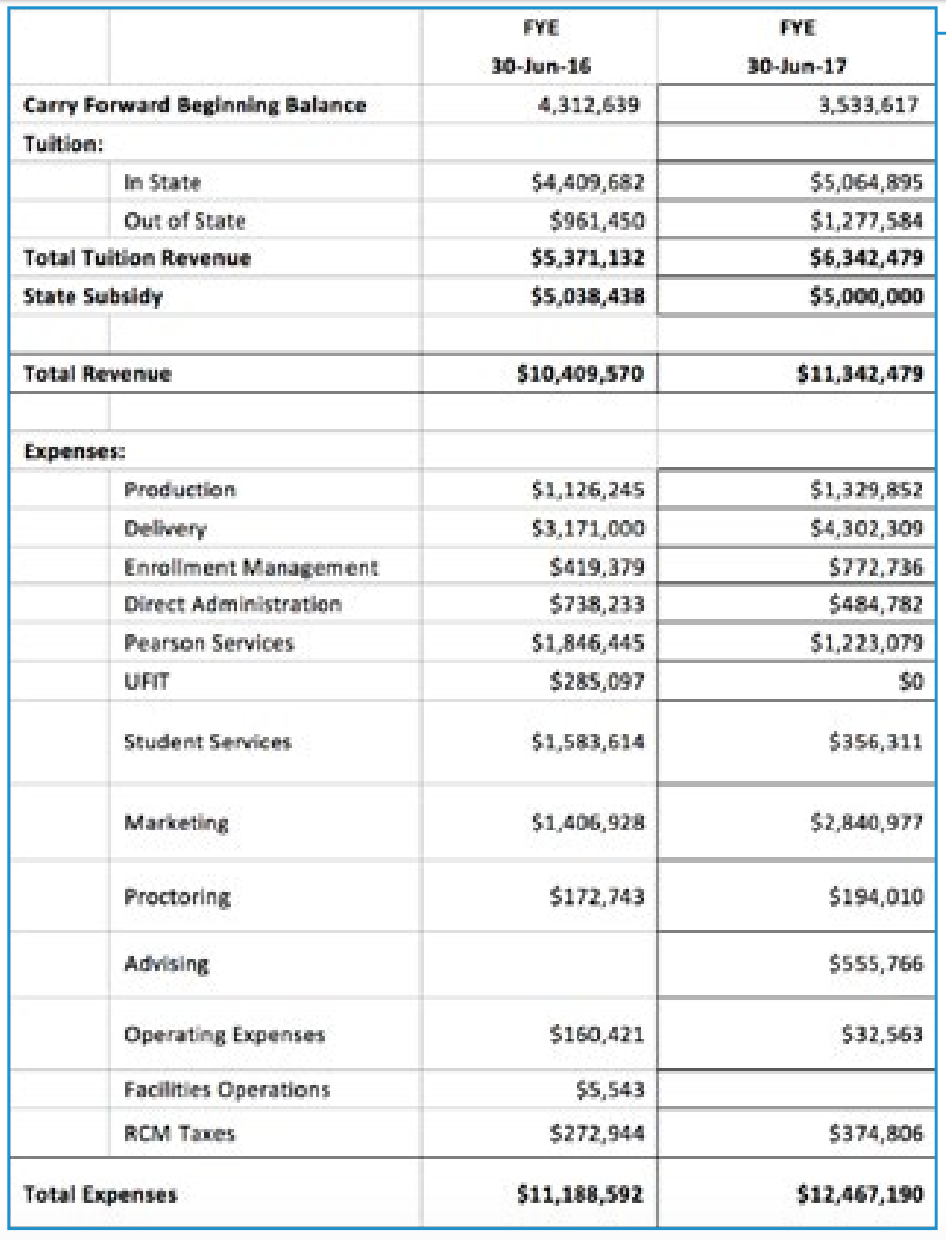
    There are also detailed financials, showing that UF Online is currently bringing in $6.3 m of tuition revenue and $5.0 m of state subsidies and spending $12.5 m.

    UF Online still has challenges – improving persistence rates, getting to break-even financials, etc. And they are not the only online program with this level of success. What makes UF Online so interesting to watch is that they made some hard choices to get past faulty original planning assumptions, they are very transparent in sharing their information publicly, and this is a very positive case of higher education embracing and learning from an outsider.

  • The Remarkable Transformation at UF Online

    The University of Florida, based on a plan created by the state legislature, started UF Online in 2013. The original business plan was a case study in optimistic enrollment planning and the road-to-riches through online education. From program inception, UF Online was forecast to grow to a headcount of 24,000 students within 10 years, 43% of whom would be out-of-state high-tuition students, generating $76 million in annual revenue and $14 million of “profit”. Then reality hit. The first executive director quit, enrollment reality did not match plans, they got rid of their Online Program Management partner (Pearson), and they hired a new executive director with no higher education management experience. In my May 2015 coverage, I concluded:

    UF Online seems to be institutionally-focused rather than student-focused, and the initiative is shaping up to be a case study in hubris. Without major changes in how the program is managed, including the main campus input into decisions, UF Online risks becoming the new poster child of online education failures. I honestly hope they succeed, but the current outlook is not encouraging.

    In a remarkable transformation in the past year originally described at Inside Higher Ed, UF Online appears to have made “major changes to how the program is managed” and is now focusing on students and reality. (more…)

  • Unizin Updates on Florida State System and Acquisition of Courseload

    I’m not sure when e-Literate was awarded the exclusive rights for non-PR Unizin coverage, but there were two announcements this week to cover.

    State University System of Florida Joins

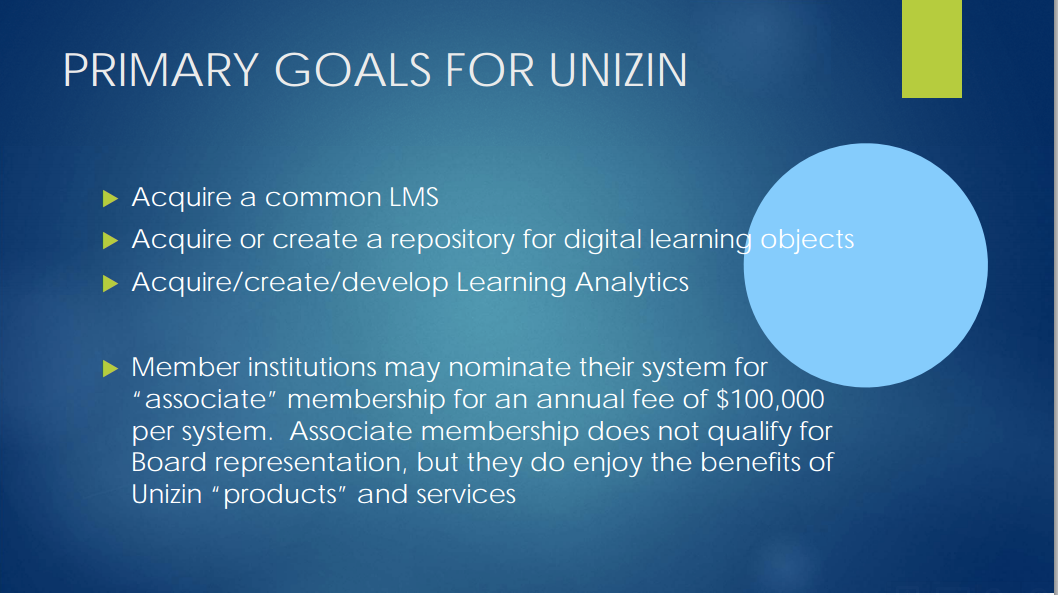
    The first announcement is an update and confirmation of my recent post about the new associate membership option. If a member institution (one of the 11 members paying $1.050 million) sponsors their statewide system, that system can join Unizin as “associate members” for $100 thousand per year but without retaining a board seat and vote on product direction. The week the State University System of Florida (SUSFL) announced they are joining Unizin.

    Building on its growing record of collaboration, the State University System of Florida, comprised of Florida’s 12 public universities, has joined Unizin, a group with a mission to have more control and influence over the digital learning ecosystem. (more…)

  • Unizin Perspective: Personalized learning’s existence and distance education experience

    By reading the Unizin pitch for the State University System of Florida shared yesterday, we can see quite a few claims about the (potential) benefits to be provided by the consortium. “Make sure that the universities were not cut out of [distance ed] process”; “Secure our foothold in the digital industry”; “Promote greater control and influence over the digital learning ecosystem”; Provide “access to the Canvas LMS at the Unizin price”; Provide “access to tools under development, including a Learning Object Repository and Learning Analytics”; Provide “potential for cooperative relationships to ‘share’ digital instruction within and across the consortium”.

    I want to pick up on University of Florida provost Joe Glover’s further comment on Learning Analytics, however.

    The third goal for Unizin is to acquire, create, or develop learning analytics. Some of the learning management systems have a rather primitive form of learning analytics. Unizin will build on what they have, and this will go from very mechanical types of learning analytics in terms of monitoring student progress and enabling intrusive advising and tutoring; all the way up to personalized learning, which is something that really does not exist yet but is one of the objectives of Unizin.

    (more…)

  • Unizin Offering “Associate” Membership For Annual $100k Fee

    Alert unnamed readers prompted me after the last post on the Unizin contract to pursue the rumored secondary method of joining for $100k. You know who you are – thanks.

    While researching this question, I came across a presentation by the University of Florida provost to the State University System of Florida (SUSFL) seeking to get the system to join Unizin under these new terms. The meeting was March 19, 2015, and the video archive is here (first 15 minutes), and the slide deck is here. The key section (full transcript below):

    Associate Membership FLSUS (more…)

  • Unizin One Year Later: View of contract reveals . . . nothing of substance

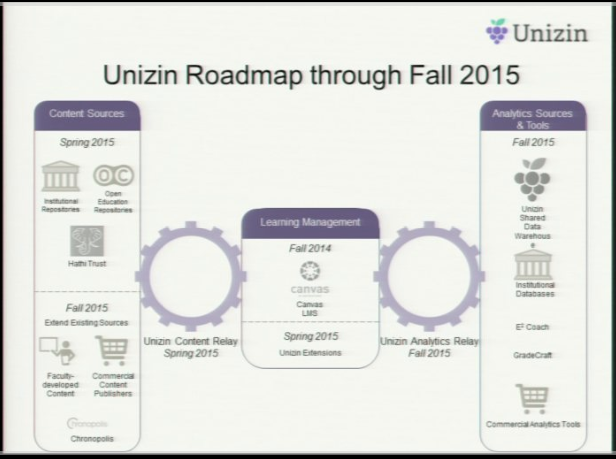
    I’ve been meaning to write an update post on Unizin, as we broke the story here at e-Literate in May 2014 and Unizin went public a month later. It’s one year later, and we still have the most expensive method to get the Canvas LMS. There are also plans for a Content Relay and Analytics Relay as seen in ELI presentation, but the actual dates keep slipping.

    Unizin Roadmap

    e-Literate was able to obtain a copy of the Unizin contract, at least for the founding members, through a public records request. There is nothing to see here. Because there is nothing to see here. The essence of the contract is for a university to pay $1.050 million to become a member. The member university then has a right (but not an obligation) to then select and pay for actual services. Based on the contract, membership gets you . . . membership. Nothing else. (more…)