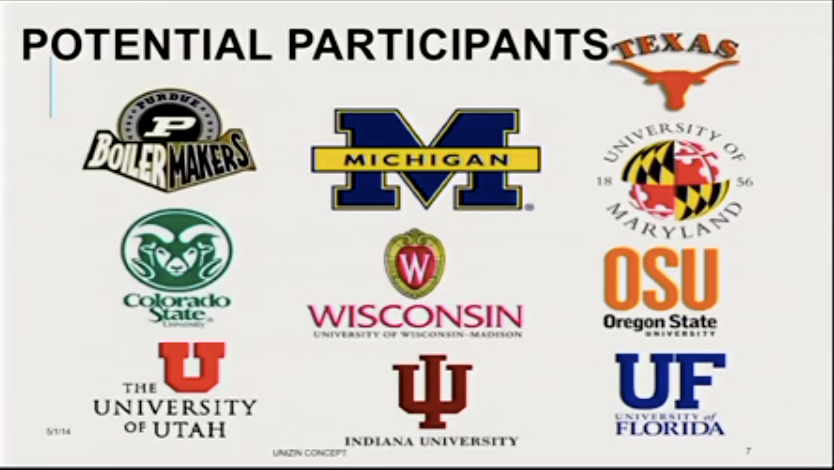
With Unizin going public yesterday, I’ve been looking over our three posts at e-Literate to see if there are any corrections or clarifications needed.
- Unizin: Indiana University’s Secret New “Learning Ecosystem” Coalition
- Why Unizin is a Threat to edX
- Unizin: What are the Primary Risks?
Based on yesterday’s press release, official web site release and media event, I have not found any corrections needed, but I do think there is a clarification needed on whether Unizin membership includes Canvas usage or not (it does not).
Common Infrastructure
During the media call, the Unizin team (representatives from the four founding schools plus Internet2 and Instructure) pushed the common infrastructure angle. Rather than being viewed as a buying club where schools can buy from a common set of pre-negotiated services, Unizin can more accurately be viewed as planned integration and operation of a common service to allow white-label outsourcing of the learning infrastructure. The idea is that a school can use Unizin’s infrastructure for LMS, content repository and analytics engine rather than hosting or maintaining their own, but the service will not be branded as Unizin for the faculty and student end users. From the Unizin FAQ page:
There is another sense in which Unizin is different from MOOC efforts. Unizin is about providing common infrastructure to support the missions of its university members. It is not a public-facing brand. It will not offer content, courses, or degrees in its own name. Unizin’s membership model is built on the premise that universities need to strengthen their influence in the use of data and content for the long run. They will accomplish this goal by working together and taking greater control over content, while also opening content up for selective sharing.
In this morning’s IHE article, the Unizin founders described the need for a common infrastructure:
The digital learning consortium, announced Wednesday morning, aims to simplify how universities share learning analytics, content and software platforms. But in order to do so, Unizin needs its members to use the same infrastructure. A common learning management system is the first part of that package.
“You don’t really have common infrastructure if you’re saying everything is heterogeneous,” said Brad Wheeler, the Unizin co-founder who serves as vice president for IT and chief information officer at Indiana University. “A lot of these different learning tools — Sakai, Blackboard, Canvas — they all do a bunch of really good stuff. But five universities picking five different ones — what’s the end value in that if they want to do something together?”
Brad Wheeler went on to describe the results that will occur from sharing infrastructure:
“This is a hard decision,” Wheeler said about picking Canvas. “I think the key point is enabling Unizin to do what it’s meant to do…. The path for Unizin is creating a dependence on Unizin — a university-owned entity — but creating potential for greater interdependence among our institutions.”
Instead of differentiating themselves based on what software tools they individually pick, Wheeler said, Unizin’s member institutions will stand out based on what they do with the common platform — in other words, the degrees they offer, the research they produce and the students they serve.