
e-Literate

Present is Prologue

Tag: university of wisconsin

  • University of Wisconsin System to Migrate From D2L Brightspace to Canvas LMS

    University of Wisconsin System to Migrate From D2L Brightspace to Canvas LMS

    In one of the most significant LMS selection projects of the past few years, the University of Wisconsin System (UWS) has chosen to migrate from D2L’s Brightspace to Canvas as its centrally-supported Learning Management System (LMS). ((Disclosure: UWS, UW Madison, Instructure, and D2L are all subscribers to our market analysis service, and we aided UWS in the needs analysis portion of this project.)) UW Madison already moved to Canvas as part of its Unizin membership, but now the rest of the 180,000 student, 26 campus system will also make the change.

    The decision was first noted on the UWS procurement portal and in a investor analysis note from Raymond James. A representative from UWS confirmed the news and added that “Canvas has been issued the Notice of Intent to Award and a final contract is going to the UW System Board of Regents for formal approval in October”.

    The UWS project page describes the process leading up to the LMS selection, starting with needs analysis kickoff in 2015.

    The Learning Environment Needs Analysis (LENA) project was undertaken as a continuation of a multi-year UW System effort to: 1) understand the current and future learning technology landscape, 2) uncover the wants and needs of UW System institutions with regard to academic technologies that support teaching and learning, and 3) identify gaps that exist in supporting teaching and learning through academic technology. The results of the LENA project were presented to the Learn@UW Executive Committee, along with a recommendation that the Committee charter the process for planning to move into a next generation learning environment for the UW System. The intention was that through this process, UW System would discover potential paths forward to support such an environment.

    Last year UWS developed the request for proposal (RFP) requirements list, and the formal RFP was released in January of 2017.

    Beyond the size of the system, UWS decision is significant due to it being the first major customer of Desire2Learn (as the company was known prior to 2014). Back in 2002 / 2003, most LMS decisions were framed as Blackboard vs. WebCT, and when UWS selected little-known D2L, it sent shock waves through the market. The decision really put D2L on the map as a true contender, and they followed up with wins at the University of Iowa ((Disclosure: In previous consulting company I advised U Iowa on their LMS selection.)), the Ohio State University, Minnesota State Colleges and Universities, and the University System of Georgia.

    We have noted several times at e-Literate and as part of the e-Literate Big Picture: LMS market analysis service that D2L has an impressive record of client retention. The company has been a fierce competitor in keeping customers, as seen when the Colorado Community College System recently chose to remain on D2L Brightspace after their LMS selection process. ((Disclosure: CCCS is a subscriber to our market analysis service. I also advised CCCS when they originally chose D2L in 2008.)) This loss of UWS is the biggest setback for the company in terms of losing clients, and it is a major win for Instructure’s Canvas system.

    Expect more market news to come out in the next month based on WCET and ECUCAUSE conferences.
  • On False Binaries, Walled Gardens, and Moneyball

    D’Arcy Norman started a lively inter-blog conversation like we haven’t seen in the edublogosphere in quite a while with his post on the false binary between LMS and open. His main point is that, even if you think that the open web provides a better learning environment, an LMS provides a better-than-nothing learning environment for faculty who can’t or won’t go through the work of using open web tools, and in some cases may be perfectly adequate for the educational need at hand. The institution has an obligation to provide the least-common-denominator tool set in order to help raise the baseline, and the LMS is it. This provoked a number of responses, but I want to focus on Phil’s two responses, which talk at a conceptual level about building a bridge between the “walled garden” of the LMS and the open web (or, to draw on his analogy, keeping the garden but removing the walls that demarcate its border). There are some interesting implications from this line of reasoning that could be explored. What would be the most likely path for this interoperability to develop? What role would the LMS play when the change is complete? For that matter, what would the whole ecosystem look like?

    Seemingly separately from this discussion, we have the new Unizin coalition. Every time that Phil or I write a post on the topic, the most common response we get is, “Uh…yeah, I still don’t get it. Tell me again what the point of Unizin is, please?” The truth is that the Unizin coalition is still holding its cards close to its vest. I suspect there are details of the deals being discussed in back rooms that are crucial to understanding why universities are potentially interested. That said, we do know a couple of broad, high-level ambitions that the Unizin leadership has discussed publicly. One of those is to advance the state of learning analytics. Colorado State University’s VP of Information Technology Pat Burns has frequently talked about “educational Moneyball” in the context of Unizin’s value proposition. And having spoken with a number of stakeholders at Unizin-curious schools, it is fair to say that there is a high level of frustration with the current state of play in commercial learning analytics offerings that is driving some of the interest. But the dots have not been connected for us. What is the most feasible path for advancing the state of learning analytics? And how could Unizin help in this regard?

    It turns out that the walled garden questions and the learning analytics questions are related.

    (more…)

  • Unizin Updates: Clarification on software development and potential new members

    In a recent post on Kuali, I characterized Unizin as a community source initiative. Brad Wheeler, CIO at Indiana University and co-founder of Kuali and Unizin, responded via email (with permission to quote):

    Unizin is not a Community Source effort in the way that I understand Community Source as we started applying the label 10+ years ago. Unizin is better understood, as you have reported, as a cloud-scale service operator somewhat like I2. It does not plan to do lots of software development other than as needed for integrations. No biggie, just a nuanced observation from the end of the story.

    Brad is correct, and I note that Unizin document has been fairly consistent in the lack of plans for software development, as seen in Unizin FAQs:

    Is Unizin another open- or community-source project like Sakai or Kuali?
    No – those endeavors focus on building software as a community, for use by individual institutions. Unizin strives to foster a community more concerned with creating and sharing content and improving outcomes.

    I have already revised the Kuali post to add a clarification on this point. I asked Brad whether this means that Unizin is ruling out software development. His reply:

    Unizin is working on its roadmap for each area. If we do need to head down some development approach that is more than integration, we’ll give thought to the full range of options for best achieving that, but there is no plan to begin an open/community source effort at this time.

    All public indications are that Unizin plans to source existing technologies (as they have done with Canvas as the LMS) for content repository and learning analytics functionality, focusing any software development on integrations.

    Potential New Consortium Members

    (more…)

  • Unizin membership fee is separate from Canvas license fee

    With Unizin going public yesterday, I’ve been looking over our three posts at e-Literate to see if there are any corrections or clarifications needed.

    Based on yesterday’s press release, official web site release and media event, I have not found any corrections needed, but I do think there is a clarification needed on whether Unizin membership includes Canvas usage or not (it does not).

    Common Infrastructure

    During the media call, the Unizin team (representatives from the four founding schools plus Internet2 and Instructure) pushed the common infrastructure angle. Rather than being viewed as a buying club where schools can buy from a common set of pre-negotiated services, Unizin can more accurately be viewed as planned integration and operation of a common service to allow white-label outsourcing of the learning infrastructure. The idea is that a school can use Unizin’s infrastructure for LMS, content repository and analytics engine rather than hosting or maintaining their own, but the service will not be branded as Unizin for the faculty and student end users. From the Unizin FAQ page:

    There is another sense in which Unizin is different from MOOC efforts. Unizin is about providing common infrastructure to support the missions of its university members. It is not a public-facing brand. It will not offer content, courses, or degrees in its own name. Unizin’s membership model is built on the premise that universities need to strengthen their influence in the use of data and content for the long run. They will accomplish this goal by working together and taking greater control over content, while also opening content up for selective sharing.

    In this morning’s IHE article, the Unizin founders described the need for a common infrastructure:

    The digital learning consortium, announced Wednesday morning, aims to simplify how universities share learning analytics, content and software platforms. But in order to do so, Unizin needs its members to use the same infrastructure. A common learning management system is the first part of that package.

    “You don’t really have common infrastructure if you’re saying everything is heterogeneous,” said Brad Wheeler, the Unizin co-founder who serves as vice president for IT and chief information officer at Indiana University. “A lot of these different learning tools — Sakai, Blackboard, Canvas — they all do a bunch of really good stuff. But five universities picking five different ones — what’s the end value in that if they want to do something together?”

    Brad Wheeler went on to describe the results that will occur from sharing infrastructure:

    “This is a hard decision,” Wheeler said about picking Canvas. “I think the key point is enabling Unizin to do what it’s meant to do…. The path for Unizin is creating a dependence on Unizin — a university-owned entity — but creating potential for greater interdependence among our institutions.”

    Instead of differentiating themselves based on what software tools they individually pick, Wheeler said, Unizin’s member institutions will stand out based on what they do with the common platform — in other words, the degrees they offer, the research they produce and the students they serve.

    Clarification on Canvas Licensing

    (more…)

  • Unizin: What are the primary risks?

    In Michael’s most recent post on Unizin, the new “learning ecosystem” initiative driven by Indiana University, he asked the question of who would be threatened by the proposed consortium (with the answer of edX). This question assumes of course that Unizin actually succeeds in large part, but what are the primary risks for the initiative to succeed in the first place? Based on the public information we have available to date (primarily in the two posts linked above), I see two near-term risks and one long-term risk that rise above the others.

    Near-Term Risk: Getting Schools to Sign Up

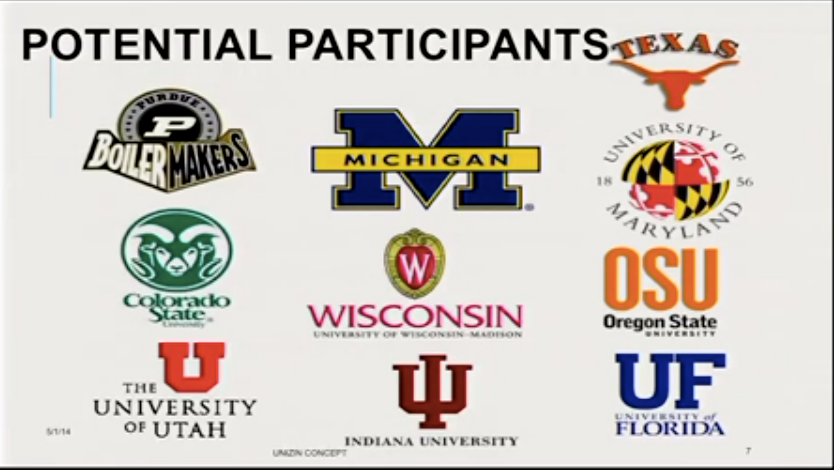
    The obvious question is whether there are enough schools willing to commit $1 million and adopt the proposed platforms to get the consortium off the ground. Based on the Colorado State University recording, it appears that the goal is to get 9 – 10 schools to commit $9 – $10 million in the initial phase. Beyond Indiana University, the most likely school to commit is the University of Michigan. Their leadership (dean of libraries, CIO) are fully behind the initiative, and from press reports they are seeking final approval. I cannot find any evidence that any other schools have reached this point, however.

    Slide from CSU Presentation
    Slide from CSU Presentation

    There are active debates in the Committee on Institutional Cooperation (CIC), primarily between provosts and CIOs, about Unizin and whether this approach works for member institutions. The provosts in fact already put out a position paper generally endorsing the same concept. (more…)

  • Unizin: Indiana University’s Secret New “Learning Ecosystem” Coalition

    Indiana University has been the driving force behind the creation of a new organization to develop a “learning ecosystem”. At least ten schools are being quietly asked to contribute $1 million each over a three-year period to join the consortium. The details of what that $1 million buys are unclear at this point. The centerpiece for the short-term appears to be a contract with Instructure for use of the Canvas LMS. But there are also hints of ambitious plans regarding learning object repositories and learning analytics.

    What is remarkable is the level of secrecy surrounding the project. Several sources from involved schools have indicated that very few people have been informed regarding their institutions’ prospective involvement. When school discussions do take place, care is being taken to keep them quiet. For example, a video recording of a presentation to faculty about Unizin at Colorado State University has since been removed from public access after it received some attention on Twitter (although e-Literate downloaded a copy of the video before it was removed from public access).

    Nevertheless, details of the project are beginning to leak out. In this post, I will share the facts that we have been able to confirm. Phil and I will both follow on with some analysis and inferences early next week. And of course, we will continue to bring you updates as news breaks.

    (more…)

  • Massive, Open, and Course Design

    Martin Weller has a great blog post up about course design responses to MOOC completion rates. He starts by arguing that, while completion rates are not everything in MOOCs, they are not nothing either. A lot depends on whether you think completion is an important metric to meet the course goals because, for example, the course is designed to help remedial students pass into a non-remedial track, or whether having students explore the content in a non-comprehensive way accomplishes your course goal. (Martin brings up an analogy by Stephen Downes that nobody complains about the low newspaper completion rates, which I have never heard before and which I love.)

    This is good stuff, but it starts us down the path toward a more radical re-examination of how we think about course design. Because while Martin is focusing primarily on course goals and how those should determine metrics, he’s beginning to raise the question of how individual learner goals should influence course design. And once you start asking that question, it changes everything.

    (more…)