
e-Literate

Present is Prologue

Tag: Unizin

  • Unizin Updates: A change in direction and a likely change in culture

    Unizin Updates: A change in direction and a likely change in culture

    After the resignation of Unizin’s CEO (Amin Qazi) and COO (Robin Littleworth) that we reported last week, we can confirm that the key issue was a change in direction for the consortium driven by the board of directors. Our information is based on on-the-record interviews with Qazi and Littleworth and additional interviews with Unizin staff, member institution staff, and outside sources. We believe this change in direction led to the resignations and will likely also lead to a change in emphasis on various Unizin initiatives.

    To recap what happened last week and add some details, there were two back-to-back board meetings for Unizin and Kuali held in Austin, TX. These meetings were not emergency meetings and were scheduled a long time ago, based on Unizin’s headquarters and Kuali’s users conference being held in that city. In an interview and follow-up discussion over the past few days, Amin Qazi described how he had not expected to resign going into the week. But in a meeting last Monday with the executive committee of Unizin, the board described a change in direction that they wanted to make, focusing on investments in initiatives with shorter-term visibility instead of those with a longer-term payoff such as the Open edX and Google partnerships. Qazi said that he was not the right person to lead the company in that direction, and after this meeting he resigned.

    I was told that Monday night Rob Lowden, Associate Vice President of Enterprise Systems at Indiana University, was asked to fly down to Austin based on this resignation. At the Tuesday Unizin board meeting, they approved his selection as interim executive director while the board searches for a new CEO. Robin Littleworth described that he was told somewhat conflicting information in his meeting with the board in that there was no change in direction.

    Coming out of the the board meeting, there was an all-hands meeting with Unizin staff, and board members told them of the changes. There was a question about rumors that Kuali.co might be acquiring Unizin, and the board members stated that this rumor was not true. Later in the meeting Littleworth gave an impassioned speech that the staff was the company, and that due to the changes and how they were handled the board had seriously harmed the company culture. He then announced his resignation. According to Littleworth, he hopes that his resignation and speech might alert the board that they didn’t think the situation all the way through and that they should reconsider how to support the company moving forward. Rob Lowden, for his part, still has his full-time job at Indiana University, but he told staff during this meeting that he would be commuting weekly to Austin for the next several months during the transition.

    I suspect that we’ll need to analyze the change in direction in more depth as details come out, but I believe that this situation is not based on finances or problems getting member institutions to recommit; rather it is a matter of emphasis on shorter-term versus longer-term initiatives.

    All Unizin member institutions that signed on in 2014 have re-signed to new three-year agreements, and according to Unizin Form 990 submissions, the consortium had $2 million in assets as of summer 2016 while running a surplus – meaning that this balance is should be even higher today. Furthermore, Littleworth stated that the Unizin management team was “not given any indication from our Board, let alone anything in writing, that we were at all underperforming or not meeting expectations”.

    What Qazi and Littleworth were pushing for were initiatives that directly addressed member institution needs even though they may take time to develop. One example is the recently-announced Open edX partnership. In an interview with Thomas Evans at The Ohio State University, he described that school’s desire to explore micro-credentials and to figure out how that would fit into an overall OSU strategy. Despite OSU’s partnership with Coursera, or actually because of it, the school did not want to figure this out with a platform company that would take a percentage of revenue. The Unizin / Open edX agreement is allowing OSU to pilot programs and figure out a strategy over the next few years.

    What we are likely to see with the Unizin change in direction is a stronger emphasis on partnerships and developments focused on near-term positioning of the consortium, include the BNED LoudCloud analytics partnership.

    The key intellectual property that Unizin has developed over the past few years is the Unizin Data Platform with its associated Unizin Common Data Model (UCDM). From a post on the UCDM:

    The UCDM rules map student, course, instruction, and learning activity information together. They solve the problem of “connecting the dots” between all of the data sources to create a single view of the student in the context of learning. As the data flows in from the SIS, LMS, and learning tools, the rules are applied to each data element, like a puzzle piece, to make sure that it is oriented to contribute to the whole picture.

    We at e-Literate have been critical of Unizin over the years for not having a clear value proposition. But from my conversations over the past two years with Unizin member institutions, the biggest value thus far from the consortium was this data platform and the hard work done to turn messy LMS and SIS data into usable formats. We have also heard from two outside sources recently that Unizin has had some real success using Engage to provide Inclusive Access digital content (course content available day one of term through institutional agreements) to several schools. And the OSU description of why they are using Open edX is compelling with its alignment with the stated Unizin mission.

    We don’t know all the details of the change in direction, but we believe this change is what triggered the management resignations last week. I will be quite interested to see if the changes affect the three initiatives mentioned above and pull the organization backwards in terms of creating value for its member institutions.

    Given the change, however, I believe there will also be a corresponding change in company culture that is inevitable at Unizin. Qazi and Littleworth (I have had many more interactions with the former but believe both to have been aligned) had an open, transparent, collegial style. Rather than ever getting defensive from questions we have asked or posts we have written at e-Literate, the two departing Unizin executives went out of their way to listen to criticism, engage us in conversations, and not try and control messaging but favor transparency instead.

    Qazi described how he was honored to have had the responsibility to guide Unizin through hard three years of launching the company, and he is proud of the team that Unizin has – they have a great deal of passion and dedication, and they have been asked to solve some very different problems from universities. Littleworth also expressed his primary pride in the Unizin staff and what they are accomplishing.

    By way of contrast, we have found the Unizin board to be quite focused on controlling the message. The board specifically asked both Qazi and Littleworth to not talk to me, but given their lack of employment agreements controlling who they talked to, both declined. I have asked to speak to board members for this story over the past few days with no response until they put out a press release today. The press release thanked Qazi for his service in a classy way and briefly noted Lowden’s new role while not mentioning Littleworth. But there is no information that I did not already have. After the press release came out I was invited, not by a board member but by a communications specialist, to submit questions for the board to address. I will do so for follow-up analysis.

    There is little doubt in my mind that the new Unizin leadership will be much more tightly controlled by the Unizin board, and they will take on much more of the board’s characteristics. This will likely lead to a change in company culture.

    Where does this leave Unizin? The consortium has money and three-year agreements in place. But there is a lot of work to be done before the consortium can deliver the value justifying $250k – $427k per year membership fees. As Littleworth described, the company is still in its infancy but now is changing direction while missing its critical leadership.

    While the following is not based on my interviews, I find the choice of Lowden as interim executive director to be quite interesting and a big part of the reason that I believe the ‘change in direction’ argument. If the board truly wanted to continue same direction despite Amin’s resignation, why not promote Steve Scott (CTO) or Robin Littleworth (COO), at least during transition? Remember that Littleworth did not resign until after Lowden was selected, and there was no discussion with the former COO about what to do next. Bringing in someone from outside so quickly seems to be significant. Furthermore, Lowden has a long history at Indiana University working for Unizin co-founder Brad Wheeler, and he was also involved early on at Sakai and then with the Kuali board – initiatives heavily influenced by Wheeler. Given his full-time job, the choice to use Lowden to replace full-time executive team for the next several months will lead to a challenging situation at a crucial time, to say the least, even though Qazi is staying on board through December to help with the transition. Was this choice partially worked out in advance, or did the board really react to Qazi’s resignation and find an interim replacement within 24 hours? What will Lowden be able to accomplish given his logistical challenges (Indianapolis vs. Austin and having multiple jobs). I will attempt to get answers from board on these questions.

    What I would watch over the next few months is whether Unizin loses additional staff due to the changes. And I would also watch the direction of the Unizin Data Platform in particular to understand the extent of changes to strategy.

  • Big Changes at Unizin: CEO and COO resign after board meeting

    Big Changes at Unizin: CEO and COO resign after board meeting

    Three and a half years after its formation, Unizin is facing its biggest challenge. Now that the consortium is dealing with contract renewals (membership based on three-year agreements), and now that it is a standalone organization and not wrapped under Internet2, Unizin will face the future without its top management.

    There’s a lot more here than just a change of one or two executives, and we plan to share more analysis next week here at e-Literate. We have also reached out to get comments from the various people involved. For now, however, here are the basics.

    This week there were two board meetings in Austin, TX – one for Unizin and one for Kuali – due to the logistics of having several people serving on both boards. We have confirmed based on multiple sources that after a meeting with the Unizin executive committee but before the board meeting, CEO Amin Qazi turned in his resignation. One day later, after the board approved a new interim CEO, COO Robin Littleworth turned in his resignation.

    The interim CEO is Rob Lowden, Associate VP Enterprise Systems at Indiana University and long-time active member of the Kuali community and prior to that in the Sakai community (including board positions in those two open source organizations). To the best of my knowledge, Lowden will remain in his job at IU while at the same time running Unizin until the board selects new executives.

    Expect more from us next week.

    Update: Clarified timing of resignation.

  • Unizin Membership Now Set As Annual Fee Of Up To $427.5k

    Unizin Membership Now Set As Annual Fee Of Up To $427.5k

    I’ve been meaning to provide an update on Unizin now that the consortium is three years old (started officially in July 2014). Thanks to public documents from the University of Minnesota, one of the 11 founding members, we now have additional clarity on the ongoing costs to remain a member of Unizin.

    Membership Fees

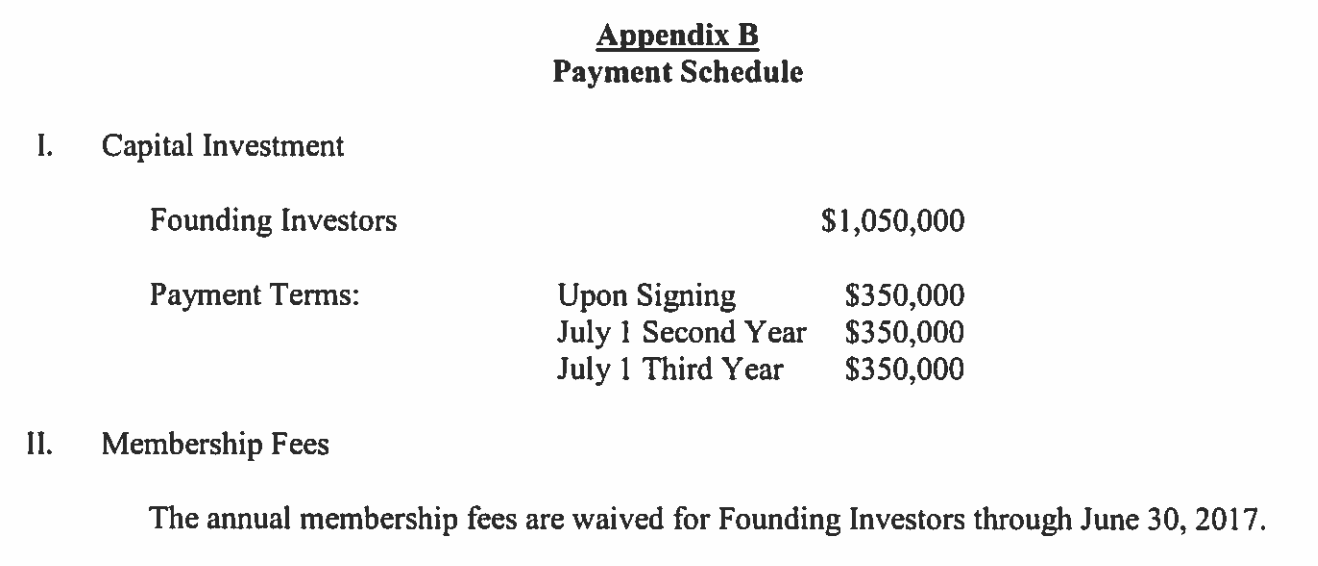
    For some background, Colorado State University staff back in April 2014 described the $1,050,000 initial fee in their meeting minutes for the University Technology Fee Advisory Board:

    3. Will this decrease overall costs on our end through collaboration?
    a. We are investing $1 million up front, but there is about a 7-year payback. We are investing in a $10 million product since the other 9 universities are putting their money in as we are too. This will absolutely decrease our costs.

    One year later, when the Florida State University System joined Unizin as associate members, we noted this item from the University of Florida / Unizin Consortium Membership Agreement:

    We noted at e-Literate in our article from 2015:

    Does this mean that founding institutions that “invested” $1.050 million over three years will have to start paying annual fees of $100,000 starting in June 2017? That’s my assumption, but I’m checking to see what this clause means and will share at e-Literate.

    Update (7/17): I talked to Amin Qazi today (CEO of Unizin) who let me know that the annual membership fee for institutional members (currently the 11 schools paying $1.050 million) has not be determined yet.

    Fast forward to 2017 and we have an answer. The University of Minnesota has to submit purchases over $1 million to its board of regents for consent, and at the July 2017 meeting the new Unizin membership fees were presented:

    To Unizin, Ltd. for $1,282,500 for a three-year renewal of membership in the higher education consortium for the Office of Information Technology (OIT) for the period July 1, 2017, through June 30, 2020. The annual payment of membership fees will be covered from OIT’s central O&M funds. The FY18 budget includes planning and funding for this expense.

    That equals $427,500 per year for the next three years for the 70,000+ enrollment university. What this now makes clear is that the up-front investment in Unizin was not a one-time fee broken up into three easy payments. Unizin member has an ongoing annual fee set in three-year periods.

    I again asked Amin Qazi for clarification, including whether all Unizin members were now paying the higher fee ($427.5k vs. $350k for initial three years). Amin confirmed via email:

    Unizin is a non-profit organization and seeks to cover its costs. We have found that our cost to provide our services and tools somewhat scale with the size of the institution. The Unizin Founding Member Fees have been adjusted after the initial three year period. So while larger institutions do pay more, smaller institutions pay less. We anticipate further adjustments as we grow and are able to recognize even greater economies of scale.

    I would then assume that the University of Minnesota, along with University of Michigan and Penn State University, are paying at the highest level and more than $350k, and that smaller schools like the University of Iowa and the University of Nebraska are paying less than $350k.

    LMS Fees

    The same University of Minnesota document also describes their costs for the Canvas ((Disclosure: Instructure is a subscriber to our market analysis service.)) LMS based on the Unizin agreement.

    To Unizin, Ltd. for $5,023,000 for a purchase of Canvas Learning Management System (LMS) for the Office of Information Technology (OIT) for the period July 1, 2017 through June 30, 2022. [snip]

    Unizen [sic], on behalf of its member institutions, conducted a competitive Request for Proposal followed by a detailed evaluation process. Through this process Canvas by Instructure was selected as a Learning Management System (LMS). The University then conducted a two year pilot of Canvas and a majority of the stakeholders preferred Canvas to the University’s current LMS, Moodle. Most of the Big Ten schools have adopted or are adopting Canvas.

    The University receives an additional 30% discount by purchasing Canvas through Unizen [sic] rather than purchasing directly through Infrastructure [sic] and 3% caps on annual increases, rather than 5%, has been negotiated.

    This five-year deal comes out to $12 – $14 per student per year. The document does not specify what level of support they have chosen, although they describe a “dedicated test server”.

    New Associate Members

    In other news, Unizin announced in July that the University of Nebraska system has joined as associate members.

    The Unizin Consortium is thrilled to welcome the full University of Nebraska system, bringing the total number of institutions in the consortium to 25. With the addition, the University of Nebraska at Kearney, University of Nebraska at Omaha, and University of Nebraska Medical Center join Unizin Founding Member the University of Nebraska Lincoln.

    Note that associate members do not pay the same amount as full members. In Florida, the State University System deal costs each associate member $100k per year.

    We’ll likely give updates at e-Literate after the EDUCAUSE conference on how Unizin has evolved in terms of services and potential new members. But for now we at least have more clarity on the financial terms of the consortium.

  • Barnes & Noble Education’s Predictive Analytics Deal With Unizin

    Barnes & Noble Education’s Predictive Analytics Deal With Unizin

    Barnes & Noble Education (BNED) announced today that they have a deal with Unizin to provide predictive analytics services through the LoudSight platform to the consortium’s member universities. As covered by Inside Higher Ed:

    BNED, as the company now likes to be called, operates nearly 1,500 bookstores, but has in recent years expanded beyond course materials. In March 2016, it acquired the software start-up LoudCloud, and it is through that company that BNED now will score a group of 22 potential new clients (or, in the cases where it already runs campus bookstores, form tighter connections with existing ones) that includes Indiana University, Pennsylvania State University and the State University System of Florida, among others.

    The deal represents a new product focus for BNED’s LoudCloud – predictive analytics – and a new financial model for Unizin. (more…)

  • Unizin RFP For LMS: An offering to appease the procurement gods?

    Well this was interesting:

    In a blog post from Monday, Unizin announced a public Request For Proposals (RFP) to solicit bids for an enterprise and multitenant LMS. The RFP states its purpose:

    We seek to identify a qualified vendor (“vendor”) to make available an enterprise and multitenant learning management system and related services (collectively, the “LMS”) to Member Institutions.

    Say what? (more…)

  • Instructure Dodges A Data Bullet

    Last week’s EDUCAUSE conference was relatively news free, which is actually a good thing as overall ed tech hype levels have come down. Near the end of the conference, however, I heard from three different sources about a growing backlash against Instructure for their developing plans for Canvas Data and real-time events. “They’re Blackboarding us”, “the honeymoon is over”, “we’re upset and that is on the record”. By all appearances, this frustration mostly by R1 institutions was likely to become the biggest PR challenge for Instructure since their 2012 outage, especially considering their impending IPO.

    The first complaint centered on Instructure plans to charge for daily data exports as part of Canvas Data, which Instructure announced at InstructureCon in June as:

    a hosted data solution providing fully optimized data to K-12 and higher education institutions capturing online teaching and learning activity. As a fundamental tool for education improvement, the basic version of the service will be made available to Canvas clients at no additional cost, with premium versions available for purchase.

    What that last phrase meant was that monthly data access was free, but institutions had to pay for daily access. By the EDUCAUSE conference, institutions that are part of the self-organized  “Canvas R1 Peers” group were quite upset that Instructure was essentially selling their own data back to them, and arguments of additional infrastructure costs were falling flat. (more…)

  • Unizin Updates on Florida State System and Acquisition of Courseload

    I’m not sure when e-Literate was awarded the exclusive rights for non-PR Unizin coverage, but there were two announcements this week to cover.

    State University System of Florida Joins

    The first announcement is an update and confirmation of my recent post about the new associate membership option. If a member institution (one of the 11 members paying $1.050 million) sponsors their statewide system, that system can join Unizin as “associate members” for $100 thousand per year but without retaining a board seat and vote on product direction. The week the State University System of Florida (SUSFL) announced they are joining Unizin.

    Building on its growing record of collaboration, the State University System of Florida, comprised of Florida’s 12 public universities, has joined Unizin, a group with a mission to have more control and influence over the digital learning ecosystem. (more…)