
e-Literate

Present is Prologue

Tag: Unizin

  • Unizin Perspective: Personalized learning’s existence and distance education experience

    By reading the Unizin pitch for the State University System of Florida shared yesterday, we can see quite a few claims about the (potential) benefits to be provided by the consortium. “Make sure that the universities were not cut out of [distance ed] process”; “Secure our foothold in the digital industry”; “Promote greater control and influence over the digital learning ecosystem”; Provide “access to the Canvas LMS at the Unizin price”; Provide “access to tools under development, including a Learning Object Repository and Learning Analytics”; Provide “potential for cooperative relationships to ‘share’ digital instruction within and across the consortium”.

    I want to pick up on University of Florida provost Joe Glover’s further comment on Learning Analytics, however.

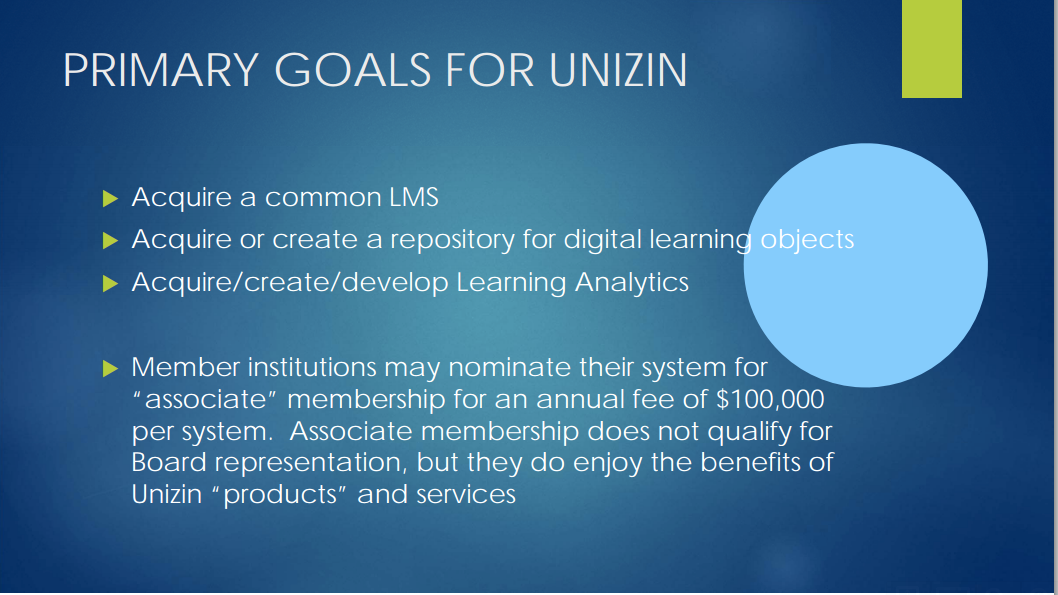
    The third goal for Unizin is to acquire, create, or develop learning analytics. Some of the learning management systems have a rather primitive form of learning analytics. Unizin will build on what they have, and this will go from very mechanical types of learning analytics in terms of monitoring student progress and enabling intrusive advising and tutoring; all the way up to personalized learning, which is something that really does not exist yet but is one of the objectives of Unizin.
    (more…)

  • Unizin Offering “Associate” Membership For Annual $100k Fee

    Alert unnamed readers prompted me after the last post on the Unizin contract to pursue the rumored secondary method of joining for $100k. You know who you are – thanks.

    While researching this question, I came across a presentation by the University of Florida provost to the State University System of Florida (SUSFL) seeking to get the system to join Unizin under these new terms. The meeting was March 19, 2015, and the video archive is here (first 15 minutes), and the slide deck is here. The key section (full transcript below):

    Associate Membership FLSUS (more…)

  • Unizin One Year Later: View of contract reveals . . . nothing of substance

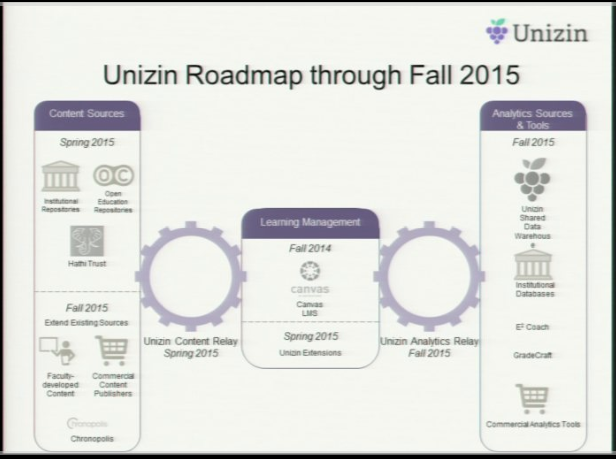
    I’ve been meaning to write an update post on Unizin, as we broke the story here at e-Literate in May 2014 and Unizin went public a month later. It’s one year later, and we still have the most expensive method to get the Canvas LMS. There are also plans for a Content Relay and Analytics Relay as seen in ELI presentation, but the actual dates keep slipping.

    Unizin Roadmap

    e-Literate was able to obtain a copy of the Unizin contract, at least for the founding members, through a public records request. There is nothing to see here. Because there is nothing to see here. The essence of the contract is for a university to pay $1.050 million to become a member. The member university then has a right (but not an obligation) to then select and pay for actual services. Based on the contract, membership gets you . . . membership. Nothing else. (more…)

  • What Does Unizin Mean for Digital Learning?

    Speaking of underpants gnomes sales pitches, Phil and I spent a fair amount of time hearing about Unizin at the ELI conference. Much of that time was spent hearing friends that I know, trust, and respect talk about the project. At length, in some cases. On the one hand, it is remarkable that, after these long conversations, I am not much clearer on the purpose of Unizin than I was the week before. On the other hand, being reminded that some of my friends really believe in this thing helped me refill my reservoir of patience for the project, which had frankly run dry.

    Alas, that reservoir was largely drained away again during a Unizin presentation with the same title as this blog post. I went there expecting the presenters to answer that question for the audience.

    Alack.

    (more…)

  • Year-end Updates on e-Literate News Posts

    For my final 2014 post, I thought it would be interesting to provide year-end updates to some news posts on e-Literate over the past year. You’ll notice that there is somewhat of an emphasis on negative stories or implications. For most positive stories, companies and institutions are typically all too happy to send out press releases with the associated media paraphrasing, and we have little need here to cover as news. The following non-exhaustive list is in date order.

    D2L Growth Claims

    In December 2013 I described layoffs at Desire2Learn (now officially named D2L). The significance of this story is that it calls into question D2L’s growth claims and trumpeting of massive new investment of $85 million. Some updates:

    IPEDS Data on Online Learning

    (more…)

  • e-Literate Top 20 Posts For 2014

    I typically don’t write year-end reviews or top 10 (or 20) lists, but I need to work on our consulting company finances. At this point, any distraction seems more enjoyable than working in QuickBooks.

    We’ve had a fun year at e-Literate, and one recent change is that we are now more willing break stories when appropriate. We typically comment on ed tech stories a few days after the release, providing analysis and commentary, but there are several cases where we felt a story needed to go public. In such cases (e.g. Unizin creation, Cal State Online demise, management changes at Instructure and Blackboard) we tend to break the news objectively, providing mostly descriptions and explanations, allowing others to provide commentary.

    The following list is based on Jetpack stats on WordPress, which does not capture people who read posts through RSS feeds (we send out full articles through the feed). So the stats have a bias towards people who come to e-Literate for specific articles rather than our regular readers. We also tend to get longer-term readership of articles over many months, so this list also has a bias for articles posted a while ago.

    With that in mind, here are the top 20 most read articles on e-Literate in terms of page views for the past 12 months along with publication date.

    1. Can Pearson Solve the Rubric’s Cube? (Dec 2013) – This article proves that people are willing to read a 7,000 word post published on New Year’s Eve.
    2. A response to USA Today article on Flipped Classroom research (Oct 2013) – This article is our most steady one, consistently getting around 100 views per day.
    3. Unizin: Indiana University’s Secret New “Learning Ecosystem” Coalition (May 2014) – This is the article where we broke the story about Unizin, based largely on a presentation at Colorado State University.
    4. (more…)

  • Kuali Foundation: Clarification on future proprietary code

    Well that was an interesting session at Educause as described at Inside Higher Ed:

    It took the Kuali leadership 20 minutes to address the elephant in the conference center meeting room.

    “Change is ugly, and change is difficult, and the only difference here is you’re going to see all the ugliness as we go through the change because we’re completely transparent,” said John F. (Barry) Walsh, a strategic adviser for the Kuali Foundation. “We’re not going to hide any difficulty that we run into. That’s the way we operate. It’s definitely a rich environment for people who want to chuck hand grenades. Hey, have a shot — we’re wide open.” [snip]

    Walsh, who has been dubbed the “father of Kuali,” issued that proclamation after a back-and-forth with higher education consultant Phil Hill, who during an early morning session asked the Kuali leadership to clarify which parts of the company’s software would remain open source.

    While the article describes the communication and pushback issues with Kuali’s creation of a for-profit entity quite well (go read the whole article), I think it’s worth digging into what Carl generously describes as a “back-and-forth”. What happened was that there was a slide describing the relicensing of Kuali code as AGPL, and the last bullet caught my attention: (more…)