
e-Literate

Present is Prologue

Tag: WCET

  • Recommended Reading: ED Clarifies Its Intent on State Authorization Reciprocity

    Recommended Reading: ED Clarifies Its Intent on State Authorization Reciprocity

    Last year Russ Poulin from WCET and I wrote an essay for Inside Higher Ed (also published at e-Literate) describing and countering attempts by the Century Foundation and other activists who were arguing against the State A

    A coalition of consumer groups, legal aid organizations and unions object to the state of New York joining an agreement that would change how colleges offering distance education courses in the state would be regulated. As coalition members asserted in an Inside Higher Ed article, the state would be ceding its authority to other states. Students would be left with no protection from predatory colleges and it would make it easier for “bad actors to take advantage of students and harder for states to crack down on them.”

    That all sounds ominous. It would be, if it were true.

    The story has taking a series of dramatic turns. First, New York state did join SARA. But in a surprise move in the final regulatory language from the Department of Education (ED), they included language proposed by the Massachusetts AG and supported by the Century Foundation that appeared to undermine the concept of reciprocity. Most analysts and insiders, including WCET and SARA themselves came to the same conclusion that Massachusetts’ AG did – SARA and the concept of reciprocity agreements would not survive as long as the regulation survived. In a surprise move, however, anonymous staffers at ED called Russ Poulin (the person to follow on this subject), letting him know that their intent is not at all to undermine SARA. (more…)
  • College Scorecard: With victories like these, who needs failures?

    Goldie Blumenstyk had a fascinating interview with the Depart of Education’s Ted Mitchell on Friday that is well worth reading and / or watching (they have video of the interview along with full transcript). One of Mitchell’s key points jumped off the page for me.

    I think it [College Scorecard] was one of the department and the administration’s greatest victories

    Really? I can see the consolidation of student loans, a strong focus on college affordability, shifting of conversation away from just elite schools, and significant push on funding public schools as worthy victories to mention. But the College Scorecard – I don’t buy it.

    Blumenstyk pushed back on Mitchell, which led to this interesting exchange [emphasis added].

    GOLDIE BLUMENSTYK: I’m glad you mentioned the College Scorecard. I was thinking about that a little bit. It’s probably one of the places where the department had perhaps its biggest defeat, or maybe you might consider it a retreat. We were originally envisioning the Scorecard as a tool for accountability. Obviously, a lot of colleges and a lot of other people opposed that idea. And it became a complicated process even to create the effective scorecard. What did you learn from that process?

    TED MITCHELL: So I guess I would have a slightly different interpretation.

    GOLDIE BLUMENSTYK: I would imagine. (more…)

  • Comparing Fully-Online vs Mixed-Course Enrollment Data

    Mike Caulfield wrote a post yesterday about a new Blackboard report on design findings regarding online students. The focus of Mike’s post was that people often assume that the norm for an “online” student is taking all courses online, when in fact it is more common for students to take some courses online and some face-to-face (what Mike calls “Mixed-Course”). This distinction is important:

    What shocks some people reading this, I think, is that online students would have face-to-face courses as a comparison or option, or that they would be consciously choosing between online and face-to-face in the course of a semester. But this is the norm now at state universities and community colleges; it’s only a secret to people not in those sorts of environments.

    I agree that this is an important topic, so let’s look at the data in more detail (and for those wondering if you can connect to Tableau Public to edit online data visualizations while flying, the answer is yes if you’re patient). The best source of information is the IPEDS database, with the most recent data for Fall 2014. WCET put out an excellent report analyzing the distance education data in IPEDS – more on that later. Both IPEDS and WCET use the term “Some but not all” in the same manner as “Mixed-Course”. Based on overall data combining undergraduate and graduate students, Mike is right that more students are Mixed-Course than they are Fully-Online – 2.926 million vs. 2.824 million. (more…)

  • Fall 2014 IPEDS Data: New Profile of US Higher Ed Online Education

    The National Center for Educational Statistics (NCES) and its Integrated Postsecondary Education Data System (IPEDS) provide the most official data on colleges and universities in the United States. I have been analyzing and sharing the data in the initial Fall 2012 dataset and for the Fall 2013 dataset. Both WCET and the Babson Survey Research Group also provide analysis of the IPEDS data for distance education. I highly recommend the following analysis in addition to the profile below (we have all worked together behind the scenes to share data and analyses).

    Below is a profile of online education in the US for degree-granting colleges and university, broken out by sector and for each state. (more…)

  • IHE Essay: Getting the political facts straight about State Authorization Reciprocity Agreement

    The following essay, co-written by Russ Poulin and Phil Hill, was originally published at Inside Higher Ed in response to articles in the New York Times and Inside Higher Ed regarding whether New York state should sign the SARA agreement.

    A coalition of consumer groups, legal aid organizations and unions object to the state of New York joining an agreement that would change how colleges offering distance education courses in the state would be regulated. As coalition members asserted in an Inside Higher Ed article, the state would be ceding its authority to other states. Students would be left with no protection from predatory colleges and it would make it easier for “bad actors to take advantage of students and harder for states to crack down on them.”

    That all sounds ominous. It would be, if it were true.

    Even in the digital era, the regulation of educational institutions is left to each state. The resulting array of requirements confuses both students and institutional faculty and staff. The State Authorization Reciprocity Agreement (SARA) was created to apply consistent review standards across the states. An institution approved in its home state is eligible to enroll students (within limits) in any other SARA member state. As of this writing, 36 states have joined in a little over two years. That number may approach 45 by the end of 2016.

    (more…)

  • College Scorecard: ED quietly adds in 700 missing colleges

    It’s worth giving credit where credit is due, and the US Department of Education (ED) has fixed a problem that Russ Poulin and I pointed out where they had previously left ~700 colleges out of the College Scorecard.

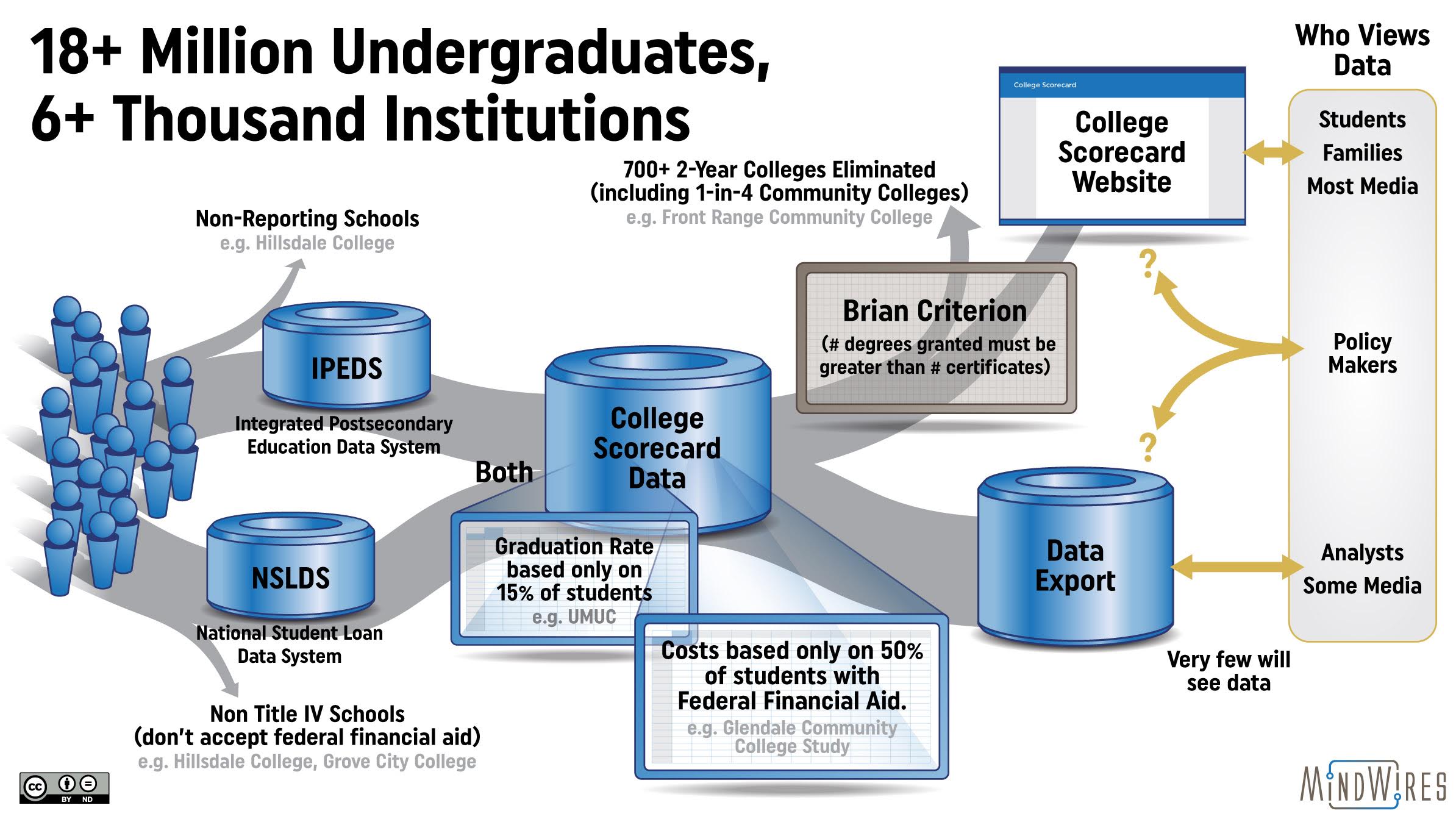
    When the College Scorecard was announced, Russ noticed a handful of missing schools. When I did the whole data OCD thing, I discovered that more than 700 2-year institutions were missing, including nearly 1-in-4 community colleges. Eventually we published an article in the Washington Post describing this (and other) problems.

    The missing community colleges were excluded on purely statistical grounds. If the college granted more certificates (official awards of less than a degree) than degrees in a year, then they were excluded as they were not “primarily degree-granting” institutions. We label this the “Brian Criterion” after the person authoring two discussion board posts that explained this undocumented filter. (more…)

  • College Scorecard Article Published In Washington Post

    I have written several posts looking at the new College Scorecard and its inherent flaws in the data, often starting with observations from Russ Poulin at WCET. Today Susan Svrluga, education reporter at the Washington Post, posted a new article co-written by me and Russ and titled “Hundreds of colleges missing from Obama’s College Scorecard?”. The gist of the article is taking a holistic view of data problems and why they exist.

    In a nutshell, the College Scorecard combines data from multiple sources – primarily from the Education Department’s own Integrated Postsecondary Education Data System (IPEDS) and National Student Loan Data System (NSLDS) – and publishes the results of both as a consumer-facing Web site and an analyst-friendly data download. The essence of the problem is that throughout this process the data is filtered based on questionable assumptions, leading to the fuzzy lens viewing subsets of the real data.

    Poulin Hill College Scorecard Graphic