
e-Literate

Present is Prologue

Author: Jim Farmer

  • Charles Severance’s “Sakai: Free as in Freedom:” A Review

    This is a guest post by Jim Farmer, instructional media + magic inc. Jim has been Treasurer of the Sakai Foundation since December.

    When building a complex software system developers want to use the latest technology. Users want business processes and data presentations that serve them and their “customers.” Management focuses on the allocation of resources and schedules. Sakai is an enterprise open-source learning system developed in 2004-2005 by a team from Indiana and Stanford Universities, University of Michigan and the Massachusetts Institute of Technology. Other colleges and universities joined the follow-on Sakai Foundation development. All encountered conflicting priorities for functionality, schedule, and new features. Open source is even more difficult because there is no central control over the contributors.

    Author Charles Severance was Chief Architect of the project from 2004 through 2005. He became a Foundation Board member in January 2006 named Executive Director of the Foundation in May. He writes from the perspective of a technologist. Severence had differences with the project Advisory Board and the Foundation Board—strategy, allocation of resources, and priorities for development. As a “Retrospective Diary” both the technical choices and the differences with the Boards are described chronologically. This assists the reader to interpret the differences of perceived priorities, technology choices, and commitments. The Sakai project was committed to deliver a working system to Michigan and Indiana in fall 2005 to replace their then current systems and to satisfy the Andrew W. Mellon Foundation grant conditions. Then a new organization needed to be created to sustain the community that began separately and provided significant funding and contributions. There are few precedents though Severance acknowledges the earlier uPortal project—similarly funded by the Mellon Foundation—was successful with a different development approach and business plan.

    Other perspectives can be read in Severance’s writings or inferred from the information he provides.
    (more…)

  • Investment Bankers and Blackboard’s Future, Part One: If …

    This is a guest post by Jim Farmer, Chairman of Sigma Group Inc.

    On Friday July 1,st after this was written, Blackboard Inc. was acquired by “affiliates of Providence Equity Partners” for $1.64 billion. They will also assume approximately $130 million in net debt. Providence will pay $45 per share; it closed Thursday at $43.38.

    The Washington Business Journal reported:

    The transaction is anticipated to close during the fourth quarter of 2011. Upon closing Blackboard will become a privately held company, remain headquartered in Washington and continue to be led by its existing senior management team.

    This suggests a more complex deal than the publicly available information suggests.

    Blackboard’s April 19, 2011 press release reads; “Blackboard (NASDAQ: BBBB) today announced that it has retained Barclay’s Capital as its financial advisor in response to receiving unsolicited, non-binding proposals to acquire the company.” On Thursday, June 23, The Chronicle of Higher Education, citing the Wall Street Journal, reported: “Providence Equity could announce a deal to buy Blackboard, Inc. as early as next week [the week of June 27 – July 1].”

    If this acquisition is completed, ((Editor’s Note: While Blackboard and Providence have agreed on the acquisition, the deal doesn’t close until the fourth quarter of 2011. Acquisition agreements sometimes do fall apart before they close, although there is no particular reason to think that this one will.)) the question then turns to the impact it will have on higher education.

    From the Wall Street perspective Blackboard is a very successful and well managed company. The founders’ goal at Cornell University was to save faculty time by automating typical faculty communications with students, and making the administrative tasks of a lecture more convenient for students. Since then, through software development and recent acquisitions, Blackboard has a suite of complementary learning applications. Blackboard’s learning management products have become a successful source of revenue. Some acquisitions products, such as Blackboard Connect, seem to be leading in their market segment.

    However, the expectation of private equity firms for earnings exceeds Blackboard’s 2010 earnings. A combination of higher prices for annual software licenses and reduction of staff and lower services will, in the short run, be needed to achieve this higher profitability.

    (more…)

  • Software Patent Wars: Is Linux next?

    This is a guest post by Jim Farmer, instructional media + magic inc. and contributor to Intellectual Property Magazine.

    It was sunny day, 76 degrees, in Tyler, Texas on April 15th, 2011 when the jury foreman handed the single page decision to Judge Davis, U.S. District Court for the Eastern District of Texas [EDTX]. There were three questions and the jury’s answers. Did Google infringe Bedrock’s two patents? Yes. Were the patents invalid? No. How much did the jury award in damages? The jury “ordered Google to pay $5 million in damages for infringing a Linux-related patent held by Texas-based Bedrock Computer Technologies.”

    Bedrock Computer Technologies is a non-practicing entity, sometimes called a patent troll, which seeks license revenue for patents in their portfolio.

    Amy Miller wrote in Corporate Counsel:

    Bedrock had sued Google in 2006, along with Yahoo, Amazon.com, PayPal, and AOL, alleging infringement of a Linux-related patent filed in January 1997. The patent describes “a method and apparatus for performing storage and retrieval,” and Bedrock said the companies had infringed it by using versions of the Linux operating system kernel on their servers. Bedrock has also asked for an injunction, but the court has not ruled on that yet.

    Because of its wide use of the Linux operating system, the key words are “Linux-related patent.”

    (more…)

  • Higher Education Recession: A new role for information technologists?

    This is a guest post by Jim Farmer. Jim is Chairman of instructional media + magic.

    Monday, 11 October the Browne report, “Securing a Sustainable Future for Higher Education,” was released in the UK. ((A copy of the Browne report is available here. Information from the JISC CETIIS Conferences can be found at the JISC web site. Inside Higher Education referenced the Times Higher Education article describing both the report and reaction—largely critical. There was also a separate commentary by editor Doug Lederman.)) If implemented there will be major cuts in funds available to U.K. universities and higher tuition for students. The combination of less funding and higher enrollment is also the new future in the U.S. Even more and bigger funding limits are expected next year. A combination of lower state revenues, higher costs, and limits on federal funding when stimulus funds will no longer be available will impact available funds..

    Although UK universities pleaded, and continue to plead, for more funding, the Joint Information Systems Committee began quietly more than 5 years ago to develop a capability for information technologists to contribute to a unified managed IT service for better university planning.

    (more…)

  • Restructuring higher education: NCES Stats-DC 2010 Conference

    This is a guest post by Jim Farmer.

    As you know, the Statewide Longitudinal Data Systems program is funding states’ work to improve their data systems. Over the past four years, 41 states and the District of Columbia have received more than half a billion dollars from this program. It has supported states as they link data from preschool, K-12, and postsecondary education. In some states, it supports their work to track students into the workforce. We’re committed to helping all states.

    Keynote presentation – Secretary of Education, Arne Duncan

    For 40 years institutional and policy researchers and information technologist have met with staff from the U.S. Department of Education’s National Center for Education Statistics to learn and advise on NCES data collection efforts. NCES is a source of useful statistics on K-12 and higher education. As described by Secretary Duncan, this year NCES staff and consultants provided detail data on the anticipated changes in higher education being implemented through the state agencies and conditions for any federal funding.

    At last year’s STAS-DC conference the primary focus of the 600 participants was qualifying to receive federal grants to develop statewide longitudinal data systems (SLDS). The $500 million was for in grants to state education agencies. Higher education did not receive any of those funds directly or via the state higher education executive officers.

    Now NCES has become the leader of perhaps the largest information technology (IT) implementation ever attempted in the U.S. It spans 4.339 colleges and universities and 98,916 public schools with annual revenue of $1.1 trillion. The Stats-DC 2010 conference, held 26-30 July in Bethesda, Maryland, focused on this implementation.

    This year’s conference provided evidence of the Department’s perspective of higher education and the requirements that would be placed on public colleges and universities and incentives for private non-profit and for-profit colleges to participate as well. Statewide Longitudinal Data Systems (SLDS) have become an unfunded mandate for higher education through new state-required data reporting requirements and data exchanges among colleges, universities, and schools. States that received funding agreed to build state-level data warehouses of these data; the model was centralization within each of the states or the use of servicers.

    In the long term higher education will be restructured by the metrics used to represent the success of college and university management and teaching faculty. The Stats-DC Conference offered an opportunity to learn the underlying assumptions about education and perception of the value and use of data. A caution: The U.S. Department of Education has a number of knowledgeable, dedicated, and hard-working educators. This is also true of the state education agencies. But the design and beginning implementation of a national education data system within the available time does not permit the thoughtful planning that would have reduced the risks of unintended consequences.

    (more…)

  • Why Not Go to a Party School?

    This is a guest post by Jim Farmer. Jim is Chairman of instructional media + magic.

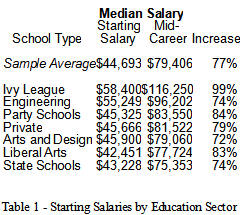
    Analysis of data recently released by PayScale Inc. and published in Bloomberg Business Week show starting salaries for graduates of Party Schools begin fifth of seven sectors moving up to third place by mid-career. Party Schools have a rate of salary increase exceeded only by graduates of Ivy League universities:

    The data comes from 611,000 surveys completed as profiles on the PayScaleWeb Site.

    (more…)

  • Art Pasquenilli and the Sun Microsystems Legacy

    This is a guest post by Jim Farmer.

    Email a few days ago reported Art Pasquenilli would not be transitioning from Sun Microsystems to Oracle Corporation.

    Art and his colleagues in Sun Global Education made significant contributions to higher education. We recognize their contributions and see, in retrospect, how their initiatives have benefited and will continue to benefit higher education.

    A Collaboration

    Sun recognized early that collaboration across institutional boundaries and even country borders would improve information technology infrastructure. Partnering with IT leaders in higher education, Sun began by funding some small conferences of Java developers that later, with Andrew W. Mellon Foundation funding, became the uPortal project. They thought early face-to-face meetings of developers would foster collaborative development—and it did. This experience set the pattern that, with minor changes, served the Sakai project—the Sakai conferences–and now the Kuali project—Kuali Days. The lesson: people who know each other informally work together more productively

    Developing IT Leadership

    For a number of years Sun Global Education sponsored the World Education and Research Conferences. Higher education IT executives from major universities were invited. But Sun and the WERC participants identified emerging IT leaders and included them in the WERC. For example, the very successful ESUP Portail Consortium in France and Ladok in Sweden began from conversations at WER Conferences. These leaders continue to serve their universities—several now in executive positions.

    The Tidal Wave of Data

    Art’s passion was electronic libraries. With several leaders in the library community, Sun sponsored the initial PASIG (Sun Preservation and Archiving Special Interest Group). Under the leadership of Michael Keller; Stanford University now co-sponsors PASIG and have taken responsibility for the website—a planned transition typical of Sun initiatives. Art and his colleagues accurately forecasted the tidal wave of data coming from research and, to a lesser extent, the proliferation of journals and books. This came at a time resources available to university libraries was decreasing. Recognizing that cooperation was the only way to increase capacity and services with limited resources, PASIG focused on the use of information and computer technology to help meet these needs. The PASIG meetings and the materials coming from the presentations became a valuable resource for all college and university, and public librarians.

    Their work also helped shape later versions of MIT’s DSpace and University of Virginia’s Fedora software. Both are now mature and mission-critical products. Implementation is growing—often based on information librarians learned from PASIG. Never the most public, Art was typical of the Sun Globe Education people who worked diligently to foresee the future, to develop Sun products and services to meet the demanding requirements, and to support the dialogs needed for implementation and results.

    For Art and others from Sun Microsystems Global Education, our best wishes. Whether you transition to Oracle Corporation or to some other organization, we hope you will remain working in our community. At this time we need your passion, experience, and leadership.