
This is a guest post by Jim Farmer for a special issue on distributed learning environments for On the Horizon. Jim is Coordinator, Scholarly Systems Group at Georgetown University and editor at the eReSS project, University of Hull.
This fall more than 17 million students will be using publisher-provided online services. More than 5 million students will be enrolled in distance learning courses. More than 15 million will be using the Internet. 6.7 million will use Wikipedia. More than 11 million students will use the public library propelled by the increased use of libraries by today’s youth—often to use online materials.
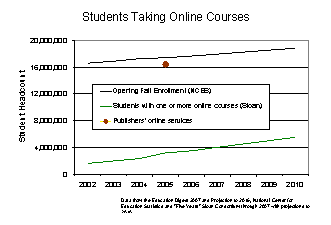 Almost 15 million students work full or part-time; 8.3 million use computers at work. An estimated 4.4 million student employees will receive online training from their employers.
These estimates do not include the several learning and library systems that may be available on the campus. Nor the online tutorial services and learning resources marketed directly to students.
Today’s college students are already in an environment of distributed learning and increasingly they, not their professors, are making decisions about which resources and services they use.
This rich distributed learning environment benefits graduate students who are motivated, demonstrated their ability to learn, and have faculty advisors guiding their learning. The current distributed learning environment may not be best for beginning undergraduate students who are less well prepared, have instructors with large class sizes, and who have less financial resources to purchase access to learning services.
 Vance Fried may change the conversation about the costs of higher education. Critics of higher education have repeatedly pointed out the costs of higher education—often referring to tuition and fees—have increased faster than the Consumer Price Index (CPI). Higher education has claimed education is “labor intensive” and students and their parents pay only a portion of the cost of instruction. All are true.
 Fred Hofstetter was a fact witness in the recent Blackboard Inc. v. Desire2Learn trial. In a break, we had two-hour lunch at the local Red Lobster. Immediately I asked Fred about his development and implementation of learning systems.