Blursdays are back again! Thanks to the good folks at Engageli, we will be permanently migrating to their platform. The format will stick closely to the one we used on the old platform for now, but we hope and expect to become even more collaborative and social as we learn how to make better use of Engageli’s affordances over time.
George Siemens
I can’t think of a better person to kick off with than George Siemens as we blend Blursday Socials with a more purposeful Blursday Barn Raising. George rose to prominence as one of the early EdTech bloggers and co-creator of a style of scaled online teaching that eventually became known as cMOOCs (or “Constructivist MOOCs). In those days, they were just called MOOCs, since George and his Canadian colleagues actually invented the term well before Stanford, MIT, and Harvard latched onto it. But their idea for scaling was quite different from the popular format of MOOCs today. It was fundamentally social and self-organizing.
Fast forward to today, and George is working heavily with technology. You’re more likely to see him at a Society for Learning Analytics Research (SoLAR) event. To me, he embodies the ideal of the empirical educator. He’s deeply committed to the notion of education as a human and social activity while actively embracing the tools that data and computation can provide to support teaching and learning.
Our session will be this Thursday, May 5th, 4 PM – 5:30 PM EST. There is no preregistration; you just show up. Although the platform does allow you to enter without registering, please do register when you log in using GMail, LinkedIn, or your email address. This enables us to know who came and make sure we have you on the list for future events.
Bonus: I know the feature that many of you will miss most from the old platform is the opening music. Luckily, Argos’s very own polymath Eric Hilfer has composed a new theme song for us. Don’t miss its debut!
I’ll be writing a series of long-form, e-Literate-style posts about the thinking behind my company, Argos Education. Since I’m trying to keep e-Literate ecumenical, I’ll be writing these posts on the Argos site. You can read the first of them here.
I’m trying to maintain some separation between my writing on e-Literate and content about Argos (the startup I co-founded with Curtiss Barnes). It won’t be perfect because I write about what I think about and right now I’m thinking about Argos-related stuff a lot. But I’m going to post about Argos-centric topics—the design, the thinking behind the company, etc.—on the new Argos blog. You can read my posts, posts by my colleagues (like the great one by Anita Delahay that’s up now), and news updates.
I have a surprise for you. I can’t share all the details yet, but it’s going to be fun. And Blursdays will be a part of it.
Argos, my new start-up with co-founder Curtiss Barnes and a killer little team, is receiving a major two-year grant working with a university partner to invest in open-source software that will, among other things, help improve OER. And we’re going to crowd-source some of the design and improvement work. I can’t provide all the details yet because we’re still working with the grantor and the partner on finalizing the details for the official announcement. But the basic idea is that we’ll be developing software in the first year that will help us test improvements in OER (among other things) in the second year.
And we want you all to be involved.
So here’s the plan for the three-week reveal:
This week, we’ll review a demo of the Argos vision which some Blursday regulars may have seen, but with an emphasis on the aspects that are important for the project and the bigger picture.
Next week, we’ll show the software as it exists in 1.0 form today—in production for several thousand students!—so you can get an idea of the base we’re working from.
The week after that, we’ll have our big reveal of the grant and talk about how we want to enlist your help. (Fingers crossed that the final bits of paperwork will be signed and press releases approved by then.)
From there, we’ll use some Blursdays as barn raising sessions to get your help in designing the open-source software and organizing OER improvement hackathons. I’ve always intended to bring Blursdays together with the Empirical Educator Project (EEP) and we now finally have the perfect (funded!) project for it.
We will still have Blursday Social events with the familiar format, and the Barn Raising sessions will have a social component too. (Hence, the name.) Fun and impact! Plus, some surprises and special friends are coming.
Please RSVP for our first Blursday Barn Raising this Thursday, March 3rd, from 4 PM to 5:30 PM ET.
It’s been a while since I’ve written much on e-Literate. Sorry about that. I’ve been super busy with my new start-up, Argos Education. I’ll be doing more again soon; here, on the Argos site, on Blursdays, and so on. I thought I’d start today with a warm-up post.
Rebecca Koenig published a piece in EdSurge a few weeks about the potential for Web3 in higher education. Koenig is a decent journalist who gamely tries to tackle a genuinely confusing topic. Something about decentralization and taking the internet back from big corporations (while possibly giving it to other big corporations) and stuff like that.
I don’t claim to have clarity or answers about Web3 yet but I do have two hypotheses:
Blockchain, the technology upon which Web3 is premised, doesn’t add a whole lot to the ability to decentralize education in ways that were not possible before.
In any event, the real challenge with decentralization isn’t the technology. It’s the humans. Blockchain doesn’t really help there in any way that I can see.
What the heck is Web3?
To be completely honest, I don’t know and I’m not convinced anybody else does either.
At the core of it is something called blockchain, which is the technology that underlies cryptocurrencies like Bitcoin. I won’t try to reproduce the many good explanations of the technology that are available elsewhere, but the key benefits are (1) it provides a transparent chain of custody for digital artifacts and (2) that chain of custody is part of what enables the recipient to be confident that they’re getting what they’re told they’re getting and that it hasn’t been tampered with.
Beyond that, there’s a lot of hype about decentralization of…um…everything? A lot of the interest in web3 (and in education, as Koenig covers in her piece), is around something called Decentralized Autonomous Organizations (DAOs). DAOs are often painted as the ultimate culmination of the gig economy in which everybody works for themselves, forming virtual organizations as needed.
No, I’m not sure that I get how blockchain makes that possible either. But we’ll return to the potential usefulness of this theoretical affordance momentarily.
Another idea that gets a lot less attention but may be more useful in EdTech is the notion of “self-sovereign identity,” The basic notion is that you can control your digital identity (or identities) and not have to rely on “log in with Facebook.” Which, hey, I’m all for. The only meaningful Web3 use case that I’ve seen actually implemented in education so far is ASU’s reverse transfer effort, which uses self-sovereign identity. (Again, I won’t get into the details here.)
Whenever a hyped concept like Web3 hits, I try hard not let myself get either too spun up or too turned off by the hype itself. Instead, I try to imagine what the thing could be good for and test out the idea in my mind.
So far, the answer I’ve come up with for Web3 is “ummm…?.” As far as I can tell, Web3 solves the wrong problems for education. I could easily be missing something. It wouldn’t be the first time and it won’t be the last. But none of the ideas I’ve heard so far make much sense.
Coase vs. Conway
If we want to think about humans working together in decentralized ways, it helps to look about both existing theory and existing practice. Let’s start with the theory.
Why do organizations exist? The leading theorist on this question is economist and Nobel laureate Ronald Coase. In two seminal articles—”The Nature of the Firm” and “The Problem of Social Cost”—Coase argued that companies (and other organizations) exist because of transaction costs between actors, including the cost of planning, deciding, changing plans, resolving disputes, and so on. If we could do all the things that organizations do to…um…organize at low enough cost without employees, then there would be no organizations. For example, companies exist when it’s cheaper to create a corporation, hire and pay employees, etc., than it is to coordinate among a bunch of freelancers all working together.
The idea of lowering transaction costs to eliminate command-and-control structures is hardly new. In 1884, Karl Marx’s collaborator Friedrich Engels wrote,
The society which organizes production anew on the basis of free and equal association of the producers will put the whole state machinery where it will then belong—into the museum of antiquities, next to the spinning wheel and the bronze ax.
Friedrich Engels, Origins of Family, Private Property, and the State
And of course, the idea of collectives or communes is considerably older than that. Organizations, after all, are human inventions. Humans existed before formal organizations were invented and humans have continued to collaborate without them in many different situations.
Technology can lower transaction costs and makes new kinds of organization possible. In his 2002 paper “Coase’s Penguin: Linux and The Nature of the Firm,” Yochai Benkler argued that open-source software has been made possible by (1) free digital copying of goods (e.g., source code) and (2) the lowering of coordination costs made possible by electronic communications. More recently, we’ve seen the rise of the gig economy, with gig jobs ranging from Uber drivers to social media influencers, enabled by technology.
The question is, where’s the limit? What sorts of organizations can be broken down by technology-enabled lowering of transaction costs and what sorts can’t? How does that apply to education?
Before we get to some practical answers, it’s worth looking at the other side of the coin from Coase. Far less well known than Coase’s Theorem is Conway’s Law. It’s been expressed differently at different times, but its simplest formulation is this:
Any organization that designs a system (defined broadly) will produce a design whose structure is a copy of the organization’s communication structure.
Melvin Conway, “How Do Committees Invent?”
Conway is a software engineer. He observed that, for example, when an organization had three different departments all working on parts of the same piece of software, the software would end up being developed in three modules. And the quality of the communication among the modules would be similar to the quality of the communication among the three groups.
Note that this is within an organization. Even the transaction costs within an organization are non-zero. Planning is hard. Coordination is hard. Human behavior is hard. Technology can help sometimes but, fundamentally, this is a biological thing. Clever monkeys with blockchain are still just clever monkeys.
So how much can technology facilitate some kind of decentralized education? Also, why is that a goal?
Coase’s graduation gown vs Conway’s learning object repository
To get at the first question, let’s look at the examples from Koenig’s article.
First up is a quote from Vriti Saraf, founder of a startup called k20 Educators:
“Universities are curators of content,” Saraf says. In the past, she explains, in order to get a Harvard education, “I had to go through Harvard; I couldn’t just go straight to a professor.” But in the future, she predicts, “Harvard could still be curating classes of professors, but it’s not Harvard’s intellectual property.”
First of all, this is not very radical. Harvard would still exist. Its certification of a credential’s value would still be the coin of the realm. Freelance professors exist today. They’re called “adjuncts,” and many of them don’t love the version of the gig economy they live in. Of course, at a place like Harvard, they have “visiting professors,” “entrepreneurs in residence,” and so on. That’s a better gig economy to inhabit. In fact, it’s so much better than contracts are often negotiated individually to meet the needs of the in-demand superstars. And Web3 makes this easier…how? There’s a bit in here about intellectual property ownership, but here again, it’s not clear how the tech helps with that change.
Saraf continues with a second idea:
“For a very long time, our credentials have focused on grades and the name of the verifying institute,” Saraf says. “Instead, what if we focused on the output and performance you’re able to gain? If I took a class on robotics, I could put the actual robot [coursework] on the chain, not the grade. People could track the process, and it’s a much better indicator of who I am and what I learned.”
This would be like a portfolio. Except electronic. An electronic portfolio. We could shorten it to ePortfolio. Catchy, right?
I wrote a piece about the confusing nature of ePortfolios as a product category in 2006. That was before companies perfected the technology to scan résumés for keywords, having humans look at even less of what students do rather than more. Most companies I’ve seen that actually look at the work of prospective employees do so in the context of a challenge they set up as part of their interview process. In other words, they want to watch the prospects working at a task the employer has designed to be relevant. With the exceptions of career niches where portfolios were used even when they were analog—e.g., architecture, fine arts, and education—ePortfolios never caught on. The cost of human-evaluating a portfolio is too high for most employers and most jobs. I don’t see how blockchain or Web3 change that.
The next example from the EdSurge article is longer, more complex, and probably not worth analyzing completely. It’s The Crypto, Culture, & Society DAO, which aspires to be “an experiment in building an educational institution directed by learners, not administrators.”
Oh. Like a book club. Or a study group. Or Udemy. Wouldn’t it be awesome if Web3 could make those things possible?
To make the group financially sustainable, the DAO plans to sell NFTs that grant owners access to future courses, plus provide educational services to other DAOs. Some of the non-fungible tokens will be reserved as “scholarship seats” for people underrepresented in the crypto world, Patel says. And for the general public, the group wrote up summaries of its first-semester courses and made them available for free.
They could call these “tuition,” “financial aid,” and “open educational resources.” Imagine a world in which we had those things….
The next example in Koenig’s article is something called EduDAO. I hesitate to critique it because I really don’t understand it. Seems like it could be a way of organizing and funding student study groups. Which would be a good thing. But yet again…I don’t get what Web3 adds here.
Of course, a story about Web3 hype wouldn’t be complete without an example that includes the “metaverse,” a concept that always works out super well in science fiction books and movies. (I’m sure Facebook—er, Meta—will make it even better.)
Imagine a virtual version of New York City, where everything is open 24/7 and geared toward teachers’ needs, desires and crypto-wallets. That’s what Saraf, of k20 Educators, says she’s building. She calls it the Eduverse.
In the Eduverse, teacher avatars will teleport around to digital edtech hubs, where they can learn new technology skills to add to their credential chains. They’ll pop into marketplaces, where they can, say, trade lesson plans they’ve created for tokens. They’ll check out career centers where they can look for new jobs. And they’ll relax in lounges, where they can chat with fellow teachers from other countries.
“The purpose is to create this live, central location where educators around the world can connect with each other,” Saraf says.
So, basically, it’s Teachers Pay Teachers. In Minecraft. With Bitcoin. (Or Ethereum. Or Dogecoin. Or Educoin. I can’t keep up.)
Very serious transitional side question: How the f*ck do these things get funded?
I (hope I) don’t get it
I’m not saying there is no use case for Web3 in education, but I am saying that I haven’t seen one yet and am having trouble imagining what one would look like (other than ASU’s aforementioned reverse credit transfer, which is not really what the Web3 enthusiasts have in mind).
I don’t get the excitement.
Unless I do.
The most obvious (and saddest) explanation is that there are two forces in play here. The first is our primate instinct to travel in groups. Gartner’s hype cycle exists for a reason. People get excited, and then other people get excited because they trust the people who are getting excited. And then still other people get excited because everybody else is getting excited. After which, disappointment, financial failures, and copious amounts of grifting ensue.
Sometimes an “innovation” emerges out of the Trough of Disillusionment and eventually reaches the anticlimactic Plateau of Productivity. (I vacationed there once. It was kind of boring, but I got a lot done.) Other times, the idea drops from the Trough of Disillusionment into the Marianas Trench of Bad Ideas We Shall Never Speak of Again. It’s hard to say which way Web3 will go this early in the hype cycle. We’ve just barely reached “WHEEEEEEE!”
The second force that may be at work is the techno-libertarian mindset of Silicon Valley, which seems to have reached new heights. Never mind that freedom, in this case, may mean freedom to move from our Facebook overlords to our Etherium overlords. This is a kind of Atlas Shrugged crypto-libertarianism (where “crypto” is not meant in the technical sense). It’s a return to “disrupting education.”
I’ll be among the first to admit that our education system is a hot mess. It’s a thousand-year-old system that certainly wasn’t designed and hasn’t really evolved so much as it has accreted over time, layer by layer, with the lower layers never really being changed so much as they have been driven deeper into the invisible foundation.
That said, having just spent the better part of two days trying to figure out the very basics of how to set up a Facebook—sorry, Meta—page for my wife’s forthcoming book, I have a hard time believing that the geniuses whose crowning socio-technological achievements to-date are creating massive stock market volatility and selling cartoons for tens of thousands of dollars are going to replace our current educational system with something better. Somebody is going to have to make a pretty good case to me.
I’m open to listening. Some of the people I’ve talked to about using Web3 in education are really smart folks who I respect and who genuinely care deeply about education. I will continue to hear them out.
It’s just that no specific proposal I’ve heard so far makes sense. I don’t mean that I’m hearing bad ideas. I mean the ideas I’m hearing literally do not make sense to me. I do not understand them. All I hear is “blah blah blah something that already exists or shouldn’t exist blah blah Web3 blah awesome!”
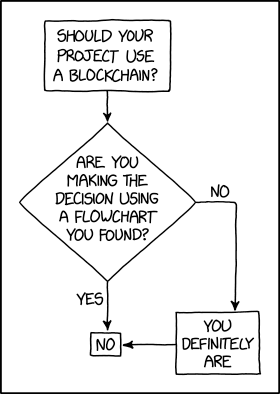
Blockchain from XKCD
Maybe something good will come out of all this that I don’t see coming. For now, I suggest sitting it out and waiting for Web4. Which I hear is going to be awesome and is going to change everything. It will be self-driving, have 5G, and William Shatner will show us how it works live, from space, without having his wig float away.
This week at Georgia Tech’s annual Affordable Degrees at Scale Symposium, the group took some time away from their usual focus on building good programs to write a declaration of principles about the relationships between MOOC (or “at-scale platform”) providers and the universities that they serve. While this effort was triggered by angst among EdX stakeholders, both EdX and Coursera institutions attended. Their end product—The Atlanta Declaration—is worth a read. I was honored to be on a panel that provided feedback on the document, along with Doug Lederman, Phil Hill, and Paul Fain. (By the way, you should check out Paul’s new project, The Job, which is all about the college/work connection.)
I’m going to share some of the feedback that I provided to the group.
My frame of reference
Since some may interpret my advice as provocative or hostile, I will start by stating my priors.
First, I am entirely agnostic about the revenue share models that both 2U and Coursera use. While I believe each university should think carefully about the complex set of trade-offs that come with those agreements, I have no problem with universities deciding those trade-offs are, on balance, good for them. The revenue share model is a tool invented for helping universities with program startup costs. Revenue share companies act as banks. They give loans to universities using the courses they create together as collateral. All the usual caveats about financing something important with debt apply. (The same applies to Income Sharing Agreements (ISAs) for students.) There’s nothing wrong with debt financing if it is taken on for the right reasons and with reasonable terms from the lender.
Second, I have no beef with either of the MOOC companies or their leadership. I know 2U CEO Chip Paucek pretty well. We’ve talked often. I’m convinced he genuinely believes in universities and wants to help them succeed. While I’ve not had the pleasure of meeting Coursera CEO Jeff Maggioncalda, people I trust who know him tell me he is a decent human being. Further, Coursera is a certified Public Benefit Corporation (PBC or B corp), and 2U has promised that its EdX division will also be a PBC. While there is justifiable debate about how effective the accountability mechanisms of PBCs will be, there is no question that gaining and maintaining certification entails considerable work. It demonstrates good intentions. As with the revenue sharing provisions, each university should ask whether its interests align with how a given vendor operates. But I have no opinion about what the answer to that question should be with respect to 2U or Coursera.
Third, I worry a lot about the forces that shape EdTech companies across generations of leadership. For a long time, Instructure was a genuinely great and ethical company. When the original leadership left, it became a pretty lousy company pretty quickly. Now, under the current leadership, it seems…fine. Not great, and not terrible. Just another EdTech company. One short-lived CEO wiped out an enormous amount of goodwill in an astonishingly short period of time. Warren Buffet said, “Invest in companies that any idiot can run because, sooner or later, one will.” I am interested in building ethical EdTech companies that any jerk can run because, sooner or later, one will.
Finally, I believe that declarations of the kind that the Atlanta group made are only useful if they catalyze effective action. So a group of MOOC customers made a declaration. Now what? How will it shape the behavior of the companies they were thinking about when they wrote it? How will it create guardrails for future behavior or drive thought or change inside these organizations? By itself, it won’t. 2U and Coursera both seem good at listening to their university partners. They’ll likely read the document, affirm that they support it, and maybe make a gesture or two to show that they’re sincere. And then they’ll move on. The declaration may be useful to help a coalition begin to form, but that coalition then needs to take further action in order to have an impact. And this, in fact, is what the writers of the declaration hope to accomplish.
My recommendations are aimed squarely at the last two points. I have nothing against either company in their current incarnations. I simply believe we have a moral obligation to be stewards of the future as well as the present.
All 2U and Coursera university partners should become shareholders
I recommend that all universities that work with these two publicly traded companies buy the minimum number of shares required to become voting shareholders. They should appoint stakeholders to represent their interests in a way that balances any revenue goals with mission goals. The representatives from the shareholding universities should meet, discuss concerns, attend every shareholder meeting, and plan collective actions at the shareholder meetings. When necessary, they should make comments or motions.
The goal is to establish a direct line of communication between the university customers and the shareholders, unmediated by senior executives. If customers raise objections or make motions as a group, it will be hard for the shareholders to disregard those concerns. 2U and Coursera may seem big, but they’re nowhere near the top on the spectrum of publicly traded companies. If shareholder activism can force Exxon to change its behavior, then activism can influence any publicly traded EdTech company. Furthermore, PBCs explicitly allow shareholders—and only shareholders—to sue the company for failing to uphold its stated mission goals. I’m not suggesting that such a lawsuit is likely to be necessary, but I am suggesting that this particular feature of a PBC gives university shareholders extra clout.
The reasons universities should buy the minimum number of shares required to vote are twofold. First, I very much doubt that they could buy enough shares to outvote the traditional shareholders. It would be a waste of money to try. Second, if universities do become significant shareholders, then their internal stakeholders who are responsible for endowment funds will become entangled in the decision-making process and dilute the focus on shareholder activism. The power here isn’t in the number of votes. It’s in the number of customer voices.
2U and Coursera should embrace this
I imagine that my friends at 2U and Coursera may not love the idea of university folk showing up at their shareholder meetings. While I think I understand the risks and complications it would entail for them, it could be very good for them in the long run. Universities generally do not know the constraints and pressures that their vendors operate under. As a result, they can get angry about situations that they don’t have the context to fully understand or ask for their needs to be met in unhelpful ways because they don’t know how to work with the grain of the company. Having university stakeholders who feel responsible for understanding how the company functions and the pressures under which it operates could pull them further into the tent.
If this idea gains traction, the best move these companies could make is to create a university liaison within their investor relations office. Actively engage with the stakeholders. Take the opportunity to educate them on how the company works and how more traditional shareholders think. Give them separate briefings that help them formulate input that is useful and helpful. Provide them with opportunities to share their needs with conventional shareholders in ways that give the companies cover to do the right thing.
EdTech companies should have academic values woven into their structure
I’m proposing a method to create greater alignment between the companies and the universities they serve. This isn’t about creating an adversarial relationship. Rather, it’s about creating conditions that reduce the likelihood of an adversarial relationship. It raises the stakes of conflict while creating new channels of communication. When the next CEO takes the helm at one of these companies, she will walk in knowing that her customers speak at her shareholder meetings. She will be motivated to ensure those customers can speak positively about how well she is serving the PBC’s mission goals.
First reminder: Today’s Blursday will be held on Engageli. It’s open to all (as usual). We’ll be talking to Engageli’s VP of Learning and Teaching Andreina Bloom Parisi-Amon about the platform and generally messing around with it.
You can RSVP here:
[mc4wp_form id=”12072″]
Second reminder: As I described in a recent post, we’ll be running our EEP virtual summit next week on Engageli. The dates are Tuesday, 10/19 through Thursday, 10/21 from 11 AM to 3 PM ET. I’m curating the folks who come but there still are some open slots. If you want to come, please email me at [email protected] with the subject line “Request for invitation to EEP summit”.
And the announcement:
The three EEP featured sessions are open to all! Here are the details:
Tuesday, 10/19 at 2 PM ET: We’ll be talking about the big open-source collaboration between Carnegie Mellon’s OLI and ASU’s ETX Center. This project arose out of Carnegie Mellon’s open-source announcement at the 2019 EEP Summit and has evolved from there. (If you’ve been following e-Literate you’ll know that I’ve made a big bet, professionally, on this work.)
Wednesday, 10/20 at 2 PM ET: We’ll have a hands-on active learning session with the aforementioned Andriena Bloom Parisi-Amon and iDesign’s superstar Whitney Kilgore. I don’t think this one will be the same as the 67,000 other virtual active learning workshops you may have attended since the start of COVID. Engageli is going to let us break out of the Zoom box and have fun.
Thursday, 10/21 at 2 PM ET: Daphne Koller is going to chat with me about how we can wrap our heads around machine learning and artificial intelligence as it makes its way toward our classrooms.