e-Literate

Present is Prologue

Author: Michael Feldstein

  • EEP is BACK! Relatedly, Blursday is on Engageli this Week

    EEP is BACK! Relatedly, Blursday is on Engageli this Week

    tl;dr:

    • EEP is back! (It never really went away, but that’s a longer story.)
    • We’re holding a virtual summit from Tuesday, 10/19 to Thursday, 10/21 from 11 AM to 3 PM ET.
    • I’m thrilled to announce that the summit will be powered by Engageli and that our friends at iDesign helped me put the program together.
    • While EEP is all about the participants and not about celebrity talking heads, I would be remiss if I didn’t mention that Daphne Koller will be one of our featured speakers. We’re not going to be chatting about her past and present EdTech startups but rather about how to think about machine learning and artificial intelligence as they make their way into EdTech.
    • For a variety of reasons, including the shot notice, I’m opening up for requested invitations. (It’s still a closed event, but less so than in the past.) Information for invitation requests is at the bottom of this post. Please read the post before requesting an invitation. You are more likely to get accepted if you do.
    • For all my Blursday Social friends, we’re going to do a Blursday Social session this Thursday, 10/14, from 4 PM to 5:30(ish) PM ET. The session will be held on Engageli, featuring my new Engageli friend Andreina Parisi-Amon.

    Because we’re using Engageli for Blursday, RSVP is a little different. Please sign up for this week’s Blursday here:

    [mc4wp_form id=”12072″]

    If you want to know what’s up with EEP and the summit (and maybe want to join), then read on…

    The back story

    For those who haven’t followed the EEP story, the Empirical Educator Project (EEP) is a thing I started a few years ago to spread the ideas that (1) teaching is a craft, (2) expertise in teaching should be part of every college instructor’s professional identity, (3) part of that identity means constantly learning from colleagues, published research, and one’s own methodical classroom explorations of what works for students.

    If you find yourself reading e-Literate regularly, chances are good that you believe in these principles. But a lot of you don’t know each other. Many of you feel like you’re laboring in the dark and that few others believe in or care about these principles. But you’re wrong. I get to meet a lot of you and talk to you about what you’re up to and what you care about. If you had the same privilege as I do, you would see the growing movement that I see. And you would find more colleagues to advance the cause.

    That, in a nutshell, is what EEP is about. It’s to help you find allies. Grow the movement.

    EEP started as an experiment, became something of a club, and was always intended to evolve into something open. In 2018 and 2019, I gathered some hand-picked folks together to have conversations. From a network-building perspective, it was a raging success. People made new friends. Conversations started. Brainstorms happened.

    To give you a flavor, here are a couple of short video compilations we made from just asking open-ended questions to our 2018 participants:

    EEP from the participants’ perspective.

    From the perspective of generating new collaborative projects, as you would expect, it was harder. We’ve had a few successes and a lot of good intentions that haven’t panned out (yet). The biggest raging success is actually the open-source courseware platform collaboration I’ve been writing about and the company I‘ve cofounded that spun out of it.

    During the pandemic, it was hard to get folks to focus on movement-building when they were so heavily burdened with the daily work of managing the crisis. Once I figured that out, I did two things. First, I continued the quiet work of the aforementioned open-source collaboration. And second, I started Blursday Socials, which was a more low-key way of building networks by creating a space for one thing that everybody was missing: relaxed but engaging hang-out time with old work-friends and the opportunity to meet new ones.

    Now that folks are in a position to start thinking about the future again, it’s time to re-engage with a more public-facing and activist version of EEP.

    But like everything else, it needs to evolve for the new world we’re in.

    What’s changed

    So first, face-to-face conferences still aren’t really easy for anyone (assuming you have a travel budget) and, honestly, Blursday Socials have taught me that we both should and can figure out engaging virtual conferences that are just a series of talking heads. EEP always viewed presentations as ways to meet interesting people and provoke conversations. Never as the main event. So we’re reconceiving the EEP summit as a virtual event. I’m thrilled to have Engageli power the summit and iDesign help think through how to translate the EEP lesson plan—which is how I always thought about the summit’s agenda and structure—into an online event.

    Second, this is the first step toward opening up EEP. I started out small and invitation-only because (a) I wanted to understand how to grow a culture before opening it up and (b) I had budget limitations that come with a physical conference that had a $0 registration fee. While we are still invitation-only, I’m opening up EEP to a kind of friends-of-friends network.

    The truth is that my network is too narrow too. Another lesson of Blursday Socials has been that many of you wonderful people who choose to wade through my long blog posts are people that I don’t actually know—but should. And you, in turn, know other people that I should know. So I’m expanding the field of potential participants. I’ll be providing instructions on how to ask to be included below. Within a few days, we’ll also be announcing other ways that people can participate more broadly.

    What’s on the agenda

    We will have three major themes and a fourth aspirational theme this year:

    1. Building EEP back better together: At our last (pre-COVID) summit, Carnegie Mellon University announced it was releasing $100,000,000 worth of grant-funded educational software as open-source. In addition to orienting everybody on the EEP way, we’ll discuss what happened with that software, with a focus on digital curricular materials (a.k.a. “courseware”). In other words, we want to pick up the project that got folks excited at the 2019 summit and move forward. More broadly, we want to start talking about what y’all want EEP to become.
    2. Active learning in a pervasively blended world: We’re not going to ignore the lessons of the past year. Instead, we’ll be talking about lessons learned from remote teaching, what we can learn, and what we have to rethink for the post-pandemic world.
    3. Machines and humans learning together: This is a look-ahead topic. Wouldn’t it be nice to be anticipating a challenge rather than reacting to a crisis? Ready or not artificial intelligence and machine learning are coming to the classroom. We need to start having conversations about both opportunities and hazards. We need policy frameworks, literacy programs for educators, and other efforts. So we’re going to talk about how to get that started.

    The fourth, aspirational theme is diversity, equity, and inclusion (DEI). We’ll have a couple of speakers on this topic but, to be honest, I have a very personal motivation for including this. At the 2019 summit, I announced that I did not meet my own standards for diverse speakers or participants. I vowed to do better. All indications are that I have failed to do so for our 2021 summit. So while DEI is always an important topic, I am specifically interested in having a conversation about how we can increase the diversity among our network of empirical educators. I, personally, need to diversify my network and learn skills for reaching and including a broader range of folks.

    And, as always with EEP, the most important agenda is yours. Come with a project, a need, an idea, an interest…whatever. Look for colleagues. If you find an opportunity to talk to somebody about something important and you want to tune out a session to have that conversation, you will be able to do that. In fact, we encourage it.

    Expectations for participation

    Here are some things to know about the summit:

    • This will not be a virtual “conference” in which you can listen to talking heads on your computer screen while answering emails. You will be at virtual tables with other humans in actual conversation about meaningful things. That’s what we think conferences are for. So please come prepared to be active. We’ll be conducting the summit on Engageli, which I promise you is not like Zoom or Teams. Look, this is a last-minute thing, so I expect that many of you will not be able to clear three half-days from your calendar. But if you don’t come to participate, then you will not get the intended value from the summit.
    • One of our explicit goals is to make sure that you leave the summit feeling like you have met somebody that you should know but didn’t and talked about an important project to you with somebody who might be helpful. As an introvert myself, I can relate to any hesitation you may feel about this. But even with our more open policy, we are still hand picking interesting people for you. I promise that you will meet people you will be happy to have met.
    • We are encouraging delegations to come from institutions. Please do not sit at the same virtual tables—we want you to meet new people—put please do compare notes with your colleagues about your experiences.
    • While we are realistic that folks have day jobs and need to get work done, we strongly encourage you to come for as much of the summit as you can. In particular, the networking sessions are not filler times for catching up on email. They are critical to the value of the event.

    About vendor participation

    Third, there’s the issue of vendor participation. I have always felt, and continue to feel, that participation by vendors is important because they can contribute to and facilitate this cultural change. The old model was that I hand-picked sponsors I thought would be good for EEP and charged them significant fees to cover the costs of the event. But we’re in a new world in several ways. First, my startup—Argos Education—is the new home for EEP. I’m not sure if that’s permanent or if we’ll spin EEP off. But for now, I’m still driving EEP and I’m working at Argos (and enlisting the help of my Argos colleagues). Therefore, Argos is the home of EEP. Since Argos is a company that may be considered competitive by certain potential sponsors, I have to rethink how this will work. Second, given that this is a transition year, I’m not sure what the new value proposition to sponsors would be yet.

    The upshot is that, while I will still be hand-picking some vendors to participate in EEP, sponsorship is not a requirement for participation in the summit. I have a couple of multi-year sponsors with whom I will be speaking to make sure they are treated fairly. Beyond that, if you are an EdTech company that wishes to attend EEP, you’re welcome to apply.

    Be aware, though, that my filter is still pretty strict. Specifically, since EEP is all about active participation in projects and culture development, I’ll want evidence that you’ve been a good contributor to the space in general and have been focused on either supporting educational research or meaningful promoting evidence-based teaching practices in active collaboration with academia.

    And no sales or marketing people are allowed. I’m looking for vendors who can send researchers, developers, product managers, and people in other roles that can contribute to project work.

    How to get an invitation

    If you’re a past participant, you should have already gotten an email. But maybe you didn’t read it, or it got stuck in a spam filter, or I screwed up somehow. Whether you are a veteran or a new person and want to come and participate for a significant portion of the summit, please email me at [email protected]. Please use “EEP summit request for invitation” as your subject line. Write a couple of sentences explaining why you would like to come. If you have a small group of colleagues who would like to come as a group, please let me know who they are and include their email addresses.

    If you are a vendor, please follow the above instructions and also include how your company contributes to a culture of empirical education and the names and roles of the person or people you would like to send.

    We have a limited number of spaces but we still have room as of this writing. And, as I mentioned earlier, we will be including more ways to participate in a follow-up announcement that’s coming soon.
  • Argos: Making Good Course Design Easy and Fun

    Argos: Making Good Course Design Easy and Fun

    I’ve been building the Argos story slowly in this series for two reasons. First, we’re in something like a trough of disillusionment with courseware products. “Trough of disillusionment” is a term from the Gartner Hype Cycle about how innovations are viewed in the marketplace over time:

    I say “something like” the trough of disillusionment because the hype cycle is really about expectations rather than product/market fit. A new product comes out and we get excited because we’re told it will “change everything.” It doesn’t. We get disappointed. We decide we’ve been scammed. Over time, we figure out that, even though the new thing isn’t going to change everything, it’s useful for some things. Once we finally figure out what it’s good for, we talk about it less and use it more. Throughout the whole process, the thing itself often hasn’t changed. Oh, sometimes the start-ups decide pivot, or they die because they can’t outlast the trough. But Stanford-style MOOCs, for example, haven’t changed all that much since 2012. We just know what they’re good for now.

    I don’t think that’s what’s going on with courseware. It feels like a trough of disillusionment. In 2014, Campus Technology wrote about “The Great Adaptive Learning Experiment.” (One sign that the market is mixed up is that we can’t seem to settle on terminology. Are we talking about adaptive learning, personalized learning, or courseware? What’s the difference?) Since then, we’ve seen a handful of these “personalized learning” companies—e.g., Knewton, Acrobatiq, and Smart Sparrow—sold off for a low price and largely fade into the companies that bought them. CogBooks was the latest to be sold off to Cambridge University Press. While this may be a decent deal for CogBooks—the financials have not been disclosed—I doubt it will be read as a sign that this product category is changing the world. The big textbook publishers have done OK with courseware but not well enough to halt their continuing shrinkage as businesses.

    There’s a general sense of disappointment and malaise with the product category. I’m arguing that this is not a genuine trough of disillusionment but a failure of product/market fit. This is actually much more common in EdTech product categories. Think of retention early-warning analytics, ePortfolios, and learning object repositories, among many others. They all got hyped, disappointed the market, and then got stuck. The problem wasn’t that the market misunderstood the product but rather that the product makers misunderstood the market.

    My colleagues and I believe that the same thing has happened with courseware. The market has gotten stuck on an idea of the value that doesn’t actually appeal to the people who have to adopt and use it. There was some progress when publishers realized that students like low-stakes practice. Before EdTech, many students voluntarily created flashcards for themselves. When publishers realized that students were increasingly refusing to buy the expensive curricular products that their professors were prescribing, they became more “learner-centric,” by which they meant that they thought of students as the buyers. So they built in features that students would like. Low-stakes practice. That helped some. But then they got stuck again.

    Low-stakes practice could give instructors more information about how their students are doing. It could change the way those instructors teach. But so far, it mostly hasn’t. Which means that instructors don’t see value in prescribing courseware over alternative formats, like simple ebooks. The “market” for textbooks is both students who buy the product and instructors who prescribe it. Both use the product in some important sense. But on the instructor side, the paradigm has largely been stuck in the bound book format. It’s immutable. It’s a thing they adopt and then teach around.

    In contrast to the publishers, stand-alone course platform providers went in the complete opposite direction. They gave instructors a blank page. In their later stages before their acquisition, these vendors invariably—invariably—began developing or acquiring catalogs of titles so that instructors wouldn’t have to start from scratch. That tells us something about product/market fit. But the platform vendors also differed from the publishers in that they were selling their platforms first to institutions as enterprise software licenses. Those institutions then typically engaged in top-down efforts to get faculty to adopt the platform and develop content. In this conception, the product has three kinds of customers—the institution paying the license fee, the instructor adopting (or creating) the curricular product on the platform, and the students who are using (and possibly paying for) that curricular product.

    It doesn’t work.

    The joy and magic of product/market fit

    Way back in the first sentence of this post, I said there were two reasons why I’ve been building this story slowly. The second reason is that I take joy in writing this way. It’s a teacher thing. I want to make you care about things that you don’t think you care about. I want to make you spend time thinking about topics that you never thought you’d spend time on.

    You think you wouldn’t spend time reading a long piece on how fMRI machines work, the mathematics behind certain kinds of machine learning, and how these pieces come together in a methodological paper in cognitive psychology? You think there’s no way you would read a seven-thousand-word article on how Pearson is using HR policies to foster efficacy in its organization (which, by the way, was published on New Year’s Day)?

    Heh. Let’s put that to the test. I bet I can make you care. And I’ll spend days or even weeks researching and crafting a blog post to prove it.

    Again, it’s a teacher thing. I have an urge. I will go to irrational lengths to fulfill that urge. But not infinite lengths. If I had to write these blog posts using Dreamweaver in raw HTML, I never would have gotten started blogging. I needed WordPress to lower certain barriers for me so that the urge could take over. Remember “web 2.0”? This is web 2.0. When I started blogging, I never imagined I would still be doing it 16 years later, or that literally almost everyone who has access to the internet is creating and sharing personal content over some platform, whether it’s Facebook, TikTok, Twitter, LinkedIn, YouTube…the list goes on and on.

    Great product design works that way. I have spent a lifetime failing to get myself to exercise regularly. No product and no subscription I tried could crack that nut. Until I bought an Apple Watch and subscribed to Apple Fitness+. Now I do 30-minute yoga sessions at least three times a week. In good weeks, I’ll add a couple of core workouts and high-intensity interval training (HIIT) sessions.

    And then there’s the kayaking. I wrote a post on product/market fit that included a description of origami kayaks that my wife and I use. We had a canoe a while back but it was too heavy and too hard to get on and off the car. Now we go kayaking. And, interestingly, I received a handful of notes from people who read my post and decided to buy themselves the same kayaks.

    Oru Kayak

    I always wanted to exercise regularly. Logistical and psychological barriers prevented me from doing so. It would have been easy to conclude from a distance that people like me don’t want to exercise. I did hate exercising, but I wanted to exercise. I wanted to not hate it. My Apple Watch and Oru Kayak enabled me to find ways of exercising that I didn’t hate. As a result, my lifelong behavioral patterns changed pretty dramatically.

    One of the best examples for the story of courseware is Wikipedia. When it came out, most people thought it was nuts. The big thing in encyclopedias at the time was Microsoft Encarta, which was supposed to be a multimedia, interactive Encyclopedia Britannica killer. The idea that a bunch of randos on the internet would write a credible encyclopedia was literally a joke. Stephen Colbert encouraged his viewers to write absurd details into Wikipedia articles. Random people could never write a comprehensive encyclopedia with no formal coordination and no financial incentive. And even if they did, nobody would trust it.

    Until, in 2009, The New York Times ran the headline, “Microsoft Encarta Dies After Long Battle with Wikipedia.”

    Today, when you search on Google the top-right corner of your results page will often have information summarized from and linked to Wikipedia. I don’t know about you, but I click on that link fairly often. And I generally don’t think about whether I can trust the article it takes me to. As I write this sentence, random people on the internet are fact-checking and updating articles on Wikipedia. I’m not one of them. I’m mostly just a consumer. Most of you probably are too. And that’s fine. It works.

    I started a Wikipedia page once because it was related to a particular EdTech topic that I was passionate about. I only wrote a couple of lines; it wasn’t much more than a stub for the topic. A bunch of other people each contributed a bit to the entry. I haven’t looked at it in years but others continued to contribute and update it This is the page today, complete with 148 footnotes. As I write this, the most recent update to the article was yesterday.

    We forget about Wikipedia because now we’re thinking about Facebook, which is designed to facilitate the opposite kind of behavior. Humans are malleable and adaptable. But you have to understand their drivers if you want to fulfill their needs, particularly if doing so entails a change in their behavior.

    My colleagues and I believe that the courseware product category is in a rut because the market has fundamentally misunderstood both how educators use curricular materials and how they would use them if only certain barriers were lowered for them.

    Upcycling curriculum

    In the first posts of this series, I wrote about how educators think about and use curricular materials in their course design. In this last section of this blog post, I’m going to start telling a story of how that can work using some mock-ups that we’re user testing. The goal here is to give some examples of how upcycling can work.

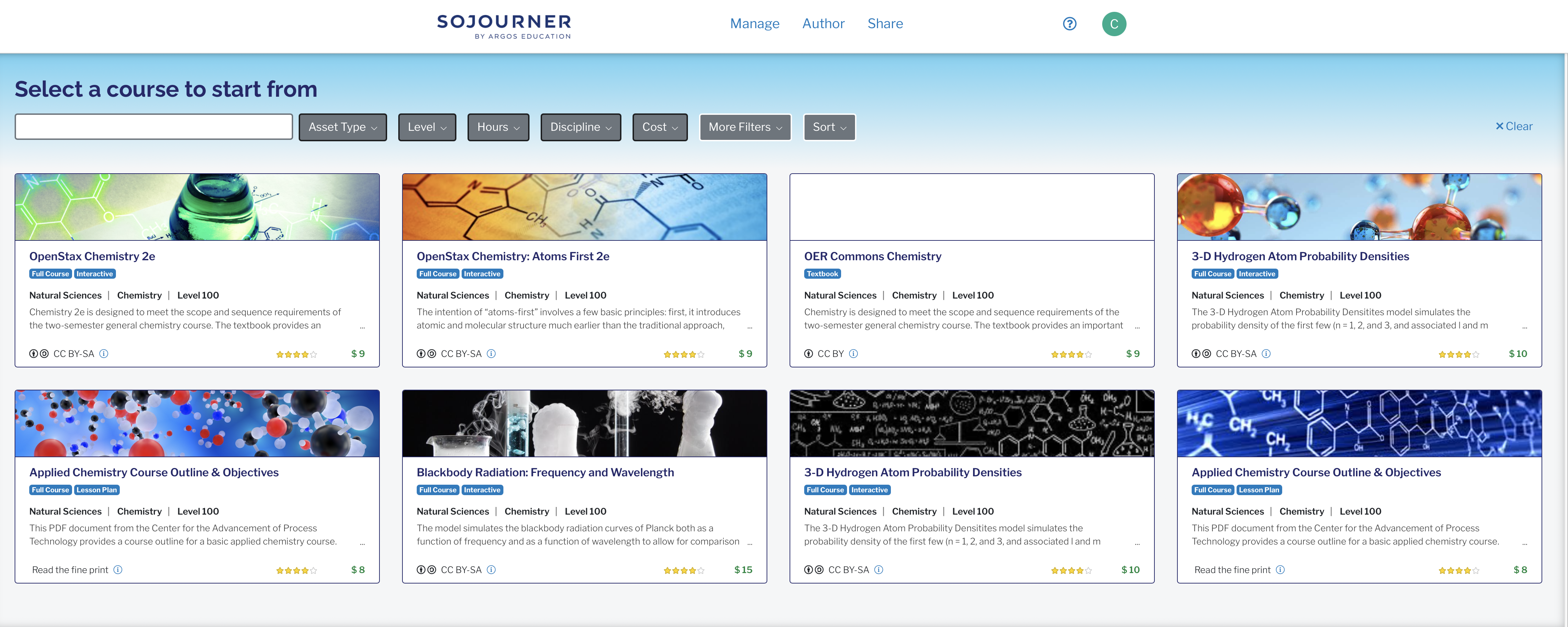
    Let’s say you’re selecting a textbook for your Chemistry for Non-Majors course. Your goal isn’t really to pick textbook. It’s to design your course. You go into the store that has all the products that run on Argos Education’s Sojourner platform. You have some good choices. You could pick Carnegie Mellon OLI’s General Chemistry course, which has a mastery learning approach and has been carefully engineered for efficacy. You could teach with ASU Inspark Network’s Critical Chemistry, a heavily experiential learning-based product for non-majors that is thematically organized around how chemistry is used to save lives. But in your case, your college puts a strong emphasis on affordability. That’s a major priority. So you search the catalog particularly for inexpensive options:

    You’re still focused on getting through the curricular materials selection process so you can get to the course design process. You review the options and pick your title.

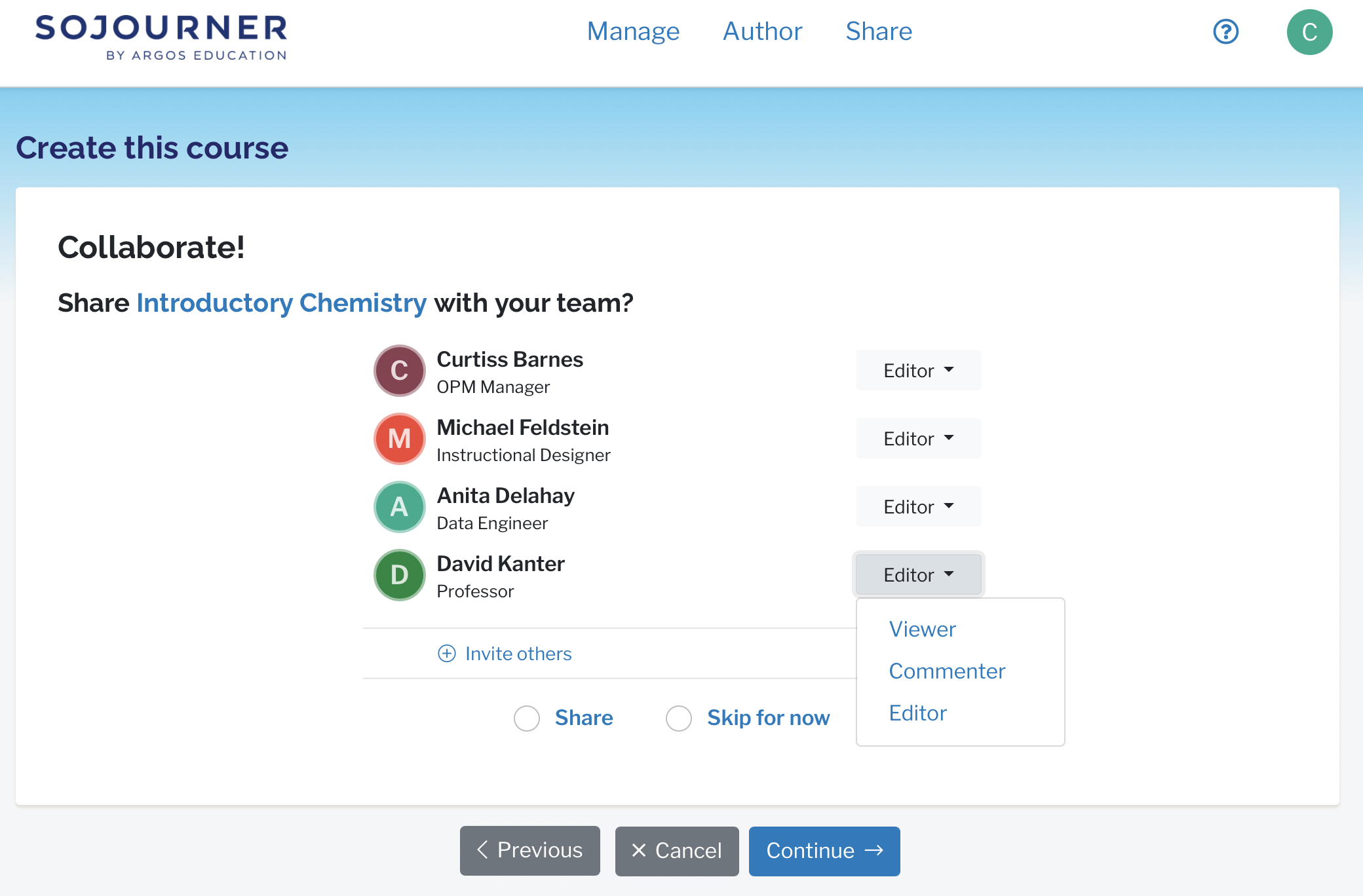
    Now you have a choice. Are you working on your own? Are you leading a departmental adoption process? Maybe working with a learning designer or an OPM to create an online course? Maybe you want collaborators involved:

    You have options based on your use case. And not everybody gets to edit. For example, maybe as a department, you want to have all instructors be able to see what you’re working on, some who are able to comment, and just a couple who are able to actually make changes. On the other hand, if you’re just making the selection yourself, you can skip over all this. Or you can invite your institution’s faculty support person or a colleague in to give you some suggestions.

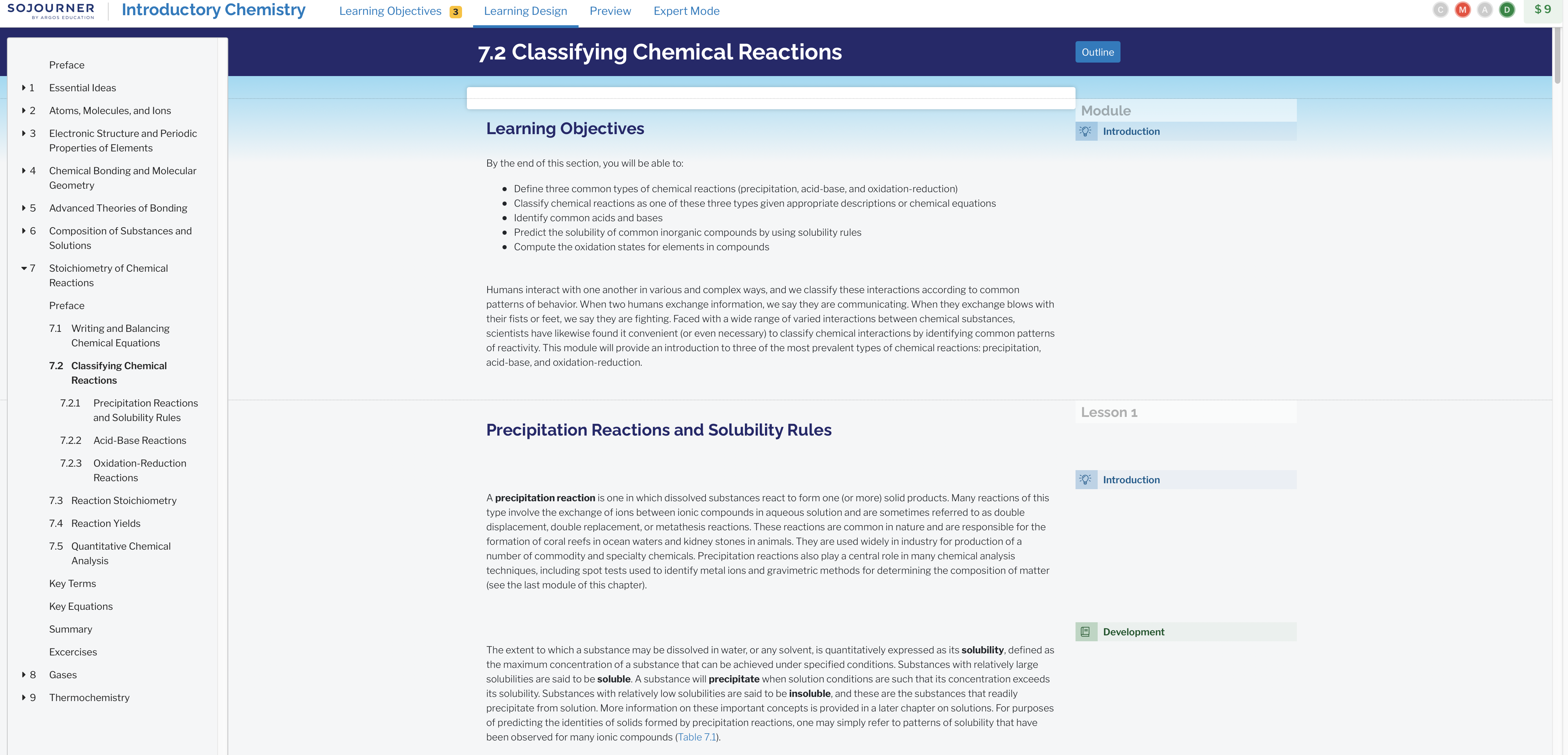
    But you’re still in adoption mode. You’re getting to know the text so that you can design your course. You’ve picked an unmodified OpenStax title, so it’s going to start off looking a lot like the free PDF version:

    Notice the little notes on the right-hand side. We’ve applied a little machine learning and a little learning design research to make the pedagogical structure of the text more visible to you. If you mouse over the little item, you can see more detail:

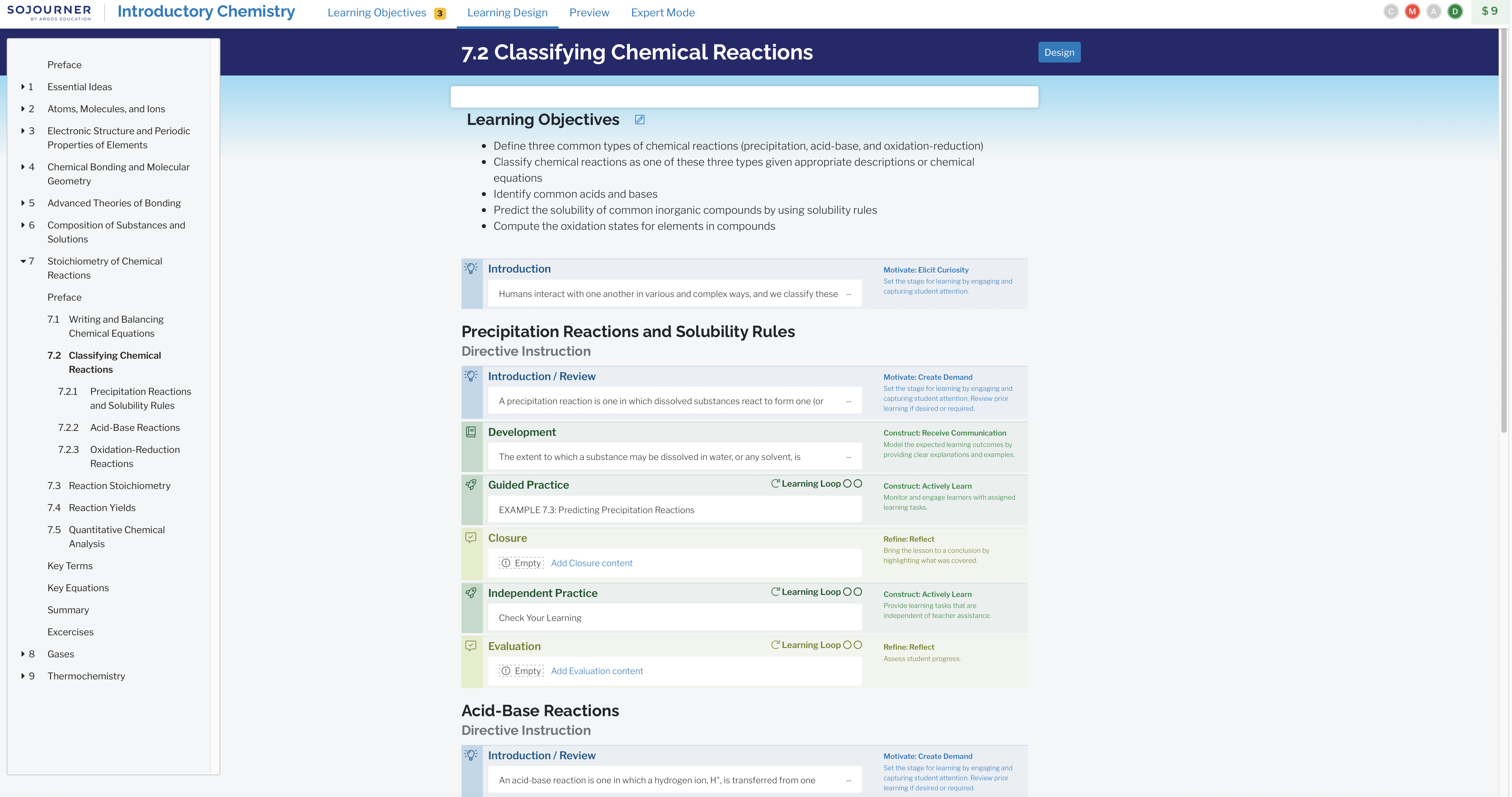
    Ah. This is interesting. You get this. It’s a bit like how you think about putting together your lectures. Maybe you want to switch to outline mode so you can see the overall structure of how this thing is put together:

    You’ve collapsed the text so that you can focus more on those little post-it notes and see the structure. It’s pretty much like a lecture. (It’s labeled “directive instruction” for a reason.) You introduce the concept to help students understand why the topic is important to the course, you provide them with some information, maybe you work a problem out for them—if you were doing this in class, you might work that problem out on a whiteboard—you…

    Oh. Hmm. Usually you wrap up the lecture with a summary. This text doesn’t do that. You could fix that, but honestly, you’re not too worried about it.

    The OpenStax text also doesn’t give an end-of-chapter test at the end. The truth is that you’d want to pull together some questions from a test bank anyway. So you’ll worry about that later too.

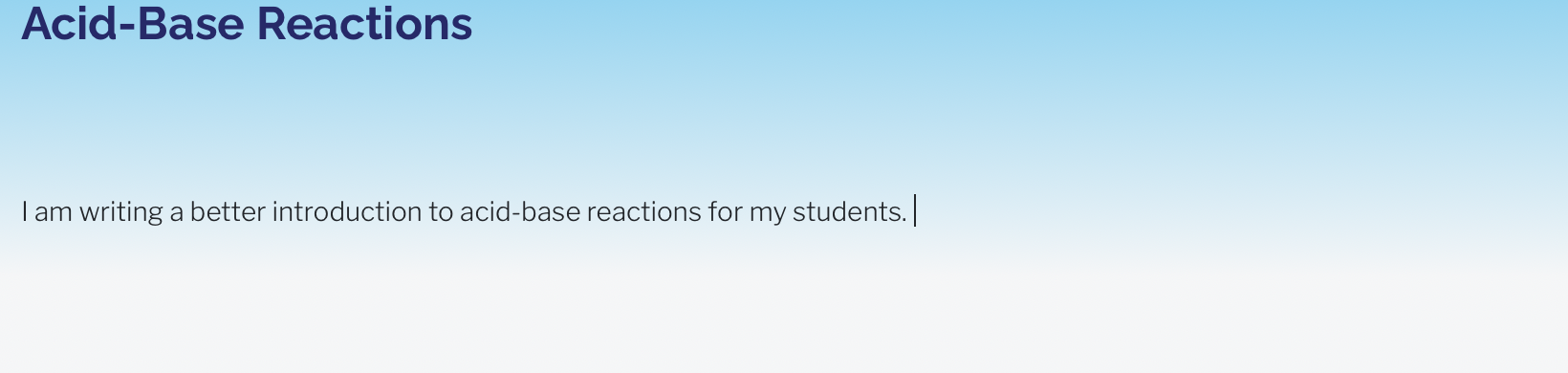
    You dive back into Design mode to review the text. You want to give it a close reading now as you think through the design of your classes. And you find another unpleasant discovery. The section on acid-base reactions is just not right for your class. The language is a bit garbled and probably unnecessarily complex for your students.

    This is the point when you would normally write the following in your syllabus:

    When you get to Section 7.2.2 on acid-base reactions, do not read it. Instead, please go to this folder in Canvas and read the document called “Acid-Base Reactions.” Follow the link at the bottom of the page and take the quiz there. Then read the rest of Section 7.”

    Which is not ideal for anyone. For you, you’re writing documents and organizing folders and diving into LMS quizzing tools and then trying to knit together what the students are doing in the LMS with what they’re doing in the courseware. For the students, they’re jumping through hoops.

    But instructors do it all the time. Locking down the courseware might create enough friction that they will do it less often than they might otherwise. But many of them will do it. It’s a bad experience for everyone. And there’s no way for anyone to tell if the net result is better or worse for the student because the activity is happening in different systems that don’t really talk to each other. But as a dedicated instructor, you will do it if you think it will help the students.

    Or, if you’re in a platform that allows you to edit the curricular materials, you could just do this:

    This is better for everyone. Students don’t have to jump through hoops. Instructors spend much less time setting up the content. And now that all the information is in one system, it’s possible to track whether these changes actually help students. That last piece is another topic for another blog post, but it’s incredibly important. If we want to create a virtuous cycle, we want to share changes, test which ones improve learning in which contexts, and generally create positive evolutionary pressure.

    Finding teachable moments in the course design process

    This idea of pulling editing “inside the tent” is central to understanding product/market fit and the levers available to change behaviors. As an instructor, you are mostly not trying write or rewrite textbooks. That’s not you think about what you’re doing, in part because the textbook is the raw material for their course design. It’s not a thing you care about in and of itself.

    We want to catch you in those moments when you’re thinking about their course design and pull you into a kind of dialog as you use the raw materials to build that course.

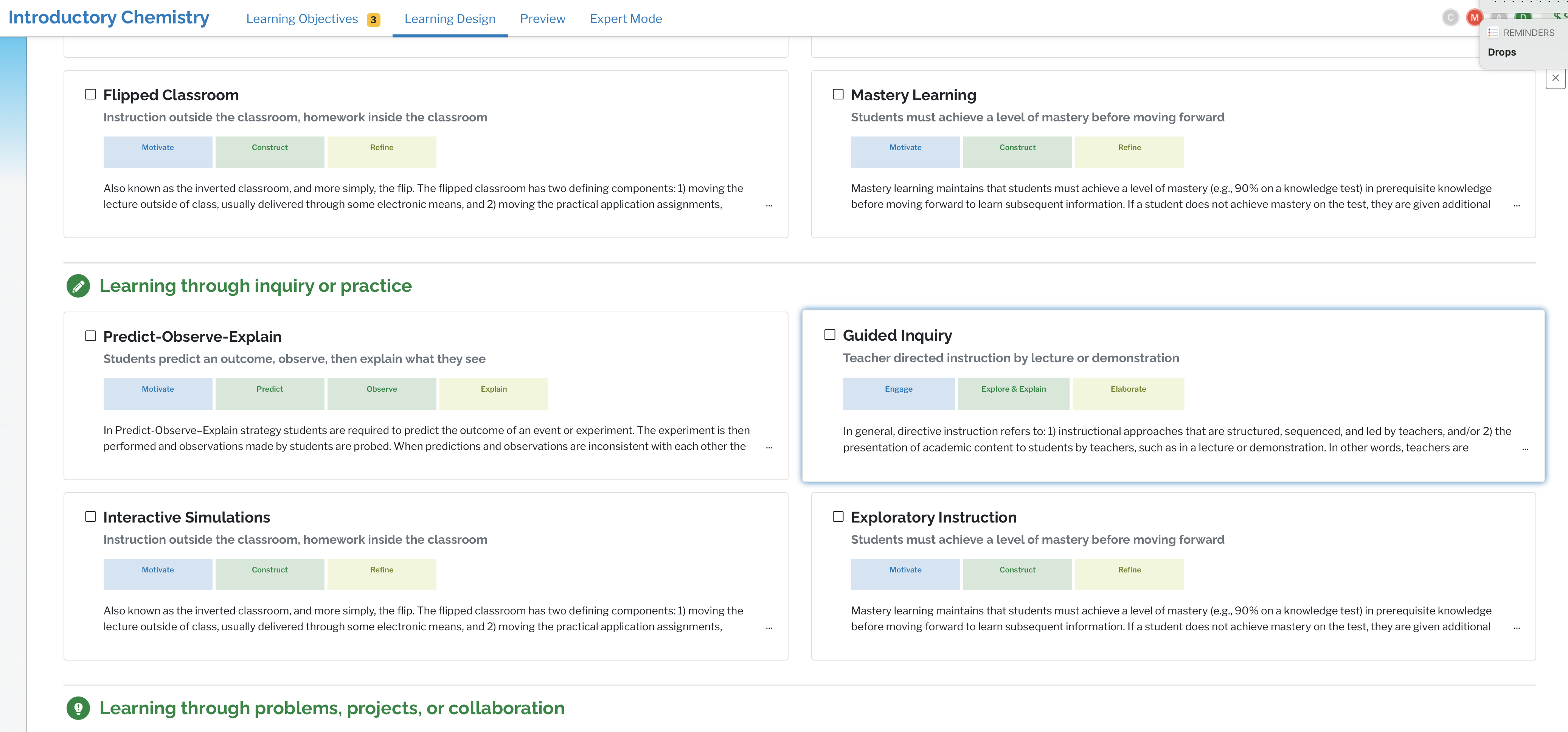
    And we’re always making choices about what we want to ask you to think about and what we want to get out of your way. If you want to add a virtual lab, maybe we give you the option of some scaffolding to help you think through all the steps you want students to go through:

    When you pick their actual virtual lab, maybe we don’t bother you by calling attention to the learning objectives but we do show you a selection of labs that are tagged with the learning objectives associated with the content section you are working on:

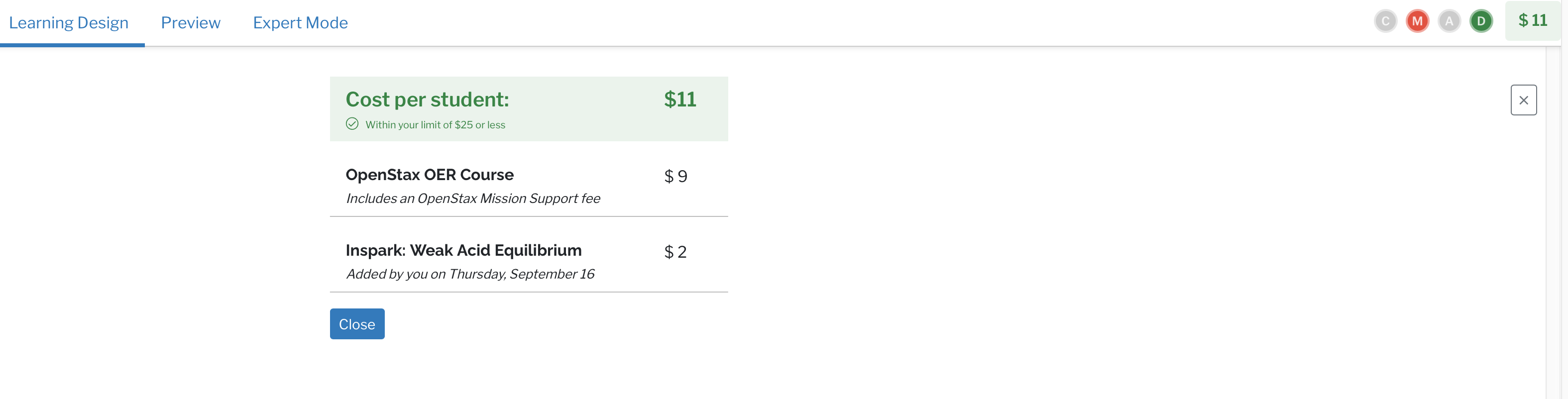
    When you choose the lab, we let you see the cost change and, if you have set a cost cap, we warn you when you go over. We even give you a breakdown of what you’re asking the students to pay for:

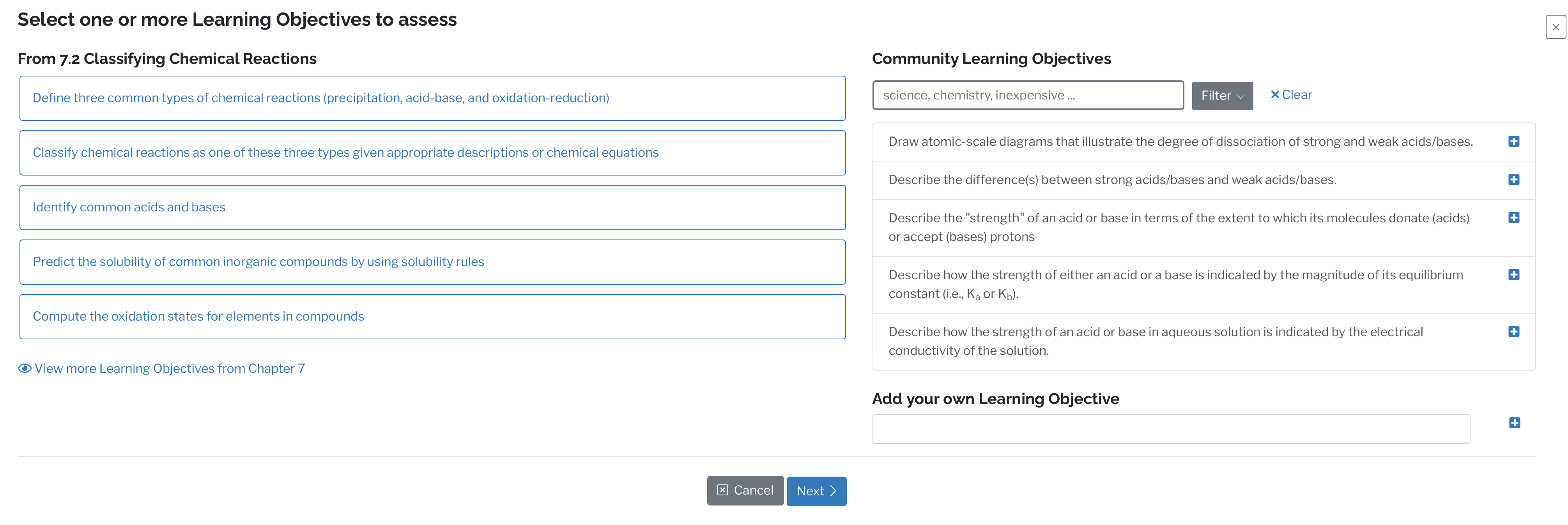
    We don’t always want to hide learning objectives from you. Rather, we pick the moment when learning objectives are most useful to think about, like when you’re picking out assessment questions:

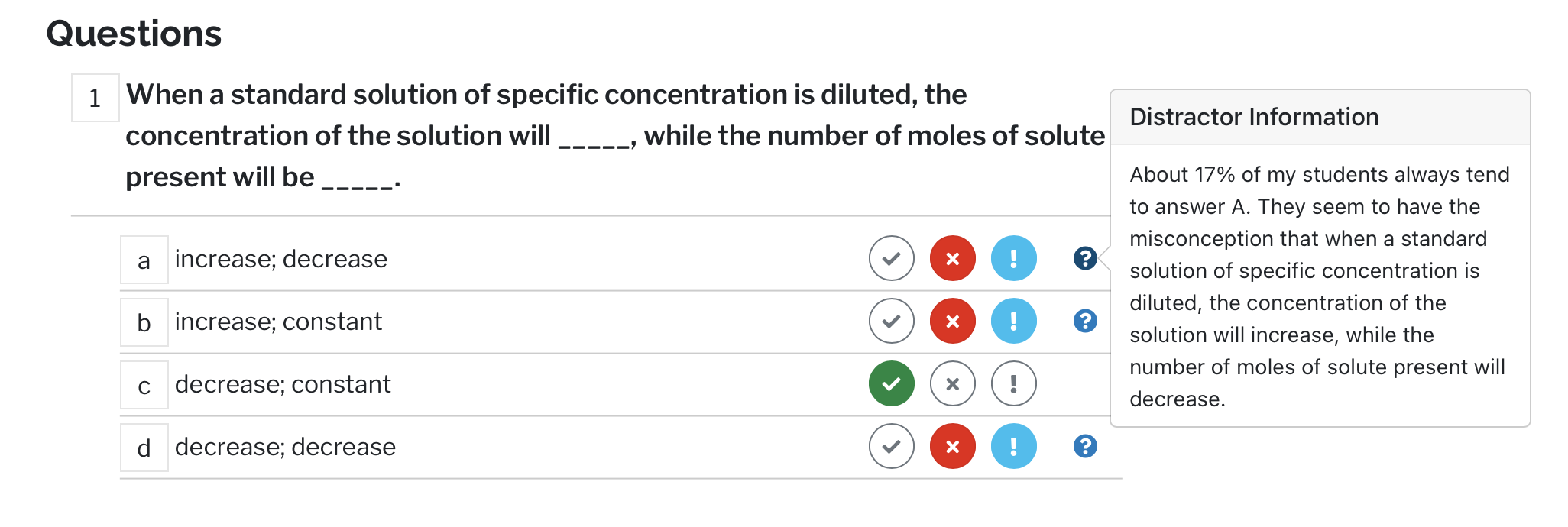
    Notice that the platform introducing a bit of implicit community here. Other instructors are also designing courses around the same curricular product that you are. Maybe they have some good ideas that they’re willing to share.

    And the real value of the sharing is not just the content but the rationale behind the course design. Why did the author write a particular answer in a particular way?

    I could go on, but hopefully the theme is clear.

    Professionally designed courseware has a lot of useful information either explicitly or implicitly built into it. We hide that design information from the instructors and then lock the product down. In doing so, we turn it into a static artifact that they have to work around. However the publisher might conceive of the product’s value is irrelevant if instructors are using it as raw materials for their course designs.

    But if you start from that assumption, let them do what they’re going to do anyway in an environment where you can scaffold, collaborate, and provide feedback on the results of their designs, you can engage them in a much deeper way while saving them time and giving them more control over the things they care about. Also, we no longer have to separate conversations about course design from conversations about effective teaching practices. The fact that we do so now is a strong indicator that something is broken in our ecosystem. Course design and in-the-moment teaching are a continuous cycle. The two are constantly in dialog with each other. That’s the way teachers actually teach in the real world. Lesson plans change. You adjust. You improvise. Much of this is not arbitrary but rather driven by your encounters with your students.

    If we want courseware to grow in adoption and educational impact (and perhaps as a useful and self-sustaining industry), we have to get away from the book. That doesn’t just mean getting away from linear, non-interactive designs. More importantly, it means getting away from the textbook as a static artifact that educators teach around.

    By the way, today’s Blursday Social (9/16 at 4 PM ET) will be a chat about Argos. So you can come to that if you’re curious. Sign up here.

  • Chegg vs. Pearson: Are back-of-chapter answers intellectual property?

    Chegg vs. Pearson: Are back-of-chapter answers intellectual property?

    We interrupt our regularly scheduled post series on Argos Education for this breaking news…

    No, I’m not talking about the news that Blackboard was acquired by some ERPish rollup creation of a private equity company. I searched my soul to examine my deepest thoughts and feelings on that topic. Here’s what I came up with:

    • I’m happy that Bill Ballhaus finally got paroled. While he and I clashed once or twice, he seems like basically a nice guy. He didn’t deserve to be stuck trying to unload that company for five years.
    • I’m both happy and worried for the nice people who work at Blackboard. I hope this means that most of them will still have jobs.
    • I have similar feelings about Blackboard customers. I hope this works out for them.
    • I am deeply grateful that Phil Hill exists so that I don’t have to spend my time trying to make sense of this deal.

    That’s it. That’s all I’ve got. My therapist tells me this is good progress in recovering from the formative trauma that turned me into the blogger that I am today.

    No, I’m talking about Pearson suing Chegg for copyright infringement because Chegg has reconstructed Pearson’s back-of-chapter homework answers:

    Specifically, the suit revolves around Chegg Study, a subscription service that among its offerings features answers to end-of-chapter homework questions from various texts for $14.95 a month, with the textbook questions often copied nearly verbatim or with just slight changes, the suit alleges. Pearson lawyers told the court that “the majority” of Chegg’s roughly $644 million in total revenue in 2020 came from its sales of answers through Chegg Study, which reportedly counted some 6.6 million subscribers as of 2020.

    Pearson Education Sues Chegg, Alleging ‘Massive’ Copyright Infringement

    You may recall my post responding to the Forbes article about them, which was entitled “This $12 Billion Company Is Getting Rich Off Students Cheating Their Way Through Covid.” The main piece of new information I added was that most of the large publishers themselves had licensed these answers to Chegg a while back. Those contracts have expired. And now we have at least a hint of how much Pearson thinks their contract with Chegg may have cost them. While the numbers here don’t translate directly into Pearson losses, they do give us an order-of-magnitude sense of the amount of business here.

    More immediately interesting to me, though, is this paragraph from the complaint:

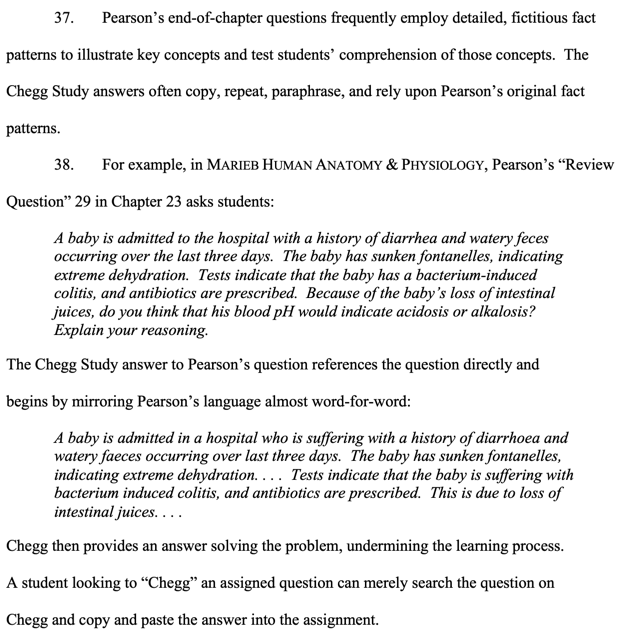
    As part of Pearson’s focus on pedagogy, Pearson and its authors devote
    significant creative effort to develop effective, imaginative, and engaging questions to include in the textbooks it publishes. Pearson’s end-of-chapter questions are strategically designed and carefully calibrated to reinforce key concepts taught in the textbooks, test students’ comprehension of these issues, enhance students’ problem-solving skills, and, ultimately, improve students’ understanding of the subject matter. Pearson’s textbooks can contain hundreds or thousands of end-of-chapter questions. These end-of-chapter questions form core components of the teaching materials contained in Pearson textbooks and are frequently hallmarks of Pearson titles. As such, the availability, quality, and utility of these questions are often important considerations when educators select which textbooks to adopt for their courses.

    Pearson v. Chegg complaint

    While the lawsuit doesn’t interest me, the core issue about the value of assessment question construction does. At first blush, it’s tempting to think that the answer to “Solve for x: x2 + 3x +9 = 0″ could not possibly be intellectual property. But, as Pearson’s complaint states further down,

    One of the points of my original post was that companies like Chegg exist in part because instructor grading policies put students in a position between wanting to learn and needing to pass. While that tension is unavoidable in some cases, it is largely avoidable in many cases. We simply haven’t taught instructors about productive ways to grade formative assessments (or even what formative assessments are).

    But the lawsuit brings up a separate and equally important angle. When we step back from the deforming effect of grading and simply look at the assessments themselves, we see teaching craft. Both the construction and the order of well-written questions are designed to probe the finer points of students’ understanding. And in some cases, it teaches those finer points. When students are asked to solve a problem that has one new twist from the previous one, sometimes they learn just by figuring out that twist in the moment.

    Pearson is arguing in their complaint that substantial teaching craft is built into their question construction. It has a financial value to the company because it’s part of the value proposition of their product. Setting aside the legal question of whether recreating homework answers constitutes copyright infringement under current US law, I agree with Pearson about the value. I also think that the publishers should not have a de facto monopoly on the craft that creates that value.

    Sometimes the questions don’t work as intended. It could be a flaw in the question construction, like an obvious correct answer or, conversely, confusing wording that trips up some students who understand the concept, causing them to give an answer that is considered “incorrect.” Or the sequencing could be off. If the order of questions can be carefully crafted for pedagogical reasons, then anti-cheating functions like question randomization or algorithmically generated questions can take away that tool. And sometimes the question may be written in a way that requires cultural or other context that not all students have in order to understand them. (IQ and other standardized tests were particularly notorious for their cultural biases in their early decades.)

    For a variety of reasons, good educators will tweak and invent assessment questions to fit the needs of the students in front of them. And yet, how many assessment EdTech tools can you think of that do a good job of helping instructors learn and share craft in this regard? It’s quite easy to break a good, psychometrically validated assessment design unintentionally by adding problems that are easier or harder than the instructor thinks they are, for example. On an even more basic level, nobody ever taught me how to write a good distractor or even what that term meant. I had to pick that craft up on my own, first by instinct and later by reading and by asking experts. (I am lucky enough to have had access to such experts.)

    There has to be a balance. On one hand, instructors should be taught how to recognize and analyze the embodied craft of the assessment questions that they use as part of a curricular product. On the other hand, we should not assume that those assessments are perfectly designed or even that there is any such thing as a single perfectly designed assessment for all teaching contexts in which a curricular product may be used.

    Instructors will very often use a mix of pre-made assessment questions and their own. And if they don’t have one tool that lets them do both, then they will mix bits of assessments from different tools with very little way to integrate the information usefully. No product I know of is currently doing a good job of helping instructors think through how to mix and match well. Even dedicated publisher homework platforms like Pearson Mastering or MHE ALEKS, which are theoretically intended for supporting exactly this use case, struggle to strike a balance between the features where the platform is making design- and data-driven decisions and the features where the instructors can insert their own problems. Product designers tend to think of the former as their real mission and the latter as something they have to accommodate because some instructors demand a measure of control.

    This is a market failure. Some of the consequences are as follows:

    • Instructors don’t make full and appropriate use of advanced curricular products.
    • Instructors often have no way, either functionally in the product or intellectually with the skills they have been taught, to appropriately modify a crafted assessment to make it better rather than worse.
    • There are not tools that enable instructors to look across their entire collection of assessments and easily evaluate how the pieces are working together.
    • There are no clear and easy means for instructors to collaborate with the designers of their curricular products, other adopters of the product who are master teachers, or even their campus faculty support staff, to help them upcycle the curricular product into a course design that is as good as or better than what they’re starting with.

    One way to look at copyrighted material is as embodied craft. We have gotten hung up on the idea that the particular embodiment is the locus of educational value. Hence, the lawsuit. Instead, we should really be working on how we can enable and encourage career educators to become expert practitioners and empower them with tools that enable them to practice their craft with more skill and precision. While they shouldn’t have to craft everything from scratch, neither should they be forced to live in a world where there’s a hard and opaque wall between the course design components that they are upcycling and the ones that they are crafting themselves.

  • Argos: Upcycling Course Design

    In my first post in this series, I wrote about what good teaching is. While the argument was wrapped in a lot of autobiography, it makes a number of assertions that are foundational to the mission of Argos:

    • The best evidence we have suggests that teachers change lives, by I we mean that students who have had good teachers will make more money, be physically and mentally healthier, and have more fulfilling relationships over the entire course of their lives.
    • Good teaching combines the emotional and the intellectual. In particular, teaching the diverse group of students that can be found in almost any classroom effectively requires diagnostic skill and creativity.
    • The intellectual aspect of good teaching is largely invisible to our society, including even many proponents and practitioners of education. The average person may sense it from time to time but, as a rule, we don’t talk about how it works and don’t think about it as an aquired skill set (nevermind a discipline that evolves over time).
    • As a result, there are social barriers to educators sharing craft with each other on top of the barriers created by the employment conditions in higher education.

    One result is a poor understanding of the textbook’s role and product/market fit. In turn, this has contributed to several decades of slow, painful, and often unproductive efforts to creating a vision for a digitally transformed version of the product. We can’t see what we can’t see. As Henry Ford put it, “If I had asked customers what they wanted, they would have told me a faster horse.”

    The primary purpose a textbook serves is to enable an instructor to upcycle the author’s course design. They adopt and adapt that design to fit their local needs and context rather than spending enormous amounts of time writing all the course elements from scratch. In the Industrial Age, where editing, typesetting, printing, distributing, and selling paper books were all labor-intensive and specialized tasks, it made sense to have one author, one editor, and one distributor to produce an artifact that each instructor would then independently upcycle. In the digital world, we can continuously upcycle course design by crowdsourcing improvement, both directly through collaboration and indirectly through shared data.

    That’s an essential part of what Argos Education does. We enable a virtuous cycle where educators can continuously upcycle their course designs with their peers. This enables them to teach more effectively with less work. It also creates a positive evolutionary pressure on their course design and delivery. While educators are still free to exercise their judgment in their respective classrooms, they will do so knowing how their peers are upcycling the same basic course design as well as how well various aspects of the course design are working based on analytics. In other words, they will have peer and expert feedback and suggestions that they don’t have now.

    How paper textbooks work

    What is an educator doing when she selects a textbook? What is she looking for? What are her criteria? On a micro level, then answers vary dramatically from one educator to the next. One is looking for good back-of-chapter questions. Another is looking for readings that will be engaging and accessible to her students. Or a particular angle on the curriculum. Or a particular teaching method.

    On a macro level, all of these fall into the larger bucket of looking for pieces of course design to upcycle. The specifics of what professors look for can be heavily inflected by a variety of factors. For highly procedural subjects like math, many educators will focus on the progression of scaffolded and unscaffolded problems. In economics, it could be philosophical/political. Conservative economists may like Greg Mankiw’s explanation of inflation while progressive economists may prefer Paul Krugman’s. A biology professor may choose a text that emphasizes an ecological lens to the topic over a microbiological one for several reasons. Maybe her university is known for its environmental studies programs but not for its pre-med programs. Or maybe she herself feels better equipped to teach the subject well from one angle rather than the other.

    These differences can be neutral with respect to some imagined ideal of an “effective” class. How much does it really matter if a first-year biology student learns a little more ecology and a little less microbiology? Or the other way around? In those early courses, we mainly want to help the students develop their interest in the subject, some general knowledge, and some discipline-related thinking skills.

    But in context, the differences can be dramatic. Teaching biology 101 from a microbiology perspective to a student who is trying to decide whether she wants to pursue a major in environmental studies may cause her to drop the course or even her major. Likewise, having a professor teach the course from an angle that they’re not comfortable with is likely to lead to a disengaged, paint-by-numbers teaching approach. If the educator is bored or uncomfortable, then the students will likely be bored or uncomfortable too.

    Educators look for textbooks that give them more materials that they can upcycle into their course designs. The more the materials fit the course design in the teacher’s head, the more that teacher can focus on adding value in her context rather than filling in holes in the base course materials. And make no mistake: Educators almost always customize, even if they don’t think about what they’re doing in those terms.

    When I taught a variety of subjects to middle school students, the one I was least opinionated about was pre-algebra. The book I had been given was pretty good and I didn’t feel terribly confident in my ability to come up with better teaching approaches to that subject. So I taught the book, chapter by chapter. I didn’t write a lot of supplemental materials or skip around. But I improvised all the time. For example, at that age, some students acquire abstract thinking later than others. This makes teaching concepts like negative numbers difficult. The book I was using talked about number lines but those were still too abstract. So I took the kids out onto the streets of Hoboken and we turned one of them into a number line that the students could walk. Later, when we were graphing lines, we turned it into a two-dimensional graph. (I was lucky that Hoboken streets had a grid layout.)

    I created lessons that weren’t in the book so that the course design would fit the real needs of my actual students. I didn’t do it for pleasure or out of a sense that I was a better mathematician than the textbook author or even that I was a better curriculum designer in the global sense. But I knew better what my students needed from me because I knew my particular students’ needs and my own capabilities better. So I upcycled the course design. I took a found object that didn’t quite fit the purpose and turned it into something that did.

    Credit: Surfer Today

    Even though I was more opinionated about how to teach science, I found a textbook that I really liked and followed that fairly closely too. But when a student asked a question that was provoked by but not answered by the experiment in the book, what was I supposed to do? Ignore it? Tell the student to go read about it?

    No. I wanted to visibly reward genuine scientific curiosity in front of the class. So we made up experiments together to answer her question.

    I didn’t think of it as either following or not following the textbook. I didn’t care about the textbook one way or the other. The textbook was just a tool for producing a better course design with less work. I cared about helping my students learn what they needed to learn in the ways that they needed to learn it, some of which the textbook’s author could anticipate and some of which he could not. (It was a male author.)

    Sometimes—often, if we’re being honest—educators are not lucky enough to find a book that fits their contextual needs perfectly. For example, some of my students had never been out of a city. Taking them to the zoo helped stimulate some of them, but a zoo is not the same as a natural habitat. And even if I had VR and could take them out to the African savannah or an alien planet virtually, it still would have been an abstract concept to them. The best way to hook a lot of them was to create a transect in the park directly across the street from the school. I showed them how the space where they hung out and kicked a ball around was absolutely teeming with life that they never noticed. Suddenly, ecology was real to them. It was salient. At that point, the information in textbook would become much more meaningful to them.

    The book I had adopted had some ideas about creating transects but I had to improvise a lot and fill in gaps where the text failed to address urban ecologies. I ended up creating a fair bit of original curriculum. Again, that had not been my intention. I didn’t even think about it as altering the course design. I was just trying to fill in holes for my students. It was often an improvisational act.

    College is no different. First-generation students at Georgia State University are just as likely to have never seen the countryside as my Hoboken middle schoolers. In every course at every school, we have to adjust to the people who are in front of us using the skills that we have. There is no chance that we can “instructor-proof” courses with “personalized learning” any time in the foreseeable future, even if that were a desirable outcome.

    We have fetishized the artifact of the textbook without really understanding how it is used by an expert practitioner (partly because we don’t think of educators as expert practitioners). We have constructed a fantasy of A Young Lady’s Illustrated Primer as the apotheosis of the textbook when textbooks have never functioned that way.

    Biologists don’t select “Pearson Biology.” The top-selling biology textbook sold by Pearson is named after the biologist who authored it—Neil Allison Campbell. Educators who adopt Campbell Biology do so, in part, because they like Campbell’s course design, freeze-dried into textbook format. They upcycle the materials for their own classes. They attribute that course design to a presumed colleague, even if he’s one they haven’t met: noted biologist and biology educator Neil Allison Campbell. Pearson actively maintains that fiction even though Campbell has been dead for sixteen years and three editions have been published since his death. So baked into the very heart of today’s textbook branding system is a sense of collegial sharing that is increasingly a facade created by the publishers.

    Two-cycle upcycling

    Sometimes academic departments select textbooks as a group. And they do so as part of designing the curriculum for their entry-level courses. In this case, the department is upcycling the course design collaboratively—or, at least, the tenured and tenure-track professors are—and then that design on to the individual educators. Who inevitably upcycle it themselves from time to time. Even if they color inside the lines, there are always things that come up with the students that the course design didn’t anticipate. And many educators take liberties with the course designs they are given.

    In an ideal world, educators within a department would meet regularly to share their upcycling and improve on the core course design template. But they generally don’t because they don’t have the time and because these upcycling changes aren’t easy to share. Sometimes they happen in class, either planned or unplanned. Sometimes they happen in the LMS, or in individual tools connected to the LMS. The departmental course adoption process demonstrates the need and desire for collaborative, multi-cycle course design upcycling. But it’s too hard and too time-consuming. As a result, all that extra work that educators put in to improve their course designs, and that could contribute to a collegial upcycling conversation, are lost.

    EdTech has made upcycling harder

    You would think that having everything in digital would make upcycling easier. At the moment, the opposite is true. Suppose, for example, that you decide to adopt the latest edition of Campbell Biology. You have a couple of choices. Your students could use the eText or a textbook. The eText is no more editable than the textbook. You could also augment by adopting the bundle of the eText and Mastering. So you’ll have to tell students, “First, read this section in your eText. Then follow this link to the homework platform. After that, come back to the LMS.” Is that easier than it was to accomplish the same tasks in a physical classroom? Is it easier for the instructor to set up and customize? Or easier for the students to follow along? I think not. It is easier to grade the homework. And it’s super easy for students to Google the answers to those homework problems.

    Now suppose you don’t think a section of the textbook is appropriate for your students. Maybe it’s too hard for the mix of students you have, for example,

    Read sections 7 to 7.2.2 in your eText. Do not read section 7.2.3. Instead, follow this link to the LMS folder called “Chapter 7” and read the document called ‘Alternate 7.2.3.’ Then, follow the link at the bottom of the document and take the quiz in the LMS. After that, go back to your eText and read 7.2.4 through to the end of the chapter.

    Easy, right? While we’re at it, let’s throw in a virtual lab and a discussion in the special, non-LMS forum tool that you like. Upcycling in this environment is incredibly hard. Sharing your upcycling for somebody else to use—or even just migrating it from one LMS to another—is way too hard and time-consuming to expect full-time educators to do.

    Attempts to address this problem have largely failed. OER creates a licensing structure that is supposed to facilitate upcycling. But upcycling requires infrastructure as well as a license. Just because you can theoretically edit that OER-licensed PDF doesn’t make it any easier to upcycle in reality.

    On the technical side, Learning Object Repositories (LORs) designed by technologists for large organizations fail because the product category takes the wrong approach. The whole idea of a “re-usable learning object” is built on the analogy to re-usable software objects. But software and content aren’t re-usable in the same way. Educational content is all about context. You can’t chop up a bunch of courses on the same topics, paste pieces together, and have them make sense to learners. Creating modular, ready-to-reuse content (as opposed to upcyclable content) is incredibly hard. Often impossible. So LOR creators often spend tremendous amounts of time creating elaborate content taxonomies, only to discover that most people are using their fancy systems as media libraries and quiz question banks.

    I’m not suggesting that either open licenses or LORs are useless. They just don’t solve the whole problem of continuous upcycling.

    Continuous upcycling is possible

    What if we could dramatically lower the barrier for continuous, collaborative, data-informed upcycling of course designs? Catch that teacher at the moment of improvisational need and make a good suggestion? Share brilliant teaching ideas that often never leave the classroom of the person who created them? Nudge teachers who are in a bit of a rut to show them some exciting things their colleagues are doing? All while keeping them focused on their core teaching challenges?

    What if every educator who adopts a “textbook” could join one or more communities of adopters? What if they could edit, delete, and insert new content into the product they were upcycling? What if they could choose to share those edits with their department, their learning designer, the original author of the curricular product, or the whole community of educators who are adopting it? What if the product could recommend changes that colleagues are making, particularly if those changes seemed connected to better learning outcomes? What if educators could selectively adopt those changes? And what if they could choose to have conversations with their colleagues about the design, how they’re changing it, why, and how they could tell if it works?

    This is how Argos Education aspires to change the fundamental value proposition of the “textbook,” or “courseware,” or whatever awful name you want to invent for that freeze-dried course design that educators upcycle to meet their local needs.

    In my next post in this series, I’ll talk concretely about how this ecosystem—and economy—works.

    In the meantime, this week’s Blursday Social will be a chat about Argos. So you can come to that if you’re curious. Sign up here.

  • Announcing Argos Education

    Announcing Argos Education

    Those of you who have been paying close attention to my LinkedIn profile have known that something has been up with me. I have quietly been working with friends and colleagues toward building a start-up. As we have been building the company, we have been collecting a group of Angel investors who are, almost universally, people we respect and turn to for advice. We’ve been very lucky that way.

    Yesterday WGU Labs announced that they are our first institutional investor. I am deeply satisfied that our we are starting off with support from a fund that is affiliated with an access-oriented university. It sets the tone for who we want to be and what we want to accomplish.

    This post is the first in a series about what Argos Education is. The truth is that I’ve been writing about aspects it for a while without mentioning the startup angle. My post series about the open-source collaboration on a courseware platform between Carnegie Mellon University’s OLI group and Arizona State University’s ETX group was about the software and the collaboration that forms the heart of Argos. If you’re impatient with the meandering Feldstein style and want to get a concise summary of what we’re up to, one of our Angel investors, the wise-beyond-his-years Matt Tower, has written up his own thesis about us. Matt is far more succinct than I am.

    Here on e-Literate, I feel compelled to tell the story e-Literate-style. This first entry will be a very personal one. I’ve been lucky to have long-time readers who have traveled my EdTech journey with me for as long as sixteen years. I’m going to take some time to explain how this latest change fits into that journey. You won’t learn much about what Argos actually does in this installment, but if you’re an e-Literate reader, you’re used to my George R. R. Martin style. I promise you, The Winds of Winter is coming and it won’t suck like the TV show.

    Argos is very personal to me. It has to be. I walked away from a very comfortable consulting practice during my peak earning years to take on a level of risk and hard work that frankly don’t make sense at this stage in my life. The reason I’m doing it is that I believe I have a once-in-a-lifetime opportunity to make an impact. If it succeeds, it will be the culmination of everything I’ve tried to accomplish in my professional life. Beyond my wildest dreams.

    So today I’m going to write about the personal mission and values that led me to this step as well as how it will affect my continuing work here on e-Literate and on the Empirical Educator Project. Later posts in this series will delve more deeply into Argos’s mission goals and how we aspire to accomplish them.

    I believe in teachers

    If there’s one statement that has guided my life choices, including the co-founding of Argos and even a major reason why I fell in love with my wife, it’s that I believe in teachers. This is not a bromide. It means something very specific and nuanced to me.

    I grew up in a family of educators. Both my parents and both of my sisters are in the family business. My father, who is my role model in many ways, was an elementary school principal for much of my life. To this day, the highest compliment he can pay to person is to call them “a good teacher” or “a real teacher.” When he says that, he is making a holistic statement about the person’s character, values, intelligence, and skills. Real teachers change people’s lives, not just through their inspiration and dedication but also through their acuity and ability to solve complex problems. Dad reveres reading teachers for their diagnostic skills. I come from a family of real teachers and aspire to live up to their excellence and accomplishments.

    When I went to college, I thought I wanted to teach philosophy. My very first week at Rutgers, I met a senior who was a philosophy major and, importantly, had a very impressive beard to prove his bona fides. He told me he was interested in something called “cognitive science.” I had never heard of it before but instantly decided that was what I wanted to study. Since Rutgers didn’t have a cognitive science major, I made my own unofficial one. In philosophy, I gravitated to courses in topics like epistemology, philosophy of mind, and philosophy of science. Outside of my (official) major, I took a lot of courses in linguistics, cognitive psychology, cognitive anthropology, and any other subject I could find that seemed related. I even managed to talk my way into a couple of graduate courses that were genuinely interdisciplinary studies of cognitive science frontiers at the time, like learnability theory.

    At first, I thought I was doing it to acquire knowledge of the subjects I would teach. But the more time I spent sitting in graduate classes, the more I realized that I wasn’t passionate about studying how humans learn. No, I wanted to apply that knowledge. My studies were my way of figuring out how to be a real teacher.

    I have always been deeply troubled by the lack of recognition of the skill and knowledge required to teach well. I still remember vividly how a well-meaning advisor at Rutgers reacted when I told her I wanted to be a teacher.

    “Well, we need good teachers, but you’re too smart to be a teacher,” she said.

    I was too stunned to respond, but I thought, “Who do you want teaching your kids, lady? Who do you want to be in the room with them when they get stuck or when it turns out they have an undiagnosed learning problem? Or are going through a personal or developmental crisis? Do you think that any idiot can do diagnose and help your kid and 25 others simultaneously in one class?” To this day, it make my blood boil to think about it. And yet, she was just saying what so many people think. She was trying to help me fulfill my potential. In her world, smart people couldn’t possibly make full use of their intelligence by becoming teachers.

    That lack of understanding of teachers as skilled professionals is endemic to our society. It infects the way we talk about, think about, and implement EdTech. While I take every opportunity I can to mock the former CEO of Knewton’s statement that his product was a “robot tutor in the sky that can semi read your mind,” the truth is that he mostly just said the quiet part about EdTech ambition out loud. Sometimes our society seems more ready to entrust the education of its youth to unproven and poorly understood technological gadgets than it is to trust human educators. When people talk about products or strategies that are “learner-centric,” they often implicitly or even explicitly denigrate the role of the educator. So-called “personalized learning” products are often designed to do end runs around the teachers.

    This attitude is by no means confined to the start-up world. I’ve heard smart, well-intentioned people working at highly influential organizations talk about “instructor-proofing” courses with technologically enhanced content.

    Some of the most robust longitudinal findings we have confirms the personal experience that’s so pervasive it’s become a cliché: real teachers change lives. To accept those finding while believing also believing that educators cannot be trusted to decide how to teach their students…I don’t know how you square those two beliefs. I don’t know what teaching is in a world in which both of those statements are true. I don’t know what teachers would actually do.

    I believe many college instructors are—and/or aspire to be—”real teachers”

    There’s a popular notion that most college instructors don’t really want to teach or care about their teaching. I will write more about the evidence base that contradicts this in a future post, but for now, just think about it for a minute. Most professors found their career path because some teacher or teachers sparked their passion. Ask a few. They can usually tell you who it was. They had an encounter with somebody who set their lives on a new course.

    That course will have them spending the greater portion of their week…teaching. Very few of even the most talented, elite young professors are able to avoid teaching between six and ten courses every year for at least their first five years (if they’re lucky) until they get tenure. The overwhelming majority of college professors are destined to spend the overwhelming majority of their professional time teaching for their entire careers. And even the ones who are elite enough to be able to spend more of their time researching went through the crucible of teaching. Working really hard for mediocre to lousy pay relative to their level of education. Do you believe that the majority of people who are willing to endure seven years of graduate school to become college instructors genuinely dislike the main job they know they’re going to be spending a large percentage of their lives doing?

    Or let’s approach this from another angle. If you’re reading this, there’s a good chance that you have a weird job which is hard to explain. Maybe you’re in EdTech. Maybe you’re a venture capitalist. Or an administrator. Or a learning scientist. You’re probably not a police officer or family doctor. You don’t have a job that most people know a lot about and can picture what you do without you having to explain it. My family mostly doesn’t understand what I do for a living despite us all trying really hard to remedy that situation. I have mostly given up trying to explain it and they have mostly given up asking about it. That’s true with many of my friends, too. Including close ones. When I find somebody who actually gets my explanation and is hungry to learn more, it’s the best feeling in the world. It’s crack cocaine for geeks.

    When you’re a college instructor, you have an opportunity in every class to inspire students the way that you were inspired to dedicate your life studying bugs or irrational numbers of some long-dead poet. You get to let your freak flag fly. Students are self-selecting. They come to you. Sometimes it’s to fulfill a graduation requirement, but even then, you have a window of opportunity. You spend a lot of time carefully crafting your 15-week journey with them to invite them into your world.

    Again: We know from solid longitudinal research that educators who genuinely want to share that passion for their subject with their students improve students wellbeing for the rest of their lives against a variety of measures, including financial, physical, mental, and social metrics. But if you’re a college professor, you don’t need to read the Gallup-Purdue research to know this. Somebody already changed your life. That’s how you ended up in that classroom. Now you have a chance to be that person who changes people’s lives.

    Are there college instructors who hate teaching or just don’t care about it? Sure. Name me one profession in which nobody hates their job. There’s no reason to believe that college instructors are worse than average on this score.

    On the other hand, there’s plenty of reason to believe that college instructors are actively discouraged from caring about their teaching by their institutions. At an elite university I know that offers one—one!—course in effective pedagogy for all graduate students, they have to deal with potential enrollees being told by their graduate advisors that “every minute you spend not working on their dissertation is a minute they spend harming your career.” We know about the pressure to publish and research for tenure and promotion even at institutions that pull in fairly little grant money and are primarily teaching institutions. We know that college instructors are not trained to teach, not supported well in their teaching duties, and not rewarded for their excellence in teaching.

    This is finally beginning to change for reasons that have to do with the changing nature of college and university funding sources. Worcester Polytechnic Institute has pioneered the tenured position for non-research teaching faculty. I don’t believe they will be alone in this for long. Again, this is a topic for another post. The point for today is that if you want college to be more student-centric, then you have to make it more teacher-centric. I’m not talking about pandering to faculty and letting them do whatever they want in the classroom. I’m talking about cultivating the sense that their excellence and accomplishments as educators should be part of their professional identities that they promote rather than hide in order to advance in their profession and in the eyes of their peers.

    And let’s please cut the crap about the word “teacher” being “too K12.” That just perpetuates the problem. If we want our college instructors to teach well, then they have to think of themselves as ones who teach. As teachers. We should embrace that term with pride.

    I continue to work in higher education because I believe that it is full of real teachers, in the way my father means it, whose potential is underdeveloped and underutilized.

    EdTech is about education, not technology

    Given the above, I have always believed that that the principal value of EdTech is to enable, promote, and disseminate the craft and science in teaching. When I first starting designing educational software, it forced me to think consciously about teaching moves that I made instinctively in the classroom. They didn’t work the same online. I had to rethink some, abandon others, and invent some new ones. I learned to control my craft better. The name of this blog, “e-Literate,” was meant to be self-deprecating. I considered myself to be illiterate in using technology for teaching. That was a good thing. I was raised to believe that ignorance is an opportunity to learn, which is one of the best things in the world.

    Later, when I helped college teachers learn to teach online, I saw it help them become more mindful of their craft the way it had helped me. This, by the way, is further evidence of my point of view about college instructors. Ask a handful what they learned when they were forced to teach online during COVID. The ones with thoughtful, interesting answers—and I guarantee you will find some—have some natural teaching ability.

    EdTech could and should be a vector to enable, test, refine, and propagate effective teaching practices. And yet, we almost never think about it that way. Run through your head the list of EdTech product categories you know of. It might be a short list or a long one, depending on your role and experience. It doesn’t matter. However long your list is, think about the product categories in it. How many can you say put meaningful emphasis on the priorities I’ve articulated here? How many are good at it? And on the other hand, how many actively undermine teaching skill by trying to replace educator judgment rather than improve it? Or by focusing on solving other problems, making the exercise of the educator’s teaching craft problem harder in the process?

    I care about EdTech because I care about improving education. And one of the best ways I know of to do that is to improve teaching.

    Teaching in isolation is a bad idea

    My first year teaching middle school, I used to go into the teachers room and ask for help with my latest challenge. In the early months, this would happen at least once a week. Later that year, one of the veterans there told me she thought I was brave for doing that. I thought that was a weird thing to say. I needed help solving a problem. There was help in the teachers room. I got help. Problem solved. How did bravery play into it?

    Oh yeah. Because we’re somehow supposed to know what we’re doing. This is even more true in higher education than it is in K12. As a college instructor, even though nobody has ever given you a single lesson in how to teach, you’re just supposed to know. These are scholars who spend their lives exploring the edges of the known in their respective disciplines. But somehow there isn’t supposed to be anything new for them to learn in teaching. If they admit their ignorance, they fear it will reflect poorly on them.

    I remember toward the end of my first year teaching, I went back to my favorite high school teacher. Mrs. Galligani. She asked me how it was going. I told her I was a terrible teacher. She asked me why I thought that. I gave her a twenty-minute litany of everything I had done wrong. I mean, everything. She just nodded sympathetically and listened until I wound myself down.

    Finally, she said, “You’re going to be great.”

    “How can that possibly be true?” I asked. “I just told you a million things I did that were obviously wrong.”

    “Michael, she said, “All first-year teachers are bad. The good ones know it. I worry about the ones who tell me that everything is going great. Teaching is hard.”

    That fear that you’re a terrible teacher is a core barrier to change. It’s not that college educators don’t care about their teaching. It’s that there’s so much fear and shame.

    The irony is that, once you get past that, real teachers love to share. Remember, crack cocaine for geeks? It’s a wonderful feeling to find somebody who understands the challenges you choose to grapple with and an even better one to find somebody who wants to help. Or somebody who wants your help. I started the Empirical Educator Project partly on this belief: If I could just get people talking, great things would happen. And they did. Argos Education would not exist were it not for the spirit of academic collegiality and collaboration between some friends at Carnegie Mellon, some friends at ASU, and some friends at Unicon, none of whom knew each other at the beginning but all of whom are friends with each other now.

    So…what’s the point already?

    You’ve read all this way and I still haven’t told you what Argos Education is. I could give you some slogans. A sample of the 10,000,000 different elevator pitches we’ve tried.

    It’s a floor wax AND a dessert topping!

    The short version is that we’re bringing all the values I articulated above to rethinking curricular materials and, more holistically, course design. I’m gonna do me and tell this story my way. There will be more posts in the coming days.

    For now, there are two points to keep in mind. First, everything you’ve learned about me in the past 16 years of e-Literate posts is relevant to Argos Education. This isn’t a pivot. It’s not a sellout. It’s a culmination. It’s a big bet on everything I believe in. If you keep that in mind, then my narrative about the company will make more sense.

    Second, Argos will let me keep doing what I do. I will keep writing e-Literate. It will not change into a company blog. I will write about the big themes of my current work, as I always have. And I will write about other things, as I always have. I will be inviting some of my great colleagues to write occasional posts about e-Literate–appropriate topics here as well. You’ve already met my co-founder and dear friend Curtiss Barnes. My other teammates are also brilliant.

    If you want to read Argos-specific posts and updates, I and my colleagues will eventually be blogging at the Argos web site. We don’t have much there yet, but if you enter your email in the signup form on the site we’ll keep you updated.

    This week’s Blursday Social will also be a chat about Argos. So you can come to that if you’re curious. Sign up here.

    The Empirical Educator Project (EEP) is also still very much a thing. Consider Argos to be a permanent sponsor of it now. We’ll have a big announcement coming up in less than two weeks. It will evolve, as it should, but the mission goals are the same and I’m as committed to it as ever.

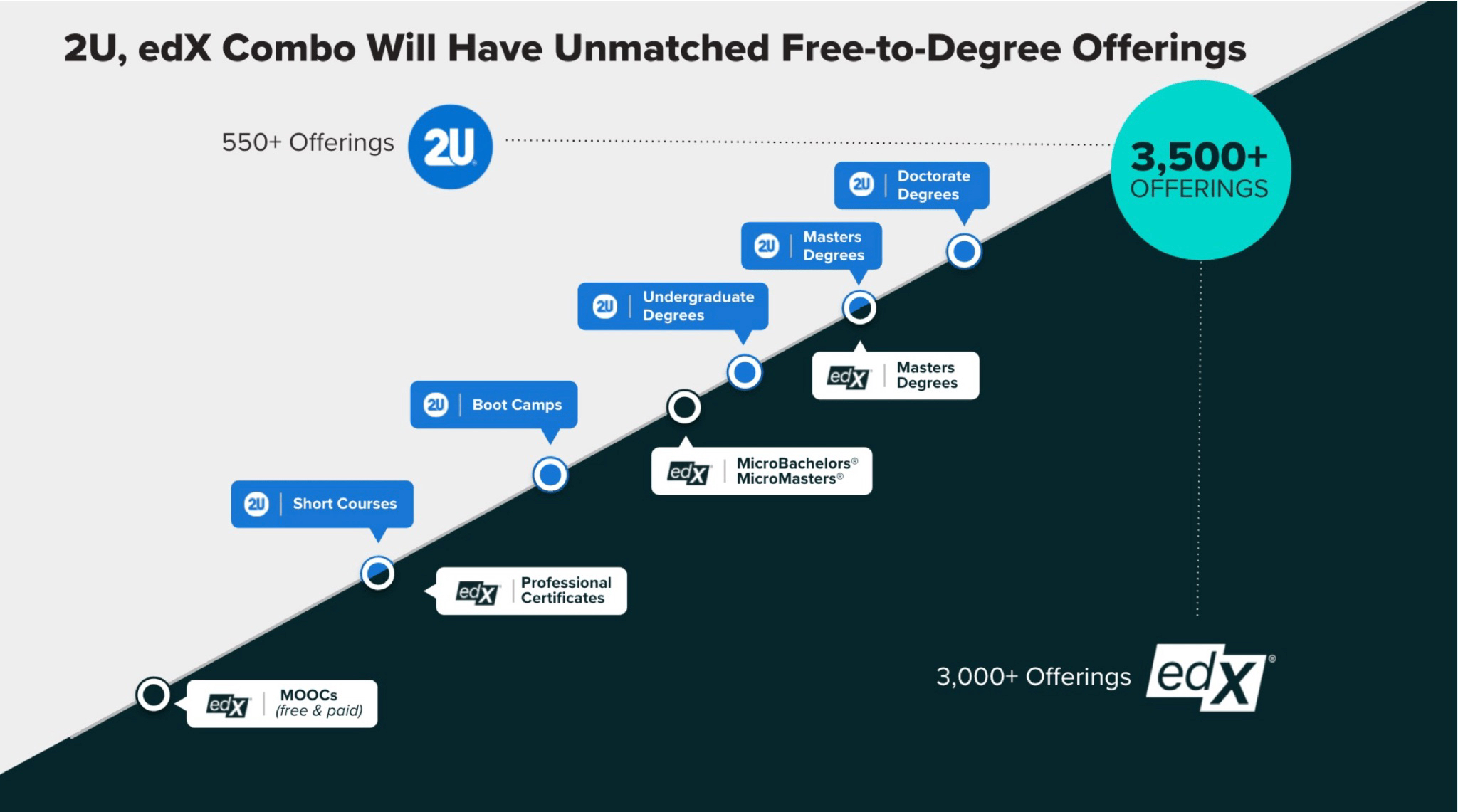
  • The EdX Aftermath

    The EdX Aftermath

    I’ve been asked by a few different people to write about the EdX purchase by 2U. More specifically, I’ve been urged to write about what should happen next with Open EdX.

    I’ll be honest. I don’t really care much about Open EdX in and of itself. I’m far more interested in the ramifications of the sale on public-good collaboration in higher education. I think Harvard and MIT have done significant damage to the landscape and to themselves. They have an opportunity to repair some of the damage (though I doubt they will do so). And I believe 2U has an opportunity to step up and make public-good contributions in ways that they have not so far.

    Trust lost

    My sources inside these institutions, particularly MIT, tell me there’s quite a bit of internal upset and foment over the transaction. I suspect that this internal reaction is what the two universities were responding to in their series of vague missives about all the good they’re going to do with the money in the weeks following the announcement. I don’t get the sense that the administration has a grip on how much external reputational damage they have done, particularly with other institutions that had put their time and money into EdX. Sooner or later, that will come back to bite them.

    MIT and Harvard betrayed their commitment to their partners and to the ostensibly public-good mission of EdX. In the process, they burned through an enormous amount of social capital among their peer institutions. Well, MIT did. Harvard, whose endowment hit an historic high of $41.9 billion in 2020, has never been known for its generosity. ((While I’m sure I’ll get some angry comments from Harvard folks about this or that philanthropic initiative by the university, the institutional reputation is what it is.)) MIT, on the other hand, has gotten a lot of mileage out of their “save the world” efforts. There was, for example, this 2001 New York Times piece about how, through the magic of OpenCourseWare (OCW), anyone in the world could “audit an MIT class” for free. (I have used OCW but do not consider myself to be MIT-educated. I’m modest that way.) A bit more than a decade later, MIT made roughly the same claim—to the same acclaim—with MITx, which became part of EdX.

    I don’t fault MIT for setting lofty ambitions and failing to achieve them. While I find their braggadocio and their ability to suck all the air out of the room to be annoying and occasionally damaging, that’s not the main issue here either. Nor do I find the sale of EdX to 2U to be overly problematic in and of itself.

    No. It’s the hypocrisy.

    The creation of EdX was positioned as a direct response to those dirty, grubby capitalists from Stanford who were going to privatize higher education with Coursera. EdX, in contrast, was to be a non-profit. It was a public good. Universities that paid into Coursera were paying fees to a vendor. Those that paid into edX were donating to the cause of keeping education pure.

    It turns out that the other participating universities, after getting less input and worse customer service as “partners” in EdX than they would have gotten as Coursera customers, find the noble organization they contributed to…was sold to become part of Coursera’s most direct for-profit competitor. Even partners who were more pragmatic than mission-minded in their participation are angry. If EdX was effectively a start-up that was sold for a profit, then dues-paying universities were investors. Where’s their cut?

    MIT and Harvard promise to use their enormous profit from the EdX sale to do great things for the world. Maybe they’ll make it possible for everyone in the world to have a free MIT education for a third time. Whatever they announce next is as likely to be met with eye rolls as with fanfare. And if it requires other universities to put cash in, I strongly suspect that most prospective partners will clutch their wallets tightly and back away.

    OK, so what should happen next? How can MIT and Harvard fix what they’ve broken? How can 2U step up and be a good citizen here?

    Well, I have some thoughts….

    Incubate Open EdX in the Apache Foundation

    MIT and Harvard have said they will use the profits from the EdX sale to steward and improve Open EdX. I don’t believe them and you shouldn’t either. Neither university cared about Open EdX even before the sale. It was a passion project from inside the organization. These “stewards” need an outside auditor who can ensure the software is being managed in a way that protects its future. Apereo, the higher education-specific open-source foundation, doesn’t have the juice to hold Harvard and MIT accountable. It has to be Apache.

    The Apache Foundation has a formal incubation process through which many open-source projects have passed and many more have failed to pass. It is designed to ensure a healthy open-source community and governance practices. MIT and Harvard should take a portion of their profits and endow a small foundation whose job is to steward the code through the Apache incubation process. This Open EdX Foundation would not be charged with deciding the future of the software. Rather, it should be charged with shepherding the software through the incubation process. The initial board could consist of former EdX members and Open EdX contributors. MIT and Harvard should not have undue influence or control. Once the software has passed through incubation—which is usually a multi-year process—then a new board should be elected from the community to chart its future.

    Separately, MIT and Harvard could take the rest of their profits and create an educational research grant-giving body focused on improving global education and educational equity. MIT and Harvard faculty and staff would be permanently disqualified from receiving grant dollars from the foundation. A credible board of academic experts and NGO leaders would oversee the distribution of funds.

    If they’re serious about fixing their reputational damage, then not one single penny of the profits from the EdX sale will go to MIT and Harvard. They will want to remove all doubt that they mean what they say about applying their windfall toward the public good. There cannot be the slightest hint of conflict of interest. Only then will ongoing initiatives such as OpenCourseWare as well as new ones that may emerge from these institutions be freed of the taint that their universities have created.

    2U’s Opportunity

    Interestingly enough, 2U has the opportunity to come out of this looking like the most civic-minded entity in the transaction. At a minimum, 2U is more likely to treat MOOC-publishing universities better than they were treated as EdX “partners.” Providing good customer support is hard even in a well-functioning organization. It’s impossible in an organization that is constantly thrashing about for a sustainability model while pretending it’s not a business. So 2U can clearly improve the situation on that front.

    But that’s table stakes. 2U has to treat their new EdX partner schools well because they don’t want to lose them. The company has a potential opportunity to do more on two fronts.

    First, they should try not to do a hard fork of Open EdX and should instead push to help create and participate in the Apache project. Lots of big, profitable companies actively participate in open-source these days. In fact, many are major contributors. To be clear, I’ve yet to see evidence that 2U is capable of this particular sort of collaboration. It takes a specific kind of cultural DNA to work with a community on something this mission-critical to your business. 2U’s strength is in controlling everything end-to-end in order to deliver on all the details for their partners. That strategy has often but not always served them well. They have an opportunity to step up here and try something different. Particularly in the area of learning platforms, they might benefit from collaborating with the academic community.

    Second, 2U should take up the flag of educational research. For a long time now, I have wanted to see 2U engage its partners in true learning science-based continuous improvement. I haven’t seen anything significant come out of the company in this regard. That made me sad but I accepted it. Not every company will do this. More recently, though, 2U has started making noises—at least on LinkedIn—about how their course design process is based on “learning science.”

    If I were still writing e-Literate in cop-on-the-beat mode, I would have gone after that bit of PR puffery immediately. If a company chooses not to prioritize research, OK. I get it. But don’t trumpet a framework that somebody on your team put together based on a layperson’s reading of the research literature and invoke “learning science.” That’s actively harmful. Based on 2U’s public record to date, I have seen no evidence that the company’s course design approach is actually informed by learning science in any meaningful way.

    2U did hire Gallup to conduct an outcomes study. I put a lot of stock in Gallup’s work for this sort of thing and give 2U credit for engaging in that kind of audit. But that’s not the same as baking learning science into their course design process.

    The EdX acquisition gives the company a new opportunity. The staff that is coming over with the transaction includes at least one bona fide learning scientist. Further, 2U’s Chief Learning Officer, Luyen Chou, came from the single most effective company at integrating learning science at scale into their product development: Pearson. For all its flaws, Pearson was deadly serious about that work and did a lot right. (Unfortunately, because Pearson did a lot else wrong, that good work often got buried.) Luyen has seen the publisher’s efficacy work up close and knows what a serious effort looks like.

    2U has an amazing setup to work with. My goodness, their partners run multiple identically taught sections multiple times a year. They have the kind of opportunity to conduct real controlled experiments that Pearson could only have dreamed about. And now they also have a platform that enables them to conduct research at scale. It even comes with an existing community of academic learning science researchers.

    I’m talking, of course, about Open EdX.

    The real potential for Open EdX—for all parties involved—is to grow a more vital community of applied learning science to improve education.

    Let’s please have genuine, more imaginative university/private partnerships

    I’m speculating here, but I suspect the reason that MIT and Harvard put themselves into a position where their most logical move with EdX was one that made them hypocrites is that they simultaneously did and did not want to be in business in the first place. The world knew next to nothing about Stanford-style MOOCs at the time that EdX came out. If memory serves, there had been a grand total of about three in the world, all out of Stanford, all in computer science. One enrolled 100,000 students. Yes, that was shocking. Yes, it certainly seemed like an opportunity to have an educational impact at scale.

    And yes, there probably would be some way to monetize all those eyeballs. That’s what Coursera believed, that’s what Udacity believed, and although they may have been careful about who they said it in front of, that must have been what at least some critical stakeholders at MIT and Harvard believed. So the two universities were going to launch a not-quite-a-business. If one course could attract 100,000 students in its first iteration, how many students did they expect to serve? Millions a year at the very least. Did MIT and Harvard have any reason to believe that they could run a cloud-based business serving millions of users across the globe every year?

    No, they did not. That’s not what universities excel at.

    Worse, it turns out that the best way to monetize MOOC eyeballs is the same way that Google does: by advertising stuff. Try this: Search the internet for the most recent article you can find about the costs and profitability of MOOC programs. I bet you won’t find anything more recent than 2015. Why is that? Because with a few exceptions, MOOCs aren’t profitable. From a business perspective, they are an effective marketing expense for selling other online programs. Students who enroll in a MOOC tell the MOOC provider what they’re interested in learning about. Maybe somebody who takes a MOOC on AI will want to pay for a certificate or a degree. To make money off of MOOCs, you need to be in a position to sell other types of educational experiences at a scale that is far larger than MIT and Harvard. You need a sophisticated, multi-level, multi-supplier marketplace.

    Since MIT and Harvard were never going to build that kind of a business, EdX was never going to be sustainable for them. If it was going to have a future, it was going to be at a company like 2U, which helps universities sell online education programs that can make money. Selling EdX to a large OPM was both a highly logical move and a complete betrayal of everything they originally claimed to have stood for (and against).

    2U’s sales and marketing ladder (h/t Phil Hill)

    The irony is so thick you can cut it with a knife. OPMs came into being in the first place precisely because universities with neither the start-up capital nor the skillset wanted to build large revenue-generating online programs. The classic model was to turn everything over to the OPM in return for half of the (new) revenues. The first OPMs grew out of LMS hosting companies like Embanet. (This was back in the days before cloud-hosted LMSs.) An acquaintance who worked at one of these companies back then called it the “deans gone wild” period.

    The hosting company would get approached by a dean who would say, “Hey, I want to build an online graduate program but I don’t know how to do that. Can you do it for me?”

    “Uh…suuuuuure. We can, um, do…that.”

    “Great! One more thing. My president doesn’t know I’m doing this and I don’t have any money.”

    “Oh. Uhhh…I guess we could…hmm…we could cover the up-front costs. In return, we’d need to take, say, 50% of the revenues for 10 years. OK?”

    “Deal!”

    That’s not an exaggeration. It’s more or less the way that the OPM industry came to be.

    In the early days, some universities didn’t even provide faculty. All they supplied was their brand. And as you might imagine, the results were often pretty bad, educationally, financially, and reputationally.

    Over time, OPMs slowly improved as the market became more competitive and high-profile failures drove universities to provide more oversight. 2U made its name by taking the product category upscale. Programs they helped create generally made money and provided educational experiences that their customers’ faculty senates would sign off on. In the process, the company was able to sell its services to more prestigious universities and build deeper institutional relationships. Since then, OPMs have diversified their business models quite a bit, to the point where it’s hard to make any generalizations about them.

    But these two polar paradigms, represented respectively by the origins of EdX and the origins of the OPM product category, are the two dominant models we have for driving the digital transformation of education. Neither works very well. Either the university acts like a business and often (but not always!) fails or the university outsources its functions and often (but not always!) gets heartburn from the deal at some point. I can point to examples of one, the other, or both happening with LMSs, SISs, and digital textbooks, to name a few EdTech product categories. Each situation was different because the contexts were different. But the models and the mindset continue to drive thinking about EdTech.

    We can do better than this. We need new models.

    I’ve beaten up on MIT and Harvard pretty hard here, but the main mistake they made was when they founded EdX in the first place. It was a knee-jerk reaction, laced with hubris, that was overwhelmingly likely to end up in one of two ways: obscurity or controversy. If these universities are genuinely worried about the future of education, whether their concern is unbridled commercialization or impact at scale, then they need to be better, smarter stewards. Their reaction to the imminent formation of Coursera could have been more thoughtful, realistic, and strategic. Their effort to clean up the mess they’ve made still can be.

  • Blursdays Restart with John Whitmer (9/2) and Michael Berman (9/9)

    Blursdays Restart with John Whitmer (9/2) and Michael Berman (9/9)

    After taking most of August off, Blursdays are back!

    Today we’ll be visiting again with our friend John Whitmer. John, as you may know, is a guru on various topics from AI to learning analytics to efficacy studies. He’s currently at the Federation of American Scientists, where he gets to consult on all kinds of interesting projects. Before that, he worked at ACT, Blackboard—where he was affectionately referred to as “Dr. John”—and the Cal State System. I’m interested in talking to John about how we should think about AI in EdTech. This is part of a larger conversation I want to cultivate around goals, guardrails, and guidelines that should ultimately lead to some institutional policy and practice recommendations.

    RSVP for John’s session on 9/2 at 4 PM ET.

    Speaking of the Cal State system, next week we’ll have Michael Berman, CIO of that hallowed university system. Michael is a classic example of a Blursday guest that you absolutely should know but may not if you don’t hang in the right circles. He has had a wide range of experiences that give him great perspective. And he’s fun to talk to. I’m curious to get his perspective on this “new normal” that we’re all trying to anticipate, but the conversation could go anywhere.

    Michael Berman

    RSVP for Michael’s Blursday session on 9/9 at 4 PM ET.

    The 9/16 Blursday is going to be a surprise. If you’ve been paying close attention to my comings and goings (and my LinkedIn feed) you may have some intimation of what it’s going to be about.

    That’s all I’m gonna say.