Phil Hill has a great post up on the latest chapter in the Moodle partner soap opera. You should read the whole thing if you care about the LMS world, but the gist is this:
- Moodle, in addition to being open-source software, is also an Australian for-profit company called Moodle Pty. Said company exerts a great deal of control over the development of the software and whose business model is licensing the Moodle trademark to partners who provide Moodle-related services in exchange for a percentage of their Moodle-related revenue.
- Moodle creator and company owner Martin Dougiamas was very unhappy when Blackboard bought some of the biggest Moodle Partners some years back. After a lot of drama and tension, Blackboard left or was ejected from the Moodle Partner program. (Details vary depending on which party is telling the story.) Since Moodle Pty owns the trademark to the Moodle name, it revoked Blackboard’s permission to call its Moodle-based product “Moodle” or to use the Moodle logo.
- Blackboard renamed their Moodle-based product OpenLMS, which it eventually sold to a company called Learning Technologies Group (LTG).
- Somehow LTG or one of its subsidiaries was apparently a Moodle Partner at this time. It’s a little hard to follow because Moodle Pty has had some ongoing drama with LTG in their Moodle Partner program as well. At any rate, LTG continued Blackboard’s strategy of buying up Moodle Partners.
- This week, after a lot of drama and tension, Moodle Pty ejected LTG from the Moodle Partners program, accusing LTG of creating lock-in with proprietary extensions in violation of the principle of “Openness” (which probably has some truth to it, but…well…more on that in a bit).
- In parallel, OpenLMS announced its own policyabout what it will release as open-source and what it will keep as proprietary.
- Recriminations between the two companies have been flying back and forth about a variety of topics, including whether OpenLMS’s openness policy is open enough.
When e-Literate changed editorial focus in 2019, it largely stepped away from (a) providing coverage of the LMS market as an end in itself and (b) taking on one of its primary missions as policing vendor behavior. I have been very happy with both of those decisions. I’m going to make an exception to both here mainly because I want to make a point about “Openness” (where, as you will see, the choice of capitalization is not mine).
Over the years, I’ve tended to go easy on Moodle because it, and Martin, have accomplished enormous good in the world. Whatever one thinks about the LMS as a product category, it has enabled online education at scale, a development whose value has been spotlighted by the global pandemic. Moodle, by virtue of its design, license, and community, has brought these capabilities to communities and regions that no other vendor has deemed profitable enough to serve. Moodle has genuinely made the world a better place. And although I am pointedly and repeatedly going to emphasize Moodle Pty’s nature as a for-profit company, I fully believe it is a mission-oriented company that has prioritized impact.
Corporate structures, business models, trademark laws, and software licenses are all inventions. They are artificial constructs we design in order to have specific effects on the world. Many of these constructs are specific kinds that we collectively refer to as “intellectual property” or “IP.” IP is simply an idea that somebody legally owns. That ownership can be legally expressed in a variety of ways, such as a patent for an invention, copyright for content, or a trademark for a company or product name or logo.
(Update: IP is a little more complicated than that, as a couple of early critics of this post have pointed out. The degree to which the ownership is of the idea itself or the particular expression of it varies by type of IP. A process patent is different than copyright. This is a nuance that is beside the points I’m making here, but I’m noting it in the interest of precision.)
IP in all its forms is a tool. In the United States, our Constitution specifically framed it this way. Here in the US, IP is a temporary monopoly that Congress can grant in order to provide financial motivation for the creation of new ideas and works. For example, you may be granted a copyright so that the years of your life writing the Great American Novel will pay off in the form of royalties, thus enabling you to contribute art to the world and, perhaps, to even be able to afford to start working on your next novel.
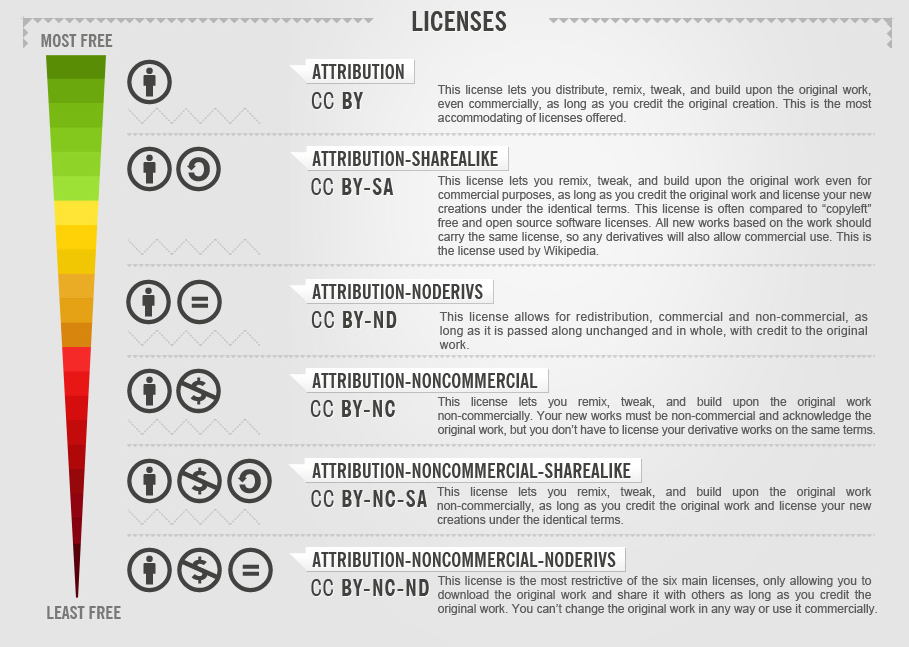
Open licenses along the lines of open-source and Creative Commons are hacks of this system but do not depart from its essential purpose. Thir underlying insight is that sometimes existing IP licenses are hindrances to the desirable activities they are intended to encourage. For example, I publish this blog for free because I want to share knowledge. I want people to create new works using mine as building blocks. All I want in return is credit for my contribution. If I made every person who wanted to quote e-Literate explicitly ask my permission—as copyright law requires—then that extra effort might discourage some from adding to our educational knowledge. So I publish the blog under a Creative Commons license that lets people use my content without having to ask me as long as they properly attribute it.
Some people who use open licenses view this kind of sharing as an inherent value. I personally tend toward the utilitarian. I have an affinity for openness and believe that, all else being equal, open is better than not. But I view openness as subordinate to other values such as educational impact. This is a matter of personal philosophy; other folks legitimately feel differently. But even as an end in itself, those who are immersed in topics like open-source or Creative Commons licenses know that the definition of “openness” and the value that it represents are very much contested territory among advocates.
One way to divide the territory is into open licenses, which are specific legal contracts with well-defined terms, and “openness,” which is a squishy concept with a mix of utilitarian and moral connotations that vary from person to person. Well-written open licenses are clear-cut in their requirements and limitations. They often support, but do not necessarily define, commitments to a specific definition of openness as a value.
Let’s focus on the utilitarian part for a moment. Martin created Moodle Pty with a particular revenue model, a particular open-source license, and a particular approach to using the Moodle Trademark as intellectual property. These pieces all fit together into a machine for growing “Moodle,” by which I mean both the adoption of the software and the company that Martin owns. It’s a model that served the Moodle mission and sustainability goals well at the time it was created. Many small schools, colleges, and other organizations all over the world had no access to any tool for centrally supporting online and technology-enabled learning. The Moodle software is free and easy to run (up to a point). Moodle Pty created a network of small, local businesses supporting support schools that did not have the capability to run Moodle on their own. Moodle Pty collected (and still collects) a percentage of revenues from these local vendors. This money went toward the development of the Moodle software, promotion of Moodle and its partners, paying salaries, and so on. At the time, the model worked incredibly well, making Moodle far and away the most popular LMS around the globe outside of the US and Canada.
But the world has changed. Moodle was created before cloud computing and before online learning became mission-critical at scale across large swathes of the globe. These changes broke Moodle’s business model. It has been broken for quite some time. It arguably broke when a Moodle Partner called MoodleRooms, before it was eventually acquired by Blackboard, demonstrated that it could support one million simultaneous users on a single multi-tenant instance. This was a cloud version of Moodle, even if that term wasn’t popular at the time. Once a cloud version of Moodle existed, the power balance between Moodle Pty and its customers…er…partners shifted, and the number of customers from which it could collect revenues was destined to shrink. Rather than being a supplier to many small businesses, Moodle increasingly became the supplier for a few large businesses, each of which became increasingly important for its revenues. Again, read Phil’s post if you want a detailed breakdown of the Moodle model’s…um…breakdown.
Open is as Open does
Back to the present. Remember, LTG’s OpenLMS (which it purchased from Blackboard) made an announcement this week about which parts of their code they would release under an open-source license and which parts they would keep as proprietary. Phil Hill asked Martin to comment on OpenLMS’s announcement about their openness policy as part of the reporting for Phil’s blog post. Here is Martin’s reponse:
Our actions have obviously been a factor in causing this, which I count as a good thing for everyone. Please note, though, that their stated direction is to sell the integration of the full suite of LTG products – and none of those other things are open or planned to be. Clients will still have the same lock-in to LTG as before (as desired by LTG). https://www.youtube.com/watch?v=mBFShI8OYe4
Not even all the “Open LMS” SaaS product will be actually open either. I don’t know exact figures, so I’m estimating, but the OpenLMS service is probably 90% Moodle, with perhaps 10% other stuff, and they’re going to make only perhaps half of that other stuff available under GPL, so 5%. It’s not a big deal and honestly, the least they could do.
Moodle’s Dispute with LTG and its Growing Suite of Former Moodle Partners
Meh.
News flash: All vendors try to make their customers want to stay by adding features or services they can’t get anywhere else. Some strategies are more ethical than others. Moodle Pty., like many vendors, uses its proprietary intellectual property to create what could arguably be called lock-in. Moodle Pty’s customers are Moodle Partners. Its intellectual property is its trademark. Martin has, on multiple occasions, exercised the threat of withholding that valuable IP when its customers have left or when they have behaved in ways that he believes are contrary to the interests of Moodle.
There is nothing inherently wrong with this. Moodle has a mission that depends on revenues to sustain. Moodle Pty gets revenues from mostly smaller Moodle vendors. It uses its IP in the form of its trademark as kind of a soft lock-in to its customers (or “Partners”). If the customers walk away, they can still use the Moodle code. They just can’t use the Moodle trademark, which has value because it is recognized and trusted.
LTG and its subsidiaries, eThink Education and OpenLMS, also provide value-added intellectual property to differentiate themselves, attract prospective customers, and hold onto existing customers. Moodle had earlier ejected eThink from the partner program for not being sufficiently “Open”:
The Learning Technologies Group (LTG) announcement of the acquisition of eThink Education represents LTG’s intention to move customers into the Open LMS platform, which is not truly Open at all. Their extensions to Moodle are not downloadable, and not available from other service providers. Once on their platform, it is harder for institutions or organisations to move to a different provider, or to their own servers. This goes directly against Moodle’s values of openness. Consequently, as of 18 December 2020, eThink Education is no longer a Moodle Certified Partner or otherwise associated with or recommended by us at Moodle.
Moodle’s Dispute with LTG and its Growing Suite of Former Moodle Partners
Martin’s definition here of “Open” has always been problematic. A lot of software is designed to integrate with or even run on other software. If somebody runs Moodle on a Windows server, does Moodle cease to be “Open” because Windows is not? If a school integrates Zoom—which is not downloadable and is not available from other service providers—as an “extension” to Moodle, does Moodle cease to be open source?
Of course not. Heck, I would bet money that he personally has written code in Moodle that enables proprietary vendors to integrate their products deeply into Moodle. Further, the cloud has made this situation vastly more prevalent. How many of the software products you integrate as “extensions” to your LMS are downloadable to run on your institution’s servers? How much do you care? Instructure, whose source code to Canvas is largely (though not completely) open-source, has had vanishingly few institutions choose to download and run Canvas on their own servers or seek out an alternative provider. That’s because the virtue that drove customers to Canvas was its nature as cloud software, which means it is designed precisely so that nobody would have to download the software and run it on their own servers. It turns out that schools are not typically great at running mission-critical software applications with no hiccups and no downtime. The cloud has diminished the utility of “openness” (with a lower-case “o”) for many institutions.
Now, it’s perfectly fine for Moodle Pty to hold that as a requirement for its partners and assert that their version of openness a value. Certainly, if its mission is to prioritize those parts of the world where affordability dictates either self-hosting or a small operation that can’t write its own cloud harness for Moodle, then the company certainly is within its rights to make a decision about that. If so, they should say that.
By the way, Moodle Pty does have a cloud version of Moodle called, aptly enough, MoodleCloud. If their cloud-enabled version of Moodle has been released as open-source, I have not been able to find it. Again, I take a utilitarian view of any decisions that Moodle Pty makes in this regard. In my view, it’s a good decision to the degree that produces desirable results for educational equity and effectiveness. My concern is with Martin’s apparent hypocrisy, which is underlined by a tone that I read as sanctimonious.
Likewise, if LTG is alleged to have violated Moodle’s open-source license or infringed on its trademark—in other words, if LTG stands accused of stealing Moodle Pty’s IP—then Moodle Pty should be clear about that accusation. The fact that they have not done so is suggestive. If LTG’s extensions legally violated Moodle’s open-source license’s “openness” requirements, then Moodle Pty would (and should) sue. They have not sued, which suggests to me that LTG’s code is cleanly separable. It may not be as clear-cut as Zoom or Windows, but it appears to be clear-cut enough that Moodle Pty has not pursued legal recourse.
This is not to say that LTG couldn’t be playing games with features that (a) customers do not know are proprietary and (b) would have a hard time leaving behind if they migrated. I don’t know LTG’s offerings well enough to have an opinion on the matter. Martin could conceivably make a specific argument along these lines. Not a legal one, mind you. Moodle Pty’s trademark lock-in is relatively weak and circumscribed. But he could try to make an ethical argument that LTG’s extensions trick customers into lock-in. He seems to insinuate that.
But he has not actually made the case. In fact, his waving away of OpenLMS’s statement about what they are opening as “the least they could do,” speculating about the percentage of code that remains proprietary rather than pointing to explicit features that concern him, suggests that he is not particularly interested in making that argument. He wants to make an argument about Openness in some pure and absolute sense.
I have two problems with that. First, it comes across as hypocritical. Again, I don’t have any problem with Moodle Pty setting terms for its resellers, kicking out resellers that violate those terms, and enforcing the terms by withholding use of the Moodle trademark. But let’s not pretend that Moodle Pty has eschewed all IP, like some sort of corporate Buddhist, or that it has declined to assert that IP to protect its interests. I assume that Martin has a set of principles regarding openness that he is following. They must be more nuanced than “Openness is judged by the percentage of code is downloadable and available from other vendors.” He should state his principles clearly, not as the Proper definition of Openness but as Moodle Pty’s objective and concrete commitments and rationale. In fact, the OpenLMS statement that he dismissed so blithely does exactly this. Martin has enjoyed a position of assumed moral privilege for too long. If he wants to serve “Openness,” however he defines it, he should start by defining it in serious, testable, and internally consistent terms.
Second, I reject the notion that Openness is a well-defined and absolute virtue by which others are Judged. ((Two can play the Capitalization Game.)) I always have and always will. Martin is far from the only person to wield an “opener than thou” attitude as a weapon in educational communities. He’s also far from the worst offender. But the way in which he’s choosing to communicate his decisions about the Moodle Partner program is particularly harmful because of his global stature. People who are deep into any of the various open communities—open-source, OER, open access—have inevitably been exposed to the complex and nuanced debates about the pros and cons of different licenses. These debates are fundamentally about the values and affordances of different definitions of openness, as expressed in those licenses. I understand that participants in these debates have passionate views on the subject. I don’t doubt Martin’s own passion. But by presenting the matter as cut-and-dried, he flattens this useful debate instead of taking the opportunity to raise awareness and literacy regarding its nuances. In the process, he risks coming across as naive at best and manipulative at worst.
Martin could also take another (simpler) approach, which is to explicitly require Moodle Partners to adhere to Moodle Pty’s limitations around permitted extensions and reserve the right, without sanctimony or high dudgeon, to eject Partners that don’t adhere to the Terms and Conditions. I have no problem with that.
Ironically, I have never been able to see a copy of the Moodle Partner Terms and Conditions, even though I explicitly asked to see them at one point. Apparently, they are (or were) considered to be proprietary IP of Moodle Pty and are (or were) not to be shared.
I hate this crap
Ugh.
As I write these words, I am 50/50 on whether I will hit the “publish” button. If you are reading this post, it means I decided the discussion of the larger principle justifies wading into a topic that I largely don’t care about to criticize a person and organization whose accomplishments I respect. I don’t care about the LMS market per se. I have no real opinion about the dispute between Moodle Pty and LTG. Nor do I care enough to put in the work required to form one, at least based on what I’ve heard so far. I harbor no ill will toward Moodle Pty or Martin Dougiamas. Truly, I have a long list of topics that I would relish writing about instead of this one.
All that said, I find the way that Martin is publicly characterizing the nature of the dispute to be disturbing and harmful, just as I found it to be disturbingly simplistic when he used the same rhetoric with Blackboard. If he truly believes that there is a clear moral definition of “Openness” (which he chose to turn into a proper noun through capitalization) then he should define it and articulate his argument for it. Alternatively, he could simply state that these are the conditions for Moodle Partnership without the air of moral superiority. Either option would be fine with me.
We should be able to have thoughtful and productive discussions about how different definitions of openness can support or hinder different aspirations and values. My desire to do so is my motivation to write this piece and characterize the rhetoric coming from Martin and Moodle Pty in such strong terms. I am writing because I believe that Martin’s language is doing more to obscure the values and goals of “Openness” than it is to support and illuminate them. I find that to be particularly upsetting because I believe that Moodle has historically advanced goals and values that I cherish. In my view, Martin’s current rhetoric risks damaging that good work while diminishing the value of openness as a tool for future good work.