A while back, I had the pleasure of being interviewed by friends at the University of Cape Town about the future of higher education as part of a short video they were compiling for their senior leadership. Here’s what they came up with:
#unleash teaching and learning to create the UCT of the future – Vision 2030
I love this. Their aspirational mindset and movement toward a shared, positive vision is should be an example to universities everywhere.
Naturally, the video was created by taking snippets from longer interviews. (Honestly, Dear Reader, do you think me capable of being succinct without heavy editing?)
Here’s my full interview:
Me talking a lot
I talk about the Empirical Educator Project and much more.
e-Literate author and Senior Advisor Curtiss Barnes
This Blursday, we’re going to start by talking about where the textbook market is headed. Having done several tours of duty at major publishers—including running a digital platform portfolio at Pearson that, if it were a separate company, would have bigger than Instructure—he has some unique insights.
As is the case with just about everything else in higher education, COVID has accelerated and amplified existing trends. Textbook publishers, who were not doing well before, are still not doing well now. That said, there is undeniable increasing interest in digital curricular materials and in inclusive access (the latter of which Phil Hill wrote about recently). OER use is growing, as is faculty interest in questions of equity and efficacy (though not necessarily at the same pace). The explosion of interest around cheating on the one hand and making up for the COVID-caused education gap on the other are driving folks to think about digital curricular experiences in new ways.
As always, we’d love to hear your thoughts about both where you see the market going and where you think it should go. Please join us this Blursday, 3/4, at 4 PM ET.
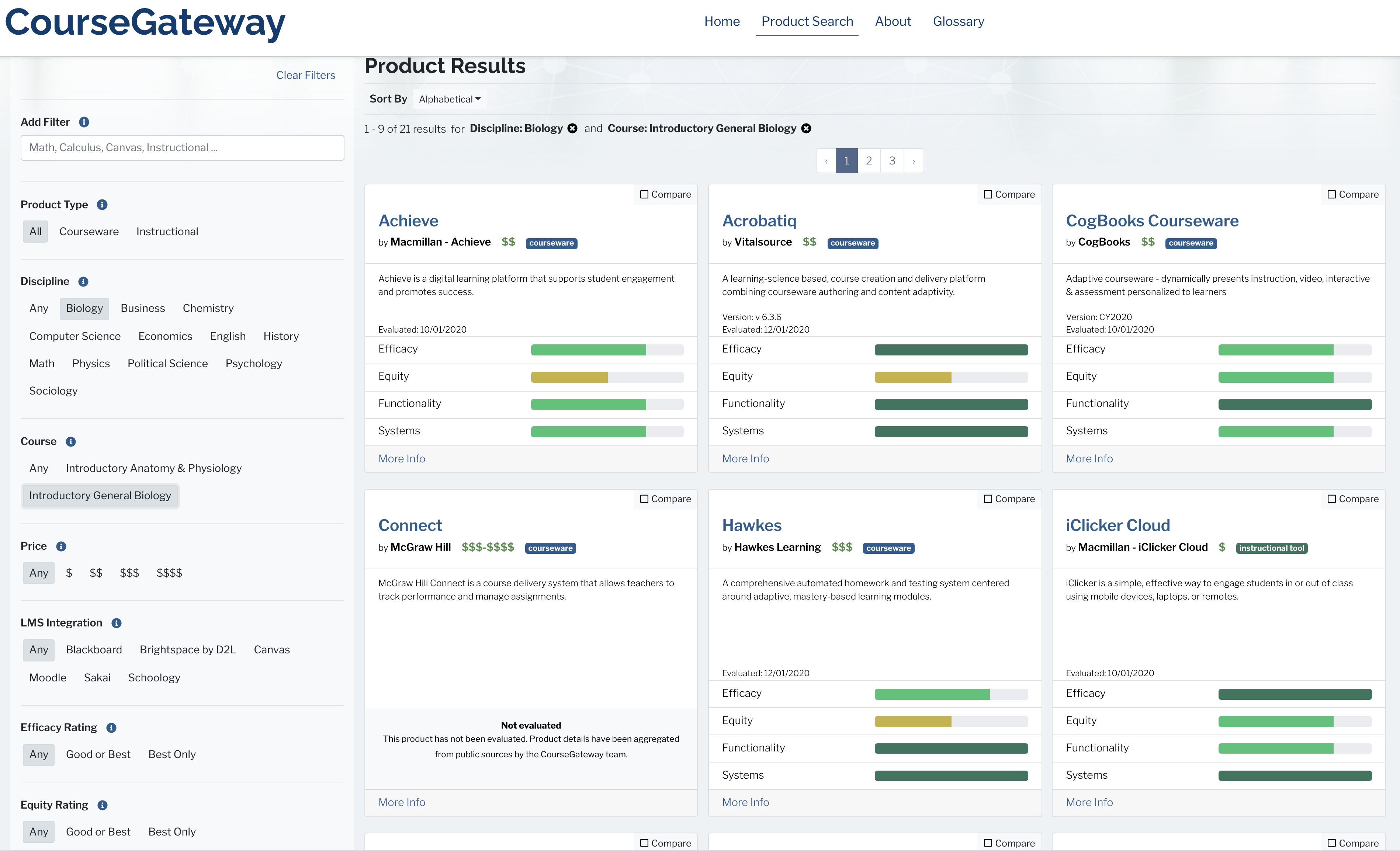
Ever since EduTools way back in the day—remember that?—folks have been grappling with a way to create a useful and maintainable tool for sorting through EdTech solutions. My friends at Tyton Partners, under a grant from the Bill & Melinda Gates Foundation, have created a new tool to try at CourseGateway.org. Descended from the CWiC Framework, it focuses on courseware but also includes other tools.
I may be biased, since EEP played a small role in providing input to Tyton, but I really like what they came up with:
Panning for Gold in EdTech
Y’all should poke at it before this Blursday so you can bring your questions, critiques, and suggestions. We’ll be chatting with Tyton’s Managing Partner Adam Newman and Principal Jeff Snell.
Tyton Partners’ Adam Newman and Jeff Snell
I love these guys; they’re super-smart and fun to talk to about just about anything higher ed-related. The conversation will be fun, wide-ranging, and driven by you, as usual.
I was delighted to be the inaugural guest on Rethink Education‘s podcast series, The Rethinking Education Sessions. My hosts were Rethink’s Managing Partner Matt Greenfield and Associate Amanda Beaudoin.
I love talking with Matt for a few reasons. First, he’s a deeply humane person who shares my values and puts them front and center in his business practices. Second, he’s a former English professor, so he really gets teaching and the magic of the classroom in a way that many VCs don’t. And finally, he asks great questions. Toward the end of the episode, Amanda jumped in and we had a really interesting three-way conversation about how pro forma spreadsheets can be forms of personal expression, what that tells us about the definition of “liberal arts,” and also what it tells us about the nature of learning.
We covered a lot of ground and yet left a lot to be explored (perhaps partly because I seem constitutionally incapable of giving a short answer to a question). It was truly a delight.
The always fascinating and gentlemanly Doug Lederman
This week we’re bringing back e-Literate LIVE! fan favorite Doug Lederman, co-Founder and Editor of Inside Higher Ed, for our Blursday Social chat.
As usual, we can talk about whatever you want. Personally, I’m interested to hear Doug’s thoughts on what the (hopefully) first post-pandemic academic year will be like. But just about anything higher education-related crosses Doug’s desk, so everything is fair game.
This Blursday, we’ll be speaking again with Jeff Young, the higher education reporter extraordinaire who spoke with us in the fall about his fabulous Campus Pandemic Podcast diaries. Jeff has also done some great reporting on learning engineering (among many other topics), so we have a lot to talk with him about.
Jeff is one of my absolute favorite higher education journalists. His combination of empathy for the people he covers and understanding of the complexity and nuance enable him to produce consistently compelling and thought-provoking pieces.
It’s obviously an unsympathetic portrait. At one point, the author quotes Chegg CEO Dan Rosensweig as saying,
“You live in Silicon Valley, and everybody is a billionaire, and you’re not. Everybody goes public and at least has the one moment where their stock goes up—and yours didn’t.” It got so bad, he said, “I had a moment of sucking my thumb in bed.”
Chegg CEO Dan Rosensweig
While that quote may be cringe-inducing—and was taken from a long interview with Rosensweig that had plenty of cringe-inducing moments—the CEO’s fixation on his status is beside the point. The real damning passages were ones like this one:
A 2020 George Washington University graduate who is applying to grad school says she tried to use Chegg the way company executives say it was intended, “more as an instructional tool.” But her mechanical physics course was very tough. “I felt like a moth drawn to a flame,” she says about chegging her physics homework at the last minute. “When it’s nearly midnight, why not use Chegg just to finish the assignment?”
“This $12 Billion Company Is Getting Rich Off Students Cheating Their Way Through Covid,” Forbes
And this one:
It’s doubtful that [Chegg’s new anti-cheating feature called] Honor Shield will dent students’ chegging. Already many professors and instructors have given up the fight. At UCLA, physics lecturer Joshua Samani says that he believes “an astonishingly large portion” of his students have used Chegg to cheat on his exams and quizzes. But he doesn’t try to catch them. “If you’re spending your time attempting to battle Chegg, you’re going to lose,” he says.
“This $12 Billion Company Is Getting Rich Off Students Cheating Their Way Through Covid,” Forbes
If we’ve reached the point where “to chegg” is considered to be a legitimate verb in the English language, that’s another indication of just how widespread the problem is.
Forbes author Susan Adams gets to the crux of the problem in the last paragraph of the piece:
It’s unreasonable to lay all the blame for cheating at the feet of Chegg, of course. Human nature is at fault, especially when studying from home makes it much harder to get caught. Constant social media exposure to political leaders who make a virtue out of dishonesty doesn’t help either. But Chegg has weaponized the temptation and is cashing in on students’ worst instincts. Our arsenal of digital tools and global connectivity should be deployed to transform education for the better. Instead, Chegg is using them to outsource cheating to India. That is a tragedy.
“This $12 Billion Company Is Getting Rich Off Students Cheating Their Way Through Covid,” Forbes
There’s a lot to unpack here. First, the “weaponizing” of “temptation” is a familiar refrain in social media stories in general these days. And it’s a thorny problem. Chegg has not one but at least two major competitors in the homework help space which are notably valued at over a billion dollars each. Adams mentions Course Hero ((Disclosure: Course Hero is a sponsor of the Empirical Educator Project)) but misses Quizlet. Each of these companies operates a little differently and each tries in different ways and with different levels of apparent earnestness to address the charge that they are “weaponizing temptation.” It’s hard for any company to fight against sliding down that slippery slope—particularly when, as Adams points out, that slope is profitable for the companies. All of the broader debates about the promise and perils of an internet filled with user-generated content and driven by the desires of the masses apply here.
But there is one major difference between Chegg and its two unicorn competitors in the homework support business that I want to call out. Course Hero and Quizlet both rely on student-generated content (and, to a certain degree, on educator-generated content). Adams correctly points out that Chegg is different but is not entirely correct when she asserts that Chegg gets its homework answers primarily by outsourcing homework answers to India.
In fact, Chegg got many of its homework problem answers by licensing them directly from the textbook publishers.
Yes, you read that correctly.
Multiple sources at multiple textbook publishers have told me that their companies licensed the instructor’s edition homework problem answers to Chegg. My sourcing is not comprehensive enough to assert that all the major publishers did this. But I know for a fact that many of them did. It’s an open secret in the textbook publisher world.
To be clear, these are old contracts. The people inside the publishers who talk about them now are generally not the ones who signed them but rather the people who have to deal with the mess created by them. These deals were bad for the publishers. They reduced the value of the textbooks. The bit of money that they got from Chegg was not worth the devaluation of the core products. I doubt that the contracts will get renewed when they expire.
All that said, the fact remains that the publishers sold the textbooks to students…and then sold the homework answers to Chegg so that Chegg could sell those to students as well.
That’s still not the worst of it
But let’s not lose sight of the big picture. We have at least three companies worth at least a billion dollars each that are in the business of “homework help” which, as currently structured, has moral hazards. The most valuable of these companies was actively aided in achieving its dominant position by the publishers, who sold homework problem answers to the company without thinking through the consequences.
Buried in the Forbes article is yet another link in the chain of profits from academic dysfunction:
Throughout the pandemic, schools have spent millions on remote proctoring, a controversial practice in which colleges pay private companies like Honorlock and Examity to surveil students while they take tests. The proctoring outfits lock students’ Web browsers and watch them through their laptop cameras. Critics say the services invade students’ privacy. Test takers have reportedly urinated at their desks, fearing they will be accused of cheating if their camera catches them getting up to go to the bathroom.
Although most students Forbes interviewed say remote proctors make them too scared to cheat on exams, several note that they chegg their online exams regardless of whether or not they’re proctored. “As long as you’re not using the school’s Wi-Fi, you won’t get caught,” says a sophomore at a large state school.
“This $12 Billion Company Is Getting Rich Off Students Cheating Their Way Through Covid,” Forbes
To sum up:
Publishers, after selling expensive textbooks to students, sold the answers to the homework questions in those expensive books to Chegg.
Chegg sells the answers to the questions to the students, who often use them to cheat.
To combat this problem, universities pay for proctoring software, which is apparently more effective at preventing students from going to the bathroom than it is at preventing cheating.
To add insult to all of this injury, “to chegg” is now apparently a verb in the English language. We will all have to live with that linguistic violence.
Professor Frankenstein, you’ve created a monster
A common response to all of this is, “Hey, students are going to cheat. We fight it as best we can.” To which I reply by quoting Steve Jobs on why he thought the iTunes Music Store would beat out Napster-style piracy:
We believe that 80% of the people stealing stuff don’t want to be, there’s just no legal alternative. So we said, ‘Let’s create a legal alternative to this.’ Everybody wins. Music companies win. The artists win. Apple wins. And the user wins, because he gets a better service and doesn’t have to be a thief.
Steve Jobs
I believe the Georgetown student in the Forbes article who said she didn’t set out to cheat but felt pressured into doing so by her anxieties about her course. In fact, I think that scenario is more common than not. Chegg did not create that anxiety. We can debate the degree to which they deliberately exploit it, but the source of the anxiety comes from somewhere else.
I want to return to the word “outsourcing” because, while the degree to which Chegg is “outsourcing cheating to India” is an open question, outsourcing is definitely part of the problem. Specifically, universities have created the conditions in which many professors are motivated to outsource homework questions to textbook publishers. This is where the problem starts. Everyone is using the same outsourced questions, which enables cheating at scale.
In and of itself, that would not break the homework process (as opposed to high-stakes exams) were it not for the second problem. Instructors are not trained in how to use and grade these questions to decrease the likelihood of cheating. The homework questions could be used to help students feel prepared for higher-stakes exams. In other words, they could be used to lower the student test-taking anxiety that drives them toward cheating. Using the homework effectively requires having some skill at creating a class participation-style grading scheme and a willingness to spend some real time going over the homework, showing the students why doing the work helps them. When properly positioned, homework should feel to students like something that helps them learn and succeed. Since instructors are not trained in the skills necessary to position it this way, many create conditions in which the assignments raise the students’ anxiety, which increases the likelihood that students will cheat.
We should not be OK with billion-dollar companies whose success is built on an arms race between cheating and surveillance that is driven by student anxiety. Nor, to follow the metaphor to its logical conclusion, should we place sole responsibility on the arms dealers for causing war.
In 2020, the United States budgeted roughly 100 times as much for the Defense Department as it did for the State Department. As a country, we spend 100 times more on fighting wars than on preventing them. These decisions are made by elected officials who represent their constituents. At some level, the priorities, and the responsibility for them, flow back to us. Likewise, the spending priorities on these products and the responsibility for those priorities flow back to academics and academic institutions. These companies are solving problems that are partly created by the ways in which academia chooses to work. How much money does the average college spend on EdTech products relative to instructor professional development in pedagogy? How much larger does that disparity get when we include the money that students pay as they deal with the consequences of this imbalance?
It’s easy to paint the corporations as the villains here. None of these product categories—textbooks, homework sites, or proctoring products—are particularly well regarded in academia. But the more important question is, “Why do these companies and business deals exist in their current form?” Remember, product/market fit is like a key in a lock. These companies have unlocked literally billions of dollars’ worth of services that academics tend to view as problematic at best and illicit at worst. What are the conditions that encourage the widespread and highly monetizable temptation for students to slide from seeking help into cheating? Who, exactly, is outsourcing what to whom? And what are the knock-on consequences?
Young Frankenstein
If you listen to the whole of the Rosensweig interview quoted in that Forbes article, you’ll hear a guy who is not an educator. He’s a businessman who wanted to make money solving some problem related to education. And yes, he wanted to feel like he was helping students in the process. We can scoff at that all we want, but the fact is that students go to Chegg seeking help. They pay for that help, which they believe they need and are not getting from their academic institution. We can choose to be cynical about the companies, and even about the students. Or we can improve academic practices and challenge Mr. Rosensweig to make his money by providing services that actually help students to learn.