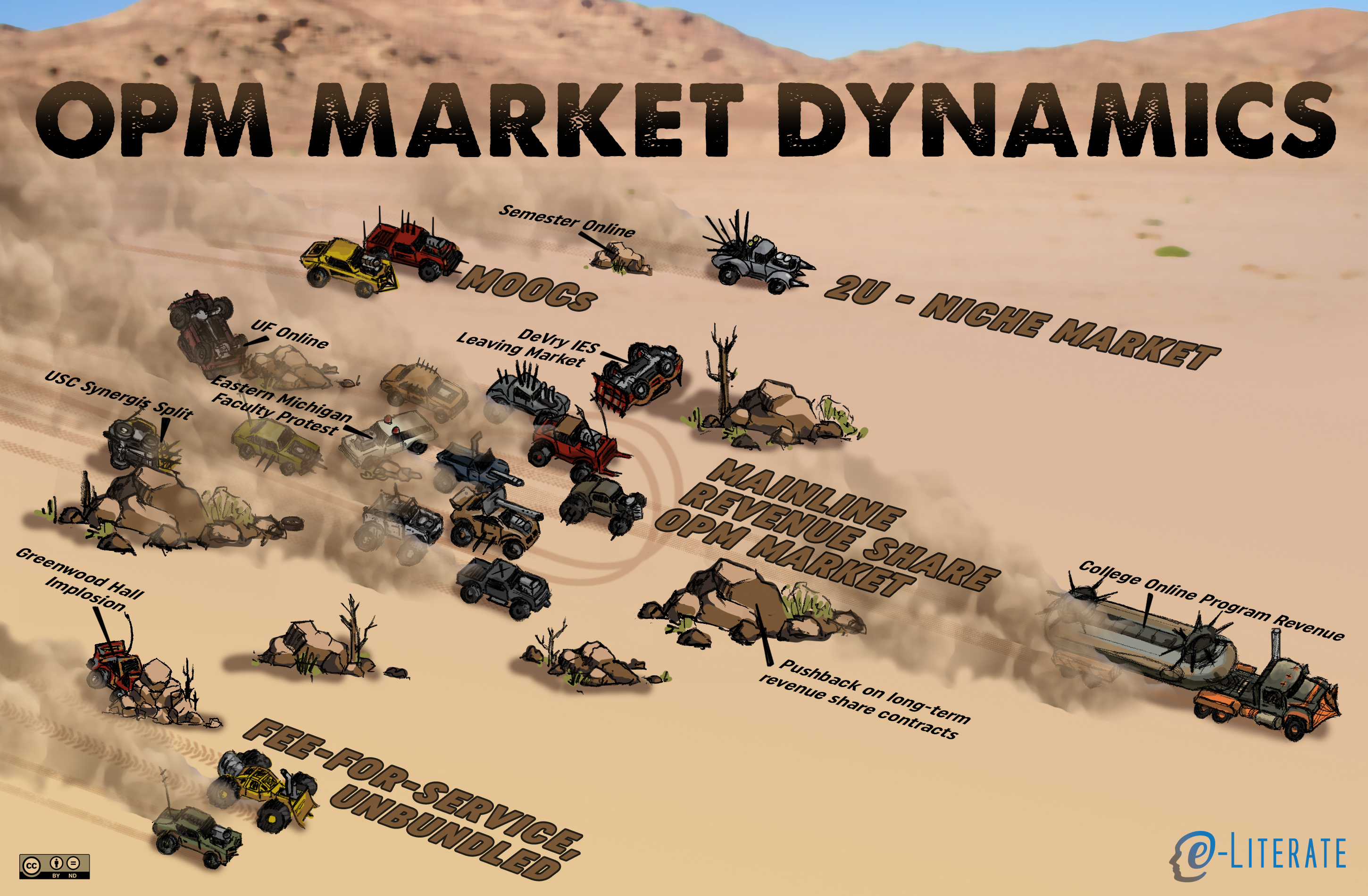
A couple of weeks ago, our response to Open SUNY’s Request for Information (RFI) on Online Program Management services (OPMs), we published an abridged version of our response on our company website and wrote a post about our observations here on e-Literate. Since, then, ExtensionEngine has followed suit. Here’s the introduction to the version that they published on their site:
The online program management (OPM) landscape is a confusing one, the result of rapid evolution and an ever-greater assortment of businesses keen on winning their share of what has become a very lucrative market. We do not envy the task of any institution of higher learning seeking to upgrade their online learning program, and even less one considering the launch of their first program.
A few days ago, MindWires — a strategic consultancy and advisory firm — took an unusual step, one that begins to make the task a little easier by increasing transparency among all of these diverse providers: they published their response to a request for information (RFI) from the State University of New York (SUNY).
The action reflects — and begins to correct — concerns expressed by MindWires’ Michael Feldstein in a series of articles regarding the complicated 2018 OPM market. Greater transparency, as modeled by this move, may be exactly what the marketplace needs to make sense of itself.
In fact, the SUNY RFI itself has made a contribution to greater clarity. This RFI was more than a request for information on what various providers could do for them; rather, it asked the question: What do we need to know before we move forward? Asking for this guidance before generating a request for proposal, or RFP (which will come later), was a brilliant and insightful move on SUNY’s part.
The SUNY RFI listed 15 information-gathering objectives. As we formulated our own response, we noticed that we were, in effect, creating a road map through the wilderness of the 2018 OPM market, one that could be valuable to many institutions of higher learning that are thinking of creating or upgrading an online learning program. Some sections are more pertinent to multicampus systems like SUNY’s, but much of the road map applies to any institution, regardless of size.
For those who are not familiar with ExtensionEngine, we are a professional services organization that designs, builds, launches, and markets custom learning experiences — an integrated, holistic experience designed for learners, pedagogy, vision, and brand. We are a fee-for-service partner — no revenue sharing — and are paid by the hour to provide a full suite of services to help our clients to create successful online learning.
So, in the spirit of transparency inspired by MindWires’ publication of their response, we are following suit to share portions our response to SUNY’s RFI. Below is a substantial excerpt from the road map through the OPM landscapewe created for SUNY, shared with their permission.
This is great stuff. In mature product categories like the LMS, this kind of sharing can do more harm than good, because schools tend to just copy and paste requirements without giving a lot of thought about or investigation into which requirements are right for their particular context. But in the still-maturing OPM and broader Digital Enablement Solutions product categories, this kind of sharing helps to surface the differences in needs and contexts that lead to different kinds of optimal solutions. Publishing both the requests and, at least, abridged versions of the responses is very helpful in advancing the conversation. As ExtensionEngine’s Scott Moore noted in the blog post, such responses can “creat[e] a road map through the wilderness of the…OPM market.”
More transparency in this space would be extremely helpful at this time. We’re giving some thought into different ways to accomplish that aim.
It is almost exactly the six-month anniversary of the Empirical Educator Project’s (EEP’s) first annual summit at Stanford University. The thesis behind EEP is simple: We believe that one of the biggest barriers to increasing student access and success in US higher education is a failure to communicate. We see substantial innovation and progress happening across the sector, from individual classrooms to entire university systems, from access-oriented institutions to research universities to vendors of all shapes and sizes. But for a variety of reasons, the lessons being learned rarely travel far. We believed that if we could just get the right people talking to each other and sharing their work with each other, then good things would happen.
That’s it. It was that simple.
Six months ago, we tried it for the first time with about 50 hand-picked people for one and a half days. Most people there knew less than half the people in the room. That was one of our goals; we wanted to get people talking across the normal boundaries of their peer (or customer, or competitor) groups.
Early indications are that we succeeded beyond our wildest hopes. The group generated somewhere between 15 and 20 project collaboration ideas, many of which have been active even over the summer months. We haven’t written much about the ongoing work because we’ve been waiting for the participants to feel they have made enough progress on their respective projects that they are ready to talk about them publicly.
Today, I am happy to tell you about the first EEP collaboration that has crossed that threshold. Here’s the text of an announcement from James Madison University’s (JMU’s) department of Psychology:
Since that time, JMU faculty member Dr. Jeanne Horst traveled to CMU to engage in training offered by the Eberly Center for Teaching Excellence & Educational Innovation in June 2018. During the 2.5 day Teaching As Research Institute, Dr. Horst engaged in conversation about evidence-based teaching and learning practices. She and the CMU professionals shared experiences regarding the process of developing and implementing intentional curriculum and instruction in higher education and assessing its effectiveness.
In July 2018, JMU hosted our CMU colleagues Mike Melville and Elizabeth Whiteman for training offered during JMU’s week-long national award-winning Assessment 101. During this training, JMU faculty and graduate students offer practice-orientated materials and build skills regarding student learning outcomes assessment.
In August 2018, Dr. Marsha Lovett traveled to JMU to observe JMU’s large-scale Assessment Day. In addition to learning about how to plan, proctor, and engage students during institutional accountability testing, Dr. Lovett also observed a focus group to elicit students’ perceptions of general education courses. She also met with JMU faculty and graduate students to plan the next steps in our strategic partnership. JMU faculty look forward to sharing our expertise in assessment and measurement with CMU faculty while gaining additional knowledge and skills associated with creating and implementing evidenced-based programming from the experts (and our friends) at CMU.
JMU and CMU are about half a day’s drive from each other. They are both (underrated) top-tier universities. Each has particular areas of strength in applied learning science research that complements the other’s. And yet, they didn’t know about each other until they met at EEP. That one meeting was all it took to trigger three rather substantial reciprocal campus visits—one in June, one in July, and one in August—to learn from each other and to develop what JMU is now publicly characterizing as a “strategic partnership.”
The EEP network has quite a few other such pots simmering on the stove that you’ll be hearing more about in the coming months. Not all ideas for joint efforts will bear fruit, and not all EEP participants are engaged in successfully progressing projects yet. We at e-Literate are still learning how to reduce the friction that inhibits successful collaboration. But we are off to a fantastic start, thanks in large part to the amazing folks in our first EEP cohort.
Here’s an e-Literate TV video of several CMU Simon Initiative and Eberly Center faculty talking about their view of learning science:
And here’s JMU’s Sara Finney talking about their approach to course and program effectiveness assessment in her lightning talk at the EEP summit:
Peanut butter, meet chocolate.
Stay tuned. We’ll have more good stories to share soon.
If you spend some time browsing the Google News search results for ‘OPM “revenue share”‘, you’ll find one industry figure who seems nearly ubiquitous, particularly in pieces by general audience news outlets: John Katzman. Mr. Katzman, currently the founding CEO of OPM company Noodle Partners, is one of those rare individuals who has been extremely successful as a serial entrepreneur in education. He founded both Princeton Review and 2U before going on to start Noodle. In his current incarnation as Noodle Partners CEO, Katzman is waging a publicity war against the OPM revenue share model that companies like his last one—2U—are built on. Josh Kim’s recent interview with him in Inside Higher Ed is quite revealing and tells us a lot about the real debate surrounding OPM revenue sharing.
In three years, no one will be able to explain why it was that colleges and universities continued to hand more than half of their tuition to companies marketing and supporting their online programs — the online program managers. It will be even more challenging to explain why some agreed to contractually share their tuition for the next 10 or 15 years.
In that same piece, Katzman referred to traditional OPM revenue sharing agreements as “payday loans” and wrote,
I’m suggesting the time for the ‘share the bounty’ approach to online education is over. This approach is driving up education costs (and student debt) and fueling a marketing race as schools and online program managers spend more and more to recruit and retain online students.
That online program managers continue to sell their outdated and misaligned tuition-sharing model fuels the suspicion and mistrust educators have for for-profit education companies. Those of us who believe for-profit investment and innovation can improve the quality and accessibility of education are obligated to raise our voices when things go off the rails or become ineffective or outdated – as the revenue sharing model has….
Few, if any, institutions can afford to share their tuition and none can afford the all-out marketing war that outside companies will be all too happy to wage for a cut of the action.
The good news is that the market knows a change is coming. Tuition-sharing percentages are trending down and contracts are getting shorter. More colleges are investing in in-house solutions to recruit and manage their online offerings. And fee-for-service management options like the one my company offers are also becoming more abundant. That’s progress.
Pretty harsh words, especially from a guy who founded one of the most successful OPMs in the industry. Has Katzman softened his stance in the last two years?
Nope.
Here’s what he says in response to Josh’s question about whether the OPM industry should form an association:
My job is to decimate the OPM industry, which is driving up higher ed tuition. So … perhaps, but doubt they’d want me in it.
Clearly, Katzman is on a mission to kill revenue sharing agreements. Here’s what he says in response to Josh’s question about how universities can manage the up-front costs of building an online program without revenue-sharing agreements:
Some traditional OPMs are trying to position us as fee for service, but Noodle also offers a temporary revenue-share option in which we fund a program and take on all risk. The school pays a share of revenue, but only until we have recouped our out-of-pocket expenses for its programs, after which it pays for actual services. This is the best of both worlds, and about half our schools take advantage of it.
Wait. What?
Noodle Partners’ position gets flattened into “revenue sharing bad,” partly because it makes good headlines, partly because Mr. Katzman knows it makes good headlines, and partly because Noodle Partners’ position has evolved. According to the Wayback Machine, Noodle Partners’ 2016 version of their web site said the following about financing:
Choosing to work with Noodle Partners is the most affordable route to great, quality online programming. While there is an up-front investment necessary to launch your programming, Noodle Partners can work with you to get outside capital from a trusted, low-interest financing partner.
But if revenue sharing isn’t the core problem that Noodle Partners is intended to rectify (anymore?), then what is? Is it the bundling? Here’s what Mr. Katzman says to Josh on that point:
[U]nbundling isn’t exactly what we’re doing. A program needs instructional design, marketing, recruiting, funding, technology and support services; we’re just comfortable with helping a school build capacity rather than use outside providers exclusively. Any way our competitors follow us, though, they will leave Noodle as the leader in the next-generation OPM space.
In my last twoposts, I talked about OPMs being long-term partners in the ongoing management of online programs. I also argued that unbundling of services opens up a world of possibilities for solving different problems, and that we therefore need an umbrella product category called “Digital Enablement Solutions” with other (emerging) subcategories that could live along side Online Program Management. Noodle Partners isn’t unbundling services but is rejecting the model of the long-term full-service management of online programs by the company.
So what does that make them?
I would call the service that Katzman describes “Online Program Enablement (OPE).” In this model, the vendor may offer revenue sharing or some other form of financing designed to cover the up-front costs of full-service support for the program launch, but then unbundles those services to some extent and allows customers to pay for them as needed on a fee-for-service basis. That shift in models after the program launch is what distinguishes an OPE from an OPM.
Katzman characterizes the shift as “next-generation OPM,” but the resulting service really solves a different problem than an OPM does. If you think your institution is best served by focusing on its current core competencies and outsourcing the lion’s share of online program management work to a specialist on an ongoing basis, then an OPM service is what you want. If, on the other hand, you want full-service support (and financing) to launch your program but want to take over management of significant portions of it once it is up and running, then an OPE service is really what you want.
How much OPM and OPE services are ultimately going to compete or just co-exist is an open question. At the moment, we don’t see a lot of evidence that OPE growth is coming at the expense of OPM growth. There is likely a Venn diagram of potential customers between the two product categories, but we won’t know the size of the overlap for a while. In fact, we have very little visibility into OPE growth, in part because many service providers are offering multiple pricing options these days. There’s still a lot of improvisation going on without a lot of thought about how tinkering with the pricing model changes the offering enough to put it into a different product category.
The main point, once again, is that many significantly different offerings are getting crammed into the OPM product category because it’s the only product category that we have. This obscures the fact that some of these services are different enough from each other that they solve different problems from each other. And the differences that tip an offering into a different product category are not always obvious.
There are several factors that are major contributors to the current rush to by vendors to call themselves OPMs:
The variation between kinds of programs that universities are looking to launch is significant and increasing. As a result, different OPM vendors are specializing in different kinds of programs.
More universities are making fine-grained choices about which aspects of their online programs they want to outsource to a specialist, which aspects they want to pay a consultant to help them get started or improve, and which aspects they believe they can do themselves. This broadening out of customer choices is creating further variability in in OPM business models and OPM-like services offered by an increasingly wide range of companies.
As the OPM business disaggregates, universities are increasingly recognizing that certain functions that OPMs perform, like recruiting students who are likely to be successful in a program, redesigning courses to maximize student success, providing early interventions to promote student success, and working with employers to help with career readiness and post-degree employment are all services that might be useful for improving the success of their traditional programs.
This last point is especially important. Within the three-letter acronym OPM, the “P” and the “M”—”program” and “management”—are defining features of the product category. OPM is a service in which the vendor actively manages at least some substantial subset of a full online programfor some significant period of time. As in multiple years. Once customers start contracting for individual services a la carte on a relatively short-term basis—say, just to get the program up and running—those customers are no longer paying for an OPM service. They are paying for some other digital enablement service which may not yet have a widely used name.
Because this distinction can be a little fuzzy, it helps to have a case study. Luckily, we have one. Open SUNY recently released a Request for Information (RFI) for vendors that can help them meet a wide range of ambitious goals. While the term “OPM” was never used in the RFI, it’s pretty clear that the request was written specifically to include questions that one might ask of an OPM service provider. MindWires, our consulting company, responded to that RFI. Because we think the answers we provided to SUNY might be useful to a wide range of colleges and universities, we have published a shorter, edited version of our response. Because that response includes fairly detailed descriptions of our consulting services, we have published it on the MindWires site rather than here on e-Literate. But some less commercial discussion of SUNY’s request is also appropriate for the blog because it sheds some light on the challenge defining the product category in a useful way.
SUNY’s Goals
In their RFI, Open SUNY enumerates quite a few ambitious and complex goals (even before accounting for the fact that these goals are for a system of 64 diverse and independent colleges and universities):
Opportunities to position SUNY as a unique provider of educational opportunities for all learners;
Reaching the millions of New York residents currently not enrolled at a SUNY campus, who need higher education to be more effective on their jobs;
Significantly expanding SUNY’s online learning experience to serve exclusively online students who are currently not at a SUNY campus;
Potential next-generation innovations in online/digital education where SUNY may have a unique opportunity to leapfrog competition;
The most appropriate ways to productize SUNY’s vast educational offerings to prospective students;
Business and revenue sharing models to incent behaviors, ensure sustainability and provide campus/System revenue growth;
Opportunities to capture students SUNY is losing to other online schools generating revenue for investment in our campus operations;
Outreach and marketing plans that reach a broad range of key stakeholders, including potential students in-state and out-of-state, internal staff and professors, and other key stakeholders as identified;
Platforms and services to expand SUNY’s current online environment and enrollments to challenge current leaders in the field;
Insights into the type and structure of programs appropriate for this platform/business model;
Requirements to continually align educational opportunities with labor market needs;
How to best integrate SUNY’s 64 campuses and their faculty into this improved platform/business model;
The impact of the changing demographics in New York, as well as surrounding states and potential global opportunities;
Partnering with interested industry leaders, including other university systems;
Consideration of prior learning assessment as part of the improvement to this process.
Much of this sounds like classic OPM work. For example, “[b]usiness and revenue sharing models” and “outreach and marketing plans” are classic elements of an OPM solution.
The revenue sharing model is both particularly characteristic and widely misunderstood. Revenue sharing is best understood as a service offering. It’s financing. When I bought my last car from the dealer, I got a loan from them to help pay for the car. There were other ways that I could have financed the purchase. I saw the prospect of owing money and paying interest to the car company as a feature rather than a burden because the specific terms they offered were advantageous relative to other options I had at my disposal. In my case, I was buying a new car that cost more than the cash I had on hand. So I needed to take a loan from somewhere. But at 0.9% interest, I might have decided to take the loan even if I had the cash. I might have decided that the interest rate was low enough that I’d prefer to hold onto my cash.
In SUNY’s RFI, they specifically ask for information about “business and revenue sharing models” because the system wants “to incent behaviors, ensure sustainability and provide campus/System revenue growth.” The revenue sharing model, which is also a risk sharing model, theoretically aligns the vendor’s incentives with the customer’s. Again, theoretically, the vendor makes money only to the extent that the new program is successful. In order for companies to share the risk, they generally want some of the control in addition to some of the revenue. They want some ability to influence decisions that impact the program’s success. This kind of arrangement only makes sense for both parties when the customer wants the vendor to actively manage parts of the program on a long-term basis because they believe their program will have a higher likelihood of success if the vendor does so. Management is a particular kind of enablement where the service provider actively oversees a particular function that the customer doesn’t feel is their core competency (like online marketing) so that the customer can focus more energy on in-house areas of strength (like curriculum).
So here’s a rule of thumb for defining the shape and boundaries of an OPM service: If a reasonable person could believe that a revenue sharing arrangement is a rational option for paying for the program (regardless of whether the customer chooses that option), then the service may well be an OPM.
Conversely, if a rational person could not believe that revenue sharing is a rational choice, then it probably isn’t an OPM service. Revenue sharing isn’t definitional for OPM, but it is an indication of the kind of close, ongoing reliance on the vendor to actively manage the program that is the hallmark of an OPM service. One could imagine a customer having one or more of SUNY’s goals and not wanting a full program management service. Take, for example, “[p]latforms and services to expand SUNY’s current online environment and enrollments to challenge current leaders in the field”. This could be as simple as an LMS or a courseware platform. It’s hard to imagine a university or system signing a revenue-sharing contract with their LMS vendor. A learning platform, or even a course registration portal, would be a kind of digital enablement service. But it would not be online program management.
I’ve been very careful so far to refer to OPM as a service. “Solution” or an “offering” also both work. But I have deliberately avoided talking about OPM companies. Such beasts do exist. 2U and Academic Partnerships are two well-known examples of fairly pure-play companies that are known for offering full-service, revenue-sharing online program management solutions. But once companies start to unbundle their offerings to the point where it no longer makes sense for customers to think about paying for what they are buying via a revenue-sharing agreement, then those companies are offering both OPM and non-OPM digital enablement solutions. Since the sector doesn’t have product category names for those other solutions, they tend to get called OPM services. But prospective customers should think about them quite differently. In one case, the business arrangement should maximize the alignment of incentives between long-term partners. In the other, the customer might well want the opposite, i.e., to minimize long-term dependence on the vendor.
Generally speaking, true OPM solutions make sense when a college or university is looking to launch a new, differentiated, free cash flow-generating online degree or certificate program. Many of those words can be boiled down to one: Money. The college or university (or system) wants to create an offering that, among other things, pays for itself and generates free cash flow—i.e., leftover money after covering certain core expenses—to spend on fulfilling other aspects of its mission. It’s a new program, and maybe even a completely new kind of offering for the school, so it’s more likely that the institution will need ongoing help with certain aspects of the program. Since there are a million billion MBA programs online already (for example), a new MBA program would need to be differentiated enough to draw students. Otherwise, it won’t generate money. Many colleges and universities know how to create traditional face-to-face programs that are differentiated and will bring in more money than they cost. Fewer know how to launch and run one online. Or, honestly, would want to. There are all kinds of tricks to marketing online programs successfully. Managing seamless registration is hard. Managing, say, live nurse practicums to support an online nursing degree program is hard. Running the registration, LMS, CRM, learning analytics, accounting, and other software, tuned to work together for an online program, is hard. Some schools just don’t feel like they want to put their money and energy into learning how to do these things well enough to run an excellent program. That’s where an OPM offering—which is almost always some flavor of lasting partnership between the school and the vendor, regardless of financing arrangements—can look attractive.
There is a lot of attention being paid to a-la-carte, fee-for-service models within the OPM product category. We think that much of the activity in a-la-carte falls into one of two situations. First, a lot of OPM service providers tinker with the details to customize their service a bit. “Would you like to hire us for only 80% of our full service portfolio? OK, we can take these things off the service agreement (but not those others).” “Would you like to finance partly with loans rather than revenue sharing? Or use a down payment to reduce the size of your long-term payments to us? You can do those things.” The other situation is that the customer is looking for digital enablement but not online program management. They want help to get up and running. Maybe they’ll continue to contract out a couple of things, like help desk or marketing, but for the most part, they expect to manage the online program themselves. We’re not seeing a lot of activity in the middle ground between these two types of situations. That supports our belief that these are really two distinct product categories. True a-la-carte digital enablement services that do more than tinker around the edges are not OPM services. That doesn’t make them better or worse. It just means that they solve a different problem.
There’s one more point worth making about the boundaries of “OPM” which is specific to SUNY’s situation. Precisely because online program management requires a very close, ongoing collaboration between the school and the vendor, many OPMs sell first not to universities but to individual schools within a university. First they may develop a relationship with the business school. Maybe they’ll use that to get a referral to the nursing school. And so on. That way of working cuts against the grain of a large, diverse, and decentralized system like SUNY. I used to work at SUNY Systems Administration, and I still know people both in the central offices and out on the campuses. It’s very difficult to get SUNY to do anything in unison as a 64-campus system. Nor is that abnormal for a large, diverse state system. The kind of slow consensus-building and respect for autonomy required to galvanize group action in that kind of environment is hostile, if not outright antithetical, to kind of joined-at-the-hip relationship required for a successful OPM partnership. SUNY can vet and pre-negotiate with OPMs for adoption on a campus-by-campus basis. They can contract for system-wide digital enablement services where campuses can opt-in. They can even build their own sort of system-internal OPM (which would not be entirely different from the function of the original SUNY Learning Network). But we don’t see any evidence that a traditional OPM service could be successfully implemented as the default partnership system-wide in an environment like SUNY. To reach that kind of scale in that kind of environment, the State of New York will have to come up with something truly innovative.
We are seeing a tremendous surge in interest regarding Online Program Management (OPM) companies. Certainly many of the major higher education news outlets are running stories on them and many analyst firms are publishing white papers. That’s a sign that others who pay attention to this space are hearing…something. But it’s not a strong signal by itself.
In our own work, we are definitely hearing more interest in OPMs, and we are also hearing from OPM companies (and OPM-like companies) that there is a pick-up in incoming requests from universities. For example, we had an opportunity to facilitate an institution-wide approach at UCLA to vet and pre-qualify OPM vendors as individual colleges determine their online strategy. There was a pretty robust and diverse range of responses. Equally importantly, the pre-qualification approach indicates a sense that different schools and other stakeholder groups within large universities or systems may have different needs.
You can see this as well in Open SUNY’s system-wide Request for Information (RFI). Here is one of the largest university systems in the country, and they are essentially casting a wide net, asking, “What do you think we should know about this space in order to serve our 64 very different campuses with a wide range of needs, while also serving the needs of the system as a whole?”
That wide open RFI from SUNY really speaks to the good news/bad news of the current state of the OPM market. The good news is that there is an increasingly broad range of options for colleges—or schools within those colleges—with different needs. The bad news is that the market is such a mess right now that it’s hard for colleges to find the right vendors to talk to and hard for vendors to find potential customers who need what they’re offering.
A lot of the analysis we’ve seen so far has been variations on a theme: “There’s a lot of [mostly unspecified] innovation in the the OPM market. For example, revenue sharing isn’t the only financial model anymore!”
While there is indeed increasing variation in the OPM space—only some of which we would call genuine “innovation”—we believe the expanding range of financing options is the tip of the iceberg. The deeper cause of the current chaos in the market is largely the result of a more profound broadening out of demand. This, in turn, is driven by a tectonic shift in how universities go about fulfilling their core mission of enabling student success. As new change management needs emerge, we don’t yet have names for the solution categories that meet those needs. But since the new solutions share elements with solutions to online program management problems, everything is getting lumped under the heading of “OPM.”
There are several factors that are major contributors to the current rush to by vendors to call themselves OPMs:
The variation between kinds of programs that universities are looking to launch is significant and increasing. As a result, different OPM vendors are specializing in different kinds of programs.
More universities are making fine-grained choices about which aspects of their online programs they want to outsource to a specialist, which aspects they want to pay a consultant to help them get started or improve, and which aspects they believe they can do themselves. This broadening out of customer choices is creating further variability in in OPM business models and OPM-like services offered by an increasingly wide range of companies.
As the OPM business disaggregates, universities are increasingly recognizing that certain functions that OPMs perform, like recruiting students who are likely to be successful in a program, redesigning courses to maximize student success, providing early interventions to promote student success, and working with employers to help with career readiness and post-degree employment are all services that might be useful for improving the success of their traditional programs.
The common theme with all three factors is that customers who think they are all looking for “OPMs” are, in fact, trying to solve a wide range of different problems. So wide a range, in fact, that the term “OPM” is on the verge of becoming meaningless.
We believe that all of these needs belong under a larger umbrella that we call “Digital Enablement Services.” In general, colleges and universities are beginning to move from having a philosophical commitment to student success toward operational excellence at enabling student success. The idea here is to use modern tools—and more importantly, the educational practices and organizational processes enabled by those tools—to do a better job of making sure that students don’t fall through the cracks.
It’s easiest for universities to see the need to improve their operational excellence when they are launching a new, (hopefully) revenue-generating and net cashflow-positive degree or certificate programs. They are making a substantial upfront financial investment in the hope that future tuition will make that investment pay off for the university as well as for the students. To do this, they need to keep students happy enough that they stay in the program, even as the university loses the traditional face-to-face touchpoints that they have relied on to engage with their students and have to figure out how to build digital equivalents. It can feel like a scary (and potentially career-ending) undertaking. This is why 2U—a publicly traded OPM with a $3.9 billion valuation—made a smart branding choice with their tag line, “No back row.” ((Disclosure: 2U is one of the sponsors of the Empirical Educator Project.)) It is also why universities have been willing to accept revenue share arrangements. They reduce the up-front cost of the program—sometimes to the point of making an otherwise unaffordable program possible—and shift some of the risk to the vendor in return for a share of new revenues and some sharing of control over certain aspects of the program design and management.
There is increasing interest from universities to step away from revenue sharing agreements and be more selective in how they use external vendors to plan, launch, and manage new online programs. That’s a real trend, though it is being somewhat hyped by shallow market coverage and some industry players who are looking to differentiate themselves against more established competitors. As far as we can tell, there is growth across the different models, particularly since the range of program types universities are looking to offer increasingly have different kinds of risk profiles.
Think about the differences in launching and running the following different types of programs: (1) a largely synchronous online nursing degree, including a required face-to-face practicum at a hospital, (2) a mostly self-paced, competency-based MBA, (3) a “micro-masters” degree in cyber-security, and (4) a code academy. Think about what it would take to design and launch each type of program, how much new expertise each would require of the university, how much support the students would need in each case, how hard it would be to recruit students, to track them in the existing ERP system, and so on.
Given the differences in these challenges, there should be demand for significant variety in OPM services with different sweet spots. OPMs with different models do end up competing head-to-head in the market sometimes, but that’s partly because customers don’t yet have a good way of sorting out what kinds of characteristics are most important to support their specific goals. In its current state, the market isn’t efficient at enabling customers and vendors to determine if there’s a good fit.
The chaos we are seeing now is nothing compared to what’s coming. Universities are beginning to see needs for OPM-like services elsewhere. As budgets continue to tighten and pressure to improve outcomes continues to rise on public colleges and universities, academic leaders are increasingly realizing that improving degree completion and decreasing time to degree are good for both the student and the financial health of the institution. At the same time, changing student expectations are putting pressure on high-end private colleges and universities to recognize that the formula which has made them successful for the past century is not guaranteed to bring them top students and generous alumni in the next one. This has the potential to be a Pandora’s box. Where is the line for defining an OPM? And how can universities find vendors with the kinds of OPM-like services and business models that are appropriate for helping solve their particular problem?
Over the next months, we at e-Literate are going to try to put some definition around this market, first by defining the boundaries of the OPM solution category—and the variation within those boundaries—and then by naming and defining other, similar-looking solution categories that solve different problems. We will be blogging about it and releasing at least one report about it as well.
I’ve written about how Instructure has, by our count, tied and (very) slightly surpassed Blackboard in US market share. Blackboard didn’t love that story. You know who else didn’t love it?
Instructure.
Up until now, Instructure has gotten enormous mileage out of playing the role of the scrappy underdog. Here’s co-founder Brian Whitmer reflecting on the company’s cultural roots in response to our reporting:
We showed up on the edtech scene in 2008, and people were more than happy to not just give us the time of day, but to unload their frustrations with Blackboard — and ideas for new hotness they were afraid they’d never see. Blackboard was really stinking it up from what we could tell. We crashed their user’s conference in Vegas after a few years and told everybody we were the anti-Blackboard. We didn’t need a better value prop than that. Just “not Blackboard” and a bunch of t-shirts was enough to get people excited.
At InstructureCarn 2018, current employees also admitted that the company preferred the role of the insurgent and that being perceived as the market leader is a fraught position for them.
Both because of that change and because they are now a publicly traded company, Instructure is in the process of becoming…something else. We’re not sure what it is yet, exactly, although there are some signs of what may be to come. Whatever it is, it will have to be more of an adult company. Instructure can’t get away with crashing the other guy’s party and passing out snarky T-shirts anymore. It has to grow up.
Along the way, there will be embarrassing and unsightly blemishes. There will be social awkwardness. There will be break-ups and friends lost. InstructureCarn 2018 marked the company’s transition into full adolescence. Officially, Instructure is 10 years old. But functionally…well…welcome to 8th grade. Good luck in junior high, kid.
Who are you and what have you done with my CEO?
The first sign of…the changes…came early in the conference. Instructure CEO Josh Coates is known for giving odd, almost stream-of-consciousness keynotes that appear to have little direct connection to the company and yet somehow, almost inexplicably, charm the audience while arriving at an unexpected and heartwarming ending.
Not this time.
In an awkward attempt at self-deprecating humor, Josh managed to insult adjunct faculty. He also made comments that irritated disability advocates and fans of the humanities in the audience. While none of these gaffes felt egregious to me, they were far enough off-target that you have to wonder whether they would have slipped through the filter had Coates had the benefit of review from now-departed executives who helped prepare for so many previous InstructureCons. At the same time, the audience reaction was more strongly negative than I’ve seen from an Instructure crowd before—to anything, really, including idiosyncratic and announcement-free CEO keynotes that would have set off riots at other LMS conferences. When you are a teenager (or market leader), your friends become less forgiving.
But hey, maybe all will be forgotten once Josh brings out the special guest. Who will it be this year? They Might Be Giants? Jewel? Nope. This year it was…drum roll please…
New Instructure President Dan Goldsmith!
What’s going on here? The most obvious explanation is that Josh, like much of the rest of the executive management team that took Instructure public, is likely getting ready to move on. Goldsmith is being groomed/auditioned as a successor, and part of that means preparing customers for this change.
It’s delicate. Nobody at Instructure said this is what’s happening, but they weren’t exactly hiding it either. Our analyst interview with the executive team seemed like part Coates coaching Goldsmith on how to handle us given our quirky role in the industry and part Goldsmith demonstrating that he has done his homework and understands the company.
For whatever it’s worth, our first impression of Dan is positive. He does do his homework, he did show an understanding and appreciation for the importance of the corporate culture, and he generally comes across as a nice, bright, adult human. ((You should know that my initial positive impressions of EdTech executives do not correlate well with future performance. Phil tells me I have too much faith in humanity.))
But his résumé portends other changes that might come with growing pains.
Get a job, kid
Instructure’s detractors are fond of reminding us that the company is not profitable. The company does indeed face some specific financial pressures now that it is publicly traded, although boiling it down to profitability is a bit of an oversimplification. Under certain conditions, investors will happily tolerate unprofitability in their investments for long periods of time. Amazon is the canonical example of this. The two things investors want to see from Instructure are (1) growth, and (2) indications on the balance sheet that the company is unprofitable only to the degree that it is choosing to invest in that growth (rather than because it simply can’t be profitable).
Instructure has three major options for growth, none of which will be easy:
Selling new products to existing customers: Both Blackboard and D2L have portfolios of products that they can sell to their existing customer base. (They can also sell these products to schools that don’t use their LMSs, but it’s often easier and cheaper to sell a second product to an existing customer than a first one to a new customer.) Blackboard has a particularly mature set of cross-selling products, including established ones like Collaborate and the new smash hit they have in the Ally content accessibility support system. D2L’s cross-selling success has been a little more uneven, but they do have a reasonably broad portfolio and appear to be doing particularly well at selling services. Instructure is well behind its competitors in this regard. The company backed off plans to sell an analytics data service in 2015 after customers pushed back on having to pay for it. While their Arc lecture capture product and their newer, K12-focused Gauge assessment management system seem to be well received by customers, they have not been runaway commercial successes. Instructure may turn out to have a bit of a sleeper hit on their hands with Practice, a clever video product they recently acquired and have been mostly promoting in the corporate market so far. But at the moment, these are all small ball compared to the kind of growth that their investors expect.
Growing internationally: All the major LMS vendors are looking abroad to new markets. Much of the world is running self-hosted Moodle. As distance learning grows in popularity in a given country, the LMS becomes more mission-critical. Students and faculty become more demanding about issues like downtime and usability and universities become more willing to spend money on their LMS. Given the potential size of the international market, this isn’t necessarily a zero-sum game for the LMS vendors—including Moodle support vendors. There is room for everyone to grow their respective businesses. Theoretically. In practice, there is no such thing as an “international” market. There are many national markets. Each one is different, each requires investment in product feature development, sales, and marketing, and each is growing at a different rate. International growth is hard, expensive, and often slower than casual observers might imagine.
Growing into the corporate market: With Bridge, Instructure has entered the corporate LMS market, which is substantially different from the educational LMS market in quite a few ways. The required functionality is different, the sales process is different, and the market is much more crowded and fragmented. Of the three opportunities for growth, this is the one that has the most potential to distract the company from its current core customer base. It is also the one that Wall Street seems most obsessed with.
I’ve written recently about the pressure that Blackboard is under due to its private equity (PE) ownership and the heavy debt burden they placed the company under. It’s important to understand the differences in the pressures on a PE-owned company like Blackboard versus a publicly traded one like Instructure. It’s a little bit like the difference between waterboarding and Chinese water torture. ((Also known as Spanish water torture, depending on your cultural frame of reference.)) In the big picture, Blackboard has a more mature product portfolio and—as far as we know based on limited public information—likely has better business fundamentals than their LMS market share trend line would indicate. But the combination of having a heavy debt burden and PE owners who typically want to be corporate “house flippers” makes the company vulnerable to sudden drastic measures imposed on them by outside forces. In contrast, there are few, if any, individual shareholders that can force Instructure to make drastic short-term moves. A single sudden stock price drop like the one that happened last week won’t force the company to make dramatic changes either. But the drip, drip, drip of investor pressure over time can eventually force a company to change course if that pressure isn’t actively managed.
Enter Dan Goldsmith.
I’d like to speak to your father, please
Here is how Goldsmith is described in the press release announcing his new position at Instructure:
With more than 20 years of experience in software and services, Goldsmith’s career is marked by directing high-performing global teams and achieving outstanding penetration and growth in challenging markets. Goldsmith spent the last eight years as a senior executive at Veeva Systems, a cloud-based software company, where he started and ran Veeva’s international business, led the company’s strategy in new markets and products, and most recently was responsible for Veeva’s global engagement and growth in strategic accounts.
“It is an exciting time for Instructure. We are well positioned for success as we focus on the continued growth of Canvas, expansion of Bridge, and international execution,” said Josh Coates, CEO of Instructure. “Dan’s energy, creativity and proven track record in driving go-to-market strategies and rapidly scaling businesses make him a tremendous addition to Instructure at the perfect time to lead us through our next phase of growth.”
Goldsmith was one of the first 50 employees at Veeva. He helped lead the company through a successful IPO and a growth path to a $10 billion market cap. Prior to Veeva, he worked in various executive positions at top companies, including Accenture, PwC and IBM. During his years in management consulting, Goldsmith led initiatives in global markets and developed new offerings. Goldsmith will have an immediate impact on Instructure’s strategy. His initial focus will be on market growth, with the sales leaders reporting directly to him.
Here’s a guy who has international business development experience, knows how to sell to the corporate market, has built out product portfolios, and would likely be perceived as a familiar, comforting presence by Wall Street analysts.
Friends, meet Instructure’s CEO-in-waiting:
Instructure President Dan Goldsmith
Assuming the trial period goes well, I think it likely that he will be promoted to the top job within 9 months. The reason I pick this time frame is anything too close to InstructureCon 2019 poses the danger of being a distraction during the most important event of the year for the company.
Goldsmith was working very hard in both formal and informal settings throughout this year’s conference to demonstrate that he understands, values, and intends to protect the company culture. If he’s going to be the dad, he wants to be the cool dad.
Nevertheless, even if he proves himself to be the coolest dad around, there will be changes, likely including the format and feel of the company’s unique and iconic annual conference.
Do you live in a barn?
Phil and I have bothwritten about how company culture has been one of Instructure’s most underestimated competitive weapons and how InstructureCon is the embodiment of that culture to the customers. It’s one of those things that you can’t fully understand if you haven’t experienced it. There’s nothing else quite like it in EdTech.
That is going to change. How much remains to be seen.
We saw some signs this year that Instructure has dialed back on the spending. It was still a spectacle and a unique cultural event. It was just a less expensive one. Carnival rides cost less than pop star appearances. The stage sets—yes, InstructureCon has stage sets, complete with props—were good, but didn’t rise to the Disney Imagineer-level quality of the past. Up to a point, that change is good. As an insurgent, Instructure’s extravagant spending on the conference seemed to successfully communicate the message of “people over profits” to the customers. But as the company is increasingly perceived as the market leader, educators will start looking around and asking themselves, “How much of this money could have gone toward lowering the cost for students or making the product better?”
At the same time, it will be a delicate transition. InstructureCon 2019 will be moved to Long Beach, which isn’t a bad thing in and of itself. Keystone is hard to get to, hard to navigate, and probably too small for the current size of the conference. But InstructureCon 2019 will be held at the Long Beach Convention Center.
InstructureCon has never been held at a convention center.
The company is going to have to pull off the transition to a more conventional (and cost-effective) venue without losing the gravity-defying magic of the ultimate unconference atmosphere they have managed to conjure consistently, year after year. And they may only get one shot at this. If customers walk away from InstructureCon 2019 feeling like they just attended any old LMS conference, that could have an outsized impact on their holistic perception of Instructure. That, in turn, may lead them to be less forgiving of mistakes.
Speaking of which…
Did you do your homework?
After announcing two years ago that they would be responding to customer concerns about the limitations of the quizzes and tests functionality in Canvas, Instructure finally delivered “Quizzes.Next,” their major rearchitecture of the quizzing functionality as a set of stand-alone micro services. The truth is that all of the major LMS providers have struggled at different times as the nature of the engineering challenges in LMS development evolve. D2L arguably hit the wall first a number of years ago, when they designed an innovative retention early warning system that was hampered by the core platform’s inability at the time to provide timely and reliable data streams. Blackboard is getting hammered now for their slow progress on Ultra and early mishaps with the SaaS transition (although, in fairness, they are taking on a real beast of a transition on multiple fronts and probably deserve more credit than they get on the technical front). For Instructure, Quizzes.Next turned out to be the publicly embarrassing stumble. ((Maybe I’m taking this adolescence analogy too seriously; I’m starting to have gym class floor hockey flashbacks.))
Decomposing the LMS into micro services is a seriously difficult challenge to think through and get right, both technically and functionally. It’s also critical if you want to be perceived as not just an LMS but a modern, flexible learning platform (or NGDLE, or LMOS, or whatever), which Instructure, D2L, and Blackboard all aspire to be. While it’s possible that Quizzes.Next was under-resourced, we tend to believe the company’s explanation that they just underestimated the complexity of the challenge.
But this won’t be the last such challenge. Between micro services and data analytics, today’s LMS engineering challenges are substantially different and harder than building a grade book that sucks less (which, by the way, is very hard in its own way). Meanwhile, Blackboard and D2L have both raised their game from user experience and architectural perspectives. If Instructure both loses its reputation as the LMS company that’s truly different and makes a couple of more stumbles like Quizzes.Next, the winds that are currently at its back could turn surprisingly quickly.
It’s all part of growing up, dear
Instructure’s unbelievably long age of innocence may finally be coming to an end. That doesn’t mean that it is going to fail or to become the next EdTech company that everybody hates. It does mean that it is beginning to go through some changes, that some of those changes will be awkward and hard, and that the company will eventually grow up to become somewhat different than it has been. Not necessarily better or worse. But necessarily different.
When we were at BbWorld the week before last, Blackboard’s executive management pushed back vehemently on our analysis of how their high levels of debt could impact their business decisions. We heard their strong disagreement expressed in our very first meeting of the conference from Chief Learning and Innovation Officer Phill Miller and in our very last meeting from CEO Bill Ballhaus.
We stand by our analysis. In fact, Blackboard’s pushback had the opposite of its intended effect. We left BbWorld more convinced that we are right rather than less.
But in fairness, there is an empirical fact of the matter here, and we do not yet have conclusive public evidence that the company’s high levels of debt will, in fact, affect their business strategy. So here’s what we’re going to do:
I will summarize their position as objectively as I can.
I will explain why we don’t find their position persuasive.
I will lay out the signs that concrete evidence we will be looking for going forward that will either support or undermine our thesis.
Phil and I will publish updates as we monitor these signs and, if there is no additional public evidence of our thesis by BbWorld 2019 (or strong evidence emerges that we are wrong before then), then we will publish a mea culpa post.
Blackboard’s position
The public kerfuffle of the last couple of weeks has been over our reporting that Canvas has (barely) surpassed Blackboard in US market share. But the focus of the company’s pushback at BbWorld was on the financial claims. The heart of the argument we heard was essentially the same as the one articulated by Blackboard to the Washington Business Journal:
A company spokesperson said in a statement that Blackboard was a “healthy business with a proven and sustainable business model” with strong financial backing from its private equity investors, who have placed hundreds of millions of dollars more over the last two years.
“We have made a strategic decision to focus on the future instead of just quarterly results or debt ratings. Thus, we’ve chosen to focus investments on long-term, market-driving opportunities that meet the evolving needs of our clients, including but well beyond the learning management system (LMS),” the spokesperson said in an email.
We’re not aware of public information about the “hundreds of millions of dollars more” that Blackboard claims their owner, Providence Equity, have placed in the company over the last two years, but Providence’s willingness to continue pouring money into Blackboard going forward is really the key question. Ballhaus argued to us that the amount of debt that Blackboard is carrying is a strategic choice that he and the private equity investors—he used the pronoun “we”—make together. In particular, he argued, “we” could choose at any time to invest more money in the company, paying down debt in exchange for equity. Further, he argued, it’s logical to assume that Providence would do so if needed because “they only make their money if we improve.”
Why it’s not credible
Paying down debt in exchange for equity, called “recapitalization,” is a strong vote of confidence by a private equity (PE) owner. First, since debt holders get paid before equity holders in the event of bankruptcy, it increases risk for the PE firm. Second, it would mean a substantial investment of cash, which is partly what PE firms typically try to minimize by requiring the companies that they own to take on substantial debt in the first place. When PE-owned companies find that they are in danger of being unable to make their debt payments—which both Moody’s and S&P Global Ratings have said is currently the case with Blackboard—the PE owners can and do employ a number of different strategies that are financially less risky to them in order to address the problem, either instead of or in addition to recapitalizing.
For example, when Cengage Learning found itself with unmanageable debt levels after its acquisition by private equity, they filed for bankruptcy:
“The decisive actions we are taking today will reduce our debt and improve our capital structure to support our long-term business strategy of transitioning from traditional print models to digital educational and research materials,” Michael Hansen, Cengage Learning’s chief executive, said in a statement.
To be crystal clear, I am not suggesting that Blackboard is likely to file for bankruptcy. Providence Equity has other options at its disposal, some of which I will write about in the next section.
Rather, the point is that Ballhaus’ claim that we should just assume Providence will see it as being in their interest to recapitalize Blackboard is not credible on its face to anybody with even passing knowledge of how private equity companies work. For example, the tone of the Washington Business Journal article I referenced above, which (obviously) was written by a business reporter, suggests significant skepticism that Providence will not let the company’s debt challenges impact their business decisions. The industry experts we typically consult with when writing financial or business stories like this one were even harsher in their evaluations of Blackboard’s position. Two literally laughed out loud at it.
Further evidence we will be looking for
All that said, there’s a lot we still don’t know. Because Blackboard isn’t publicly traded, we don’t have very good access to their financial information (though Moody’s and S&P do). And we certainly are not privy to the conversations that Ballhaus has with the company’s board of directors. It’s worth noting here that, in addition to being CEO, Providence chose to make him Chairman of the Board. So we will still label our analysis here as a (confident) hypothesis, subject to revision based on further empirical evidence.
Here are a few actions Blackboard could take in the future that would indicate Providence Equity has chosen to push Blackboard to solve its own debt problem rather than making it go away with more of Providence’s money:
Sell off one or more parts of the business: A Bloomberg piece written by journalists from their distressed debt desk reports, “With some of Blackboard’s bonds selling at deeply distressed levels, Ballhaus is crafting a comeback, and possible options include the sale of its payment processing division, said the people, who asked not to be identified because the discussions are private.” Said payment processing division, Blackboard Transact, is a cash cow for the company. If Blackboard sells off one of its more profitable business units at a time when the company is having trouble making debt payments, that would indicate a choice by Providence Equity to find a way to reduce debt pressure that is less risky for them in terms of cash investment but more risky for Blackboard in terms of long-term health. Particularly since Providence already tried to sell Blackboard once and has now owned the company for well past the normal sell-by date that PE companies like to follow, the sale of Transact might suggest further moves to follow.
Unload expenses (like office space): The Washington Business Journal article notes, “Blackboard is also interested in unloading its 70,000 square feet of office space at 1111 19th street, with 12,000 square feet already sublet, according to an April post on Tech Office Spaces. It’s unclear where Blackboard will go if it succeeds in leasing out its entire footprint. Blackboard stood to benefit from a tax rebate program for companies that agree to sign 50,000 square feet for at least a dozen years, valued at half the company’s tenant improvement costs, or a maximum of $5 million over five years.” Of course, companies take cost-cutting measures all the time, regardless of their financial health. The business reporter’s phrasing suggests that he may be detecting a whiff of desperation in the specifics of this transaction. Since that’s his expertise more than ours, we’ll be looking for additional confirmation of our thesis, such as if Blackboard were to…
Significantly restructure with major layoffs: If Blackboard were to move to a smaller office while also laying off employees—beyond those that might leave in a sale of a business division or the slow leak of headcount that the company has been having for a while now—that would certainly be an indicator that Providence is not ready to just give Blackboard the money the company needs to complete a turn-around and is instead pushing them to solve their own financial problems.
Given the sourcing of the first two potential indicators, we will not be surprised if at least those two come to pass by the end of 2018. Time will tell.
What evidence would suggest that our analysis is mistaken? The strongest would be if Providence recapitalizes Blackboard. Even that would not be black and white; for example, Cengage’s owners recapitalized the company along side of having them declare bankruptcy. The details will matter. But a significant recapitalization—where “significant” is defined by the markets and the financial experts—certainly would indicate that Mr. Ballhaus’ characterization of Providence’s willingness to invest further in Blackboard’s success is more accurate than current evidence suggests.
The other thing that could happen is nothing. If a year passes and Blackboard manages to weather the debt pressure without having to make any major moves, then it will only be fair to expect e-Literate to publicly revisit our analysis.
And of course, we are still listening to any arguments that Blackboard executives are willing to make. While they haven’t persuaded us thus far, we have accepted their invitation to keep the dialog going, and we remain open to more persuasive arguments. We will hold ourselves accountable, just as we will hold Blackboard accountable.
But honestly, I don’t think we will need to wait a year for public evidence that Providence is not going to wave its magic wand. I predict we will be writing a follow-up story within six months.