e-Literate

Present is Prologue

Author: Michael Feldstein

  • Cengage Unlimited Draws the Battle Lines in the Curricular Materials War

    Cengage Unlimited Draws the Battle Lines in the Curricular Materials War

    As Phil wrote about recently, Cengage has announced “Cengage Unlimited,” which is being described in various outlets as the “Netflix” or “Spotify” of curricular materials. It’s an all-you-can-eat digital subscription service to Cengage’s complete catalog. Spotify is probably the more apt comparison, both because the Netflix analogy is contaminated and because the music industry is a more apt analogy for the economic pressure this puts on content creators.

    Make no mistake; this is a potential inflection point in the curricular materials market. There is a war raging between curricular materials that are “good enough,” meaning that the lower price has a bigger impact on student outcomes than any differences in the quality of more expensive alternatives, versus “better enough,” meaning both instructors and students believe the product makes a sufficient difference in student outcomes that the more expensive product is worth the premium. Cengage is betting the farm on “good enough” beating out “better enough” and, win or lose, their bet could cause tectonic shifts in how curricular materials are developed, purchased, and used. It will have implications for inclusive access, adaptive courseware, textbook companies, textbook authors, and the landscape of options available to students and teachers.

    (more…)

  • Pearson Open Sources Equella—Properly

    Pearson Open Sources Equella—Properly

    Not too long ago, Pearson contributed the Equella software to the Apereo Foundation as open source software. ((Disclosure: Pearson is a former client of ours and a current sponsor of a yet-to-be-announced e-Literate project.)) Equella, which both Pearson and Apereo refer to as a “digital repository,” might have been called a Learning Object Repository (LOR) in a previous era (and probably was called that back then). Because LORs are considered passé in many circles, and because Equella is not widely adopted, it’s easy to dismiss this as an unimportant story to anyone who is not an Equella customer. But there are some interesting lessons here about Pearson and the market.

    Why Pearson was in the Enterprise Software Business, and Why it isn’t anymore

    In her annual epic end-of-the-year post series, Audrey Watters made some astute observations about recent changes in Pearson’s business vis-a-vis software platforms:

    Pearson announced last year that it was leaving the learning management system market. Pearson does not have a platform. It has a lot of content – it’s still one of the largest textbook publishers. It still runs testing centers and has testing contracts. But Pearson is not a platform.

    Pearson represents an older business model – the conglomerate. Pearson was founded in 1856 in Yorkshire, England as a construction company but expanded throughout the nineteenth and twentieth centuries to own newspapers, book publishers, airline companies, oil companies, electric companies – the information and infrastructure of the material world. Pearson has been – until recently, that is – an active acquirer of education technology companies. That’s how it’s attempted to make a move from the material world to the digital one.

    Pearson has not made any acquisitions this year. Rather it has continued to divest itself of products. It sold a 22% stake in Penguin Random House to the publisher Bertelsmann for about $1 billion. It sold its tutoring companies TutorVista and Edurite to the tutoring company BYJUs. (The terms of the deals were not disclosed.) It also sold its adult language learning company Wall Street English to two private investment firms.

    What’s going on here?

    We don’t have to go back as far as 1856 to understand the company’s entry into and exit from the enterprise software business. Pearson acquired eCollege in 2007 and Equella in 2009. It bought a controlling stake in TutorVista in 2011, which was the same year that it launched OpenClass.

    A few things were going on during this period. First, Pearson had come to realize that they had a monster hit on their hands with MyMathLab. This was the product that proved to the textbook publishing industry that digital products could be profitable in and of themselves, rather than just providing window dressing for textbooks. Suddenly, digital was a thing in the curricular materials market. Second, online learning was at peak hype as a revenue generator for universities. It’s hard to think of plain old non-MOOC LMS-based online learning as having been hyped, but it was—at least from a financial perspective. University of Phoenix and the for-profits in general were growing and the spate of scandals was just beginning to break. Public colleges and universities were also experiencing something of a gold rush in terms of building out online programs to attract profitable out-of-state students. Academic Partnerships, one of the first online program management companies (OPM), was founded in 2007. At the same time, we were also at peak dissatisfaction with the LMS. The infamous Blackboard ‘138 patent, which the company had asserted against Desire2Learn, was invalidated in 2008, which was the same year that a little Utah startup called Instructure was founded. Meanwhile, the textbook publishers were beginning to realize that their period of easy growth was over but had not yet come to grips with the fact that their fundamental business model was in trouble.

    Pearson executives of the time decided they could give a shot in the arm to their still very profitable curricular materials business by creating essentially an online school in a box. Customers who licensed eCollege could gain easy access to Pearson materials. Since a large portion of the market was deeply unhappy with their LMS at the time, offering a hosted LMS—eCollege was cloud before there was such a thing as cloud—seemed like a move that could bring in customers. A LOR like Equella seemed like a natural fit for this strategy, since it had become clear by this point that one of the main niches for LORs would be centralized online learning programs like many of the for-profits run. (In that context, a LOR is a workflow tool rather than a content sharing tool.) And Pearson bought EmbanetCompass, an OPM, in 2012.

    But the textbook was still at the center of all of this in their minds. eCollege appears to have been thought of almost as a sales channel for curricular materials. It, Equella, and other software offerings, were certainly treated by the sales force as “deal sweeteners.” Schools that signed large contracts for textbooks, MyLabs, and so on were offered the enterprise software bundled in at huge discounts. And therein lay the problem, because Pearson executives had misread the direction of the market. They thought that their content would retain its differentiation while the ed tech platforms commoditized. But the opposite proved true. The rise of Instructure while OpenClass, which was free, languished, proved that customers were still interested in differentiation in the LMS market. Meanwhile, the market began to experience downward pricing pressure on curricular materials that continues to this day. (See, for example, Cengage’s recent all-you-can-eat announcement.) As a result, Pearson found itself in a position where it had essentially given away licenses to enterprise software products that required an annual investment by the company to keep them maintained and up-to-date, while the only “boom” for company turned out to be the sound of the curricular materials market imploding.

    So Pearson proceeded to divest itself of these products. It shuttered OpenClass. That wasn’t a huge deal in terms of customer impact, since the platform had few adopters. eCollege was a bigger deal, but the company dealt with that by making a deal with D2L to give eCollege customers support and a price break to transition over.

    But Equella was a problem. First, there simply aren’t a lot of LORs on the market, and the ones that are out there are quite different from each other. This product category never converged around a standard feature set in the same way that the LMS did. Second, many Equella customers had highly customized their installations to fit their particular workflows. These two factors made migration off Equella and onto something else an intensely painful prospect for Equella customers. That said, Pearson didn’t have to care. The software had a small customer base relative to the company’s scale. A few of those customers may have been fairly large or strategic, but probably not enough to move the needle on the company’s numbers. Pearson probably could have killed the product with manageable damage.

    That’s not what they decided to do.

    The Open Source Route

    There are a number of ways for a company to abandon a product that has existing customers. The worst, obviously, is just to kill it flat out. A slightly less harsh version of this approach is to give the clients a perpetual license, possibly with source code access, and tell them, “Good luck keeping it running!” (Note that this strategy only works with old-school on-premise software. If you’re in the cloud, then you’re out of luck.) A variation on this theme is to release the source code under an open source license, dump it into Github, and walk away. The term for this kind of open sourced product is called “abandonware.”

    Pearson chose none of these strategies. In a move championed by Matt Leavy, Pearson’s Managing Director of Global Managed Services (and formerly head of the team that had been responsible for maintaining many of these enterprise software products), the company decided to spend the money necessary to release the code in a way that would be most likely to lead to a sustainable future for the product. They hired Unicon, a company that has businesses both developing software for companies like Pearson and supporting academic open source software for universities, to perform a code audit and, in close collaboration with Edalex, an Australian company that has some of the original Equella developers on staff, prepare the software for incubation in the Apereo Foundation. ((Disclosure: Unicon is a sponsor of a yet-to-be-announced e-Literate project.)) For those not familiar with it, Apereo is the closest thing higher education has to the Apache Foundation. It is a university-run non-profit that hosts multiple open source academic software projects, including Sakai, uPortal, CAS, and Student Success Plan (SSP), among others. Unicon and Edalex are leading Equella through Apereo’s project incubation process, which includes attracting university participants in the open source project.

    Again, Pearson spent money to make this happen. That’s unusual in an era when the company is cutting everywhere that it can. And this decision had to go pretty far up the food chain. The press release quotes Curtiss Barnes, Pearson’s Managing Director, Product Management and Design, Global Product. (It can be hard to tell how high-ranking people are from their titles if you don’t know how the company is organized, but Barnes is just a couple of notches from the top.) Some of this is driven by the personalities involved. Leavy and Barnes happen to be among the more community-minded executives at the company. But it is also a reflection of a more general change in attitude at curricular materials companies. Back when Pearson first came out with its big efficacy push, I observed that the company’s strategy, while a step in the right direction, still demonstrated that they had not figured out that they have to listen to and engage with their customers in new ways if they are going to survive. Since then, the major publishers have slowly begun rethinking their relationships with their customers. Pearson’s handling of Equella is a small example of this; I’ll be writing about a couple of larger examples in the next couple of weeks.

    Revenge of the LOR?

    I also think the timing of this is interesting because of what’s currently happening on the university side of things. Again, one major niche for LORs has been team-based course design, where instructional designers and media specialists are actively engaged with faculty in putting together the curriculum and all the curricular materials, sometimes standardized or semi-standardized across multiple course sections. The for-profit sector that really pushed this approach is starting to bottom out, while high-profile leaders in the not-for-profit sector, including Western Governors University, Arizona State University, and Southern New Hampshire University, are doing a lot of team-based course design in an effort to improve student outcomes. There aren’t many LORs left on the market, and some of the most successful and sophisticated ones are focused specifically on video. We could learn something about the propagation of team-based course design based on Equella’s ability to attract adoptees and contributors (or not). Unicon and Edalex, along with a company called Next Education Services, all are or will soon be offering Equella support in their respective geographies. Their progress will be worth watching.

  • Fear and Loathing in the Moodle Community

    Fear and Loathing in the Moodle Community

    Moodle News responded to our recent coverage regarding the platform’s declining market share by pushing back hard with an article that simultaneously insinuates bias on our part and attempts to use our numbers to draw the opposite conclusions from the ones that we have put forward. This presented us with something of a dilemma. As professional analysts, we try very hard to be undefensive when we are critiqued. If people think we are biased, they are entitled to their opinions. If people question our data or analysis, we try to respond only if we think their critique of us has merit. If we don’t think it does, we generally let our original work speak for itself unless we have a specific reason to do otherwise. So, from this perspective, our default editorial position is to let Moodle News have their say and leave it alone. I will add that our overall impression of Moodle News has been that it is generally a fair and thoughtful outlet. We have no particular desire to pick a fight with them.

    On the other hand, we are not just analysts. One of the more common compliments we get from people who trust our work is that they believe it is animated by a concern for improving education. I take these comments to mean more than just that we “care” in some abstract sense. Rather, they seem to be saying that our choices of what stories we cover and how we cover them are animated by our desire for our analysis to be a tool for educators to help improve education. From that perspective, it’s hard for me personally to let the Moodle News story go unanswered. I care about what happens to Moodle, not so much because I care about Moodle in and of itself but because I care about the good that the platform and the community do for education across the globe.

    Sometimes when we poke at a group because of a problem, it’s partly because we want to call their attention to it in the hopes that they fix it. If we poke harder, it may be because we’re not convinced that they’re paying attention to the dangers that we see. (See, for example, Phil’s recent Unizin coverage.)

    Beyond the Moodle News piece and the occasional (but energetic) challenges we get from Moodle advocates when we present our numbers at conferences, the case for poking here is bolstered by Martin Dougiamas’ periodic public questioning of our analysis, including his comment on that aforementioned last post. The bulk of that comment was as follows:

    I get that you are a fan of certain companies and that is fine, but I don’t understand the highly negative and uninformed spin from you lately. Look at the title of this article! These feel like intentional attacks, to be honest, and I have to wonder why.

    The fact is your entire article here is based on the false supposition that our business model is a) static and b) based entirely on higher ed. However, we already have a number of new and exciting initiatives that you clearly don’t know about (MoodleCloud, MoodleNet, LearnMoodle, MoodleServices as well as new things not announced yet) that are supporting our current and future growth.

    Sustainability of Open Source and all Open initiatives is something we care about deeply and is part of everything we do.

    Again, readers have to come to their own conclusions regarding the quality of and motivations for our posts. From our perspective, we tend to write negative headlines when we see negative news. We tend to get more negative in our tone when we think the people we are trying to reach are not hearing us (or are not honest, though that is not an accusation that I am making here).

    As somebody who has been very directly involved with and committed to open source projects myself, I have learned that the very passion which drives participation can also cause advocates to dismiss any bad news as “fake news.” This can be fatal to a project. Moodle has massive market share, a fresh infusion of cash, and plenty of talent. There is time to address any challenges that the project faces. But only if those challenges are faced.

    I have decided to take one more run at this topic because I would like to see the Moodle community succeed, and in order to do that, I believe it will have to grapple with challenges that I don’t see evidence that it is fully grappling with yet.

    The Passion Play of Open Source in Crisis

    While the role I have chosen for myself in the ed tech ecosystem has required me to be ecumenical in recent years, I had previously been an active participant in two different open source LMS projects. The first was a system called dotLRN, which came into existence around 2000 and seems to have died around 2010. (The web site is still up, but nobody appears to be home.) From a functional perspective, dotLRN was fantastic. In retrospect, it was a decade ahead of its competition in a number of ways. But its technology stack was quirky. It was written in a programming language called TCL—which stands for “tool command language” but is referred to by its proponents as “tickle”—and ran on top of an early open source application server called AOLServer. I was told by people I trusted that these were perfectly valid technical choices that had distinct advantages over contemporary alternatives. As a newbie to software development and a non-engineer, I had no reason to doubt those assessments.

    But while I didn’t know much about technology, I did know how to listen. Over time, it became clear to me that attracting new developers and winning the confidence of university IT departments would be hard. Nobody seemed to think that learning a programming language called “tickle” and an application server called “AOLServer” seemed like a path to a career on the cutting edge. I grew more confident in that assessment as it became clear that adoption growth of the platform had hit a wall and it wasn’t even getting considered as an option in most cases. I raised this concern with the community, but many of the engineers continued to insist that the superiority of their choices would win in the end. And they could point to all the strengths of their platform relative to the competition as evidence for their case.

    The problem came to a head one day for me when I made a discovery about one of those strengths. There was a situation—I’ve long since forgotten the details—where the dotLRN developers decided to turn one of the capabilities of the platform into a web service. I asked, “How hard was that to do?” The answer? “Trivial. It’s just configuration. We can turn pretty much any API call into a web service with the flip of a switch.”

    I was stunned. This seemed like the way out! Let the dotLRN core continue to be developed by a limited number of specialized engineers, similarly to how web servers like Apache were being written in C by a small number of hard-core specialized developers. Develop a new front end using a more popular language, which at that time would have likely been PHP, Python, or Java. Use web services to communicate between the two. This was before REST and JSON had really hit the scene, so they would have been XML-based web services. But the point was, nobody would have to learn TCL. It would change everything, I thought.

    The dotLRN developer community was less enthusiastic. They believed their development approach was technically superior. Why should they pander to the least common denominator by promoting an awful, inelegant language like PHP? Besides, they had a huge installation in Brazil. Things were looking up, they said.

    It turns out that many open source communities, when faced with declining adoption that is forcing consideration of unpalatable choices, become some version of David Hasslehoff. “I may be the butt of jokes in the US, but I’m huge in Germany!” That is a bad place to be. Before you know it, the only things people remember you for are your deeply unfortunate “drunken stupor” YouTube video and your cameo in the SpongeBob movie.

    Could a switch to web services have saved dotLRN? I don’t know. It would have been tough no matter what. But the point is that open source communities are often driven by the passion of the participants. While it was exactly that commitment to the mission that attracted me to dotLRN at a time when the proprietary alternatives made me very queasy, it was that very same emotion that blinded some of the most passionate and committed community members to problems that turned out to be existential.

    When I left the dotLRN community, it was in the process of tearing itself apart. There was a lot of internal debate about whether anything needed to be done for the health of the project and, if so, what. One particularly bright and charismatic young leader in the community became offended that there was resistance to the direction that he (and his company) wanted to take dotLRN. So he left. (I hear he has since gone on to do great work under the auspices of the Mozilla community.) There was a sense among the remaining members that their suffering was externally inflicted. How could the world fail to appreciate the wonderful things that they had built and shared for everyone’s benefit? They were the victims, sacrificed by the unappreciative mob as thanks for their self-sacrificing effort. And now….

    I have seen similar challenges, albeit to a much lesser degree, in the Sakai community. By and large, that community has a more realistic grasp of where their challenges are and what their niche is. They also appear to be fairly stable at the moment.

    But passion can blind the Sakai community members from time to time too. (“We’re big in Spain!”) I can remember a time not too many years ago when people in that community—smart people who I respect and whose livelihoods depended on the health of the platform—who thought everything was just fine. One in particular told me that all Sakai needed was a refresh of the grade book and the test engine. Otherwise, everything was just great. (I’m not sure whether this was before or after Sakai finally fixed a fundamental problem where the platform broke the browser back button, but if it was after, it wasn’t long after.)

    That guy is now the CTO for a company that is not Sakai-focused.

    More recently, the last time I was at an Apereo conference, I attended a session whose abstract said the presenters would talk about how they welcome RFP processes and have kept Sakai competitive at their schools. I was curious. What followed was a litany of the presenters raising every imaginable obstacle to choosing Sakai over competitors, including many reasonable ones, and off-handledly dismissed them one by one. Perhaps inevitably, they came around to Phil’s squid diagram. They clearly didn’t know either that I was connected to the graph or that I had previously served on the Sakai Foundation Board of Directors. I didn’t say anything; I hadn’t gone to the session to ambush the poor guys. But others in the room knew who I was. All eyes turned to me, and several people pointed to me. The guy presenting in the moment rehearsed his arguments.

    ”That graph is based on old data, right?”

    No, you just have an old version. The latest version is up on the blog, and it doesn’t look any better.

    ”But this is just a small sample.”

    About 90% of US and Canadian institutions.

    You get the idea.

    No organization can remain healthy and effective if it doesn’t balance its passion with a healthy dose of skepticism and self-reflection.

    Which brings us to the Moodle News piece.

    Getting the Numbers Right

    There appear to be three sources of misunderstanding in the article in question. The first is not understanding our point about the intersecting trends of the collapse of new implementations (meaning very few new schools choosing to adopt Moodle in a particular year) with an increase in decommissions (meaning more schools replacing Moodle with another LMS). In North American higher education, we are already seeing a decline in total Moodle institutions of 45 – 50 (depending on when you measure). This is roughly equal to the 1% rounding number that we mentioned in the post (i.e., 1% of 4,500+ institutions in North America dataset).

    The Moodle News author is correct in noting that for the horse race view, Blackboard and Moodle are closer than ever when measured by percentage of institutions using as primary system. However, this is mainly because Blackboard’s market share has collapsed much faster than Moodle’s. Arguing that this shows Moodle is strong is a little bit like arguing that MySpace is strong because it has surpassed Napster’s market share (though I will grant that a slow decline is better than a fast one).

    The second problem is in not understanding the difference between new implementations and installed base. The chart I referenced in my last Moodle post measures the percentage of new implementations in each year moving towards Moodle – this is where (at the time of article) 0% of 2017 new implementations went to Moodle, 55% went to Canvas, and 44% to D2L. (To be fair, we’ve detected a few new implementations since that last piece; we will include them in our next periodic update of the graphs.)

    The author then asks:

    All of which leaves us to wonder: How can an LMS have no growth while its close competitors show increases of 55% and 44% (for D2L, now with a 15% market share), and end the year with its market share unchanged?

    Market share is based on installed base—the percentage of institutions having a particular LMS as its primary system as measured in a point of time. To get this number, we add new implementations, subtract decommissions, account for the changing denominator in the total number of institutions (there are a lot of consolidation and closings happening in the US), and round to the nearest whole percentage.

    So the answer to the author’s question is that Moodle has lost 45 – 50 net institutions in North American higher education. In other words, roughly equal to the 1% rounding number.

    The third problem is not understanding the difference between primary institutional adoptions, which is the measure that we use in our analysis, and the measure of the number of registered sites in Moodle.org’s stats. We don’t, for example, count the sites that may be self-run by an individual professor or department and that may be registered with Moodle.org. The latter may be important to the community from a mission perspective, but those adoptions do not impact the financial resources available for development of the platform. You can’t combine the two numbers.

    Speaking of which, the situation looks even worse for Moodle the closer we get to counting things that directly translate into revenues. The numbers that we track in many of our charts and graphs are the numbers of institutions that adopt different platforms. But the numbers that really matter for the financial health with most of these platforms is the number of students, because institutions pay their vendors, including the Moodle Partners that bankroll Moodle HQ, by the enrollment. For example, Southern New Hampshire University (which is moving to D2L) and Glendale Career College (which is on Moodle) each count as one institutional customer. But SNHU has over 100,000 students, while GCC has 300.

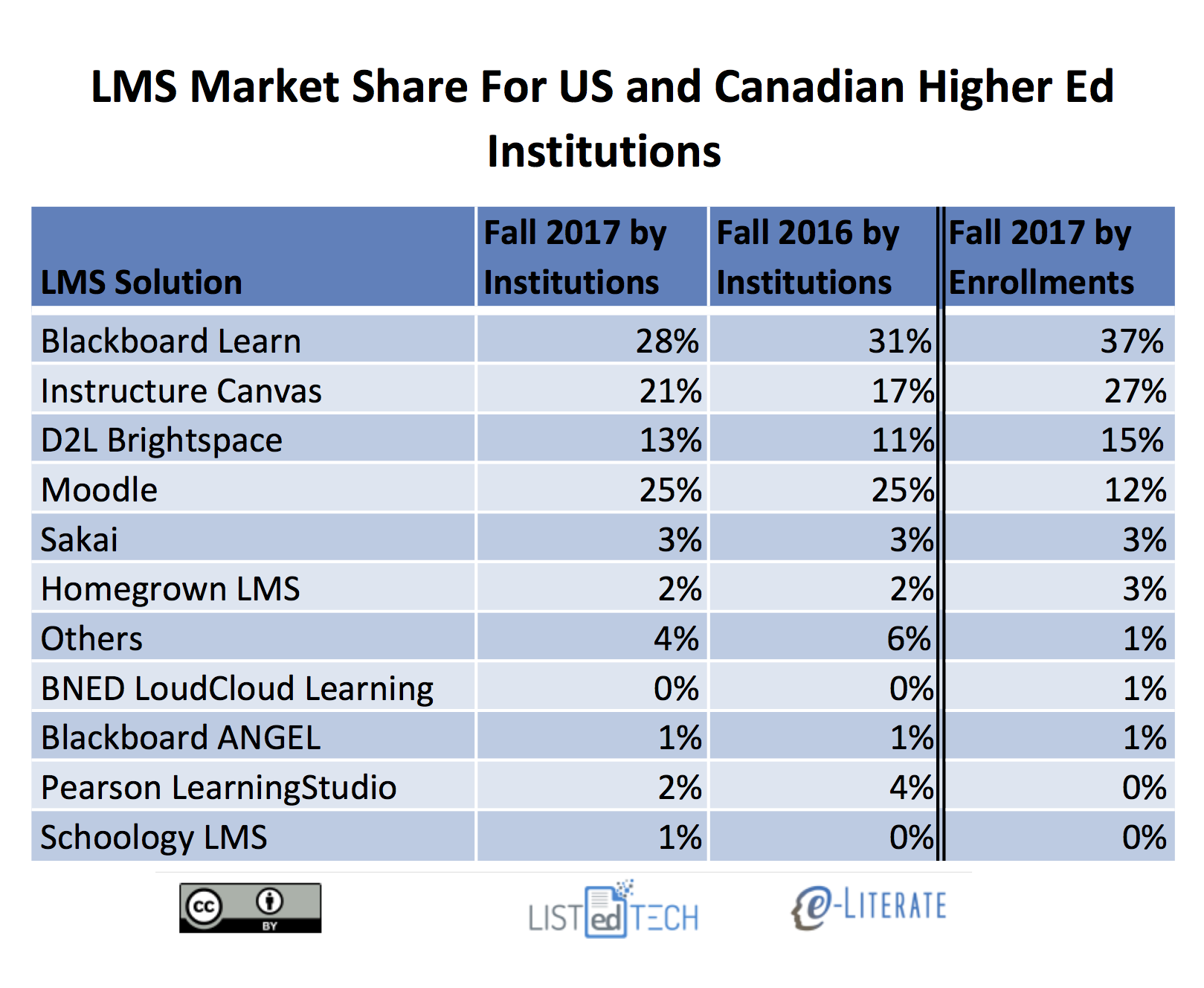
    When measuring by numbers of students, Moodle is fourth in the US and Canada, behind Blackboard Learn, Canvas, and Brightspace—and these numbers do not include future losses from the University of Minnesota and other schools that have chosen to migrate off of Moodle in the near future. Note the numbers in the right-most column of this chart:
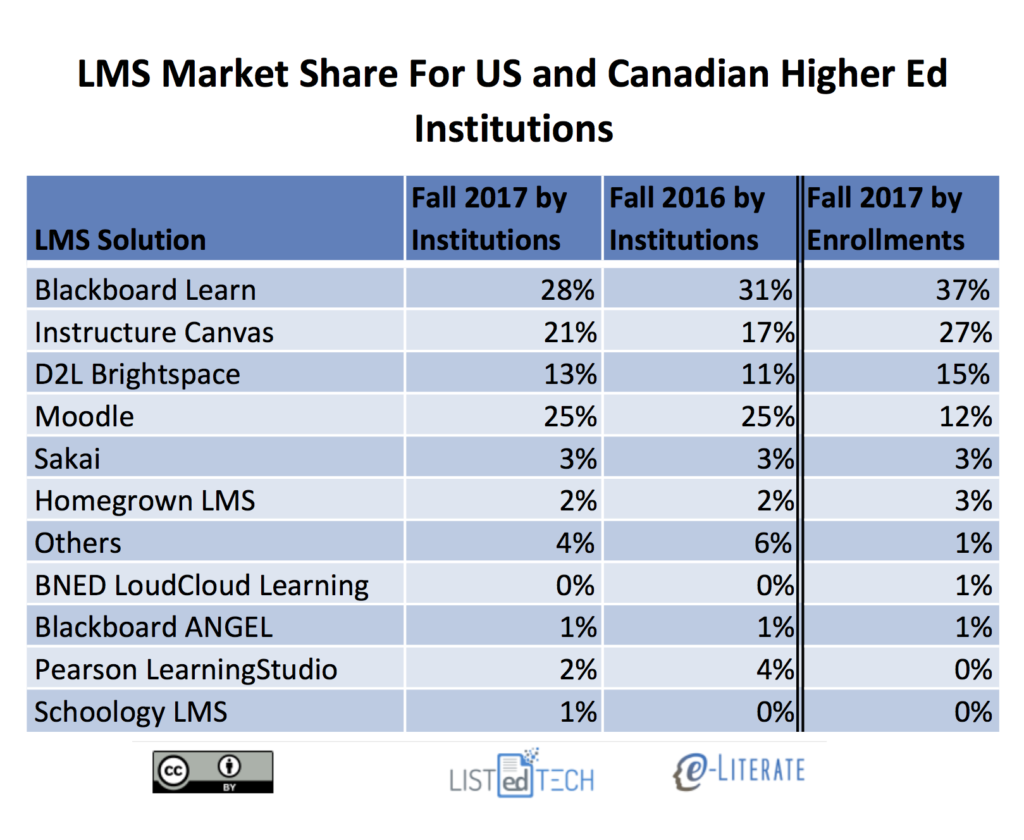
    If, as our data show, the Moodle market share in US and Canada is much smaller when measured by numbers of students versus institutions, even as the number of Moodle institutions is shrinking, that is a bad picture for Moodle HQ’s financial health. If you care about Moodle, then you should be worried about these numbers.

    A Healthy Skepticism of Skepticism

    Is it possible that we at e-Literate are biased against Moodle? Of course it is. While we try our best to be objective, we are humans, and humans can be biased. The Moodle News author spends a fair bit of energy insinuating that we have a preference for other platforms. I’m not going to address that question, partly because I’m not the best judge of my own biases and partly because it’s not the question that Moodle advocates should be asking. Rather, the main question they should be worried about and should be investigating with as much absence of bias as they can muster, is the following:

    Is e-Literate’s analysis true?

    Could we be wrong? Of course we could. I very much doubt that we are off by much in the US and Canada, where we our data are the strongest. The margin of error increases as we get to parts of the world where our coverage is less complete (or, in some cases, non-existent). Those areas should be clear—and, in fact, are referenced in the Moodle News article—because we quantify the data fidelity in our regional analyses. If Moodle is huge in Germany, or China, or Myanmar, we might not be picking that up in our data.

    There is one person who may well have better data than we have, and Moodle advocates have reason to believe that he is not biased against Moodle. His name is Martin Dougiamas. He argued in the comment quoted at the top of the post that we don’t really understand or have visibility into the business model of Moodle Pty. If that is true, then we would like to be enlightened. And the Moodle community should want that too, for peace of mind.

    Moodle Pty could provide the community with two kinds of information that would help its advocates understand how much they should be worried (or not). First, Moodle Partners likely give Moodle Pty counts of customers by institution and numbers of students. (I don’t know this for certain, but I’m not sure how Moodle Pty could verify that they are being properly paid by the partner without this information.) The company could publish this information, aggregated by country so that individual customers and partners have some degree of anonymity while still giving the community a sense of the inputs that fund Moodle development. A second disclosure that Moodle Pty could offer is direct revenue numbers that are transparent enough for community members and other interested parties to independently verify the company’s financial health. While Moodle Pty is not legally obligated to provide any of these numbers, there are disclosure models in both non-profit foundations and for-profit companies that the company could choose to follow. At the moment, the status of Moodle Pty as a private corporation shields it from transparency requirements of either non-profit foundations or publicly traded corporations. But that doesn’t mean that the company, as the main engine of sustainability for a huge open source project that, despite current growth challenges, remains by far the world’s most widely adopted academic LMS, couldn’t or shouldn’t choose to be transparent about numbers that are critical to the project’s sustainability.

    If Moodle News really wants to check our numbers, then they should be asking Moodle Pty for adoption numbers of Moodle Partner-supported installations by institution, headcount, and/or revenues. And their biggest concern, as Moodle advocates, should not be whether some US analysts are talking smack about their favorite platform. It should be about how healthy and sustainable that platform truly is.

  • How and Why the IMS Failed with LTI 2.0

    How and Why the IMS Failed with LTI 2.0

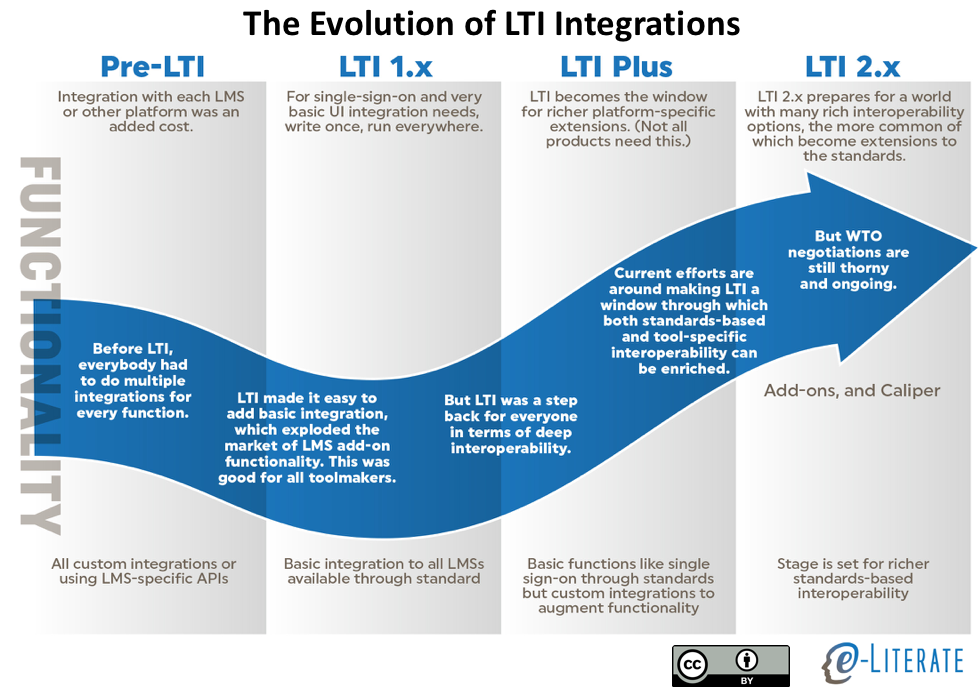
    While at EDUCAUSE last week, we heard from several sources that the IMS is walking away from LTI 2.0. I’m not sure what term the organization is using to characterize what they’re doing; there’s nothing on the public web site that I can find at the moment. But the reality is that they are no longer encouraging the adoption of LTI 2.0 and are actively investing their energy in developing the 1.x branch, starting with something that they’re calling “LTI Advantage.” (More on that in a bit.)

    To be clear, I believe this is a good decision, and I also believe the fact that they felt the need to do so is not particularly scandalous. Everybody makes mistakes. The important thing is to learn from them. So, with that in mind, and with the IMS quarterly meeting coming up this week, I thought it might be useful to write a post-mortem that could potentially be of use going forward.

    Interoperability Standards as Multilateral Trade Deals

    One of the biggest problems the IMS faces is that a lot of the participants on the specification committees don’t fully understand the big picture of how standards adoption works in the real world. They are mostly technologists with a sprinkling of product managers. They usually have the best of intentions. But they do not have the right roles to see the business ramifications of spec development clearly, and they very often do not get adequate guidance from the stakeholders in their respective organizations that do have the right roles.

    First and foremost, interoperability specifications are a lot like multilateral trade agreements. They are agreements that everybody will operate according to certain rules under certain circumstances. The fact that these agreements are written in engineering language and implemented in software code doesn’t change the fact that they are multi-party treaties. One of the major implications that falls out of this circumstance is that organizations will not adopt the standard—or “sign the treaty”—unless they believe the benefits will outweigh the costs. If a specification is going to be broadly adopted, then it needs to be designed so that all the adopting parties will see direct benefit. Remember, every minute of developer time spent implementing a standard could have been spent developing a feature or fixing a bug instead. If their customers don’t care about the benefits of the standard and developers don’t see internal benefits (like reducing the time they have to spend on one-off integrations), then the rational decision for product or project owners is to not implement the standard.

    Such a decision does not mean that all progress grinds to a halt. In the trade world, there are many more bilateral trade agreements than there are multilateral trade agreements. In the software world, the equivalent to a bilateral agreement would be a proprietary integration. Many companies today that want to provide richer integration with another platform—especially with an LMS—will use the multilateral agreement that is LTI 1.x as a baseline and extend it with the bilateral agreements of proprietary integrations. This is as it should be. Not every integration needs to be standards-based. In fact, a lot of innnovation happens beyond the edge of the standard as software developers come up with new ideas about how their products can work together. They hammer out a bilateral trade agreement to get that new idea implemented and to gain a competitive edge for a while. Eventually, enough products may choose to implement the same pattern that it makes sense for everybody to adopt the same way of integrating so that developers don’t have to build slightly different versions of the same integration over and over.

    Interoperability standards, being multilateral trade agreements, are rarely innovative or sexy if they are done right. Once in a while, a working group may come up with a new spin that is generative. But this is always a risky proposition. The technologists and product designers on these working groups, being creative people, want to come up with cool stuff. But “cool” isn’t what drives their employers to adopt. There always needs to be a cost/benefit analysis for each potential adopter. If that analysis doesn’t look good, then no amount of coolness will matter.

    As far as I can tell from the outside, this is precisely what went wrong with LTI 2.0.

    Please Pass (on) the SOAP

    Back in the early days of service-oriented architecture (SOA) in software engineering, everybody was using a complex XML-based protocol called SOAP. The idea was that everybody had data to pass around, and if there were discrete services that could be called for that data, then we could have a lot more interoperability. SOAP was considered secure (or securable, anyway), so it could be used for sensitive data. SOA advocates envisioned a world in which all software provided lots of services for other software to use, creating rich opportunities for interoperability. In fact, they thought there would be so many services that it would be impractical to connect them all up by hand. So they invented something called a service bus that helped each piece of software automagically discover the services available to it from other software in the system and also to offer up its own services to any other software that needed them.

    As you might imagine, this all turned out to be horribly complex and expensive. I happened to work at Oracle at the time that all this peaked, so I had a ring-side seat. The company was selling hugely expensive service management software that was often implemented by hugely expensive consultants. Some of that stuff took off and is in use in some places—usually big IT shops like moneycenter banks. But it never got the ubiquitous adoption that the enthusiasts expected because it was too much work for not enough payoff. There just weren’t that many services to justify the management costs.

    That was roughly ten years ago. Fast forward seven years from then. What is the essence of LTI 2.0? It was essentially an attempt to implement the same idea using the more modern REST style of web programming. It was going to have a strong security model and service discovery. Predictably, it was really hard to implement. A senior development manager from a major LMS vendor—somebody who has been in the industry and involved with the standards process for a very long time—said that LTI 2.0 was by far the most complex standard he’s ever had to implement. If the major LMS providers struggled to implement it, then what are the chances that lots of small LTI-compatible tool makers will implement it? To answer that question, start from zero and subtract a significant number.

    But I don’t think LTI would have had a high chance of success even had it been less complicated, because it wasn’t designed to be a multilateral trade agreement. What problem would a secure service bus with discoverability solve for each of the treaty signatories? The LMS companies do get a clear benefit. For them, many of the customers have LMS systems administrators who spend their days hooking up tools for individual instructors. The LMS gets most of the blame for this situation, not because it’s primarily their fault but because their customers perceive it as a pattern of weakness when they use the product. Automagic integrations would make some of their key stakeholders very happy.

    On the other hand, if you’re a tool vendor, you usually only get blamed for the challenges of one integration: your tool into the customer’s LMS. And even then, the LMS vendor gets most of the heat. At the same time, hardly anybody is passing data to you, and it can be a struggle to even get the LMS vendors to accept the data that you want to give them. So LTI 2.0 offered most tool makers a lot of pain for no obvious benefit.

    The people at the negotiating table for LTI 2.0 were apparently not the right people to negotiate a trade agreement. They were the right people to think of something really cool. For a standard to work, you need the former and want the latter, but only if the people thinking of cool stuff are in close communication with their colleagues who are making the cost/benefit decisions.

    Now, I believe there is an opportunity to get to the cool world that the LTI 2.0 working group envisioned. But to get there, you need to flip the script.

    Services First

    Let’s try another analogy for a moment. In the early days of the telephone, human operators connected every call manually. There was interoperability in the sense that all telephones operated the same way over the network of wires and switchboards, but each individual connection between callers had to be hand-configured. In the early days, that was fine. It made sense. There were few enough callers that it was worth the cost of the operators. But eventually, the number of phone connections grew to the point where hiring humans to manually wire connections was no longer viable for anybody. Call connection times grew, as did service provider costs. At that point it made economic sense to create an automated switchboard.

    LTI 2.0 was an attempt to invent a very fancy automated switchboard at a time when there are still hardly any callers. Once we reach the point where many tool providers are offering multiple data services and, in some cases, also receiving them, then they will see direct benefits from a secure and automated service discovery mechanism. At that point, the negotiations can begin regarding feature richness versus cost of implementation.

    To get there, the IMS needs to flip the script and start by creating a world that is rich enough in services that people need to care more about managing them all. The IMS has made a good (re)start with LTI Advantage, which just adds roster provisioning, grade return, and deep linking to LTI. These are basic hygiene needs. Basically, this means any tool can find out from the LMS who is in the class and what their roles are, which a lot of tools need and is a step up from the way LTI passes user information along now. LTI Advantage can also enable the tool provider to give the LMS links that support single sign-on to specific places within the tool, and it can enable tools to return multiple grades to the LMS. Lots of apps would find these capabilities handy.

    I’ve heard through the grapevine that the next challenge is improving security. Obviously, securing student data is critical. There are a lot of data sharing services that shouldn’t be offered until that security can be guaranteed. (I won’t comment on the security of rostering and grade information in LTI Advantage because I don’t know anything about it, but obviously that is one very sensitive area where schools should be asking questions about security.)

    Once security is in place, the next step beyond that should be to focus on generating enough call connections to keep the switchboard operator busy. I have been arguing for some time that Caliper should be used as a data interoperability exchange standard between apps that operates through the LTI window. This could work for bilateral agreements. For example, let’s say that you want to integrate a blog with an LMS so that posts with a certain tag could be automagically submitted upon publication for a particular assignment. Let’s further suppose that the IMS has not yet developed a standard, a multilateral trade agreement, for that kind of integration. If LTI and Caliper provide tools that make developing that integration easy enough, then the two integrating parties could do the work in the style of an official integration, saving time by drawing on the LTI and Caliper infrastructure that’s already in place. If enough other tool makers become interested in the integration, then it could be submitted for ratification as an official extension of the standard. This only works if designing and implementing a new Caliper profile is easy. But if it’s done right, then we should see the number of services explode.

    At some point, it will become obvious to all parties that they need autodiscovery to manage all these integrations. Then and only then will it make sense to come up with a hopefully simpler implementation of service discovery for the next run at LTI 2.x.

    Open It Up

    To reiterate, the path to getting to the next era of interoperability is to make it easy for many developers to build bilateral integrations that draw on the building blocks of the standards and are easy to incorporate as extensions to the standards. Some of this involves prioritizing the work on LTI and Caliper to make this easy. But it also likely will require the IMS to consider changing its policies in ways that will make some stakeholders uncomfortable.

    A little history is in order here. A bit more than a decade ago, the IMS nearly died. It wasn’t generating enough revenue to sustain the work. While IMS Global is a non-profit, it still has salaries to pay, rent to cover, and so on. Operating it is not free. One of the steps that the organization made to save it from potential insolvency was to put a lot of the work behind a paywall. I don’t like it, but I get it. And it worked. The IMS appears to be much healthier now and has produced some of its best work in a very long time. Life is about trade-offs.

    It may be time to consider a new trade-off. Just like getting the telephone to take off required a network effect—the value of the network increases exponentially with the number of people on it—the value of a world of standards-based services increases exponentially with the number of services on it. To get there, it’s time to at least consider lowering the pay wall. The IMS needs to create an environment with very low barriers to creating standards-compatible integrations. A membership fee, however reasonable it may seem to the membership organization, is a barrier. The IMS leadership should think creatively about how to lower this barrier while maintaining the financial stability of the larger organization.

    The Nub of It

    To sum up, here’s what I think the IMS should do to recover from the LTI 2.0 misstep and foster a step-function change in interoperability:

    1. Promote LTI Advantage and build from there.
    2. Focus next on creating a simple security model that is trustworthy for common use cases.
    3. Focus Caliper efforts on turning it into a quick and easy to use method for creating data interoperability extensions that take advantage of the existing LTI infrastructure.
    4. Make a giant push to get developers to build their bilateral integrations using the LTI and Caliper infrastructure, whether or not they submit those integrations as extensions to the standard. This should explicitly include re-examining policies about giving non-members early access to the work being done inside the IMS in cases where such access will increase the velocity of new Caliper-compatible service generation.
    5. Wait for demand to build on both provider and consumer side before attempting another run at discoverability.
  • Why Moodle Supporters Should be Concerned

    Why Moodle Supporters Should be Concerned

    In Phil’s last post, in which he explained our data gathering methods for our LMS analysis work, he started with a quote from Moodle leader Martin Dougiamas that suggested our numbers were primarily US-based. Because it captured a common misconception about our data (and was based on a fair question), it was a good launching point for the post. But there was more to Martin’s comments on the subject, and we’ve heard various objections from some Moodle advocates about why our numbers are either inaccurate or irrelevant. ((The Moodle community is no more monolithic than any other; we have of course heard a wide range of opinions from Moodle advocates about the state of the union.))

    I’d like to review those arguments here. While Moodle is still by far the most widely adopted LMS in higher education globally and is no danger of disappearing any time soon, I believe that our data should give the Moodle community cause for considerable concern about their long-term future and should trigger some soul searching about how the community can ensure it continues to have the development resources necessary to continue to be relevant in the long term.

    The Data

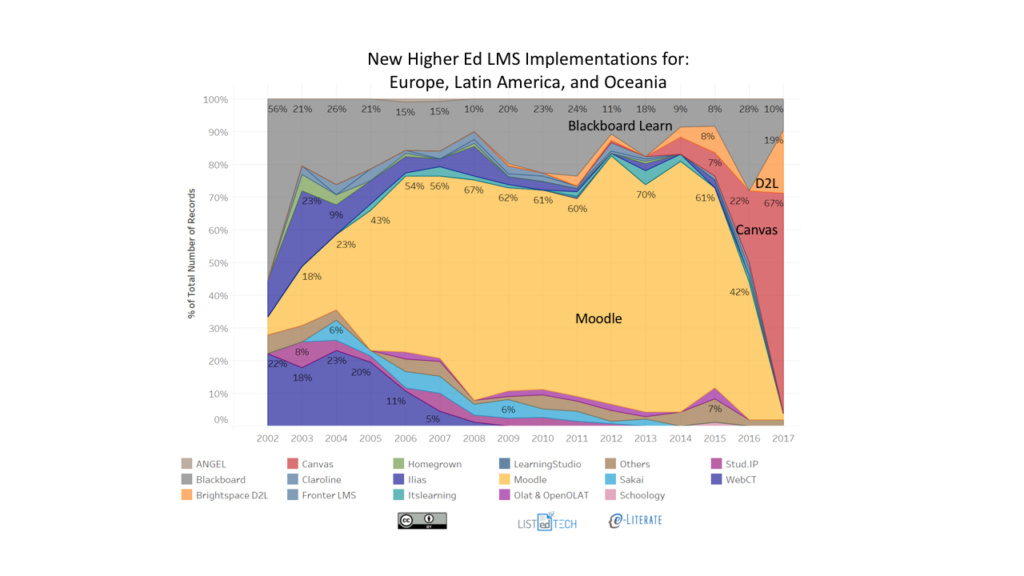
    Let’s start by reminding ourselves of the data in question. It really boils down to this one chart:

    Notice the scope of the chart: It does not include the US and Canada. This is data for Europe, Latin America, and Oceania. So this chart is not biased in any way by US-centric trends.
    There are two important caveats here. First, as Phil states in his post, our coverage of these areas of the world are not as complete as they are in the US and Canada, so trends we see in our data for these parts of the world should be considered directional and somewhat provisional rather than pinpoint accurate. That said, we only publish data for regions where we have enough coverage to be confident that our sample is representative. We don’t yet cover China or Africa for this reason. We believe the chart above is directionally correct, but there is a margin of error because we have a sample rather than a close-to-100% complete data set.

    The second caveat is that the chart shows new adoptions. When we look at installed base, Moodle still looks formidable:

    So the issue we’re talking about is not that Moodle is disappearing but rather that it is losing ground during new adoption cycles.

    The three most common arguments we hear from Moodle advocates are the following:

    1. The e-Literate numbers aren’t global or aren’t accurate.
    2. e-Literate is using the wrong adoption measure.
    3. e-Literate’s numbers are irrelevant, because an open source project doesn’t need to worry about growth in the same way that a profit-motivated company does.

    Phil’s earlier post addressed the first objection by describing the data we have, how we get it and validate it, and how we try to be transparent about its limitations.

    I’d like to address the other two objections in this post.

    The Wrong Measure?

    We measure higher education institutional adoptions. That means there are Moodle adoptions that we don’t measure or don’t report. We don’t have counts K12 or corporate adoption at all; Moodle has significant uptake in both of these areas. While we have data on secondary higher education adoptions (e.g., adoption by a school of education at a university that uses a different LMS for the rest of the institution), we don’t report these numbers. Nor do we report adoption by individual faculty. All of these are meaningful numbers and we do not dismiss them.

    But institutional higher education adoption is a particularly meaningful measure for Moodle’s long-term health. While Moodle is open source, Martin Dougiamas’ company Moodle Pty—more widely known within the Moodle community as Moodle HQ—does most of the development of the core Moodle code and maintains tight control over which code submitted by third parties gets accepted into the code base. This is what is sometimes known as the “benevolent dictator” model of open source, which was popularized by Linus Torvalds, the creator and development leader of the Linux kernel.

    Under the current way of doing things, both the direction of Moodle development and velocity at which occurs are largely controlled by Moodle Pty. However much input the company may take from the community, the ultimate decisions and, perhaps more importantly for this post, the work of implementing those decisions, fall under the purview of Moodle Pty, a for-profit company that must generate revenue to pay the employees who actually write that code. Moodle Pty’s revenues mostly come from Moodle Partners, which are companies that are licensed to use the Moodle trademark by Moodle Pty in return for a percentage of their Moodle-related gross revenues.

    If Moodle Partners lose paying customers, then Moodle Pty loses revenue. If Moodle Pty loses enough revenue, then at some point it would have to start laying off developers. If Moodle Pty starts laying off developers, then the pace of Moodle development will slow. If the pace of Moodle development slows, then the loss of Moodle-adopting schools may accelerate, creating a vicious cycle.

    While we don’t know the percentage of Moodle’s revenues that come from higher education (as opposed to K12 and corporate), we know it’s significant. The anecdotes I have heard from various sources suggest that it may well be the substantial majority of the total financial resources that fund the development of Moodle’s core platform. So, while other kinds of adoption may be great and may bring in new participants to the Moodle community, Moodle advocates should be concerned with higher education institutional adoption if they are concerned with having development resources for the Moodle platform in the long term.

    Irrelevant?

    Another argument we hear sometimes is that the Moodle community doesn’t need to care about these numbers because, as an open source project, it will fulfill its purpose if meets the needs of its adopters and doesn’t need growth for its own sake the way that a for-profit project does. Martin himself made this argument in the comments referenced above:

    Martin ended his comment on this topic by saying what makes our project different is that we are not driven by numbers. We are driven by the needs of our users and that he would be happy if there were only 100 universities using Moodle if we are following that approach.

    From an abstract philosophical perspective, this is undeniably true (or was at the time the comment was made, at any rate). An open source project does not need to satisfy investors or meet revenue targets. It just needs to attract enough developer resources to keep the code base viable and up-to-date. But there are a few serious problems with this argument in Moodle’s specific case.

    First, Moodle’s growth model was spectacularly successful in its first decade in part because it was a Robin Hood model. In richer countries, adopters could afford to pay hosting or management companies to run their mission-critical instances. A portion of this money would flow back to Moodle Pty and get invested in the salaries of developers who would improve Moodle and continue to release it under an open source license. In poorer countries, they could adopt Moodle themselves without paying a hosting or support vendor. Moodle has always been unusually easy to install and run on even modest hardware relative to its competition, so poorer schools could still manage to adopt it with the resources that they had. But if Moodle is losing ground in the richer countries (or, more accurately, the countries that can invest and are investing more dollars in educational technology), then it is also losing its development revenue base.

    (I would add that the message, “Hey, it’s no big deal to us if we lose some adopters” is not a great one for members of the community who feel like their needs are not being met.)

    But the problem is potentially worse for Moodle, because we’re beginning to see a pattern take hold in international markets as they reach a certain level of maturity, and it’s not good a good one for Moodle. In the US and Canada, the big hurdle to LMS migration was the move from self-hosted to cloud. Once institutions became comfortable with cloud hosting, the market changed rapidly, with Canvas in particular taking a strong lead and Moodle (among others) losing ground.

    We are seeing early evidence that the same pattern may be beginning to take hold in Europe now. While the data we have are not definitive yet, they are suggestive and are supported by the qualitative research we are doing. And this pattern could easily take hold elsewhere as well. For example, my colleague O’Neal Spicer and I recently had the good fortune to visit Brazil, where Moodle is still very much dominant. But consider this: Seventy-five percent of Brazil’s college students go to for-profit universities, and those businesses are enormous and growing. For example, Kroton, the country’s largest university, has about 2 million students. Given that these organizations are companies with investors and profit motives, there is no particular reason to believe that they are ideologically inclined toward open source. The fact that both Instructure and D2L have offices in São Paolo suggest that they believe they have an opportunity to win over the Brazilian market now that it has gotten big enough to be profitable for them. In other words, Moodle’s Robin Hood model is under threat because whenever a market becomes rich enough to generate significant revenue for Moodle Pty, it also becomes rich enough for universities to consider switching to cloud hosting by one of Moodle’s commercial competitors.

    Adding to this pressure is the fact that Moodle Pty just took $6 million in investment money. This is not a grant; it is an investment. However well-aligned and patient those investors may be, they still will eventually need to see a return on their $6 million. When investors do not see the return they expected, they eventually begin to put pressure on the company management to take steps that improve the finances. I don’t know enough about the terms of this particular investment relationship to know what kind of leverage Leclercq has to push for changes in Moodle Pty if they are not happy with its performance, but the fact of the matter is that Moodle Pty now has financial performance targets to meet.

    Put all this together, and it strongly suggests that members of the Moodle community should be concerned about the adoption trends we are seeing, for both mission and strategic reasons.

    Moodle’s Role

    I want to return to the example of Brazil for a moment to show why this matters not just to Moodle advocates but to anyone who cares about education. According to the 2016 Analytic Report of Distance Learning in Brazil published by Brazil’s premiere distance learning association, the Associação Brasileira de Educação a Distãncia (ABED), about three-quarters of a million Brazilians took online or blended courses in 2016. According to our analysis, Moodle has over 80% of Brazil’s higher education institutional LMS market share. It’s entirely possible that we would not have seen that kind of growth in access to education if Moodle had not existed. Yes, one or more other open source LMSs might have been adopted, but the existence of that Robin Hood sustainability engine built by Martin Dougiamas ensured that significant developer resources went to developing a high-quality globally adoptable LMS that could be deployed by even poor institutions. It has been an engine of educational growth.

    If the data patterns we are observing hold, then that engine may be under long-term threat. While Moodle has far too broad an installed base to disappear any time soon and just received an infusion of investor money, the fact is that its sustainability model is now in question. That’s bad for everyone. It’s bad for Moodle advocates, it’s bad for people who care about improving educational access for the developing world and economically challenged people in general, and it’s bad for those educational technology companies that have depended on international maturation of markets that open up new commercial opportunities for them.

    For everyone’s sake, I hope that the Moodle community—and particularly its leadership—owns up to this potential challenge to its sustainability model and confronts it head-on.


  • The Strayer/Capella Merger and What it Means for For-Profits

    The Strayer/Capella Merger and What it Means for For-Profits


    Strayer Education and Capella Education just announced a merger.

    STRA Capella

    Strayer has the upper hand in the merger, taking a 52% controlling interest in the new company, which will be called “Strategic Education” and will maintain Strayer’s “STRA” stock symbol. With combined enrollments of close to 80,000 students, the new company will be one of the largest for-profits in the US.

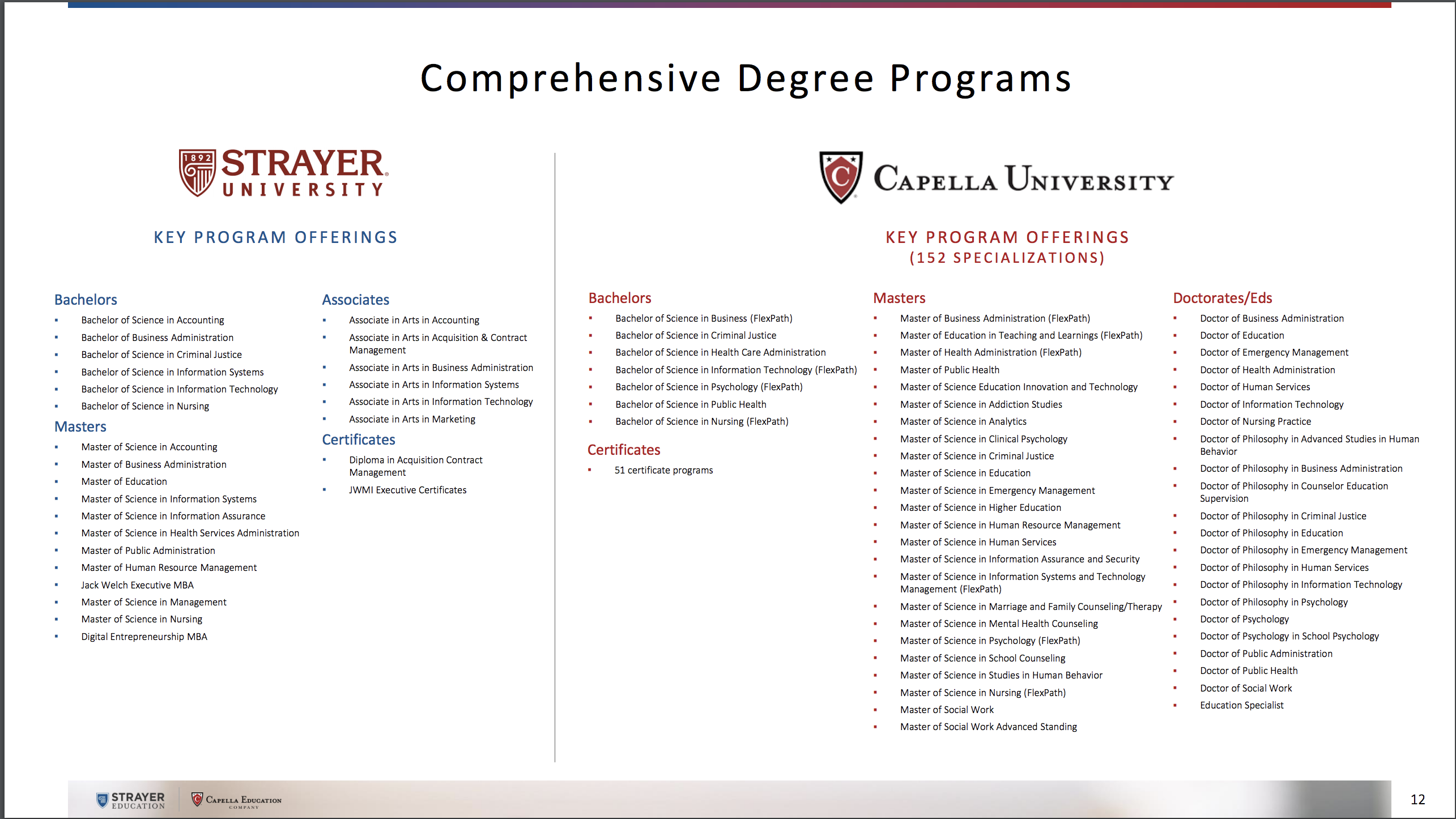
    As the company touts, there is a high degree of complementarity between the two entities. First, both kept their noses clean during the for-profit scandal era and maintained good reputation. Capella has, in fact, shown a willingness to actively collaborate with the broader university community, including not-for-profits, by sharing best practices and collaborating in research on topics like learning analytics. Strayer’s degrees are largely concentrated in business and IT, while Capella has a broader portfolio including education, health care, and criminal justice. Strayer has a number of physical campuses for classroom or blended learning, while Capella is focused on fully online. Strayer is known to be particularly good at building partnerships with employers, while Capella is known for its work in new educational trends like learning analytics and Competency-based Education (CBE). Strayer has a lot of working adults completing their undergraduate degrees while Capella has a robust set of graduate programs. Both dabble in other formats like code academies, and Capella has 51 certificate programs.

    Assuming the merger goes through, both schools will continue to operate largely separately as independent brands. Faculties are specifically called out as remaining separate, though credits will be tranferrable from one institution to the other. The areas singled out for “consolidation” (read: layoffs) are “executive and corporate functions, certain marketing capabilities and IT operations.” Corporate headquarters will be in Virginia, where Strayer’s headquarters currently are, but IT will be run out of Minnesota, where Capella is.

    When we look at this merger in the context of both Purdue’s acquisition of Kaplan, DeVry’s internal restructuring, and University of Phoenix’s transition of ownership and leadership, some trends in the for-profit space begin to emerge. ((Disclosure: University of Phoenix was recently one of our consulting clients.))

    Still on the defensive

    Despite the hype about the Trump administration being friendlier to for-profits than the Obama administration, the truth is that we continue to see defensive moves. University of Phoenix’s old PE owner decided to sell the business, and the leadership brought in by the new owner promptly closed 20 campuses. DeVry fired its CEO after closing 14 campuses and settling a slew of state and Federal lawsuits. ((Disclosure: DeVry has recently been a consulting client of ours.)) Kaplan decided to get out of the for-profit university business altogether. (What is left over of that company after the sale to Purdue, and what it will become going forward, is still unclear.) And the most immediate effect of the Strayer/Capella merger will be cost cutting in redundant operations.

    In other words, Education Secretary Betsy DeVos has not changed the laws of physics. These institutions were under pressure before and are still under pressure now. We should not be surprised to see more closures like Corinthian Colleges and ITT Tech, particularly of second- and third-tier for-profits. They may not be driven by active prosecutions, but the damage to the sector has already been done. Government intervention wasn’t the sole cause of the collapse of Corinthian; lack of cash on hand played a role.

    The questions going forward are (a) is the for-profit crash bottoming out, and (b) if so, what does their next act look like? It’s too early to tell regarding the first question, but we are getting some interesting hints regarding what the leadership of some of the larger for-profits think possible answers to the second one is.

    Course design, analytics, and employer connections

    A few details of the Strayer/Capella announcement stand out. The first one comes out of the rhythm of a merger announcement like this one. There’s a format of “Company A brings strength X while company B brings complementary strength Y.” The announcement touts one of Strayer’s strength as “close relationships with employers” that complements Capella’s “competency-based learning infrastructure, assessment capabilities and track-record of improving student success.” To begin with, these are real strengths of the respective companies rather than made-up talking points. Strayer is good at employer partnerships and does fairly extensive profiling of their students’ career goals and paths. Capella, for its part, was giving talks about their learning analytics work way back in the early days, before there were even products on the market.

    The bit about CBE, which comes up several times in the released materials, requires a bit of unpacking. Capella offers two flavors of what they label Competency-Based Education: “FlexPath,” which is a fully self-paced program in the style of Western Governors University or SNHU’s College for America, and “Guided Path,” which Capella labels as CBE despite the fact that it is instructor-facilitated, delivered within a term structure for a class cohort, and charged by the credit. What they really mean by CBE in this case is what Phil calls “CBE lite” or what is more commonly known in academic circles as “backwards design,” where the outcomes and assessments are designed first and then the content is structured to match (rather than picking the content for the syllabus and then designing assessments after).

    Only a relatively small percentage of Capella’s degree programs are full CBE FlexPath programs:

    Screenshot 2017-10-30 11.45.48

    So most of these programs are not actually self-paced CBE but backwards-designed and traditionally delivered courses. That may actually be a lot more important. As Phil has written, full self-paced CBE is still struggling to take off. Backwards design, in contrast is a good practice for course designs that drive improvements in student outcomes and is also a prerequisite for various types of learning analytics and adaptive learning approaches as well as full self-paced CBE. So when Strayer touts Capella’s strength in CBE, the real value may be in the course design process and the ways in which those designs can be instrumented in the learning analytics.

    Strong connections to employers, consistent application of backwards course design principles, and analytics supported by those course designs, are three areas where the centralized structure of for-profits enables them to move more quickly than many not-for-profits. Reading between the lines, it looks like the Strayer/Capella leadership think they have found a way to compete on quality. And they may not be the only ones tacking this approach. We see signs that at least pieces of these strategies are beginning to surface elsewhere. For example, it was interesting to see that the University of Phoenix’s new owner chose a new president who was previously an executive at McGraw-Hill Education, which currently styles itself a “learning science company.”

    Kaplan is obviously different, but maybe not as different as it appears at first blush. They had a very strong learning science and analytics-driven approach to course design, driven by thought-leader Bror Saxburg (who recently left to work at the Chan-Zuckerberg Initiative). Purdue, for its part, pioneered retention early warning analytics. Despite some controversy regarding one of their research papers, the university has deep experience with using analytics to drive outcomes.

    It’s still early days, but we may be seeing the beginning of a trend among for-profits to drive toward a particular notion of a quality education as a key competitive differentiator.

  • WGU Is Not Off the Hook

    WGU Is Not Off the Hook

    In Phil’s first piece on the Department of Education’s Office of the Inspector General (OIG) finding the Western Governors University (WGU) should be considered a correspondence provider rather than a distance education provider, he wrote,

    This audit is a travesty in my opinion. Even though it is likely to be rejected by the ED itself, it will have an impact, and the internal review of the audit will likely take years.

    The problem, in a nutshell, is that the OIG decided that WGU’s unbundled instructor’s role, with multiple staff roles supporting students in a (largely) self-paced environment, does not count as “regular and substantive interaction between students and teachers,” which is a requirement for classification as a distance learning provider.

    Phil believes that this assessment by the OIG was arbitrary and, based on my admittedly limited understanding of their assessment process, I tend to agree. But that doesn’t mean that the OIG is wrong. It means we don’t know whether the OIG is wrong. And the heart of the problem—the definition and test for “regular and substantive interaction between students and instructors”—is a real challenge. While feel fairly confident that the OIG applied too narrow an interpretation of a standard that problably needs to be revised anyway, coming up with a better evidence-based standard is tough. And if we don’t have one, we can’t tell if WGU’s programs should be considered equivalent to more traditional distance learning programs.

    There are two positions that one could take in arguing against the OIG finding: (1) that it is possible to deliver the equal of a traditional education without regular and substantive interaction between students and teachers, or (2) that this interaction is necessary but we need a different, perhaps more flexible definition of it.

    Let’s look at each of these in turn.

    Position 1: The Standard is Unnecessary

    The more radical of the two positions is that “regular and substantive interactions between students and teachers” is outdated in the sense that such interaction is not necessary for a quality distance education program. In this view, good design and good technology provide enough support for self-paced students. People who take this position tend to have a high opinion of the impact of technology, a low opinion of the impact of the average instructor, or both.

    I’m not aware of any research that definitively settles this particular debate and would be surprised if there were any. In fact, I’m not sure it’s possible to produce such evidence in principle, because there are too many contextual factors to come up with just one answer. Some students in some programs studying some subjects to some level of achievement may do as well (or better) in a self-paced, largely self-guided competency-based program as they would in a traditional instructor-led setting. There would need to be an enormous amount of research, including some foundational research that we don’t have yet, to sort out all of the many “ifs” that determine the circumstances under which such a program would be equivalent in effectiveness.

    I think it’s dangerous to assume that “regular and substantive interaction between students and instructors” is an obsolete standard, and I do think there are at least three strands of research with results that should give us pause about being too aggressive about taking human teachers out of the equation.

    First, there’s Benjamin Bloom’s research on the Two Sigma Problem. Since I recently wrote about this in some detail as part of a longer post, I’ll give you the short version. Bloom found that by using tutors in a mastery learning context, he could achieve two standard deviations of improvement over standard instruction. One could argue that WGU’s model of self-paced learning with periodic assessments and support from course mentors attempts to imitate Bloom’s approach (although one would have to look closely to see whether the degree to which they are actually doing so). The relevant detail for our current purpose is that Bloom could never isolate exactly what it was about the tutors that delivered that second sigma. Without understanding the reasons why having a human tutor involved improves student outcomes by as much as a full course grade, it seems imprudent to assume it can be removed or replaced.

    Second, there’s the research conducted by Gallup and Purdue University showing that college graduates were 1.7 times more likely to thrive in all five of Gallup’s measures of wellbeing—physical, financial, community, career, and social—if they agreed with the statement “My professors at [college] cared about me as a person.” They were 1.5 more likely to thrive on those measures if they answered agreed with the statement “I had at least one professor at [College] who made me excited about learning.” Those are pretty compelling results, and it’s hard to see how one would replicate them without some form of regular and substantial interaction between students and instructors. For more on this study, see my post on it.

    In a follow-up piece to that post I just referenced, I talked about the third strand of research from Vincent Tinto. He showed that students are more likely to persist at college if they feel a sense of belonging. “[S]Students have to come to see themselves as a member of a community of other students, faculty and staff who value their membership.” Yet again, there is evidence of impact for a human factor that argues in favor of regular and substantial interaction between students and teachers.

    To be clear, I’m not suggesting that one could not create an educational system that provides real value without such interaction. But it would probably be a different kind of education that provides different kinds and levels of value. The OIG is concerned with classification and equivalence: Is WGU providing educational value that’s similar enough to more traditional distance learning programs that it can be classified as the same type of degree? I don’t think we can let the university off the hook by dismissing the “regular and substantial interaction” requirement as obsolete.

    Position 2: The Standard Needs Revision

    The more conservative argument against the OIG’s evaluation of WGU’s courses is that we still need a standard for “regular and substantial interaction between students and teachers,” but that our interpretation of that standard should be more flexible than the one that the OIG applied. Ideally, there would be some sort of evidence-based test. Let’s see if we can imagine what such a test might look like, based on the three research strands I mentioned above.

    It would be hard (and probably pointless) to try to replicate Bloom’s highly controlled laboratory experiments which took place in a very different schooling context. But we might get something from the spirit of the experiment. Simply put, can we come up with some sort of rough measure of the impact of the instructors (or the various folks who individually or collectively fulfill the instructor’s function) on mastery of materials? Can we find evidence of impact? One place might be to look at variance in student performance between instructors teaching the same material. If there is substantial variance that can be reliably attributed to instructors, then WGU could argue that their courses have enough student/instructor interaction to make a difference.

    The Tinto and Gallup/Purdue research would be relatively straightforward to draw upon, since they both use student attitude surveys. But only relatively, because I haven’t seen studies applying any of these instruments specifically to distance learning programs. (If anybody knows of such research, please let me know.) One would need to establish a baseline. But that seems like a good idea anyway.

    So there are probably a number of ways that the OIG could establish an empirical test to find evidence of student/instructor interaction that is regular and substantive enough to pass an equivalence threshold. It would probably be crude, but a crude test is better than no test at all, which appears to be what we have now.

    I don’t know if the OIG assessment of WGU’s courses was wrong. I feel fairly confident that it was made arbitrarily. But the fact that we have no reason to believe that it is right is not the same as saying we have reason to believe that it is wrong. The reason that bears repeating is that, defined this way, the problem exists not only for WGU but for every assessment that the OIG makes. If the standard is completely subjective and therefore inherently arbitrary in its application, then it is meaningless.