e-Literate

Present is Prologue

Author: Michael Feldstein

  • Welcome to the Refreshed e-Literate

    Welcome to the Refreshed e-Literate

    We’ve just released a refresh of the web site that is the first of what will be periodic updates. Don’t expect anything too flashy, though. We’re old-fashioned; we believe that the content makes or breaks the site. So we’ve deliberately kept the site simple and content-focused.

    There are two benefits to you from this update. In the short term, we’ve revamped the post categories to make them more useful. There are now a few top-level categories:

    • The Big Picture includes macro issues like outcomes, policy, and research
    • Business & Economics covers analysis of ed tech companies and the economic ecosystem
    • Academics & Academia includes pedagogy but also change management and companies that help with strategic change (such as OPMs)
    • Ed Tech is the product stuff, but also includes technical interoperability
    • Bits & Bytes articles are the short recommended reading posts plus notes from the editors (like this one, for example)

    These categories, along with some changes to the site design, will hopefully make it easier for you to find more of the content that is useful to you.

    Longer term, this refresh will give us the infrastructure we need to make continued improvements. In addition to making it easier for you to find the content that interests you, we intend to improve the conversation and community capabilities of the site.

    We hope you like the changes. As always, feedback is appreciated.

  • Setting a Standard for Explanations in Learning Science and Ed Tech

    Setting a Standard for Explanations in Learning Science and Ed Tech

    Via John Gruber, I was struck by this quote from David L. Goodstein in his book Feynman’s Lost Lecture:

    Feynman was a truly great teacher. He prided himself on being able to devise ways to explain even the most profound ideas to beginning students. Once, I said to him, “Dick, explain to me, so that I can understand it, why spin one-half particles obey Fermi-Dirac statistics.” Sizing up his audience perfectly, Feynman said, “I’ll prepare a freshman lecture on it.” But he came back a few days later to say, “I couldn’t do it. I couldn’t reduce it to the freshman level. That means we don’t really understand it.”

    First of all, I love what this says in general about the relationship between teaching and academic work. My high school English teacher Mrs. Galighani used to say, “If you’re not writing clearly, then you’re not thinking clearly.” Feynman takes this to the next level. If you can’t explain your research clearly to a smart novice in a manageable amount of time—say, the amount of time you have in a single lecture period—then maybe you don’t fully understand what you’re talking about. And not just you, but maybe even your entire field.

    I’ve certainly found that to be true in both educational technology and educational research. I’ve read a lot of academic papers that sling a lot of statistical lingo to obscure the fact that they haven’t actually proven anything. Actually, that’s not entirely fair. I think some authors get so buried in the lingo and the details that they don’t actually realize that they haven’t proven anything. The same is true, by the way, with many of the theoretical papers in the constructivist camps that get all wrapped up in French literary theory and add the suffix “-atized” to every third word. Clarity is hard. Even Feynman didn’t know that he didn’t fully understand why spin one-half particles obey Fermi-Dirac statistics—indeed, that nobody did—until he tried and failed to boil it down to a freshman-level lecture.

    On the other hand, we get marketing copy or press summaries of summaries of summaries that completely lose the original thread, never mind the nuance. Again, I suspect in most cases the authors don’t know that they are dumbing down the research. They are working on deadline, with a word count limit, and a finite knowledge base.

    The end result in both cases is the antithesis of enlightenment. If we are to move education forward, then there has to be a social contract between those who do the research and those who could use it in the classroom. Authors must commit to communicating clearly to laypeople—to reducing their research to the level of a freshman lecture. In return, people consuming that information must be willing to commit the time and effort that they would hope and expect from freshmen sitting in on one of their own lectures.

    There is a role here for “media,” writ large. At e-Literate, we make an effort to make complex research accessible to laypeople who are willing to invest in reading an 8,000-word article. We also attempt to recover information that is lost in translation when academic studies get boiled down so far that there’s nothing left in the pot. But we’re not going to solve the larger problem with a blog. Academia needs to embrace the notion of education as an applied science, which means we need to generate both supply and demand for Feynman-style explanations of what we are learning about learning.

  • The Case for Learning Platform Grade Book

    The Case for Learning Platform Grade Book

    A little while back, I wrote a post reflecting on how close we are to getting a next-generation, modular learning platform and how the next steps in the IMS standards-making process can influence whether and when we might actually see this elusive beast in the wild. Today, I’d like to zero in on what I believe is the next logical step, given the current state of the ecosystem: namely, making LMS grade books fully interoperable with courseware and other ed tech tools.

    No, it isn’t sexy. No, it won’t revolutionize education. But I believe that it will benefit vendors and educators alike in a way that will shift relationships among ed tech tools, reduce wasted effort reinventing the wheel, and open up new design possibilities.

    (more…)

  • Digital Badges Are Gaining Traction

    Digital Badges Are Gaining Traction

    One trend that struck me as new at the recent IMS Global and ASU/GSV conferences was a ramping up of activity around digital badges. At the moment, they seem to be filling in cracks that more formal credentials don’t cover. While there are some efforts to convert formal certificates and (more rarely) degree programs into stackable micro-credentials, those activities are mostly happening around the edges at the moment.

    (more…)

  • A Flexible, Interoperable Digital Learning Platform: Are We There Yet?

    A Flexible, Interoperable Digital Learning Platform: Are We There Yet?

    In 2005, some colleagues and I had been tasked with identifying a single LMS that could serve the needs of all 64 campuses of the State University of New York—from Adirondack Community College to SUNY Stony Brook to the two medical schools. We came to the conclusion that no single LMS at the time could meet such diverse needs. We proposed instead that SUNY should build a modular system from which each campus, and indeed each educator, could create their own fit-for-purpose digital learning environment. We called this idea the Learning Management Operating System, or LMOS.

    We were neither the first nor the last group of people to propose such an idea. We had been preceded by e-Learning Framework, which had been put forth by the UK’s Joint Information Services Committee (Jisc) a year or two earlier. In 2012, Phil wrote about the idea of  Learning Platform here on e-Literate. In 2015, the EDUCAUSE Learning Initiative (ELI) started promoting the idea of a Next-Generation Digital Learning Environment (NGDLE).

    There are some conceptual and implementation differences among these different formulations, but they share two things in common. First, they all posited that contemporary learning environments were insufficiently flexible to meet a diverse range of teaching and learning needs. Second, none of them have been implemented. An upcoming issue of EDUCAUSE Review will focus on NGDLE, in part to try to build momentum for it. I have contributed an article.

    Nearly a decade and a half after the idea of some kind of modular learning environment surfaced, why hasn’t it happened yet? How close are we? What are the barriers? Having recently returned from IMS Global’s annual Learning Impact meeting, I am convinced that we are closer than ever. But how quickly the remaining barriers fall and how well the end result works will depend heavily on what happens next in the standards-making process.

    (more…)

  • Recommended Reading: With or Without EdTech

    Recommended Reading: With or Without EdTech

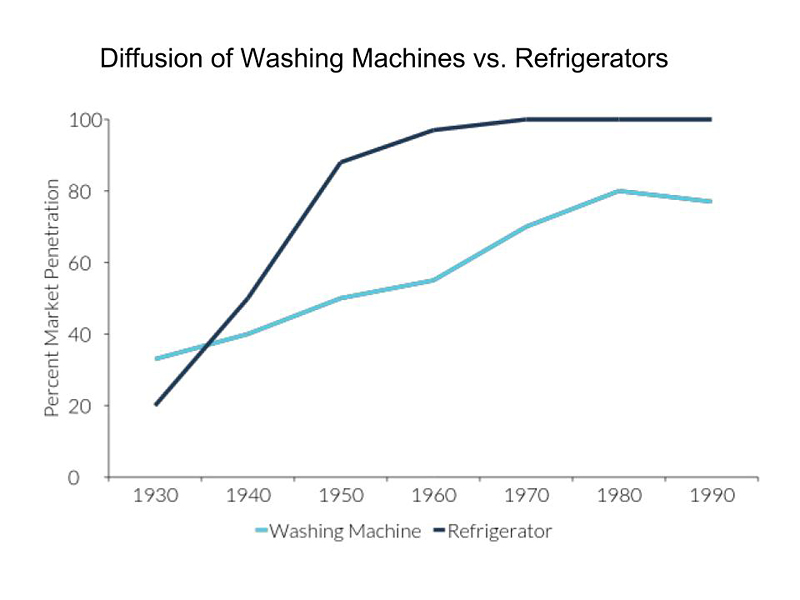
    A few weeks ago, I recommended an EdSurge piece by the Clayton Christensen Institute’s Julia Freeland Fisher. It featured this graph of refrigerator vs. washing machine diffusion:

    machines-1491937394

    I saw this same image featured last week in a main stage talk at the IMS conference, so it is making the rounds.

    Audrey Watters pointed me to this blog post responding to Freeland Fisher by CSU Pueblo history professor Jonathan Rees. Jonathan has made several appearances here on e-Literate. I would describe him as an open-minded and engaged ed tech skeptic. He teaches using tech but is suspicious of narratives such as Christensen’s “disruptive innovatation” that tend to displace educators in favor of tech. He also happens to be a scholar of the history of refrigeration.

    Ruh roh.

    Jonathan takes apart the graph using a number of tools of scholarship:

    • He notes the lack of sourcing for Freeland Fisher’s data. (This is a problem that’s common in ed tech blogging and reporting—as opposed to scholarship. The less formal style of writing and different audience invites a certain sloppiness in sourcing at times. We’ve occasionally been guilty of this sin on e-Literate.)
    • He surveys alternative scholarship, finding a difference in diffusion rates for the washing machine than the figure Freeland Fisher cites.
    • He looks at differences in the analyses to explain differences in the data. “Perhaps this [difference] can be explained by the difference between owning a washing machine and ‘accessing’ a washing machine in the basement of your apartment building or taking your dirty laundry down the street to a laundromat.”
    • He looks at differences in context to explain differences in the data: “French or English people in 1957 still had easy access to fresh meat and produce at large markets.  Many still choose to live that way today because fresh perishable food tastes better. Americans, on the other hand, tend to preference convenience over taste. That’s why the refrigerator industry was one of only three in the whole United States to grow during the Great Depression.”

    These are all solid analysis techniques that are common in scholarship across many disciplines. But we rarely see them applied directly to claims of “efficacy” in ed tech, particularly in mainstream outlets where academics who are not education scholars can read them and evaluate the arguments.

    Whether Rees is correct in his takedown of Freeland Fisher is almost beside the point to me. His casual demonstration of scholarly analysis is a stark reminder that we are missing something critical in our academic conversations about ed tech.

    Read it here.

  • Recommended Reading: Is Your Edtech Product a Refrigerator or Washing Machine?

    Recommended Reading: Is Your Edtech Product a Refrigerator or Washing Machine?

    Don’t be put off by a title that reads like click bait; this piece in EdSurge by Julia Freeland Fisher is the real deal. The column looks at the adoption rates of…well…fridges and washing machines.

    Refrigerators were adopted much more quickly than washing machines.
    Credit: Julia Freeland Fisher

    The reason, she argues, is

    Most households had electrical outlets that refrigerators could plug into directly, thus leaving iceboxes in the dust. But few homes had the pipes and drain lines required to install a washing machine.

    In other words, homes at the time were never designed with washing machines in mind. As a result, to take advantage of the new technology households didn’t just have to shell out money; they had to hire a plumber to configure the pipes that would pump water into and drain water out of the new contraptions.

    The analogy is that some ed tech innovations fit more readily into the ways that colleges and individual educators do things than others. This is a fundamental limiting factor on adoption, regardless of theoretical value or “efficacy”.

    I have argued that the problem is even worse than that. We can’t really know the impact of the ed tech product or service outside the context of the the institution, many of which are not as easily checked as “Is there hot water line to the basement where I can plug in my washing machine?”

    Anyway, Freeland Fisher’s piece is well written and drives the point home with clarity. Go read it.