e-Literate

Present is Prologue

Author: Michael Feldstein

  • Why Unizin is a Threat to edX

    In the week since we published our Unizin exposé, there has been nary a peep from the group to us, or apparently to the traditional news outlets either. When we ran the piece, we emailed Indiana University CIO Brad Wheeler to request comment or corrections. We have not heard back from him yet. Brad, if you’re reading this, our door is always open. Talk to us.

    Luckily for us, we don’t need to rely on new pronouncements from Brad to give us more insight into what’s going on. It turns out that he’s been speaking in public about this idea for years. He just hasn’t called it Unizin. And from what I can tell, it should give edX cause to worry.

    (more…)

  • The IMS Is More Important Than You Think It Is

    I have long argued that the development of technical interoperability standards for education are absolutely critical for enabling innovation and personalized learning environments. Note that I usually avoid those sorts of buzzwords—“innovation” and “personalized learning”—so when I use them here, I really mean them. If there are two fundamental lessons we have learned in the last several decades of educational technology development, they are these:

    1. Building monolithic learning environments generally results in building impoverished learning environments. Innovation and personalization happen at the edges of the system.
    2. There are tensions between enabling innovation at the edges and creating a holistic view of student learning and a usable learning environment. Integration does matter.

    To these two education-specific principles, I would add a general principle about software:

    • All software eventually grows old and dies. If you can’t get your data out easily, then everything you have done in the software will die with it (and quite possibly kill you in the process).

    Together, these lessons make the case for strong interoperability standards. But arriving at those standards often feels like what Max Weber referred to as “the strong and slow boring of hard boards.” It is painful, frustratingly slow, and often lacking a feeling of accomplishment. It’s easy to give up on the process.

    Having recently returned from the IMS Learning Impact Leadership Institute, I must say that the feeling was different this time. Some of this is undoubtedly because I no longer serve on any technical standards committees, so I am free to look at the big picture without getting caught up in the horrifying spectacle of the sausage making (to mix Germanic political metaphors). But it’s also because the IMS is just knocking the cover off the ball in terms of its current and near-term prospective impact. This is not your father’s standards body.

    (more…)

  • Unizin: Indiana University’s Secret New “Learning Ecosystem” Coalition

    Indiana University has been the driving force behind the creation of a new organization to develop a “learning ecosystem”. At least ten schools are being quietly asked to contribute $1 million each over a three-year period to join the consortium. The details of what that $1 million buys are unclear at this point. The centerpiece for the short-term appears to be a contract with Instructure for use of the Canvas LMS. But there are also hints of ambitious plans regarding learning object repositories and learning analytics.

    What is remarkable is the level of secrecy surrounding the project. Several sources from involved schools have indicated that very few people have been informed regarding their institutions’ prospective involvement. When school discussions do take place, care is being taken to keep them quiet. For example, a video recording of a presentation to faculty about Unizin at Colorado State University has since been removed from public access after it received some attention on Twitter (although e-Literate downloaded a copy of the video before it was removed from public access).

    Nevertheless, details of the project are beginning to leak out. In this post, I will share the facts that we have been able to confirm. Phil and I will both follow on with some analysis and inferences early next week. And of course, we will continue to bring you updates as news breaks.

    (more…)

  • New e-Literate TV Series on MOOCs

    hypecycle

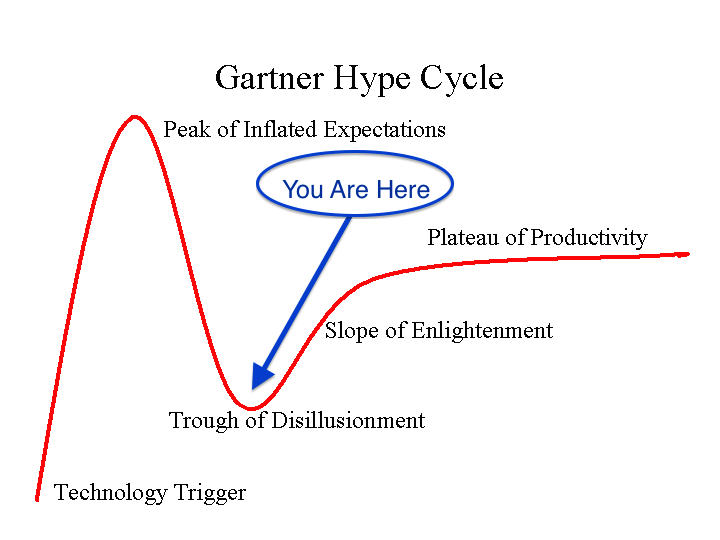
    If 2013 was the year that MOOC mania peaked in the Gartner hype cycle, then surely 2014 is the year in which they have entered the trough of disillusionment. And just as it was important last year to push back on the inflated expectations, it will be equally important this year to make sure we don’t throw out the baby with the bath water.

    With that in mind, I’m pleased to announce our new e-Literate TV series, “Massive and Open: What Are We Learning?” Filmed at the 2013 MOOC Research Initiative (MRI) conference, it delves into the current state of knowledge of the field. The interview with Stanford’s Amy Collier from our pilot series should really be considered Episode Zero for the series, as it explores the value of the first generation of MOOCs (particularly xMOOCs). To that, we have added three episodes from the new series:

    1. MOOC Research Initiative Grant Projects: After a brief introduction with MRI lead researcher George Siemens, Phil and I talk to a number of the grantees about the research they are undertaking. The range of research questions is eye-opening.
    2. MOOC Point/Counterpoint: We intercut interviews between MOOC enthusiast Keith Devlin and MOOC skeptic Jonathan Rees. The result is a rich and nuanced dialog between these two smart guys.
    3. Crowdsourced Answers to Popular MOOC Questions: We got MRI conference attendees to give their answers to frequently asked MOOC questions. The answers are varied and give a good sense of just how much our thinking about MOOCs is still all over the place.

    Enjoy!

  • Head in the Oven, Feet in the Freezer

    Some days, the internet gods are kind. On April 9th, I wrote,

    We want talking about educational efficacy to be like talking about the efficacy of Advil for treating arthritis. But it’s closer to talking about the efficacy of various chemotherapy drugs for treating a particular cancer. And we’re really really bad at talking about that kind of efficacy. I think we have our work cut out for us if we really want to be able to talk intelligently and intelligibly about the effectiveness of any particular educational intervention.

    On the very same day, the estimable Larry Cuban blogged,

    So it is hardly surprising, then, that many others, including myself, have been skeptical of the popular idea that evidence-based policymaking and evidence-based instruction can drive teaching practice. Those doubts have grown larger when one notes what has occurred in clinical medicine with its frequent U-turns in evidence-based “best practices.” Consider, for example, how new studies have often reversed prior “evidence-based” medical procedures. *Hormone therapy for post-menopausal women to reduce heart attacks wasfound to be more harmful than no intervention at all. *Getting a PSA test to determine whether the prostate gland showed signs of cancer for men over the age of 50 was “best practice” until 2012 when advisory panels of doctors recommended that no one under 55 should be tested and those older  might be tested if they had family histories of prostate cancer. And then there are new studies that recommend women to have annual mammograms, not at age  50 as recommended for decades, but at age 40. Or research syntheses (sometimes called “meta-analyses”) that showed anti-depressant pills worked no better than placebos. These large studies done with randomized clinical trials–the current gold standard for producing evidence-based medical practice–have, over time, produced reversals in practice. Such turnarounds, when popularized in the press (although media attention does not mean that practitioners actually change what they do with patients) often diminished faith in medical research leaving most of us–and I include myself–stuck as to which healthy practices we should continue and which we should drop. Should I, for example, eat butter or margarine to prevent a heart attack? In the 1980s, the answer was: Don’t eat butter, cheese, beef, and similar high-saturated fat products. Yet a recent meta-analysis of those and subsequent studies reached an opposite conclusion. Figuring out what to do is hard because I, as a researcher, teacher, and person who wants to maintain good health has to sort out what studies say and  how those studies were done from what the media report, and then how all of that applies to me. Should I take a PSA test? Should I switch from margarine to butter?

    He put it much better than I did. While the gains in overall modern medicine have been amazing, anybody who has had even a moderately complex health issue (like back pain, for example) has had the frustrating experience of having a billion tests, being passed from specialist to specialist, and getting no clear answers. ((But I’m not bitter.)) More on this point later. Larry’s next post—actually a guest post by Francis Schrag—is an imaginary argument between an evidence-based education proponent and a skeptic. I won’t quote it here, but it is well worth reading in full. My own position is somewhere between the proponent and the skeptic, though leaning more in the direction of the proponent. I don’t think we can measure everything that’s important about education, and it’s very clear that pretending that we can has caused serious damage to our educational system. But that doesn’t mean I think we should abandon all attempts to formulate a science of education. For me, it’s all about literacy. I want to give teachers and students skills to interpret the evidence for themselves and then empower them to use their own judgment. To that end, let’s look at the other half of Larry’s April 9 post, the title of which is “What’s The Evidence on School Devices and Software Improving Student Learning?” (more…)

  • AAC&U GEMs: Exemplar Practice

    A while back, I wrote about my early experiences as a member of the Digital Working Group for the AAC&U General Education Maps and Markers (GEMs) initiative and promised that I would do my homework for the group in public. Today I will make good on that promise. The homework is to write-up an exemplar practice of how digital tools and practices can help support students in their journeys through GenEd.

    As I said in my original post, I think this is an important initiative. I invite all of you to write up your own exemplars, either in the comments thread here or in your own blogs or other digital spaces.

    (more…)

  • Disclosure Update

    Regular readers know that we try to be as transparent as we can about the funding sources of our business, particularly when those sources are from organizations that we write about. This is an update about our relationship with a long-time funding organization: The Bill & Melinda Gates Foundation (BMGF).

    We have been fortunate enough to receive a few grants from the foundation over the last few years. These grants were to fund coverage of digital education in general and courseware in particular. To their credit, the foundation respected our editorial independence over the years. Further, their support enabled us to create content that we hope will have enduring value. Here are a few examples:

    • Our piece defining the value of “personalized learning” in EDUCAUSE Review
    • Our analysis of the nuances behind SRI’s adaptive learning report in The Chronicle of Higher Education
    • Our animated explainers on various personalized learning concepts, like this one on memory-based adaptive learning:

    • Our case studies delving into the details of adaptive and personalized learning, like this one on the value of technology to make student activity more visible:

    From a mission perspective, we share the foundation’s aspirations of providing everyone with a quality education and, in particular, of closing achievement gaps. But we are rethinking how we can be most effective at contributing to the achievement of those aspirations. In part through the foundation’s grants and our broader participation in the network of grantees, we have learned some lessons about what does and doesn’t work in terms of promoting effective practices. Over time, we have developed our own theory of change.

    We have decided to put our money where our mouth is and form the Empirical Educator Project to test our theory. As a consequence of our commitment to and focus on this new effort, we have decided not to pursue another round of funding from BMGF for continued within the foundation’s current framework. Making this decision also enables us to advance another of our goals, which is to decrease our financial dependence on any particular influencer in the market, particularly when it comes to direct funding of our reporting and analysis.


    We wish the foundation staff and grantee network the best of luck in their pursuit of our mutual goals and hope to find ways in which we can collaborate with them in other capacities over time as we work toward our mutual aspirations for education.