e-Literate

Present is Prologue

Author: Phil Hill

  • Ellucian Stops Support for Brainstorm, its CBE platform

    Ellucian Stops Support for Brainstorm, its CBE platform

    In a surprise move, Ellucian has decided to end support for Brainstorm, the competency-based education (CBE) platform it acquired from Helix Education two years ago. All Brainstorm customers are being notified of the end-of-life and aggressive measures are being used to help these customers quickly migrate to alternative platforms.

    Ellucian staff contacted me to share the general news of ending Brainstorm support. The stated reason for this change is that Ellucian perceives that there is insufficient market demand for full CBE programs, with many schools looking to ease into CBE in a minimalist fashion (I’m paraphrasing here). Brainstorm was designed primarily for non seat-time courses that are fully based on a competency framework and self-paced student access. We have covered Brainstorm / Helix on these issues here, including this observation:

    One educational model that is becoming more and more important is competency-based education (CBE). One of the challenges for this model is that the traditional LMS – based on a traditional model using grades, seat time and synchronous cohort of students – is not easily adapted to serve CBE needs.

    (more…)

  • Improved NAU Student Success in Subsequent Courses After Math Emporium

    Improved NAU Student Success in Subsequent Courses After Math Emporium

    Last week I published three e-Literate TV episodes on Northern Arizona University and their suite of initiatives aimed at helping first-year (and often first-generation) students. In those videos, NAU staff made some interesting claims, in particular that they are seeing improved student performance in subsequent courses after students take one of their modified emporium math courses in the Lumberjack Mathematics Center.

    (YouTube playlist: http://bit.ly/etv_NAU)

    (Video source specific claim: http://bit.ly/NAU_SMCclaim)

    (more…)

  • Northern Arizona University: Modified math emporium for first-year students

    Northern Arizona University: Modified math emporium for first-year students

    In episode 1 of our e-Literate TV case study on Northern Arizona University, we gave a broad overview of the suite of initiatives (primarily) targeted at helping first-year students amidst the tensions coming from growing enrollments. ((Disclosure: Our e-Literate TV series of video case studies and explainer videos is funded by a grant from the Bill & Melinda Gates Foundation.)) In episode 2 we covered their advising and student support, including work with IPASS initiative. In this episode we look at their modified math emporium approach leveraging the Lumberjack Mathematics Center.

    Math emporia have a mixed reputation, occasionally described as “the place where all the non-math majors are generally sent to virtually teach themselves subjects” or that “we’ve outsourced jobs for professors to a bunch of students on hourly wage”. Yet studies have shown positive results in many cases. Just saying there is an emporium approach doesn’t tell you much – some are run well with plenty of support for students, and some leave students on their own with poor support. So it is useful to see a specific case. How has NAU implemented a math emporium approach, what does it look like, what support is provided, and what are the results? NAU has implemented a modified emporium, and they have invested in a new facility to support this model.

    (Video source: https://youtu.be/A1GLmGri1So)

    (more…)

  • Winter Is Here: EdTech investments and M&A dropped significantly in 2016

    Winter Is Here: EdTech investments and M&A dropped significantly in 2016

    With the long-term rise in Ed Tech investments – starting in roughly 2007 – many analysts have been predicting a fall for several years. Maybe not a bubble burst like we saw in 2001, but a real drop in activity and volume. Now we also find out that there is also a 70% drop in mergers and acquisition values for the education industry according to a new analysis by the investment bankers Berkery Noyes.

    Throughout 2016 we had plenty of signs that the change was finally here. I got into the act in response to a ludicrous TechCrunch article that concluded that Ed Tech was “2017’s big, untapped and safe investor opportunity”. By the end of the year, there were several reports that investment (venture capital, private equity) had definitely gone down in 2016. Audrey Watters reported “The total dollars invested in 2016 are off by about $2 billion from this time last year”. EdSurge reported a drop of 31%. CB Insights reported a drop of 32% (based on estimates for Q4). (more…)

  • Northern Arizona University: Their work in student support and IPASS initiative

    Northern Arizona University: Their work in student support and IPASS initiative

    In episode 1 of our e-Literate TV case study on Northern Arizona University, we gave a broad overview of the suite of initiatives (primarily) targeted at helping first-year students amidst the tensions coming from growing enrollments. ((Disclosure: Our e-Literate TV series of video case studies and explainer videos is funded by a grant from the Bill & Melinda Gates Foundation.)) In this episode we look outside of the classroom to see how they’re approach advising and student support.

    As we mentioned yesterday, NAU has a rapidly growing enrollment and has a large percentage of students (more than 40% of incoming freshman) that are first-generation. These students do not have a long-history of academic success, and they typically do not have a family support system in place to help them understand what to expect in college and how to succeed. First-generation students tend to come from lower-income families and have a greater tendency to work 20+ hours per week on top of their college studies. We even documented last year how first-generation students tend to spend more on textbooks. Simply put, for schools attracting high percentages of first-generation students, there is an even greater need to provide support and advising structures in place to help them acclimate to college life and studying requirements. And even guidance on how to manage their degree and career plans.

    This is the context to understand the challenges NAU faces as they have changed their approach to advising and student support.

    (Video source: https://youtu.be/0uuogTI_IRY)

    (more…)

  • Northern Arizona University: A suite of initiatives to help first and second-year students

    Northern Arizona University: A suite of initiatives to help first and second-year students

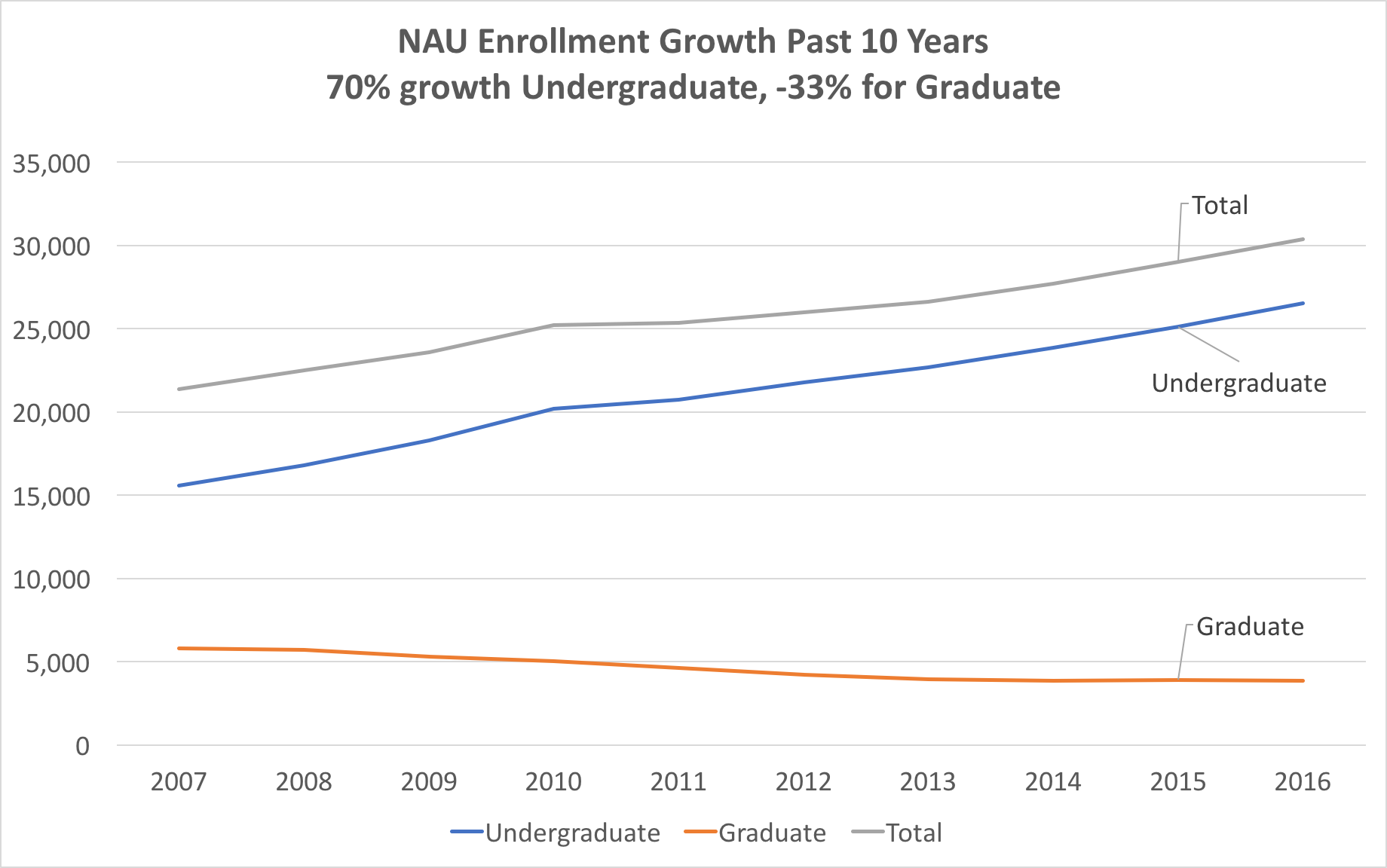
    As part of our e-Literate TV series of case studies, we had a chance this fall to interview faculty and staff at Northern Arizona University about, well, a lot of stuff. ((Disclosure: Our e-Literate TV series of video case studies and explainer videos is funded by a grant from the Bill & Melinda Gates Foundation.)) Rather than highlighting a specific program or course redesign, NAU has invested in and implemented a suite of initiatives focused on improving student learning and success by rethinking the experience of (mostly) first-year students.

    The core challenge NAU faces is to make these student-facing changes while facing growing enrollment, particularly for full-time undergraduate students.

    enrollment-growth-level
    (more…)

  • Schoology Layoffs: Focusing on smaller higher ed opportunities

    Schoology Layoffs: Focusing on smaller higher ed opportunities

    We’ve noticed and had several people ask us about corporate changes at Schoology, the LMS vendor. More specifically, the questions have been based on whether they are laying off staff, and what that means for the higher ed LMS market. Short answers – yes to the layoffs, and the company will be more selective on which higher ed opportunities to pursue.

    Through phone and email interviews, I asked CEO Jeremy Friedman to respond to these questions.

    As you and I have talked about, operational efficiency is a strategic objective for Schoology in 2017. As we built our plan for the year we saw opportunities to focus our efforts and operate at a higher level. This meant that we decided to reduce our headcount by a little over 10%, primarily across sales and marketing. To be clear, we reduced how much we are going to spend in Sales and Marketing, and we increased how much we are going to spend in Research & Development and Customer Success. The net impact is a more efficient company that can invest more in product innovation and our customers.

    (more…)