
e-Literate

Present is Prologue

Author: Phil Hill

  • Personalized Learning Changes: Effect on instructors and coaches

    Kate Bowles left an interesting comment at my previous post about an ASU episode on e-Literate TV, where I argued that there is a profound change in the instructor role. Her comment:

    Phil, I’m interested to know if you found anything out about the pay rates for coaches v TAs. I’m also interested in what coaches were actually paid to do — how the parameters of their employable hours fit what they ended up doing. Academics are rarely encouraged to think of their work in terms of billable increments, because this would sink the ship. But still I’m curious. Did ASU really just hike up their staffing costs in moving to personalised learning, or was there some other cost efficiency here? If the overall increase in students paid off, how did this happen? I’m grappling with how this worked for ASU in budgetary terms, as the pedagogical gain is so clear.

    This comment happened to coincide with my participation in WCET’s Leadership Summit on Adaptive Learning, where similar subjects were being discussed. For the purposes of this blog post, we’ll use the “personalized learning” language, which includes use of adaptive software as a subset. Let’s first address the ASU-specific questions. (more…)
  • Instructor Replacement vs. Instructor Role Change

    Two weeks ago I wrote a post about faculty members’ perspective on student-centered pacing within a course. What about the changing role of faculty members – how do their lives change with some of the personalized learning approaches?

    In the video below, I spoke with Sue McClure, who teaches a redesigned remedial math course at Arizona State University (ASU) that is based on the use of Khan Academy videos. There are plenty of questions about whether this approach works and is sustainable, but for now let’s just get a first-hand view of how Sue’s role changed in this specific course. You’ll see that it took some prodding to get her to talk about her personal experience, and I did have to reflect back what I was hearing. Note that the “coaches” she described are teaching assistants.

    (more…)

  • Moodle Association: New pay-for-play roadmap input for end users

    As long as we’re on the subject of changes to open source LMS models . . .

    Moodle is in the midst of releasing a fairly significant change to the community with a new not-for-profit entity called the Moodle Association. The idea is to get end users more directly involved in setting the product roadmap, as explained by Martin Dougiamas in this discussion thread and in his recent keynotes (the one below from early March in Germany).

    [After describing new and upcoming features] So that’s the things we have going now, but going back to this – this is the roadmap. Most people agree those things are pretty important right now. That list came from mostly me, getting feedback from many, many, many places. We’ve got the Moots, we’ve got the tracker, we’ve got the community, we’ve got Moodle partners who have many clients (and they collect a lot of feedback from their paying clients). We have all of that, and somehow my job is to synthesize all of that into a roadmap for 30 people to work on. It’s not ideal because there’s a lot, a lot of stuff going on in the community. (more…)

  • Pilots? We don’t need no stinkin’ pilots!

    Timothy Harfield commented on Arizona State University’s approach to pilots and scaling innovation at ASU.

    excellent comment on the problem of scaling innovation in #HigherEd. This is a central concern for @UIAinnovation.

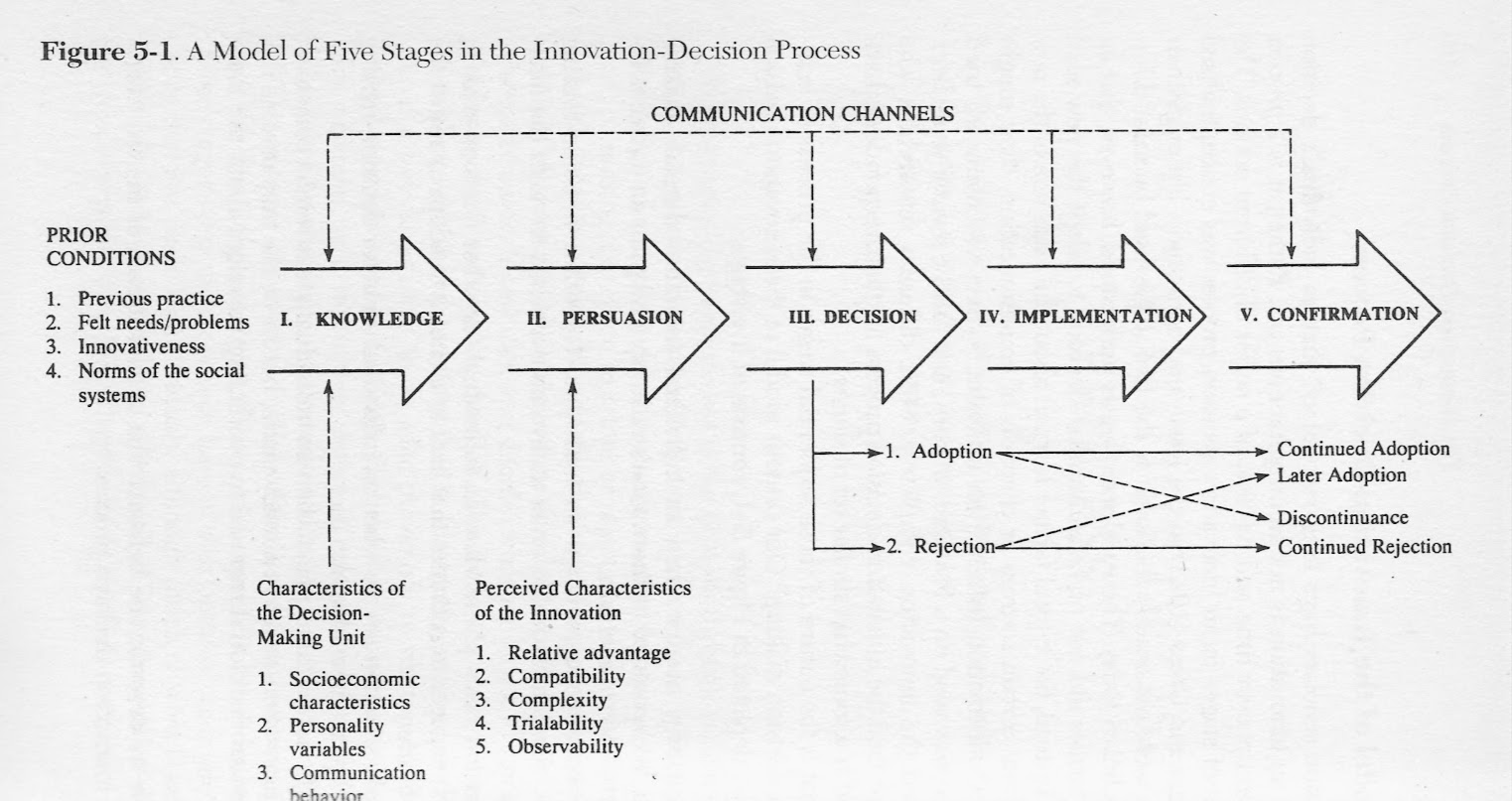
    The University Innovation Alliance is “a consortium of 11 large public research universities committed to making high-quality college degrees accessible to a diverse body of students”. I wrote about this “central concern” last summer in a post titled “Pilots: Too many ed tech innovations stuck in purgatory”, using the frame of Everett Rogers’ Diffusions of Innovations model. While the trigger for that post was on ed tech products, the same situation applies for the course design situation.

    5 Stages of Adoption

    What we are seeing in ed tech in most cases, I would argue, is that for institutions the new ideas (applications, products, services) are stuck the Persuasion stage. There is knowledge and application amongst some early adopters in small-scale pilots, but majority of faculty members either have no knowledge of the pilot or are not persuaded that the idea is to their advantage, and there is little support or structure to get the organization at large (i.e. the majority of faculty for a traditional institution, or perhaps for central academic technology organization) to make a considered decision. It’s important to note that in many cases, the innovation should not be spread to the majority, either due to being a poor solution or even due to organizational dynamics based on how the innovation is introduced.

    The Purgatory of Pilots

    This stuck process ends up as an ed tech purgatory – with promises and potential of the heaven of full institutional adoption with meaningful results to follow, but also with the peril of either never getting out of purgatory or outright rejection over time.

    (more…)

  • NYT Michael Crow Condensed Interview: More Info needed . . . and available

    The New York Times ran an “edited and condensed” interview with Arizona State University (ASU) president Michael Crow, titled “Reshaping Arizona State, and the Public Model”.

    Michael M. Crow sees Arizona State as the model of a public research university that measures itself by inclusivity, not exclusivity. In his 13 years as its president, he has profoundly reshaped the institution — hiring faculty stars from across the country, starting a bevy of interdisciplinary programs, growing the student body to some 83,000 and using technology to bring his ideas to scale, whether with web-based introductory math classes or eAdvisor, which monitors students’ progress toward their major. Last year, Dr. Crow made headlines when the university partnered with Starbucks to offer students the chance to complete their degree online for free. His new book, written with the historian William B. Dabars, is called, appropriately, “Designing the New American University.”

    (more…)

  • Release of ASU Case Study on e-Literate TV

    Today we are thrilled to release the third case study in our new e-Literate TV series on “personalized learning”. In this series, we examine how that term, which is heavily marketed but poorly defined, is implemented on the ground at a variety of colleges and universities.

    We are adding three episodes from Arizona State University (ASU), a school that is frequently in the news. Rather than just talking about the ASU problems, we are talking with the ASU people involved. What problems are they trying to solve? How do students view some of the changes? Are faculty being replaced by technology or are they changing roles? For that matter, how are faculty members involved in designing some of these changes?

    You can see all the case studies (either 2 or 3 per case study) at the series link, and you can access individual episodes below. (more…)