
e-Literate

Present is Prologue

Author: Phil Hill

  • Worth Reading: Use of adjuncts and one challenge of online education

    There is a fascinating essay today at Inside Higher Ed giving an inside, first-person view of being an adjunct professor.

    2015 is my 25th year of adjunct teaching. In the fall I will teach my 500th three-credit college course. I have put in many 14- to 16-hour days, with many 70- to 80-hour weeks. My record is 27 courses in one year, although I could not do that now.

    I want to share my thoughts on adjunct teaching. I write anonymously to not jeopardize my precarious positions. How typical is my situation?

    The whole essay is worth reading, as it gives a great view into what the modern university and the implications of using adjuncts. But I want to highlight one paragraph in particular that captures the challenge of understanding online education.

    I have taught many online courses. We have tapped about 10 percent of the potential of online courses for teaching. But rather than exploring the untapped 90 percent, the college where I taught online wanted to standardize every course with a template designed by tech people with no input from instructors.

    I want to design amazing online courses: courses so intriguing and intuitive and so easy to follow no one would ever need a tutorial. I want to design courses that got students eager to explore new things. Let me be clear, I am not talking about gimmicks and entertainment; I am talking about real learning. Is anyone interested in this?

    (more…)

  • LMS Is The Minivan of Education (and other thoughts from #LILI15)

    During yesterday’s K-20 learning platform panel at IMS Global’s Learning Impact Leadership Institute (the panel that replaced the LMS Smackdown of year’s past), Scott Jaschik started the discussion off by asking “what is the LMS?”. As I have recently complained about our Saturn Vue that replaced a Chrysler Town & Country, the answer I provided was that the LMS is the minivan of education. Everyone has them and needs them, but there’s a certain shame having one in the driveway.

    The Car Committee

    It’s popular to gripe about minivans, but in reality they reflect what we (the family set with kids still at home) actually are and what we do. Sure, the minivan encourages us to throw everything in the car and continue soccer mom lives, but they do offer great seating, storage, smooth rides (on boring roads at least). Likewise, the typical LMS is in actuality still a Course Management System (CMS), which reflects how courses are organized and managed in large part.

    We’re done with the boring minivan and have moved on to SUVs, but the SUV has morphed into a minivan with bad gas mileage and poor seating. It feels so nice to call it a different name, but it’s still a CMS minivan at its core.

    There are new innovations in the car market, like the Tesla. The risk we face in education is falling back on our RFP-driven habits. Great car demo, but the committee is using a family-driven process.  Item #142 includes having more than 5 seats, with a place for little Kenny’s sippy cup in each. You know what, let’s just make it taller and add a hatch in the back. Item #275 requires ethanol percentages (and we read an article that batteries are risky), so  could you add in an standard engine? Two years later . . . “dammit, the LMS”.

    Put it together, and the LMS is important and ubiquitous, but we all know we need better options. Despite this, take away the LMS and see if students like a different method to submit assignments or check grades for every class. (more…)

  • Release of e-Literate TV Series on Personalized Learning

    Today we are thrilled to release the initial episodes in our new e-Literate TV series on “personalized learning”. In this series, we examine how that term, which is heavily marketed but poorly defined, is implemented on the ground at a variety of colleges and universities. What does it really mean in practice? What problem is intended to solve? And how well is it working?

    e-LiterateLogoMED

    We have initially released case studies of approximately 30 minutes each from two very different schools – Middlebury College and Essex County College. You can see all the episodes (either 2 or 3 per case study) at the series link, and you can access individual episodes below.

    e-Literate TV, owned and run by MindWires Consulting, is funded in part by the Bill & Melinda Gates Foundation. When we first talked about the series with the Gates Foundation, they agreed to give us the editorial independence to report what we find, whether it is good, bad, or indifferent.

    As with the previous series, we are working in collaboration with In the Telling, our partners providing the platform and video production. Their Telling Story platform allows people to choose their level of engagement, from just watching the video to accessing synchronized transcripts and accessing transmedia. We have added content directly to the timeline of each video, bringing up further references, like e-Literate blog posts or relevant scholarly articles, in context. With In The Telling’s help, we are crafting episodes that we hope will be appealing and informative to those faculty, presidents, provosts, and other important college and university stakeholders who are not ed tech junkies.

    We will release three more case studies over the next month or two, and we also have two episodes discussing the common themes we observed on the campuses. We welcome your feedback, either in comments or on Twitter using the hashtag #eLiterateTV.

    Enjoy!

  • Pitchbook Lists Most Valuable Ed Tech Companies

    Update: Jeez – sorry about the multiple typos (mistakenly showed in thousands instead of millions). Fixed now.

    Pitchbook – a database service for M&A, private equity and venture capital – listed in Hot Topics what they saw as the top ten most valuable ed tech companies based on public valuations ((Note that estimates are as of the end of 2014.)). The definition of startup is a little loose, as one company (D2L) was founded in 1999 and public companies are excluded.

    Below are the market valuation estimates, to which I have added the year each company was founded along with the total funding by each company in parentheses, according to Crunchbase data.

    Company (year founded, funding total)  Market Valuation

    1. Pluralsight (2004, $169m)            $1.0 billion
    2. Instructure (2008, $79m)               $554 million
    3. Lynda.com (1995, $289m)             $456 million
    4. Coursera (2012, $85m)                   $367 million
    5. Open English (2006, $120m)        $350 million
    6. Craftsy (2010, $106m)                   $339 million
    7. D2L (1999, $165m)                        $330 million
    8. Lumos Labs (2005, $68m)           $265 million
    9. Clever (2012, $44m)                      $247 million
    10. Edmodo (2008, $88m)                 $236 million

    (more…)

  • ASU, edX and The Black Knight: MOOCs are not dead yet

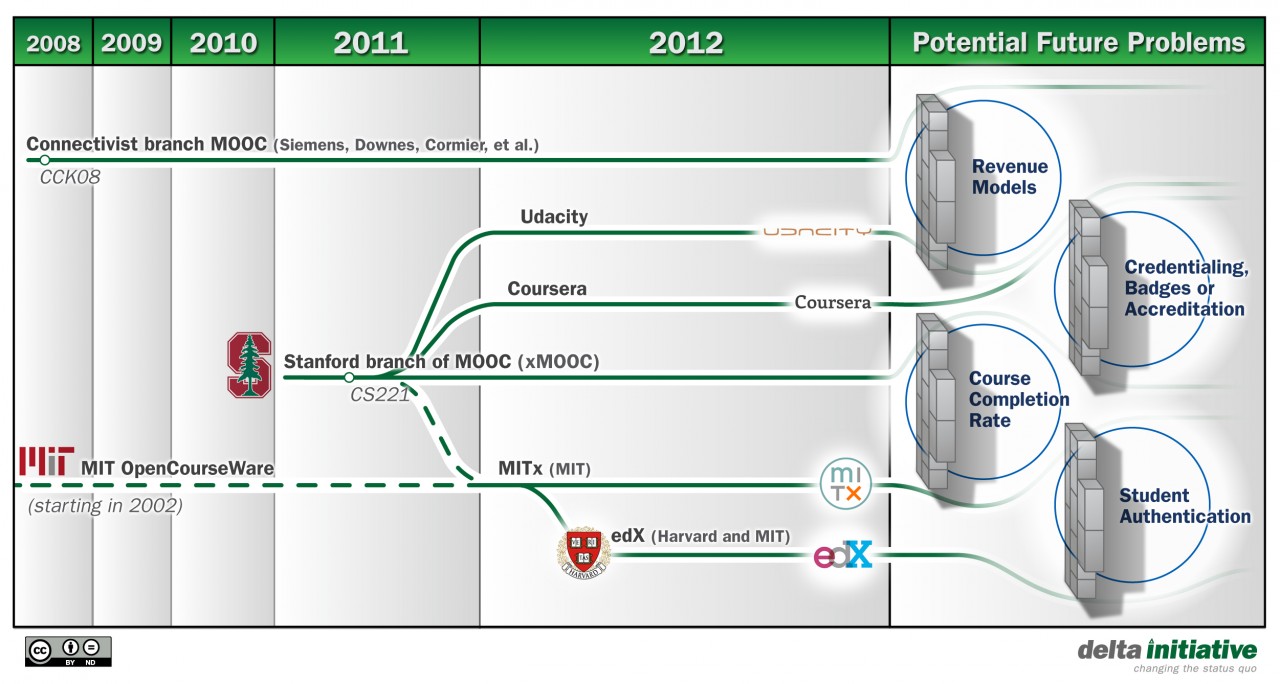
    In 2012 I wrote a post during the emergence of MOOC mania, pointing out some barriers that must be overcome for the new model to survive.

    So what are the barriers that must be overcome for the MOOC concept (in future generations) to become self-sustaining? To me the most obvious barriers are:

    • Developing revenue models to make the concept self-sustaining;
    • Delivering valuable signifiers of completion such as credentials, badges or acceptance into accredited programs;
    • Providing an experience and perceived value that enables higher course completion rates (most today have less than 10% of registered students actually completing the course); and
    • Authenticating students in a manner to satisfy accrediting institutions or hiring companies that the student identify is actually known.

    Fig 3 EvolutionCombine20120927

    Since that time, of course, the MOOC hype has faded away, partially based on the above barriers not being overcome.

    Today, Arizona State University (ASU) and edX announced a new program, Global Freshman Academy, that takes direct aim at all four barriers and could be the most significant MOOC program yet. From the New York Times story: (more…)

  • Cisco’s Collaborative Knowledge: Further blurring of higher ed & professional dev lines

    Cisco, which at one time was the most valuable in the world, made an announcement that apparently got no one’s attention (outside of the venerable e-Literate). Cisco ((Disclosure: Cisco, through a different division, is a client of MindWires Consulting.)) released a new product, Collaborative Knowledge (CK), that is designed to allow companies to access real-time expertise and enable collaborative work based on employees’ expertise, or in another word, competencies. From the press release (because I cannot find an independent news article to reference):

    To be positioned for growth, performance and productivity, organizations must transform into digital workplaces where knowledge sharing, learning and talent innovation are able to occur in real-time, anytime, anywhere.

    Cisco Collaborative Knowledge integrates best-in-class consumer and business technologies to enable capabilities such as highly secure knowledge sharing, expert identification, continuous learning, social networking and analytics into one complete and end-to-end enterprise knowledge exchange. With Cisco Collaborative Knowledge, workers are able to benefit from these continuous learning features, helping organizations innovate and solve real-world business challenges.

    Beyond the Buzzwords, What Is It?

    (more…)

  • 2U Learning Platform Update: Removal of Moodle, addition of accessibility options

    2U has now been a public company for over a year, and that had what is easily the most successful education IPO in recent history. Shares have almost doubled from $13.00 at IPO to $25.50 last week. At the same time, there is a swirl of news around their new partner Yale and the Physician Assistant’s program – first the announcement of program from one of the elite of elite schools, second the news that accreditation approval for the new program is not going to be as easy as hoped.

    While both aspects are newsworthy, I’d like to dive deeper into their infrastructure and learning platforms. The company is far from complacent, as they continue to make significant changes. (more…)