
e-Literate

Present is Prologue

Author: Phil Hill

  • Mobile-first learning platform EmpoweredU acquired by Qualcomm

    Qualcomm, the giant $26 billion wireless technology conglomerate, acquired EmpoweredU – a mobile-first learning platform available for the education market. What does this acquisition mean?

    Who is EmpoweredU?

    The company was created by CEO Steve Poizner in 2011 in partnership with Creative Artists Agency, the world’s largest sports and talent agency, under the name “Encore Career Institute”. The initial work was to offer continuing ed classes targeted at Baby Boomers through the UCLA extension.  ((These are certificate programs for $5,000 – $10,000 total tuition.))  In essence, this was an Online Service Provider (OSP) model similar to Embanet, Deltak, Academic Partnerships and 2U. As described by the San Francisco Chronicle in 2011:

    Poizner, in an interview at the firm’s headquarters this week, said the company combines “three of California’s greatest assets” – its famed public university system, the creative know-how of its technology center, Silicon Valley, and the cutting-edge marketing savvy of Hollywood. [snip]

    In addition to its employment potential for Baby Boomers, Poizner said, the collaboration could bring new revenue for cash-strapped UCLA and thousands of new students from around the nation to its online courses.

    The company changed names to Empowered Careers and then eventually settled on EmpoweredU.

    In the meantime they figured out that the OSP model is high risk and expensive, often requiring investments of $1 – $10 million per program by the OSP, with revenue-sharing profits occurring several years later. EmpoweredU has pivoted over the past year to become a mobile-first learning platform with content services.

    The platform is built on top of the Canvas open source version offered by Instructure and started pilots at 15+ schools this spring (including specific programs at USC, UC Berkeley, U of San Francisco, etc). This may be the most significant use of open source Canvas, and it might end up competing with Canvas, at least indirectly.

    As we’ll see later, EmpoweredU is also attempting to create a learning ecosystem that can combine multiple technologies.

    Why is Qualcomm making an ed tech acquisition?

    I interviewed Vicki Mealer (Senior Director, Business Development, Qualcomm Labs, which is the unit acquiring EmpoweredU) and Steve Poizner today. Vicki’s description of Qualcomm’s interest in ed tech is that they are all about mobile technology, and they have had a philanthropic interest in education for years (donating over $240 million cash to various institutions).  Qualcomm wants to be a behind-the-scenes cheerleader, but they also need an ecosystem for each market. Qualcomm Labs started looking at education a year ago, trying to identify and overcome barriers for adoption of mobile technology. Some of the perceived barriers: (more…)
  • To see how illogical the Brookings Institution report on student loans is, just read the executive summary

    il·log·i·cal
    i(l)ˈläjikəl/
    adjective
    1. lacking sense or clear, sound reasoning.  ((From Google’s definition))

    There have been multiple articles both accepting the Brookings argument that “typical borrowers are no worse off now than they were a generation ago” and those calling out the flaws in the Brookings report. I have written two articles here and here criticizing the report. The problem is that much of the discussion is more complicated that it needs to be. A simple reading of the Brookings executive summary exposes just how illogical the report is.

    College tuition and student debt levels have been increasing at a fast pace for at least two decades. These well-documented trends, coupled with an economy weakened by a major recession, have raised serious questions about whether the market for student debt is headed for a crisis, with many borrowers unable to repay their loans and taxpayers being forced to foot the bill.

    The argument is set up – yes, tuition and debt levels are going up, but how is a crisis defined? It’s specifically about “many borrowers unable to repay their loans”. Is there a crisis? That’s not a bad setup, and it is a valid question to address.

    Our analysis of more than two decades of data on the financial well-being of American households suggests that the reality of student loans may not be as dire as many commentators fear. We draw on data from the Survey of Consumer Finances (SCF) administered by the Federal Reserve Board to track how the education debt levels and incomes of young households evolved between 1989 and 2010. The SCF data are consistent with multiple other data sources, finding significant increases in average debt levels, but providing little indication of a significant contingent of borrowers with enormous debt loads.

    This is an interesting source of data. Yes, the New York Fed’s Survey of Consumer Finances tracks student debt, but this data is almost four years old due to triennial survey method.  ((Also note that we’re skipping the years with the highest growth in student debt.))

    But hold on – now we’re talking about “significant contingent of borrowers with enormous debt loads”? I thought the issue was ability to repay. What does “enormous” even mean other than being a scary word? (more…)

  • Early Review of Google Classroom

    Meg Tufano is co-Founder of SynaptIQ+ (think tank for social era knowledge) and leader of McDermott MultiMedia Group (an education consulting group focused on Google Apps EDU). We have been checking out Google Classroom – with her as the teacher and me as the student. I include some of Meg’s bio here as it is worth noting her extensive experience designing and teaching online courses for more than a decade.

    Meg posted a Google Slides review of her initial experiences using Google Classroom from a teacher’s perspective, which I am sharing below with minimal commentary. The review includes annotated slides showing the various features and Meg’s comments.

    I have not done as much work to show the student view, but I will note the following:

    • The student view does not include the link to the Chrome Store that Meg finds to be too confusing.
    • The biggest challenge I’ve had so far is managing my multiple Google accounts (you have to be logged into the Google Apps for Edu as your primary Google account to enter Classroom, which is not that intuitive to students).
    • I wonder if Google will continue to use Google tools so prominently in Classroom (primary GDrive, YouTube, GDocs) or if the full release will make it easier to embed non-Google tools.
    • I have previously written “Why Google Classroom won’t affect institutional LMS market … yet”, and after initial testing, nothing has changed my opinion.
    • I have one other post linking to video-based reviews of Google Classroom here.
  • CCSF Update: Accreditation appeal denied, but waiting for court date

    It looks like I’ll have the California trifecta for the past week, having already posted on Cal State and University of California news recently. Maybe I should find a Stanford or some other private university story.

    In my last post on CCSF from January:

    Last week, as expected, a California superior court judge ruled on whether to allow the Accrediting Commission for Community and Junior Colleges (ACCJC)  to end accreditation for City College of San Francisco (CCSF) as of July 31, 2014. As reported inmultiple news outlets, the judge granted an injunction preventing ACCJC from stripping CCSF’s accreditation at least until a court trial based on the city of San Francisco lawsuit, which would occur in the summer 2014 at the earliest. This means that CCSF will stay open for at least another academic term (fall 2014), and it is possible that ACCJC would have to redo their accreditation review.

     In the meantime, ACCJC reviewed CCSF’s appeal of the accrediting decision, and ACCJC is sticking to its guns on the decision, as described in the San Francisco Chronicle:

    City College of San Francisco remains out of compliance with eight accreditation standards, so the threat to revoke its accreditation stands, said the commission that set July 31 for the action that would shut the college down.

    Accreditation won’t be revoked on that date, however, because a judge delayed the deadline until an October trial can determine if the Accrediting Commission for Community and Junior Colleges properly conducted its 2012 evaluation of City College.

    In other words, ACCJC has changed its determination that CCSF should lose accreditation. There are only two caveats at this point:

    • The injunction that prevents ACCJC from revoking accreditation until the October court date; and
    • A new loophole called “restoration status”.

    (more…)

  • University of California’s $220 million payroll project reboot

    Chris Newfield has an excellent post at Remaking the University about the University of California’s budget situation and how it relates to the recent Moody’s negative outlook on higher education finances. The whole article is worth reading, but one section jumped off the page for me [emphasis added].

    The sadder example of ongoing debt is the request for “external financing for the UCPath project.” UC Path was UCOP’s flagship solution to UC inefficiencies that were allegedly wasting taxpayers’ money–in other words, new enterprise software for the systemwide consolidation of payroll and human resources functions. This is boring, important back office stuff, hardly good material for a political campaign to show the state “UC means business,” but that’s what it became. Rather than funding each campus’s decades-old effort to upgrade its systems on its own, UCOP sought centralization, which predictably introduced new levels of cost, complexity, and inefficiency, since centralization is often not actually efficient.

    I had heard nothing good about UC Path from people trying to implement it on campuses, and have tried to ignore it, but this week it has resurfaced as a problem at the Regental level. The project timeline has grown from 48 to 72 months, and its costs are said to be $220 million (it had spent $131 million by May 2014) . Worse, the repayment schedule has mushroomed from seven to twenty years. Annual payments are to be something like $25 million. Campuses are to be taxed to pay for 2015-era systems until 2035, which is like taking out a twenty year mortgage to pay for your refrigerator, except that your fridge will be working better in 2035 than next year’s PeopleSoft product. Since the concurrent budget document notes efficiency savings of $30 million per year (top of page 4), UCOP may be spending $220 million to save a net $5 million per year over a couple of decades–and going into debt to do it. In the end, an efficiency measure has turned into a literal liability.

    What the hell – a $220 million project to save money? How did this project get in this much trouble?

    (more…)

  • It’s The End of Cal State Online As We Know It . . .

    In a letter to campus leaders, Cal State University system office last month announced that Cal State Online will no longer operate as originally conceived. Emphasis added below.

    As the CSU continues to expand its online education strategies, Cal State Online will evolve as a critical component. An early Cal State Online goal will continue: to increase the quality and quantity of fully online education offerings to existing and prospective CSU students, resulting in successful completion of courses and graduation.

    The re-visioning of Cal State Online was recommended by the Council of Presidents and approved by the chancellor. This will include a shift to a communication, consultation and services’ strategy for fully online campus degree programs, credentials, certificates and courses supported by opt-in shared services. Cal State Online’s shared services will be designed, delivered and managed to:

    1. Make it easy for prospective and existing students to discover, decide, enroll and successfully complete their CSU online education opportunities.

    2. Make it more cost-effective for CSU campuses to develop, deliver and sustain their high- quality fully online degree, credential and certificate programs and courses.

    Background in a nutshell

    In early 2010 a sub-set of the Cal State presidents – the Technology Steering Committee (TSC) – came up with a plan to get the system to aggressively push online education across the system. In fall 2011 the group commissioned a consultant’s set of reports to help them pick an operating model, with the reports delivered in February 2012. This study led to the creation of CSU Online, conceived as a separate 501(c)3 non-profit group ((I have not independently verified that the organization truly was set up as a 501(c)3.)) run by the system, with the plan to use a for-profit Online Service Provider (OSP). ((Pearson had a team in place at Cal State providing LMS, implementation and integration services, enrollment management & marketing, course design support, analytics and reporting, learning object repository, help desk and technical support, training and faculty support.)) Early on they realized that Colorado State University was already using the CSU Online name, and the initiative was renamed Cal State Online. The idea was to offer fully-online programs offered by individual campuses in a one-stop shop. Based on an RFP process, in August 2012 Cal State Online selected Pearson as their OSP partner.

    Some media coverage of initiative:

    The March IHE article quoted official Cal State documents to describe the initiative.

    “The goal of Cal State Online is to create a standardized, centralized, comprehensive business, marketing and outreach support structure for all aspects of online program delivery for the Cal State University System,” says the draft RFP. In the open letter, the executive director offers assurances that “participation is optional” for each of the system’s nearly two dozen campuses, “all programs participating in Cal State Online are subject to the same approval processes as an on-campus program,” and “online courses will meet or exceed the quality standards of CSU face-to-face courses.”

    What has changed?

    This change is significant and recent, meaning that Cal State likely does not have full plans on what will happen in the future. For now:

    • Cal State Online will no longer be a separate operating entity, and the remnant, or “re-visioned” services will be run by the existing Academic Technology Services department within the Chancellor’s Office.

    The re-visioning Cal State Online team will be led by Gerry Hanley (Assistant Vice Chancellor for Academic Technology Services) with Sheila Thomas (State University Dean, Extended and Continuing Education).

    • Pearson is no longer the OSP, and in fact, they had already changed their role many months ago ((I believe this occurred Feb 2014 but am not sure.)) to remove the on-site team and become more of a platform provider for the LearningStudio (aka eCollege) LMS and supporting services.
    • Cal State is no longer attempting to provide a centralized, comprehensive support structure “for all aspects of online program delivery” but instead will centrally provide select services through the individual campuses.
    • It is clear that Cal State is positioning this decision to show as much continuity as possible. They will continue to provide some of the services started under Cal State Online and will continue to support the programs that have already been offered through the group.

    Some services will continue and CSU may keep the name, but it’s the end of Cal State Online as we know it.

    I am working on a longer post to explain what happened, including (hopefully) some interviews for supporting information . . . stay tuned.

    Update: Changed description of Pearson change and added footnote.

  • A response to Bloomberg article on UCLA student fees

    Megan McArdle has an article that was published in Bloomberg this week about the growth of student fees. The setup of the article was based on a new “$4 student fee to pay for better concerts”.

    To solve this problem, UCLA is introducing a $4 student fee to pay for better concerts. That illuminates a budgeting issue in higher education — and indeed among human beings more generally.

    That $4 is not a large fee. Even the poorest student can probably afford it. On the other hand, collectively, UCLA’s student fees are significant: more than $3,500, or about a quarter of the mandatory cost of attending UCLA for a year.

    Those fees are made up of many items, each trivial individually. Only collectively do they become a major source of costs for students and their families and potentially a barrier to college access for students who don’t have an extra $3,500 lying around.

    I’m sympathetic to the argument that college often costs too much and that institutions can play revenue games to avoid the appearance of raising tuition. I also think that Megan is one of the better national journalists on the topic of the higher education finances.

    UCLA Fees

    However, this article is somewhat sloppy in a way that harms the overall message. I would like to clarify the student fees data to help show the broader point.

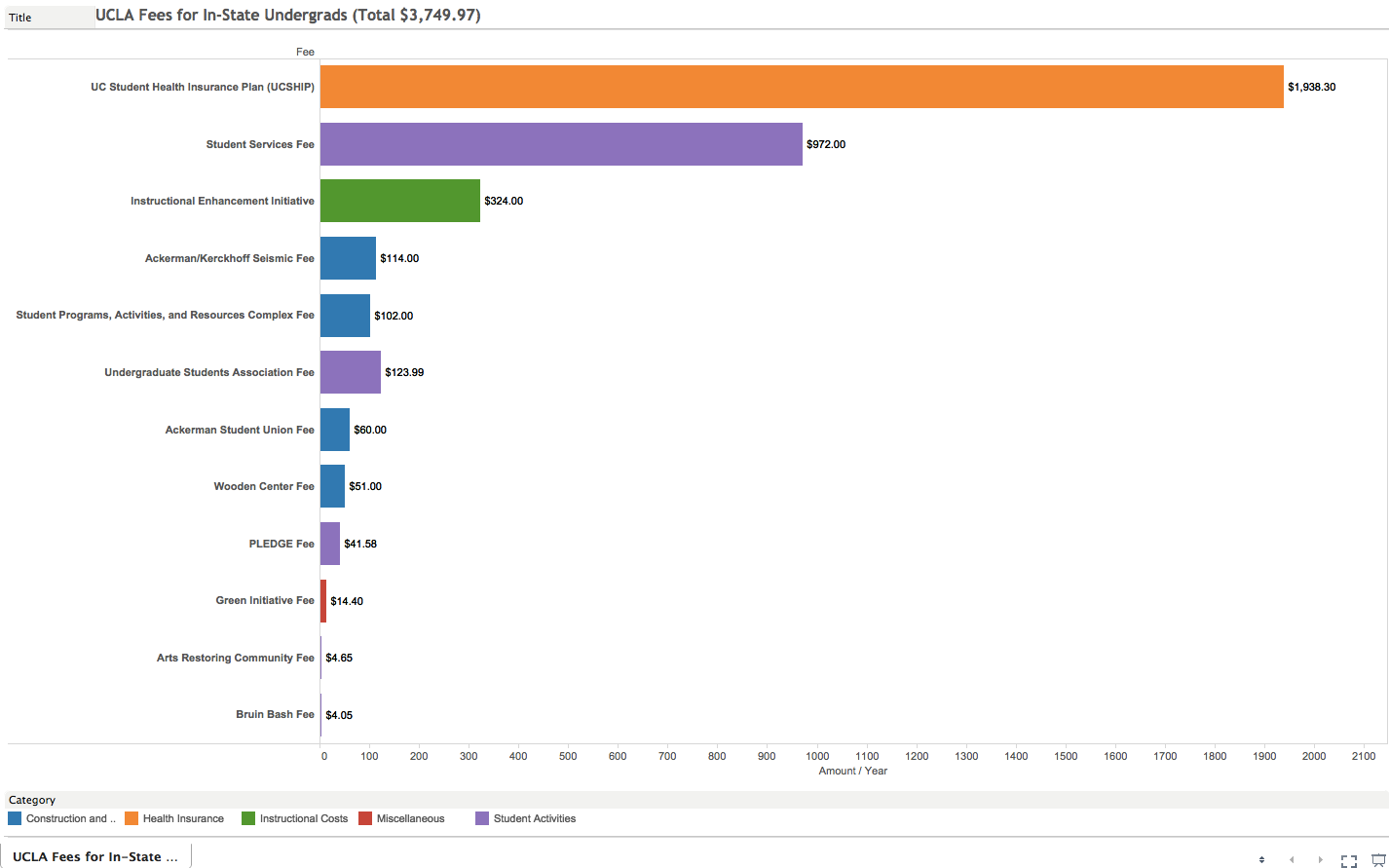
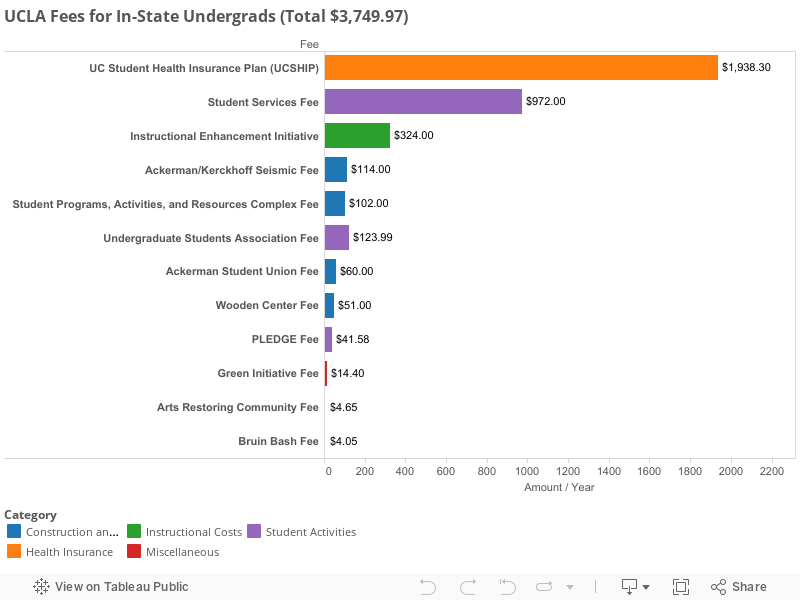
    Let’s look at the actual data from UCLA’s web site. I assume that Megan is basing this analysis on in-state undergraduate full-time students. The data is listed per quarter, and UCLA has three quarters for a full academic year. I have summarized below summing three quarters into yearly data, and you can:

    • Hover over each measure to see the fee description from UCLA’s fee description page;
    • Click on each category that I added to see the component fees;
    • Sort either column; and
    • Choose which rows to keep or exclude.
    • NOTE: Static image above if you cannot see interactive graphics

    Some Clarifications Needed

    • The total of non-tuition fees is $3,750 per year, not $3,500; however, Megan is right that this represents “about a quarter of the mandatory cost of attending UCLA for a year” ($3,750 out of $14,970).
    • The largest single fee is the UC health insurance fee (UC-SHIP), which is more than half of the total non-tuition fees. This fact (noted by Michael Berman on Twitter) should have been pointed out, given the significant percentage of the total.
    • With the UC-SHIP at $1,938 and the student services fee at $972, I hardly consider these as “trivial individually”.

    Broader Point on Budgeting

    The article’s broader point is that using extraneous fees to create additional revenue leads to a flawed budgeting process.

    As I’ve written before, this is a common phenomenon that you see among people who have gotten themselves into financial trouble — or, for that matter, people who are doing OK but complain that they don’t know where the money goes and can’t save for the big-ticket items they want. They consider each purchase individually, rather than in the context of a global budget, which means that they don’t make trade-offs. Instead of asking themselves “Is this what I want to spend my limited funds on, or would I rather have something else?” they ask “Can I afford this purchase on my income?” And the answer is often “Yes, I can.” The problem is that you can’t afford that purchase and the other 15 things that you can also, one by one, afford to buy on your income. This is how individual financial disasters occur, and it is also one way that college tuition is becoming a financial disaster for many families.

    This point is very important. Look at the Wooden Center fee, described here (or by hovering over chart):

    Covers repayment of the construction bond plus the ongoing maintenance and utilities costs for the John Wooden Recreation Center. It was approved by student referendum. The fee is increased periodically based on the Consumer Price Index.

    To take Megan’s point, this fee “was approved by student referendum”, which means that UCLA has moved budgeting responsibility away from a holistic approach to saying “the students voted on it”. This makes no financial sense, nor does it make sense to shift bond repayment and maintenance and utilities cost onto student fees.

    While this article had some sloppy reporting in terms of accurately describing the student fees, it does highlight an important aspect of the budget problems in higher education and how the default method is to shift the costs to students.