e-Literate

Present is Prologue

Author: Phil Hill

  • Some validation of MOOC student patterns graphic

    File this under “you read it first on e-Literate”.

    In previous posts from spring 2013 I provided a graphical view on MOOC student patterns based on observed retention over time as well as differing student types. This graphic was based on anecdotal observations of multiple MOOCs, mostly through Coursera.

    studentPatternsInMoocs3-2


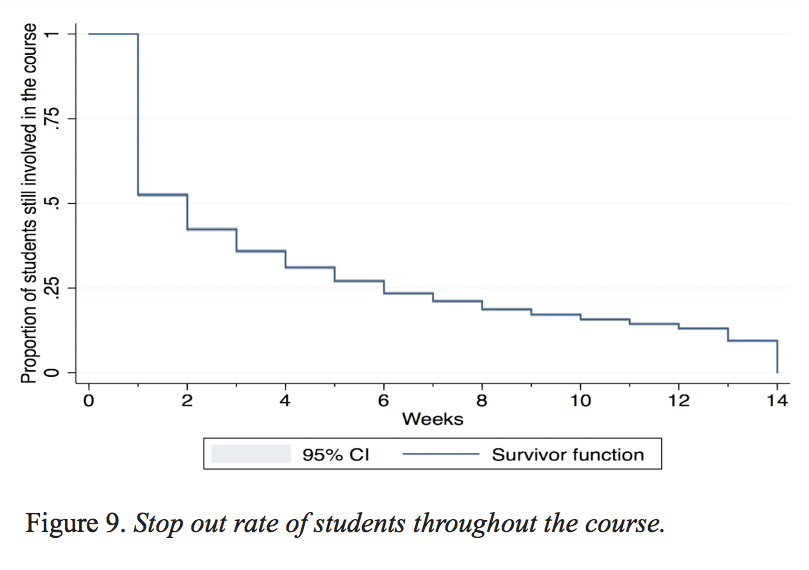
    Based on a recent study of the edX Circuits and Electronics MOOC, there is this interesting chart of student patterns based on actual data analysis of the 155k students from the spring 2012 offering of this course. The full report is worth reading, by the way, with some real student pattern insights.

    edX Retention


    I took this chart and overlaid it on the MOOC student patterns graphic, scaling for 0% / 100% of enrollment vertically and start / stop of course horizontally.

    Combined MOOC patterns


    It’s good to see this validation of the overall retention pattern based on real data analysis to augment the original graphic’s model.

  • What does Devlin Daley’s departure mean for Instructure?

    Despite all the media hype on MOOCs over the past two years, perhaps the most important recent market entry for ed tech has been Canvas, the LMS from Instructure. Instructure was founded in 2008 by Brian Whitmer and Devlin Daley. At the time Brian and Devlin were graduate students at BYU who had just taken a class taught by Josh Coates, where their assignment was to come up with a product and business model to address a specific challenge. Brian and Devlin chose the LMS market based on the poor designs and older architectures dominating the market. This design led to the founding of Instructure, with Josh eventually providing seed funding and becoming CEO by 2010.

    Michael covered the burst of news in January 2011 that served as the launch of Canvas.

    Instructure has just announced that they will be releasing an open source version of their Canvas LMS product. Between this announcement, the winning of the Utah Education Network contract (109,000 college students and 40,000 K12 students), and the oh-so-ever-brief lawsuit by Desire2Learn about that win, Instructure has been making quite a splash lately.

    Since that time Instructure has grown to 7M+ users, 500 customers and 240 employees while raising $50M in total VC funding. With that much early success, it was a surprise to see Devlin Daley leave the company as of last week with his Douglas Adams reference. (more…)

  • SJSU Plus Udacity Pilots: Lack of transparency in describing data

    Alternate Headline: “Our Long National Nightmare is Over – SJSU and Udacity solve problem of college graduates being able to pass remedial math”

    The more I read on SJSU’s announcement on the pilot program, the more troubled I am with the lack of clear description of student population change (I wrote briefly about the change in student populations yesterday). In a nutshell, the spring 2013 pilot was completely different in the major demographic variables than the summer 2013 pilot. That’s good, right, showing that SJSU and Udacity are learning their lessons? It would be good if SJSU clearly described the student differences and avoided any implications that the numbers could be compared. Further, it would be good to avoid misleading comparisons to face-to-face courses at SJSU.

    But that is not what is going on. SJSU, in particular, is going out of its way to compare spring, summer pilots alongside SJSU on-campus courses in its media blitz. And the strategy is working, based on the articles that came directly from SJSU / Udacity interviews and information releases.

    (more…)

  • SJSU Plus / Udacity Update: Different student populations

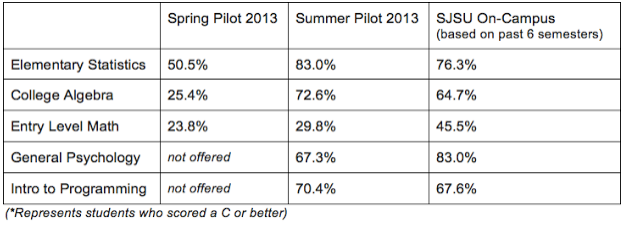
    San Jose State University (SJSU) and Udacity have announced the results of their summer pilot, and the headlines cover the big improvements (text from IHE article, table from Udacity blog).

    Thrun recently hinted that the summer pilot’s results would be more positive, and that Udacity was getting close to finding the “magic formula” to deliver high-quality, low-cost education.

    The lone holdout among the SJSU Plus courses is entry-level math, which saw the smallest increase in students who received a passing grade, from 23.8 to 29.8 percent. That places the pass rate almost 40 percentage points below the closest SJSU Plus course, and about 15 percentage points below the pass rate of the on-campus course.
    Thrun Blog

    I am not trying to throw cold water here, but it is very important to look at the student populations. To his credit, Sebastian Thrun describes the big differences in his blog post.

    This summer, we ran the second instance of our pilot. While in the Spring, we actively sought out underserved high schools from low-income areas in California, this time we simply opened up enrollment to anyone. As predicted, with 2,091 students who enrolled, we mainly reached students who would not ordinarily attend college. Only 11% of the summer students who took the for-credit courses from SJSU were matriculated students in one of the California State Universities. 71% of our students came from out of state or foreign countries. And while the total number of high school students went up, their proportion in the total student body went down. [snip]

    One key difference between Spring and Summer was that we opened our Summer session to everyone. This led to a substantial difference in student body. Among the student body, 53% reported that they already hold a post-secondary degree (5% Associate, 28% Bachelor’s, 16% Master’s, and 4% Doctorate). Only 12% of the students had a high school graduate diploma or equivalent, and 15% were active high school students. This is very different from the Spring Pilot, in which approximately 50% of the student body were active high school students, and the other 50% were matriculated SJSU students. [emphasis added]

    One of the key success factors of online education is to target student populations who can succeed in this environment. If you target groups (remedial students, underserved students, high school students), then there must be tremendous student support.

    Pay attention to the student populations – this might be the real story. If you ignore the difference in student populations, you might draw the wrong conclusions.

  • Cal State’s New Online Concurrent Enrollment Program: A Student’s View

    Michael and I have written about California’s efforts to leverage online education to address the challenge of students having access to needed courses, but it would help to hear what students have to say. Towards that end, I am sharing a student newspaper article about Cal State’s new online concurrent enrollment program. The student is my daughter, Hillary Hill, who is in her third year at Sonoma State University. You can find the original article here.

    As a student attending a school that is part of the California State University system, specifically Sonoma State University, I know the dread and frustration associated with registering for classes.

    In some ways, it seems like we are being set up to fail; we have a 16 unit cap, registration times get mixed up, and it seems like every class you need is full after five minutes.

    (more…)

  • Postscript on accreditation transparency: Basic financials of two accrediting commissions

    Last week I wrote a post on two significant accrediting actions related to City College of San Francisco and Tiffin University.

    If there really is a shift in the DOE’s views on accreditation or in the accrediting commissions’ interpretation of standards, then that could have fairly profound cascade effects on competency-based learning programs, private online colleges, MOOCs, and online service providers.

    That is also why the lack of transparency from the accrediting commissions is so troubling. They are making decisions that have profound effects on many institutions, not just the specific schools under review.

    Mathieu Plourde asked a good question in the comments.

    Do you know how these accrediting bodies get their funding? If it’s at least in part from government funding or through membership fees from public institutions, I’d say it’s time to make them open up their data.

    While I have not figured out if there is a method to force the accrediting commissions to “open up their data”, I would like to answer the first part of Mathieu’s question on funding.

    Accrediting commissions are designated non-profit organizations, typically designated as 501 (c) (3) by the IRS. This means they have to file annual returns (form 990) to maintain their tax-exempt status. One sight that has this information is the Foundation Center. I’ve pulled up the most recent forms for the  Accrediting Commission for Community and Junior Colleges (ACCJC), responsible for CCSF’s accreditation, and the Higher Learning Commission (HLC), responsible for Tiffin University’s accreditation. Some notes before getting to the data:

    • There are six regional accrediting agencies in the US covering postsecondary education. Each agency has one or two commissions as members that are responsible for the actual accreditation reviews, for a total of eight regional accrediting commissions (New England and Western agencies have two commissions each).
    • ACCJC is part of the Western Association of Schools and Colleges (WASC). Since there are two commissions in WASC, WASC files the form 990 instead of ACCJC. Their most recent form available is for the tax year ending June 30, 2011 (I do not know why the 2012 data is missing).
    • HLC is a member of the North Central Association of Colleges and Schools (NCACS). Since there is only one commission in NCACS, HLC files its own form 990. Their most recent form available is for the tax year ending August 31, 2012.
    • “Membership Dues” covers the fees paid by accredited institutions.
    • “Program Services” combines paid workshops, consulting and annual conference revenues – typically from the member institutions.
    • “Evaluation Visits” are primarily travel and direct expenses for peer review teams visiting institutions during review.

    The actual forms can be found here for WASC / ACCJC and here for HLC . I have combined the most relevant data into one table.
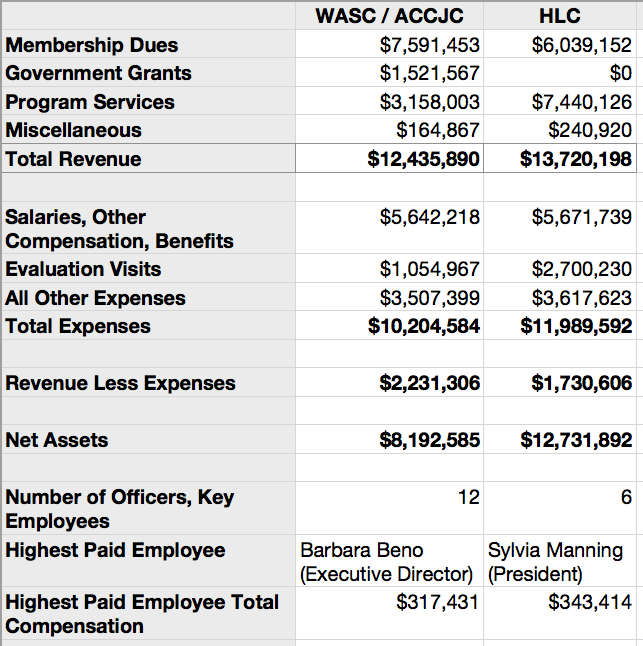
    Form 990


    I went back and forth on whether to highlight the ‘highest paid employee’ data. In the end I chose to include this in the table as it seems relevant in terms of the organization’s motivations for self-preservation. In the case of ACCJC, there have been many charges of conflict-of-interest for the commission members, and the Department of Education has even found that the commission does not have adequate conflict-of-interest policies. The people running accrediting commissions are few in number but make a decent living. There is more information available in the form 990s.

    So, for my long-winded answer to Mathieu: Accrediting commissions get their revenue primarily from membership dues and additional program services from member institutions, many of which are themselves public entities; they also make some revenue directly from government or foundation (e.g. Lumina Foundation, Gates Foundation) grants but not every year.


  • Some big personnel changes in LMS market

    In just the past week we have had three fairly significant people depart higher ed LMS companies. This really is turning out to be a bumpy ride as the market changes.

    • Ray Henderson announced last night that he is leaving his operational role at Blackboard (President, Academic Platforms and CTO) and is moving into a role with the Board of Directors. More info from Jay Bhatt’s post here and Ray Henderson’s post here. Michael is working on an e-Literate post with more information soon. Bill Flook covered in an article here.
    • Devlin Daley, one of the two founders of Instructure, the company behind the Canvas LMS, is leaving the company as of today. I talked to Instructure rep today who indicated that Devlin is looking to get back in to startup ed tech mode, whereas Instructure is becoming a larger company. I’ll write more of an analysis on this move soon. For now I’ll just say that it is extremely rare for a tech founder to leave a company that might go public within a year or two.
    • Al Essa, the Director of Analytics Research and Strategy for Desire2Learn, has left the company to join McGraw-Hill based on his LinkedIn profile. This is curious timing, given Desire2Learn’s major focus on analytics and the Student Success System this year.

    More to come.