e-Literate

Present is Prologue

Author: Phil Hill

  • State of the Anglosphere’s Higher Education LMS Market: 2013 Edition

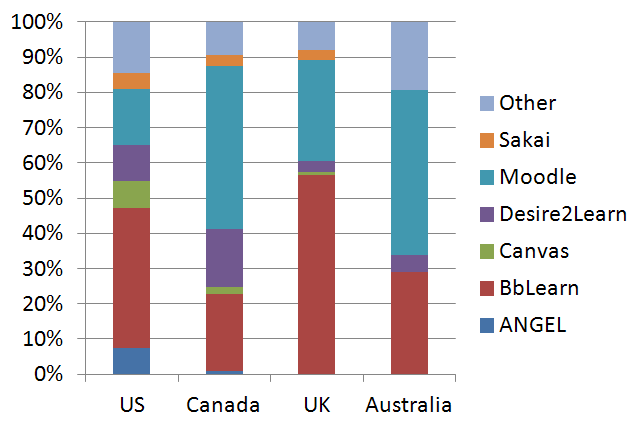
    I shared the most recent graphic summarizing the LMS market in September 2012, and thanks to new data sources it’s time for an update. As with all previous versions, the 2005 – 2009 data points are based on the Campus Computing Project, and therefore is based on US adoption from non-profit institutions. This set of longitudinal data provides an anchor for the summary.

    What I’ve been attempting to do lately is to expand the market definition beyond the US. Last year I used some heuristics:

    LMS_MarketShare_20121018-Home

    (more…)

  • New data available for higher education LMS market

    Despite much talk about the demise of the LMS market, the end is nowhere in sight. Unlike many of the newer learning platform concepts (e.g. MOOCs, free platforms, unbundled learning platforms), the LMS market has an established business model and real revenues. Just today came news of an investment analysis report predicting that total LMS market (higher ed, corporate training, K-12) would triple in revenue by 2018, moving from $2.6B to $7.8B. The LMS ain’t sexy, but it’s still important.

    global_LMS_stacked_by_typeThis is why I have found it surprising how long it is taking to move from survey-based and anecdotal market information to harder data directly measured by the actual LMS implementations. Until recently, that is, when there are at least two very useful sites available.


    Edutechnica

    George Kroner, a former engineer at Blackboard who now works for University of Maryland University College (UMUC), has developed what may be the most thorough measurement of LMS adoption in higher education at Edutechnica (OK, he’s better at coding and analysis than site naming). This side project (not affiliated with UMUC) started two months ago based on George’s ambition to unite various learning communities with better data. He said that he was inspired by the Campus Computing Project (CCP) and that Edutechnica should be seen as complementary to the CCP.

    (more…)

  • Comment from member of research team on USA Today flipped classroom article

    Update 10/26: We now have Rachel Levy and Nancy Lape (who was the researcher interviewed by USA Today) both agreeing with Darryl’s comments. That’s three of the four members of the research team. While I do not claim to understand how the reporter developed her story line (I have asked for comment), it is quite clear that the article does not represent the work of the Harvey Mudd research team and has a misleading headline and lede.

    As a follow up to my response to the USA Today article on flipped classroom research, there was a very informative comment one Google+ from Darryl Yong (one of the members of the Harvey Mudd research team). I thought this comment deserved to be seen by a wider audience, so I’m reproducing in full.

    Thanks, Phil, for this post. The USA Today article paints an inaccurate picture of our work and I wanted to try to clarify some things and continue this conversation with you and your readers. (I am only writing on my own behalf and not for my collaborators on this study.)

    My biggest regret is that the article greatly oversimplifies things by portraying our study as an attempt to answer whether flipped classrooms work or not. That kind of research question is too blunt to be useful. Our goal is to better understand the conditions under which flipped classrooms lead to better student outcomes. As Phil and others here point out, there are many different manifestations of what we mean by the term “flipped classroom” and that we should be wary about talking about it as if there is one canonical implementation. How are the benefits of flipped classrooms affected by school and student contexts, and are there other benefits that we haven’t yet characterized? We don’t have any preconceived answers to these research questions. While folks might disagree with us whether these research questions are interesting or not, they should at least know that we’re aware of the good work that others have already done and we’re trying to build on it rather than debunk it.

    (more…)

  • Please Welcome Featured Blogger Mike Caulfield

    Michael and I have been very impressed with the articles from Mike Caulfield, an edublogger who writes at Hapgood. Mike is director of blended and networked learning at Washington State University Vancouver, and he and Michael first met at a Lumen Learning event this summer. In addition to writing at his blog, Mike Caulfield has also written an excellent  EDUCAUSE Review article along with Amy Collier and Sherif Halawa, titled “Rethinking Online Community in MOOCs Used for Blended Learning”.

    I’m happy to say that Mike will be doing a series of posts for us, starting today. Please welcome him.

  • A response to USA Today article on Flipped Classroom research

    Update 10/25: Bumped comment from Darryl Yong, a member of the research team, into its own post here.

    Update 10/26: We now have Rachel Levy and Nancy Lape (who was the researcher interviewed by USA Today) both agreeing with Darryl’s comments. That’s three of the four members of the research team. While I do not claim to understand how the reporter developed her story line (I have asked for comment), it is quite clear that the article does not represent the work of the Harvey Mudd research team and has a misleading headline and lede.

    USA Today published an article today titled “‘Flipped classrooms’ may not have any impact on learning“, based on research from four Harvey Mudd professors. This research is backed by a “$199,544 grant from the National Science Foundation to study the effects of the flipped classroom on students’ learning”. This is newsworthy, right? A real research report with NSF funding finding no statistical difference in learning outcomes from flipped classroom seems to contradict much of the recent promise of ed tech.

    Upon closer reading, however, there are some major problems with the story. Exaggerated claims by ed tech enthusiasts are not helpful, but neither are exaggerated claims by ed tech skeptics. We at e-Literate have been critical of both flavors (witness our analysis of San Jose State claims, Desire2Learn claims, and edX claims for examples of the former).

    Let’s review today’s story as an example of the latter.

    In a flipped classroom, students watch their professors’ lectures online before class, while spending class time working on hands-on, “real world” problems.

    The potential of the model has many educators thrilled — it could be the end of vast lecture halls, students falling asleep and boring, monotone professors.

    This is a decent summary, although I would argue there should not be a one-size-fits-all mentality. Flipped classrooms, even where successful, should not replace all lecture-based classes. But for national media, this is not a bad description.

    But four professors at Harvey Mudd College in Claremont, Calif. who are studying the effectiveness of a flipped classroom have bad news for advocates of the trend: it might not make any difference.

    This is the lede, and the claim that we should examine. What is the basis of their study?

    (more…)

  • e-Literate TV trailer from EDUCAUSE 2013

    Last week Michael announced a new project of ours called e-Literate TV. To recap, the idea is that there are new groups involved in decisions that impact ed tech and online education. Deans, provosts, presidents, boards of trustees, state legislators, and even national media are newly interested in topics with different levels of understanding and different perspectives.

    This new situation can be frustrating for e-learning professionals who have been involved in ed tech for years, but we cannot and should not wish away this new interest. Instead, there is an opportunity to develop new ways to engage the various groups in discussions about the usage of technology to enable change in education.

    This is the goal of e-Literate TV. One way we see e-Literate TV being used is by e-learning professionals sharing easy-to-consume ~10-minute videos with various stake holders as a method to enable more productive conversations. As such, all of the video segments will come with a creative commons license for easy sharing.

    What event is complete without a cool tee shirt?
    What event is complete without a cool tee shirt?

    (more…)

  • Differentiated, Personalized & Adaptive Learning: some clarity for EDUCAUSE

    Josh Kim wrote three predictions at Inside Higher Ed for the EDUCAUSE 2013 conference, and I particularly agree with the basis of #2:

    Prediction 2: Adaptive Learning Platforms Will Be the Toast of the Party

    Everyone will want to talk to Knewton. The ASU / Pearson / Knewton partnership is a huge deal. Knewton has the technology, relationships, funding, and management team to make a huge impact.

    I’ll be looking at EDUCAUSE at the other adaptive learning players. Where are they focusing their platform work? What deals and relationships do they currently have? How big is their market penetration? What is the quality of their leadership team and employees they have a EDUCAUSE?

    I’m betting we will see at least one major adaptive learning vendor announcement. A purchase, a big collaboration deal, or a new huge round of funding.

    I also expect much of the discussion this year to be on adaptive learning. But one risk of this zeitgeist (if it comes to pass) is that terminology becomes fuzzy and often devoid of meaning. Hey, get your adaptive here. You want to be adaptive, don’t you? We are the adaptive makers… and we are the dreamers of dreams.

    (more…)