e-Literate

Present is Prologue

Author: Phil Hill

  • The Right to Educational Access Paper, Part II

    Update: This paper can be found at the 20MM site and has also been broken into four separate posts on e-Literate:

    Three Basic Approaches

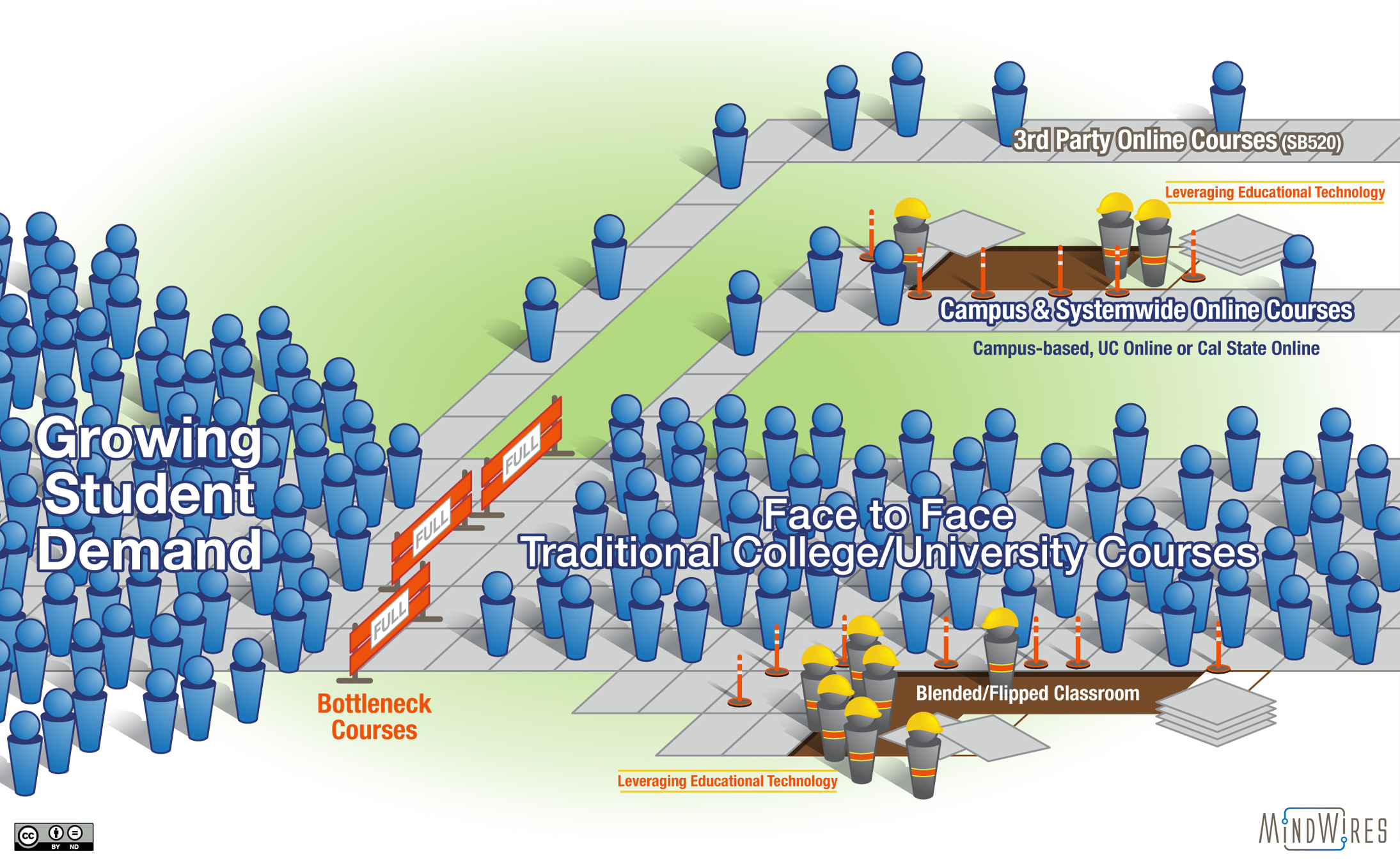
    By its very nature, the problem of bottleneck courses is centered on access and scale. Students need access to courses which tend to be in high demand and are overenrolled. These high-demand lower-division courses imply the ability to scale the course in a cost-effective manner, to meet the realities of budget and enrollment demands.

    CalStudentFlow Graphic copy

    (more…)

  • Harvard Faculty Request Faculty Oversight of HarvardX (Their Usage of edX)

    Yesterday, 58 faculty members from the Faculty of Arts and Sciences at Harvard wrote an open letter to the dean requesting faculty oversight of HarvardX. When schools sign up for edX, their implementations tend to be called SchoolX, thus HarvardX specifically refers to their usage of the MOOC platform, not to the overall edX organization. This distinction is important, given Harvard’s founding role in creating the edX organization and $30m pledge of support.

    The letter is short, so I’ll quote it in full (the signatures are much longer than the letter itself).

    As the university marks the first anniversary of edX and HarvardX, some faculty are tremendously excited about the potential of HarvardX; others are deeply concerned about the program’s costs and consequences. We appreciate the meetings, town halls, and other arenas in which faculty have been able to discuss HarvardX. But we believe that many critical questions about the relationship of the FAS to HarvardX, and to edX, have not yet been addressed. These questions (which fall outside the remit of the two existing HarvardX faculty committees, most of whose members are not from FAS) range from faculty oversight of HarvardX to the impact online courses will have on the higher education system as a whole.

    The Faculty of Arts and Sciences is directly responsible for the teaching of Harvard undergraduates and Ph.D. students. It is our responsibility to ensure that HarvardX is consistent with our commitment to our students on campus, and with our academic mission. Given the rapid pace of development of HarvardX, we believe it is essential to have a formal, sustained, and structured faculty discussion on these issues as soon as possible. We write to request that you appoint a committee of FAS ladder faculty to draft a set of ethical and educational principles that will govern FAS involvement in HarvardX, to be brought before the FAS for a vote in the coming academic year.

    Note that they request FAS ladder faculty, which means tenure and tenure track faculty and specifically not adjuncts and lecturers. It is possible, however, that the requested committee of ladder faculty could choose to involve adjuncts in the process.

    (more…)

  • MOOCs Explained: Radio Interview with University of Delaware

    Just over a week ago I had the opportunity to participate in a radio interview for the University of Delaware’s local station WVUD, with the Campus Voices interview airing on May 17th. The interview was in advance of Delaware’s summer faculty institute, where I will be speaking in just over a week. I really enjoyed the interview, and this is an area that needs more attention – local educational technology support for faculty innovation, with an emphasis on faculty sharing best practices. The summer institute is May 28th – 31st.

    I was interviewed by Richard Gordon and Paul Hyde, and some of the key topics we explored:

    • Not everyone is a reader of the Chronicle of Higher Education – what the heck is a MOOC?
    • How do MOOCs affect faculty teaching in a bricks-and-mortar university?
    • What are the completion rates of MOOCs and what are the student types?
    • Are there applications beyond higher education?
    • Why is there such significant pushback against MOOCs lately?
    • What disciplines beyond science and engineering are using MOOCs?

    Here is link to the U Delaware radio interview – audio only. It’s about a half hour in length, but with some cool NPR-sounding music to kick it off.

    I have also added some graphics and created a video of the interview.

  • Blackboard Changes Underway: Jay Bhatt Interview and Management Changes

    There is an interesting article today from Bill Flook , who has covered Blackboard as a business, including the story of Michael Chasen’s departure in late 2012 along with two rounds of layoffs.

    Blackboard Inc. has been a company in transition long before CEO Michael Chasen announced his upcoming departure.

    In fact, the presence of Blackboard’s longtime chief has been its most visible constant. So the big question coming out of Monday’s news is this: What will the ed-tech behemoth look like, sans Chasen? [snip]

    If anything, it’s surprising that Chasen stayed on so long after the private equity buyout. He and Providence had “mutually sat down and worked out the right time frame for there to be a transition,” Chasen said in an interview Monday afternoon. “I’ve been here 15 years,” he said. “While I love Blackboard, and I think there is huge opportunity in front of us, I’ve been doing this since I was 25 years old and looking for there to be a good time for me to phase out.”

    Today we are starting to get more insight into the changes, based on Bill’s interview with Jay Bhatt, Blackboard’s new CEO, and coverage of management changes at the company.

    What hasn’t changed are the external pressures. Competitors in the core learning management system (LMS) market like Instructure and Desire2Learn are eating into Blackboard’s once-dominant market share. Open source is challenging the traditional licensed software model, just as mobile and cloud-based services challenge native desktop software. Blackboard is an internationally recognizable brand, with a broad array of products and a powerful private equity player behind it. It is, however, still seen as the legacy player.

    In his first in-depth interview since joining Blackboard, Bhatt laid out his vision for navigating those challenges. And with less than half a year in the role, he’s marked off two key areas of investment: the online program management market, and international.

    Bhatt emphasized the need to grow top-line revenue.

    Bhatt was equally emphatic about what his mission at Blackboard isn’t.

    “Make no mistake, our goal is to be a top-line growth company,” he said. “Obviously, we want to be profitable, and we want to generate the returns that our investors want. But we need to grow the top line. Software companies that grow the top line effectively are really adding value to their industry, they’re not just monetizing their industry.”

    According to the article, there have been some significant management changes at Blackboard as well. Tim Hill (president of global marketing), Siegfried Behrens (president of global sales, recently hired from Microsoft) and David Mills (VP of R&D, formerly of ANGEL and MoodleRooms, key visionary behind xpLor) have all left the company in the past two weeks. Kayvon Beykpour (general manager of Blackboard Mobile and co-founder of TerriblyClever) is also on a leave of absence. Matthew Small has been promoted to president of international, and Jim Kelly from McGraw-Hill has been hired as VP of business development.

    Bill indicates that he will have more information and insight on Blackboard’s future direction coming out soon. Read the whole article here.

  • Big 3 MOOC Providers Turning One Year Old

    We are in the middle of the first anniversary of the creation of the big 3 MOOC providers (Coursera, Udacity, edX).

    • Sebastian Thrun announced the creation of Udacity on January 23, 2012 as described by Reuters.
    • Daphne Koller and Andrew Ng announced the creation of Coursera on April 18, 2012 in this NY Times article.
    • MIT and Harvard announced the creation of edX on May 2, 2012 in this MIT article.

    And what a year it’s been, especially in terms of the engagement of national media, university presidents and boards on the topic of MOOCs, online education and the future of higher education in general. I doubt there is a higher education conference this year that doesn’t mention MOOCs in one form or another.

    But one year is a seriously short time period for higher education and educational technology, which are just not used to changes on this time scale. To give some perspective, consider the following:

    • There are quite a few ed tech products that have been or will have been in beta or introductory mode for at least a year when fully released.
    • This time one year ago, few people outside of Virginia knew what a Rector or how a board of them might force a president to resign partially based on discussions about MOOCs.
    • Many LMS and almost all student information system / ERP selection processes (not even including implementation) take more than a year.
  • Open SUNY: A Game Changer in the Making

    Update 4/25 and bumped due to changes: Thanks to Greg Ketcham and Robert Knipe, I have replaced the 2009 interim proposal document with the updated advisory team report. This changes the intro blurb, description of 9 inter-dependent components, and list of contributions below.

    I have been surprised at how little interest the Open SUNY announcement last week generated in educational media and blog discussions. Perhaps the MOOC portion of the story, which was prominent in several headlines, caused people to assume this was just another school trying to jump on the bandwagon. What is significant, however, is that one of the largest statewide systems in the country is making a multi-pronged approach to reduce time-to-graduation and therefore lower student costs.

    In brief, Open SUNY is part of the system’s agenda to expand access to public higher education by leveraging existing programs or experiments already in place at member campuses or at the system level, and it has strong ties to Open Educational Resources (OER) concepts. The concept for the strategic plan originated in 2009, eventually leading to the report Getting Down to Business: Interim Report of the Chancellor’s Online Education Advisory Team released in December 2012 [updated].

    The Advisory Team recommends “Open SUNY” be officially adopted as the name of SUNY’s new online learning initiative. The term Open SUNY represents an opening up of the educational opportunities that SUNY can provide through the enhancement of existing—and development of new—online education resources, courses and degree programs.

    Open SUNY has the clear potential to establish SUNY as the preeminent and most extensive online learning environment in the nation by providing affordable, high quality, convenient, innovative, and flexible online education opportunities for the citizens of the State of New York and beyond. As a collaborative online educational network, the Open SUNY Online Consortium (SUNY campuses and SUNY system offices) will draw on the Power of SUNY to connect students with faculty and peers from across the state and throughout the world, and link them to the best in research-based online teaching and learning environments, practices, and resources. Dedicated to providing access to open and online learning opportunities, Open SUNY will connect learner and community needs and will allow the State University of New York to bring this concept to scale like no other college, university, or system in the United States.

    (more…)

  • Amendments of California SB520 Bill for Online Courses

    Last week California SB520 – the bill aiming to create a pool of online availability of 50 high-demand lower-division courses for which the public systems would have to award credit – was amended based on ongoing discussions and negotiations. The fact that the bill has been amended is not surprising, as this is the intent of the legislative process.

    Michael and I have covered the basics of SB520, original text, and some analysis in recent posts. The specific amendments can be viewed at the official CA legislature site.

    The themes of the amendments are to:

    • shift the approval of the pool of online courses from the California Open Access Resources Council (COERC) to the administration and faculty senates of the three systems (University of California, California State University, and California Community Colleges);
    • tie the administration of the program to the California Virtual Campus;
    • restrict each course to matriculated California public higher education and qualifying K-12 students;
    • tie the provisions of the bill to funding in the Annual Budget Act; and
    • remove any tie to American Council on Education recommendations.

    Amended Bill Language

    Below are some of the key changes to the bill, with markups (red strikethrough text for deletions, blue for additions).

    (more…)