The “Academics and Academia” category covers topics related the ways in which colleges and universities function that are relevant to technology-supported education. One key aspect covered here is pedagogy—how people teach—and how technology impacts teaching and learning.
But this category also includes more institutional aspects that are relevant to technology-supported education, such as how campus leadership supports (or doesn’t support) new initiatives, politics and bureaucracy that impact these efforts, and so on.
Finally, “Academics and Academia” covers commercial and non-profit services that provide support for technology-supported education initiatives, such as Online Program Management (OPM) companies.
We have now fully transitioned into the second wave of the COVID crisis for higher education. Educators and students, having survived the sudden and painful transition to remote education, are now turning to the fall and frantically searching for a less painful and more meaningful educational experience than the one they just endured. I’m beginning to see hopeful signs in the sector-wide collaboration in this phase. Within a week, there will be an announcement of the first initiative that will demonstrate what a proportionate response could look like. Stay tuned for the details.
But the third wave is coming fast. It will be a financial crisis that tears at the social fabric of academia and threatens to unmake colleges and universities as we know them, not only because of the economic hardship itself but also because many academic institutions do not have the unity of vision and effective governance to navigate this next wave without a great deal of distracting and destructive infighting. As the early budget cuts are starting to roll in, so are the early skirmishes being fought in faculty senates and in the academic press.
As I read one harbinger of the next wave of the crisis—”Bashing Administrators While the University Burns” by Gabriel Paquette in The Chronicle—I was struck by just how intimately related the coming challenges are to many of the themes covered here in e-Literate. If we want to weather the coming waves with as little permanent damage as possible, we would do well to revisit these lessons afresh and consider them as intimately connected to academia’s core challenges rather than as one niche of debatable importance.
Ahistoricity
It’s easy to read Paquette’s piece as the expected administrator’s response to a labor dispute with faculty brought on by budgetary pressures. But if we read the piece more closely, there is a lot here to unpack.
Take this passage, for example:
Myths provide comfort but offer little practical guidance. It is easy enough to conjure a vision of a lost academic paradise where philosopher-kings served as presidents, and departments were semiautonomous cantons. This paradise, the myth continues, was decimated by the irruption of centralized authority, the eclipse of academic [sic] by corporate values, and the corruption brought by private philanthropy and athletics. The only chance for redemption, according to this view, is a restoration of the prelapsarian idyll.
If such an idyll ever existed, its heyday coincided with an age when universities were bastions of race-, gender-, and class-based privilege, with a minute fraction of the population enrolled in higher education. This scholastic arcadia could not withstand the pressures brought by the expansion of access to (and democratization of) higher education, the conversion of universities into vehicles of social mobility, the administration of enormous government contracts and grants, and universities’ newfound status as economic bulwarks of entire communities. The resulting transformation gradually made traditional modes of academic organization obsolete. What replaced this beloved anachronism was not necessarily superior to it. But it was a form of management better suited to the complex, large-scale multiversity.
Back in 2017, when describing research on cultural differences in learning, I wrote,
We are currently facing two civilizational educational challenges. By “civilizational,” I mean that they go beyond country- or region-specific challenges. They are unprecedented in the history of humanity. The challenges I’m talking about are universal access to quality education and universal lifelong learning, both of which are almost certainly ones that you’re well aware of. But we don’t talk enough about how unprecedented they are, what we need to learn to do differently to meet them, and how we could go about learning what we need to learn.
Notably, that post was about a study examining the differential impact of teaching techniques in MOOCs on students from different cultures. Yes indeed, the world has changed. As much as there has been good reason to decry the early hype and continuing shortcomings of the MOOC model, nobody was asking this kind of research question back in the good old days of the Great Depression. (The previous one.) We cannot commit ourselves to the ideal of equal access to quality education for a global population of 7.8 billion people and simultaneously remain committed to the ideal of small in-person seminars as the paragon of quality education. The two are simply incompatible. I am not suggesting that we lower our standards. Rather, I am suggesting—and I believe Paquette is suggesting—that we take a good hard look at how much our standards may be influenced by hidden assumptions of privilege. Why should a “quality education” for the 21st-Century masses look identical to the “quality education” of the 19th-Century elites? Where do these ideas of quality come from? Whose goals do they serve? And what trade-offs do they entail?
Paquette continues,
Among the drivers of the much-lamented “administrative bloat” are government regulation and student services. The former has added layers of compliance most university denizens applaud, including the creation of offices to uphold civil-rights laws and Title IX, unmistakable signs of social and political progress. Similarly, the advent of a vast support apparatus is not an affront to the university’s academic mission. The monochromatic student body of yesteryear has been replaced, felicitously and partially as a result of faculty advocacy, with a heterogeneous one more reflective of society’s diversity at large. Students from less privileged backgrounds often depend on support services to flourish, with staffs large enough to meet high demand.
This faculty critique of the contemporary university is predicated, then, on a surprising ahistoricity. Such critiques obscure from view the rationale for current structures of governance.
This part of Paquette’s argument is more complicated. On one hand, there are many reasons why administrative costs have grown dramatically, not all of which are as straightforwardly benign as Title IX compliance. On the other, the very complexity of these decisions is further justification for the careful and cool-headed accounting conversation that Paquette calls for.
Consider robo-graded homework platforms. Why do they exist? Five or ten years ago, publishers would tell you it’s because faculty appreciate the labor-saving convenience. (They have better answers now, but those answers have nothing to do with why robo-graded homework platforms were created to begin with.) Faculty will often tell you it’s because they just can’t grade multiple homework assignments a week in a 400-person class, even with the help of TAs. Why do we have 400-person classes? Because as universities strive to teach more students without having access to proportionately more money, it turns out that large lecture classes are very cost-effective. In a different sector, they would be called “profitable.” They generate more revenue than they cost. Where does that extra revenue go? It’s hard to tell in many cases because a lot of colleges and universities are allergic to this kind of accounting. But one place that money often goes is to subsidize courses and programs that would be called “unprofitable” in a different world. Foreign language departments. Upper-division and graduate programs. Is this the right educational trade-off to make? I don’t know. I’m not sure there is one universally correct answer to that question.
But I do know answers to two different questions that are highly relevant to the previous one. First, was this set of trade-offs made consciously by most institutions? No, it was not. The vast majority of the people involved in making the incredibly complex chain of decisions that are relevant here—down to how many graduate students academia should be producing in different disciplines—are almost completely ignorant of these economics. They certainly are not trained to have sophisticated conversations about them (even if their institutions were capable of performing the necessary accounting, which many are not).
Second, could a different set of technology-assisted trade-offs have been made? For sure. Technology is good at reducing the cost of repetitive work that requires relatively little judgment. For example, when I was a product manager at Oracle in the mid-2000s, I was shocked to discover that most faculty were still copying students’ final course grades from their electronic LMS grade book and pasting them manually into their electronic registrar grade book. Every minute spent doing so was a minute less that a given instructor had to perform other, higher-value work. If you work at a college or university, think about how much of your day is spent performing such mind-numbing tasks, like manually entering data into a spreadsheet when that data exists somewhere else in electronic form. Academia could have relentlessly sought out such inefficiencies first. But they didn’t. They still haven’t.
Here’s another example: Businesses understand that losing paying customers is bad. If they go away, not only do you lose the revenue, you also have to spend money to attract a new customer to replace that revenue. Many universities treat student retention as a mission issue. They’d rather not fail their students that way, all things considered. Not all universities even see it as that much of a problem. So-called “weeder” programs are still all too common. But in reality, in addition to being an issue of ethical responsibility, retention is also one place where universities leak money. This is an area where the institution can be more financially sustainable by serving its students better. Technology can definitely help with this problem in multiple ways. And yet, many segments of academia have been slow to prioritize retention, as well as the related challenges of degree completion and time-to-graduation.
Hang together or hang separately
Ultimately, Paquette is not as focused on taking sides in an adminstration/faculty budget war as he is on pointing out that war is not the answer:
Denunciation, recrimination, and grandstanding are pit stops on the road to oblivion. This is not to say that faculty criticisms of university leadership are unfounded or invalid. But they are a dead end unless accompanied by the constructive aim of collective betterment. The allure of mounting the barricades is almost irresistible, but what’s the point if we all end up guillotined? What use is rehearsing old grievances if students balk at further indebtedness, and our revenue models collapse?
I anticipate one of two scenarios in the coming years. In the first, the familiar feuds persist, and the university edifice crumbles, with old enmities slight consolation for those who remain amid the ruins. In the second, instinctive self-preservation and mutual interest incite faculty-administrative cooperation, institutional moribundity is reversed, and a new university is erected on the foundations of the old. Viva la revolución, indeed.
In one of my earlier posts on COVID, I quoted Ben Franklin as saying, “We must, indeed, all hang together or, most assuredly, we shall all hang separately.” That is as true intra-institutionally as it is inter-institutionally. In recent months, e-Literate has proudly featured two guestposts by Susan Baldridge, co-author of The College Stress Test. Both posts were about having hard internal conversations about institutional change. They may have seemed tangential to e-Literate‘s core focus. They were not.
What does it mean to be “e-literate”? When I came up with that name many years ago, it was meant to be self-deprecating. But it also contains a serious message I believe in passionately, now more than ever. Academics—educators—take literacy very seriously. It is a word with deep meaning and many nuances. A life-changing word. E-literacy is a kind of literacy. Today, as we all learn how a funeral or a wake over Zoom can be meaningful and resonant, as we learn how social media can be used simultaneously to bring us together and tear us apart, as we struggle to support friends and loved ones and colleagues and local businesses and total strangers from a distance, we are learning to be more e-literate. Just as literacy is about more than employing the technology of the printed word, e-literacy is about more than EdTech. It’s about culture. It’s about understanding how we change ourselves—consciously or not—when we choose to depend on certain tools in certain ways. And it’s about making mindful choices.
We are entering the third wave of the crisis. If you want to understand what that means, then just turn on the TV news for five minutes. This is the moment when either we all come together or we all fall apart.
We need to think harder, and we need to share what we are learning with each other so that we can learn faster together. That’s what the written word was invented for. That’s what literacy is about.
I have been writing here on e-Literate about the need for higher education to create a resilience network in response to COVID-19 and future continuity crises (like hurricanes, wars, and so on). In the course of evangelizing this idea with various parties, I have discovered two barriers. First, as with every other aspect of the COVID-19 crisis, people are at different stages of understanding with the first-, second-, and third-order effects. We are not yet all on the same page regarding how different this crisis is and how different our response needs to be. Second, even with people who are far along in that journey, many struggle to envision what an appropriately different response could look like. COVID-19 is revealing the reflexes and habits of mind that have made us vulnerable. But recognizing that our most reliable strategies are failing us is not the same as being able to envision new strategies. We are confronting a cascade of systemic failures, one of which is a failure of imagination.
Time is running out. We are not moving quickly enough and I have apparently not been communicating clearly or urgently enough. This is a call to action.
What’s at stake
Let’s start with what we know.
We know that, while online education can be as effective for students as face-to-face, it often isn’t. We know that delivering quality online education is hard, requiring specifically trained faculty, specifically designed courses, specifically optimized technology services, specifically designed guidance programs, and a whole host of other difficult operational skills. We know that, when colleges don’t get all of these hard operational details right, more students fail out or drop out. Sometimes dramatically more. We know that underserved and neurodivergent students are disproportionately hurt during these failures. We know that students who drop out are at higher risk of not returning.
We know that the most effective online programs have taken years or even decades to hone. We know that the vast majority of colleges and universities do not have years or decades of experience and do not have sufficiently knowledgable staff in sufficient numbers to be able to build such programs quickly. We know that many of the people upon whose shoulders a transition will fall are not active participants in the associations that help people like them find the knowledge and resources that they need.
We also know that even the tried-and-true formulas of the most experienced online programs may not fit the environment we will face several months from now. I am not aware of any university that designed entire degree programs to be adaptable on the fly to multiple possibilities of online and blended. I am not aware of any university that has trained all its faculty and prepared its physical plants for the kind of flexibility we may very well need for an unknown period of time. The vaccine is at least a year away, and that estimate is extremely optimistic.
The other day I was on a call with an administrator I respect from one of the very best and most effective online programs that I know of. One that operates at significant scale. He said he is very worried that his own administration is overconfident in their ability to move the rest of the university online quickly and effectively. He said they think they are a lot better prepared than they actually are. I can’t name that university here, but if I did, you would be appropriately afraid. I certainly am.
We are on the cusp of losing a generation of students. But that is not the worst of it. Because if we lose a generation of students, then many colleges and universities, including ones that we have thought of as safe and stable, will fail. The University of Michigan is forecasting a $1 billion budget shortfall. Every college that emphasizes the benefits of residential education is at particular risk. All of their previous investments in that idea are now costs that they have no obvious way of sustaining. Everything that was a mark of distinction is now a disadvantage.
The state’s other four-year public university system, the 10-campus University of California, was not prepared on Tuesday to immediately follow CSU’s example, a spokeswoman said.
“We are exploring a mixed approach with some material delivered in classroom and labs settings while other classes will continue to be online,” Claire Doan said in an email to EdSource. “Our campuses will reopen for on-site instruction when it is safe to do so — in coordination with federal, state and local health departments and authorities.”
Classes across the UC system have been online since March. The UC Board of Regents is meeting next week and is expected to discuss plans for the fall. So far, UC San Diego has announced a massive coronavirus testing plan for students, faculty and staff. UC San Diego this week is starting testing for the 5,000 students currently on campus, with plans to expand that to all 65,000 students, faculty and staff in the fall. That campus is aided by having its own medical center.
Think about that billion-dollar shortfall that Michigan is facing. Now think about how the UC system is struggling with the idea of giving up the fees that pay for student dormitories, cafeterias, gyms, and so on. And struggling to imagine how they convert the kind of residential education that they have held up as an ideal into an online format that students will recognize as being of equal quality—and equal financial worth—in three months. Think about how many colleges and universities are in this situation.
We are facing more than one pandemic.
All of those crazy predictions of 25% or 50% of colleges going out of business are suddenly a lot more plausible. We will lose institutions. Some will be ones that you don’t expect. Many that do survive may have to make draconian cuts that, particularly if they are made out of a sense of panic, could fundamentally alter the missions of these institutions while putting them at greater risk of failure. This could happen very quickly.
As with COVID-19 itself, every day counts. We will permanently lose students and universities. Careers will die. Institutions will die. The question is how many. The answer to that question depends on the adequacy of our response.
Our current response is inadequate
I have written before about how the POD Network has published a Google Sheet with 400+ links to university continuity web sites, and that it overlaps to an unknown degree with a separate Google Sheet organized by Bryan Alexander that also has several hundred entries. This is laudable work. And it is impressive, particularly given how much else the organizers have to deal with in the rest of their work and personal lives. Four hundred institutions is a non-trivial percentage of all colleges and universities in the United States. Almost a double-digit percentage. (Not all of the institutions on the spreadsheet are US colleges and universities, but that doesn’t take anything away from the accomplishment.) I have spoken with many educators who are involved in one sort of effort or another to create a database or a web site or a Google Sheet that lists resources. I thank you all. I admire you all.
Please understand that I mean no disrespect when I say that all of these efforts amount to a drop in the bucket relative to the current need. Those people who found time in their busy days to add a link to their web site in the Google Sheet? Each of those people is in the middle of a separate institutional hurricane. It is chaos. OK, they have some content. Is it the right content? Is it everything they need? If not, will they have the time they need to click through each of the 400+ links in that Google Sheet in an effort to find what they need? Are they able to get the information effectively to all the institutional stakeholders who need it, when they need it?
You already know the answers to these questions.
Some of you have pointed out to me that there are years—decades, even—of high-quality resources that people have been creating to help faculty learn how to teach online. That’s true. Let’s imagine that everybody knows about this content. (They don’t.) Imagine that they know where to find it. (They don’t.) And that they know what to look for. (They don’t.) Ask yourself this question: As somebody who knows about all of this great existing content intimately, are you able to fill all of your campus’ informational needs simply by plugging in resources that already exist? Or are you finding yourself creating new documents, videos, and training interventions despite the fact that all these great resources exist, and that you know about them, and you know where many of them are, and you know what you need? As your institution goes through successive waves of the crisis—from online to blended, or blended to online, through the budget crisis, through the thrashing about for new kinds of programs that can keep you afloat, through teaching everybody just what the heck a stackable credential is, through the unknown series of twists and turns—as you go through all of the waves that are coming, what are the odds that you will continue to need to create new resources?
So we’re all in #pivotonline now, and online is finally getting its due. Yay rah. Nobody expected us to pivot this way. Nobody prepared for this. Nobody can fully prepare for what comes next. Because we don’t know what comes next.
We are not ready for this.
Nobody will save us
Will the state of Michigan fill the university’s billion-dollar budget hole? Could they do it even if they wanted to? I don’t know. Will universities that had what they thought were good cushions in their endowments be able to live off their rainy day funds now that the stock market has tanked and revenues are circling the drain? I have no idea. Will the Federal government ride to the rescue? I’m not even sure that the Federal government will continue to deliver my mail six months from now.
No central agent will coordinate the production of COVID tests. Nobody is procuring and distributing PPE, balancing supply and demand across 50 states. Nobody has maintained the stockpile of ventilators and made sure that they are in good working order. There will be no grand rescue plan. Nobody is coming to save us. We must save ourselves.
The corollary is that whatever we can do that is different and more effective than what we are doing now, it will not be beautifully architected and meticulously orchestrated. It will be messy. Inefficient. Chaotic. Redundant. Exhausting. In other words, similar to the current situation, but incrementally and iteratively better. It will not be an adequate response to the crisis either. We are beyond the point where adequacy can be achieved in the foreseeable future. We must now aspire to produce the least inadequate response possible and to make it less inadequate as quickly as possible. This is where we are. The sooner we come to terms with that, the more careers and institutions we will be able to save.
What a resilience network could be, conceptually
When I have spoken about a resilience network with various people, I have repeatedly gotten the sense—sometimes said explicitly, but often not—that people think it is something that I intend to own or control. Let me be clear: the Resilience Network is not trademarked. It is not proprietary to me. This is not about me. It’s about mustering a more effective group response to immense suffering.
In terms of ownership and central coordination, I think of the resilience network as something like a hashtag and something like a potluck dinner. It’s like a hashtag in the sense that it is a way to crowdsource organization with intentionality. Creating lists of useful resources is good. Creating discoverable resources is better. Creating discoverable resources that are tagged with something that has semantic weight is better still. There is a difference between the way the #adorables hashtag works and the way the #MeToo hashtag works. Also, #pivotonline is different than #resiliencenetwork. There’s nothing wrong with either of them, but one focuses intentionality on the problem of the moment—getting courses online—while the other focuses on building a supply chain that can help us respond to the larger crisis as it evolves over time in a way that leaves us more capable rather than less. But the main point is that anybody can label their resource, their list, their workshop, or whatever as #resiliencenetwork.
The resilience network something like a potluck dinner in the sense that the tagging with intentionality enables us to conduct some lightweight collaboration. If we know who is coming to the potluck dinner and what they are planning on bringing, we can begin to identify redundancies and holes. If we have four salads and no proteins, then maybe somebody should bring a protein. Note the level of specificity. Realistically, everybody is producing and sharing what they are capable of producing and sharing. No amount of intentionality will make me capable of cooking salmon without producing an inedible mess. But I can probably manage some burgers if I know that people need protein and already have plenty of greens. We can incrementally but meaningfully improve our coordinated production and sharing of resources.
This description may give you a sense of what a resilience network could feel like, but it’s probably still too vague to give you a clear vision for what it actually does. We need to get more specific and operational.
What a resilience network could do
I have a few ideas about what we could realistically be doing to improve the effectiveness of our crowdsourced response at this moment of great chaos.
Use technologies to help with curation
Between the two aforementioned Google Sheets alone, there are hundreds of web sites that purportedly fulfill the same purpose. It would not be hard to have a web crawler index all of these sites and apply machine learning to begin classifying the documents it finds. It could make a list of all resources that look like instructions for creating effective lecture videos, all the ones that look like they are about facilitating online discussion, and so on. I suspect the level of effort for the first iteration of this is somewhere on the order of one engineer working for somewhere between a few days and a few weeks. Several iterations would likely be required to make the software as useful as it could be. For example, we might cross-reference URLs with IPEDS data so that somebody browsing the database could filter documents for ones being used by institutions that are like their own. We could also increase its value by having it crawl more data sources, like databases that are being maintained by various associations for different purposes. But even the first iteration could greatly increase the value of the resources that are being shared by increasing their discoverability and making their curation easier.
Importantly, this application of technology would enable us to detect changes in the resources being produced over time. As we roll through successive phases of the crises, needs will change. The people on the ground who are managing their respective institutions’ sites will be the first ones to see the new needs as they arise. If we can watch their responses as they are evolving, then we can galvanize faster and more effective collective action.
By itself, a crawler with some intelligence behind it would be a major improvement over what we have now. It doesn’t supplant the current efforts by human experts. Rather, it augments them. Even better would be to have a collaboration space where some of the people who are creating, curating, or looking for content can collaborate across organizational boundaries. The crawler’s classification algorithm will need to be tuned and retuned over time. To do this, we will need people to correct its mistakes and to enrich the results with information that only the human experts can apply—like, for example, if the resource is grounded in evidence-based practices—in order to make the resource lists maximally useful. So having a large-scale but porous collaboration space, like Slack or Yammer, could complement the machine classification by supporting better human curation across the organizational silos that normally confine this sort of work. At some point, we all need to talk about what we’re bringing to the potluck, what we have too many of, and what we need more of.
Use technologies to help with dissemination
The strategy above would help us develop better resource lists, but that’s only part of the problem. Another part is that most educators struggling to get through this crisis don’t have time to sort through even well-curated lists. Support staff at colleges and universities are doing heroic work organizing content into structures that help faculty walk through course design and delivery processes with step-by-step and just-in-time guides. But they are overwhelmed. Even if all faculty came for help (which they don’t), there simply aren’t enough staff to answer all the questions that aren’t on the generic guides.
We have technology that can help with this too. Once we have the curated and evolving list created with the help of our crawler, we can feed it to a chatbot. Educators could ask natural language questions for exactly what they need and get targeted answers. As with the crawler, a first iteration of a chatbot could be built quickly and then refined iteratively over time. Rather than answering the same questions 100 times over, the human experts could identify the increasingly frequent questions, train the chatbot to recognize and answer them, and then focus their time on answering the tough or unusual questions. A cloud-based chatbot could be embedded anywhere and everywhere that people might have questions in the moment. It could be put in an LMS. Or in a courseware product. Or on a university web site. Or an association web site. It could be in all of those places at once. Since different points of use would likely have different audiences, we can use the information about where the chatbot is embedded to scope the answers and produce more reliably useful ones. If the chatbot is embedded in a chemistry text, then users are more likely to be asking questions about teaching or learning chemistry. If it’s on the site of an association for instructional designers, then we can expect different questions.
With these technologies, we can assemble a supply chain. We can find resources wherever they are, track changes in production of those resources, organize and curate them so that the right resources are more likely to be routed to their point of need, and create a delivery system that is ubiquitous.
When people talk about the Fourth Industrial Revolution—a phrase that I confess I am ambivalent about—this is what that term can mean in the best sense. Machines helping humans to be more fully human. Creating tools that let us apply our expertise and good intentions more effectively, wasting less time on work that could be automated so that we can invest more time in high-value work that requires human judgment. This is not the hard part. There is absolutely no reason I can think of why we can’t or shouldn’t do this.
Facilitating collaboration
But by itself, technology won’t save us. We need to do the work. And we need to do it together. Collaboration is hard in even the best of times, but the fact that it is hard does not make it any less necessary. We need to find lightweight yet effective ways to coordinate our potluck efforts.
I am offering to run a traveling collaboration roadshow. The first organization to schedule such an event is the Apereo Foundation, although I am in conversations with a number of other organizations and expect to have more such announcements soon. In Apereo’s case, my roadshow will be part of their 2020 virtual conference next month. I’ll describe how we intend to structure the interaction, as I expect it to serve as the first iteration of a template for similar events.
I will record a brief video talking about the concept of a resilience network as a hashtag and a potluck. The video will end with two discussion prompts. First, what does your community have to offer to such a network now that it wishes to share more effectively? Second, what could your community create, consistent with its strengths and own immediate needs, that it could contribute to a larger effort? This video will be embedded in a discussion thread before the event. Community members will be invited to comment.
At the two-hour session itself, I will open the conversation with a brief expansion on the idea of a resilience network, including some of the ideas in this post. I will then have a conversation with a community leader, responding to the comments that we gathered in response to the discussion prompt. (In this case, my discussion partner will be Aria Chernik from the Open Source Pedagogy Research + Innovation network (OSPRI), a Red Hat-supported project housed at Duke University, about how institutions can process the lessons learned from the pivot to emergency remote instruction this spring.) The intention here to set the stage for the second round of brainstorming, this time in the synchronous session.
From here, we will go to breakout groups. Participants will add to the original discussion thread as they develop ideas in their breakout groups. We will end the session with a final discussion led by Aria and me to process the ideas.
I hope to conduct a number of these sessions with different organizations, and to encourage each organization to follow up on the brainstorming by identifying the best ideas that their group can follow through on. By the fall, I hope to have had enough of these conversations that representatives from these groups can gather for a potluck planning session. What is everybody cooking up? Are there ways in which we can adjust our plans to increase the complementarity and reduce redundancy in the work that each group is doing?
I don’t know for certain what we should do after that. It will depend on what everyone wants to do and is able to do. The way we will figure out how to better collaborate going forward is by collaborating better now.
It’s on us
I am working to bring about all of the ideas listed above, as well as helping out with some other initiatives that I believe are important to the idea of a resilience network (whether or not they choose to label themselves as such). In many cases, I am doing this work for free. In some cases, I may actually end up contributing money as well as time. I’m doing this not because I believe that the resilience network is my project but because I believe that helping in this time of crisis is my responsibility. If you want to do something that you believe is relevant to #resiliencenetwork and think I can help, then ask me. I will help if I can. Whether or not you need my help, you definitely don’t need my permission. We need a resilience network. Please build one. Do your part. Take the name. Take the ideas. Take whatever you need. Just do it.
I love the people who work in education. I don’t mean that in the casual sense. I love you. The work you do—particularly now—inspires me. It pains me greatly to tell you that what you are doing is not enough. We are not rising to the challenge, collectively, in the way that we need to be. Everybody is working incredibly hard. Everybody is working in good faith. Those are not enough. We also must work effectively. And we must work differently. Change and efficiency are not higher education’s strong suits.
But we are good at learning. It’s time to learn quickly and act quickly.
I know that we can do this. But I don’t know if we will.
One of the weird things about humans is that we most want to be told what will happen next at the exact moment when the future is uncertain because the outcome depends upon decisions we have yet to make. Most of the time, the future is predictable partly because there isn’t a lot we can do to change it. This is not one of those times.
Like so many aspects of this civilizational crisis, our choices—as individuals, institutions, and societies—will shape the future. We can decide to let our institutions fall apart. We can try to hold them together with chewing gum and string. We can let others decide for us, which risks letting the most powerful and self-interested actors determine our future. Or we can choose to mindfully rebuild. Each of us gets some say in what happens next (though, tragically, some more than others).
I don’t know how all of this will play out, and pretending otherwise would be harmful. We all need to dwell in the uncertainty that enables us to make choices, and we need to make our choices together as a sector. For this reason, I’m reluctant to advocate too forcefully for my views of what is likely happen, or even what should happen. There may be time for that later. But at this moment, as our educational first responders are struggling to deal with the first wave of the crisis while beginning to brace themselves for the second wave, I think it important for those of us who are not in that role to exercise some situational awareness. Now is not a great time to pontificate or prognosticate—at least not without extra doses of humility and empathy.
That said, we are far enough into the first wave that it is time to start thinking about the future. For some of us, that will mean learning to walk, chew gum, and juggle chain saws at the same time. So with that in mind, I’m going to offer up some of the change vectors I’ve been thinking about lately as conversation starters
Everyone will be cash-strapped
Students and their parents have lost income. Adjunct faculty, upon whom so many colleges and universities rely, are also highly vulnerable to a social safety net with many holes in it. Universities face the possibility of refunding student tuition and fees, and may well experience a major shift in enrollments next year as students reconsider their options. States face massive budget deficits.
While all of this is obvious, the implications are not. We don’t know yet how our federal governments will respond. Or the states. Or the institutions. Or the students. Or anyone, really.
When I think about these sorts of multi-level problems, I try to find the highest organizational level at which I think I can have a significant influence. For climate change, I am more focused on state and local actions than at Federal or global ones because I feel more able to influence my state and local governments. For COVID-19 and higher education, it may be at the institutional level. University communities have never been terribly good at understanding the mechanics of their institutional sustainability models. How much money comes from public funding vs. grants vs. tuition vs. alumni donations? Which programs cross-subsidize which others? What have been the drivers of cost increases? How are these dynamics shifting? Now is the time to get smarter about this so that we can make smarter decisions going forward. While this sort of thinking feels uncomfortably close to reducing education to a consumer commodity, there will be no higher education if universities can’t get their budgets to balance. This is a particularly urgent conversation to be having.
Online isn’t going away any time soon
While I find some of the cheerleading for #pivotonline to be too soon and sometimes too opportunistic—particularly from folks who are not working on the front lines—we shouldn’t expect the need for online education to magically disappear by September, or for the world to eventually revert to the way it used to be. What holds for all other aspects of the post-coronavirus world also holds for education. Social distancing is a reality that we will be living with for a long time. Long enough that new patterns of life and work will set in. The implications are both deep and wide.
First, this change will impact the sustainability models I referenced above. Students are already asking for their housing costs to be refunded for the semester. Those who have been paying attention to the trends in online pricing are aware of a wide range of price-relevant experiments in various stages of progress in the market, from xMOOCs to stackable credentials to affordable degrees at scale to premium-priced OPM-designed master’s degrees. There is no one right answer here. Colleges and universities will find different combinations that fit their missions, sustainability needs, and organizational capabilities.
Second, we will need to pay extra attention to equity. This is an area that was already beginning to get some much-needed focus, but the current crisis will bring the problem into sharper relief. For example, universal access to affordable broadband is more obviously an equity issue when it is inextricably tied to access to education. More broadly, we know, based on a rich body of research, that underserved students underperform relative to their peers online. (This is likely even more true in hastily and poorly executed remote education courses like the ones that are being thrown up out of necessity this term.) We need to redouble efforts to understand their needs and fill gaps in our support for them.
One potential bright spot in the larger crisis is the opportunity to introduce more faculty to both new ways of thinking about their teaching practices and closer relationships with expert support staff. We know that both of these things tend to happen when faculty are introduced to online teaching on a more orderly and voluntary basis. Unlike with face-to-face instruction, many instructors don’t feel like they should be expected to somehow know how to be master teachers online and therefore are less reluctant to see themselves as novices and students. On the other hand, if the transition goes disastrously poorly at a moment when faculty (like all of us) are feeling vulnerable in other parts of their lives, the trend could turn in a different direction. This is a moment when the deep structure of academic culture will get rewired, one way or another. We need to be mindful about how we support and enable the support staff so that they have the best chance of steering the change in a productive direction.
The curricular materials ecosystem is especially fragile
This one may be less obvious to some. The curricular materials ecosystem was already in danger. Almost none of the textbook publishers were financially healthy even before the virus hit. OER is doing fine, but it is not on a growth path that is remotely fast enough to fill the giant hole in course coverage that would be left should the publishers start to implode. And while it may be tempting for some to say “good riddance” to the traditional providers, try telling frazzled faculty who are in the midst of a sudden, unplanned, and unwelcome online transition that they will also have to cobble together a replacement for their textbook in the process.
At the same time, if we really are facing a new reality of a large-scale and long-term switch to online education, then we need to find the means and measures for closing online achievement gaps for transitioning students in general and underserved populations in particular. To do this, we will need to embrace digital affordances. The sector is in no way prepared for this. We don’t have the privacy policies, procurement practices, or widespread literacy among faculty regarding how to make effective use of digital affordances. Furthermore, if the publishers collapse, where will these digital products come from? The majority of sophisticated courseware authoring platforms have either died on the vine or been acquired by the publishers. There is very little in the way of sustainable open-source alternatives. Nor is there an alternative ecosystem in place to produce content for these platforms.
As part of this larger shift, we need to engage in some big, out-of-the-box, but reality-grounded thinking about how we might reconfigure the entire curricular materials ecosystem to create more stable and beneficial sustainability models. I don’t have a lot to say about this yet but hope to have more to say about it soon.
Working together more effectively
Finally, folks who have been reading e-Literate regularly over the last few years know that my current professional obsession is about how ineffectively higher education collaborates as a sector, despite the deep reservoirs of goodwill and generosity among the people who work in it. I have written quite a bit about the Empirical Educator Project in general and the idea of a resilience network in particular. We need to work on improving our collaboration now more than ever.
As Ben Franklin memorably put it, “We must, indeed, all hang together or, most assuredly, we shall all hang separately.”
This post is part of a series on building a lasting resilience network to support the continuity of quality higher education during times of crisis. In the web version of this post, a table of contents for the series is included at the top of the post.
In my most recent post in this series, I wrote about the kinds of resources that are necessary to create, curate, and distribute during a continuity crisis such as the one we are experiencing now with COVID-19 and made the analogy to the supply chain for healthcare. As the crisis unfolds, we are learning about not just the materials that are needed but how they need to be found or created, vetted for quality, and distributed to where they are needed. Sometimes those resources already exist. A store of N95 masks may be sitting in the crypt of a cathedral. Somebody might invent a way to convert a snorkel mask into a ventilator part, which will need to be tested for efficacy and safety. Or they may develop and test a new ventilator hardware design and release those specifications as open-source, but the plans still need to get into the hands of organizations that are capable of making the device. Maybe thousands of former military personnel volunteer to help, but those volunteers must be matched to hospitals that need them. If we produce needed resources while ignoring the logistical challenges of distributing them effectively, we may end up with serious problems like bidding wars for life-saving supplies. We have a similar problem with educational resilience resources.
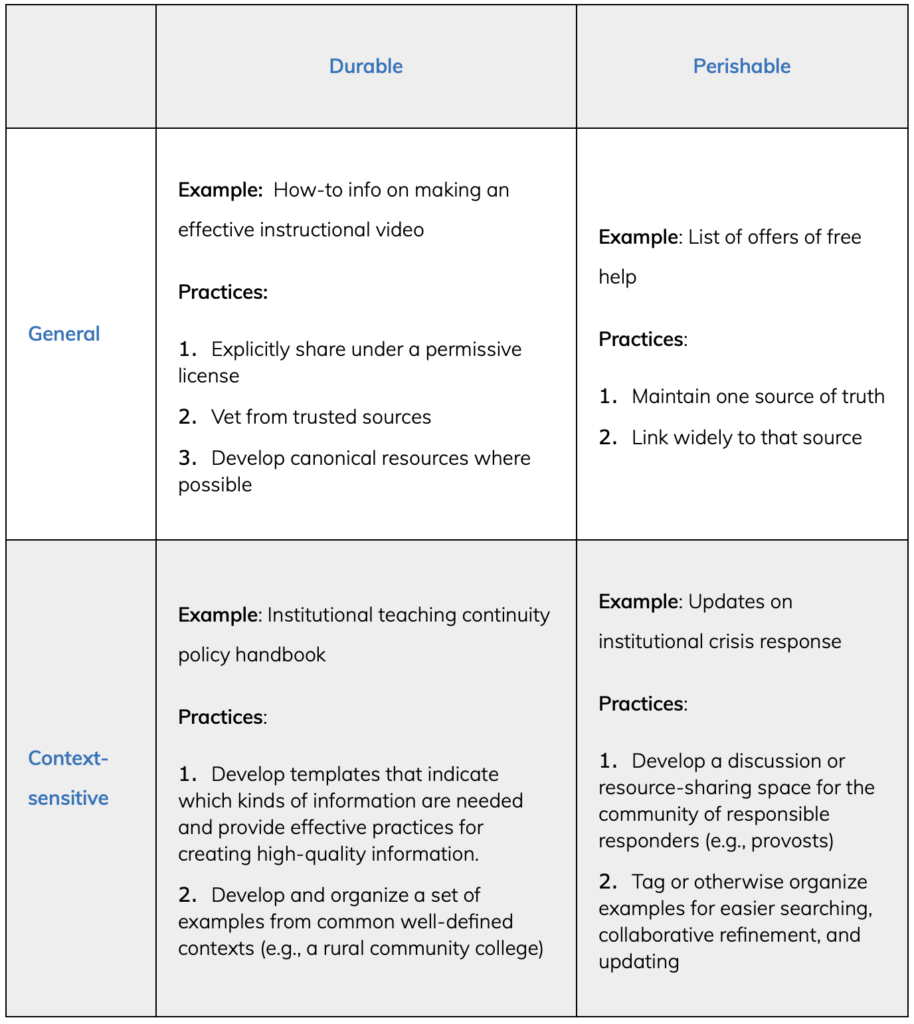
Not all resources are the same. We need to think through our supply chain challenges differently for different kinds of resources.
A content resource supply chain
In my most recent post in the series, I broke down the different content resources into four different categories:
There are basically two types of resources here: (1) content that should be easily shareable and adaptable for point-of-use applications and (2) canonical copies of information that should be maintained in one place by a trusted curator.
To understand how we can improve the supply chain, let’s return to the overlapping Google Sheets mentioned in my first post in the series: the POD list of university continuity web sites (which has 420 entries as of this writing) and Bryan Alexander’s list of universities that are going online during the crisis, including links to each institution’s documentation (which has 279 entries so far). Assuming no overlap, that would give us 679 URLs of web sites that contain a mix of the various types of information and that probably link out to other sites that also contain relevant information resources. Both POD and Bryan’s Future Forum have been effective networks for gathering links to useful information. But sorting through all that information is labor-intensive even within a given network. If we add the goal of sharing information and sorting through the overlap between these networks—and others that may be doing similar aggregation work—the task quickly becomes daunting.
But it is also one that lends itself to technological aid. For example, somebody could create a crawler that indexes all of these sites and applies machine learning to provide a preliminary categorization of resources. “These pages look like policy documents, while these other pages look like instructions on how to teach using webconferencing software.” That information could be cross-referenced with basic IPEDS data like whether the document comes from a community college or a research university.
This preliminary categorization could then be surfaced to human curators, who could verify the labeling by the algorithm, correct any errors, and add relevant metadata that would be important for people interested in using the content that might not be detectable by an algorithm. These curators could be hand-picked for their expertise, or editing could be Wikipedia-style, relying on the wisdom of the crowds. Either way, there needs to be a collaborative online space for reviewing the results of the search and enriching the resulting records. The result would be a single searchable database with a wide range of high-quality machine-sorted and human-curated resources.
We then would need to get those resources to points-of-use, which will be different for different people. It might be a web site of an association like EDUCAUSE. Or an individual university’s web site. Or it might be distributed by vendors. Vendors are a particularly important distribution vector because they are generally very good at reaching particular types of educational stakeholders with targeted messages. One way to do this would be through a faceted search interface like Amazon’s, where you can refine your search results by checking boxes on the sidebar related to different parameters. People could search for what they need and link or embed the resources where they need them. Another approach would be to create a chatbot interface that can be embedded at the point-of-use and scoped according to the same parameters available in the faceted search. For example, you might want to tell the chatbot that it should only display resources related to teaching online when embedded in a web site where that’s what people are most likely to be looking for. These two approaches aren’t mutually exclusive.
A people resource supply chain
One of the interesting aspects of creating a content resource supply chain in this way is that it also enables us to identify experts by attribution. Who authored this particular resource? Who curated it? Who edited it? We can use these connections to enable people who want to help build profiles that make them more findable. And again, we can use machine learning algorithms to make helpful suggestions. “It looks like you have contributed three content resources related to active learning techniques in online courses. Would you like to include that as an area of expertise in your public profile?” In other words, we can back into a kind of LinkedIn for resilience-related help expertise simply by taking advantage of attribution. People become findable—and build their reputations for expertise—based on their contributions.
Mass volunteering is an interesting hybrid case. Suppose, for example, you want to make a list of instructional designers who want to volunteer to help faculty convert their courses in a hurry. The list itself is a content resource. But each name will be linked to a profile. If we really want to go crazy here, we can make it possible for people to issue profile endorsements (or badges) based on the help that the volunteer provided.
All of the technology pieces for this network exist in the world today and could be assembled with a small fraction of the effort that is being put by many well-meaning organizations and individuals that are currently tossing their offerings into the ether and hoping that somebody finds their messages in a (digital) bottle. Furthermore, since these are all resources that people want to publicly contribute, privacy issues should be easy to navigate. (“Would you like to add this to your profile?”) We can create a resilience supply chain if we choose to organize ourselves.
If your main intellectual response to the current health crisis is to double down on your previously held beliefs, then you are probably not thinking deeply enough. For example, suppose that we develop both treatments and a vaccine for COVID-19, but the immunity conveyed by that vaccine only lasts for a season (much like other flu vaccines). Suppose that flu strains become permanently more virulent and more deadly. Some of the changes in the healthcare system that we are seeing now—in point-of-care, supply chain, and research efforts—become permanent. The risk of getting together physically in groups is permanently altered. Not to the degree that it is now, but significantly higher than it was. Think about how that permanent change would impact all the many businesses that are being impacted now. The growth sectors of our economy would change. The geopolitical landscape would change. Everything would change. Much of what we thought we knew about the future of work would have to be thrown out and rethought. And much of what we thought we knew about the future of education—what jobs we need to prepare students for, how we should be teaching, what sustainability looks like for an educational institution, and so on—would also have to be thrown out and rethought.
It is hard to think such thoughts. I find my mind desperately casting about for reasons to believe that this scenario is not plausible. That life will someday, somehow, return to normal. That the world has not changed.
But it has. And we must all learn how to think the unthinkable. We have to find ways to let go of the comforting assumptions that enable us to glide through the day on autopilot, somehow not swerving off the road while we fiddle with the car radio or talk on the phone or think about what will happen when we arrive at where we are going. We have to look at the road with fresh eyes. See what is in front of us. Prepare our minds for unexpected obstacles. The adaptive cruise control and lane-assist and other comforting tools that we have built to protect us from the need to be in the moment will not serve us well on this road we have found ourselves on. In fact, they provide a dangerous illusion of comfort. We must seize the wheel and learn to be navigators again.
Right now, as we respond to an unprecedented crisis, a lot of the safety mechanisms in the system are being thrown out even as we face massive uncertainty. Multi-trillion-dollar legislation is being passed through Congress incredibly quickly. The medical system is finding various shortcuts to get around the system of checks that are designed to make sure treatments that tinker with your immune system are safe. These safeguards were created for good reasons, one of which is to mitigate the impact of sloppy or reflexive thinking on consequential actions. If we are going to remove them, then we must think harder.
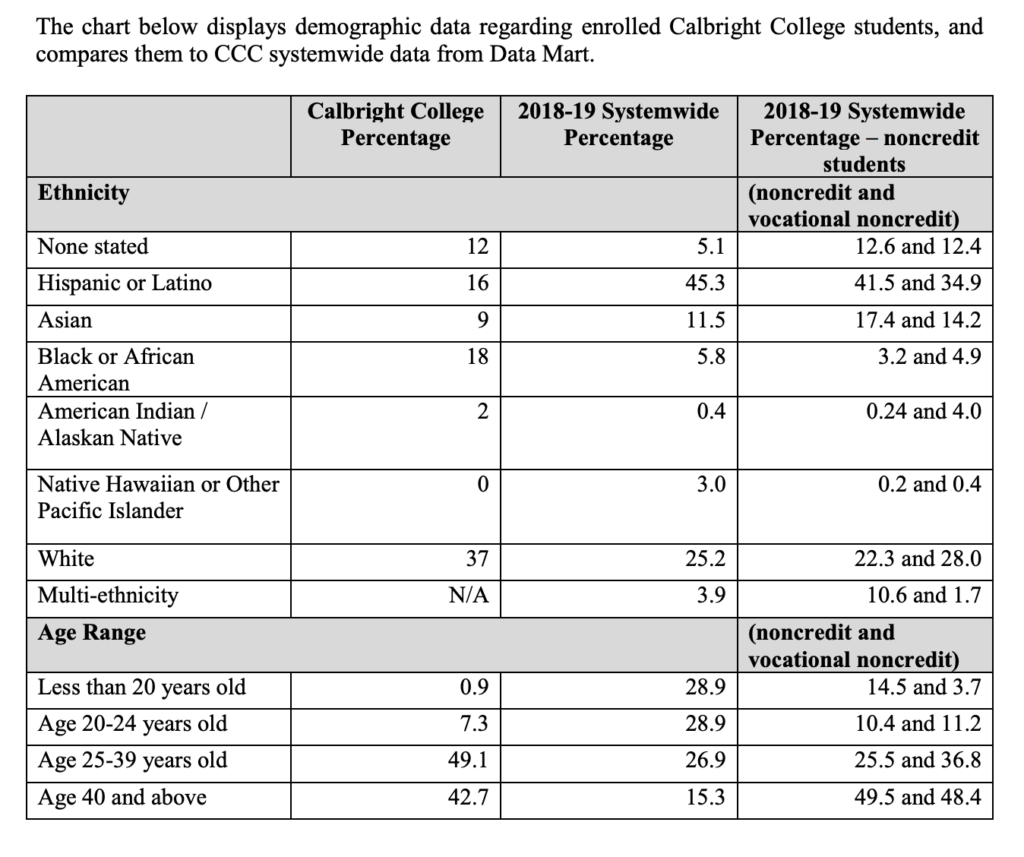
Even under normal times, I would have been disturbed by the Christensen Institute’s argument that “California should double down on Calbright College—by leaving it alone.” The post author Richard Price asserts that California’s new, experimental online community college, which received a $100 million initial allocation and a $20 million annual budget from the California State Legislature, is already fabulously successful. And it will be even more successful if only it is freed from the shackles that the other 114 California community colleges manage to live by and State Senators would back off of their call for Calbright to be audited for its finances, progress, and its compliance with the conditions under which it was authorized. He makes these assertions without evidence or even much in the way of argument to back them up. While reading the piece, I can’t escape the feeling that I am in the back seat of a car with a habitually distracted driver who is reflexively trusting his GPS to guide him through territory that has not been mapped.
I have been patient with the more careful proponents of disruptive innovation in education, despite my skepticism, because it is not their fault that the term has been appropriated by testosterone-addled Silicon Valley teenagers, and because they have made cogent (if unconvincing) arguments. But the opening line of Price’s Calbright post, while sounding completely anodyne, alarms me:
As the COVID-19 outbreak increasingly prompts universities to move instruction online, California lawmakers may want to reconsider their deep skepticism of the state’s first fully online community college—the young institution is proving itself more vital than ever.
There are just so many things wrong with this sentence. For starters, the author links to an article about lawmakers’ “deep skepticism” without mentioning anywhere in his own piece that the article describes the reasons why lawmakers are skeptical. He certainly doesn’t attempt to refute those reasons. To the contrary, he asserts that the “young institution is proving itself more vital than ever” without ever really explaining what that means. Second, the sentence conflates skepticism about Calbright with skepticism about online education. Reading it, one would never guess that the California Legislature has poured something like a quarter of a billion dollars into online programs for the California Community College System alone, plus hundreds of millions more into the Cal State and UC systems. Lawmakers are not demonstrating skepticism toward online education. Rather, they are demonstrating skepticism of Calbright’s implementation as the best application of the substantial investment they are making in online education.
Worst of all, the introduction sets the tone for the article, which is to accuse others of dogmatism while itself making its case on pure dogma. In doing so, it links to another post on the Christensen Institute’s site by another author about another system. This article, unfortunately, also gave me the feeling of being an uncomfortable passenger sitting beside a driver who is barreling down the road toward a destination that he is determined to reach, heedless of what may lie between here and there.
The end result is a specious chain of arguments made from a position that indirectly has Harvard’s imprimatur—because Christensen was a noted Harvard professor—arguing that the state of California should commit to throwing tens of millions of dollars at an unproven program. And that it should do so while declining to hold that program accountable or even expecting it to follow the rules that all the other community colleges manage to live under. The main justification for this position is a theory that was designed to explain what happened to steam shovels and old disk drive technologies and is now being applied to a dramatically different domain without attention to context or evidence.
If you are going to argue for removing safeties at a time of historic emergency, then you must think harder.
It is time for the more serious proponents of disruptive innovation in education to take a good look in the mirror and ask themselves if they have been thinking hard enough. As their predictions about mass closures of universities and other dramatic changes have failed to materialize repeatedly over many years, their assertions about the future have become increasingly strident and sloppily constructed. It is time for them to seriously consider the possibility that they are just plain wrong, and that their attachment to cherished ideas is doing more harm than good.
My own prior assumptions
If I’m going to be fair, I should lay out my own prior thinking about both disruptive innovation and Calbright so that you can decide whether I am the one who is stuck in old thinking.
I am a fan of Clay Christensen’s work. I have three of his books on my shelves, all of which I have read at least once, and two of which I find myself occasionally dipping back into for reference or inspiration. I find his basic thesis to be clever, well-argued, reasonably grounded in evidence, and provocative. That said, his theory is interesting because of the inference chain he constructs rather than because any of his individual insights are particularly novel in and of themselves. For example, one central concept in disruptive innovation starts by “competing against non-consumption,” which is a fancy way of saying you should go to where the competition isn’t by figuring out who isn’t being served well. While this assertion is worth noting, it is the opposite of revelatory. It borders on the banal. Another stepping stone in his argument is that successful organizations will tend to resist ideas that are different than their historically successful ways of doing things. We nod at this without pausing. Christensen’s argument pulls us along not because the steps along the way stop us in our tracks but, to the contrary, we glide down an easy path and suddenly end up somewhere unexpected. As Price puts it in his article, “In the Innovator’s Dilemma, Clayton Christensen made an unsettling observation—CEOs of established companies that fell to disruptive entrants often did everything right, and for that very reason failed to save their companies.”
Disruptive innovation theory boils down to the idea that companies that are fat and happy tend to result in products that are fat and customers that are less happy. At some point, Microsoft stopped building features into Office that were useful to everybody and started focusing on features that were useful to their most lucrative niche customers. Office customers who were not in those niches became less happy as the software became more expensive and harder to use. But the company was focused on maximizing revenues from its best customers.
So they didn’t react much when Google came out with Docs, Sheets, etc. This was a perfectly reasonable business decision for them to make, since Google was not an immediate threat to their customer base and some very profitable corporate customers wanted specialized features. Google’s products were obviously inferior for mainstream word processing tasks. I tried and abandoned Google Docs a few times in the early years because it just didn’t meet my needs. But it got better over time, first satisfying needs for which Word wasn’t well suited, then nibbling at the simplest applications of Word, and eventually becoming sophisticated enough to challenge the dominant word processor for a substantial percentage of common tasks. Today there are a billion users of Google Drive. I am one of them. I have not abandoned Microsoft Office, but I have thought about it at times.
Disruptive innovation is both a particular kind of disruption and a particular kind of innovation. It is important to understand this. When we learn to trust a theory, we begin to take it for granted like we take our cruise control for granted. We stop thinking about it. But we need to understand how our tools work so that we can know when we are safe to trust them and when we are not. As I put it in 2014,
These days, “disruptive” and “innovation” seem to always come together in the same sentence. It’s a bit like “big galoot.” Theoretically, “big” is a modifier for “galoot.” But you never hear people talking about small galoots, average sized galoots, or galoots of indeterminate size. In modern common usage, galoots are always big. “Big galoot” has pretty much become an open form compound word, like “post office” or “real estate.” But “disruptive innovation” is not a compound word. Disruptive innovation is a particular kind of innovation, and a fairly narrow kind at that. Specifically, disruptive innovation is a phenomenon in which a new market entrant can overtake a leader in an established market by offering cheaper and simpler solutions. It’s important to remember that some of Clayton Christensen’s seminal examples of disruptive innovations were steam shovels and disk drives. This is not the same kind of innovation that produced the iPhone. It’s essentially about identifying the slow fat rich kid and taking his lunch money. To be fair, it’s not that inherently mean-spirited, because presumably one takes the rich kid’s lunch money (or market share) by providing solutions that consumers prefer. But the point is that disruptive innovation is generally not about solving new problems with brilliant out-of-the-box ideas. It’s primarily about solving old problems better because the old solutions have gotten overbuilt.
The reason that I have been skeptical about disruptive innovation’s applicability to education has to do with differences in both demand and supply from the situations that Christensen analyzed in his books. On the demand side, I argued in 2013 that education doesn’t fit the disruptive innovation framework because it is not a product:
Silicon Valley can’t disrupt education because, for the most part, education is not a product category. “Education” is the term we apply to a loosely defined and poorly differentiated set of public and private goods (where “goods” is meant in the broadest sense, and not just something you can put into your Amazon shopping cart). Consider the fact that John Adams included the right to an education in the constitution for the Commonwealth of Massachusetts. The shallow lesson to be learned from this is that education is something so integral to the idea of democracy that it never will and never should be treated exclusively as a product to be sold on the private markets. The deeper lesson is that the idea of education—its value, even its very definition—is inextricably tangled up in deeper cultural notions and values that will be impossible to tease out with A/B testing and other engineering tools. This is why education systems in different countries are so different from each other. “Oh yes,” you may reply, “Of course I’m aware that education in India and China are very different from how it is here.” But I’m not talking about India and China. I’m talking about Germany. I’m talking about Italy. I’m talking about the UK. All these countries have educational systems that are very substantially different from the U.S., and different from each other as well. These are often not differences that a product team can get around through “localization.” They are fundamental differences that require substantially different solutions. There is no “education.” There are only educations.
Students’ reasons for the college choices they make are much more complex and varied than their reasons for choosing a word processing program. So I’ve been skeptical about whether the nebulous cloud of ideas and ideals that we call “education” is a thing that can be disrupted in the Christensonian sense.
There are also mismatches to the theory on the supply side. Christensen’s theory of organizational behavior fits best with organizations that conform to economist Ronald Coase’s theory of the firm. Command-and-control organizations that are optimized for profitability and growth will be particularly vulnerable to the pathologies that he identifies. Most universities don’t function that way, and no university systems do. While universities do have to worry about optimizing for sustainability, that goal is complicated by their strong mission focus and their shared governance structures.
And university systems are even further from Christensen’s model because they are governed by political systems, which operate under entirely different decision-making processes than companies do. For example, with 114 physical community colleges grouped into 72 districts across California’s 58 counties, every state legislator has a local interest in protecting one or more of those colleges. There were mission-related reasons for this design decision, having to do with making education accessible in an era before modern online learning. Regardless of the degree to which those reasons may or may not still apply, decisions for the California Community College System are still driven by political representation of those county interests in the state’s legislature. Christensen wrote an entire book—The Innovator’s Solution—on how entrenched corporations can stay innovative. As far as I can recall, none of the example organizations in that book looked remotely like the California State Legislature. So at the very least, somebody would need to make the affirmative case that Christensen’s prescriptions for corporations can be applied in this very different context.
And remember, it’s the chain of inferences that makes disruption theory interesting. If any of the links break, then we have to question whether the theory holds. Cherrypicking evidence for one or a couple of the individual common-sense assertions in the inference chain puts us on a fast road to Stupidville, however our GPS display may label the destination.
I have historically been skeptical of Calbright for reasons that have less to do with disruptive innovation and more to do with math. COVID-19 has been giving us all a hard lesson on the mathematics of growth. If every person carrying the disease spreads to between two and three other people, then the number of people with the disease will double every few days. On the other hand, if the average infected person spreads the disease to at most one other person, then it will eventually die off.
The challenge of Calbright has been that the math never worked for the kind of growth that the legislature expected it to achieve. If the main goal was to create an incubator that would eventually teach us better ways to serve underserved students, that would be one thing. But the goal was to actually serve millions of underserved students in a relatively short span of years. Calbright’s growth rate would have to be unprecedentedly high in order to achieve that aim. Phil Hill broke it down in a post in 2017:
The maximum growth rate of [some] cherry-picked successful schools ranges from ~1,200 / year for Excelsior to ~7,700 / year for SNHU (note that Rio Salado at ~1,400 / year is the only public institution). Add to this the fact that all of these schools have been around for decades. No accreditation issues, no time-consuming establishment of core leadership team, etc.
There is a big difference in dealing with institutional issues and statewide issues, particularly in California. One in five US community college students in the US do so in California, and the statewide issues tend to come in large numbers. Statewide issues tend to come in hundreds of thousands while institutional issues tend to come in tens of thousands.
What this points to is that for a new fully-online institution to get to some meaningful level of enrollment (let’s say 20,000) in the same ballpark as these comparison schools, I estimate it would take a full decade at the least. This is the reason, by the way, that Mitch Daniels and Purdue University made the Kaplan University deal even though Kaplan’s enrollments are dropping. Daniels did not want to wait a decade to get to meaningful enrollment numbers for an online college serving working adults – if everything works out, within a year Purdue will have a fully-online institution serving 30,000+ working adults. That is a big if, by the way.
I have no problem with the idea of Calbright as an experiment in supporting underserved students. But the math doesn’t support the idea that it is going to have an impact at scale any time in the next decade, even under the most optimistic of scaling scenarios. So my concern with Calbright is that both California politicians and proponents of disruption theory have seized on it as a means for solving different problems than the ones it seems suited to solve.
I have one more predilection that you should know about, which is that I believe theories should be disprovable if they are to be credible. You can’t say that disruptive innovation is going to result in 50% of schools going bankrupt—no, wait, maybe it’s 25%—and that it’s MOOCs that are the disruption—or maybe just online learning in general, or possibly CBE, or maybe adaptive learning—and continue to be taken seriously. There has to be a way to arrive at the statement, “data X would disprove my hypothesis.” It can’t be the case that any old data can support your hypothesis while no data can disprove it. That’s not a theory. It’s dogma. My patience with proponents of disruptive innovation in education has worn thin over time because I haven’t seen them demonstrate the willingness to ask themselves the question, “But what if we’re wrong?”
Now that I have laid my own comforting assumptions on the table, it’s time to examine the assumptions that are evident in the arguments from the Christensen Institute.
Is Calbright a disruptive innovator?
Let’s return to the hyperlink in the very first sentence of Price’s post, which is attached to the words “their deep skepticism.” What is the skepticism described in the Education Dive article behind that link? First, the article emphasizes the question of whether Calbright would be best run in the existing structures rather than as an independent campus. That’s one surface resemblance to disruption theory. Again, you don’t have to believe in disruption theory to believe that sometimes a little autonomy from a large, entrenched bureaucracy might lead to fresh thinking. But at least it’s consistent.
On the other hand, Price neglects to mention other salient facts. Like the fact that the legislative analyst’s report in 2018 said there is no evidence that Calbright will solve the problems that prevent Californians from enrolling in college (or, in Christensonian parlance, that it can compete against non-consumption). Here’s the relevant paragraph from that report:
Unclear If Providing Online Offerings Will Solve Key Barriers for Target Student Group. One of the proposal’s goals is to increase educational attainment for adults who currently have no postsecondary credentials. Although this is a laudable goal, the administration has not provided any evidence that an online community college will address the key barriers for this potential student group. Although an online program can increase convenience, working adults may not be pursuing additional education for a number of reasons. The administration also has not provided evidence that those working adults who are interested in more education cannot access it through existing online or in‑person community college programs.
California LAO report
Is there reason to believe that the innovations of Calbright’s design will cause large numbers of students who were previously not enrolling in existing online offerings to enroll in Calbright’s? I don’t know. The California LAO’s office didn’t see such evidence, and Price fails to even mention it as a problem.
The Education Dive article also mentions that Calbright has duplicated existing academic offerings of other community colleges in violation of state rules. Here Price does have a rejoinder, though he does not dispute that Calbright has violated state rules:
[C]oncerns that Calbright’s courses may duplicate existing OEI offerings fail to acknowledge that competency-based, self-paced courses differ fundamentally from seat-time based courses covering the same material, and better serve time-constrained adult learners.
OK, that’s a claim. Where is the supporting evidence? Such programs exist in the world. Western Governor’s University, SNHU’s College for America, and others implement the instructional approach that Calbright has chosen. I’m not arguing that evidence doesn’t exist. But I do think that if somebody is advocating for a $100 million initial allocation plus a $20 million allocation in support of a new and unproven institution while simultaneously advocating that rules should be relaxed and oversight waved off, then one should present any evidence so that we can examine it together. The action Price is calling for requires less reliance on cruise control and more on the blind-spot camera.
Rather than focusing on making an evidence-based case for Calbright, Price chooses to make an argument against California Online Education Initiative (OEI):
Consider CCCS’s Online Education Initiative (OEI), a course exchange program, which Calbright critics point to as obviating the need for a separate, online college. In theory, students can enroll in online courses offered by other state community colleges. In reality, CCCS’s enrollment-based funding model discourages school participation, since only the college that offers the course earns enrollment revenue. This has limited course offerings and engagement overall.
Here is an example of how Calbright, operating under a different business model, could be an asset to CCCS as an autonomous institution. Free from the constraints of the funding model that has proven incongruent with expanding online course options, Calbright could work towards revenue and course enrollment models that best serve large numbers of job-seeking adult learners.
This is factually wrong on several levels. First, the course exchange is just one component of OEI. Luckily, MindWires—the consulting practice that I used to be a partner in and that Phil Hill still runs—produced this convenient explainer on behalf of OEI (which is less than four minutes and is easily findable on YouTube):
Intended Consequences
(Video link: https://youtu.be/1DdlaIZYiDI)
As Phil recently wrote, Calbright is currently serving about 450 students. In contrast, in the 2020-2021 academic year, OEI projects 99,000 enrollments in new academic pathways. (And word is that the OEI number is likely to be revised upward significantly based on more recent data.) Apples-to-apples, this translates into probably a couple of tens of thousands of students.
The course exchange part of OEI is one component. It may or may not succeed at scale. But the broader OEI program is indisputably reaching many more students than Calbright. Worse than getting the incentive mechanism wrong for the course exchange, Price apparently failed to conduct even cursory research regarding the nature and impact of the program he was critiquing. Even if the course exchange portion of OEI fails utterly, the overall program is still tracking to increase enrollments by two orders of magnitude more than Calbright will in the next year.
That doesn’t even count the ways in which Calbright’s progress toward (unspecified) milestones was accomplished, in part, by using resources built with OEI funding. Here is a screenshot of Calbright’s essentials course:
The link at the bottom of that screen leads to this page:
Of the Calbright students enrolled in October through December of last year, 449 enrolled in essentials courses, while 20 enrolled in a program pathway. In other words, the vast majority of students taking Calbright courses last term were taking courses that were using OEI content resources.
Also, while Calbright’s mission was specifically to reach underserved students that aren’t being reached via the 114 existing community colleges, the results so far are not promising on that score. For example, despite specifically targeting Latinx students, they represent 16% of Calbright’s enrollments—in contrast to 45% Latinx enrollment system-wide. Calbright’s students are, in fact, disproportionately white:
In addition to these reasons for questioning Calbright’s progress toward and ability to accomplish the mission set for it by the State Legislature, there’s also the fact that Heather Hiles, former Calbright CEO, resigned abruptly without public explanation less than a year after being hired.
So given these facts, is it reasonable for California to ask whether Calbright makes sense and is working as intended at this time? I think it is. While I don’t prejudge the outcome of that introspection, the legislators have a responsibility to at least ask the hard questions.
But, worries Price, whether or not OEI may work in practice, does it work in theory? He seems to take a kind of libertarian position that any program that is regulated will inherently be inferior to one that is not. He is aghast at the LAO’s concern that Calbright will eventually have to comply with the system’s collective bargaining agreements and spend 50% of its budgets on instructional salaries.
In other words, Calbright being embedded in CCCS subjects it to strictures that will eventually hamstring the school in its efforts to innovate for adult learners. The LAO report ironically makes the argument that even as an independent school, Calbright isn’t autonomous enough.
Does it? How much does it cost to run a Calbright-style CBE program with quality? How much of that money goes into instructional costs? How does that compare to the requirements that it is currently required to comply with and that OEI online programs do comply with? Again, the data exist, but Price either doesn’t believe he needs to justify his position or doesn’t have the data in question.
I don’t have it either. What I do have is a quote from the President of Southern New Hampshire University (SNHU), which the Christensen Institute valorizes without understanding—more on that in a bit—about the amount of human time and attention that is required to deliver quality CBE education:
I think there is a general lack of awareness of how rich now the underlying data analytics are. We monitor our students 24/7. We know when someone hasn’t logged on. We know when someone has struggled with a project. We know when performance has dropped off. We actually have closer to a 360-degree view of our students than most traditional institutions do. Then, when those students are engaged in the work, they have ready access to qualified faculty if they’re really stuck. We’re never going to let somebody get stuck on a math concept, for example, and just say, well, just figure it out. We’re going to get you help.
SNHU is putting significant time and money into instructor support. Is it 50%? I don’t know, and Price apparently doesn’t either. Is there a case to be made for granting Calbright some flexibility based on evidence of results in successful programs? Possibly, but Price doesn’t make it. Instead, he simply declares,
Without an autonomous Calbright, CA will struggle to properly serve its adult learner population. Innovators like WGU and SNHU will take good care of these learners, but CA will have ceded, rather than seized, the future of learning.
With little in the way of argument and nothing to speak of in the way of evidence, he concludes that (a) only Calbright can “properly” serve California’s adult learner population, (b) Calbright can only do so if it is “autonomous,” (c) Calbright represents “the future of learning,” and (d) if the California Legislature doesn’t cede oversight Calbright while continuing to fund it, then out-of-state competitors may disrupt or otherwise somehow surpass the California Community College System. It’s not at all clear how Price got us here, or even what he means by “properly” serving California’s adult learner population, or making Calbright “autonomous,” “ceding” or “seizing” the “future of learning,” or what role he believes that “innovators” such as WGU and SNHU will play in California’s future should the State Legislature fail to follow his prescription. He does link to (without really explaining the relevance of) another Christensen Institute post by another author about how the PASSHE system partnered with SNHU. I wish I could say that I found that article more persuasive.
Alas.
Is SNHU disrupting PASSHE?
Michael Horn’s post from February of this year bears the breathless title, “Why disruptive innovation is stealing Pennsylvania’s students.” The trigger for the article was an articulation agreement signed between Pennsylvania’s State System for Higher Education (PASSHE) and SNHU which enables PASSHE students to transfer up to 90 credits to SNHU and complete their bachelor’s degree at SNHU at a 10% tuition discount.
Horn emphasizes his belief that state regulations and slow-moving bureaucracy have hobbled PASSHE’s ability to innovate in online education, leading it to the necessity of outsourcing. He does so mainly by analogy to SNHU. There are several problems with this approach.
First, as I pointed out earlier, the idea of increasing autonomy to spur innovation was not newly introduced by disruption theory. Bell Labs embodied this strategy from its formation in 1925. Clayton Christensen wasn’t even born until 1952. Second, as I also pointed out earlier, the success of this strategy does not validate all of disruption theory, never mind its applicability to education. As Horn acknowledges in his post, PASSHE is not failing because its leaders did everything right in pursuing its most lucrative customers. (Not that we would want public education systems to do that anyway, which is yet another problem with disruption theory’s applicability.) To the contrary, PASSHE arranged for the articulation agreement because many of its (tuition-paying) students are not finishing their degrees, according to PASSHE Chancellor Dan Greenstein. Presenting those students with another reasonably priced online option was intended to increase student graduation rates, even at the possible cost of the system’s most lucrative customers. We have to follow Horn down a chain of several inferential steps—each of which is given with either thin factual support or none at all—to arrive at the implication that “disruptive innovation is stealing Pennsylvania’s students.”
Horn relies on a loose comparison to SNHU to do most of the work from him. To give him the benefit of the doubt, let’s stipulate several points:
SNHU’s growth has been undeniably impressive at a time when PASSHE has been experiencing a slow-motion crisis.
SNHU President Paul LeBlanc, like me, is a fan of Clay Christensen’s work. He has thought about it a lot and credits it with influencing his thinking.
Even so, it’s not that simple. LeBlanc hasn’t applied the separation principle dogmatically. SNHU operates under one shared governance structure. Autonomy is not the same as freedom from rules or oversight. Second, he has not hesitated to revoke autonomy when it wasn’t working. SNHU’s competency-based education unit, the College for America, used to be autonomous but has since been pulled back into the larger online learning unit.
Overall, Horn’s article is a confusing muddle. He readily acknowledges that the causes of PASSHE’s troubles look nothing like the causes of disruptive innovation described in The Innovator’s Dilemma. He also admits that better funding of the chronically underfunded system would help. He then swerves off into an explanation of disruption theory, connected only by the thread that SNHU employed the same basic strategy that Bell Labs used successfully nearly 30 years before Clayton Christensen was born. He ends with a call for state systems to create small incubators where new ideas can be piloted. I agree with that idea, but I don’t think it bears any relationship to the completely unjustified clickbait title of his post. I don’t think one has to believe in disruption theory to come to the conclusion that university systems have become sclerotic and need to find ways to get out of their own way. This could have been a perfectly good article if it weren’t trying so desperately hard to validate disruption theory. Horn’s rather modest call to action is not in any way proportionate to the dire pronouncement of the headline; nor does it justify Price’s call for Calbright to be exempted from oversight or collective bargaining rules before it has even proven that it can serve 1,000 students.
This is all hauntingly familiar. I mentioned that I own three of Christensen’s books, two of which I occasionally dip into to this day. The other one is Disrupting Class, which is the book that Christensen co-wrote with Horn about the application of disruption theory to education. In stark contrast to The Innovator’s Dilemma and The Innovator’s Solution, it was a disappointing mess. Parts of it attempt to stretch disruption theory beyond recognition in order to fit educational examples. Other parts contain thoughtful, reasonable observations that bear no credible connection to disruption theory. It doesn’t hang together as a cohesive work. I found the book unpersuasive when it was published 12 years ago and do not believe it has aged well. And in subsequent publications by disruption theory proponents in education, the flaws that were apparent in that original work have been papered over rather than addressed. Christensen has passed away, but the people carrying his torch in this domain have not done his legacy a service, however diligently and earnestly they may have tried.
Twelve years of trying is enough. It is time to think harder.
Grieving our errances
Alexander Pope wrote that to err is human, but he might have added that to err repeatedly due to habits of mind is particularly human. The disruption theory proponents love their idea. As a man who has written 7,000-word blog posts, I cannot credibly claim immunity from that particular siren song.
It is not a propensity to be ridiculed. Our capacity to fall in love with a thing as aetherial as a concept has been a key to our survival as a species, and to creating lives for ourselves that are about more than just surviving.
Sadly, we have not evolved to feel equal love for the process by which we produce, examine, and sometimes destroy ideas. We became toolmakers because tools enable us to accomplish more work with less effort. Ideas are tools that enable us to accomplish more work with less effortful thought. To err is human; to think is divine. These days, I am less inclined toward mocking people for being passionately wrong than when I was young enough to believe that only other people ever commit that sin. But I will attack their arguments without hesitation or mercy when I think they are harmful.
It has become clear to me that all talk of disruptive innovation in the context of education is harmful. Not just when applied thoughtlessly by people who don’t understand the theory, but even when applied diligently by people who do. It is harmful to advocate for a failed idea as if the fate of education depends on believing it is true.
Disruption theory in education is dead. Be sad if you need to, but move on. Seize the wheel and learn to be a navigator again.
As for Calbright, I remain agnostic. I believe it is a good idea in principle for California to create a safe space to experiment with alternative means of reaching the millions of Californians who need education but aren’t getting it. I worry that this characterization is not fully aligned with the stated goals of the Calbright program. I do not know whether the experimental college is being run well, or whether now is the best time to prioritize it over other educational exigencies of the moment. I do believe it is not only fair but important to ask these questions and insist on arriving at fact-based, well-reasoned answers.
Clayton Christensen got the attention of campus leaders with his claim that 50% of colleges will be closed within a decade, and others – perhaps with less dramatic predictions – have joined the gloomy chorus. As overstated as that number may be, you might expect that we would be moved by this prediction to ask hard questions about the future of higher education and what it means on our campuses. And some of us are. But the academic communities that are collectively engaging the challenges implicit in such dire predictions are few in number. Not only are these difficult conversations infrequent, but when they do take place they are fraught with controversy and rarely result in significant, sustained change. Why is it so hard?
It isn’t because we don’t know what the challenges are. Read the Chronicle or Inside Higher Ed on any given day and you’ll find a ready list of topics for campus conversations: providing a relevant curriculum and effective pedagogy, responding to dwindling enrollments and resulting resource constraints, addressing failures of equity and inclusion in an increasingly diverse environment, developing the optimal role of technology to promote learning…the list goes on and on.
Even with so many places to focus a collective search for solutions, we seem to avoid naming the elephants in the room. Even schools that are teetering on the brink – who presumably stand to gain (and lose) the most from collective action – are not talking openly about their institutions’ particular challenges. Witness the shock and outrage when colleges (there have been a number in the last year in my home state of Vermont) announce that they are closing, or merging, or seeking partners to help them weather the storm. In one highly-publicized case—Mt. Ida College in Massachusetts—lawsuits were filed following the closure announcement alleging that leaders intentionally kept the reality of the school’s circumstances from the campus and other stakeholders. The outcry seems to be, “Why weren’t we informed?”
It’s not hard to understand why a college president might not wish to share the problems of an institution with the wider world. Candid efforts to confront challenges to the long-term health and success of an institution invite external scrutiny, and this creates a counter-pressure to focus solely on the positive. My co-authors, Bob Zemsky and Susan Shaman, and I address this in our newly published book from Johns Hopkins University Press, “The College Stress Test,” in which we examine the market factors associated with institutional risk of closure:
“…A common focus of campus messaging is on the particular data points that suggest that, whatever risks may be facing other schools, the future for my college is bright. The point would seem to be to reassure constituents that, in the landscape of higher education, one’s own school is well-positioned to withstand today’s threats. Thus, presidents’ communications are far more likely to share the good news that applications are up this fall or to highlight the positive publicity received by a recent graduate, than they are to speak to potential threats to long-term viability.
This language of optimism and reassurance is understandable. Addressing threats to the sustainability of an institution requires persistent hard work by many, and a panicked community isn’t likely to be able to respond effectively. What’s more, if there is anxiety within the leadership ranks, it would not benefit anyone to acknowledge it. Much of the work of recruiting, enrolling, and retaining students—to say nothing of fund-raising—is about building reputations and managing the public’s perception of an institution’s desirability, prestige, and credibility. Potential students and donors are not likely to open their checkbooks to an institution whose future appears shaky. So, a struggling institution’s leaders may wait to publicly acknowledge that reality until the very last hope for recovery has faded.”
Understandable or not, as leaders work to keep the public perception oriented toward the strengths of the institution and its bright future, the opportunity to begin necessary, but likely difficult and nuanced conversations, is passing.
The disincentives around meaningful conversation and collective problem-solving go beyond external pressures and marketing concerns, however. When resources are diminishing or need to be reallocated, it shouldn’t surprise us that those who have been the beneficiaries of historical privilege (and I mean that in the broadest sense) tend to wrap their arms around what’s “theirs” and hold on tight. Administrators who have made decisions to take funding away from one group in order to support the work of another, or who have closed an expensive and declining program to keep a college afloat, know what it means to incur the wrath of those accustomed to an institution’s historical beneficence. And on some campuses, the need to make significant changes falls upon a community that has already suffered a kind of “death by a thousand cuts”—short-sighted, marginal, supposedly temporary budget reductions that have left those who might have been invited in to a collective conversation about long-term change and transformation feeling resistant, diminished, and beleaguered.
I don’t mean to suggest that we resist these conversations merely out of avoidance, however. Rather, the difficulty in addressing necessary change is often a function of something that is a source of strength: the values, commitments, and identities of those who work in higher education. Those who have made their careers on college campuses are typically deeply invested in the work that they do and the way that they do it. For many, it is not merely a job, but a calling. What’s more, faculty have spent years training to be critical evaluators of new ideas and initiatives. These people bring all that commitment and all those critical skills to bear on a proposal for change. Thus, we shouldn’t be surprised that moving an academic community in a new strategic direction can feel like a Sisyphean task.
I spent 15 years serving in a variety of administrative roles. It was my job to lead just this kind of challenging conversation and to work to bring a diverse community together in productive pursuit of collective action. Sometimes I was successful – and I hold those successes close at night. But even when change was achieved, it often required endless discussion and debate over months and even years. In one particular case, I recall a colleague who was opposing a proposed change to the structure of several departments – a change that he felt called into question his past and future contributions. Although the process had involved years (literally years) of meetings and votes, as it neared its conclusion, he said to me, “Susan, this is all happening with baffling speed.” These conversations can be tests of endurance.
This may be even more true when changes speak to the fundamental mission of an institution. If an institution’s leaders decide that the curriculum must be more explicitly oriented toward career preparation in order to maintain financial viability, what does this mean for the faculty members whose work, and sense of professional identity, has always been focused on learning for learning’s sake? And even if those colleagues are permitted to continue their work without participating in the broader institutional shift, what does it mean that they may no longer feel connected to the institution’s most visible priorities? No wonder that these people might question and even resist attempts to promote change that leave them feeling sidelined and their work diminished. Thus, it’s worth remembering that some resistance to change reflects the real and deep commitment of many individuals to the students and institutions they serve.
Sometimes the difficulty in these conversations isn’t nearly as meaningful as a fight for scarce resources or a battle over values and identity. At times, it simply represents a kind of reflexive laziness, or at least mindlessness – administrators react this way because they’re administrators, faculty respond that way because they’re faculty. Tackling these hard conversations can sometimes feel like staging a well-known play in which all the players know the text by heart. No one need question the characters’ motivations– we know the tropes and how we are supposed to respond to them. President X is the evil villain, Professor Y is the brave hero or heroine, Student Z is the pitiful victim. One of the most common complaints I hear from administrative colleagues across the country is their frustration with being presumed to be ill-intentioned, motivated by corporate greed, and lacking a commitment to the mission and values of their institutions. These presumptions seem to come with the role.
Even if everyone on a campus came to these conversations with good will and benign assumptions about one another, our governance practices and structures are often an impediment, not a facilitator of progress. If you read most college handbook provisions on changes to the curriculum or terms of employment, you’ll find a manual of hurdles and roadblocks. Of course, these checks and balances have been put in place to prevent short-sighted, ill-advised, and possibly nefarious actions. But they can also impede progress and necessary change. Anyone wishing to undertake a candid campus-wide conversation had best be a student of campus governance and should pack for a long trip.
So there are many reasons why we are more likely to avoid than engage the complex challenges we face. And yet, the stakes for many institutions, and ultimately for the students we seek to serve, could not be higher. There are certainly some who will simply continue to avoid and delay, hoping that the path will be charted by someone else or that the turbulent times will resolve themselves and allow us all to return to life as we knew it. But as we demonstrate in the analyses we present in the “College Stress Test,” and as others like Nathan Grawe and Jeff Selingo have shown, demographic change and shifting markets mean that many schools will need to respond and adapt, not simply wait out the turbulence. Put another way, for many, there may be no way out but through.
So how do those most at risk begin a conversation that is so potentially fraught and that experience suggests may be unpleasant and perhaps ultimately unproductive? At the risk of appearing to offer a facile answer, let me propose that the work starts with the realization that, difficult or not, we must have those conversations anyway. How, in particular, we might approach them will be the subject of another post in a few weeks. But let’s begin by acknowledging that many schools are facing, or will soon face, the necessity of some kind of significant change. The path to success will require collective action – and I believe that the most creative and effective action will start with honest, clear-eyed conversation about our challenges. The most important work is ahead of us.
I have long argued that the best path to long-term sustainability for many colleges and universities is to serve as many students within their geographic reach as possible, as well as they can, for 20 to 40 years rather than for two to four years. And that in order to do this, they need to transform from organizations with philosophical commitments to student success into ones that are operationally excellent at enabling student success. In other words, we need more student-ready colleges.
The reasons for this need are becoming increasingly clear and uncontroversial. On one hand, both real and hypothetical alternative revenue sources are not materializing. States are not dramatically increasing funding for public universities and in some cases continue to do the opposite. Demographics are reducing the number of “traditional” students who would almost automatically apply to their local schools. Grant funding is down. And distance learning reach to non-local students is proving to be limited. On the other hand, today’s workers are in constant need of more education as their jobs continually change. We expect that trend to accelerate. All of this argues that the way forward for many colleges and universities is (a) to increase the enrollment and success rates of students who haven’t traditionally applied to or completed college, and (b) maintain close, continual, long-term relationships with graduates by offering them “small bite” opportunities at education that fit with what they need to stay current and get ahead in their career paths.
Academic institutions were not designed for this (to the extent that they were designed at all). And I think that we have been singularly bad at talking about change management. There’s a lot of finger-wagging and angst but not a lot of clarity about how to get the front-line folks from here to there. For all our talk about the future of work for the whole world, we seem to have a blind spot for the future of work in academia. We’re not thinking about it, never mind planning for it.
One way to think about both the Empirical Educator Project and the broader new mission of e-Literate is as just that: helping to clarify the future of work for academia. To that end, I am calling out two e-Literate events happening this week that are thematically related to this idea.
Developing a growth mindset
Carol Dweck’s idea of a growth mindset is a deceptively simple one. In contrast to a fixed mindset, where we believe that we are who we are, fundamentally limited by the talents and abilities we are born with, the growth mindset is the disposition that talents can be developed and that we can become more than who we are now. As Dweck often writes, it is easy to oversimplify the idea in practice. But this summary is at least a good place to start.
If academic institutions are going to be resilient in the face of the massive changes they face in their environment, then academic workers will need to cultivate a growth mindset. On an individual level, they will have to define their professional identities not just on what they have already been trained to do but what they could learn to do on the path forward from where they already are. And on a cultural level, they will need to engage in positive conversations about how they could grow together to meet the future. Strategic planning in the context of shared governance and an environment of rapid change is all about cultivating a growth mindset. It only works when the participants are willing to let go of their customary roles and explore new ways that they can constructively participate in defining both the future of the institution and their roles in it.
I’m proud to announce that Susan Baldridge will be writing (at least) a couple of guest posts on this topic. I met Susan at Middlebury College where, as Provost, she created a new role of Associate Provost for Digital Learning as one important element for fostering new thinking among the faculty about how Middlebury could continue to thrive as recognizably Middlebury in the 21st Century.
Since leaving that role and starting her own consulting business, she has co-authored a forthcoming book with Bob Zemsky and Susan Shaman called The College Stress Test: Tracking Institutional Futures Across a Crowded Market. Because the authors developed a quantitative method for identifying sustainability risk levels for colleges, the academic press wants to write stories about the output of that method. They want to write about which schools are most in danger of going bankrupt. But focusing on the output misses the point of the book. Rather, the authors’ goal is to provide academics with new analytic tools which, when coupled with a growth mindset in a functional shared governance process, will enable institutional communities to steer clear of rocky shoals and chart a course toward safer waters.
I have offered Susan space here on e-Literate to frame the conversation she would like to encourage us to have. She has so far said that she will write two posts, the first of which will go live later this week. If we are lucky, she won’t stop there.
Guided pathways
The second “happening” I want to talk about is not new but rather a reminder: On Thursday, February 20th at 2 PM, I’ll be hosting the e-Literate Standard of Proof webinar, Competency-based Credentials for Educational Professionals: LX Pathways from iDesign. I had the pleasure of attending the IMS’s summit on digital credentials last week, which put this webinar in a new perspective for me. What are digital credentials, anyway? What’s the point? What are badges, how do they tie into guided pathways, and how do those, in turn, connect with a growth mindset or the future of work?
One of my realizations of the week is that these things are all tied together. A badge is just a way of signifying that something that you did has some value to somebody. A digital badge is designed to do this in a way that hopefully makes it possible for people (and machines) to see some evidence that connects the thing you did to the value being assigned. And it’s a small step, which is the point. If you are trying to move somebody from a fixed mindset to a growth mindset, you want them to have the experience of feeling that something they did counts. And you want them to have that feeling often because it is addictive. Achievement is addictive. We get a little rush of dopamine. My Apple Watch told me today that I am on a “streak” for my standing and moving goals. It also gave me a badge for my “longest move streak.” We sometimes call that strategy of frequent reward through recognition “gamification.” When the person internalizes their ability to earn those little rewards, that represents movement toward a growth mindset.
At some point under the right circumstances, those rewards can add up to something. The participant can “level up.” In modern academic parlance, this is called a “guided pathway.” It both cultivates a growth mindset and channels that impulse toward the participant’s real-world goals rather than just satisfying the immediate need for a sense of accomplishment. And micro-credentials, like turns in a game that can be saved and returned to later, are durable. Part-time learners who are squeezing their further education in around the rest of their lives typically need to “save the game” and come back to it often. They need an easy way to save their place and pick up where they left off, but also to choose a different path forward from there depending on how they have changed since the last time they were engaged in the coursework. Maybe they thought they wanted to be an instructional designer but since learned that they have an affinity for—and maybe a job opportunity as—a learning architect. The badges they earned that are relevant toward both paths should help them evaluate and accelerate their progress on their revised path.
One of the aspects that I like about iDesign’s LX Pathways competency-based program is that it has all of these features. Learners work toward one of several certificates of 21st-Century academic work skills, like instructional technologist or learning architect. They do it one competency at a time. Competencies that apply to multiple credentials give learners the flexibility to make different choices at a fairly granular level. This is a model that we need to think about providing for academic workers if we want to support the future of academic work. This, in turn, is something we need to think about if we want our academic institutions to continue serving society well in the next millennium.
These are not the first two e-Literate/EEP efforts in the “future of work for academic workers” theme, but they are the first two that I have explicitly labeled as such. I will be developing this theme going forward.