e-Literate

Present is Prologue

Category: Academics & Academia

The “Academics and Academia” category covers topics related the ways in which colleges and universities function that are relevant to technology-supported education. One key aspect covered here is pedagogy—how people teach—and how technology impacts teaching and learning.

But this category also includes more institutional aspects that are relevant to technology-supported education, such as how campus leadership supports (or doesn’t support) new initiatives, politics and bureaucracy that impact these efforts, and so on.

Finally, “Academics and Academia” covers commercial and non-profit services that provide support for technology-supported education initiatives, such as Online Program Management (OPM) companies.


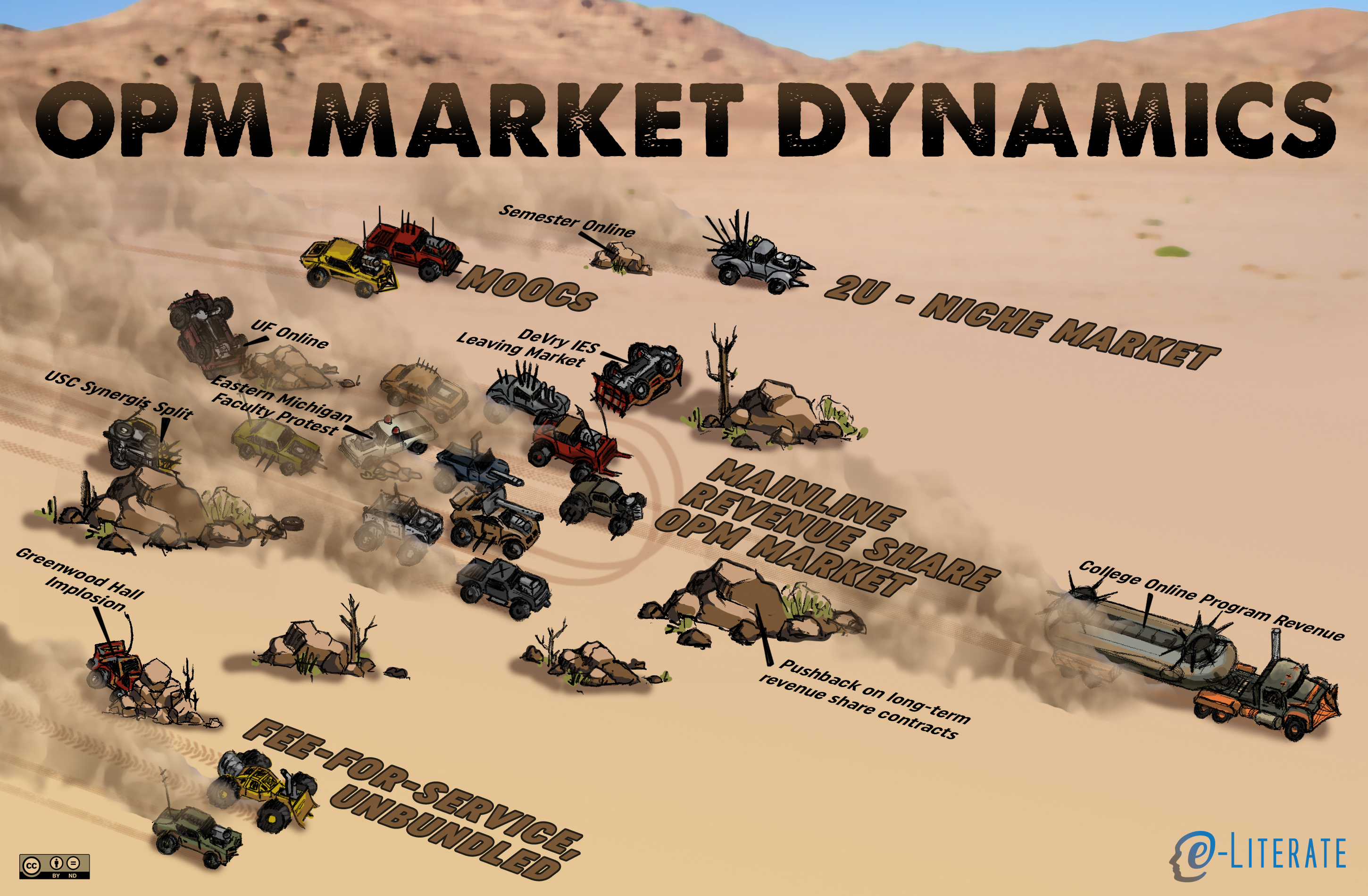
  • OPM Market May Be Growing, But It’s Not Without Chaos

    OPM Market May Be Growing, But It’s Not Without Chaos

    There has been growing interest in the Online Program Management (OPM) market, as more schools try to develop a strategy and revenue model for online programs (particularly for master’s level), and as 2U continues its rapid rise in the stock market (with a nearly $4.8 billion market cap). Typically the description of this market is that the total annual revenue is somewhere between $1.5 – $2.5 billion and that it is growing. The implications are that we have a land grab as companies get rich off the new programs.

    The reality, however, is more complicated. The OPM market may be growing, but it is chaotic and messy. Consider the following problems within the market:

    • This is not an easy market, as many programs take millions of dollars of investment by the OPM provider before an account becomes profitable, often 3 – 5 years down the road.
    • 2U’s Semester Online initiative, targeted at the undergrad market as a consortium, shut down in 2014 due to the departure of several founding member institutions and due to low enrollment.
    • Later that same year Cal State Online shut down in all but name, along with its usage of Pearson as its OPM partner.
    • In 2015 Synergis Education pulled out of its work with USC’s Master of Integrated Design, Business and Technology program, to be eventually replaced by 2U.
    • In 2016 the University of Florida Online (UF Online) canceled its contract with Pearson and pivoted to a new approach not using an OPM partner.
    • After raising $230 million from Bertelsmann in 2015, HotChalk has failed to bring in any new clients of the scale of Concordia University, and in 2016 the company paid a $1 million settlement (though not admitted any fault) based on a federal investigation and lawsuit.
    • Sometime in 2016/17, the nonprofit OPM Educators Serving Educators from Excelsior College shut down.
    • In 2017 after a management shake-up, DeVry Education Group (now Adtalem) pulled out of the OPM market and got rid of its Integrated Education Solutions group.
    • In late 2017 the Eastern Michigan University’s chapter of the American Association of University Professors filed a complaint against EMU’s contract with Academic Partnerships, although an arbitrator sided with the school earlier this year.
    • Also in late 2017 Greenwood Hall – a call center-based fee-for-service OPM provider – collapsed in dramatic fashion, with AnswerNet eventually buying the remaining assets.
    • There has been growing pushback on the mainline revenue-sharing model, where full-service OPM providers make 50% or even more of tuition dollars from online programs. This has led to the rise of unbundled, fee-for-service category of OPM providers.

    The picture one gets is of a chaotic market that is not for the faint of heart, and one that will likely see further consolidations and category changes. 2U, for its part, has been successful partially due to a niche strategy where they go after elite master’s programs and mostly avoid direct competition or engagement with the rest of the market. And recently we have started to see the MOOC providers become OPM providers – where the primary revenue for Coursera and FutureLearn are based on revenue sharing with online programs, albeit with lower sharing rates and with very different marketing approaches. In other words, there seems to be several efforts to enter into the same OPM race, but if possible to avoid being in the mainline rev-share OPM market. The Toecutter would feel right at home.

    The Mad Max view of OPM market dynamics

    Not even represented here is the movement of former for-profit institutions (e.g. Grand Canyon University, the parent company of Kaplan University) becoming OPM providers.

    This means that our landscape view of the market is temporal in nature – expect more shake ups and category changes as the OPM market continues to grow in new ways.

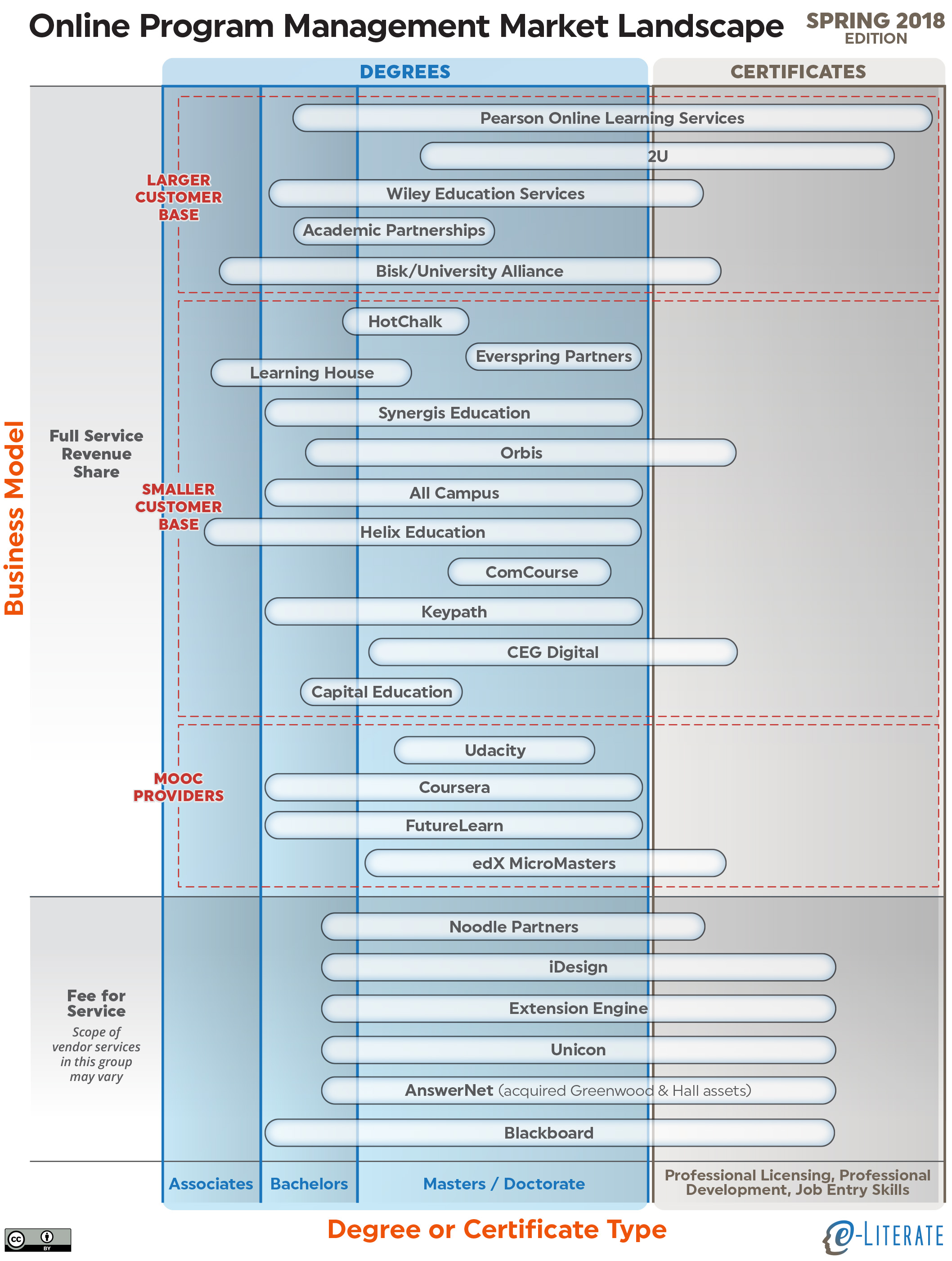
    Market landscape of OPM vendors

  • Rio Salado College As Exemplar: A critical external view

    In yesterday’s post I described how a review of two courses at Rio Salado College indicated reasons to question the use of this school in the ASU / BCG case study report on Digital Learning ((Disclosure: Our e-Literate TV series was funded in part by the Bill & Melinda Gates Foundation who also funded the ASU / BCG study.)). The report, titled “Making Digital Learning Work: Success Strategies From Six Leading Universities and Community Colleges”, has the following description [emphasis added]:

    How can the use of digital technologies in postsecondary education impact students’ access to education, student outcomes, and the return on investment for students and institutions? What are the biggest challenges for an institution seeking to implement high-quality digital learning opportunities? What promising practices enable an institution to achieve impact at a larger scale? [snip]

    The answers, at least in part, lie in case studies of six colleges and universities: Arizona State University, the University of Central Florida, Georgia State University, Houston Community College, Kentucky Community and Technical College System, and Rio Salado Community College. The first three institutions in this list are public research universities, representing different geographic populations and access missions. The other three institutions include two community colleges and a state-wide community college system.

    These six institutions have a strong track record of using digital learning to serve large, socioeconomically diverse student populations, and each has been a pioneer in innovating to expand access to postsecondary education, improve student outcomes, and provide higher education at an affordable cost.

    Let’s look at the track record of Rio Salado College in terms of aggregate academic student outcomes to see how appropriate it is to include them as an exemplar in such a case study-based report. For much of my analysis, I looked at the 862 public 2-year colleges fully reporting data in the Fall 2016 IPEDS data set.

    Reduced Expenditures

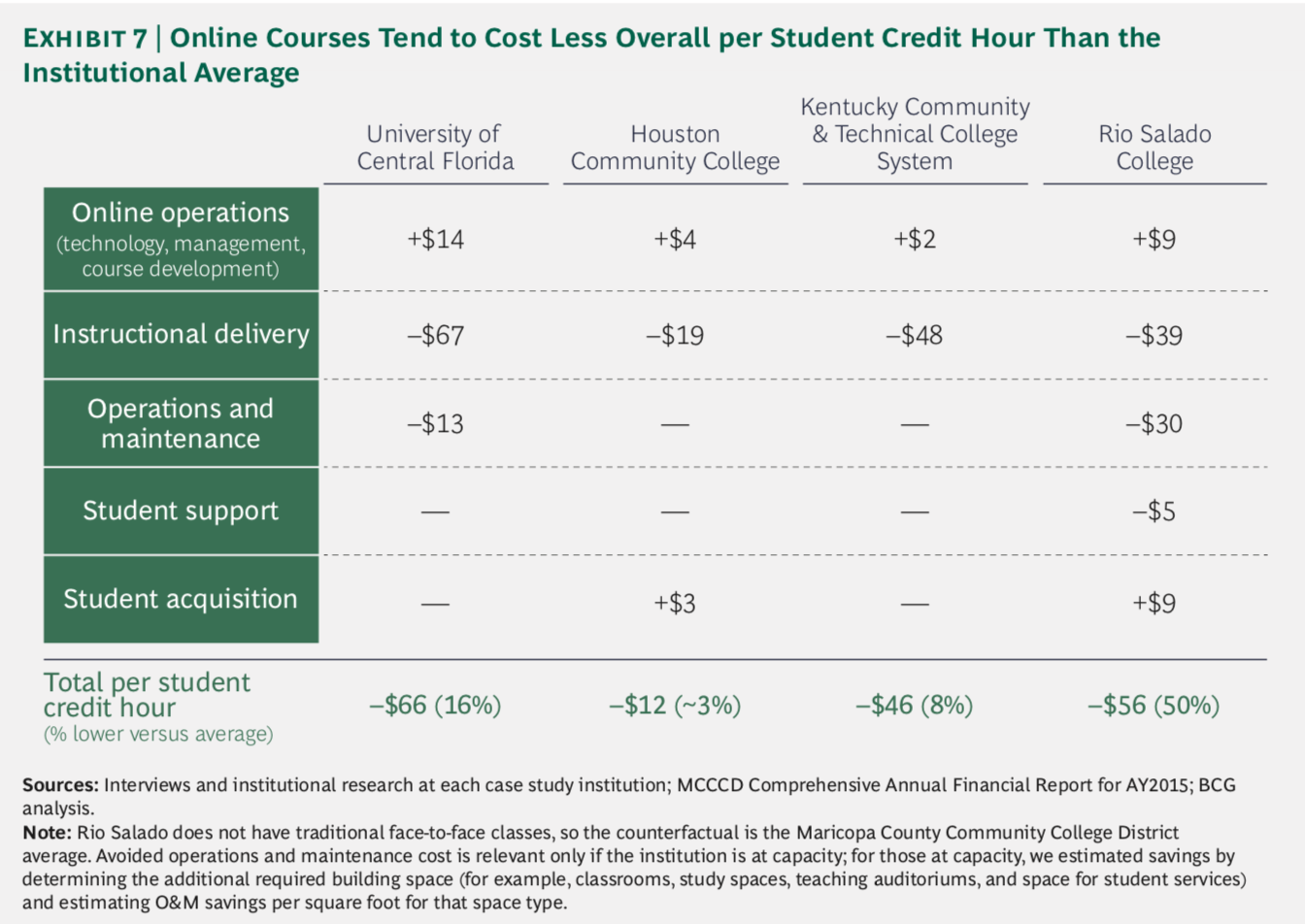
    The primary claim made in the ASU / BCG report is that Rio Salado is has reduced costs.
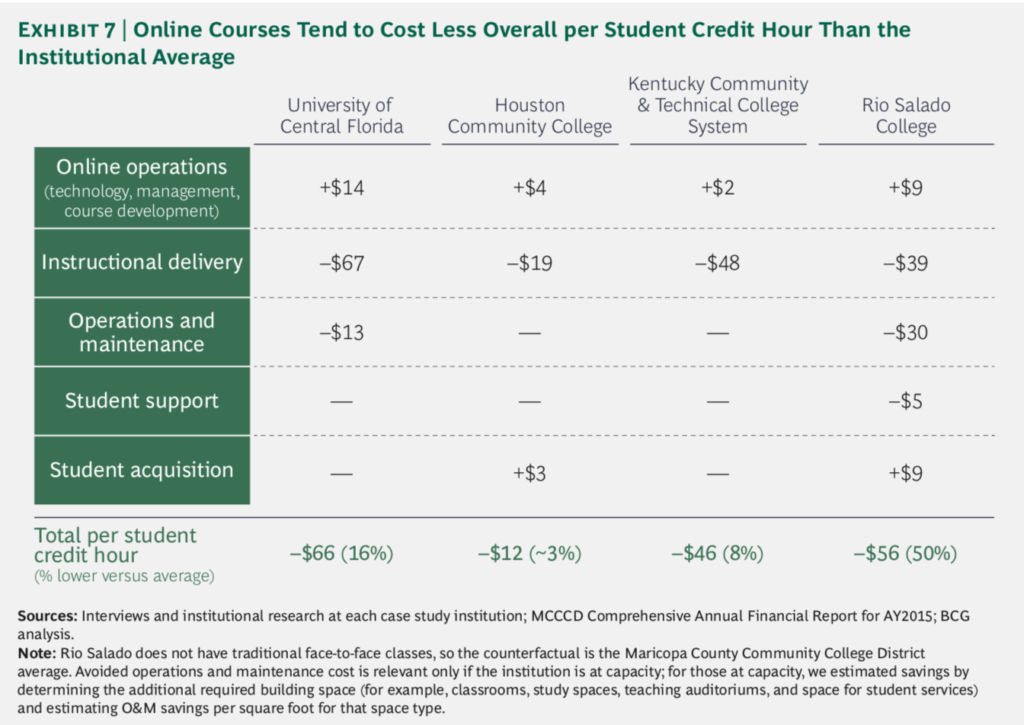
    This claim does hold up to scrutiny, as Rio’s $89 of instructional delivery costs per student credit hour and $16 of student services costs are 10th and 9th lowest in the country for the 862 colleges I reviewed.

    The primary outcomes claims made in the case study quickly brush off the standard metrics for Rio.

    Rio Salado’s success is not defined solely by improvements in graduation and retention rates. In particular, the college has a high transfer-out rate (32% compared to an average of 19% for other MCCCD colleges [ed. – the other schools in the Maricopa County Community College District]), and the students who transfer to Arizona universities from Rio Salado have a 74% four-year graduation rate—3 percentage points higher than the average for other MCCCD transfer students. At Rio Salado itself, students’ course-level success rates have slowly been improving over time, to about 64% in 2016.

    Graduation and Retention Rates

    It is all well and good to point out the importance of transfer students, but we should not ignore graduation and retention rates. And we should explore whether the data supports the phrase “improvements in graduation and retention rates”.

    The report describes Rio’s investment in a suite of advising tools.

    Obtaining these advisory tools required an initial investment of $1 million, but the tools pay for themselves by increasing Rio Salado’s term-to-term retention by 7%, increasing ROI through improved student progress and the additional tuition dollars that the institution receives from retained students.

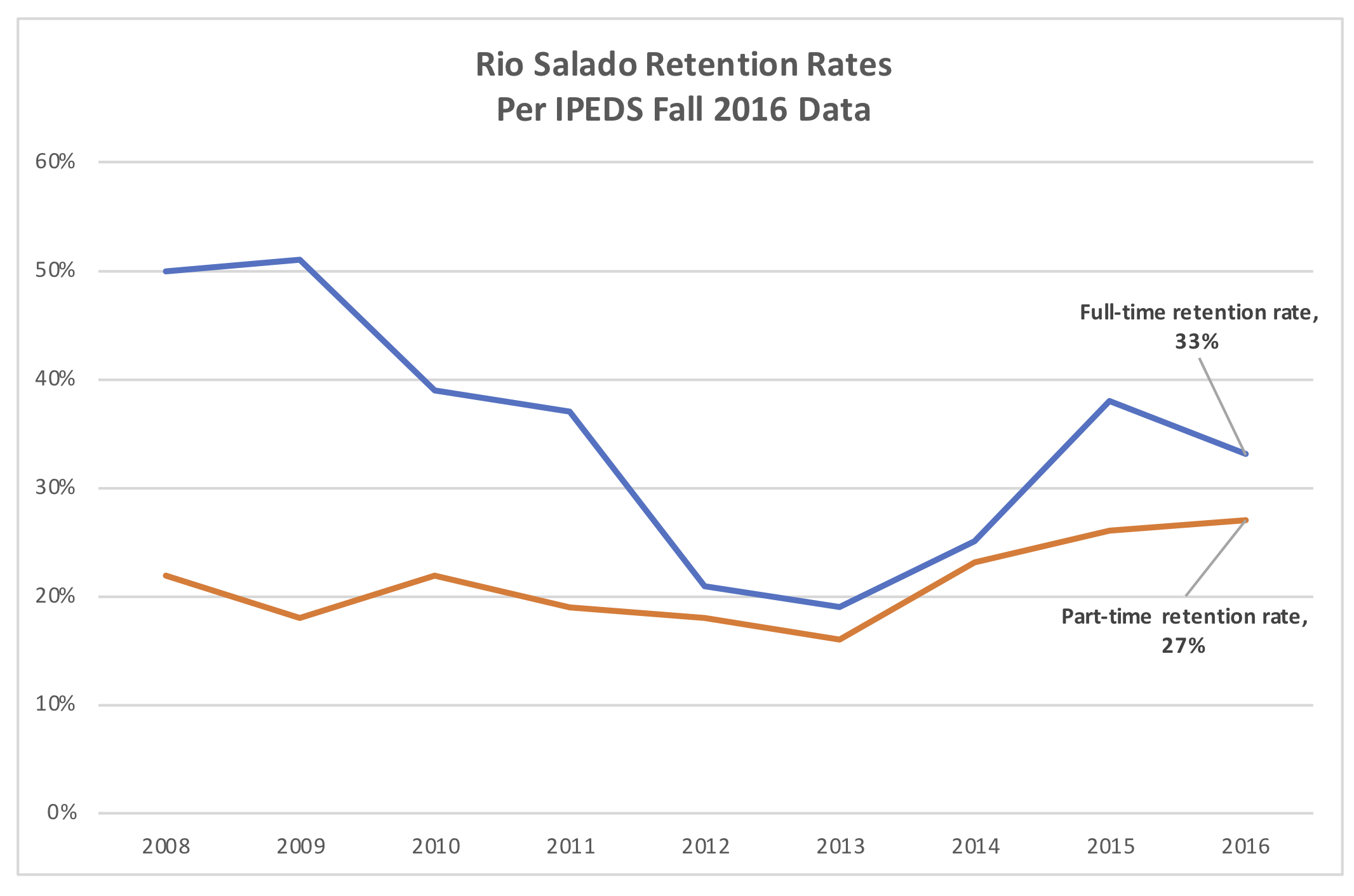
    Looking at IPEDS data, we can see Year 1 to Year 2 retention rates (not quite the same as term-to-term), and it shows improvement since 2013. Unfortunately, Rio’s retention rates for full-time and part-time students are both in the bottom 10% of all community colleges at 33% and 27%, respectively. And the full-time rate is lower than it was prior to 2011.
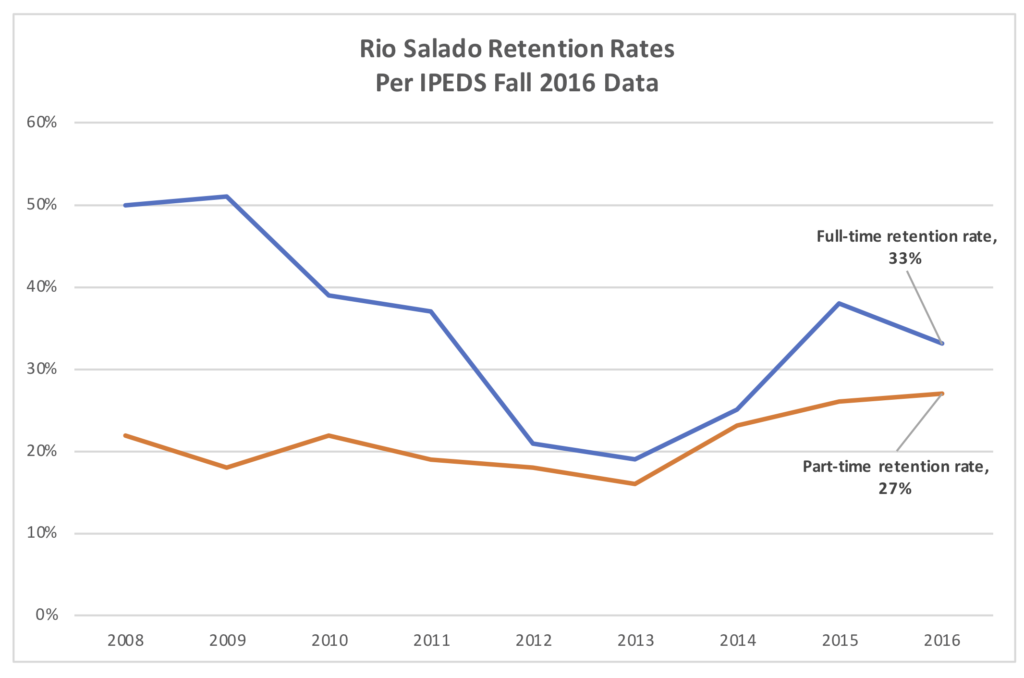
    Rio Salado Year 2 Retention Rates

    While the ASU / BCG report does not mention graduation rates directly, there have been several claims made about Rio’s numbers in other publications.

    The problem is that Rio Salado’s 4-year graduation rate for first-time full-time students as reported in IPEDS is 5% – the second lowest of any public 2-year college in the nation. How can we resolve this discrepancy?

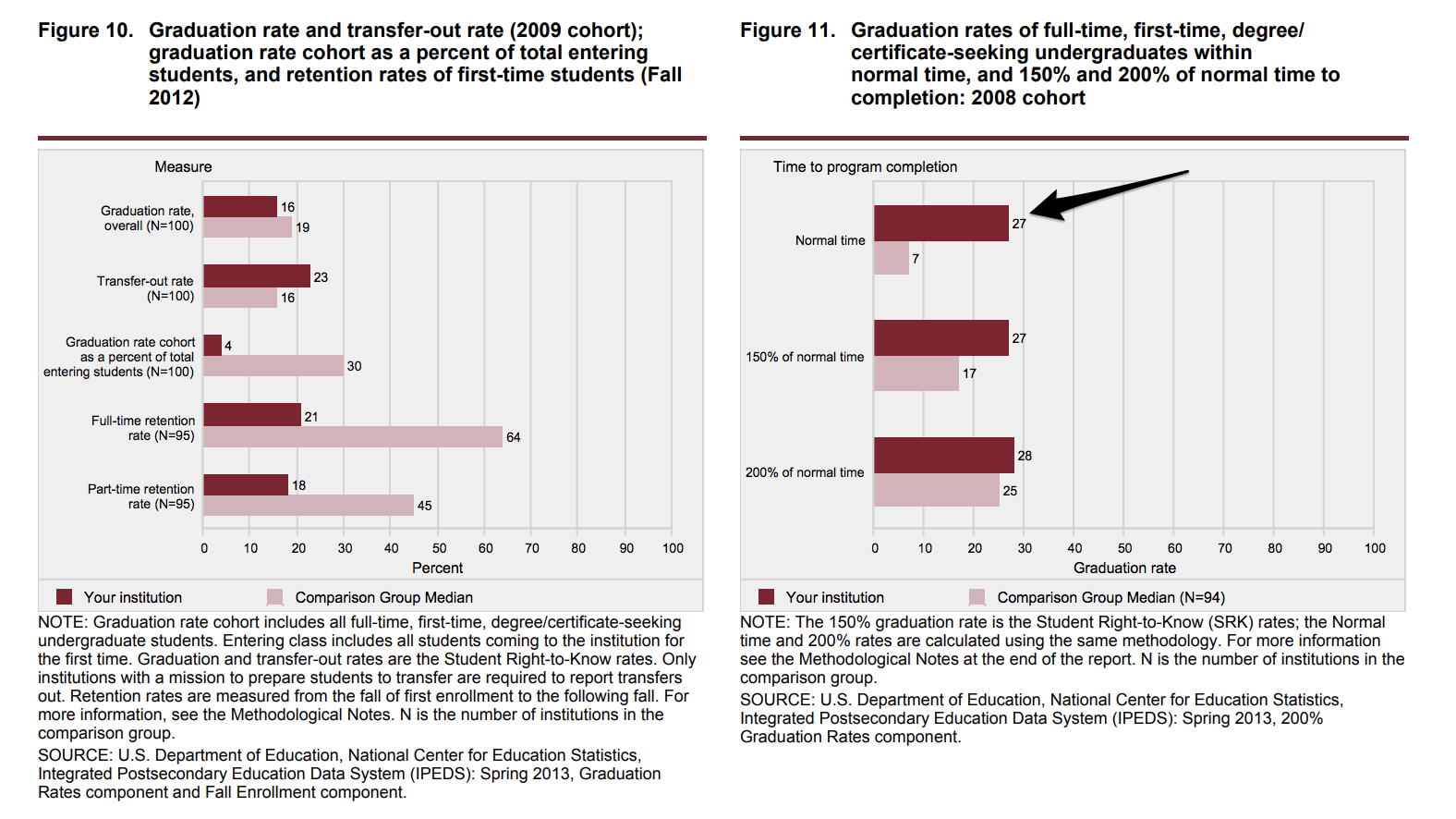
    The key to understanding the claims in these four articles is to follow the two links, which both point to a customized IPEDS Feedback Report from 2013 for Rio against their selection of 100 peer institutions.
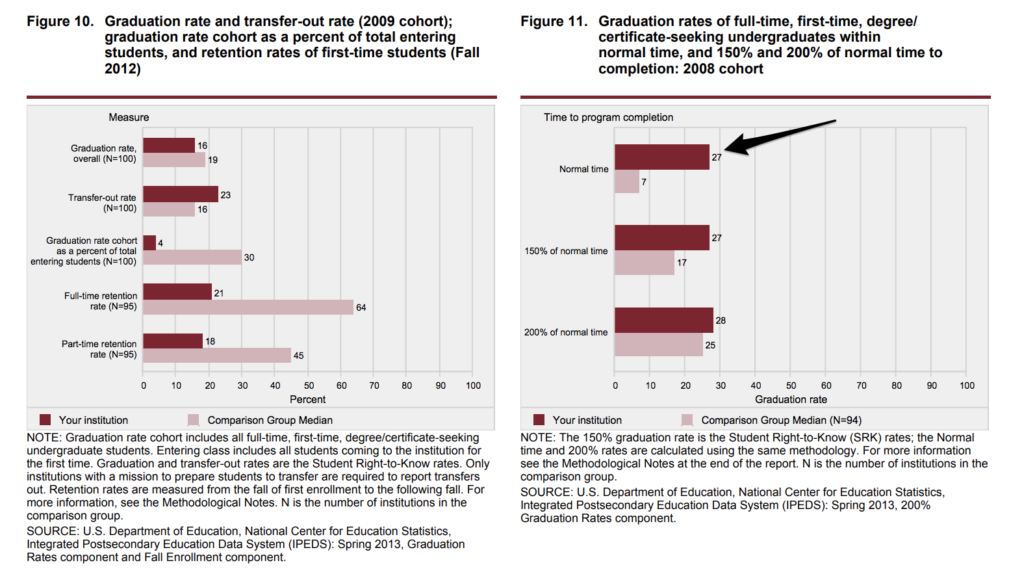
    Figures 10 and 11 from IPEDS report

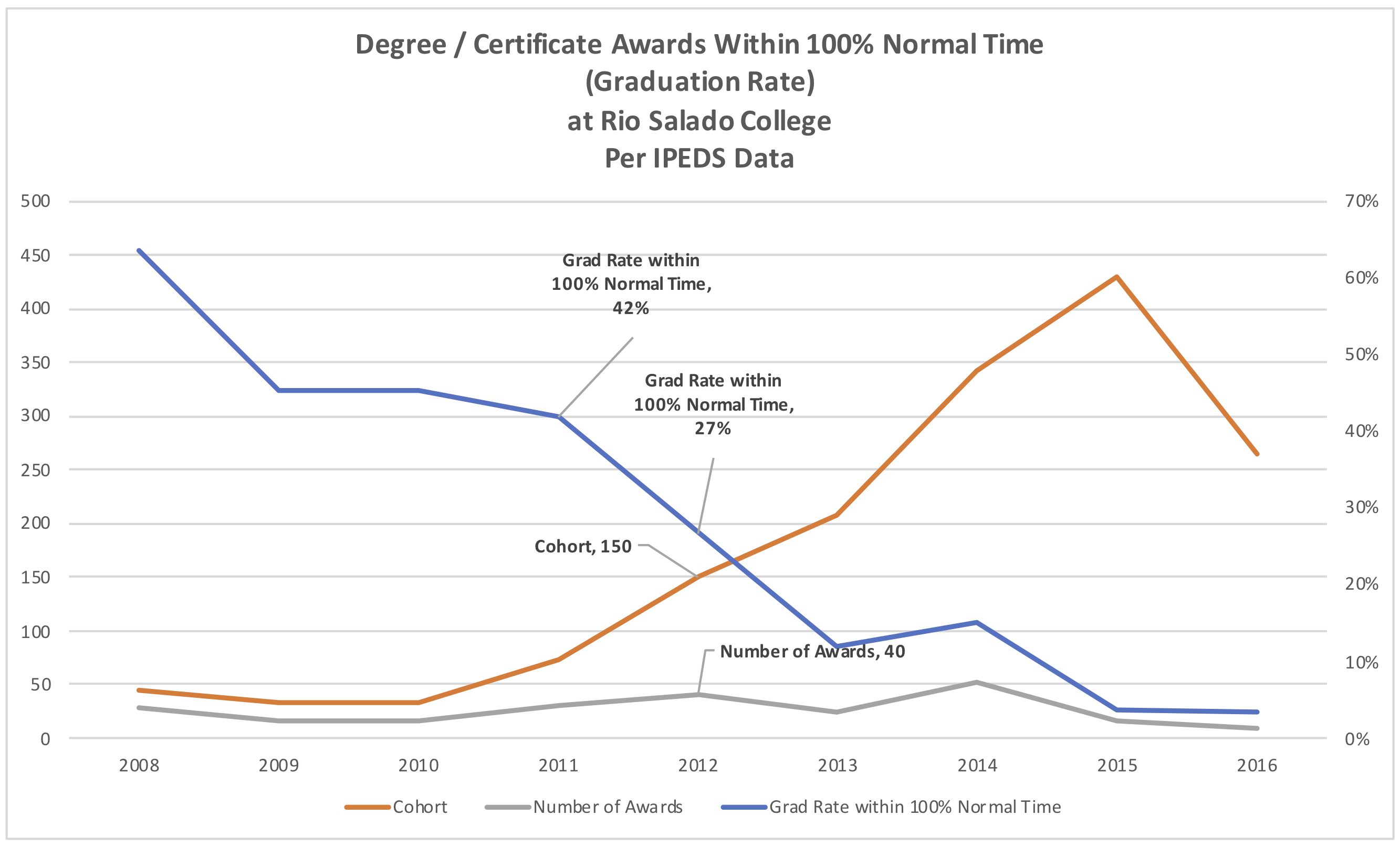
    This measure captures any award – degree or certificate – for a small cohort of entering full-time students at Rio from 2009. If you trace that data through IPEDS, you see that this measure is for a 150-student cohort (in 2012) out of the 45,000+ students at Rio.
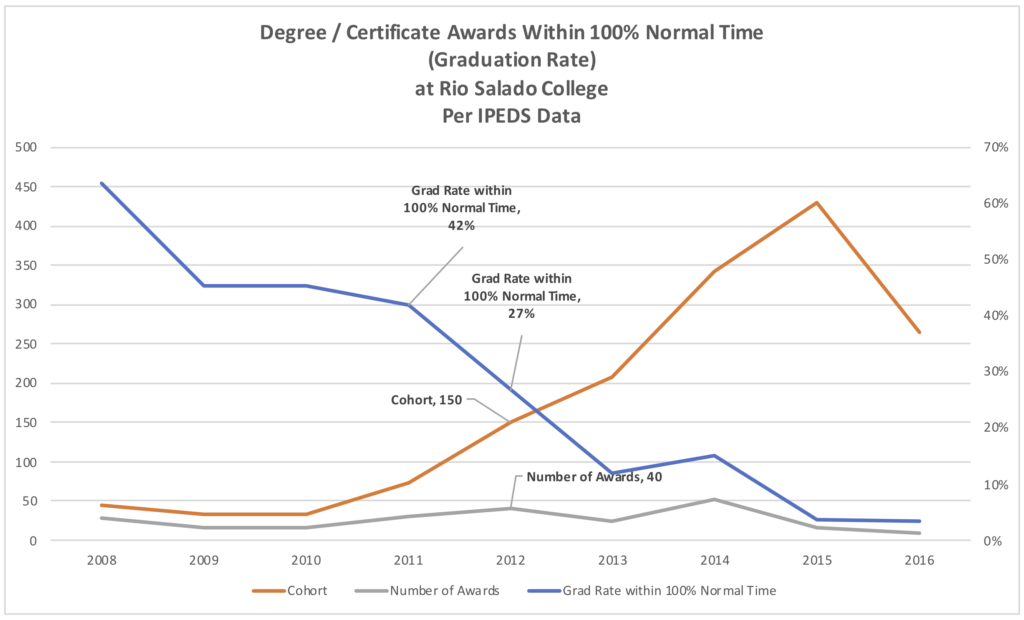
    Using this specific metric, you can find the 42% graduation rate in 2011, and the “four times greater” rate of 27% in 2012, both as the rate plummets from 64% in 2008 to 3% in 2016.

    Using broader, up-to-date metrics for graduation and retention rates as well as the new IPEDS outcomes measures (which allows comparison outside of just full-time first-time cohorts), we see that Rio Salado College has some of the lowest student outcomes measures in the country.
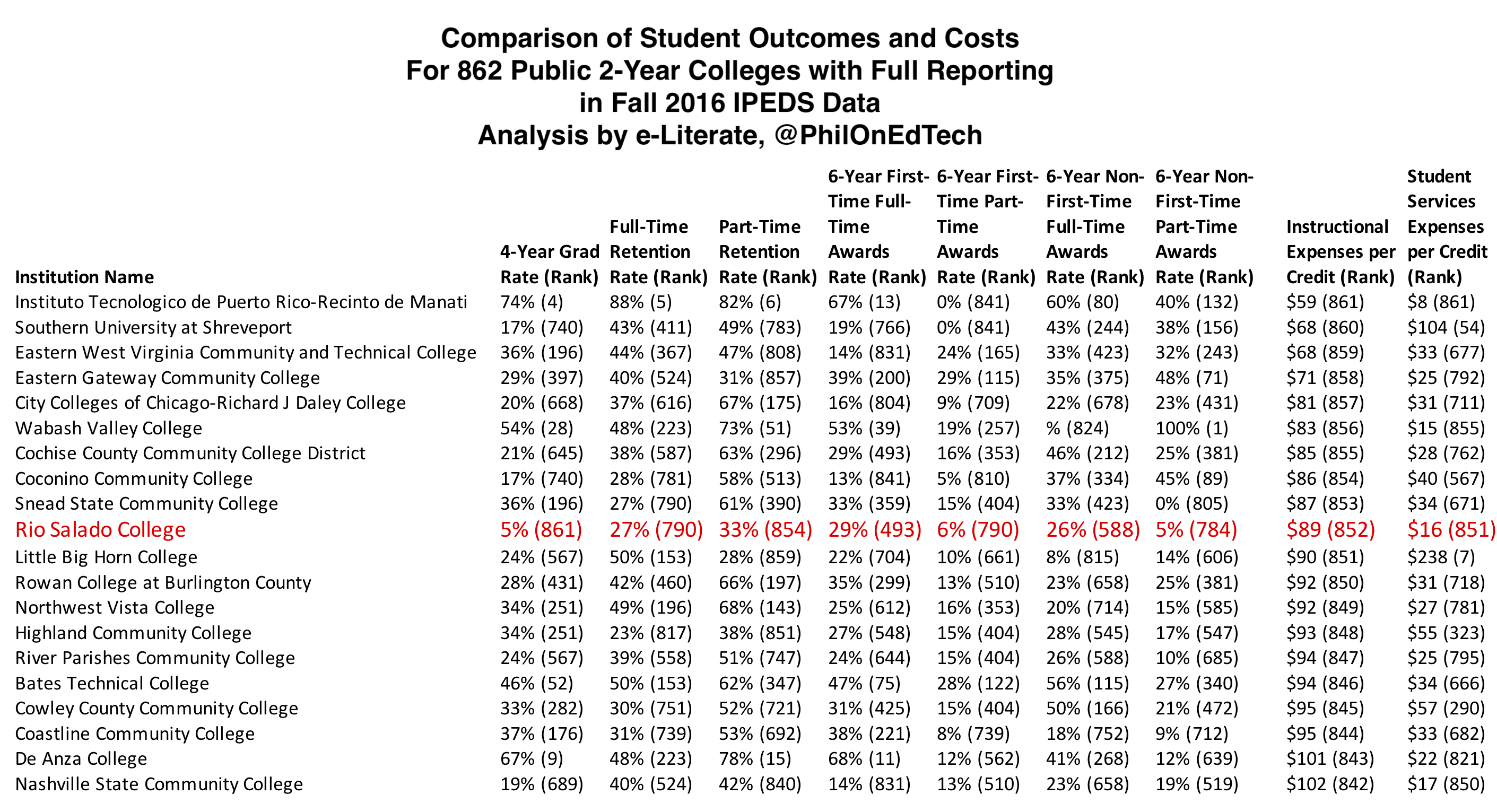
    For all but two measures (6-year First-Time Full-Time Awards and 6-year Non-First-Time Full-Time Awards), the performance is in the bottom 10% of all colleges in the study. For those two awards measures, the performance is in the bottom half of the country and represents just 11% of the student body.

    Transfer Rates

    What we are left with are reports about high transfer rates and subsequent success rates 3% higher than other transfers out of the same district. The IPEDS data set now includes transfer rates in its new Outcomes Measures section, and it is true that Rio Salado College does transfer out a significant portion of students. For all cohorts defined below, Rio is in top 20% of public 2-year institutions.

    • First-Time Full-Time Students: 39% transfer rate, Rank 170 out of 862
    • First-Time Part-Time Students: 47% transfer rate, Rank 112 out of 862
    • Non-First-Time Full-Time Students: 46% transfer rate, Rank 196 out of 862
    • Non-First-Time Part-Time Students: 59% transfer rate, Rank 121 out of 862

    Note that this data indicates that students transferred to another institution and are still enrolled there. This data does not indicate what portion of the transfers were planned versus students deciding to move on for other reasons. Nevertheless, for a community college, especially one with very close ties to ASU (I have been told that a large percentage of Rio students are ASU students trying to fill out their schedule based on saving money and more convenient schedules), this is a favorable metric.

    I cannot provide independent confirmation on the subsequent success rates, so we’ll accept that claim at face value.

    Case Study Questions

    I should note that Rio Salado College does provide accurate information on the metrics mentioned in this post, both through IPEDS reporting and through their Research & Planning section of the web site. The picture that emerges from the aggregate outcomes data is of a large school that:

    • transfers out greater than average percentage of students;
    • is just below average for awarding certificates for full-time students;
    • is among the poorest performing in the country for retaining students;
    • is among the poorest performing in the country for awarding degrees; and
    • is among the poorest performing in the country for awarding certificates for part-time students.

    At best, this is a school with mixed results that should not simply be labeled a success without caveats or explanations.

    One question we should ask is whether it is appropriate to hold up a school with some of the lowest student outcomes measures in the country as an exemplar. Yes, Rio Salado has found a way to spend as little as possible on instruction and student support services, and yes, a lot of students transfer out, but that is not enough. We need greater evidence of student success if we are to use them as a case study for others to emulate. And we also need a more robust genre of a case study that looks across, at a minimum, a relatively standard set of publicly-available information, and deeper dives where appropriate, to understand educational practices and their impacts on students. These case studies should present information in context – the good and the bad – since education is complex and challenging, and a clear focus on evidence will benefit all parties in the end.

  • Rio Salado College As Exemplar: A critical internal view

    Rio Salado College As Exemplar: A critical internal view

    10 days ago Arizona State University (ASU) and the Boston Consulting Group (BCG) released a report, supported by the Bill & Melinda Gates Foundation (BMGF) ((Disclosure: Our e-Literate TV series was funded in part by the Bill & Melinda Gates Foundation.)), titled “Making Digital Learning Work: Success Strategies From Six Leading Universities and Community Colleges”. The basic idea [emphasis added]:

    How can the use of digital technologies in postsecondary education impact students’ access to education, student outcomes, and the return on investment for students and institutions? What are the biggest challenges for an institution seeking to implement high-quality digital learning opportunities? What promising practices enable an institution to achieve impact at a larger scale? [snip]

    The answers, at least in part, lie in case studies of six colleges and universities: Arizona State University, the University of Central Florida, Georgia State University, Houston Community College, Kentucky Community and Technical College System, and Rio Salado Community College. The first three institutions in this list are public research universities, representing different geographic populations and access missions. The other three institutions include two community colleges and a state-wide community college system.

    These six institutions have a strong track record of using digital learning to serve large, socioeconomically diverse student populations, and each has been a pioneer in innovating to expand access to postsecondary education, improve student outcomes, and provide higher education at an affordable cost.

    The methodology is a case study of each school, and the report then takes a stance on what other institutions should do.

    Now is the time for leaders to champion the potential of digital learning to open the doors of higher education wider and to improve student outcomes, while operating more efficiently and at lower cost. The journey of each college or university will be unique, but the set of promising practices described in this report may serve as a useful guide for all institutions.

    There are multiple methods to evaluating a school; it turns out that some are more meaningful than others, and it is always helpful to start with what students experience in actual courses. The ASU / BCG report provides useful context on course design.

    At Rio Salado, 22 full-time faculty chairs develop courses with the support of a central team that includes subject-matter experts, instructional designers, media support staff, and production staff. About 1,500 adjunct faculty members teach the courses, which they can personalize by adding an introductory message or video for each module.

    It turns out that I have access to two courses – ENG102 (First Year Composition) and EED200 (Foundations of Early Childhood Education) – and this gives an opportunity to better understand the student experience. What these courses indicate, however, is a troubling lack of meaningful interaction between faculty and students.

    Looking at ENG102, the course materials is Rio Salado developed courseware embedded in their custom course management system, RioLearn. The materials appear to be quite extensive, and all materials are available at the start of the term in 14 lessons. To find actual due dates, students have to go to the gradebook, as no specific dates are included in the courseware.

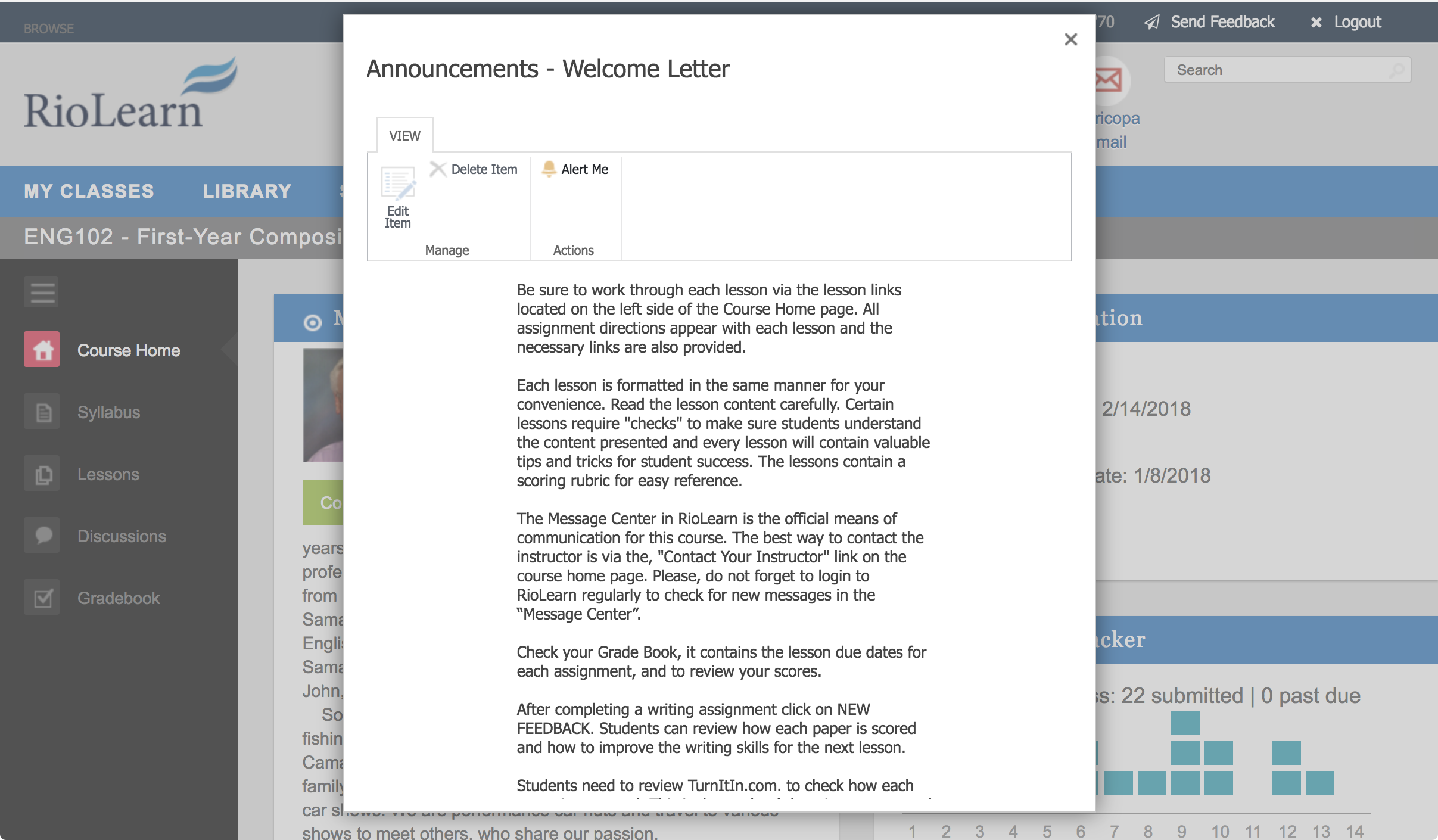
    Course Welcome Message

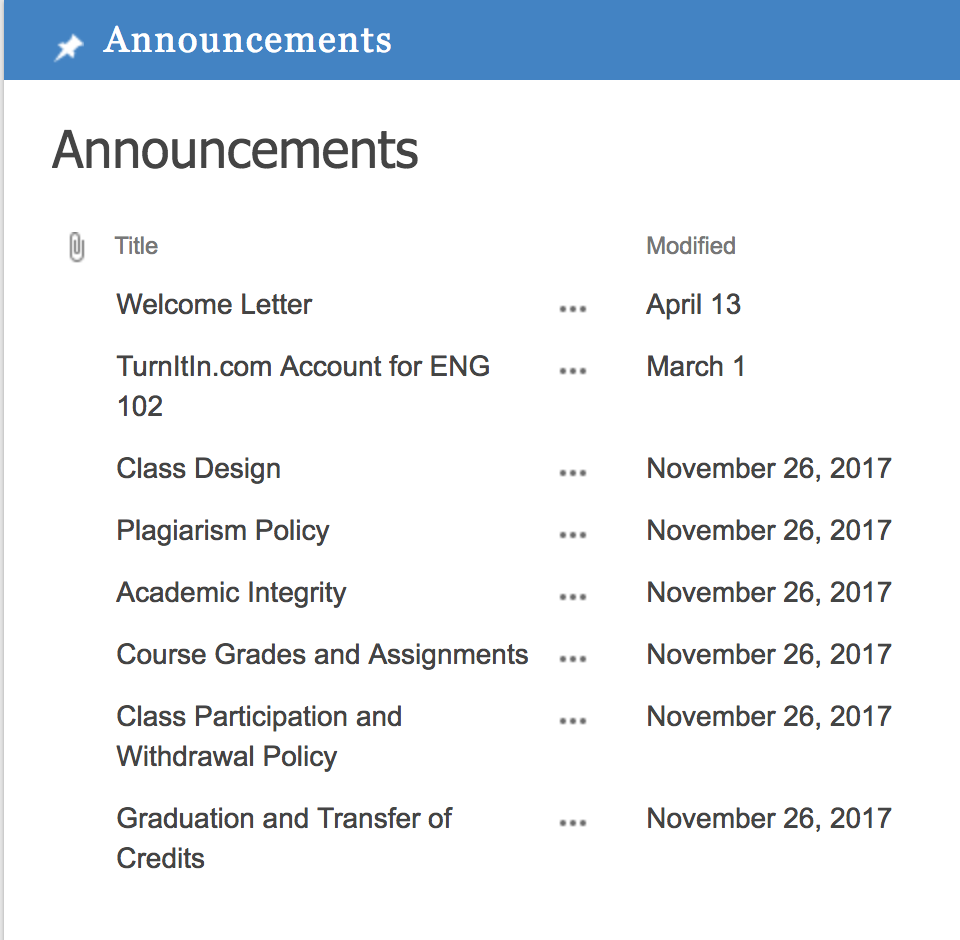
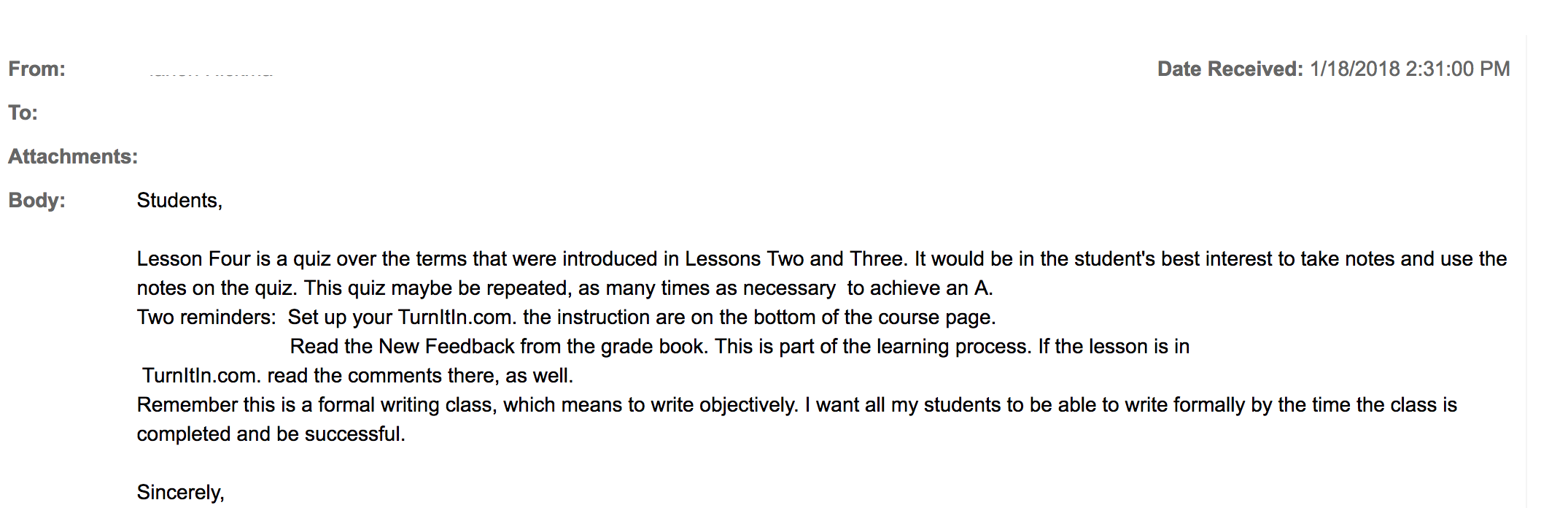
    The instructor sent out several announcements at the beginning of class, a welcome letter, and then one reminder or update message at the beginning of each month. That’s it for instructor-initiated interactions.

    Course announcements

    Sample Message

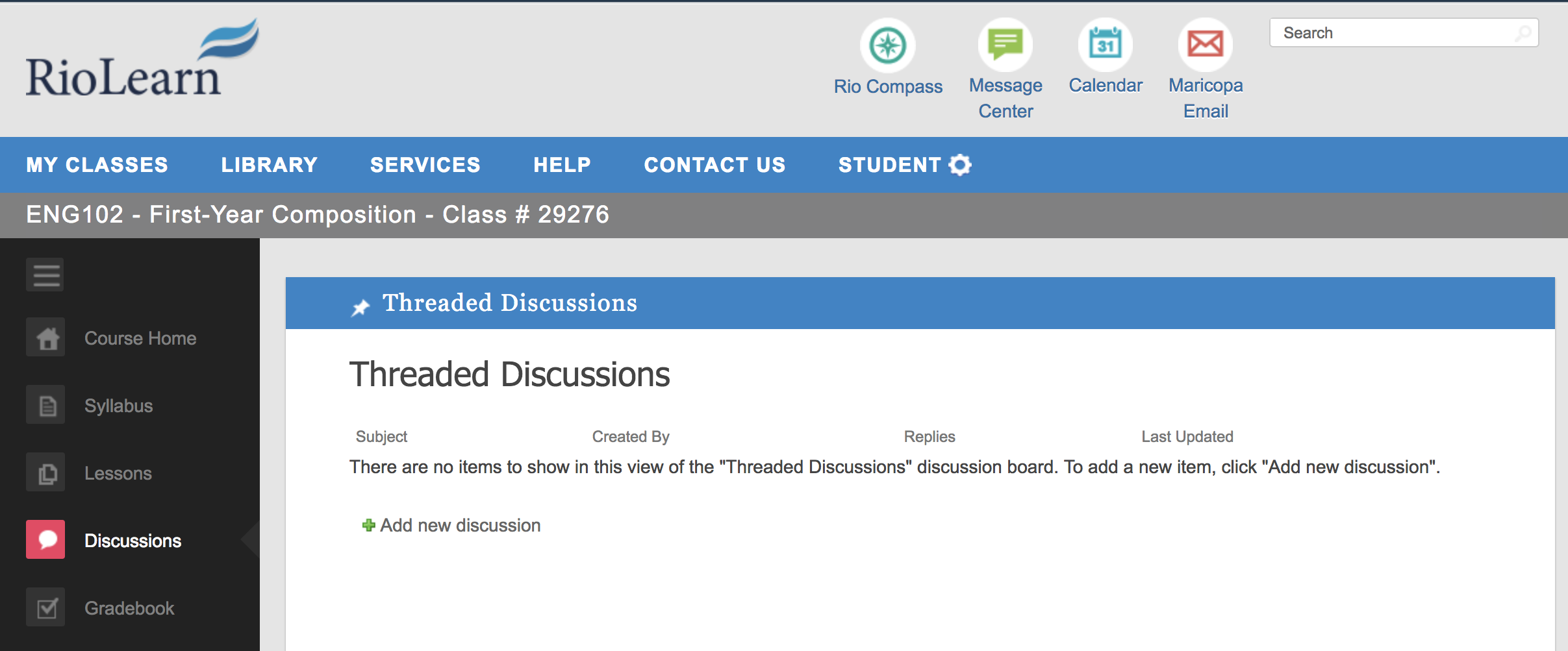
    There were no student-to-student discussions, as the discussion board was unused for the course. There was one peer-review activity, but otherwise no interactions between students. I have been a frequent critic of threaded discussion boards, but it is certainly better to have something instead of nothing.

    Discussion Tool

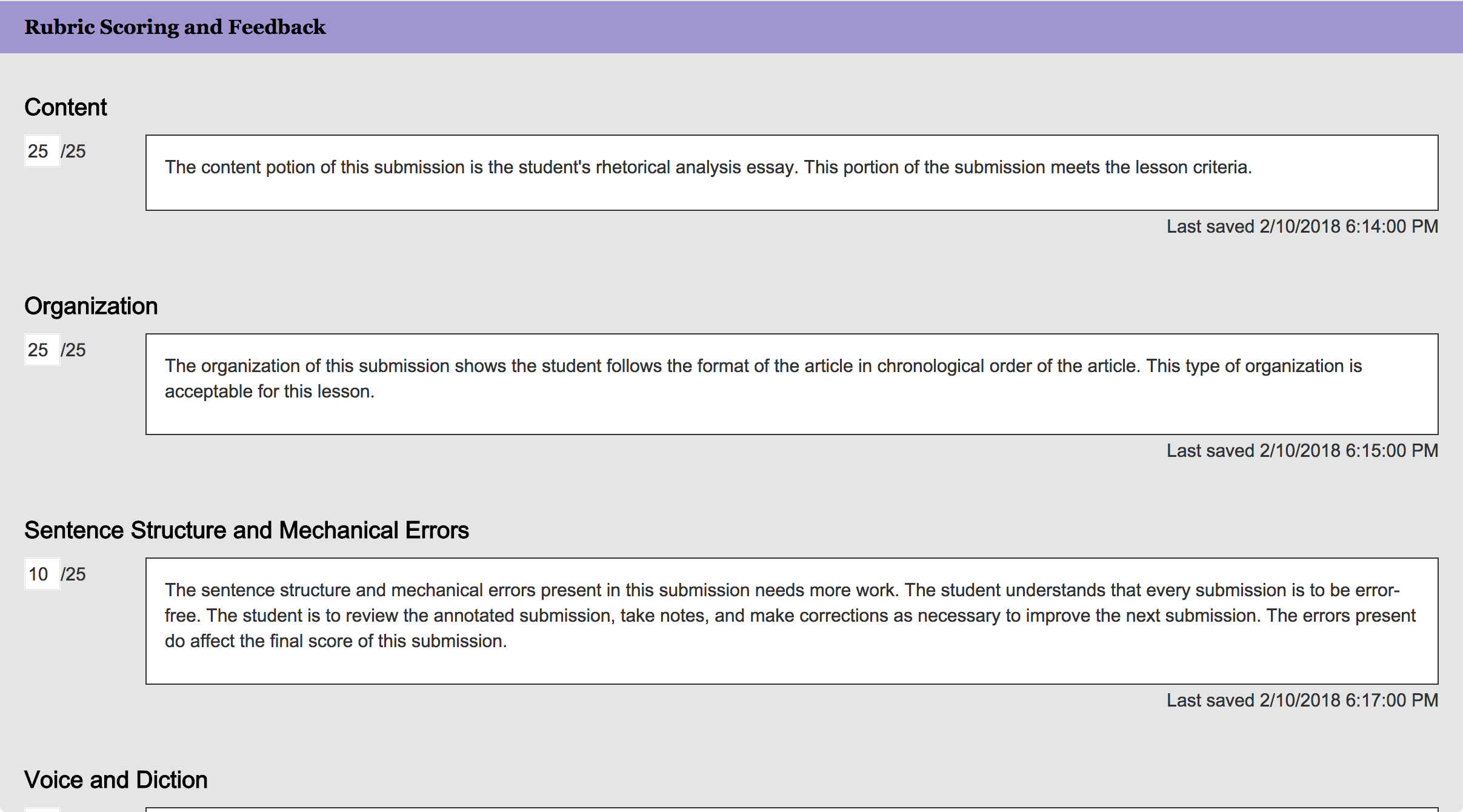
    The rest of the interactions came in two categories: grading of assignments and responses to student-initiated messages. The primary feedback method in these two courses was faculty usage of the custom-developed Feedback Tool, which uses rubrics to grade assignments.

    Lesson Feedback

    There were several assignments that included annotated mark-ups of the submitted papers, which appear to be the most useful feedback from instructors.

    A review of EED200 shows the same course structure – few instructor-initiated interactions, use of rubric grading as feedback on assignments, and specific responses when students send questions in through the Message Center.

    For both courses, the instructors typically responded to student messages within a day or two.

    This approach is troubling, as both courses appear to not meet the “regular and substantive interaction” regulation for credit-bearing online courses. I have been critical about the vague standards and the egregious application by the Department of Education’s Office of Inspector General audit of Western Governors University, but these complaints do not mean that the regulation has no point. The idea is that course design and facilitation should be implemented to ensure that students are not left to figure out static course materials and to be responsible for initiating most forms of interaction. As stated in a 2014 Dear Colleague Letter on the subject of regular and substantive interaction based on competency-based education (CBE) approaches [emphasis added]:

    We do not consider interaction that is wholly optional or initiated primarily by the student to be regular and substantive interaction between students and instructors. Interaction that occurs only upon the request of the student (either electronically or otherwise) would not be considered regular and substantive interaction.

    Some institutions design their CBE programs using a faculty model where no single faculty member is responsible for all aspects of a given course or competency. In these models, different instructors might perform different roles: for example, some working with students to develop and implement an academic action plan, others evaluating assessments and providing substantive feedback (merely grading a test or paper would not be substantive interaction), and still others responding to content questions.

    The problem with case studies is that the selection of cases to study may not be representative or appropriate to prove one’s thesis. It is possible that I happened to look in detail at two courses that are aberrations. But even so, this view is troubling, as these are centrally-developed courses (not subject to the whim of individual instructors), and both courses have little meaningful provisions for faculty-student or student-student interactions. The instructors were responsive to messages, but that is not enough to back up claims of high-quality courses. The dissonance between these two courses and what is described in the ASU / BCG report led me to take a critical look at the data.

    For the next post, I’ll take the external view and look at aggregate public data on Rio Salado College on academic outcomes.

  • The CWiC Framework: Context around Courseware

    Update: I got feedback that it wasn’t clear the embedded video was a three-video playlist, so I have broken them out individually.

    We have a new case study up in which we interview members of the Courseware in Context (CWiC) framework advisory committee about their work:


    The focus isn’t so much on the framework itself as on the project goals and, somewhat less directly, it’s sustainability model. We’ve seen repeated failures in the market to create selection tools for curricular materials or edtech products. (Some of us are old enough to remember EduTools.) The committee members are very thoughtful about the missing element, which is context. There are, in CWiC advisory committee member Tanya Joosten’s words, “a million” different contextual variables, from classroom implementation to support to individual student needs. CWiC is an attempt to take a traditional product selection tool model and enrich it enough to account for all these contextual variables.

    The committee members seem acutely aware of how big of a challenge this could be, which is part of what makes these interviews so interesting. At our recent Empirical Educator Project summit, René Kizilcec (whose research we have featured here on e-Literate) made a fascinating comment, which is that we education “desperately needs” a “science of context.” The CWiC folks are trying infuse the output we currently have from the beginnings of that science into what is essentially a tool for selection and procurement. Will it work? I don’t know. The committee members are pretty clear about the size of the challenge. But it’s the right direction.

    The Empirical Educator Project (EEP) attempts to take on the other side of René’s phrase. What would it mean to have a science of context? Who would the scientists be? What cultural institutions would we need to form a consensus around what a science of context would look like such that people who care about it could cooperate on it more effectively, and such that it would attract the funding it needs to be carried out? What business process support tools, including but not limited to procurement tools, do we need to implement a science of context, and how would implementation provide input back to the scientific research? These are the questions that EEP attempts to answer. Will it work? I don’t know. But I feel confident that it’s the right direction.

  • Online Program Management: Spring 2018 view of the market landscape

    Online Program Management: Spring 2018 view of the market landscape

    Nearly two years ago I wrote two blog posts giving a high-level view of the Online Program Management (OPM) market landscape. This is a growing but messy market, and the market changes since mid 2016 call for an updated view.

    OPM providers are for-profit organizations that help non-profit schools develop online programs, most often for Master’s level programs. These companies provide various services for which traditional institutions historically have not had the experience or organizational capability to fully support, at least for fully-online programs and often for non-traditional student populations. Some examples of the services include marketing & recruitment, enrollment management, curriculum development, online course design, student retention support, technology infrastructure, and student & faculty call center support.

    The OPM market has historically been known for a full-service, revenue-sharing model, based on the premise that most traditional institutions are not only operationally unprepared to offer online programs at scale but also are not set up to invest in online programs up front. There are extensive costs, particularly in marketing and recruitment as well as curriculum and course design, that cause most scalable online programs (that is, those designed with the intent and infrastructure to allow more than just a few dozen students) to require investment over the first several years, before tuition revenue catches up. Rather than requiring the institution to spend sizable up-front money without a guarantee of repayment, revenue-sharing OPM vendors provide this financing themselves – which is in itself an expensive proposition. It often takes three to five years for an OPM company to become profitable for any online program, which is why they often require 10-year or even longer contracts.

    As the online education market has matured, however, there has been a growing pushback against revenue-sharing as the only model available. Thus there is an emerging unbundled fee-for-service OPM model, in which the companies offer the same services, or some subset, for the market price of those services. The institution pays for the services used, mostly independent of the amount of tuition revenue coming into the online program. This category leads to the program, or institution, to take the up-front financial risk but not have to sign contracts sending ~40 – 60% of the tuition revenue to the vendor. Fewer strings attached but more responsibilities and risks for the school.

    With the recent success of Southern New Hampshire University and longer-term models from Penn State World Campus (as well as others), there are also questions about whether non-profit schools can create scalable programs without an OPM partner at all. This category, for obvious reasons, is not presented in our market landscape but is a real option.

    In our view, there is not an either-or proposition in the market. We see strong arguments for both bundled revenue-sharing models and for unbundled fee-for-service models, and I personally do not believe that the market is moving away from revenue sharing as much as there is pressure for additional models. There are a growing number of choices available to schools, but there is also a crowded marketplace that is becoming more difficult to understand.

    With that setup in mind, on to the market landscape graphic.

    As before, please note that this view is intended to give a visual overview of the market landscape and is not comprehensive in terms of vendors represented. This is especially important to understand for the Fee for Service category, where there is no clear definition yet of what is an unbundled OPM provider and what is a product or service provider who happens to serve online programs. Treat this category as illustrative and not exhaustive.

    Market landscape of OPM vendors

    There are three primary changes to note in the graphic’s design since 2016:

    • We have combined different categories of Certificates into one column on the right side of the graphic, since it was difficult to to differentiate between OPM target markets.
    • We have added a sub-category of MOOC Providers under Full Service Revenue Share category to capture the recent changes in that market.
    • We have combined the Fee for Service and General Contractor into one category labeled Fee for Service, again due to difficulty differentiating service offerings.

    We should also note that there will likely be another sub-category of Full Service Revenue Share to capture the ongoing pivots by former for-profit institutions. Graham Holdings sold Kaplan University to Purdue University and remains a single-client OPM provider for that new brand Purdue University Global. Grand Canyon University is converting to a non-profit institution with the remaining for-profit company turning into a (single-client?) OPM provider. Bridgepoint Education plans to turn Ashford University and University of the Rockies into a combined non-profit institution, leaving the remaining for-profit company as an OPM. We are not ready to add this sub-category, and it is not clear yet if these providers plan to go beyond servicing the non-profit conversions.

    There are several changes to the vendors listed:

    • Pearson no longer refers to the Embanet brand that they acquired and now goes by Pearson ((Disclosure: Pearson, 2U, iDesign, Unicon, and Blackboard are sponsors for our Empirical Educator Project. See this post for more details.)) Online Learning Services.
    • 2U, after the May 2017 acquisition of GetSmarter, now serves certificate programs and not just masters degree programs.
    • Wiley no longer refers to the Deltak brand that they acquired and now goes by Wiley Education Services.
    • DeVry Integrated Education Solutions no longer appears to be active in the market, based on outdated web site (key executive listed has been gone for seven months) and no marketing or competitive presence. We have removed their listing.
    • Cambridge Education Group’s CEG Digital unit has emerged as an OPM provider serving UK-based institutions.
    • We (re)added Udacity based on the success of the Georgia Tech Masters in Online Computer Science program, which has helped spawn the new sub-category of MOOC Providers in the market, even though Udacity appears to have no interest in pursuing other higher education degree offerings.
    • We added Coursera as an OPM Provider, as this market now appears to be their core market moving forward.
    • We added FutureLearn based on their continuing expansion as a MOOC-based OPM provider.
    • We added edX with their MicroMasters initiative.
    • We added ExtensionEngine as a Fee for Service provider based on their work with Notre Dame and related program creation.
    • We changed Greenwood Hall to AnswerNet. After a spectacular implosion from Greenwood Hall a few months ago, AnswerNet acquired the remaining assets. It is not yet fully clear if AnswerNet will not provide more than Call Center services, so we’ll keep an eye on this one.
    • Excelsior College’s Educators Serving Educators (ESE) initiative, launched in 2012 to provide a non-profit OPM offering, is no longer active.

    We’ll keep updating our landscape diagram over time and look for other methods to help make sense of this market.

  • Short eLiterate Course on Analytics and Adaptive Learning

    A while back, we released a playlist of animated explainer videos that could be used to introduce faculty to personalized learning, which we argue is a family of pedagogical approaches rather than a set of technologies: ((The videos featured in this post were funded by grants from the Bill & Melinda Gates Foundation))

    We now have a new set of six explainer videos that represent a short introductory course to the concepts behind adaptive learning and learning analytics, which are tools that are useful for personalized learning pedagogical approaches:

    We still lead with the pedagogy, as always. For example, we have one explainer that’s focused on continuous formative assessment. Here’s a taste of it:

    And here’s a bit about memory decay from our episode on memory-based adaptive learning:

    We also break down the technologies, connecting them to the pedagogical concepts. For example, we explain that there are actually multiple kinds of adaptive learning products that work in different ways:

    We give individual explanations of memory-based adaptive learning…

    …and skill-based adaptive learning.

    And, as we always try to do, we give educators tips for how to think about these tools in ways that help them evaluate the usefulness of various technologies and products for their particular teaching contexts:

    We hope you find these useful. Let us know what you think.


  • Empirical Educator Project: A Quick Update

    As you may recall, we recently announced that eLiterate is launching a new initiative called the Empirical Educator Project (EEP). From the announcement post:

    We believe one major barrier to progress is social. Work is being done, but it is fragmented. New approaches are being pioneered, but they aren’t shared, tested in different educational contexts, or framed in a way that makes them easy for other individuals and organizations to adopt them. An innovation often doesn’t make it outside the classroom or institution where it was created. When it does, it usually travels to peer groups—other members of the same department, other colleagues in the same discipline, or other universities of the same type.

    Colleges that have educational challenges they need to solve often lack researchers to help them, while research universities often have researchers who are looking for good problems to solve. Despite the obvious collaboration opportunity that this resource imbalance presents, classroom educators aren’t aware of relevant educational researchers, and researchers rarely make their work product accessible to and adoptable by classroom educators. And if those researchers happen to work for vendors rather than universities, the problem is even worse. Vendors have no good way to convince the average academic that their research is valid, even when they have real and significant contributions to make. Academics who want to engage with vendors on research projects have no clear avenues to do so.

    At e-Literate, we are in the rare and lucky position to be able to see into and across all these various silos. Given that we are seeing both increasing motivation and increasing activity in pockets across the higher education sector, we want to focus on increasing propagation and collaborative refinement of this work by lowering the barriers and increasing the opportunities and incentives for collaborative work. But part we believe that creating incentives for action is not the biggest challenge. Many people and organizations already have enough incentive that they are taking actions now, on their own, with whatever resources they can muster. In many cases, we will just need to create enough additional incentive to make collaboration worth the effort over and above whatever energy they are already putting into their projects.

    We had our summit at Stanford about 2 weeks ago with 50 participants from a pretty wide range of institutions and roles. (You can see the attendee list on the project web page.) We’re still processing everything that we’re learning from that gathering and the follow-up, but here are two big lessons that I’m taking away from it personally:

    1. Our hypothesis that gaps in our networks are preventing us from seeing the progress that is being made and collaborating to accelerate that progress was strongly supported by the early outcomes of that meeting. Participants seem thrilled to hear about work they didn’t know about from people they’d never met at institutions they never encounter. The number of collaborative project ideas coming out of the summit was far, far higher than we expected. We will see how many of them come to fruition, and how many of those produce real impact, but we are off to a running start.
    2. The work of Carnegie Mellon University anthropologist Lauren Herckis, which we have highlighted here twice, really resonated with the group. It turns out that telling faculty they should adopt effective teaching practices isn’t an effective teaching practice. With the caveat that she has conducted one (extensive) study at one institution, her work suggests that we tend to dramatically underestimate the degree to which most faculty care about teaching while dramatically overestimating the degree to which they will be persuaded by academic research that they should change their teaching practices. Faculty have all kinds of reasons why they resist pedagogical change, some of which are very logical and some of which are more intuitive or emotional. If we don’t engage with these cultural blockers head-on, then no amount of research, promotion, technology investment, or grant money will move the needle on student success.

    Put these two observations together, and it looks like EEP will be most helpful if it promotes collaboration around projects that move campus culture in the direction of embracing an open-minded and experimental approach to educating, in which increasing student success is viewed as a collective endeavor in which we can advance the state of the art using the same intellectual tools of inquiry, debate, and peer review that academics apply all the time in their disciplinary work.

    We will have much more to share about both the summit and our plans for EEP going forward within a couple of weeks. In the meantime, we have encouraged the participants to share their own views on the project as they see fit through blogs, articles, or other venues.

    Stay tuned.