e-Literate

Present is Prologue

Category: Academics & Academia

The “Academics and Academia” category covers topics related the ways in which colleges and universities function that are relevant to technology-supported education. One key aspect covered here is pedagogy—how people teach—and how technology impacts teaching and learning.

But this category also includes more institutional aspects that are relevant to technology-supported education, such as how campus leadership supports (or doesn’t support) new initiatives, politics and bureaucracy that impact these efforts, and so on.

Finally, “Academics and Academia” covers commercial and non-profit services that provide support for technology-supported education initiatives, such as Online Program Management (OPM) companies.


  • D2L Fusion 2018: Product improvements and potential signs of addressing challenges

    D2L Fusion 2018: Product improvements and potential signs of addressing challenges

    This year’s D2L Fusion conference in Houston carved out a space somewhere between the carnival atmosphere of InstructureCon in Keystone and the subdued feel of BbWorld in Orlando (note: we plan another post on each of these conferences to share more details of our observations). This  was the perfect note to hit for where D2L is in its evolution as an educational technology company. A number of things seem to be falling in place for D2L ((Disclosure: Blackboard, Instructure, D2L, and Schoology are subscribers to our LMS Market Analysis service. Blackboard, Instructure, D2L, and Pearson are sponsoring participants in our Empirical Educator Project.)) with its LMS product, but we will have to see if the recently expanded management team will be able to address the ongoing challenges that D2L faces with customer experience and expectations.

    Like Blackboard and Instructure, D2L is in the middle of a transition partially driven by financial considerations. In D2L’s case, the issue is that the two rounds of $165 million aggregate funding in 2012 / 13 lead to expectations of larger market gains. In August of 2017 we shared that “D2L is on a roll, racking up significant client wins in higher education, and the company shows real signs of change in its ability to truly listen to and empathize with customers.” Two months ago we described D2L’s concerted effort to move customers to the cloud and some promising improvements surfacing in the new Daylight user experience. Despite these improvements, however, D2L has lost some marquee customers such as the University of Wisconsin system to offset some of the wins, and the company has remained steady or made slight gains in North America, European and Latin American LMS market share.

    At D2L Fusion, our goal was to get a better read on how actual customers and prospects are reacting to the cloud deployment move and streamlined user experience that we have observed. A second goal we had was to get a better sense of whether D2L will be able to improve its customer service and delivery on promises made to customers.

    Reactions to Cloud and User Experience

    From customers we spoke to at D2L Fusion, the value of the move to the cloud as well as user experience improvements have provided breakthroughs. On the cloud front, D2L now has upwards of 98% of their customer base either hosted through Amazon Web Services (AWS) or in the company’s data centers.  According to a company spokesperson, 55% of what they describe as cloud implementations are hosted by AWS, the remainder by D2L in their leased data centers. All new implementations moving forward will be hosted by AWS and by fall 2019 D2L estimates that nearly all implementations will be on the AWS infrastructure. This will be a significant achievement for a legacy on-premises software provider to make this transition. From our June post:

    D2L has long worked on managed hosting options, but in late 2013 the company introduced Continuous Delivery where software releases are pushed to customers incrementally, such that customers would jointly run the latest versions of Brightspace, their LMS. This move is important, as one primary benefit of cloud deployment is to remove the explosion of software configurations and versions that make it expensive and difficult to diagnose and fix bugs and to release new features.

    Three years later in 2016 D2L announced their move to AWS for cloud deployment.

    At Fusion 2018 we saw a continuation of this strategy, and we heard largely positive reception from customers and prospects, and we are not hearing the grumblings from customers as was evident in late 2016 / early 2017. We should also note that this move to the cloud is more aggressive than that being made by Blackboard and Learn SaaS, but more on that in a future post.

    As for the new user experience and recent changes in product design, it’s useful to first establish context for what’s been happening internally at D2L. About three years ago D2L brought in a new chief operating officer, Cheryl Ainoa, and a new VP of Product, David Koehn. One of their goals was to turn the product development process on its head and, drum roll, put the users first. This means engaging with users, listening to users, understanding their problems and viewing them as partners in the effort to deliver better software. It also means solving the small things that annoy users on a daily basis and shifting away from feature releases as the key metric of progress. For companies that have been engaged in agile methodology and iterative development, this likely sounds basic. For D2L, it was a fundamental cultural shift in how development is done. At this year’s Fusion, we are seeing concrete signs that change has taken root both with the company and with customers.

    Daylight Experience is the name for D2L’s redesign of its streamlined user interface. When it was first announced in early 2017, we were somewhat skeptical as the initial changes were evident in different fonts and cleaner look-and-feel but not significant improvements in the workflow for faculty and students.

    As time goes on and we see more advanced demos, our view is changing. The Daylight Experience does have some real improvements not just in look-and-feel but in fewer and more intuitive clicks to get the same job done. A major focus on the Emerald Release this summer (in time for D2L Fusion users conference) is more fully encouraging usage of the activity stream for higher ed clients (this feature was initially targeted at K-12 market but has been adapted for colleges and universities).

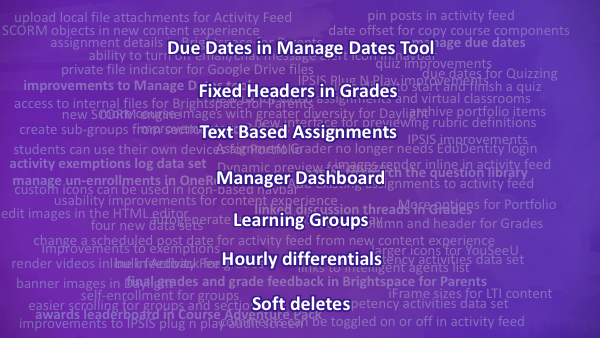
    The product showcase slide that arguably got the most enthusiastic response from the crowd was the one that focused on the small changes that users had been clamoring after for years – things like “Due Dates in Manage Dates Tool”, “Fixed Headers in Grades”, “Learning Groups”.

    New features from D2L Fusion conference

    These are not sexy, headline-making announcements, but they matter to users. D2L has long been viewed as a platform for people and institutions that like to have a lot of control over how to configure and run an LMS; however, the breadth and complexity of options often came at the expense of an intuitive user experience. While D2L has had a solid product for a sub-set of the market for years, they have had difficulty being viewed as ‘intuitive’ or ‘easy to use’, at least since the advent of Canvas and the resultant change in user expectations. The streamlined design afforded by the Daylight Experience, and the progressive disclosure of more advanced features, could change this situation if they’re able to get it in front of potential customers for a serious look.

    Customer Experience and Expectations

    On the second question regarding customer service and delivery on promises there are several reasons to be upbeat, but also reason for concern. Several new customers we spoke with, from Europe, Latin America and North America, all spoke about “partnership” as being a key reason for their choosing D2L over the competition. During lengthy procurement processes, these institutions got the sense that D2L was eager to engage and work with them to achieve their goals with broad service offerings as well as an eagerness to shape product development to suit these new clients.

    That said, D2L has a mixed record on follow through. A number of sources we have spoken with over the past 6-12 months have discussed a pattern of the company over-promising and under-delivering when it comes to implement promised changes. For example, these sources have told us they went into the relationship with this same expectation of a partnership, of having a voice in product direction, only to find out they are having trouble getting D2L staff to respond in a timely manner. It is not clear yet on how prevalent these concerns are, but we do believe they will need to be addressed in order for D2L to make material changes in overall market share.

    D2L has made two key hires in recent months, seemingly in recognition of potential market opportunities as well as persistent internal challenges. One targets growth, the other customer satisfaction. Puneet Arora, a former sales executive with several SaaS companies, has been brought in as chief revenue officer, and April Oman, a veteran customer success executive with a number of enterprise software companies, has been added as as Senior VP of Customer Experience. Arora is new to the education space but seems to be asking a lot of the right questions, and his task is to grow the user base in a meaningful way. Expect to see some changes in how D2L positions itself and who they try to sell to, shifting the balance away from administrators and towards faculty and student end users. Oman’s role is a new one and speaks to the need to develop a stronger relationships and partnerships with customers. This will be critical as D2L tries to establish themselves as much more than a software solution and as they attempt to improve customer experience.

    Better Position but Needing Results

    The center of gravity of D2L’s executive team is more diffuse than it used to be. Much of the longer-tenured leadership of D2L is based out of the Kitchener, Ontario home office: John Baker, CEO; Nick Oddson, CTO; Melissa Howatson, CFO; Jeremy Auger, SVP Strategy; and Ken Chapman, VP of Market Research. Ainoa, Koehn, Arora, and Oman (the new hires), however, are all in the Bay Area in California, and Tracy Strauss, SVP Marketing, is out of Los Angeles. There seems to be a deliberate approach to finding new ways of thinking from a broader field of expertise.

    D2L appears to have largely revamped its approach to product development that is more responsive to customer needs, and is putting resources into building partnerships. Yet they have not made the market gains envisioned after winning the Blackboard patent wars and then raising two large rounds of financing. We still see a two-horse race for new implementations (LMS product switches) in higher education, largely shared between Canvas and D2L, but the second horse that is looking better than it used to still needs to make further adjustments and run faster.

  • Terminology is Key to Understanding Blackboard Learn Prospects

    Terminology is Key to Understanding Blackboard Learn Prospects

    There are three observations from Blackboard’s users conference that we feel are important to share before we pull together our thoughts for more comprehensive posts, and all three issues build off of Blackboard’s strong focus at the conference on Learn Ultra as the future of their LMS product line.

    Learn Ultra “In Production” or “Using Ultra”

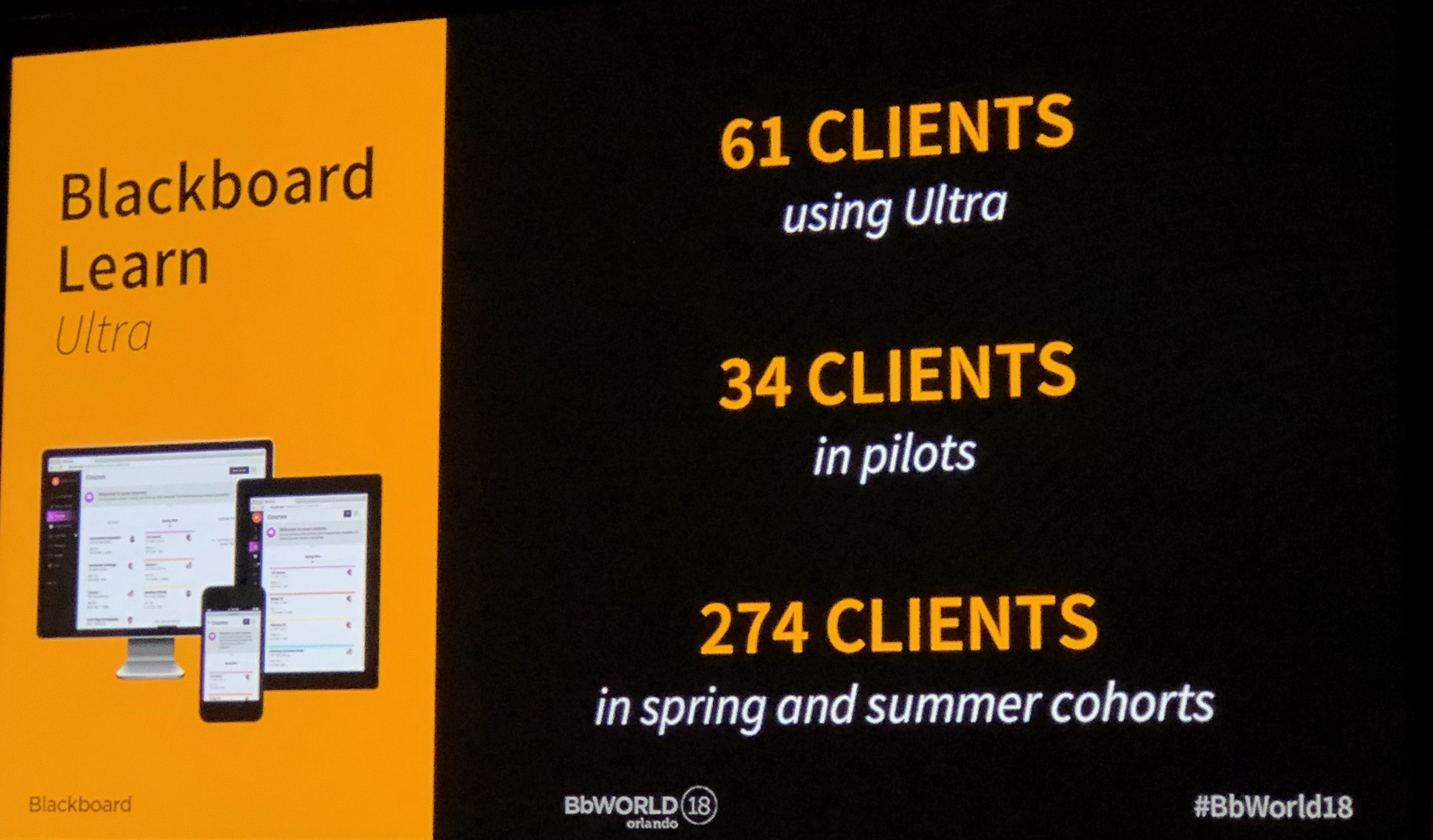
    The first issue is terminology around Learn Ultra. Blackboard ((Disclosure: Blackboard is a client of the e-Literate LMS Market Analysis service and a participating sponsor in our Empirical Educator Project.)) is pushing the metric that there are 61 or 62 Learn Ultra customers “in production” or “using Ultra”, yet we have found very few that use, or even plan to use, Learn Ultra as their primary, institution-wide LMS. What gives? What became quite clear at the conference is that when Blackboard says in production, what they mean is that the LMS administrator has enabled the Ultra global navigation, which uses the new Ultra user experience framework as the landing page / dashboard with activity feed that users see before entering a specific course. The company calls this Base Navigation, but at this point every course can be configured to be in the Original Experience or the Ultra Experience. Thus, enabling the possibility of running a course in Ultra counts as in production.

    Slide from BbWorld18

    Once a school has enabled Learn Ultra Base Navigation, they could choose to move exclusively to Ultra (e.g. the University of Phoenix, Northwest Florida State College, and a few others), or they could choose to keep all courses in Original (e.g. Northeastern State University), or they could choose to have some courses in Ultra and some in Original (used by the majority of schools investigating Ultra). This last mode is known as Dual Course mode, and even Blackboard executives are surprised to find out that the vast majority of schools putting Ultra in production are in fact running in Dual Course. For many of these schools, there are no definitive plans to ever move exclusively to Ultra.

    This distinction is important, as the majority of functionality for an LMS occurs within a course, even if we did hear a few schools present that they saw some end-user benefits to having the landing page itself. We will add more commentary on this subject in future posts, but for now the takeaway is that Ultra in production numbers from Blackboard do not necessarily mean that any or most courses are in the Ultra Experience.

    Product Variations Resulting in Three Dates for New Features

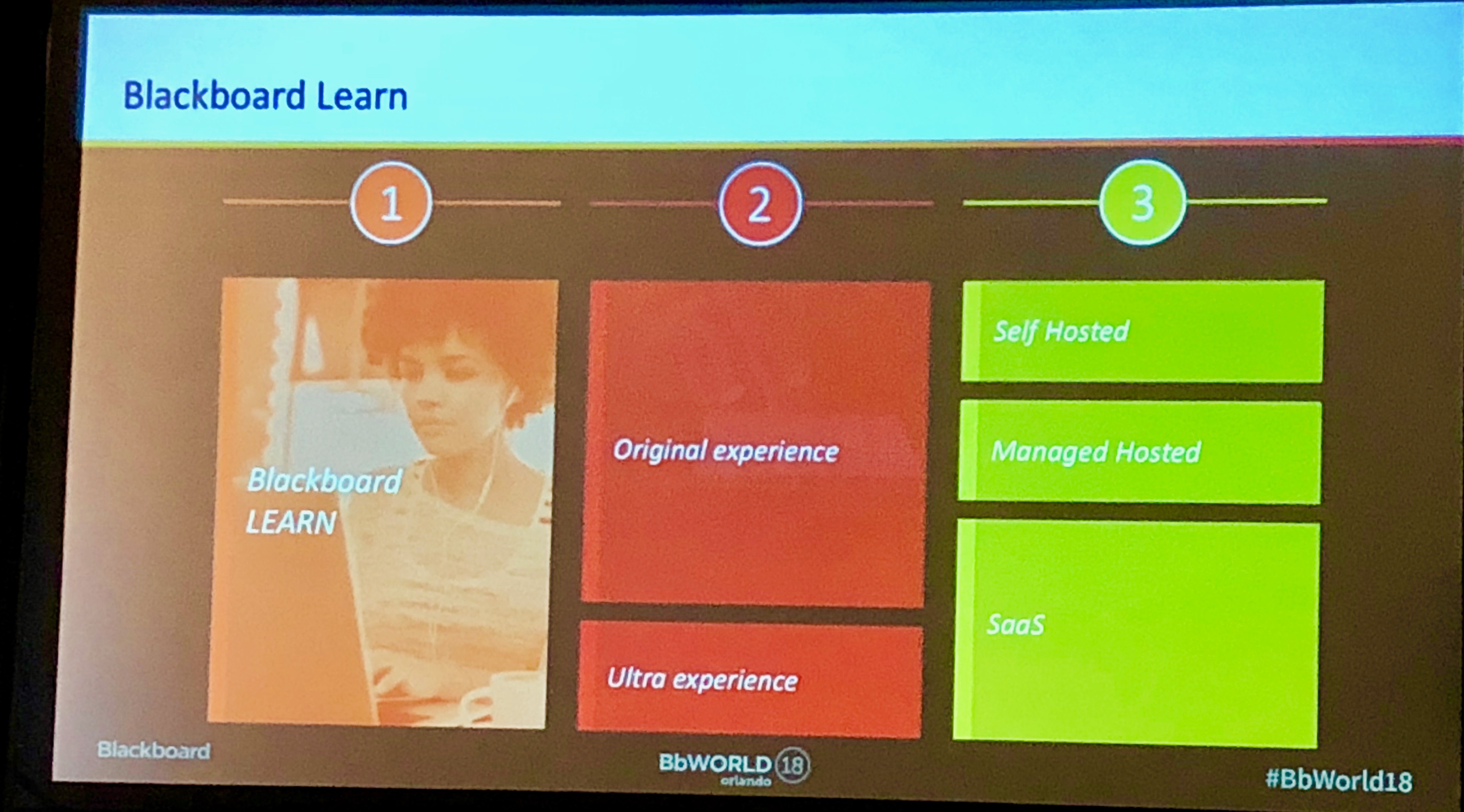
    The second issue is that Blackboard Learn has two experiences (Ultra and Original), three deployments (self-hosting, managed-hosting by Blackboard, and SaaS-hosting at using AWS), often resulting in three different dates for full delivery of new features.

    Slide from BbWorld18

    Keeping in mind that the Original Experience is available on all three deployment models but Ultra is available only in SaaS, here is the view of the final delivery groupings for the courses:

    • Learn Original on self-hosting and Learn Original on managed-hosting, which the bulk of their customers use, is the first case.
    • Learn Original on SaaS-hosting, which represents the bulk of their 383 customers on Learn SaaS announced at the conference, is the second case.
    • Learn Ultra, which represents some subset of the 62 customers announced as “Ultra in production”, is the third case.

    Of course there is significant overlap in terms of common code, such as the micro-services running in the SaaS environment for both experiences, or shared source code between deployment options. But from a feature delivery perspective, the full release often has three different delivery dates – Original SH & MH, Original SaaS, and Ultra.

    This is good news or bad news, depending on your perspective. For Blackboard’s customers, it means more options without forced migrations. Blackboard staff stated several times in presentations and in hallway conversations that none of the deployment options or experiences have any plans to go end-of-life or even into maintenance mode. But on the other hand, Blackboard will not achieve many of the benefits of becoming a cloud product company until they can move the majority of development purely onto SaaS.

    SaaS Better Indicator Than Ultra of Client Retention

    The third issue, which is related to the first two, is that we believe ((OK, OK. I admit that Michael should get credit for seeing this issue more clearly than I did. Not many people read footnotes, so I feel comfortable with this admission.)) that the migration to Learn SaaS might be a better indicator – at least in the short run – than Ultra adoption of whether a school plans to stick with Blackboard. Whether or not the school enables Ultra base navigation or any courses in the Ultra Experience.

    When a school moves to Learn SaaS, they tend to sign contract extensions for 1 – 3 years to cover the new services. And the migration to Learn SaaS does not suffer from the vague terminology issues – a school either uses Learn deployed on SaaS (through AWS) or they don’t.

    For now, just treat this as clarification on the complexities of Blackboard Learn LMS options that became more apparent at the conference.

    Update 7/23: Changed header and some text in second section to focus on dates of feature delivery.

  • Revisiting 2012 Post on Barriers That MOOCs Would Face

    Revisiting 2012 Post on Barriers That MOOCs Would Face

    Inside Higher Ed published an article today, titled “Free MOOCs Face The Music”, about edX quietly adding support fees for many of their courses. Dhawal Shah and I both commented that we were not surprised by the move.

    Writing about the introduction of the fee, Dhawal Shah, founder and CEO of Class Central, a review site for online courses, said the announcement was the latest in a phenomenon he termed “the shrinking of free.” Regardless of MOOC provider — be it edX, Coursera, Udacity or FutureLearn — “all have cut back on what was originally free in MOOCs.”

    Phil Hill, co-founder of Mindwires Consulting and an author of the e-Literate blog, agreed that the edX announcement was not surprising. Early MOOC providers like edX thought they would be able to “get really big for free,” said Hill. “Magic didn’t happen, and now they’re facing reality.”

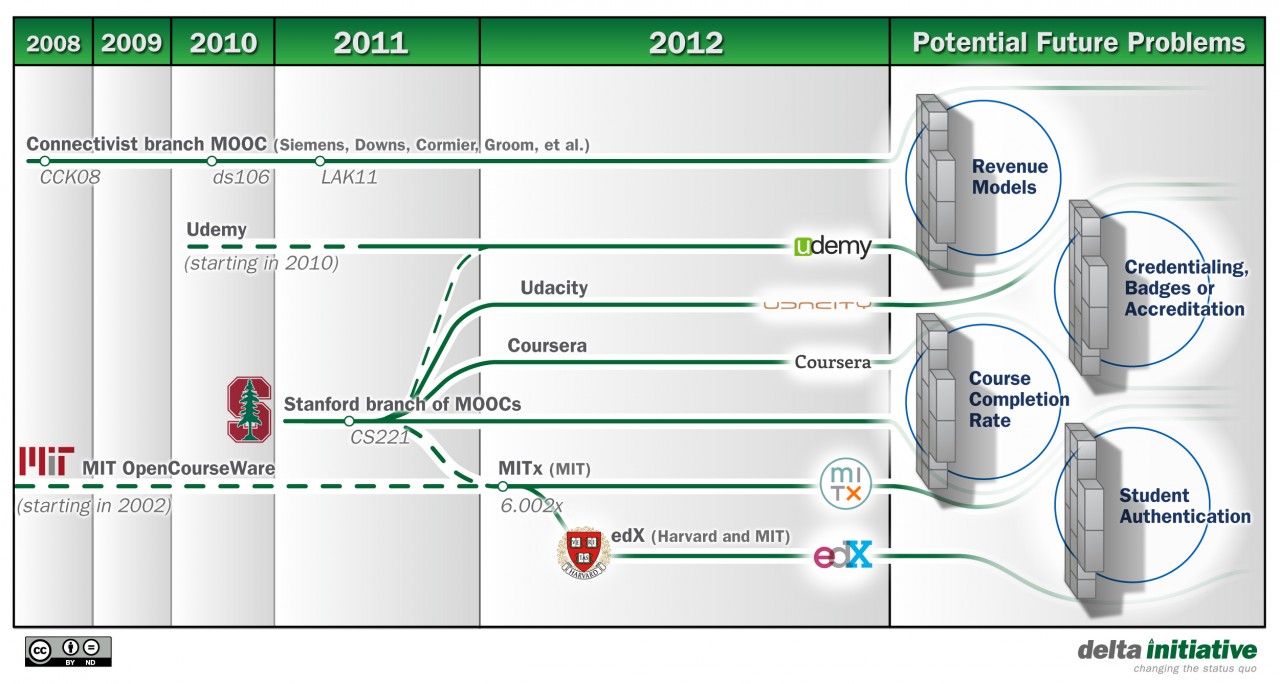
    There’s more information in the article worth reading, but I would like to revisit a post here at e-Literate from 2012 to help explain the point I made. In “Four Barriers That MOOCs Must Overcome To Build a Sustainable Model”, I noted:

    The current generation of courses has proven the feasibility of massive online enrollments, but the Kolowich article reveals that the result is based on a form of adult continuing education. The majority of students in the Udacity and Coursera courses analyzed were professionals in the software industry – hardly the target audience for those seeking a change in how we educate postsecondary students. The current MOOCs provide a nice proof-of-concept, but hardly solve significant educational problems.

    So what are the barriers that must be overcome for the MOOC concept (in future generations) to become self-sustaining? To me the most obvious barriers are:

    • Developing revenue models to make the concept self-sustaining;
    • Delivering valuable signifiers of completion such as credentials, badges or acceptance into accredited programs;
    • Providing an experience and perceived value that enables higher course completion rates (most today have less than 10% of registered students actually completing the course); and
    • Authenticating students in a manner to satisfy accrediting institutions or hiring companies that the student identify is actually known.

    Given this short timeline and the nature of investment-backed educational experiments, I think the real focus should be on whether and how MOOCs or successor models build on current scalability and openness while overcoming these four barriers.

    What have we seen since 2012?

    • Revenue Models: Coursera, FutureLearn, and edX moving towards an OPM business model, and Udacity focusing on corporate education;
    • Credentialing: All MOOCs offering some sort of verified certificates, and in the OPM cases offering actual degrees through their partner institutions;
    • Course Completion: MOOCs realizing that the two issues above lead to higher completion rates; and
    • Authentication: Verified certificates and OPM models requiring student authentication through webcams and approaches similar to online proctoring companies, and even partnering with proctoring companies.

    At this stage  pretty much everyone recognizes a blatant ‘I told you so’ post written while Michael is on vacation and unable to talk me out of it, so I’ll move along and cut off further commentary.

  • UF Online’s New Corporate Partner: Discover Financial joins Walmart with Online Education benefit

    UF Online’s New Corporate Partner: Discover Financial joins Walmart with Online Education benefit

    Last week Walmart announced a new education benefit for its employers, subsidizing undergraduate college degrees at select online programs at the University of Florida (through UF Online), Brandman University, or Bellevue University.

    The company said it estimates as many as 68,000 of its employees initially could sign up for the new college program. Walmart employs 1.5 million in the U.S. The company declined to comment on how much this initiative will cost it.

    Employees will contribute $1 per day, for 365 days every year, toward their education, so long as they’re enrolled. Walmart will cover the rest of the tab. Workers will be able to choose from the three nonprofit schools and have the option of taking classes online with the flexibility to study during the evenings or on weekends.

    Today UF Online announced another partner: Discover Financial Services, issuers of the Discover Card and Diners Club International, with its 14,000 employees.

    Discover announced a significant new education assistance benefit that provides all eligible U.S.-based employees the opportunity to earn a bachelor’s degree online from an accredited public or non-profit private university at no cost.

    Known as The Discover College Commitment, the benefit covers tuition and required fees, books and supplies needed to complete select online degrees at one of three schools – the University of Florida (via UF Online), Wilmington University and Brandman University. The benefit has no tenure requirement so employees can start participating as soon as they want regardless of how long they have been with the company, including new employees on their first day.

    The two partnerships are part of what UF Online calls their Employer Pathways, and in the process seem to be defining an alternate method of marketing and enrollment management, in contrast with most Online Program Management (OPM) assumptions.

    Employees from Walmart and Discover Financial Services have expanded opportunities to earn a bachelor’s degree from the University of Florida (UF) thanks to a new and significant investment in their education from their employers. This remarkable step by these and other large employers demonstrates the value of a UF degree and the accessibility of UF Online, UF’s online undergraduate experience. Employers will provide a robust support package covering tuition, fees, plus access to life coaching and college readiness programs.

    Discover is offering this new benefit to select programs at UF Online, Wilmington University, and Brandman University.

    Discover is covering 100% of cost for select bachelor’s degrees. Discover is proud to offer “The Discover College Commitment” program – an innovative full-ride college education benefit, providing US-based employees the opportunity to participate in one of several select high-quality, fully paid, online bachelor’s degrees.

    Both packages of education benefits is managed by Guild Education, “a tuition reimbursement and education platform that helps large employers extend education benefits, including tuition reimbursement, to workers”.

    I think these moves are more significant than just individual benefits. What we are seeing is UF Online, along with a handful of others, defining a different approach to marketing and finding potential online students, at least for undergraduate degrees. Historically, there is a common assumption that to enable a scalable online program there is a need for traditional digital marketing as the primary approach – Google AdWords, call centers, social media campaigns – with a partnership or two thrown in on the side. The origin of the OPM market is centered on providing these services in exchange for a percentage of tuition revenue, and for the majority of cases, the OPM’s spending on this marketing and enrollment management category is the most expensive service in the package. The Employer Pathways approach by UF Online has the potential to flip the student acquisition assumptions – primarily driven by employer partnerships with traditional digital marketing channels as a secondary approach.

    Walmart and Discover already have potential students identified, and the companies have the incentive to internally market these education benefits to employees. UF Online needs to support that internal marketing and feed applicants into the same application process, but they have a reduced need for general-purpose marketing. UF Online started out with Pearson Online Learning Services (formerly known as Embanet) to be their OPM partner, but in late 2015 they pushed Pearson out and decided to take over this management internally.

    I talked to Evangeline (Evie) Cummings, Associate Provost and Director of UF Online, at WCET’s Leadership Summit last week, and she described how UF Online is trying to reduce their marketing spend and instead invest more in faculty and course development. Part of that move is to spend less trying to get out-of-state students, which may pay higher tuition but still cost much more per student in acquisition costs. But the other move is to decrease the need to spend on traditional marketing channels.

    We can think of Guild Education in this case as a derivative of the unbundling version of OPM, enabling the front-end services with an alternative approach and what appears to be a lower revenue share.

    Rather than charge a transaction fee per student to the employer, Guild takes a cut of the tuition revenue from the universities it works with. This revenue-share model is an “elegant” solution for institutions that want to grow their enrollment online but don’t want to spend more on marketing, said Carlson. It’s also an attractive proposition for employers, who don’t have to pay any additional charges on top of the contribution they make to their employees’ tuition. The tuition fees are not discounted for the employers and will be charged at in-state or out-of-state rates depending on the location of the student. Neither Guild nor the three universities involved in the Walmart offer would disclose what percentage of tuition revenue Guild will take.

    The bulk of the OPM market serves master’s programs, and UF Online is centered on bachelor’s degrees with a handful of master’s, so this approach might not work across the board. But I’ll bet that there will be plenty of undergraduate online initiatives that will be looking to UF Online and wondering if they should develop similar degree pathway partnerships as the centerpiece of their student acquisition plans. The online education space is maturing and becoming a lot more interesting.

  • Some Thoughts on OER

    Last week I had the good fortune to co-keynote the Northeast Regional OER Summit at UMass Amherst. My counterpart keynoter was Don Kilburn, the current CEO of UMassOnline and former CEO of Pearson North America. We each gave brief talks, followed by a conversation facilitated by UMass Amherst’s Marilyn Billings. It was a lively discussion that inspired a lot of passionate debate on Twitter. That, in turn, inspired requests for more information about the conversation from people who weren’t able to come. So this is my recap.

    Don’s talk

    Don was there in his UMassOnline capacity but he spoke from his perspective as a long-time senior executive at a major textbook publisher. From the beginning, it was clear that having Don on stage would be both potentially interesting and inevitably fraught. Many folks in the OER community have a visceral negative reaction to the way of thinking and the kind of language that Don employs instinctively due to his particular professional history. And Don, for his part, didn’t seem to have had a whole lot of exposure to or understanding of the audience he would be addressing. The most cringe-worthy moment was when he trotted out the old “free as in puppy” chestnut as if it were a novel statement and not something that the OER community, and the open source community before it, had heard ad nauseam for at least a decade. That cultural clash between the audience and the opening speaker…resulted in the kinds of tweets that you would expect, and appeared to have an outsized influence on the way a vocal segment of the audience reacted to the whole conversation.

    That’s unfortunate, in part because Don knows a lot that could be useful to people who want to learn how to be more effective at driving OER adoption and understanding how a broad cross-section of faculty approach curricular materials adoption in general. He knows about the many experiments, both successful and unsuccessful, that the textbook industry has tried in order to figure out which value propositions persuade faculty to adopt curricular materials. He knows what’s happening in the market right now, how the publishers think, where they are gaining traction, and where they are struggling. Whether or not you agree with him, he can provide useful intel that is normally inaccessible to academics.

    I won’t summarize his talk here, but since the first part of my talk built off of Don’s, you’ll hopefully get a rough sense of the ground he covered through my summary of my own talk.

    My talk, part one

    I’m not going to recap the discussion in strict chronological order. Instead, I’ll address the piece of my talk that built off of Don’s now and circle back to the other part—which was really the main part of my talk—later. In retrospect, the conversation after the talk provides some good context for understanding the main point I was trying to make.

    A lot of Don’s talk was about how curricular materials prices are coming down and how the industry is trying to establish the value of its product in the face of this change. This seemed like a good place for me to pick up, since the most common argument for OER is about affordability There is absolutely no question that the value of base informational content—the part of a textbook that could easily be replaced by a Wikipedia article, for example—has commoditized. This is one reason why textbook prices are coming down. (I could tell another story about used books and rentals and Amazon and Chegg, but the two narratives are really just two sides of the same coin.)

    In the curricular materials markets, there are two pricing bands that are beginning to emerge. The first one is in the $10 to $40 range, and it is often presented as either a cheap version of the print textbook—a black and white softcover, for example—or something close to a direct digital replacement of the book. The other band, in the $60 to $100 range, tends to have products with lots of formative assessments, student and instructor dashboards, nudges and reminders, and maybe adaptive capabilities. Here, publishers are trying to establish a different value proposition from the print textbook. The “courseware” products that typically inhabit this price band can provide both students and instructors with a lot more information about how the students are doing, whether they are coming prepared to class, and where they need help. I have written several posts about these two competing value propositions, labeling them as “good enough” versus “better enough”.

    As long as those two value propositions dominate the way in which curricular material choices are framed for (and by) the faculty, they will also frame the way that OER are valued. And I mean that partly in economic terms, since not all OER are cost-free to the students and none are cost-free to the creators and maintainers. If the Wikipedia-like portions of the textbook have little to no economic value, then what else are students paying for and how much should they have to pay for it? How much is professional curation—in the form of scope and sequence—worth? How much is it worth to have somebody align learning objectives, assessment questions, and the informational content? To keep the content up-to-date? To provide frequent, auto-graded or easy-to-grade formative assessments? To provide dashboards that show progress on those assessments? To provide adaptive learning tools as differentiated instruction aids? There is no one correct answer for each of these questions, but now at least the pricing is starting to become transparent enough and product options unbundled enough that it is possible to answer them. The affordability problem, while not yet solved, is moving in the right direction. Because unbundling is part of this movement, educators can start making more fine-grained, student-centered choices about any potential trade-offs between accessibility and effectiveness.

    In my view, the OER community needs to become more sophisticated in its discussions of these trade-offs and more respectful of the individual decisions faculty make as they try to find the right trade-offs for their particular contexts. “Free as in puppy” may be glib, but that doesn’t mean it’s completely false. On the one hand, I don’t know anybody who got a free puppy that didn’t…you know…already want a puppy and know that puppies require care and feeding. On the other hand, some people do underestimate the amount of care and feeding a puppy requires. If you want to make sure that those puppies don’t get given to a shelter or abandoned at the side of some road, you need to make sure that somebody is prepared to be responsible for them. You need a puppy sustainability strategy. Some puppies are more work than others, and some families are more prepared to care for puppies than others. Sometimes you’d be better off adopting a dog that’s already been house trained. Or to pay for a trainer. Or to get a cat instead. Or a goldfish. Any resource that has a cost of upkeep needs a sustainability plan. Resources that do more will often—though certainly not always—require more initial investment and more upkeep. A puppy that is going to be a family pet requires a different level of investment—both up front and ongoing—than a rescue dog or an agility dog.

    The utility of an open license, part 1

    Of course, “good enough” and “better enough” is not the only way to frame the value of either affordability or OER. This is where the conversation among OER advocates can (and did) get chaotic quickly. For example, one topic that came up during Q&A was the utility of an open license to enable faculty to customize the content to their students’ needs. I said that faculty can and do customize with proprietary content all the time, and that anyone who believes the only way to do this is with OER is fooling themselves.

    This comment caused some consternation. I stand by it.

    When faculty want to adjust proprietary content, they skip chapters, supplement with other content (including some they may have made themselves), reorder the content, combine different texts, and so on. Instructors are endlessly creative in the ways that they slice and dice proprietary content. In fact, this exact tendency is one reason why textbook publishers got into pricing trouble in the first place. They have known forever that English comp professors are likely to use maybe one out of every three readings in an anthology, and that the particular readings which get used will vary from professor to professor. So they produce anthologies with three or four times as many readings as any class could use in a term. They do the same thing with problem sets. Or textbook chapters. Maybe one Biology 101 professor likes to spend more time on cellular biology while another is into ecology. No problem; the publishers just put in lots of chapters on both. Faculty will use what they want.

    What you end up with by employing this publishing strategy is a puppy that has been house trained, agility trained, and rescue trained. That is one very expensive puppy. And the students—who, after all have to buy that puppy—get irritated because it is obvious to them that they will never have to use their dog for an avalanche rescue.

    Customization happens regardless of license. Yes, a license makes certain kinds of customization easier. It’s an affordance. If you train your puppy yourself, you can decide what you want to teach it to do. Our dog, who we adopted as an adult, was trained by her prior family to ring a bell with her nose when she wants to go out. That was apparently useful to them. But I’ve had lots of dogs during the course of my life, and we never had to train them to do something specific when they wanted to let us know that they had to go out. Each had his or her own way of accomplishing this function. We didn’t suffer from that particular loss of control.

    The definition of open education is an open question

    One weird aspect of the “free as in puppy” analogy is that it treats the dog like a possession whose primary salient characteristics are cost of purchase and cost of ownership. That’s certainly one valid way to think about curricular materials (though not about puppies). But if what you’re really interested in is a pedagogical approach—let’s call it “open education”—then this is not the only way, or even the best way, to think about OER. Some OER advocates are interested in open education as a way of teaching, with OER being a set of raw materials designed to support that way of teaching. The problem is that we don’t have anything close to a consensus on what “open education” actually is.

    Some of the summit attendees talked about the value of having students create and edit the content. Say you want your kid to learn some responsibility and empathy, as well as something about animal behavior and psychology. Having a dog will give them some of that. Having your kid train the dog will give them a lot more of it. Having two of your kids train the dog together will also teach them something about cooperation. In this case, the “cost” of training and caring for the dog is actually a benefit.

    There is overwhelming evidence that having students learn by doing (including by researching and authoring) can be very effective. But there are two caveats regarding how this general principle of learning translates into the specific activity of student co-creation of curricular materials. First, having students write and edit their own curricular content is not inevitably effective as an active learning strategy. Sometimes, sure. But like everything else in education, it’s highly context-dependent. Second, depending on how broadly the students are sharing this work, it’s not clear that you need an open license on it, or that you need all content and source materials to be openly licensed. If the instructor doesn’t put any license at all on the student-created content but makes it freely available on the web, is it OER? In spirit, probably, but that would not be consistent with common usage of the term.

    As a teaching strategy, I’m enthusiastic about having students co-create curricular materials. As a teaching philosophy, I’m agnostic and utilitarian about it. As teaching dogma—no pun intended—I’m deeply skeptical, as I am about all blanket generalizations about the “best” way to teach regardless of context.

    My favorite variation on student production of curricular materials as a teaching strategy is Mike Caulfield’s notion of choral explanations. It adds the dimension that having a handful of different explanations can be more helpful than having just one. Think about your own behavior when you’re looking up a health condition on Google or a how-to demonstration on YouTube. Do you tend to look at just one search result? Or do you look at a few different ones? I often look at a few, and sometimes more than a few. The reason we can have the benefit of that diversity is because, on the web, there are many different people producing content resources and sharing them for free. They may not have Creative Commons licenses, but they are OER in a real sense.

    Again, I’m enthusiastic about this approach as a teaching strategy and utilitarian about it as a teaching philosophy. If it works for your students, in your subject, with your pedagogical activities, that’s great.

    Not all open education advocates define it this way. And to be clear, I’m not trying to provide a comprehensive list of useful definitions for open education here. I’m summarizing and reflecting on last week’s conversation. But I do want to touch on a subset of those other definitions that are often less well defined, more essentialist, or both. Because they did come up in that conversation, and because that’s where there are real problems.

    Real problems

    One question I got in the Q&A was what advice I had about things that the open education community isn’t doing as well as it could. That’s easy: Stop bickering so much.

    Teaching, when done right, is deeply personal. That’s both good and bad. On the good side, first, many educators are motivated to be good teachers even when their environment actively disincentivizes them, because they care about their students. It’s one reason why educational systems produce so many success stories in spite of the fact that the systems themselves are deeply, disturbingly messed up. Also, there is evidence that the very fact that a teacher cares about a student has a strong chance of positively impacting that student’s physical, emotional, and financial wellbeing for the rest of their lives. (Many of us have our own personal stories about this, but there is also hard, longitudinal evidence.)

    The bad side of teaching being so personal is that it can be very hard to maintain ego boundaries when you care so deeply about so many students in a messed up environment like the modern classroom (or, really, like human existence in general). I speak from personal experience as well as from knowing, working with, and living with many educators over the course of my life. It’s hard to separate the job from your personal identity. For some people, “open education” is an affinity group of sorts.

    In and of itself, that’s fine. Teaching is hard, teachers deserve and need emotional support, and one way to get that support is to find your “tribe.” But I have observed a lot of infighting about shibboleths that mark membership in the open education tribe. Too often, it gets unreasonably heated and personal. At its worst, this behavior metastasizes into a particularly noxious form of identity politics. At that point, it is no longer about helping students.

    As I said in answer to the question at the summit, there are only two essential goals that I care about in education: (1) increasing access and (2) increasing the value that students get from the education that they can access. I am agnostic and utilitarian about everything else. To the degree that discussion, debate, or usage of open education teaching strategies or open educational resources furthers one or both of those goals, then I’m for it. To the degree that it distracts from activities that could further those goals, then I’m against it. In recent years when I have attended conferences that are billed as “OER” or “open education” events, I have not been impressed with the ratio of constructive conversations to painful distractions.

    This is absolutely fixable—if the participants decide that it is something they want to fix. I hope they do. Some of the brightest, most talented and dedicated educators I know are among these people. I would like to see them accomplish all the good in the world that they can.

    My talk, and the utility of an open license, part 2

    All of the conversation I described above is important. I’m glad we had it. But it wasn’t the conversation I had hoped to provoke. In the main part of my talk, I recapped the four levels of empirical education:

    1. Intuitively empirical: This comes down to whether you pay attention to your students and do something differently with them based on what you observe. Do you always do the same thing, or do you have a bag of tricks that you can draw from when you see students struggle? I believe that the substantial majority of educators are empirical in this sense. They may not think of it as empiricism, but they are observing student behaviors and are adjusting their strategies based on what they see, guided by some sort of rationale for choosing which strategy to employ in different circumstances.
    2. Mindfully empirical: Mindfully empirical educators think about how they can get the maximum amount of useful diagnostic information from day-to-day course work. They design their courses with a goal of creating many feedback loops that enable them to be adjust their teaching to the needs of the students.
    3. Meta-cognitively empirical: Meta-cognitively empirical educators are empirical not only about how they use their existing bag of tricks but also about which tricks they should have and how effective those tricks really are. They consciously and regularly test their own assumptions about effective teaching, and they are open to trying new appropaches. My read of Lauren Herckis’ research is that the barrier of moving from mindfully empirical to meta-cognitively empirical (and to the next level, socially empirical) is where a lot of the difficult work needs to be done. Lots of educators are intuitively empirical, and the transition from there to mindfully empirical is not a huge leap. Getting them to test and challenge their deeply held beliefs about what constitutes effective teaching is a lot harder.
    4. Socially empirical: Socially empirical educators view effective teaching not as an individual art but as a shared pool of knowledge and experience that everyone can learn from and contribute to. They seek out common vocabulary, methods, and standards of proof so that they can learn with their colleagues and raise the collective bar. This is the beginning of disciplinarity.

    One possible defining purpose of “open education” is fostering socially empirical education. We can learn together and teach each other, teacher to teacher, teacher to student, student to student, and student to teacher. We can collectively learn how to teach and learn more effectively. We can conduct experiments, check each other’s work, and develop shared notions of what constitutes “evidence” of effective education. With this formulation of open education, as with the others, an open license is not a necessity; it’s an affordance. But substantial kinds of openness are essential to socially empirical education. You can’t build a shared body of knowledge without sharing.

    The strategy of having students collaboratively construct knowledge artifacts fits in with this ethos nicely. Students learn how to negotiate the development of shared understanding. Here again, I am endorsing a strategy, not a dogma. But by framing student creation of curricular content as “learning how to negotiate the development of shared understanding,” we take the motivation for the educational activity out of the realm of say, social constructivism, which individual instructors may or may not buy into, and reframe it as a life skill that all humans should have. Doing this will help more instructors better understand why, when, and possibly even how they might want to utilize the strategy of having students co-create curricular materials.

    Framing open education in terms of socially empirical education is intended to be a provocation rather than an argument. Since I am a critical friend of the open education community rather than a member of it, I don’t really get a vote. But I hope that the notion of socially empirical education can enrich the conversation among proponents of open education.

  • Top Hat’s OER Announcement: Doubling down on faculty engagement

    Top Hat’s OER Announcement: Doubling down on faculty engagement

    Several months ago I wrote a post looking at the Top Hat’s push into digital curricular materials through their Textbook product and Marketplace for digital course content. Leading up to that post, I had been planning to cover the Open Educational Resources (OER) angle, as the Marketplace included a number of openly-licensed material, much of it from OpenStax, and Top Hat had already begun marketing itself as an OER provider. At the time, the OER strategy seemed a work in progress. In fact, I found that some of my questions for company staff about OER basics – the role of Creative Commons licenses, community dynamics exhibited at the OpenEd conference, etc – led to a lack of answers, and at the time there was no export capability to get OER out of the platform.

    To Fee or Not to Fee

    The situation has changed since January, and with last month’s announcement of Top Hat’s Open Content Initiative the company is taking a stand on whether it is appropriate to charge for platform access. The idea of hosting and modifying OER on a fee-based platform became a big topic last year. Lumen Learning pioneered the Red Hat type model in 2014, and last year there was a big movement with Cengage, Knewton, OpenStax, Macmillan, and Top Hat all offering OER within their platforms. In many cases, the OER content itself has been redesigned from traditional textbook-in-PDF format to learning objective-driven content with aligned assessments. ((Disclosure: Lumen is a client of MindWires, and I recently gave a paid keynote at a Top Hat user’s conference.))

    Top Hat has now removed the student platform fees and added an export-to-epub feature. As evidenced in a company blog post by CEO Mike Silagadze, they are not shy about it either.

    At Top Hat, we’ve been working on making education more effective and affordable since 2009. Now, we’re happy to make a move that delivers on both fronts. Beginning April 12, with the launch of our Open Content Initiative, we’re offering completely free access to thousands of textbooks and other Open Educational Resources (OER)—freely accessible and openly licensed learning materials—on the Top Hat Marketplace.

    It’s about time. Students have been forced to weigh the pros and cons of emptying their wallets and draining their financial aid to buy textbooks for far too long. [snip] Just as bad, digital publishing platforms and e-readers have been charging a toll to students—disguised as a platform fee—to access free, openly licensed OER.

    Enough is enough.

    I asked Silagadze about a point I noted when describing Cengage’s OpenNow product:

    For each course [VP of Content Strategy] Constantini estimates that the modifications take $50k – $100k of internal work, including verifying of licenses for embedded elements. I would note a certain irony here in that OpenStax produces more-or-less traditional digital textbooks requiring publishers or OER services companies like Lumen to break apart and realign to competencies or outcomes.

    Silagadze brushed off this description and stated that the modifications made by other providers were far smaller and easier to make than is being claimed. We now have a third variation in the OER market, with the provision of wrap-around platform and a clear argument that these platforms not only will be free on Top Hat, but that they should be free as a matter of principle.

    • Free content, not dependent on specific platform
    • Free and modified content, available on a paid platform, content available for export
    • Free and lightly modified content, available on a free platform, content available for export

    While this is a marketing position by one of the competitors in a new field, this move by Top Hat is a further sign of the OER movement breaking into different branches. From our perspective, the fractures in the OER community have been widening for the past several years, but to a degree this is a sign of success. Openly-licensed content usage is becoming more and more common in education, and even traditional publishers mostly accept the value of OER.

    Faculty Engagement

    Perhaps more significantly, at least in terms of understanding Top Hat as a company, is that the OER initiative doubles down on their bet on faculty engagement. A well-known issue with OER (and even with non-open content) is that few faculty end up taking advantage when given the ability to modify the course materials in any significant manner. In theory many people talk about open pedagogy in terms of faculty modification and collaboration on content, but in practice this rarely happens. Top Hat’s view is that the barrier has been flat content and cumbersome platforms, as best described in an eLearning Inside interview.

    “We think the promise of OER has fallen down,” said Nina Bilimoria Angelo, VP of product and customer marketing at Top Hat. The Toronto-based company has created a platform to house, customize, and share OER and other educational resources. It has been used by over 2.8 million students to date.

    “The promise was there’s a community that continues to build on open materials,” Angelo said. “But when those materials are trapped behind static PDFs, and then people are making changes to it on their own without a mechanism to share it back, that’s where things fall flat. We really wanted to create a system where things can be improved in real time, not over a 3 or 4 year cycle like with traditional publishers.”

    “Discoverability is a challenge with OER,” Angelo said. “Quality can be perceived as uneven which is probably why OER adoption has stalled at the 5-10% level for instructors. There’s a lot of skepticism amongst higher educators. We’re trying to make sure all the high quality material is available in the Marketplace. Once it’s adopted, it’s really customizable. But then those customizations – this is the magic – those customizations can be shared back with the author and the team so that they can improve upon what they’ve created.”

    This is the best way to interpret Top Hat’s OER move, in my opinion, and you can see more details in my January post about the Marketplace to better understand the customization and sharing capabilities of the platform.

    According to an internal Top Hat survey of users, 89% of adopters make changes to digital textbooks that they adopt, with 22% reporting “lots of customization”. If this internal data is representative, there may be some indicators that faculty can be more involved in modifying and sharing content. Top Hat is betting on faculty engaging with content, modifying it, sharing it, updating it. And they are betting that this model will drive faculty adoption decisions.

    There are a lot of unknowns about faculty adoption and modification of OER content through the Top Hat Open Content Initiative, but it is clear that the company is positioning itself differently than other providers. The transformation of digital curricular materials continues.

  • Postscript on Rio Salado Coverage: Clarity about different outcome types

    Postscript on Rio Salado Coverage: Clarity about different outcome types

    After my two posts two weeks ago calling into question whether Rio Salado College has demonstrated clear student outcomes that justify its usage as an exemplar institution, college officials have responded through the WCET blog and in an article from Paul Fain at Inside Higher Ed. I recommend reading the IHE article in particular to get an understanding of the challenging an nuanced question of what is “good enough” in terms of college completion, and for even more detail read Rio’s written response. Unfortunately, the lengthy explanations on graduation rates from Rio end up obscuring a critical distinction between awarding degrees versus certificates of completion. The reason this matters is that Rio appears to be doing a better than average job supporting student transfers to four-year degree programs, a worse than average job of helping students complete two-year degrees, and an unknown job of providing students with non-degree stand-alone certificates.

    Before dealing with this issue, I’d like to point out how useful this dialog has been and how open Rio has been in sharing internal metrics. One example that I wish other institutions used, and that can help us clarify how to understand completion data, is based on student goals.

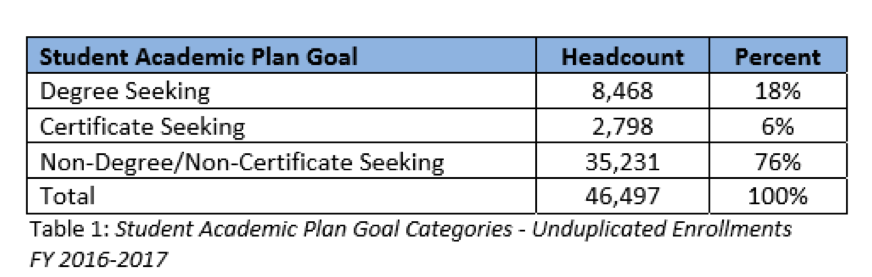
    Rio Student Intentions

    Fully 76% of Rio students have no intention to get a degree or certificate, and of this group 33% (11,628) indicated earning transferable credit as the key reason to enroll. As Sally Johnstone said in the IHE article, “It’s a feeder school for Arizona State University”. This transfer of credit mission can be good or bad – it depends on how well these students perform in getting an ASU degree. In the written response, but not in WCET or IHE articles, Rio shares an interesting but incomplete metric.

    Additionally, as part of the work RSC does related to accountability, we track the success of our transfer students to the three public universities in Arizona (The 2010/11 – 2015/16 5 year trend shows a 77.10% increase in bachelor degrees awarded to students that had completed a minimum of 12 credit hours (up to 60 or more hours) at Rio Salado College).

    Increase to what and over what? It is not clear if this is comparing to Arizona university students who do not transfer any credits from Rio, or those who transfer less than 12, or those who transfer from other colleges. Nevertheless, this is an indicator of the college helping students obtain four-year degrees through credit transfers.

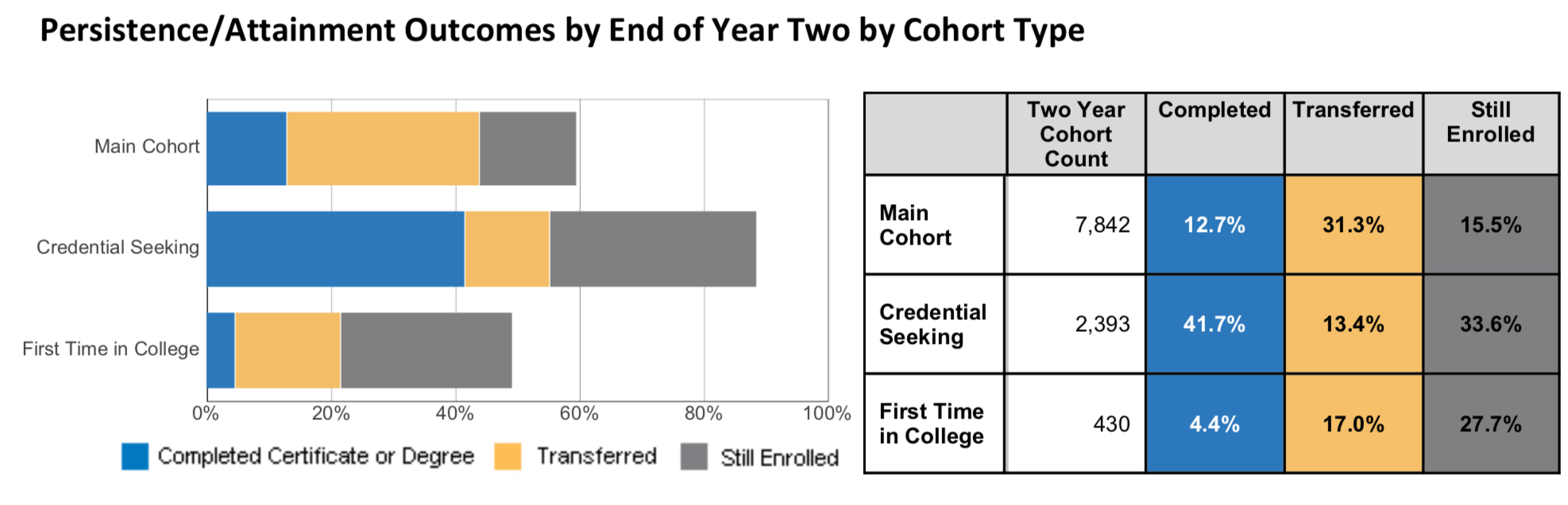
    Once you get beyond non-degree / non-certificate seeking students, the numbers are murkier, and this is the area that needs clarity. One out of four Rio students are there to get an award – how successful are they? Rio recommends we look at the Voluntary Framework for Accountability (VFA) measures, instead of IPEDS, with the following results.

    • 2-year graduation rate is higher than peer institutions: Rio 13%; Peer Institutions 10%
    • 6-year graduation rate for credential-seeking cohort is 36.2%
    • The credential seeking cohort far outperformed sister institutions in completion: Rio 42%; Peer Institutions 16%

    I do not know why Rio uses the term graduation rate, as VFA instead describes Percent Students Completed a Formal Award, but from the numbers used we can see where the data comes from. The first and third bullets come from the VFA Two-Year Progress measures (blue column under Completed). ((The VFA definition of the cohorts: Main Cohort = fall entering, first time at reporting college; “all students”; Credential Seeking = earned 12 credits by end of year two.))

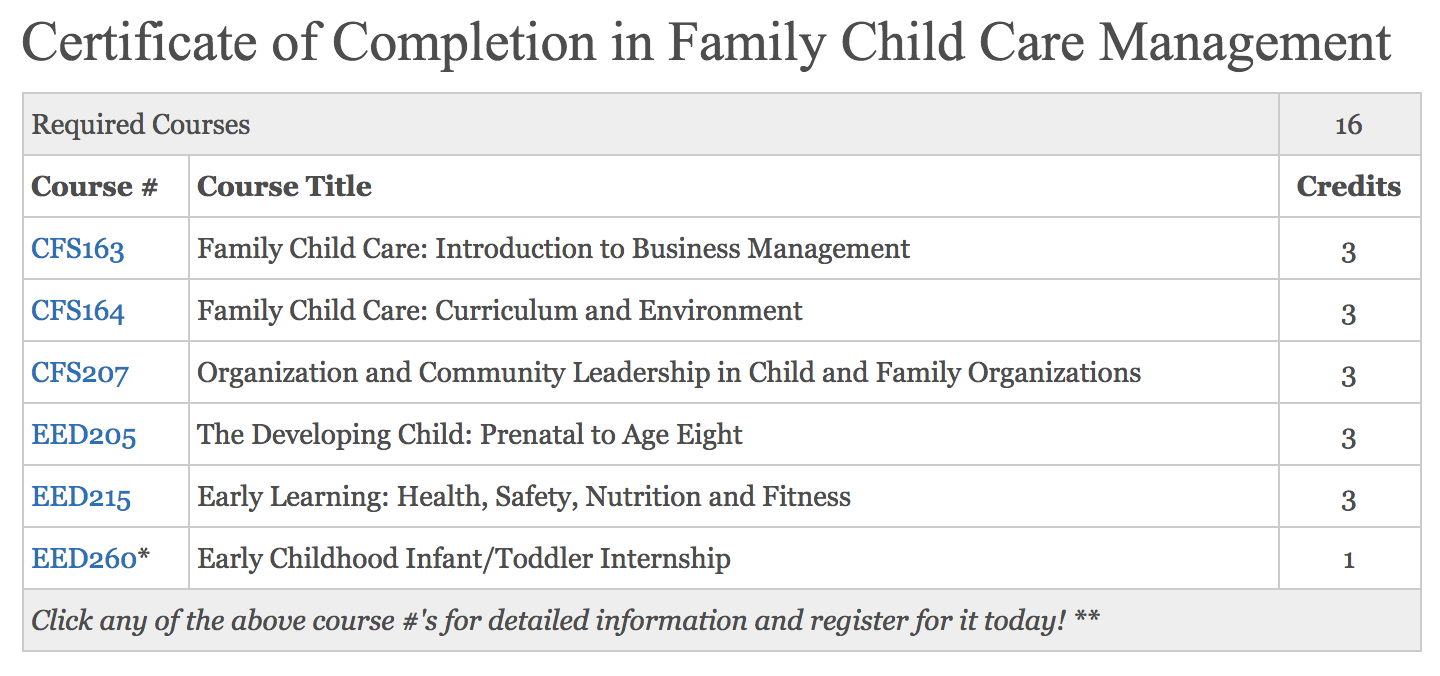
    What is key is that the Completed metric includes those who obtained an associate’s degree or official certificate. Unlike degrees, certificates of completion have no standards across schools, and their usage is very uneven. As an example of Rio’s usage:

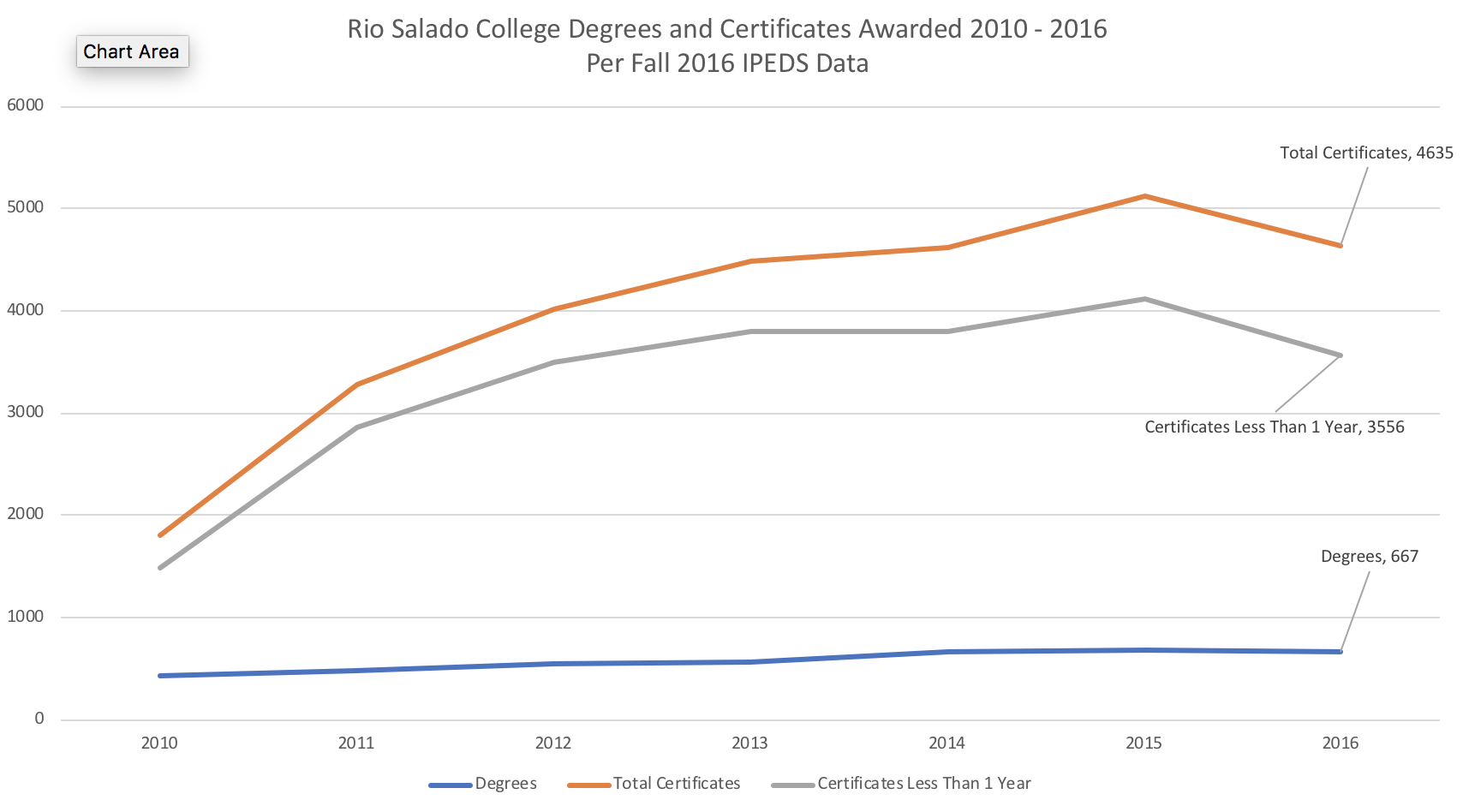
    Notably, since 2010 Rio has defined and awarded more and more of these <1 year certificates, based on IPEDS data.

    We can see is that the large majority of completions, which Rio labels under graduation rate, comes from the nonstandard certificates rather than degrees.

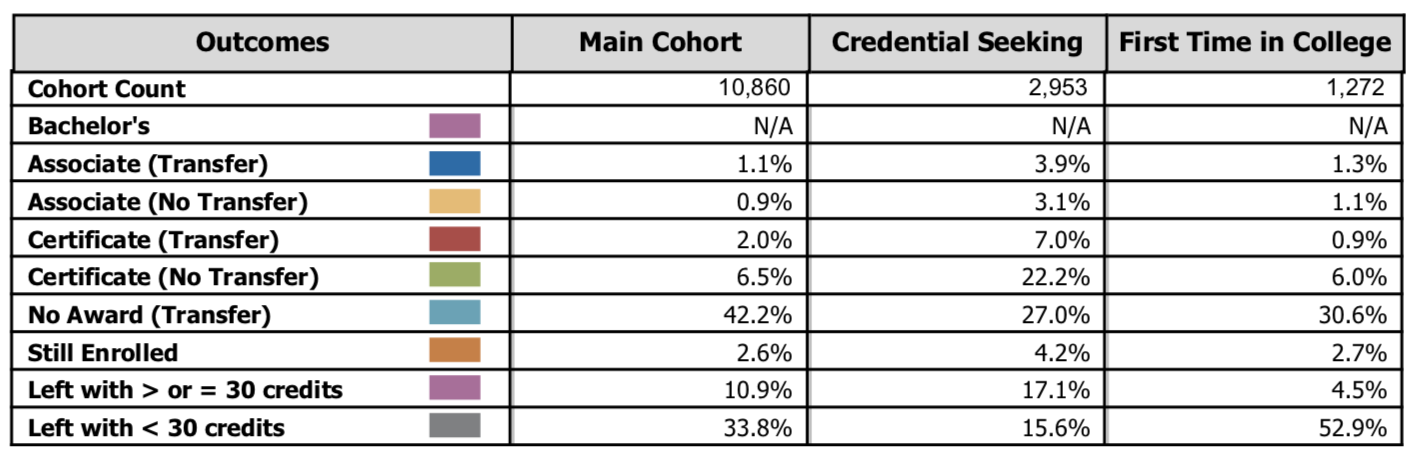
    One of the strengths of VFA is that under the Six-Year Outcomes measures, you can separate out the various types of award. Below is the data for Rio – pay attention to the Credential-Seeking Cohort, as it removes the majority of non-degree / non-certificate seeking students at Rio only looking to transfer a small number of credits. ((For degree or certificate-seeking cohorts, I prefer the Rio definition based on student self-reporting, but the VFA definitions get at the same idea.)) Also note that VFA outcomes are mutually-exclusive and hierarchical in the order shown. If a student gets a certificate and a degree, they are listed under the degree outcome.

    For the Credential-Seeking Cohort, 22% of Rio students get a certificate and do not transfer to a four-year school, 7% get a certificate and transfer, 3% get an associate’s degree and do not transfer, and 4% get an associate’s degree and transfer. A large majority of Rio Salado completions are for certificates, which is consistent with the IPEDS data.

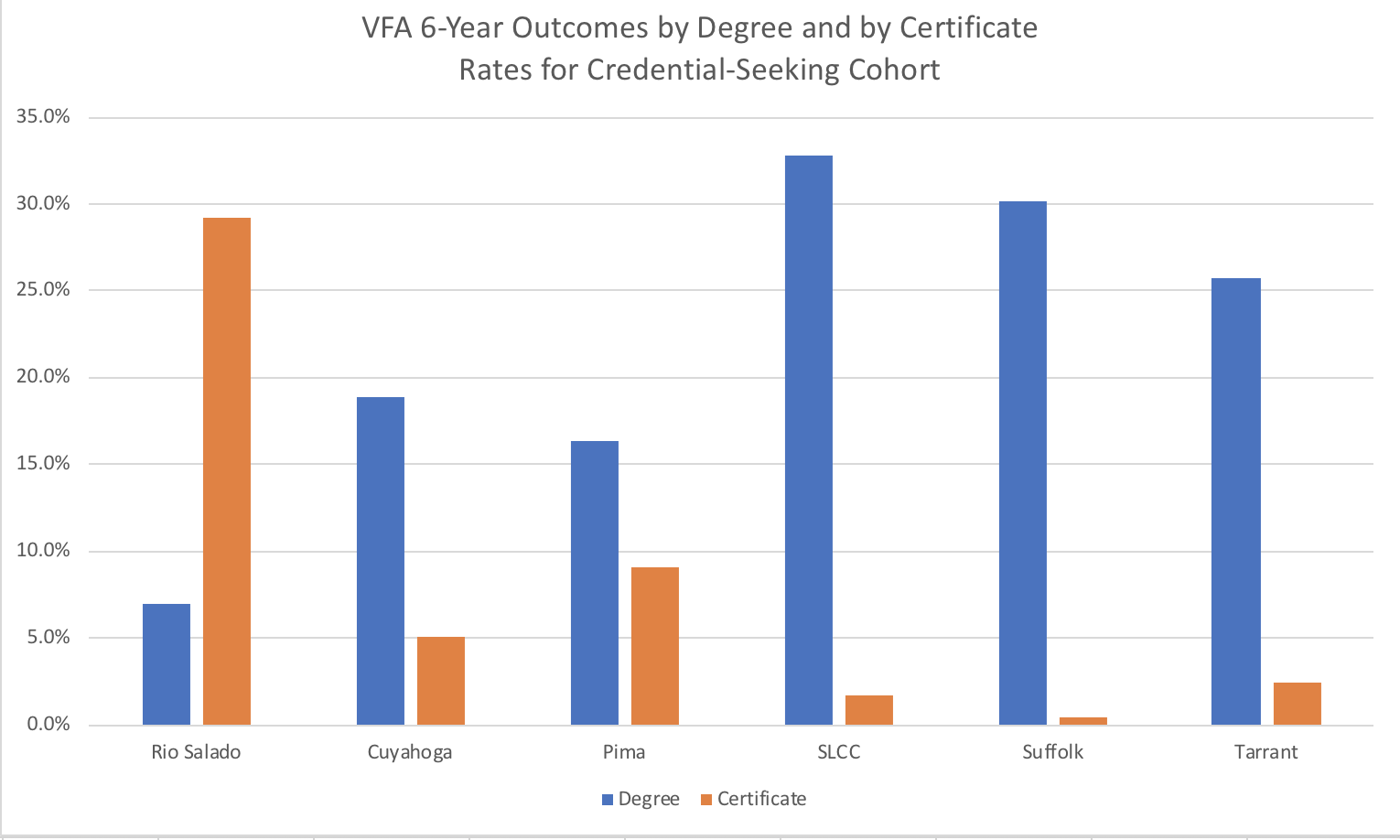
    How does Rio compare to other large community colleges? While we have not analyzed all 200+ colleges in VFA, spot checking with some peer schools indicates that Rio is well below others in awarding degrees but well above others in awarding certificates.

    The resulting data provide the basis of my comment in IHE:

    “This is not a bad situation, per se, as long as students are gaining value in the workplace for these official certificates,” he said via email. “But certificates are not useful in terms of comparing apples to apples, especially when one school uses them liberally, as does Rio, and most other schools do not.”

    Hill also noted that Rio Salado’s VFA completion rate for associate degree programs is a “troublesome” 7 percent.

    While I appreciate the valuable sharing of information from Rio Salado in this process, I’ll stick with my original conclusion:

    At best, this is a school with mixed results that should not simply be labeled a success without caveats or explanations.

    Rio has shown that they can cut costs and still be a successful transfer school, but not that they can be a successful degree school. This matters a great deal in terms of how transferrable the lessons are. It’s fine to focus on transfers when you’re right next door to ASU. But what if you’re Adirondack Community College? There are places where degree completion matter more or less than at Rio. And what about those students going to Rio who *are* seeking degrees? Does this model promote some educational outcomes at the expense of others? And if so, shouldn’t students know about that before enrolling?