e-Literate

Present is Prologue

Category: Academics & Academia

The “Academics and Academia” category covers topics related the ways in which colleges and universities function that are relevant to technology-supported education. One key aspect covered here is pedagogy—how people teach—and how technology impacts teaching and learning.

But this category also includes more institutional aspects that are relevant to technology-supported education, such as how campus leadership supports (or doesn’t support) new initiatives, politics and bureaucracy that impact these efforts, and so on.

Finally, “Academics and Academia” covers commercial and non-profit services that provide support for technology-supported education initiatives, such as Online Program Management (OPM) companies.


  • Climbing the Ladder of Empirical Education

    A while back, I wrote a post about the four levels of Empirical Education. To recap, they are as follows:

    1. Intuitively empirical: Intuitively empirical educators are curious about their students and try to figure out how to help them when they see them struggling. They try different things and pick up tricks in their teaching as they become more experienced in the classroom.
    2. Mindfully empirical: This means that the educators try to create as many opportunities as possible to evaluate how their students are doing and make little (or big) adjustments to her teaching strategies constantly as they get to know their students better. Intuitively empirical educators are empirical in the moment. Mindfully empirical educators are empirical by design.
    3. Metacognitively empirical: Metacognitively empirical educators have made the leap from assessing their students to assessing themselves. When a class struggles with a concept semester after semester, metacognitively empirical educators don’t just accept that the topic is hard. They ask whether their teaching strategies might be part of the problem. They challenge their own beliefs about good teaching.
    4. Socially empirical: When educators reach the level of being socially empirical, it means that they have begun to see that testing teaching strategies and learning to improve can be a shared endeavor. It can be a discipline, with common language and standards of evidence for effectiveness. Socially empirical educators see teaching not just as an art that is personal and ineffable but as a craft that can be taught and learned, and maybe even as a science that can be advanced through shared research and peer review.

    This isn’t just a taxonomy. It’s a theory of change. Anyone who has participated in course redesign efforts likely recognizes the milestones of this progression. That’s not an accident. Course redesign, particularly when properly facilitated by experts who are themselves practitioners of Empirical Education, can move the instructors who are going through the redesign process at least partway up the ladder. In fact, it often happens spontaneously.

    Let’s take the example of launching a distance learning program. In most cases, these programs are going to attract intuitively empirical educators. People who aren’t curious about the process of educating students usually don’t volunteer to teach using a method that they’ve never tried before. (And when they are forced to do so, it is often a disaster.) So distance learning programs are often lucky to get a preponderance of instructors who are already on the first rung of our ladder.

    Teaching online with any degree of quality almost always forces a course redesign. Educators moving from a physical classroom to a virtual one lose some senses while gaining others. Likewise, certain strategies they have come to rely on in the classroom won’t work online and have to be translated to or replaced by strategies that will. And the educator that is new to online teaching isn’t always going to know what will work and what won’t. They are almost required to become mindfully empirical in order to figure out how to replace the bandwidth they lost in the transition.

    Sometimes, the process of trying new strategies because of the redesign provokes the empirical educator to rethink some of her basic assumptions about teaching. Anyone who has helped educators get courses online for more than a couple of years has likely heard at least a couple of them say that the experience of teaching online has caused them to change the way they teach in the classroom. That’s the beginnings of metacognitively empirical education.

    And this is where things start to get hard, for several reasons. First, it’s very difficult to get faculty to make the leap to metacognitively empirical education without a conversion experience that happens when they have to teach their course differently. Both experience and research tell us that many educators—and probably most humans—have deeply held beliefs about what makes for effective teaching based on their own formative experience as learners. No matter how otherwise rational and open-minded they are, they are not likely to be persuaded by research studies. They have to live the change. Outside of distance learning programs, it’s hard to programmatically create new opportunities for formative experiences.

    Second, even when they do live the change and bring new ideas back to their other classes, that doesn’t mean that they have reached the point where they are mindfully or systematically examining their own teaching strategies. Doing the latter requires both another step of self-reflection and some new skills. So a key challenge for Empirical Education is to make it easier to reliably give educators the right experiences, prompts for further reflection, and tools for investigation, in the proper order. Universities aren’t currently set up to do this. But they could be.

    The third challenge in climbing the ladder is moving from metacognitively empirical to socially empirical. Educators who have made the metacognitive leap tend to get excited. It can be a life-changing experience. So they often want to evangelize. But where? If their home institution isn’t already creating a fertile environment for them to share teaching strategies with their peers—which it usually isn’t—then the metacognitively empirical educators tend to go to discipline-specific conferences, where they end up swapping ideas with a small circle of people who are already converted and largely share their background and training. This is far from ideal for cross-fertilization. So another great challenge of Empirical Education is to create new opportunities for metacognitively empirical educators to find each other and learn from each other across normal silos in higher education, like discipline or school type.

    Phil and I believe that colleges and universities in all segments across the sector are beginning to make the transition from a philosophical commitment to student success toward an operational commitment toward student success. What that looks like in the end, and how long it takes, is up for grabs. Empirical Education is, among other things, a theory of change that is intended to accelerate the progress of that transition while strengthening the institutions of higher learning that have served civilization so well by empowering and motivating educators to be change agents.

  • Extension Engine and OPM Market Transparency

    A couple of weeks ago, our response to Open SUNY’s Request for Information (RFI) on Online Program Management services (OPMs), we published an abridged version of our response on our company website and wrote a post about our observations here on e-Literate. Since, then, ExtensionEngine has followed suit. Here’s the introduction to the version that they published on their site:

    The online program management (OPM) landscape is a confusing one, the result of rapid evolution and an ever-greater assortment of businesses keen on winning their share of what has become a very lucrative market. We do not envy the task of any institution of higher learning seeking to upgrade their online learning program, and even less one considering the launch of their first program.

    A few days ago, MindWires — a strategic consultancy and advisory firm — took an unusual step, one that begins to make the task a little easier by increasing transparency among all of these diverse providers: they published their response to a request for information (RFI) from the State University of New York (SUNY).

    The action reflects — and begins to correct — concerns expressed by MindWires’ Michael Feldstein in a series of articles regarding the complicated 2018 OPM market. Greater transparency, as modeled by this move, may be exactly what the marketplace needs to make sense of itself.

    In fact, the SUNY RFI itself has made a contribution to greater clarity. This RFI was more than a request for information on what various providers could do for them; rather, it asked the question: What do we need to know before we move forward? Asking for this guidance before generating a request for proposal, or RFP (which will come later), was a brilliant and insightful move on SUNY’s part.

    The SUNY RFI listed 15 information-gathering objectives. As we formulated our own response, we noticed that we were, in effect, creating a road map through the wilderness of the 2018 OPM market, one that could be valuable to many institutions of higher learning that are thinking of creating or upgrading an online learning program. Some sections are more pertinent to multicampus systems like SUNY’s, but much of the road map applies to any institution, regardless of size.

    For those who are not familiar with ExtensionEngine, we are a professional services organization that designs, builds, launches, and markets custom learning experiences — an integrated, holistic experience designed for learners, pedagogy, vision, and brand. We are a fee-for-service partner — no revenue sharing — and are paid by the hour to provide a full suite of services to help our clients to create successful online learning.

    So, in the spirit of transparency inspired by MindWires’ publication of their response, we are following suit to share portions our response to SUNY’s RFI. Below is a substantial excerpt from the road map through the OPM landscapewe created for SUNY, shared with their permission.

    This is great stuff. In mature product categories like the LMS, this kind of sharing can do more harm than good, because schools tend to just copy and paste requirements without giving a lot of thought about or investigation into which requirements are right for their particular context. But in the still-maturing OPM and broader Digital Enablement Solutions product categories, this kind of sharing helps to surface the differences in needs and contexts that lead to different kinds of optimal solutions. Publishing both the requests and, at least, abridged versions of the responses is very helpful in advancing the conversation. As ExtensionEngine’s Scott Moore noted in the blog post, such responses can “creat[e] a road map through the wilderness of the…OPM market.”

    More transparency in this space would be extremely helpful at this time. We’re giving some thought into different ways to accomplish that aim.

    Stay tuned.

  • Blackboard Learn Ultra in 2018: Is it ready and does it matter?

    Blackboard Learn Ultra in 2018: Is it ready and does it matter?

    One of our longest-running series of posts is on the prospects and status of Blackboard’s Learn Ultra, the user experience redesign and move to the cloud of the world’s second-most-used (behind Moodle) and highest-revenue-producing academic LMS. It is fashionable to claim the LMS is dead or passé, yet this product category remains the centerpiece of educational technology at colleges, universities, and K-12 districts. To understand Learn Ultra is to understand much of the overall LMS market.

    Looking at the timeline of e-Literate coverage, the broad story emerges:

    • 2012: Blackboard acquires Moodlerooms, and one benefit was the see of a cloud-based platform strategy.
    • 2014: Blackboard prematurely announced Learn Ultra (new user experience) and Learn SaaS (move to the cloud).
    • 2015: Learn Ultra is already a year late (more realistically, the BbWorld14 announcement was wildly unrealistic), but the University of Phoenix selects Learn Ultra as its next-generation learning platform.
    • 2016: Blackboard switches CEOs, admits that Learn Ultra is still not ready, and struggles with a major messaging problem around the transition.
    • 2017: No coverage – maybe we got tired of lack of not having customers to talk to.
    • 2018: Blackboard makes Learn Ultra the core of its message at its users conference BbWorld18.

    (Note: It might be easier to view this as a full page timeline instead of the embed within this post.)

    What we have been asked multiple times, by institutions, by investors, by other ed tech companies: is Learn Ultra ready, and does it matter? The unsurprising answer to both questions is a qualified and somewhat confusing it depends. To describe a little further, Learn Ultra’s Base Navigation is ready, but the Course View is not ready for meaningful adoption; furthermore, Learn Ultra is important to Blackboard’s future, but we think SaaS is more important to its present.

    Is It Ready?

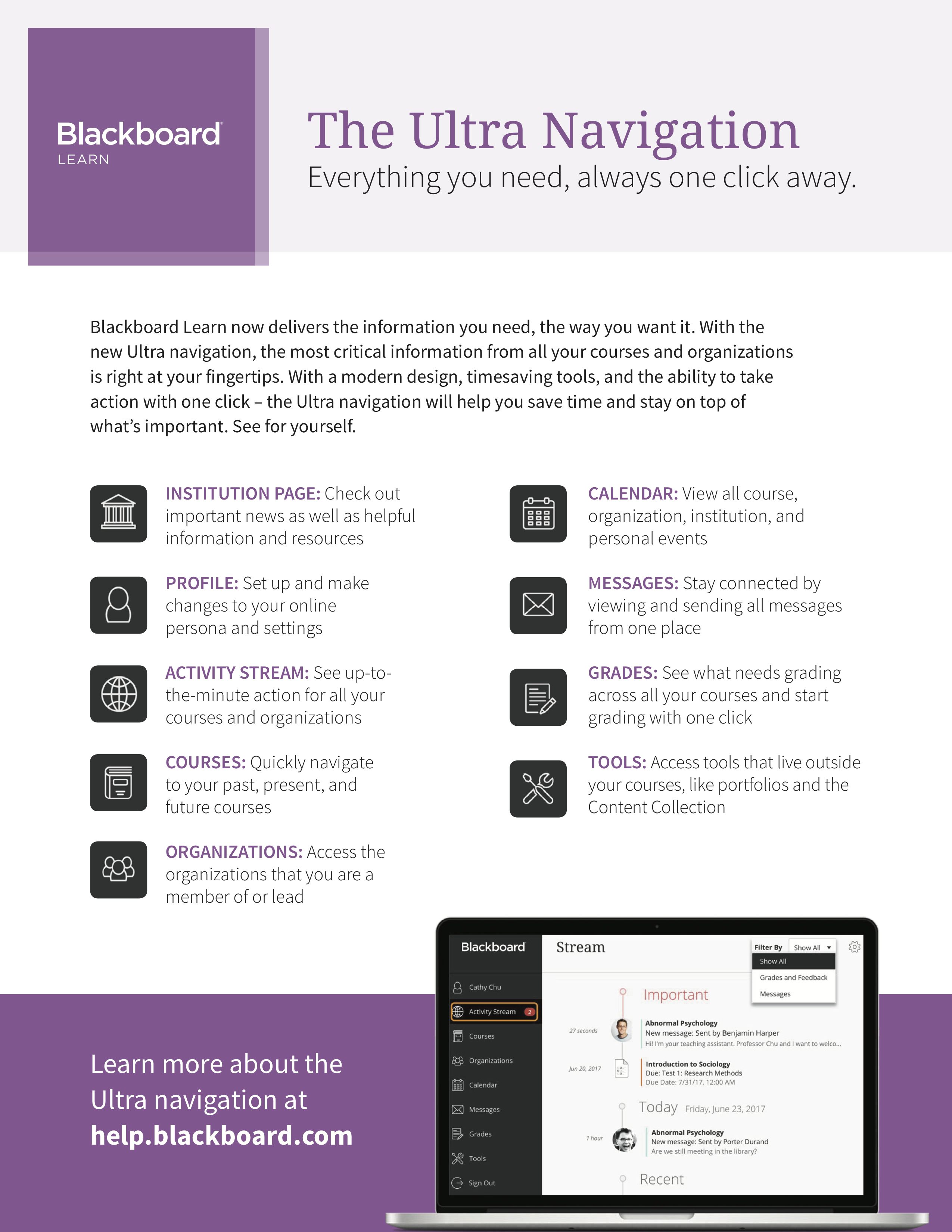
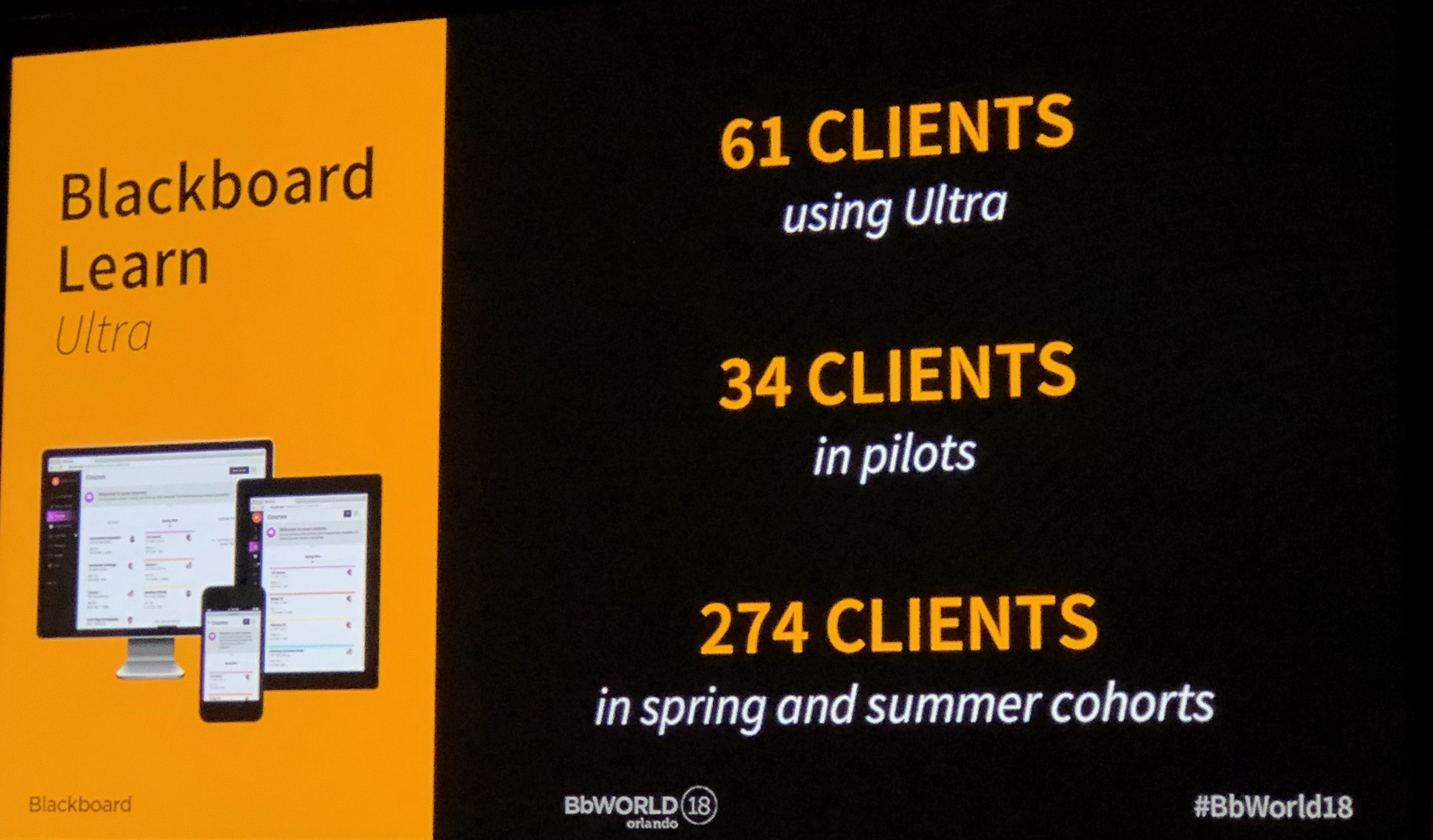
    To ask this question requires an understanding of terminology, as we first described in this post. Blackboard1 is pushing the metric that there are 61 or 62 Learn Ultra customers “in production” or “using Ultra”, yet we have found very few that use, or even plan to use, Learn Ultra as their primary, institution-wide LMS. What gives? What became quite clear at this year’s BbWorld 18 users conference is that when Blackboard says in production, what they mean is that the LMS administrator has enabled the Ultra navigation, which uses the new Ultra user experience framework as the landing page / dashboard with activity feed that users see before entering a specific course. The company calls this Base Navigation, but at this point every course can be configured to be in the Original Experience or the Ultra Experience. Thus, enabling the possibility of running a course in Ultra counts as in production (note that Blackboard now lists 91 clients on Ultra).

    Slide from BbWorld18

    Once a school has enabled Learn Ultra Base Navigation, they could choose to move exclusively to Ultra (e.g. the University of Phoenix, Northwest Florida State College, and a few others), or they could choose to keep all courses in Original (e.g. Northeastern State University), or they could choose to have some courses in Ultra and some in Original (used by the majority of schools investigating Ultra). This last mode is known as Dual Course mode, and even Blackboard executives seemed surprised to find out that the vast majority of schools putting Ultra in production are in fact running in Dual Course. For many of these schools, there are no definitive plans to move exclusively to Ultra.

    Upon re-reading this description, I believe that I should give more credit than just describing a landing page and base navigation. The cross-course functionality is and has been a long-term goal of Ultra, as we described as early as 2016.

    Creating a brand for a set of design goals is inherently fraught. Let’s look at two examples of how it makes communication of Blackboard’s strategy tricky for them. First, there’s mobile. Blackboard came out last year with a mobile app called Bb Student. It provides students with that activity stream view across courses and, of course, it’s mobile-first. (In fact, it’s mobile-only at the moment.) Furthermore, the company has made the product available for both traditional 9.x customers (which at this point is pretty much everybody) and their SaaS customers. People inside the company feel like they should be getting more credit for delivering on two major design goals (mobile first and stream-based activity views) as well as for delivering it to customers on the 9.x platform (which was more significant of a technical achievement than is immediately obvious).

    This is not a matter of Blackboard moving the goal posts, per se, and it is probably more accurate to say that Ultra cross-course functionality enabled by Base Navigation is ready and showing some benefits.

    Learn Ultra Base Navigation Brochure

    The challenge is that this move is not sufficient to make a material change in Blackboard’s company prospects. At best, Learn Ultra Base Navigation without usage of Course View will slightly slow down the rate of customers defecting for another LMS. For Learn Ultra to matter and to make Learn newly competitive, they need customers to also use Course View as the primary choice at their institution, and that usage by-and-large is not ready outside of a handful of schools.As an example from BbWorld18, Belmont University presented their experience moving to Learn SaaS (the important issue in the present, and a predecessor for  adopting Ultra)  and to “the Ultra Experience”. But after we asked a question about faculty adoption of the Ultra Course Experience, the administrator clarified that there are no courses running Ultra – all they have done is enable the Ultra base navigation, and they do not expect to do any course migrations for at least another year. This full adoption of Learn Ultra might become important in the future, but it is not driving decisions today.

    Does It Matter?

    Given that we’ve been asking for three entire years whether Learn Ultra is ready, one obvious follow-up question is whether it matters any longer. I do think the question matters as Blackboard is pinning their corporate turnaround on Learn Ultra as the core piece, and this message was heavily promoted at BbWorld 18.

    This messaging makes some sense in that we consider it unlikely that Blackboard can gain significant numbers of new clients (those moving from another LMS to Blackboard Learn, beyond a dozen or fewer schools) without Learn Ultra. Learn Original Experience has too much baggage and is too dated to compete with Canvas or Brightspace by D2L, at least in North America. The company’s new Learn LMS clients are largely the University of Phoenix and ANGEL contract conversions.

    To be fair, the exceptions include several schools in North Dakota (migrating from Moodle) as well as Northwest Florida State College (migrating from D2L). But even with NW Florida State, they based their decision on Learn Ultra.

    Based on interviews with clients arranged by Blackboard, and based on our own connections at BbWorld, what we consistently heard during dozens of interviews and from listening to panel discussions was that Learn Ultra Course View makes sense primarily for programs or schools that have not been on Blackboard Learn before. Bb Learn clients seem to have too many expectations of needing the same functionality they had before, pushing Ultra to be largely feature-compatible with Original and thus losing some of its simplicity in the process. When the Illinois Institute of Technology migrated from Learn self-hosting to SaaS, which enabled them to explore Ultra, they chose one program and a handful of faculty that were willing to jump into Learn Ultra, but for almost all others they are sticking with the Original Course View for the time being. The soonest they would expect moving primarily to Learn Ultra at the Course View would bet 3-5 years from now. You can hear the same dynamic in a recent Rod’s Pulse Podcast (shared under CC-BY-NC-SA license and also available at Inside Higher Ed), with Rod Murray interviewing Rob McCunney about their school (University of the Sciences) and its migration to SaaS and Ultra. It is a fascinating first-hand description of their experiences. Please note that they use use the terms Traditional and Original interchangeably.

    R Murray: We turned on the SaaS in January, but we really kept the Original Experience until July. In mid-July we flipped the switch to turn on the Ultra Experience. Now again for those of you are not as familiar with the way Blackboard works, that wasn’t changing the course format. They were still traditional courses, but you know all those tabs and modules disappeared, and we ended up with a new base navigation in Blackboard, which they called the Ultra Experience. So that was a major change, and we do have some summer sessions, but we felt this was the least painful way to turn it on. We didn’t want to wait till August just before our fall students came back.

    In terms of turning on the Ultra Experience, what were some of the major issues that you saw, that you were concerned with?

    R McCunney: Besides the fact that we lost the tabs and modules, so we kind of rolled out OneCampus as Rod said, I think one of the major things that that I noticed wasn’t really even on the admin side, it was just getting people used to something that was completely different as soon as they logged in to that institution page. Where’s my stuff, where is my modules? It just looks completely different than what they’re used to, and there’s some stuff missing, and we replaced it. We put stuff in other areas, and we communicated that, but that was probably the biggest hurdle. Just what is this, what is this Blackboard Ultra that you’re changing me to? And at that point, in July we only changed basically the institution page. Your average user, once they get into their course they didn’t notice anything different, but that initial freak out of here I don’t know where my form is. We told them a dozen times where it is, but it’s somewhere else. That was probably one of the major hurdles, and I didn’t anticipate that as being a big as an issue as it was. I thought there was going to be more nuts and bolts issues, which there were very few of those for the most part.

    R Murray: Right now of course we don’t have that many students here in the summer, so the real test will be in another week or so when students come back and really start. We all start kicking the tires, even on the traditional courses within the Ultra Experience.

    [snip]

    R Murray: The next big change that we have to live through has to do with converting courses to the Ultra course view. Now here at our university we certainly didn’t do it en masse, we went to play with it for at least this term and maybe next. But there are some courses that we decided made a lot of sense to convert to the Ultra course view. Those schools that those courses that are brand new, especially online courses that are brand new, it made sense to develop them directly in the [Ultra] course view.

    Schools are trying out the Ultra Experience in terms of the landing page and cross-course functionality, but by-and-large they are very cautious jumping into the Ultra Course View where most of the functionality resides.

    Based on this situation, we believe that the migration to Learn SaaS might be a better indicator – at least in the short run – than Ultra adoption of whether a school plans to stick with Blackboard. When a school moves to Learn SaaS, they all tend to sign contract extensions for 1 – 3 years or at least internally plan no LMS migrations for more than 1 – 3 years. And the migration to Learn SaaS does not suffer from the vague terminology issues – a school either uses Learn deployed on SaaS (through AWS) or they don’t.

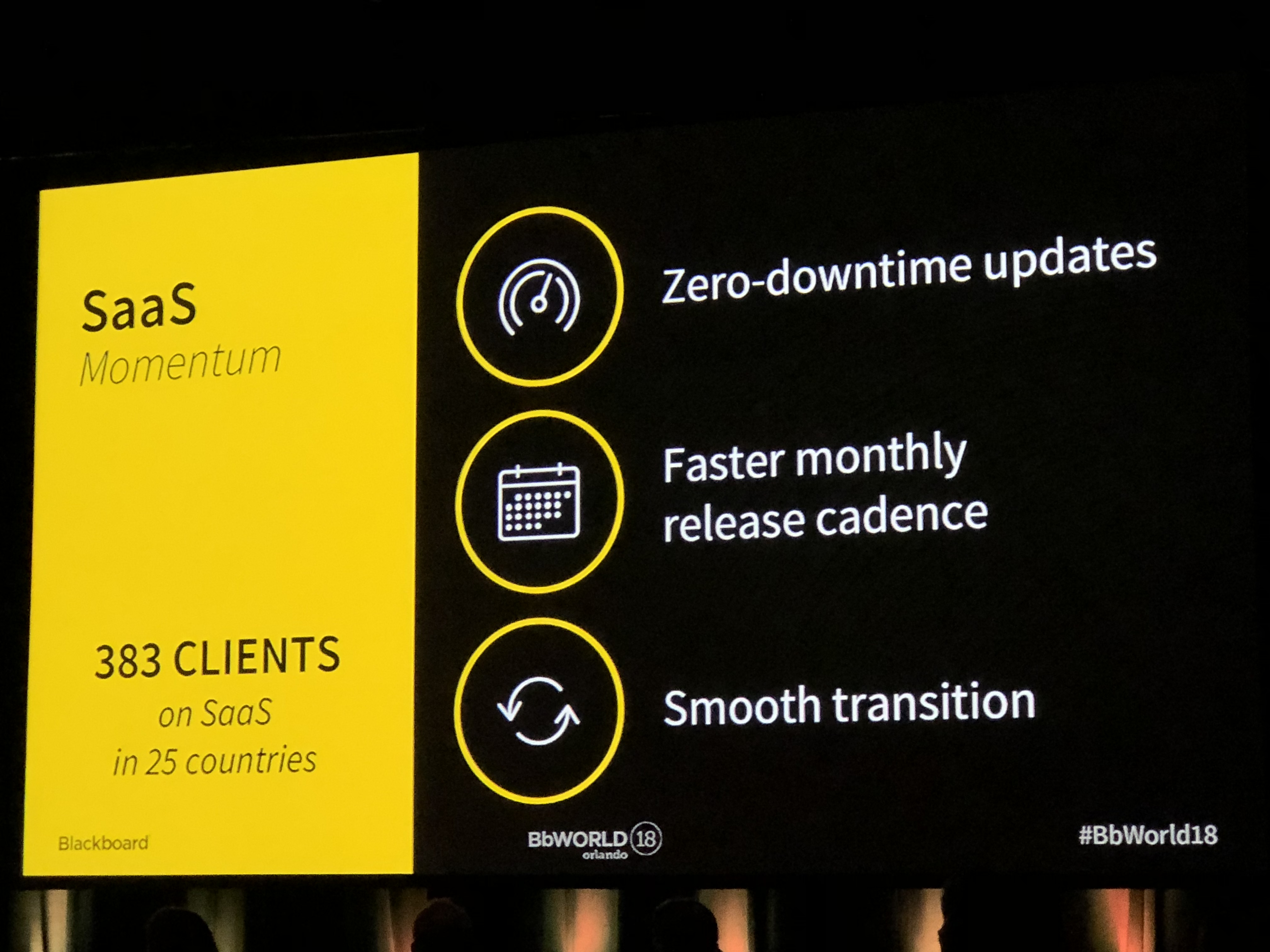
    Learn SaaS progress slide

    383 clients on Learn SaaS as of BbWorld 18 is good progress and easy to understand. This issue is what likely matters more to Blackboard clients today and for the next few years, but in the long run the company needs Learn Ultra to be accepted – including at the course level – in order to become more competitive and pick up new clients.

    In the end, Learn Ultra is partially ready and does matter, more so in the future, but the Learn SaaS migration matters much more today. This answer is a real improvement over the situation a year ago and even from the beginning of this year, but it is still a far cry from a simple yes and yes answer that Blackboard would like to have.

    Update: Fixed name of Rob McCunney

  • Expansion of OPM-Derivative Model: Disney covers online degrees for hourly employees through Guild Education

    Expansion of OPM-Derivative Model: Disney covers online degrees for hourly employees through Guild Education

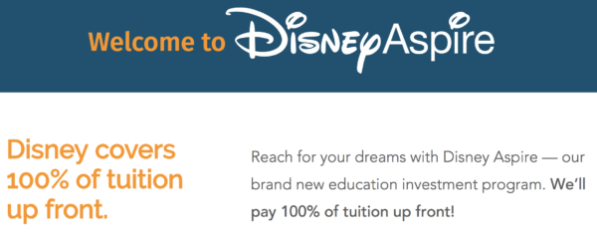
    Two weeks ago The Walt Disney Company announced a new educational benefit program called Disney Aspire that goes beyond what other recent benefit programs have offered. As described in a company blog [emphasis added]:

    Disney Aspire is the most comprehensive program of its kind. To make participation easier for eligible employees, The Walt Disney Company will cover 100 percent of tuition upfront and will also reimburse application fees and required books and materials, removing the worry of paying to start or continue school. The program is designed for working adults and offers our Cast Members and employees maximum choice and flexibility with their studies, regardless of whether the program and classes they choose are tied to their current role at Disney. Disney Aspire includes a network of schools that offer a wide array of disciplines and diplomas—including college and master’s degrees, high school equivalency, English-language learning, vocational training and more.

    This program is offered through Guild Education to 80,000 of Disney’s hourly employees in the US (after 90 days of employment), and the ‘regardless’ point is crucial – the options for degrees is not constrained to pre-selected majors or degrees that have to be tied to an employee’s current role.

    Yesterday there were additional details announced by the University of Florida Online (UF Online) about programs that they are offering for Disney Aspire.

    As part of this relationship, Disney employees may apply to one of several fully online bachelor’s degrees – the Bachelor of Arts or Bachelor of Science in business administration from the Warrington College of Business; the Bachelor of Science in sport management from the College of Health and Human Performance; and the Bachelor of Arts in public relations, and the Bachelor of Science in telecommunication from the College of Journalism and Communications. If granted admission by the University of Florida, Disney cast members could begin UF Online classes in January 2019 as part of the University’s spring semester. Once cast members sign up for the Disney Aspire educational benefit, a coach from Guild Education will contact them to determine their eligibility to receive educational benefits, review their academic background, and to provide qualified prospective students with a unique link to the UF Online admissions application.

    One reason this announcement is interesting is the rapid growth of Guild Education, providing a derivative of Online Program Management (OPM) services. Guild describes itself as providing a platform that connects large-employer educational benefit programs with partner schools such as UF Online, Brandman University, Valencia College, etc. As we described in June when Walmart and Discover Financial announced their benefit programs:

    I think these moves are more significant than just individual benefits. What we are seeing is UF Online, along with a handful of others, defining a different approach to marketing and finding potential online students, at least for undergraduate degrees. Historically, there is a common assumption that to enable a scalable online program there is a need for traditional digital marketing as the primary approach – Google AdWords, call centers, social media campaigns – with a partnership or two thrown in on the side. The origin of the OPM market is centered on providing these services in exchange for a percentage of tuition revenue, and for the majority of cases, the OPM’s spending on this marketing and enrollment management category is the most expensive service in the package. The Employer Pathways approach by UF Online has the potential to flip the student acquisition assumptions – primarily driven by employer partnerships with traditional digital marketing channels as a secondary approach.

    Since the June post, Guild Education raised a round of $40 million for a total of $71.5 million since 2015. As EdSurge noted in its article, however:

    One challenge is that few employees who are given education benefits options take advantage of them. The Wall Street Journal recently reported that while nearly 90 percent of mid- and large-size companies offer tuition reimbursement, less than 10 percent of employees at those companies take advantage of the benefits.

    That figure is even lower at Guild’s partner companies, where only 3 to 5 percent of employees take advantage of the educational offerings, says Carlson. “We are optimistic that our companies want to go beyond that.”

    Guild Education works on a tuition revenue share basis, although the details of these agreements are not public information yet. Charging tuition revenue sharing for up-front marketing and acquisition of students for online programs – sounds like a lot of overlap with the OPM market, but for a new or derivative model. This gets to Michael’s point most recently described in a post about Noodle Partners and their evolving model:

    In my last two posts, I talked about OPMs being long-term partners in the ongoing management of online programs. I also argued that unbundling of services opens up a world of possibilities for solving different problems, and that we therefore need an umbrella product category called “Digital Enablement Solutions” with other (emerging) subcategories that could live along side Online Program Management.

    Guild Education does not provide any of the program management services beyond admissions, as they do not help with program design, instructional design, student support, ed tech platforms or analytics. So it would be a mistake to lump them into the OPM category, but there are some interesting overlaps. We referenced this situation in our response to the SUNY Online Education Request for Information.

    Financing models are proliferating in higher education, to the point of creating a great deal of market confusion, in part because one size does not fit all. Universities will likely have to evaluate a wide range of financial models and make sure that their approved portfolio of solutions providers includes a substantial subset of those models.

    As for the educational partners, there is long-term potential but not yet sufficient demand for that flip in student acquisition assumptions. UF Online estimates that within the next two years they might reach 10% of students coming from their Employer Pathways. One motivation for this type of program, according to Associate Provost and Director of UF Online Evie Cummings, is that ideally the  “coach from Guild” will be able to pre-screen applicants, since the cost of marketing to students who do not make it through the admissions process is quite expensive for selective institutions.

    Beyond the online programs, starting in January there are likely to be face-to-face options as well, as described in the Orlando Sentinel.

    Under the education program, Disney employees can take courses toward a high school diploma, a college degree or vocational skill.

    A Disney spokeswoman said the online courses are the first rollout of the tuition program and employees would be eligible for in-person classes — at Valencia College as well as other schools — in the next phase beginning in January.

    Count this news as further evidence of the broader market of Digital Enablement Solutions based on tapping into corporate HR and learning opportunities rather than traditional ad-based student recruitment methods.

  • Noodle Partners and the Boundary of the OPM Product Category

    If you spend some time browsing the Google News search results for ‘OPM “revenue share”‘, you’ll find one industry figure who seems nearly ubiquitous, particularly in pieces by general audience news outlets: John Katzman. Mr. Katzman, currently the founding CEO of OPM company Noodle Partners, is one of those rare individuals who has been extremely successful as a serial entrepreneur in education. He founded both Princeton Review and 2U before going on to start Noodle. In his current incarnation as Noodle Partners CEO, Katzman is waging a publicity war against the OPM revenue share model that companies like his last one—2U—are built on. Josh Kim’s recent interview with him in Inside Higher Ed is quite revealing and tells us a lot about the real debate surrounding OPM revenue sharing.

    Josh starts the interview by quoting a two-year-old opinion piece Katzman wrote for the Hechinger Report:

    In three years, no one will be able to explain why it was that colleges and universities continued to hand more than half of their tuition to companies marketing and supporting their online programs — the online program managers. It will be even more challenging to explain why some agreed to contractually share their tuition for the next 10 or 15 years.

    In that same piece, Katzman referred to traditional OPM revenue sharing agreements as “payday loans” and wrote,

    I’m suggesting the time for the ‘share the bounty’ approach to online education is over. This approach is driving up education costs (and student debt) and fueling a marketing race as schools and online program managers spend more and more to recruit and retain online students.

    That online program managers continue to sell their outdated and misaligned tuition-sharing model fuels the suspicion and mistrust educators have for for-profit education companies.  Those of us who believe for-profit investment and innovation can improve the quality and accessibility of education are obligated to raise our voices when things go off the rails or become ineffective or outdated – as the revenue sharing model has….

    Few, if any, institutions can afford to share their tuition and none can afford the all-out marketing war that outside companies will be all too happy to wage for a cut of the action.

    The good news is that the market knows a change is coming. Tuition-sharing percentages are trending down and contracts are getting shorter. More colleges are investing in in-house solutions to recruit and manage their online offerings. And fee-for-service management options like the one my company offers are also becoming more abundant. That’s progress.

    Pretty harsh words, especially from a guy who founded one of the most successful OPMs in the industry. Has Katzman softened his stance in the last two years?

    Nope.

    Here’s what he says in response to Josh’s question about whether the OPM industry should form an association:

    My job is to decimate the OPM industry, which is driving up higher ed tuition. So … perhaps, but doubt they’d want me in it.

    Clearly, Katzman is on a mission to kill revenue sharing agreements. Here’s what he says in response to Josh’s question about how universities can manage the up-front costs of building an online program without revenue-sharing agreements:

    Some traditional OPMs are trying to position us as fee for service, but Noodle also offers a temporary revenue-share option in which we fund a program and take on all risk. The school pays a share of revenue, but only until we have recouped our out-of-pocket expenses for its programs, after which it pays for actual services. This is the best of both worlds, and about half our schools take advantage of it.

    Wait. What?

    Noodle Partners’ position gets flattened into “revenue sharing bad,” partly because it makes good headlines, partly because Mr. Katzman knows it makes good headlines, and partly because Noodle Partners’ position has evolved. According to the Wayback Machine, Noodle Partners’ 2016 version of their web site said the following about financing:

    Choosing to work with Noodle Partners is the most affordable route to great, quality online programming. While there is an up-front investment necessary to launch your programming, Noodle Partners can work with you to get outside capital from a trusted, low-interest financing partner.

    In the IHE interview—and on the 2018 Noodle Partners web site—the positioning regarding revenue sharing is more nuanced.

    But if revenue sharing isn’t the core problem that Noodle Partners is intended to rectify (anymore?), then what is? Is it the bundling? Here’s what Mr. Katzman says to Josh on that point:

    [U]nbundling isn’t exactly what we’re doing. A program needs instructional design, marketing, recruiting, funding, technology and support services; we’re just comfortable with helping a school build capacity rather than use outside providers exclusively. Any way our competitors follow us, though, they will leave Noodle as the leader in the next-generation OPM space.

    In my last two posts, I talked about OPMs being long-term partners in the ongoing management of online programs. I also argued that unbundling of services opens up a world of possibilities for solving different problems, and that we therefore need an umbrella product category called “Digital Enablement Solutions” with other (emerging) subcategories that could live along side Online Program Management. Noodle Partners isn’t unbundling services but is rejecting the model of the long-term full-service management of online programs by the company.

    So what does that make them?

    I would call the service that Katzman describes “Online Program Enablement (OPE).” In this model, the vendor may offer revenue sharing or some other form of financing designed to cover the up-front costs of full-service support for the program launch, but then unbundles those services to some extent and allows customers to pay for them as needed on a fee-for-service basis. That shift in models after the program launch is what distinguishes an OPE from an OPM.

    Katzman characterizes the shift as “next-generation OPM,” but the resulting service really solves a different problem than an OPM does. If you think your institution is best served by focusing on its current core competencies and outsourcing the lion’s share of online program management work to a specialist on an ongoing basis, then an OPM service is what you want. If, on the other hand, you want full-service support (and financing) to launch your program but want to take over management of significant portions of it once it is up and running, then an OPE service is really what you want.

    How much OPM and OPE services are ultimately going to compete or just co-exist is an open question. At the moment, we don’t see a lot of evidence that OPE growth is coming at the expense of OPM growth. There is likely a Venn diagram of potential customers between the two product categories, but we won’t know the size of the overlap for a while. In fact, we have very little visibility into OPE growth, in part because many service providers are offering multiple pricing options these days. There’s still a lot of improvisation going on without a lot of thought about how tinkering with the pricing model changes the offering enough to put it into a different product category.

    The main point, once again, is that many significantly different offerings are getting crammed into the OPM product category because it’s the only product category that we have. This obscures the fact that some of these services are different enough from each other that they solve different problems from each other. And the differences that tip an offering into a different product category are not always obvious.

  • The Boundaries OPM and What Lies Beyond: The SUNY Example

    In my previous post on OPMs, I wrote,

    There are several factors that are major contributors to the current rush to by vendors to call themselves OPMs:

    1. The variation between kinds of programs that universities are looking to launch is significant and increasing. As a result, different OPM vendors are specializing in different kinds of programs.
    2. More universities are making fine-grained choices about which aspects of their online programs they want to outsource to a specialist, which aspects they want to pay a consultant to help them get started or improve, and which aspects they believe they can do themselves. This broadening out of customer choices is creating further variability in in OPM business models and OPM-like services offered by an increasingly wide range of companies.
    3. As the OPM business disaggregates, universities are increasingly recognizing that certain functions that OPMs perform, like recruiting students who are likely to be successful in a program, redesigning courses to maximize student success, providing early interventions to promote student success, and working with employers to help with career readiness and post-degree employment are all services that might be useful for improving the success of their traditional programs.

    This last point is especially important. Within the three-letter acronym OPM, the “P” and the “M”—”program” and “management”—are defining features of the product category. OPM is a service in which the vendor actively manages at least some substantial subset of a full online program  for some significant period of time. As in multiple years. Once customers start contracting for individual services a la carte on a relatively short-term basis—say, just to get the program up and running—those customers are no longer paying for an OPM service. They are paying for some other digital enablement service which may not yet have a widely used name.

    Because this distinction can be a little fuzzy, it helps to have a case study. Luckily, we have one. Open SUNY recently released a Request for Information (RFI) for vendors that can help them meet a wide range of ambitious goals. While the term “OPM” was never used in the RFI, it’s pretty clear that the request was written specifically to include questions that one might ask of an OPM service provider. MindWires, our consulting company, responded to that RFI. Because we think the answers we provided to SUNY might be useful to a wide range of colleges and universities, we have published a shorter, edited version of our response. Because that response includes fairly detailed descriptions of our consulting services, we have published it on the MindWires site rather than here on e-Literate. But some less commercial discussion of SUNY’s request is also appropriate for the blog because it sheds some light on the challenge defining the product category in a useful way.

    SUNY’s Goals

    In their RFI, Open SUNY enumerates quite a few ambitious and complex goals (even before accounting for the fact that these goals are for a system of 64 diverse and independent colleges and universities):

    • Opportunities to position SUNY as a unique provider of educational opportunities for all learners;
    • Reaching the millions of New York residents currently not enrolled at a SUNY campus, who need higher education to be more effective on their jobs;
    • Significantly expanding SUNY’s online learning experience to serve exclusively online students who are currently not at a SUNY campus;
    • Potential next-generation innovations in online/digital education where SUNY may have a unique opportunity to leapfrog competition;
    • The most appropriate ways to productize SUNY’s vast educational offerings to prospective students;
    • Business and revenue sharing models to incent behaviors, ensure sustainability and provide campus/System revenue growth;
    • Opportunities to capture students SUNY is losing to other online schools generating revenue for investment in our campus operations;
    • Outreach and marketing plans that reach a broad range of key stakeholders, including potential students in-state and out-of-state, internal staff and professors, and other key stakeholders as identified;
    • Platforms and services to expand SUNY’s current online environment and enrollments to challenge current leaders in the field;
    • Insights into the type and structure of programs appropriate for this platform/business model;
    • Requirements to continually align educational opportunities with labor market needs;
    • How to best integrate SUNY’s 64 campuses and their faculty into this improved platform/business model;
    • The impact of the changing demographics in New York, as well as surrounding states and potential global opportunities;
    • Partnering with interested industry leaders, including other university systems;
    • Consideration of prior learning assessment as part of the improvement to this process.

    Much of this sounds like classic OPM work. For example, “[b]usiness and revenue sharing models” and “outreach and marketing plans” are classic elements of an OPM solution.

    The revenue sharing model is both particularly characteristic and widely misunderstood. Revenue sharing is best understood as a service offering. It’s financing. When I bought my last car from the dealer, I got a loan from them to help pay for the car. There were other ways that I could have financed the purchase. I saw the prospect of owing money and paying interest to the car company as a feature rather than a burden because the specific terms they offered were advantageous relative to other options I had at my disposal. In my case, I was buying a new car that cost more than the cash I had on hand. So I needed to take a loan from somewhere. But at 0.9% interest, I might have decided to take the loan even if I had the cash. I might have decided that the interest rate was low enough that I’d prefer to hold onto my cash.

    In SUNY’s RFI, they specifically ask for information about “business and revenue sharing models” because the system wants “to incent behaviors, ensure sustainability and provide campus/System revenue growth.” The revenue sharing model, which is also a risk sharing model, theoretically aligns the vendor’s incentives with the customer’s. Again, theoretically, the vendor makes money only to the extent that the new program is successful. In order for companies to share the risk, they generally want some of the control in addition to some of the revenue. They want some ability to influence decisions that impact the program’s success. This kind of arrangement only makes sense for both parties when the customer wants the vendor to actively manage parts of the program on a long-term basis because they believe their program will have a higher likelihood of success if the vendor does so. Management is a particular kind of enablement where the service provider actively oversees a particular function that the customer doesn’t feel is their core competency (like online marketing) so that the customer can focus more energy on in-house areas of strength (like curriculum).

    So here’s a rule of thumb for defining the shape and boundaries of an OPM service: If a reasonable person could believe that a revenue sharing arrangement is a rational option for paying for the program (regardless of whether the customer chooses that option), then the service may well be an OPM.

    Conversely, if a rational person could not believe that revenue sharing is a rational choice, then it probably isn’t an OPM service. Revenue sharing isn’t definitional for OPM, but it is an indication of the kind of close, ongoing reliance on the vendor to actively manage the program that is the hallmark of an OPM service. One could imagine a customer having one or more of SUNY’s goals and not wanting a full program management service. Take, for example, “[p]latforms and services to expand SUNY’s current online environment and enrollments to challenge current leaders in the field”. This could be as simple as an LMS or a courseware platform. It’s hard to imagine a university or system signing a revenue-sharing contract with their LMS vendor. A learning platform, or even a course registration portal, would be a kind of digital enablement service. But it would not be online program management.

    I’ve been very careful so far to refer to OPM as a service. “Solution” or an “offering” also both work. But I have deliberately avoided talking about OPM companies. Such beasts do exist. 2U and Academic Partnerships are two well-known examples of fairly pure-play companies that are known for offering full-service, revenue-sharing online program management solutions. But once companies start to unbundle their offerings to the point where it no longer makes sense for customers to think about paying for what they are buying via a revenue-sharing agreement, then those companies are offering both OPM and non-OPM digital enablement solutions. Since the sector doesn’t have product category names for those other solutions, they tend to get called OPM services. But prospective customers should think about them quite differently. In one case, the business arrangement should maximize the alignment of incentives between long-term partners. In the other, the customer might well want the opposite, i.e., to minimize long-term dependence on the vendor.

    Generally speaking, true OPM solutions make sense when a college or university is looking to launch a new, differentiated, free cash flow-generating online degree or certificate program. Many of those words can be boiled down to one: Money. The college or university (or system) wants to create an offering that, among other things, pays for itself and generates free cash flow—i.e., leftover money after covering certain core expenses—to spend on fulfilling other aspects of its mission. It’s a new program, and maybe even a completely new kind of offering for the school, so it’s more likely that the institution will need ongoing help with certain aspects of the program. Since there are a million billion MBA programs online already (for example), a new MBA program would need to be differentiated enough to draw students. Otherwise, it won’t generate money. Many colleges and universities know how to create traditional face-to-face programs that are differentiated and will bring in more money than they cost. Fewer know how to launch and run one online. Or, honestly, would want to. There are all kinds of tricks to marketing online programs successfully. Managing seamless registration is hard. Managing, say, live nurse practicums to support an online nursing degree program is hard. Running the registration, LMS, CRM, learning analytics, accounting, and other software, tuned to work together for an online program, is hard. Some schools just don’t feel like they want to put their money and energy into learning how to do these things well enough to run an excellent program. That’s where an OPM offering—which is almost always some flavor of lasting partnership between the school and the vendor, regardless of financing arrangements—can look attractive.

    There is a lot of attention being paid to a-la-carte, fee-for-service models within the OPM product category. We think that much of the activity in a-la-carte falls into one of two situations. First, a lot of OPM service providers tinker with the details to customize their service a bit. “Would you like to hire us for only 80% of our full service portfolio? OK, we can take these things off the service agreement (but not those others).” “Would you like to finance partly with loans rather than revenue sharing? Or use a down payment to reduce the size of your long-term payments to us? You can do those things.” The other situation is that the customer is looking for digital enablement but not online program management. They want help to get up and running. Maybe they’ll continue to contract out a couple of things, like help desk or marketing, but for the most part, they expect to manage the online program themselves. We’re not seeing a lot of activity in the middle ground between these two types of situations. That supports our belief that these are really two distinct product categories. True a-la-carte digital enablement services that do more than tinker around the edges are not OPM services. That doesn’t make them better or worse. It just means that they solve a different problem.

    There’s one more point worth making about the boundaries of “OPM” which is specific to SUNY’s situation. Precisely because online program management requires a very close, ongoing collaboration between the school and the vendor, many OPMs sell first not to universities but to individual schools within a university. First they may develop a relationship with the business school. Maybe they’ll use that to get a referral to the nursing school. And so on. That way of working cuts against the grain of a large, diverse, and decentralized system like SUNY. I used to work at SUNY Systems Administration, and I still know people both in the central offices and out on the campuses. It’s very difficult to get SUNY to do anything in unison as a 64-campus system. Nor is that abnormal for a large, diverse state system. The kind of slow consensus-building and respect for autonomy required to galvanize group action in that kind of environment is hostile, if not outright antithetical, to kind of joined-at-the-hip relationship required for a successful OPM partnership. SUNY can vet and pre-negotiate with OPMs for adoption on a campus-by-campus basis. They can contract for system-wide digital enablement services where campuses can opt-in. They can even build their own sort of system-internal OPM (which would not be entirely different from the function of the original SUNY Learning Network). But we don’t see any evidence that a traditional OPM service could be successfully implemented as the default partnership system-wide in an environment like SUNY. To reach that kind of scale in that kind of environment, the State of New York will have to come up with something truly innovative.

  • OPMs are a Subset of a Bigger Market

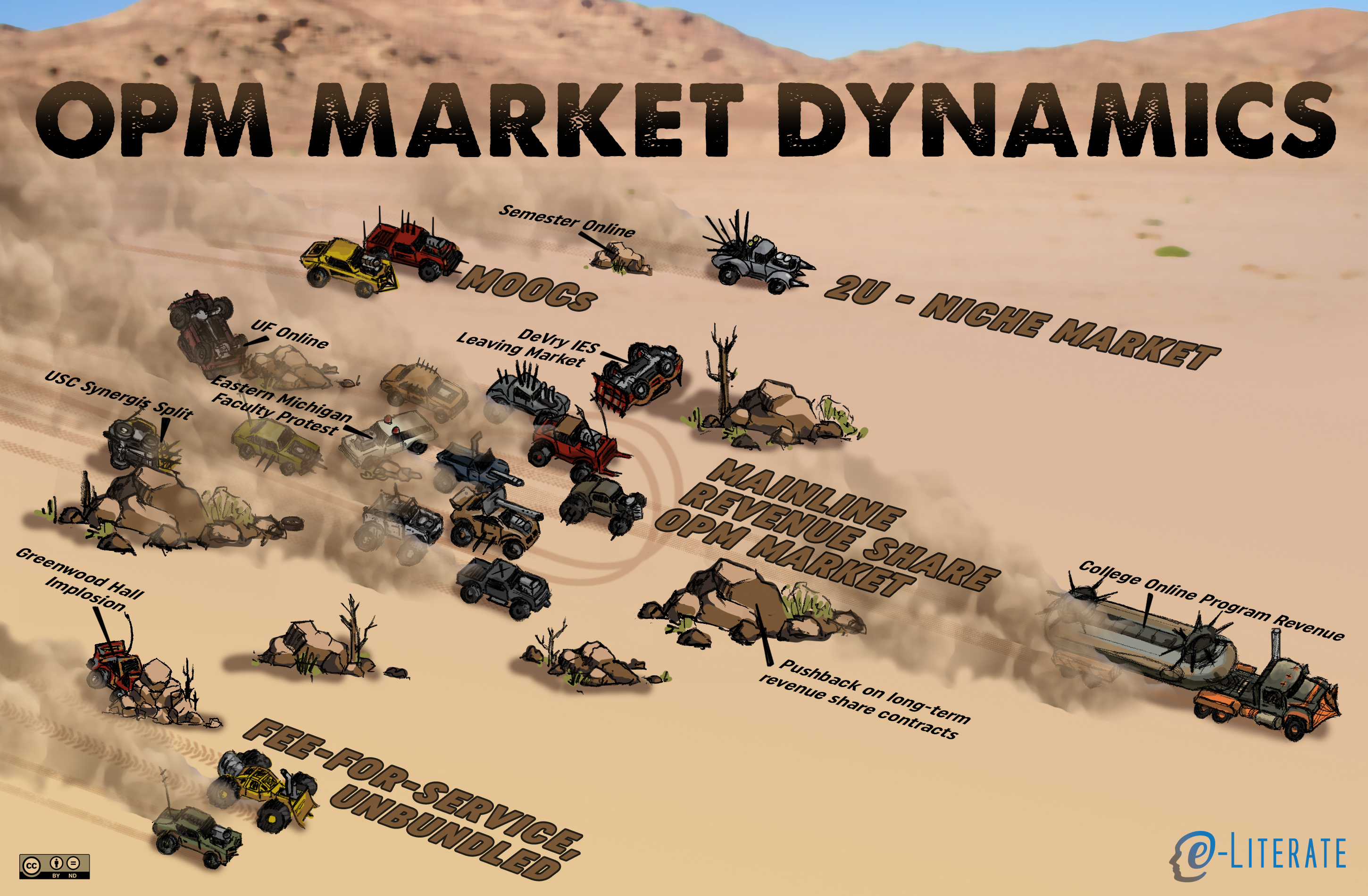
    OPMs are a Subset of a Bigger Market

    We are seeing a tremendous surge in interest regarding Online Program Management (OPM) companies. Certainly many of the major higher education news outlets are running stories on them and many analyst firms are publishing white papers. That’s a sign that others who pay attention to this space are hearing…something. But it’s not a strong signal by itself.

    In our own work, we are definitely hearing more interest in OPMs, and we are also hearing from OPM companies (and OPM-like companies) that there is a pick-up in incoming requests from universities. For example, we had an opportunity to facilitate an institution-wide approach at UCLA to vet and pre-qualify OPM vendors as individual colleges determine their online strategy. There was a pretty robust and diverse range of responses. Equally importantly, the pre-qualification approach indicates a sense that different schools and other stakeholder groups within large universities or systems may have different needs.

    You can see this as well in Open SUNY’s system-wide Request for Information (RFI). Here is one of the largest university systems in the country, and they are essentially casting a wide net, asking, “What do you think we should know about this space in order to serve our 64 very different campuses with a wide range of needs, while also serving the needs of the system as a whole?”

    That wide open RFI from SUNY really speaks to the good news/bad news of the current state of the OPM market. The good news is that there is an increasingly broad range of options for colleges—or schools within those colleges—with different needs. The bad news is that the market is such a mess right now that it’s hard for colleges to find the right vendors to talk to and hard for vendors to find potential customers who need what they’re offering.

    A lot of the analysis we’ve seen so far has been variations on a theme: “There’s a lot of [mostly unspecified] innovation in the the OPM market. For example, revenue sharing isn’t the only financial model anymore!”

    While there is indeed increasing variation in the OPM space—only some of which we would call genuine “innovation”—we believe the expanding range of financing options is the tip of the iceberg. The deeper cause of the current chaos in the market is largely the result of a more profound broadening out of demand. This, in turn, is driven by a tectonic shift in how universities go about fulfilling their core mission of enabling student success. As new change management needs emerge, we don’t yet have names for the solution categories that meet those needs. But since the new solutions share elements with solutions to online program management problems, everything is getting lumped under the heading of “OPM.”

    There are several factors that are major contributors to the current rush to by vendors to call themselves OPMs:

    1. The variation between kinds of programs that universities are looking to launch is significant and increasing. As a result, different OPM vendors are specializing in different kinds of programs.
    2. More universities are making fine-grained choices about which aspects of their online programs they want to outsource to a specialist, which aspects they want to pay a consultant to help them get started or improve, and which aspects they believe they can do themselves. This broadening out of customer choices is creating further variability in in OPM business models and OPM-like services offered by an increasingly wide range of companies.
    3. As the OPM business disaggregates, universities are increasingly recognizing that certain functions that OPMs perform, like recruiting students who are likely to be successful in a program, redesigning courses to maximize student success, providing early interventions to promote student success, and working with employers to help with career readiness and post-degree employment are all services that might be useful for improving the success of their traditional programs.

    The common theme with all three factors is that customers who think they are all looking for “OPMs” are, in fact, trying to solve a wide range of different problems. So wide a range, in fact, that the term “OPM” is on the verge of becoming meaningless.

    We believe that all of these needs belong under a larger umbrella that we call “Digital Enablement Services.” In general, colleges and universities are beginning to move from having a philosophical commitment to student success toward operational excellence at enabling student success. The idea here is to use modern tools—and more importantly, the educational practices and organizational processes enabled by those tools—to do a better job of making sure that students don’t fall through the cracks.

    It’s easiest for universities to see the need to improve their operational excellence when they are launching a new, (hopefully) revenue-generating and net cashflow-positive degree or certificate programs. They are making a substantial upfront financial investment in the hope that future tuition will make that investment pay off for the university as well as for the students. To do this, they need to keep students happy enough that they stay in the program, even as the university loses the traditional face-to-face touchpoints that they have relied on to engage with their students and have to figure out how to build digital equivalents. It can feel like a scary (and potentially career-ending) undertaking. This is why 2U—a publicly traded OPM with a $3.9 billion valuation—made a smart branding choice with their tag line, “No back row.” ((Disclosure: 2U is one of the sponsors of the Empirical Educator Project.)) It is also why universities have been willing to accept revenue share arrangements. They reduce the up-front cost of the program—sometimes to the point of making an otherwise unaffordable program possible—and shift some of the risk to the vendor in return for a share of new revenues and some sharing of control over certain aspects of the program design and management.

    There is increasing interest from universities to step away from revenue sharing agreements and be more selective in how they use external vendors to plan, launch, and manage new online programs. That’s a real trend, though it is being somewhat hyped by shallow market coverage and some industry players who are looking to differentiate themselves against more established competitors. As far as we can tell, there is growth across the different models, particularly since the range of program types universities are looking to offer increasingly have different kinds of risk profiles.

    Think about the differences in launching and running the following different types of programs: (1) a largely synchronous online nursing degree, including a required face-to-face practicum at a hospital, (2) a mostly self-paced, competency-based MBA, (3) a “micro-masters” degree in cyber-security, and (4) a code academy. Think about what it would take to design and launch each type of program, how much new expertise each would require of the university, how much support the students would need in each case, how hard it would be to recruit students, to track them in the existing ERP system, and so on.

    Given the differences in these challenges, there should be demand for significant variety in OPM services with different sweet spots. OPMs with different models do end up competing head-to-head in the market sometimes, but that’s partly because customers don’t yet have a good way of sorting out what kinds of characteristics are most important to support their specific goals. In its current state, the market isn’t efficient at enabling customers and vendors to determine if there’s a good fit.

    The chaos we are seeing now is nothing compared to what’s coming. Universities are beginning to see needs for OPM-like services elsewhere. As budgets continue to tighten and pressure to improve outcomes continues to rise on public colleges and universities, academic leaders are increasingly realizing that improving degree completion and decreasing time to degree are good for both the student and the financial health of the institution. At the same time, changing student expectations are putting pressure on high-end private colleges and universities to recognize that the formula which has made them successful for the past century is not guaranteed to bring them top students and generous alumni in the next one. This has the potential to be a Pandora’s box. Where is the line for defining an OPM? And how can universities find vendors with the kinds of OPM-like services and business models that are appropriate for helping solve their particular problem?

    Over the next months, we at e-Literate are going to try to put some definition around this market, first by defining the boundaries of the OPM solution category—and the variation within those boundaries—and then by naming and defining other, similar-looking solution categories that solve different problems. We will be blogging about it and releasing at least one report about it as well.

    Stay tuned.