e-Literate

Present is Prologue

Category: Academics & Academia

The “Academics and Academia” category covers topics related the ways in which colleges and universities function that are relevant to technology-supported education. One key aspect covered here is pedagogy—how people teach—and how technology impacts teaching and learning.

But this category also includes more institutional aspects that are relevant to technology-supported education, such as how campus leadership supports (or doesn’t support) new initiatives, politics and bureaucracy that impact these efforts, and so on.

Finally, “Academics and Academia” covers commercial and non-profit services that provide support for technology-supported education initiatives, such as Online Program Management (OPM) companies.


  • Recommended Reading: Fear of Looking Stupid

    Inside Higher Ed has summarized some findings of a study by Carnegie Mellon University anthropologist Lauren Herckis about why faculty hesitate to try new teaching practices. (The article in IHE uses the word “innovative,” but I find that word loaded, and since I don’t know if or how it was used in the study itself, I’m going to avoid it for now.) The one that made the headline of the article is faculty being afraid of looking stupid in front of their students, but two other important ones were fear of punishment from bad course evaluations (or “smile sheets,” as they are sometimes derogatorily called) and deep “gut” convictions based on personal experience that they know what good teaching is and will prefer that instinct over the findings of a research article. Read the comment thread as well as the article; the discussion is fascinating (and tends to back up the latter two findings).

    We happened to interview Dr. Herckis for e-Literate TV a while back, and here she is making a related observation:

    I also recommend reading John Warner’s response in IHE about the necessity of being comfortable looking stupid. Great stuff.

    A couple of commenters on the original IHE article asked for a link to the original study. I don’t have one at the moment and am not sure it’s been published yet but will post it when it becomes available.

  • MOOCs Now Focused on Paid Certificates and OPM Market

    MOOCs Now Focused on Paid Certificates and OPM Market

    Writing in EdSurge, Dhawal Shah from Class Central describes the mostly-complete transformation of the large MOOC providers – Coursera, Udacity, edX, FutureLearn – away from lifelong learners and towards paid certificates and a form of Online Program Management for Master’s degrees. No one still claims that MOOCs will disrupt the university as previously hyped. Referring to these previous claims:

    Now, more that five years later, we know this [disruption of universities] is not the case. I started Class Central at the end of Nov 2011 as a side project to keep track of free online courses, so I’ve followed the space closely right from the beginning. MOOC providers have learned a lot in the last five years, and they’re now more certain about who their real audience is—and they’re not the dabblers and lifelong learners who take courses just for curiosity’s sake.

    Paid Certificates

    The description of the current MOOC target audience is a twist on an old term. Shah paraphrases Coursera’s previous CEO Rick Levin and then clarifies:

    The real audience is not the traditional university student but what [Levin] calls the “lifelong career learner,” someone who might be well beyond their college years and takes these online courses with the goal of achieving professional and career growth. [snip]

    Traditional lifelong learners might learn due to their love of learning, but in the case of lifelong career learners, the “lifelong” part is driven by the necessity of constantly adapting to the changing job market. Learning for the sake of learning sounds appealing, but, at least anecdotally, I hear from many people find they are more likely to make significant progress or even complete a course when they are tied to professional outcomes (that’s certainly my experience).

    Typical paid programs lead to certificates and may be sponsored by the employer and may be tied to a monthly subscription.

    Shah also describes how the MOOC providers have dramatically reduced the offerings and features available for free, lamenting at the end:

    But if you are true lifelong learner—the ones that helped start all the hype in the first place—the MOOC experience has largely been reduced to basically a YouTube playlist with a cumbersome user interface.

    Unless, of course, you are willing to pay.

    OPM Progress

    Shah also linked to a previous post of his at Class Central describing the progress made by the MOOC providers in creating an Online Program Management (OPM) business model. Udacity started this movement with their Master’s of Computer Science degree at Georgia Tech, but now the other vendors are following suit. Coursera announced their fourth program in March (three of them at the University of Illinois), edX added one at Georgia Tech, and FutureLearn announced three programs at Deakin University in Australia. All told, there are now 10 programs identified where the MOOC providers are acting as OPM providers, albeit from four universities. From the April post:
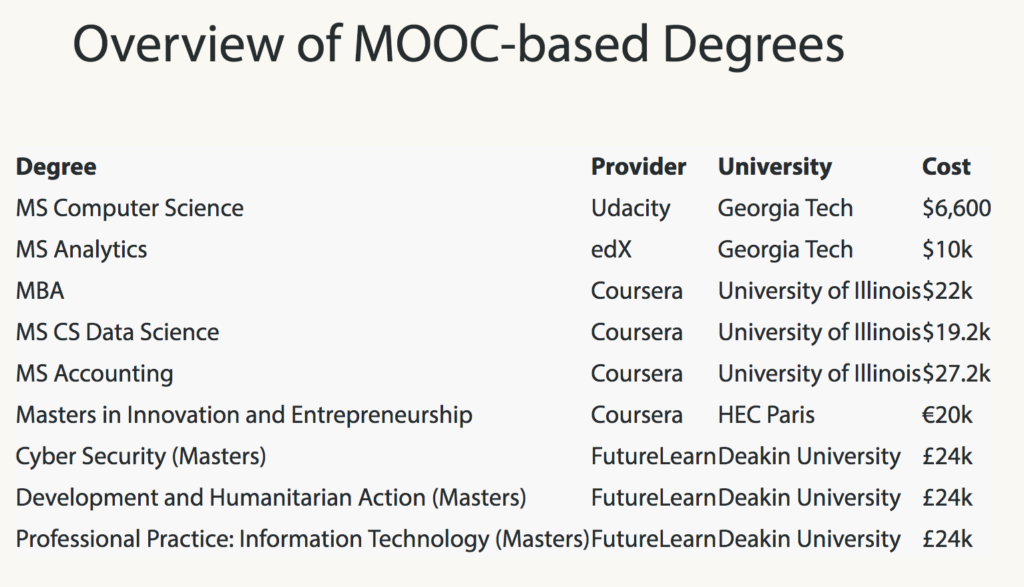
    In a post describing the OPM market last year I noted:

    The OPM market is interesting and dynamic. Here we see strong arguments for both bundled revenue-sharing models and for unbundled fee-for-service models. I personally do not believe that the market is moving away from revenue sharing as much as there is pressure for additional models. There are a growing number of choices available to schools, but there is also a crowded marketplace that is becoming more difficult to understand and compare vendors.

    The 10 programs mentioned above now represent one of these “additional models” in the crowded marketplace.

    For those wanting to understand where the large, commercial MOOC market stands in 2017, I recommend reading both of Dhawal Shah’s posts – from April at Class Central and July at EdSurge.

  • Setting a Standard for Explanations in Learning Science and Ed Tech

    Setting a Standard for Explanations in Learning Science and Ed Tech

    Via John Gruber, I was struck by this quote from David L. Goodstein in his book Feynman’s Lost Lecture:

    Feynman was a truly great teacher. He prided himself on being able to devise ways to explain even the most profound ideas to beginning students. Once, I said to him, “Dick, explain to me, so that I can understand it, why spin one-half particles obey Fermi-Dirac statistics.” Sizing up his audience perfectly, Feynman said, “I’ll prepare a freshman lecture on it.” But he came back a few days later to say, “I couldn’t do it. I couldn’t reduce it to the freshman level. That means we don’t really understand it.”

    First of all, I love what this says in general about the relationship between teaching and academic work. My high school English teacher Mrs. Galighani used to say, “If you’re not writing clearly, then you’re not thinking clearly.” Feynman takes this to the next level. If you can’t explain your research clearly to a smart novice in a manageable amount of time—say, the amount of time you have in a single lecture period—then maybe you don’t fully understand what you’re talking about. And not just you, but maybe even your entire field.

    I’ve certainly found that to be true in both educational technology and educational research. I’ve read a lot of academic papers that sling a lot of statistical lingo to obscure the fact that they haven’t actually proven anything. Actually, that’s not entirely fair. I think some authors get so buried in the lingo and the details that they don’t actually realize that they haven’t proven anything. The same is true, by the way, with many of the theoretical papers in the constructivist camps that get all wrapped up in French literary theory and add the suffix “-atized” to every third word. Clarity is hard. Even Feynman didn’t know that he didn’t fully understand why spin one-half particles obey Fermi-Dirac statistics—indeed, that nobody did—until he tried and failed to boil it down to a freshman-level lecture.

    On the other hand, we get marketing copy or press summaries of summaries of summaries that completely lose the original thread, never mind the nuance. Again, I suspect in most cases the authors don’t know that they are dumbing down the research. They are working on deadline, with a word count limit, and a finite knowledge base.

    The end result in both cases is the antithesis of enlightenment. If we are to move education forward, then there has to be a social contract between those who do the research and those who could use it in the classroom. Authors must commit to communicating clearly to laypeople—to reducing their research to the level of a freshman lecture. In return, people consuming that information must be willing to commit the time and effort that they would hope and expect from freshmen sitting in on one of their own lectures.

    There is a role here for “media,” writ large. At e-Literate, we make an effort to make complex research accessible to laypeople who are willing to invest in reading an 8,000-word article. We also attempt to recover information that is lost in translation when academic studies get boiled down so far that there’s nothing left in the pot. But we’re not going to solve the larger problem with a blog. Academia needs to embrace the notion of education as an applied science, which means we need to generate both supply and demand for Feynman-style explanations of what we are learning about learning.

  • First Board Meeting For Kaplan / Purdue University: Tuition Levels Set

    First Board Meeting For Kaplan / Purdue University: Tuition Levels Set

    Last week was the first meeting for the board of trustees for NewU, the working name for Kaplan University now that it has been “acquired” by Purdue University. And yes, the scare quotes are intentional given the $1 purchase price. I’ll give the group high marks for transparency by the press release.

    In its inaugural regular meeting, the Board of Trustees for Purdue’s new affiliated institution, currently referred to as NewU, approved plans to offer a dramatic tuition discount for Indiana resident students and free tuition for Purdue employees.  The new Indiana resident rate, also approved by Kaplan University’s trustees, will take effect at the beginning of KU’s next academic term. [snip]

    An Indiana resident student pursuing an associate or bachelor’s degree will pay the equivalent of $220, including technology fees, per quarterly credit hour, which is a discount of approximately 45 percent. The total cost to graduation for a bachelor’s degree would be $39,600, compared to a total cost to degree of $80,088 (including room and board) for Indiana residents at Purdue’s West Lafayette campus.

    The reason there are two boards of trustees involved – for NewU and for Kaplan U – is that the deal still must be approved by state and federal regulators and by NewU’s accreditor HLC. (more…)

  • Do For-profit Institutions Converting to Non-profit Affect Distance Education Enrollment Numbers?

    Do For-profit Institutions Converting to Non-profit Affect Distance Education Enrollment Numbers?

    In a comment to my post on the new Digital Learning Compass report covering distance education enrollment trends for US higher education, Richard Garrett, Chief Research Officer at Eduventures and Director at The Observatory on Borderless Higher Education, asked an interesting question.

    I’d welcome your view on a related issue I’ve been wrestling with, namely how to treat for-profit institutions with significant numbers of online students that are now nonprofit. A number made such a conversion in the fall 2012-15 period, and more are to come (e.g. the EDMC and Kaplan announcements). In your study, did you use institutional control for the year concerned or continue to treat former for-profits as such? If the former, then I think it is worth pointing out that some of the private nonprofit growth, and for-profit decline, is due to control conversion.

    With all of the news around for-profit changes, include Corinthian Colleges, ITT, Kaplan University, DeVry rebranding, I thought it would be worth addressing this question in a new post instead of just in the comments as I suspect others may have the same question.

    tl;dr – There has been no material effect of these institutional control changes for the periods covered in the DL Compass report (Fall 2012 through Fall 2015). (more…)

  • Digital Learning Compass: New report on distance education higher ed enrollments

    Digital Learning Compass: New report on distance education higher ed enrollments

    The next generation of the long-running Online Learning Survey is here, and it is now called Digital Learning Compass. Originally known as the Sloan Survey of Online Learning, then known as the Online Learning Survey, this study led by Jeff Seaman and Elaine Allen from the Babson Survey Research Group (BSRG) has been the definitive source for understanding the state of online learning for higher education in the United States since 2003.

    Three years ago the Department of Education’s Integrated Postsecondary Data System (IPEDS) started releasing census-based data on online enrollments, starting with the Fall 2012 term. The most recent data set is from Fall 2015, and today’s release of the Digital Learning Compass: Distance Education Enrollment Report covers this new data. Download the full report for free here. (more…)

  • Purdue University Deal To Acquire Kaplan University: Interview with Trace Urdan

    Purdue University Deal To Acquire Kaplan University: Interview with Trace Urdan

    The surprise news today is that Purdue University has agree to acquire the academic operations of Kaplan University. As stated in the 8-K filing by Kaplan University’s owner Graham Holdings:

    On April 27, 2017, Kaplan Higher Education LLC and Iowa College Acquisition, LLC (collectively, “Kaplan”), subsidiaries of Graham Holdings Company, entered into a Contribution and Transfer Agreement (“Transfer Agreement”) to contribute the institutional assets and operations of Kaplan University (“KU”) to a new, nonprofit, public-benefit corporation (“New University”) affiliated with Purdue University (“Purdue”) in exchange for a Transition and Operations Support Agreement (“TOSA”), pursuant to which, among other provisions, Kaplan will provide key non-academic operations support to New University for an initial term of 30 years with a buy-out option after six years.

    Additional coverage of the deal at The Chronicle, Inside Higher Ed, The Wall Street Journal.

    This is an unprecedented move, and to get some insight, I interviewed Trace Urdan, who has long covered higher education as an investment analyst and is one of the most knowledgeable observers of the for-profit sector. The following description is based mostly on this interview, paraphrasing Trace’s explanations and adding quotes in places. (more…)