
e-Literate

Present is Prologue

Category: Academics & Academia

The “Academics and Academia” category covers topics related the ways in which colleges and universities function that are relevant to technology-supported education. One key aspect covered here is pedagogy—how people teach—and how technology impacts teaching and learning.

But this category also includes more institutional aspects that are relevant to technology-supported education, such as how campus leadership supports (or doesn’t support) new initiatives, politics and bureaucracy that impact these efforts, and so on.

Finally, “Academics and Academia” covers commercial and non-profit services that provide support for technology-supported education initiatives, such as Online Program Management (OPM) companies.


  • Northern Arizona University: Modified math emporium for first-year students

    Northern Arizona University: Modified math emporium for first-year students

    In episode 1 of our e-Literate TV case study on Northern Arizona University, we gave a broad overview of the suite of initiatives (primarily) targeted at helping first-year students amidst the tensions coming from growing enrollments. ((Disclosure: Our e-Literate TV series of video case studies and explainer videos is funded by a grant from the Bill & Melinda Gates Foundation.)) In episode 2 we covered their advising and student support, including work with IPASS initiative. In this episode we look at their modified math emporium approach leveraging the Lumberjack Mathematics Center.

    Math emporia have a mixed reputation, occasionally described as “the place where all the non-math majors are generally sent to virtually teach themselves subjects” or that “we’ve outsourced jobs for professors to a bunch of students on hourly wage”. Yet studies have shown positive results in many cases. Just saying there is an emporium approach doesn’t tell you much – some are run well with plenty of support for students, and some leave students on their own with poor support. So it is useful to see a specific case. How has NAU implemented a math emporium approach, what does it look like, what support is provided, and what are the results? NAU has implemented a modified emporium, and they have invested in a new facility to support this model.

    (Video source: https://youtu.be/A1GLmGri1So)
    (more…)

  • Northern Arizona University: Their work in student support and IPASS initiative

    Northern Arizona University: Their work in student support and IPASS initiative

    In episode 1 of our e-Literate TV case study on Northern Arizona University, we gave a broad overview of the suite of initiatives (primarily) targeted at helping first-year students amidst the tensions coming from growing enrollments. ((Disclosure: Our e-Literate TV series of video case studies and explainer videos is funded by a grant from the Bill & Melinda Gates Foundation.)) In this episode we look outside of the classroom to see how they’re approach advising and student support.

    As we mentioned yesterday, NAU has a rapidly growing enrollment and has a large percentage of students (more than 40% of incoming freshman) that are first-generation. These students do not have a long-history of academic success, and they typically do not have a family support system in place to help them understand what to expect in college and how to succeed. First-generation students tend to come from lower-income families and have a greater tendency to work 20+ hours per week on top of their college studies. We even documented last year how first-generation students tend to spend more on textbooks. Simply put, for schools attracting high percentages of first-generation students, there is an even greater need to provide support and advising structures in place to help them acclimate to college life and studying requirements. And even guidance on how to manage their degree and career plans.

    This is the context to understand the challenges NAU faces as they have changed their approach to advising and student support.

    (Video source: https://youtu.be/0uuogTI_IRY)

    (more…)

  • Northern Arizona University: A suite of initiatives to help first and second-year students

    Northern Arizona University: A suite of initiatives to help first and second-year students

    As part of our e-Literate TV series of case studies, we had a chance this fall to interview faculty and staff at Northern Arizona University about, well, a lot of stuff. ((Disclosure: Our e-Literate TV series of video case studies and explainer videos is funded by a grant from the Bill & Melinda Gates Foundation.)) Rather than highlighting a specific program or course redesign, NAU has invested in and implemented a suite of initiatives focused on improving student learning and success by rethinking the experience of (mostly) first-year students.

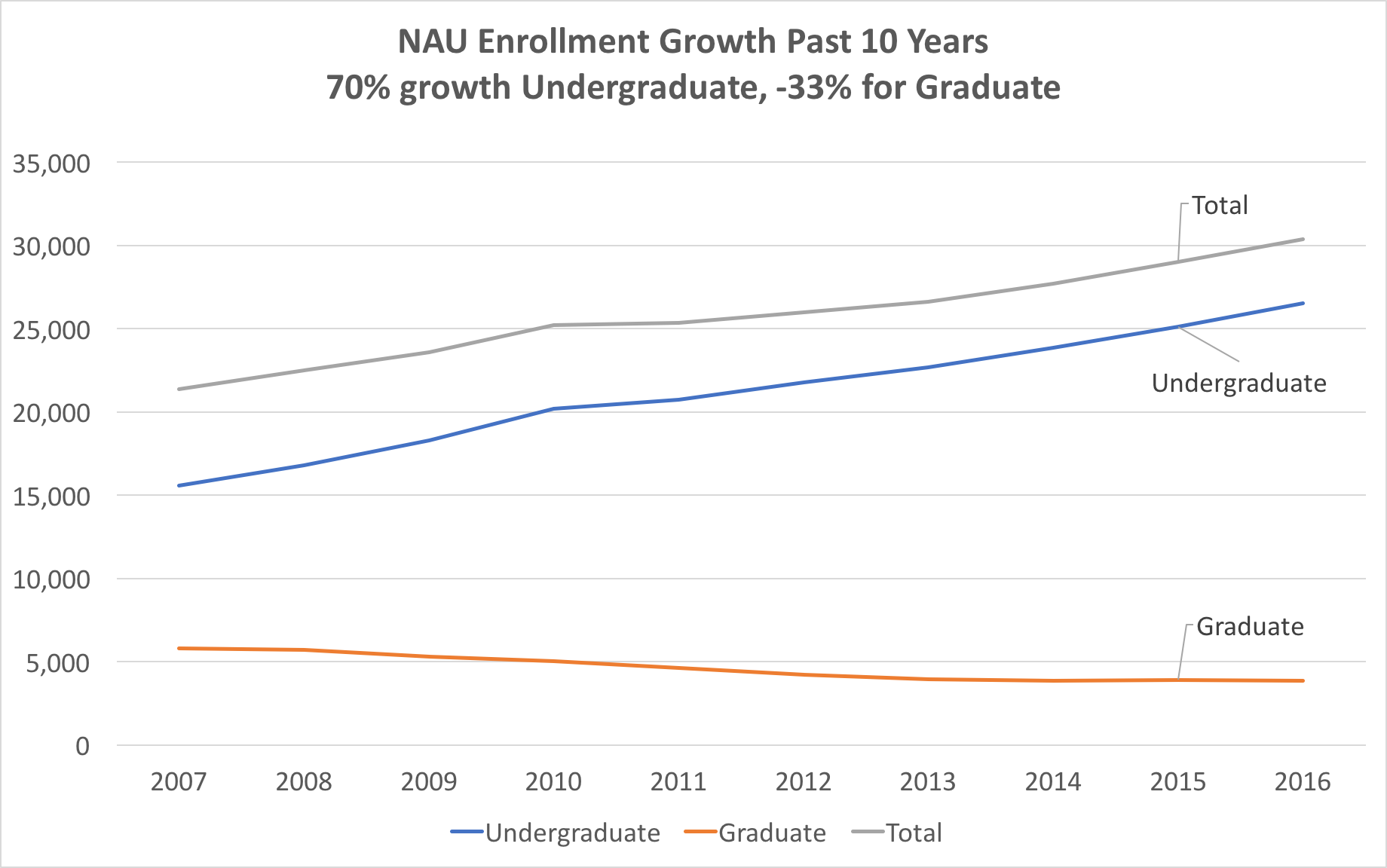
    The core challenge NAU faces is to make these student-facing changes while facing growing enrollment, particularly for full-time undergraduate students.

    enrollment-growth-level
    (more…)

  • The Intended Consequences of California’s Online Education Initiative

    The Intended Consequences of California’s Online Education Initiative

    Last month we presented two explainer videos on the growing usage of course exchanges, where multiple institutions pool resources in creating or extending online courses. ((Disclosure: Our e-Literate TV series of video case studies and explainer videos is funded by a grant from the Bill & Melinda Gates Foundation.)) If online courses or programs breaks down the barriers of campus walls and enables anytime, anywhere education, then why not explore how collaboration can open up access and improve quality. While we tend to not write e-Literate about our consulting work through MindWires, in this case we have heard a general interest from other systems to learn more about what the California Online Education Initiative (OEI) at the community college system is doing.

    The first two videos explored the concept of course exchanges in general and the required infrastructure needed to create them. In our third explainer video from this series we go back to the OEI to look at how their investment in academic infrastructure should provide benefits that go well beyond the courses and students participating in the course exchange. This extension of benefits, however, was not a surprise to those creating OEI; rather, these broader benefits represent the intended consequences of their approach to collaborative online education.

    (Video source: https://youtu.be/1DdlaIZYiDI)

    (more…)

  • Chan/Zuckerberg: The “Tech” is not the Hard Part in “Ed Tech”

    Phil and I were recently interviewed by KQED’s Sarah Tan for a story about the Chan Zuckerberg Initiative’s Summit platform. As often happens when our comments are just one bit of a larger story—particularly when we are asked to provide a more critical external perspective as a check on the enthusiastic reports of a project’s participants—some interesting parts of the interview conversation inevitably ended up on the cutting room floor. Ms. Tan was kind enough to grant us permission to repurpose some of the source material from the interview for this blog post.

    To be clear, Phil and I have no direct experience with the Chan Zuckerberg Initiative and have only seen the publicly available information on the Summit platform that it has released (although we both took some time to review that information carefully in advance of the interview). The value of the conversation snippet we provide here is in answering the questions, “Even if you think an ed tech platform seems well designed and the creators seem well intentioned, why might it fail anyway? And while we’re at it, how should we even define success?” These are questions that rarely get asked and answered clearly in discussions about ed tech, including in much ed tech research.

    (more…)

  • Pearson Releases a Significant Learning Design Aid

    Last week, Pearson announced the release of some resources they have created around science-based learning design. (Full disclosure: Pearson is a client of our consulting company, although we have not consulted with them on the subject of this post.) The resources in the release include the following:

    • A 102-page rubric the company has started using for evaulating curricular products based on their effective use of learning design principles—released under a Creative Commons license
    • A white paper describing how they are beginning to apply these principles to their own product designs
    • A few links to descriptions of early examples of these principles as they have been applied in released products.
    • A blog post providing some more background and perspective by David Porcaro, Pearson’s Director of Learning Design, whose team is behind this effort.

    In the short term, you should think of this publication as the company’s effort to “show their work,” in the classroom sense of that phrase. They want you to know more about the process they go through to incorporate research-backed learning design principles into their products. They hope that doing so will increase your confidence in the value of those products. In the medium term, they also aspire to make the framework they are developing for themselves also a useful tool for the academic community, particularly as the company refines and expands on this early release of the materials.

    In my view, the work itself is a significant contribution. It also is a positive indicator about Pearson’s future direction as a participant in and influencer of that community, although how strong an indicator is a much harder question to evaluate. And it gives us another clue about the co-evolution of educational institutions and ed tech vendors that we are likely to see over the next years and decades. In this post, I’m going to evaluate each of these aspects in turn.

    (more…)

  • Explainer Videos on Course Exchanges and the Shared Infrastructure Behind Them

    Two months ago O’Neal Spicer and I wrote an op-ed for the Community College Daily describing our observations on the California Online Education Initiative (OEI). We don’t often write about clients of ours, but in this case we felt it would be useful to share our thoughts outside of the consulting context, and the OEI staff agreed.

    While some argued that a parallel system of MOOCs, unbundled course and third-party operators should step-in, the state opted to re-invest in its existing faculty and infrastructure. At the heart of what became known as the Online Education Initiative (OEI) was a system for an online course exchange that could help to improve access to courses that were oversubscribed or not available at local campuses.

    California was not alone in making the move toward a system where a consortium of campuses pooled resources to offer online courses for students across multiple campuses. North Carolina has done so, as has Colorado and Mississippi and several others. Part of the attraction of course exchanges comes from the acknowledgement that with online education, the campus walls do not need to be an artificial barrier.

    Ryan Craig wrote a separate piece for Forbes on the upcoming release of the OEI course exchange as did Ashley Smith at Inside Higher Ed.

    We thought it would be useful to explore this concept of course exchanges more broadly. ((Disclosure: Our e-Literate TV series of video case studies and explainer videos is funded by a grant from the Bill & Melinda Gates Foundation.)) OEI is not the first course exchange – Colorado Community College System, University of North Carolina System, Mississippi Virtual Community College, Kentucky Virtual Campus, to name a few other initiatives ((Disclosure: Besides OEI, Colorado Community College System and Mississippi Community College System are past clients of either MindWires or its predecessors.)). What is the concept of course exchanges and what problem is being addressed? In a nutshell, you can think of this as removing the traditional boundaries of higher ed, as described in our first video.

    (Video source: https://youtu.be/HBCVAau8hK8)

    (more…)