e-Literate

Present is Prologue

Category: Academics & Academia

The “Academics and Academia” category covers topics related the ways in which colleges and universities function that are relevant to technology-supported education. One key aspect covered here is pedagogy—how people teach—and how technology impacts teaching and learning.

But this category also includes more institutional aspects that are relevant to technology-supported education, such as how campus leadership supports (or doesn’t support) new initiatives, politics and bureaucracy that impact these efforts, and so on.

Finally, “Academics and Academia” covers commercial and non-profit services that provide support for technology-supported education initiatives, such as Online Program Management (OPM) companies.


  • D2L: Continuing emphasis on services and completion of move to SaaS model

    D2L: Continuing emphasis on services and completion of move to SaaS model

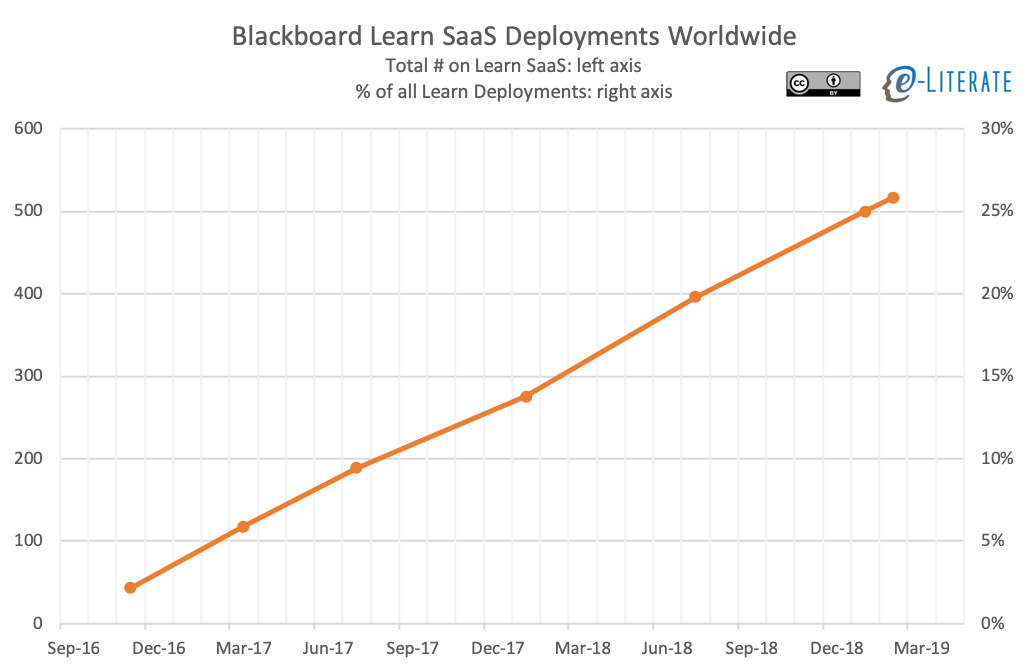
    In last week’s post on Blackboard, I shared the roughly linear progression of migration of the Learn LMS to a software-as-a-service (SaaS) model – a move that we believe is more important than is the Learn Ultra user experience. If you take into account percentages of total Learn deployments, you see that Blackboard has roughly 25% of Learn clients on SaaS after starting in late Fall 2016, increasing by approximately 10% per year. ((Each point is taken from Blackboard public release of information either directly to us at e-Literate or in press releases.))


    Blackboard Learn SaaS Deployments over time

    Blackboard is not the only LMS company migrating to the cloud, however, and D2L  ((Disclosure: D2L and Blackboard and Instructure are all subscribers to our LMS Market Analysis service.)) has taken a more aggressive bet on SaaS for their Brightspace LMS platform (also based on AWS), as described in Summer 2018.

    While we heard grumblings from multiple clients during the transition – especially through early 2017 – D2L clearly made some hard choices and and is aggressively moving to the cloud, not just as an option, but as their primary delivery model. According to David Koehn, VP of Product Management at D2L:

    • All new Brightspace implementations are on AWS cloud;
    • Virtually all current Brightspace implementations use Continuous Delivery; and
    • Approximately 50% of current customers are already on the AWS version of cloud deployment; and
    • By the end of 2018, a large majority of customers will be on cloud deployment.

    Last Fall I spent time at D2L’s Kitchener, Ontario headquarters getting an update on the company’s progress on a number of initiatives. D2L executives described that all but roughly a dozen Brightspace clients are now on SaaS deployment, and by the end of 2019 they should be fully a SaaS platform company.

    Why is percentage of total deployments important? Two reasons are that the move to 100% SaaS deployment enables the movement to a single version of code, dramatically simplifying regression testing and enabling more rapid development of new designs, while also taking advantage of modern technology stacks. As described in the Summer 2018 post:

    David Koehn also pointed out that the real driver for the AWS cloud move by D2L is to enable a redesign of the user experience [branded Daylight] and to provide improved scalability and reliability. In other words, the cloud deployment is a means to the Daylight end.

    The downside, of course, is that pure SaaS deployments largely leads to a reduction in customization capabilities. Companies like D2L and Blackboard that are moving from an enterprise model to a cloud model are betting that they can build in appropriate configuration options (rather than customized code) and leverage third-party integrations to overcome this challenge. But to get the full advantage of SaaS, a company needs to do the entire move.

    I further spent some time in London and had the opportunity to talk with D2L’s London-based leadership team that covers EMEA and Latin America regions. D2L leaders in London presented a transparent and honest appraisal of the company’s current market position in Europe and Latin America, and where they see the biggest opportunities. For starters, D2L acknowledged that Instructure’s system-wide wins for the Canvas LMS in the Nordic countries had largely blocked opportunities for expansion in that region. Other areas, however, have been much more promising. They are doing well particularly in the Benelux countries (Belgium, Netherlands and Luxembourg) with Ghent University in Belgium being an example of a recent, large (45,000 student) implementation. There have been important wins in the UK and Ireland, and activity in Spain seems to be picking up some momentum. Germany continues to be a challenging place to get a foothold partially due to university funding that favors in-house staff maintaining open source systems.

    In Latin America, D2L was open about cutting back investment in the region in 2017, particularly in Brazil, largely due to economic uncertainties and limited growth opportunities. They now see activity picking up in the region and have been investing to take advantage of the market potential.

    In both Europe and Latin America, the provision of professional services beyond the LMS platform, as well as willingness to add requested features, appears to be a differentiator for D2L, especially in comparison to Instructure. D2L has shown a much greater willingness to roll up their sleeves and collaborate on instructional design, course building, and online pedagogy using internal staff, almost in an Online Program Enablement model. It surprised me during my Fall HQ visit to see just how well-established is the content creation team that helps schools redesign courses and even design front-end web sites for online programs. We have heard similar messages from D2L customers and even from a consulting firm that works directly with Canvas and Brightspace customers.

    To a degree, none of this post is different from our Summer 2018 coverage other than updating on progress, so why has D2L not made more of a market share increase in the past year? I suspect there are three reasons. One is that D2L has done a better job updating their product line and introducing new services than they have done in fixing issues with current customers, particularly around data and analytics. During my Fall HQ meetings, when the D2L team was describing their new data and analytics approach called the Brightspace Data Platform, I pointed out that while this appears to be an improved approach, it does not acknowledge that D2L has been touting its data and analytics capabilities for years. There are leftover frustrations from customers based on previous attempts that did not match client expectations.

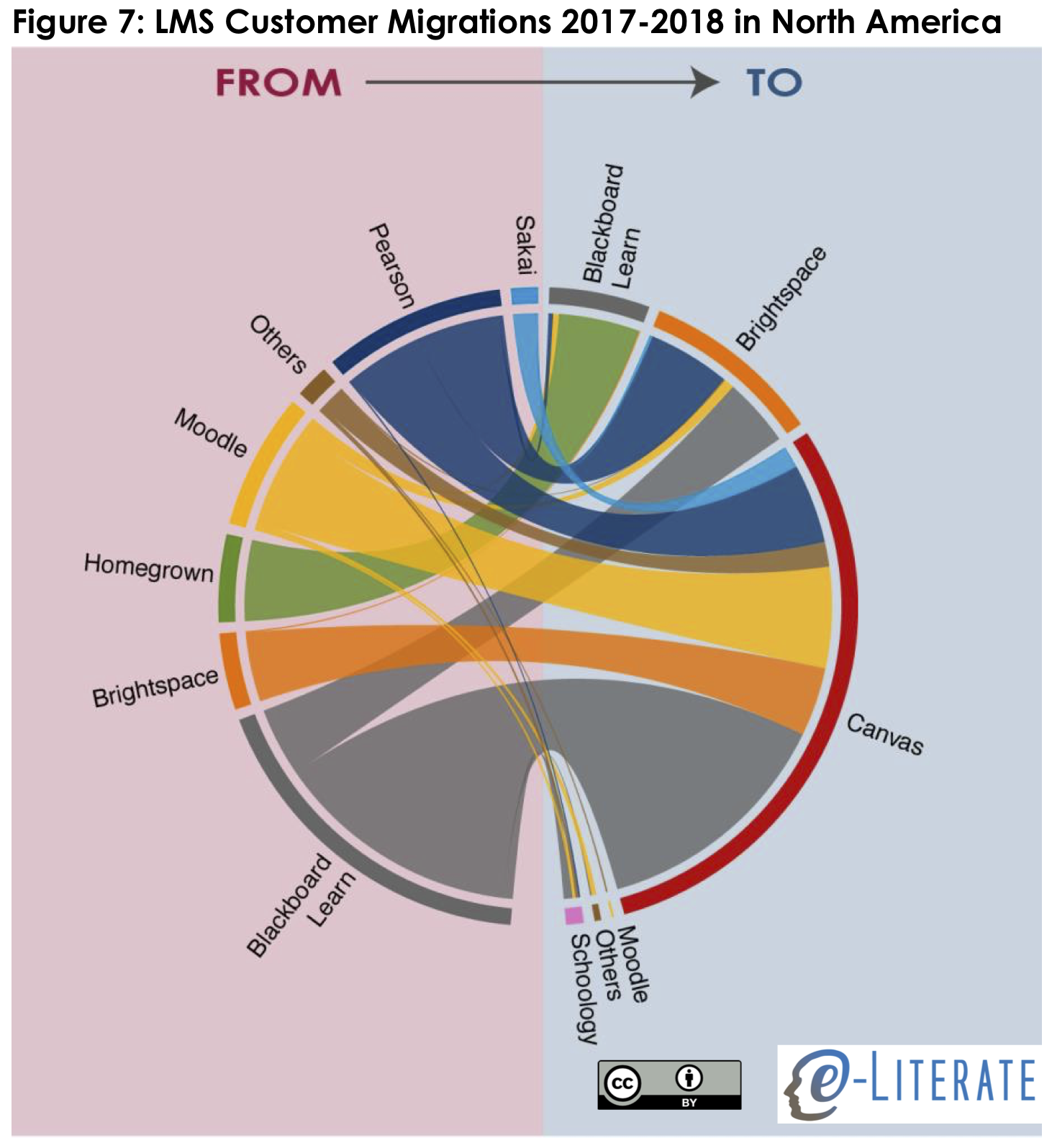
    The second reason is Instructure. While D2L is in a solid second place for new implementations worldwide (schools migrating from one LMS to another), they have also lost a number of clients in North America – almost all to the Canvas LMS. In our recent LMS Market Analysis report, we showed a transition graphic with higher ed LMS migrations from 2017 – 2018.

    LMS Migrations 2017-18 Higher Ed

    The third reason is that it is very difficult to be a third competitor in terms of customer mindshare. The academic LMS market has tended to have a narrative of a major competitor and an upstart. Blackboard and WebCT in the early and mid 2000s, Blackboard and Moodle in the late 2000s, and Blackboard and Canvas through much of the 2010s. It is difficult for a company like D2L to break through this narrative and be top of mind for institutions from day one of an evaluation.

    While D2L has challenges in market position and introduction of a new data and analytics approach, they are completing the transition to a SaaS platform company and focusing on flexibility and services.

  • OPM Readings: New policy briefing from UCT and other useful coverage

    OPM Readings: New policy briefing from UCT and other useful coverage

    Over the past eight days there have been a series of valuable articles covering Online Program Management (OPM) and the broader Online Program Enablement (OPE) markets. ((See this post to better understand the OPE concept.)) All four articles provide useful historical and academic environment context to better understand market dynamics.

    University of Cape Town Policy Briefing

    Laura Czerniewicz and Sukaina Walji from the University of Cape Town’s Centre for Innovation in Learning and Teaching (CILT) released Issues for universities using private companies for online education this week as a policy briefing for “universities who are thinking of using – or already using – private companies to develop or expand their online programmes or courses” ((I’ll stick with the South African English spelling in this section.))

    Rather than just focusing on the OPM market itself, Czerniewicz and Walji place the subject into the broader context of “marketisation, digitisation, unbundling and austerity climates.” This placement is valuable, as it frames the appropriate questions that colleges and universities should address when considering OPM or OPE vendor support.

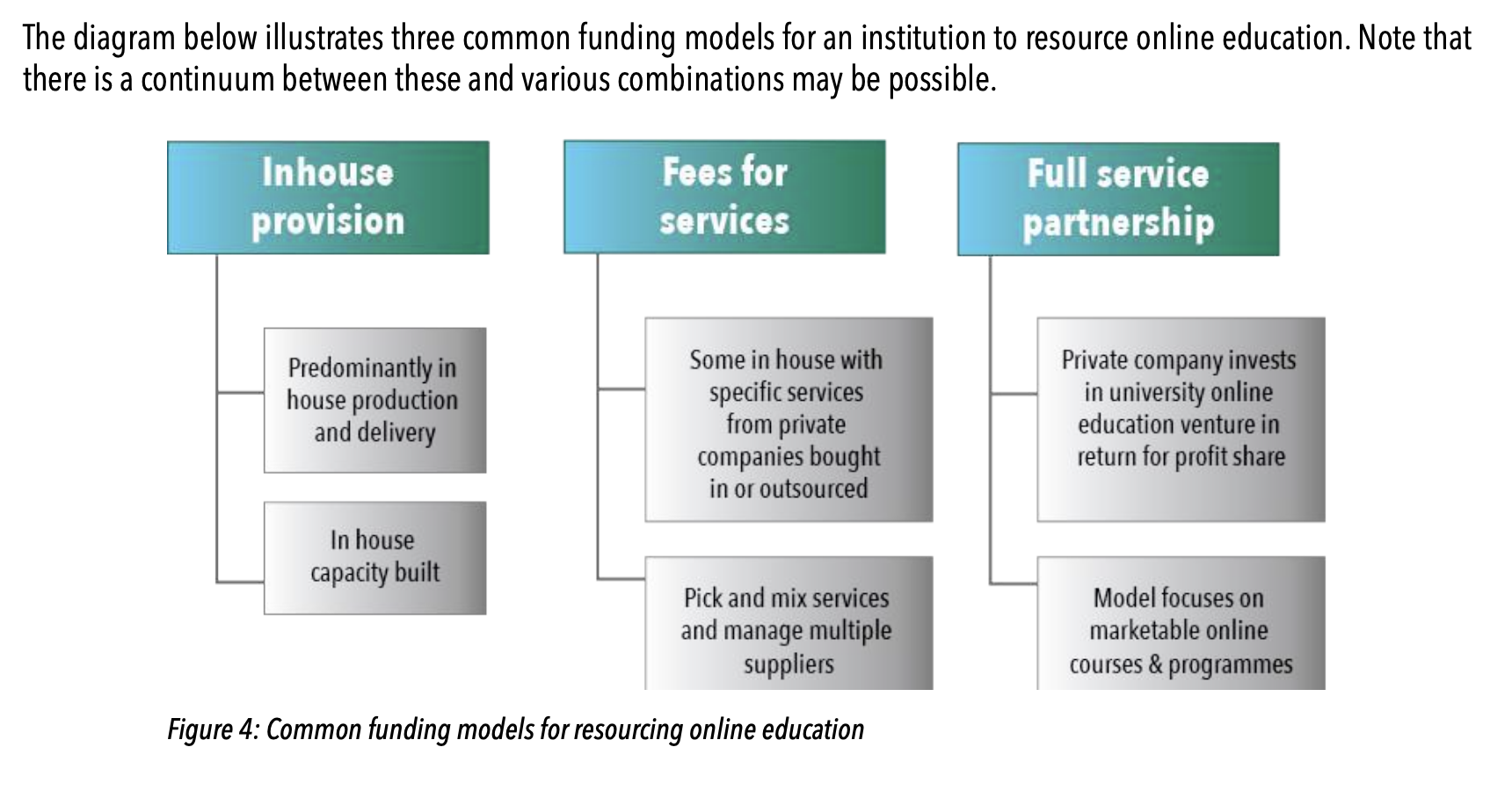
    After addressing why the OPM / OPE movement is becoming so important now – from an international perspective with some global south viewpoitns  – the briefing addresses the various funding models involved. The note in the description about these models being on a continuum with various combinations possible is crucial.

    Three common funding models - inhouse provision, fees for services, and full service partnership

    The briefing including a Strengths, Weaknesses, Opportunities, Threats (SWOT) analysis for the full-service OPM scenario and for an inhouse / fees-for-service scenario as well as use cases for different institution types. It is well-worth reading the whole report.

    EdSurge Debate on OPMs

    Last week EdSurge ran a two-article series on OPMs that missed the SNL’s Point / Counterpoint opportunity and instead tried the nuanced argument method.

    Dan, you pompous ass

    In the first post “How OPMs are the Modern Enrollment Managers”, Randy Best and Harris Pastides from Academic Partnerships described OPMs as a follow-on to the enrollment management companies that emerged in the 1970s, with OPMs partially taking credit for moving away from the for-profit sector.

    These OPMs, like enrollment management consultants decades before, assist universities in providing access to time-pressed, place-bound students for whom online education is the only choice for earning a degree. In doing so, OPMs shifted leadership in the market for online education from for-profit institutions, which dominated the landscape in the early days, to nonprofit institutions.

    After addressing four myths about OPMs, Best and Pastides position full-service revenue-sharing OPMs against the new movement of fee-for-service OPM / OPE providers.

    Given the evolution of OPMs, perhaps the time has come for a new name to describe them. They are not just managers, but partners with universities. They don’t just oversee programs, but perform operations critical to the overall success and reputation of the institution. And their efforts often result in the expansion of overall enrollment. In many ways, they should be called Enrollment Growth Partners.

    Some players in the OPM space who are not traditional comprehensive providers are trying to adopt the mantle of the future with fee-for-service or unbundled offerings. But fee-for-service simply shifts the cost and financial risk to universities. Meanwhile, by unbundling services—say by separating recruitment and retention—outside partners become solely focused on getting students in the door rather than keeping them through graduation.

    Michael wrote the second post “The ‘O’ in ‘OPM’ Could Stand for ‘Outsourcing’”, where instead of taking the simple pro / con approach to the debate, he argued for some nuance in our analysis. In particular, he took issue with the quoted description above.

    Michael’s historical context story differed from Best and Pastides, describing John Sperling’s history creating the University of Phoenix and how the current context for bundling and revenue models.

    The essential OPM characteristics of bundling and revenue sharing, both of which Pastides and Best tout as almost inherently good, contain trade-offs just like any other proposed solution to a complex problem. They balance growth opportunity against a range of risks, including risk that the up-front costs of launching the program would not be repaid, or that the universities could not execute well on essential aspects of the project (like student recruitment), or that they would let down the students by failing to maintain good quality of technology platform support or service at scale.

    There’s nothing inherently bad about managing these trade-offs through a full-service, bundled revenue sharing agreement. But there’s nothing inherently superior about the approach either. For example, universities that are more worried about the risk of failing to grow fast enough than they are about minimizing the expense of using an external vendor are often well served by finding a high-quality OPM partner, while universities with different risk profiles may come to different yet equally appropriate conclusions.

    Both posts are worth reading, and it is interesting to see the same issue described here and in the UCT briefing – about colleges and universities managing trade-offs when deciding which model is appropriate when selecting private partners to help with online programs.

    Education Dive

    Education Dive is running a three-part series on the issues involved with federal rule-making debates, and the first deep dive is “As traditional colleges grow online, OPM relationships shift”, describing the broadening market while traditional schools and systems like SUNY look to develop a strategy for online education.

    The State University of New York (SUNY) is one of several public systems looking to raise its profile online. An early pioneer with its Open SUNY platform, the 64-campus system in July issued a request for information about how it could “take the next step in creating a comprehensive environment” for online learning within and beyond New York state. [snip]

    The document, which Education Dive obtained, mentions a desire to “leapfrog competition” and “challenge current leaders in the field.”

    The article explores several of the OPM-related topics as well as motivations for traditional institutions developing online strategy, based on a series of interviews that included Michael. The key theme of the article described how the OPM market is changing, and the boundaries between online and face-to-face education are blurring.

    Soliciting OPM services for ground-based and hybrid programs can help colleges present a unified face in the market when they offer both on-campus and online versions of a program. Wiley, for example, provides full-service marketing support targeting prospective students for George Mason’s online and campus-based MBAs. That includes SEO, paid search, online advertising and social media.

    “The dialogues (are) more and more moving toward broadening the services to be more than just about the fully online student (but) to be about the student at the university no matter what their modality,” [co-president of Wiley Education Services and Learning House] Hillman said.

    That could lead to an uptick in blended and hybrid experiences, [co-founder and CEO of iDesign] Riter predicts, where learners navigate instruction online and on campus.

    “Over time there’s going to be less difference between online and face-to-face education,” he said. “It’s just going to be education, and even face-to-face residential education that exists today is going to be much more technologically infused.”

    It’s good to see four separate articles all worth reading about the emerging and broadening OPM market, with useful context.

  • Is Ed Tech Hype in Remission?

    Is Ed Tech Hype in Remission?

    Last Wednesday, there was an announcement about an investment in Civitas Learning that appeared to escape the notice of the educational press. Even EdSurge and Education Dive, which are both pretty good about covering the investment side of ed tech, seem to have missed it.

    And at first blush, it’s easy to see why. The press release reads like a generic funding round that was successfully closed:

    Civitas Learning today announced a significant growth investment from Francisco Partners, alongside current education and impact investors including Rethink Education, SJF Ventures, and Lumina Foundation. The Austin-based company pioneered the use of advanced data science, design thinking, and machine learning to inform initiatives and improve student outcomes.

    That’s the meat. The rest of the press release is the usual anodyne quotes from the CEO and investor, fun facts about the company, and so on. Blah blah blah.

    But there’s more here than meets the eye. First, Francisco Partners is not a venture capital fund. It’s a private equity firm. If Civitas were experiencing enough success to raise a growth round of funding, then a PE firm with no obvious experience in higher education would not be a conventional candidate for a funder. And we at e-Literate have seen no evidence that Civitas is, in fact, growing in a way that would justify a next round of investment. We haven’t heard about any new Civitas customers in quite a while (though we’ve heard about some customer losses and some grumbling among their current customer base). A quick perusal of their press pages doesn’t show any announcements of big customer wins either. It does reveal an announcement of a partnership with recruiting and retention company Ruffalo Noel Levitz, which is interesting and which I’ll return to later in this post.

    Put all this together, and the deal looks more like a fire sale than a growth round. We have some information from sources familiar with the deal which supports this inference, although we do not have enough independent sources to confirm it yet.

    I have no major beef with Civitas on the fundamentals of what they’re trying to do. But the buzz they generated, the valuations they got from investors, and the cool kids’ club that seemed to hover around them for a while are all symptomatic of a company that, whatever the soundness of its fundamental aspirations may be, was hyped by the markets and the press. The bubble may be deflating now.

    A smart friend commented to me the other day that there are fewer of these lo-how-the-mighty-have-fallen stories than there used to be. I think this is a profound observation. Something has been shifting in the ed tech markets over the past five years or so. The ed tech hype cycle seems to have at least partially and temporarily burnt itself out. While I have no illusions that hype cycle is dead, or that it will stay relatively dormant, the quality and intensity of it is definitely different than it was five or six years ago. And that change may be a visible symptom of some more fundamental changes that are happening in the educational landscape.

    Remember the days?

    Remember the days when EDUCAUSE was partly a kind of fashion show? I could always go there and come away with a good blog post about that year’s ed tech darling. One year it might be open source LMSs. (Did you blink? Ah, too bad. It was a sight to see.) The next year it might be Pearson’s OpenClass. (Remember that?) Or Knewton. (Yes, they do still exist. I checked.) But there was a moment about six or seven years ago—I remember talking to Josh Kim about it at the time—when the theme of EDUCAUSE became that there was no theme. It has stayed that way ever since.

    That wasn’t the end of hype. It shifted to other places. The fashion show moved to SxSWedu for a few years. And online. And in the mainstream press.

    One could argue that we hit peak ed tech hype in 2012. The Year of the MOOC. Remember how there were only going to be 10 universities in the world, and only one lecture for every subject, given by the very best lecturer in the world? Remember how everyone was going to get a Stanford education for free?

    Yeah. Good times.

    Since then, the hype cycles have been shorter and less intense. Sure, there was the whole adaptive learning bubble (or “personalized learning,” as it is inaccurately called), but a lot of that was the knock-on effect of a flood of Gates Foundation money. I never got the sense that there were many True Believers in adaptive learning as a magic bullet. There are still some True Believers in learning analytics, but it’s a small group. In fact, the OER True Believers club may now be larger than the learning analytics club.

    Mostly, people seem to be approaching all of these things—learning analytics, adaptive learning, OER, inclusive access, etc.—with a little more sobriety. These developments are all getting attention, but not a lot of hype (though not always for lack of trying). The general attitude among educators and institutions seems to be more like, “Huh. So that’s a thing now. Good to know. What can I do with it?”

    Gone are the days—at least for now—when provosts or presidents emerged from their offices all across the country and proclaimed, almost in unison, “Hear ye, people! I hath spake with the good people from Coursera, and they have shared with me the miracle of recording lectures in four-camera studios and giving away the courses for free. Huzzah! Huzzah! Let us be fruitful and make MOOCs with great haste!”

    Don’t get me wrong; there are still presidents and provosts emerging from their offices and making pronouncements. But I’m seeing a lot less of it than I used to. The fever seems to have passed and left some antibodies in its wake.

    The one area in the market where I see something approaching hype, which I would characterize more as “intense interest coupled with a lot of hand-wringing,” is in the Online Program Management (OPM) space.

    It’s worth asking why this is so.

    Operational excellence is the new hotness

    I have an optimistic and a pessimistic take on why ed tech hype is cooling and focusing at the moment. The optimistic take is that the sector is finally learning that there are no magic bullets. There used to be a lot of frantic effort generated by of fear of being left behind. That fear is now balanced by a healthy fear of wasting time, energy, and reputation that could be better invested. The pessimistic take is that, as a wider swath of institutions faces the existential threat of financial insolvency, they don’t have cycles to waste on trying to do cool things. They need to be focused on effective things. When an elite liberal arts school like Hampshire College is teetering on the edge of extinction, you know that #*@!& is getting real. There is likely some truth to both of these takes, which tend to feed each other.

    What do OPMs do for universities? The simplistic first-approximation answer is that they enable the schools to generate more live-and-thrive revenue by generating more enrollments. How do they do this? Again, the first-approximation answer is that they provide operational excellence at building, launching, and filling new online degree and certificate programs. The good ones can do it quickly, efficiently, and with decent quality levels relative to the current baseline of quality in online learning. And if you believe that the OPM solution category is partly defined by revenue sharing (which I do), then true OPM offerings include a financing service, which enables the schools to get more programs up more quickly (albeit potentially at a higher long-term cost).

    This value proposition is a far cry from robot tutors in the sky that can semi-read your mind. It’s less sexy, more grounded, and more strategic.

    This shift toward practical operational services is mirrored by shifts in the capital markets such as the recent Civitas development. I have always felt that the potentially fatal flaw in Civitas was that it should have been a service company but chose to position itself as a platform company in order to compete for capital. VCs love platforms because they can grow very big without adding the cost of a lot more humans to run them. You know, like Google and Netflix. If you want to get a lot of money from VCs, it helps a lot to look like a platform company (although I get the sense that’s beginning to change in the education investment space).

    If you want a picture of what Civitas could have been (and maybe should have been) in an alternate universe, then look at EAB. It’s positioned as a service company with some tech. Its big-picture value proposition to customers is basically operational excellence at recruiting and retaining students. Because the EAB management never had to raise venture capital, they were free to be what they needed to be in order to support their customers. They didn’t have to pretend to have a magic platform. They could be some very smart people who have some useful skills at improving end-to-end student success and who have some software that helps with that (which might also be a more honest description of Civitas).

    You’ve probably heard a lot less hype about EAB than you have about Civitas. But guess what? EAB was acquired in 2017 for $1.55 billion.

    I doubt that Civitas’ valuation is that high, particularly after this latest cash infusion. Their partnership with Ruffalo Noel Levitz is particularly interesting in this context. What do you get when you combine Civitas with a recruiting and retention services company? A more service-oriented offering that looks a little more like EAB—and a little more like an OPM or an Online Program Enabler (OPE).

    Maybe now, with a more realistic valuation, a more service-oriented value proposition, and hopefully some patient capital, Civitas can realize its potential. I’m not making any predictions, but this feels like a course correction which both reflects the current realities in higher education and has the potential to bring the company more in line with those realities.

    Operational excellence at supporting student success is the Next Big Thing

    So colleges and universities are getting more focused on developing and supporting solid online programs that serve untapped student needs well enough to generate reliable additional revenue for the institutions. There are whole product categories of companies that are succeeding by providing various kinds of operational support for this growing focus. The variations among the commercial offerings are diverse and fast-growing enough that it is creating some confusion in the market, but a lot of that naturally comes with rapid growth and the bare-knuckled competition it engenders among vendors.

    The nascent area that shows major yet poorly defined potential for growth is in helping universities improve the baseline for (online and on-premise) student success, whether that means college completion, career advancement, or something else. I see a lot of innovation at individual institutions and from individual vendors that gets at pieces of this problem. But the sector still lacks end-to-end methodologies for restructuring our colleges and universities to optimize themselves for this purpose and continually improve at it. Learning analytics are cool. But you know what’s really cool? Students who graduate, on time, for less money, and whose education enables them to live better lives.

    That’s the next frontier in higher education. It’s a hard one, and there won’t be any magic bullets that “fix” or “disrupt” all of education. But there will be large gains in significant pockets. Universities were not designed to serve this primary purpose with excellence and efficiency in a 21st-Century world. They do surprisingly well given that fact, but we will discover some big opportunities for gains similar to the ones we see when we put an electric drive train into a conventional automobile.

    “Guess what? All that up-and-down with the cylinders, all firing at exactly the right millisecond, and then the gears and contraptions to turn the up-and-down into round-and-round? Gone. Oil changes? Gone. You have a battery, you have electric motors directly attached to wheels, you have absurd amounts of torque, and very few moving parts to wear out. The power goes straight to the wheels. All that internal combustion stuff did a great job for the last 100 years, but we can propel our wheeled vehicles with more efficiency and less complexity now.”

    We will discover opportunities to rethink and return to first principles in higher education. They won’t be tech-only; the machines we are talking about are the universities themselves, and the changes will be ones of process at least as much as of tech. These changes won’t work everywhere equally well to solve all educational problems. But the fact that colleges and universities have not been consciously and continuously optimized for their new role (and sustainability needs) means that we will find many gaps where simple changes will make outsized differences.

    This is already happening in many individual places. You will likely find at least one such story on any given week reading Inside Higher Ed or EdSurge. What we haven’t seen a lot of yet is a knitting together of the individual innovations into a methodology for operational excellence at supporting end-to-end student success. EAB is one harbinger of things to come in that regard.

    Mark my words: The institutions that figure out how to do make this transformation, and the companies that figure out how to support it, will tend to thrive in the long term. In my entire career, the only thing I’ve ever found that has come close to living up to its hype is a good education.

    More of that, please.

  • Insight into Community College Students and Challenges of Online Education

    Insight into Community College Students and Challenges of Online Education

    Inside Higher Ed reported today on a new survey report on community colleges and challenges that students face.

    Most community colleges are aware of the challenges students face if they are working, raising children or struggling to afford textbooks. But a newly released survey digs into the nuances of those challenges so colleges can pinpoint ways to lift barriers to college completion and prevent students from dropping out.

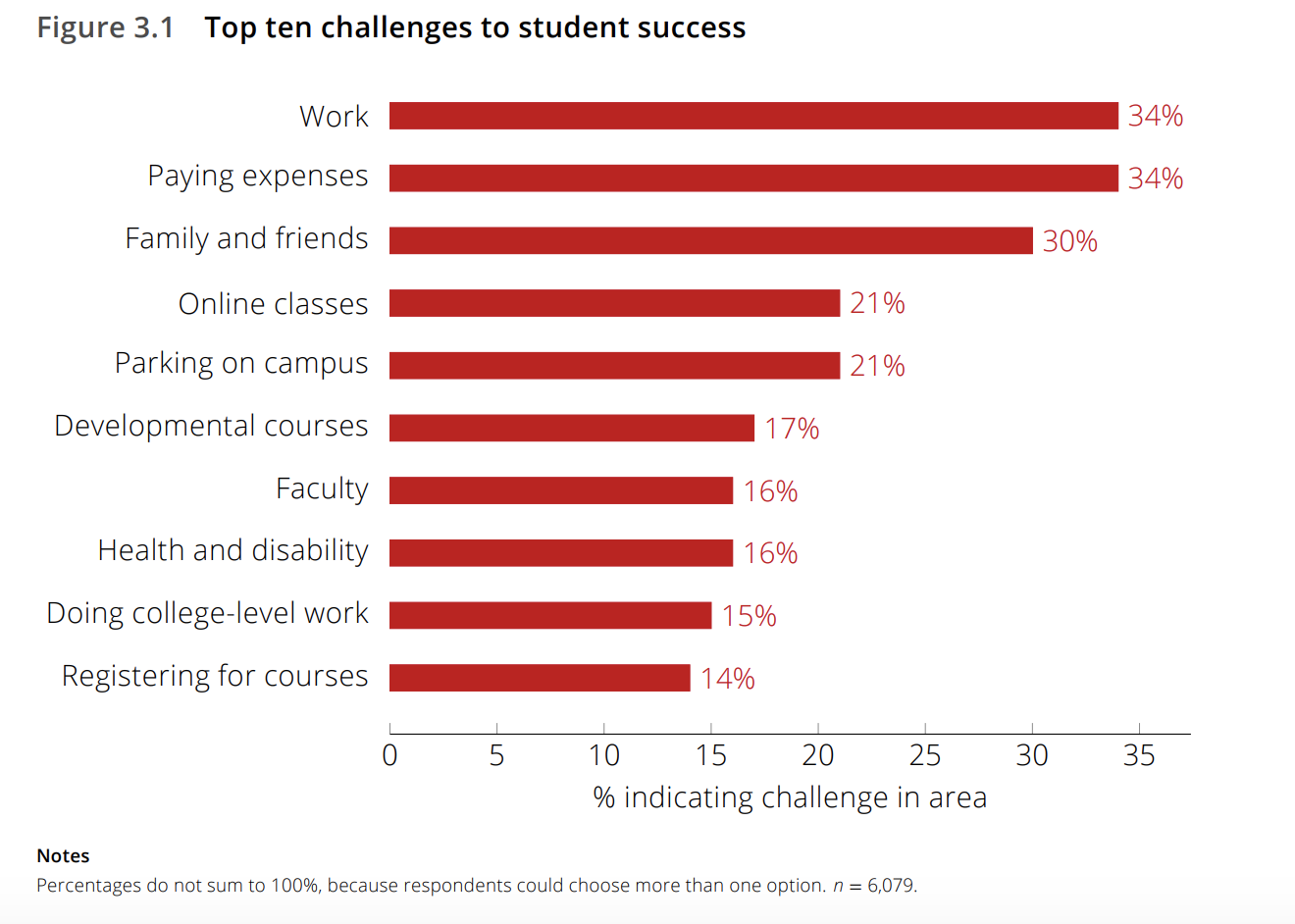
    Researchers at North Carolina State University designed and encouraged students to participate in the Revealing Institutional Strengths and Challenges survey. The survey found that working and paying for expenses were the top two challenges community college students said impeded their academic success. The researchers surveyed nearly 6,000 two-year college students from 10 community colleges in California, Michigan, Nebraska, North Carolina, South Dakota, Texas, Virginia, Wisconsin and Wyoming in fall 2017 and 2018.

    Of the top ten challenges listed, the category of online classes was tied for fourth along with parking in an ironic twist as lack of physical facilities is one of the drivers for the growth in online education. Interestingly for parking, it is not the costs. 86% of those listing parking stated it was “difficulty finding parking on or near campus” and only 10% listed parking as too expensive.

    Top Ten challenges for community college students

    The value of this survey, as described at IHE in interviews with the report authors, is in the nuance that can guide institutional planning.

    [Report authors] Umbach and Steve Porter, also a professor of higher education at the university, said they noticed a dearth of surveys that asked students about the barriers they face to completing college and wanted to provide a tool that colleges could use to eliminate those barriers and boost graduation rates.

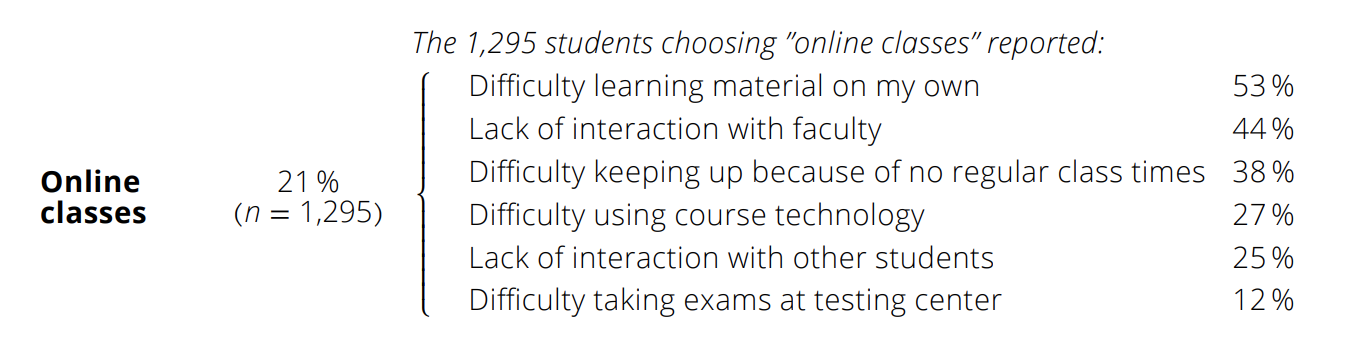
    On the topic of online education as a barrier, one view of the results could be that only one out of five students have a problem with these classes, which is not problematic as we have long known that online is not for everyone. On the other hand, the nuance provided should give institutions some insight into how they can improve their services to students.

    Reasons for online classes as a challenge

    The big issue that I’ve seen in the field is not whether a school should offer online classes – in so many cases this is the only way for students to have access to degrees – but how well-designed the courses are and how much support is provided outside of the course. Throwing courses online with no real interaction or adequate support is a recipe for disaster here, as I described in one case last year. But the school in that example is not alone in this regard. In the many cases where community colleges make these mistakes, students should have difficulty learning and the 21% number should be problematic.

    But on the opposite side, when colleges focus on improving course design and extend meaningful support services, student outcomes improve dramatically. Consider the California Community College system and their improved outcomes, where their most recent distance education report shows system-wide closing of the achievement gap between face-to-face and online students. Online education can work for community college students and is an important part of student access, but there are no silver bullets.

    I was quoted in the article about these challenges.

    Hill said the California Community College System’s Online Education Initiative, which he worked on as a consultant, is a good example of a well-designed online learning system. It helped close the gap between the rate of students successfully completing traditional courses and online classes from 17 percent in 2006 to 4 percent in 2016.

    To be clear, the California Community College System in general has been improving their provision and support of online courses for years, and OEI is not the only driver of this change.

    CCCS improvements in gap of online ed

    I don’t think the California Community College System is the only example of improvements in online education support, but I do think their focus on improving course design as well as improving advising and support structures is worth considering.

    The problem of ‘difficulty learning material on my own’  and ‘difficulty keeping up’ issues can only partially be addressed – online education is not for everyone – but more engaging and well-designed online courses can help, or at least reduce barriers. The mixing of synchronous elements of a course along with asynchronous can also play an important role.

    ‘Lack of interaction with faculty’, ‘lack of interaction with other students’, and ‘difficulty using course technology’, however, are issues that should be addressed by the institution as part of the course design and support services. It would be naive to think that these issues could be eliminated, but there is no excuse for schools to not have a coordinated effort to make improvements across all online courses.

    Online education can work, and community colleges can improve outcomes by addressing the challenges students face.

    While this post focuses on the online education angle, the whole report is worth reading. The insights into issues outside the classroom, particularly for students trying to balance work and family commitments with their education, should provide valuable input into institutional- and system-level planning.

  • Deeply Flawed GMU Report on Online Education Asks Good Questions But Provides Misguided Analysis

    Deeply Flawed GMU Report on Online Education Asks Good Questions But Provides Misguided Analysis

    Another year and another deeply flawed report about online education in US higher education, this time by Spiros Protopsaltis (associate professor and director of the Center for Education Policy and Evaluation at George Mason University, as well as former aide to Senate Democrats) and Sandy Baum (a fellow at the Urban Institute and professor emerita of economics at Skidmore College, as well as former advisor to Hillary Clinton’s presidential campaign). As Inside Higher Ed described the report, titled “Does Online Education Live Up to Its Promise? A Look at the Evidence and Implications for Federal Policy”:

    Online education has not lived up to its potential, according to a new report, which said fully online course work contributes to socioeconomic and racial achievement gaps while failing to be more affordable than traditional courses.

    The report aims to make a research-driven case discouraging federal policy makers from pulling back on consumer protections in the name of educational innovation.

    In many ways this report takes a similar approach to the report by Caroline Hoxby from Stanford University, which was subsequently withdrawn, in asking important questions but providing flawed analysis to support conclusions. But unlike the previous report, the GMU one documents its sources well with 165 end notes, and for the most part this new report describes the underlying analysis accurately. Where the major problems arise is in conflating online education in general with the for-profit sector and in drawing conclusions that are not supported by the evidence.

    The report is not easy to wade through, largely from its wide-ranging discussion of for-profits, online history, past federal policy, a snapshot of research on learning outcomes, and a discussion of current policy debates. Let’s take the primary conclusions and discuss the analysis provided.

    “Online education is the fastest-growing segment of higher education and its growth is overrepresented in the for-profit sector.”

    The report accurately describes the growth of online education, rising to point where one in three postsecondary students take at least one online course.

    Figure 1 online ed growth

    There is a disturbing tendency to describe this growth as “explosive” (mentioned five times in report) and an unexplained reliance in many cases on six year old data when new data exists. But the conclusion about growth is accurate.

    The phrasing “overrepresented in the for-profit sector” and “concentration in the for-profit sector” in describing online education is very misleading, however. It is true that for-profit schools have a larger percentage of their students studying fully online, but the topic of the report is online education in general, and for-profits represent a rapidly shrinking minority of this case. Never mentioned in the report is the most salient point about for-profits – the sector is in major decline. As documented by IPEDS:

    For-profit enrollment trends 2002-2016

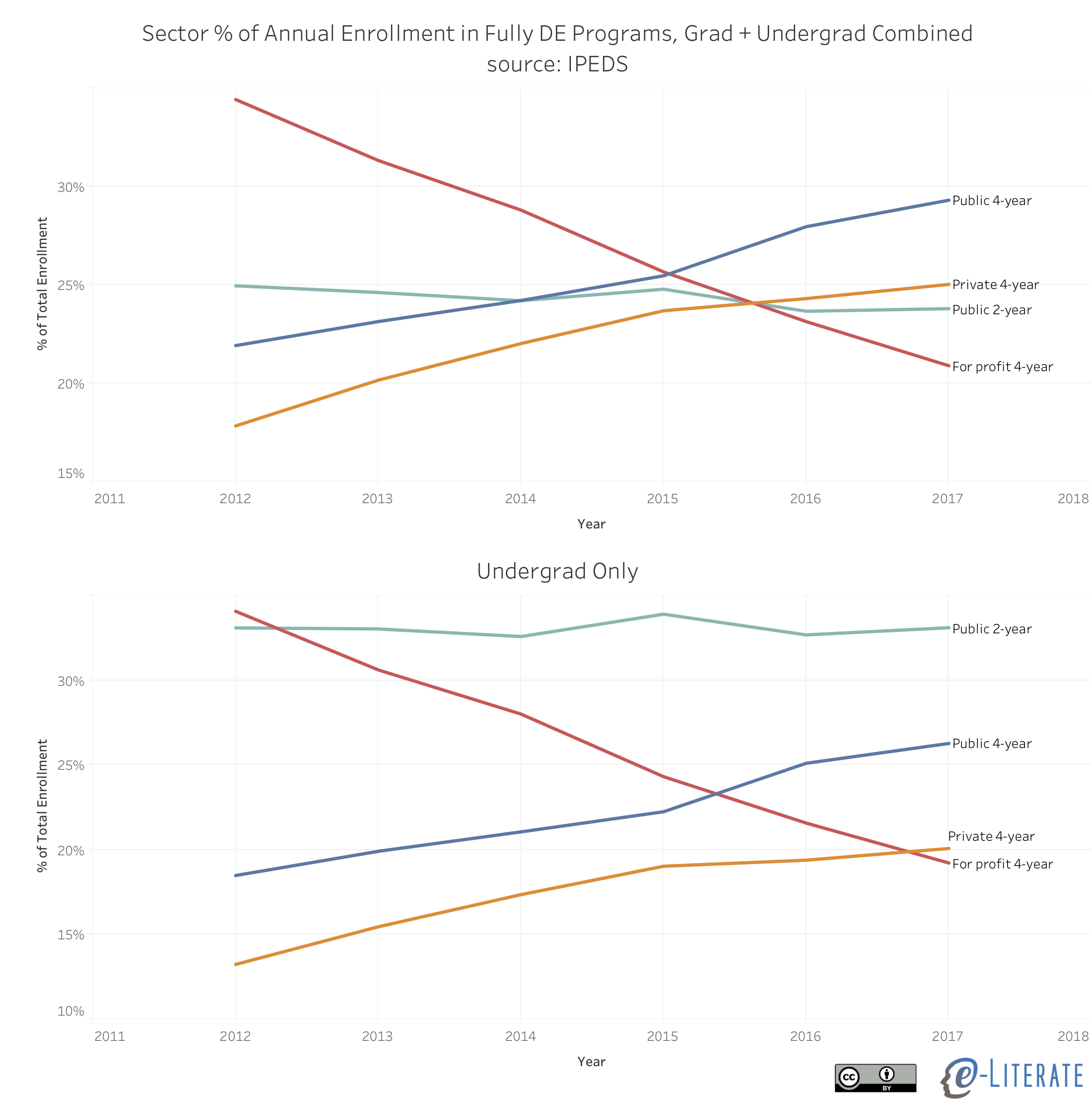
    This decline seems relevant, even if you then look at fully-online programs (e-Literate analysis of IPEDS data).

    Trends in online enrollment by sector

    Even in 2012, just two years after the for-profit peak, the for-profit sector accounted for less than 35% of fully online student enrollment, and as of Fall 2017 it was down to 21% with a clear trend. For-profits are rapidly becoming less and less relevant to the topic of online education, with no evidence to back up Protopsaltis claims that the for-profit sector is about to make a big comeback. It is high time that responsible analysts and scholars cease conflating online ed with for-profit schools, and the authors of this report should know better. If you want to study the for-profit sector, then describe it accurately and don’t extrapolate beyond what the data supports.

    “A wide range of audiences and stakeholders—including faculty and academic leaders, employers and the general public—are skeptical about the quality and value of online education, which they view as inferior to face-to-face education.”

    I find it strange to put this much emphasis on perceptions from an organization that purports to provide “timely, sound, evidence-based analysis”, but perceptions are somewhat important to understand. The body of the report describes a variety of research sources, but it is inaccurate to summarize that the wide range of stakeholders “view [online education] as inferior to face-to-face education.” Especially if you look at more recent data sources.

    Consider the 2018 Inside Higher Ed / Gallup survey of faculty (starting page 32), where they found that faculty with actual experience teaching online have surprising high confidence in the quality potential of online education. For those who have taught online, the percentage that agree or strongly agree that “for-credit online courses can achieve student learning outcomes that are at least equivalent to those of in-person courses in the following context”, 39% for any institution, 52% at my institution, 54% in my department or discipline, and 58% in courses that I teach. Put simply, a majority of faculty who have experience teaching online think results can be at least equivalent to in-person.

    Consider the 2019 Inside Higher Ed / Gallup survey of Chief Academic Officers, where fully 83% of them report plans to increase investment in online programs at their institution.

    Consider the 2018 Northeastern University Survey on the Use and Value of Educational Credentials in Hiring, where they found that “Online credentials are now mainstream, with a solid majority (61%) of HR leaders believing that credentials earned online are of generally equal quality to those completed in-person, up from lower percentages in years past.”

    Yes, perception issues are important. But the report’s conclusions are misleading and out of date.

    “Students in online education, and in particular underprepared and disadvantaged students, underperform and on average, experience poor outcomes. Gaps in educational attainment across socioeconomic groups are even larger in online than in traditional coursework.”

    This topic deserves its own report, and the GMU authors are right to point out that simply comparing online to face-to-face outcomes can obscure the important issue of underprepared and disadvantaged student experiences. On the surface, the conclusion about achievement gaps being “larger in online than in traditional coursework” is also accurate. But the more important question is not whether there is a problem, but rather how to minimize or reverse the achievement gap.

    The report references several studies from the California Community College system, mostly from years ago, describing how students “were less likely to complete online courses and when they completed them, less likely to pass them”. Yet the authors did not look at the trends within this system, as easily found in the most recent Distance Education report from the system, where the gap in performance overall for online versus tradition is closing rapidly.

    CCCS improvements in gap of online ed

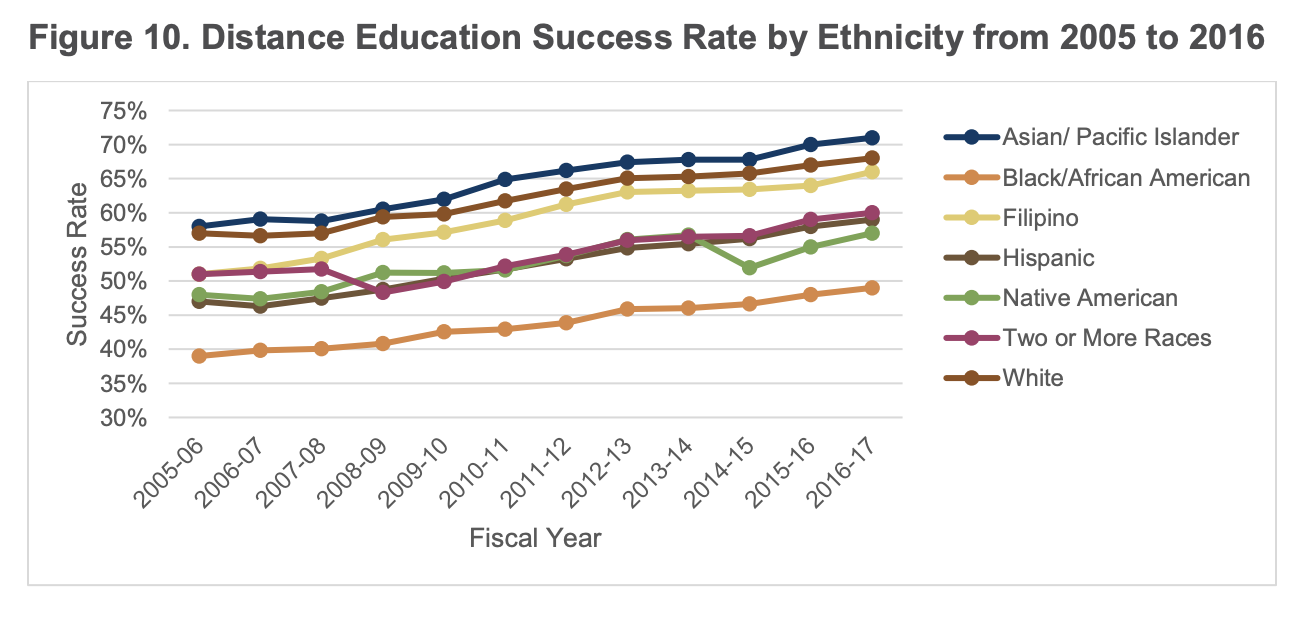
    More importantly, the achievement gains applied to all ethnic groups.

    CCCS Online performance by ethnicity

    It does appear that the performance gaps within online education are not closing by ethnicity despite the broad improvements. That is a real question to consider. Rather than viewing a simplistic view that online = bad results, we should focus on how to maintain current improvements while figuring out how to do even better in providing equal opportunity.

    “Online education has failed to improve affordability, frequently costs more, and does not produce a positive return on investment.”

    This conclusion is largely based on the NBER Hoxby report that was subsequently withdrawn, and for which I provided a detailed critique. I was not able to get a response from the report author. Beyond a gross mischaracterization of the source data, the Hoxby report made a fundamental flaw in its ROI analysis.

    This view of online education – students choosing between non-selective face-to-face institutions or online institutions – takes a zero-sum approach, as if you have the same student population just choosing between institution types. This view ignores the large and growing number of working adults who can only attend college – often in degree-completion programs or masters level programs – because of an online option. Their real choice should be seen as online institution or not at all.

    The GMU report relies on the withdrawn Hoxby report and does not even describe that it was withdrawn.

    There is an excellent point made that pricing for students has largely not been lower for online education, but there are specific examples (UF Online, SNHU, WGU, to name a few) where they specifically provide much lower-priced offerings to students than comparable face-to-face programs. It would be interesting to study enrollment trends and student outcomes for lower-priced online programs compared to comparably-priced programs.

    “Regular and substantive student-instructor interactivity is a key determinant of quality in online education; it leads to improved student satisfaction, learning, and outcomes.”

    “Online students desire greater student-instructor interaction and the online education community is also calling for a stronger focus on such interactivity to address a widely recognized shortcoming of current online offerings.”

    These last two points get to the primary purpose of the GMU report – current federal policy making efforts that include a re-evaluation of the Regular and Substantive Interaction (RSI) requirement for programs to be classified as online education and no correspondence courses.

    The GMU report describes a large body of work documenting the importance of interaction to online student success, and the report accurately describes how “the online education community has also emphasized recently the importance of student-instructor interaction for ensuring quality.” This point is crucial – the vast majority of educators working in online education understand and accept the importance of interaction; there is not significant disagreement on the subject.

    What the GMU report gets wrong is conflating actual quality interaction within courses with federal regulations. Much of the basis of the GMU analysis is a series of Office of Inspector General (OIG) reports calling out weak implementation of the RSI regulations. In the biggest case – a report on Western Governors University (WGU) and its competency-based model – this conflation is unwarranted, as I described in a detailed analysis of that action. There were two particular problems with the OIG findings in my view – the first is that the OIG defined their own terms due to the ambiguous nature of the RSI regulation.

    The OIG used a binary role-based approach (you are an instructor or you are not) leading to conclusion that only course mentors and evaluators could be considered as instructors, however. The basis of this determination was an instructor must “provide instruction on course content” – clearly a content-dissemination view that rejects alternative pedagogies. And this interpretation that the OIG treats as unambiguous is not based on law, regulations, or commonly-accepted educational terminology. [snip]

    This is why I call the audit methodology as hyper-literal. Somehow the OIG thinks they can determine – without any disagreement or ambiguity – the “ordinary meaning of those terms” based on their own interpretations.

    The second problem was that the OIG did not evaluate the actual courses or even address the issue of course quality.

    Also note that the determination was entirely based on course design materials – think syllabus and course outlines. The OIG did not look at interactions arising during the course of actual course work, just whether there were pre-defined webinars, meetings, and student-instructor interactions. [snip]

    These views essentially reject not just WGU’s approach to CBE but also the broader movement of faculty from “sage on the stage to guide on the side”. Instructors, from the OIG view, must provide instruction on course content and interactions must be pre-planned in the course design materials, at least for online courses.

    The OIG did not look at student outcomes, applied its own hyper-literal translation of an ambiguous regulation, and did not look at the course interactions themselves – just whether pre-planned course materials described future course interactions. Note, however, that despite the weakness of the OIG report, this does not mean that WGU is off the hook. Likewise, this report’s over-reliance on the OIG reports mistakes regulation for actual interaction quality, but that does not mean that there is not an issue where many or most online courses could improve faculty-student interaction.

    It is broadly understood that the RSI regulation is important but flawed. I agree with the GMU report that a simple elimination of the regulation would be a mistake. But it is overly simplistic and completely subjective for the GMU report to conclude that “unbundled faculty models that have difficulty complying should make changes to match the law instead of changing the law to match the needs of such models.” That is a policy position and not based on “timely, sound, evidence-based analysis”.

    In Conclusion

    This last point gets to the danger of this GMU report. It is a subjective set of policy recommendations disguised as extensively-documented evidence-based research. There is value in the questions asked, in much of the research documented in the footnotes, and in the clear policy position presented on regular and substantive interaction. But there is more harm than good from the report due to the mischaracterizations, selective data usage, and flawed analysis provided. Read it as a policy paper and not a research report.

    Paul Fain from Inside Higher Ed provided a valuable, pithy summary at the end of his article on the report.

    The report’s co-authors and its critics agreed that further research is needed on the rapidly evolving field of online education, particularly as more high-quality colleges and universities ramp up their online offerings.

  • Fate of EDU For-Profits: A look into recent enrollment changes and shut downs

    Fate of EDU For-Profits: A look into recent enrollment changes and shut downs

    One month ago the Education Corporation of America (ECA) was the latest for-profit system to shut down, as described by Inside Higher Ed:

    Education Corporation of America owns more than 75 campuses and enrolls at least 20,000 students in mostly certificate-granting professional disciplines such as cosmetology, culinary arts and medical and dental assistant programs. It operates chains including Virginia College and Brightwood College.

    A week later Adtalem Global Education completed their sale of for-profit systems:

    Adtalem Global Education (NYSE: ATGE), a leading global education provider, today announced the completion of the transfer of ownership of DeVry University (DVU) and its Keller Graduate School of Management to Cogswell Education LLC. Today’s announcement closely follows Adtalem’s disclosure of the transfer of ownership of Carrington College to San Joaquin Valley College, Inc. (SJVC Inc.) which was completed on Dec. 4, 2018. Post divestitures, Adtalem Global Education’s U.S. postsecondary degree-granting institutions serve the high-demand, rapidly growing medical and healthcare markets.

    The centerpiece of Adtalem’s remaining portfolio ((Disclosure: Adtalem is a former client of MindWires and past subscriber of our LMS Market Analysis service.)) is Chamberlain University, a growing system of nursing-based programs, and a look at the underlying data reveals that Chamberlain is one of only two large for-profit systems with significant growth.

    Given all the changes in for-profits, we tend to see either anecdotes about specific institutions or aggregate data on all for-profits combined. What is missing, though, is a view in between, showing enrollments and changes to a select group of for-profit schools, to help understand the different fates of different institutions.

    Why does this matter? For one, many for-profit chains are accredited as a number of different institutions, and they need to be combined to understand overall company strength. Second, following Tolstoy’s idea that “All happy families are alike; each unhappy family is unhappy in its own way”, the decline of for-profit institutions has a number of unhappy families with different lessons. In the case of ECA there is something unseen in other cases – ECA abruptly shut down despite growing enrollment by 32% year-over-year across Virginia College and Brightwood Colleges in the most recent IPEDS.

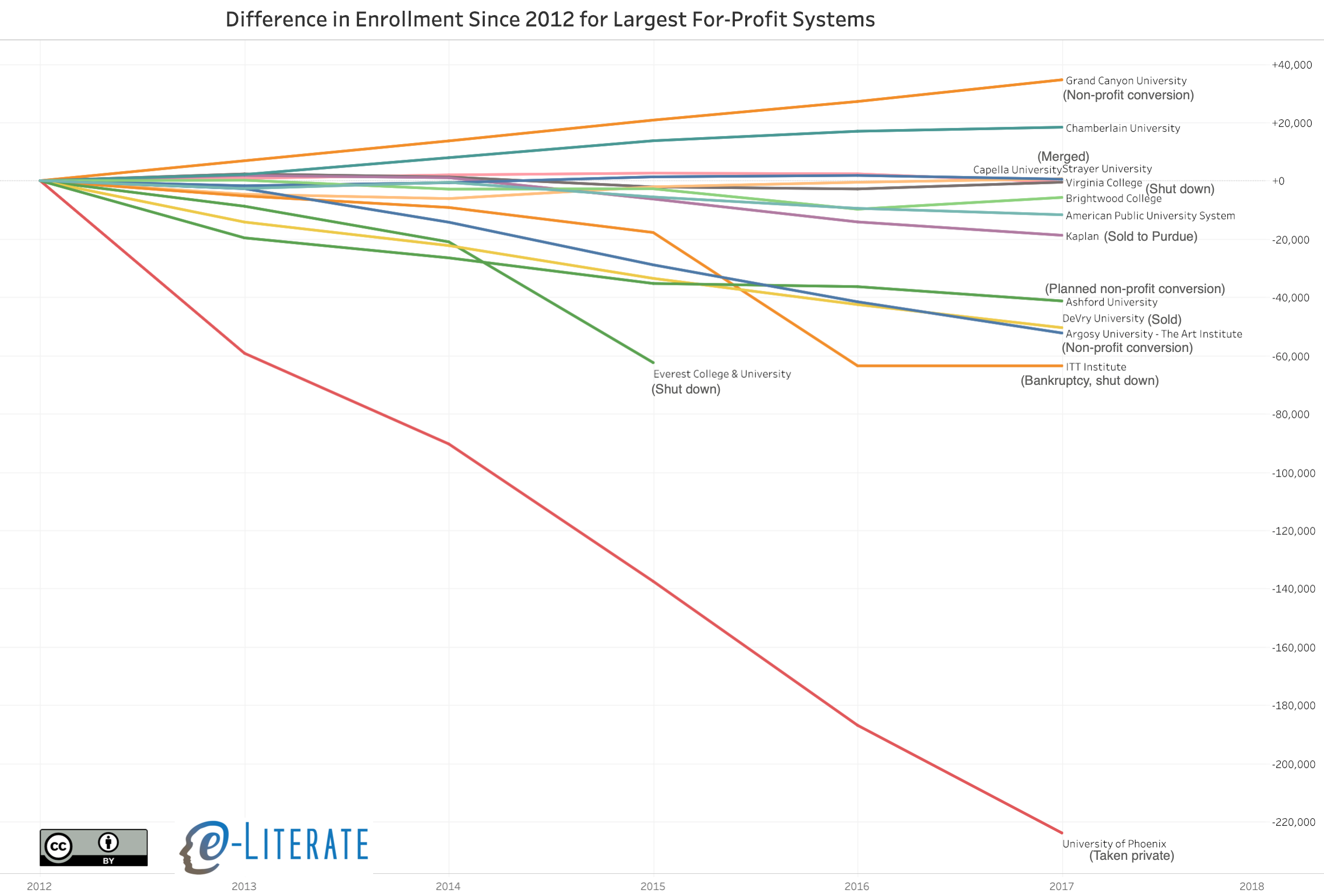
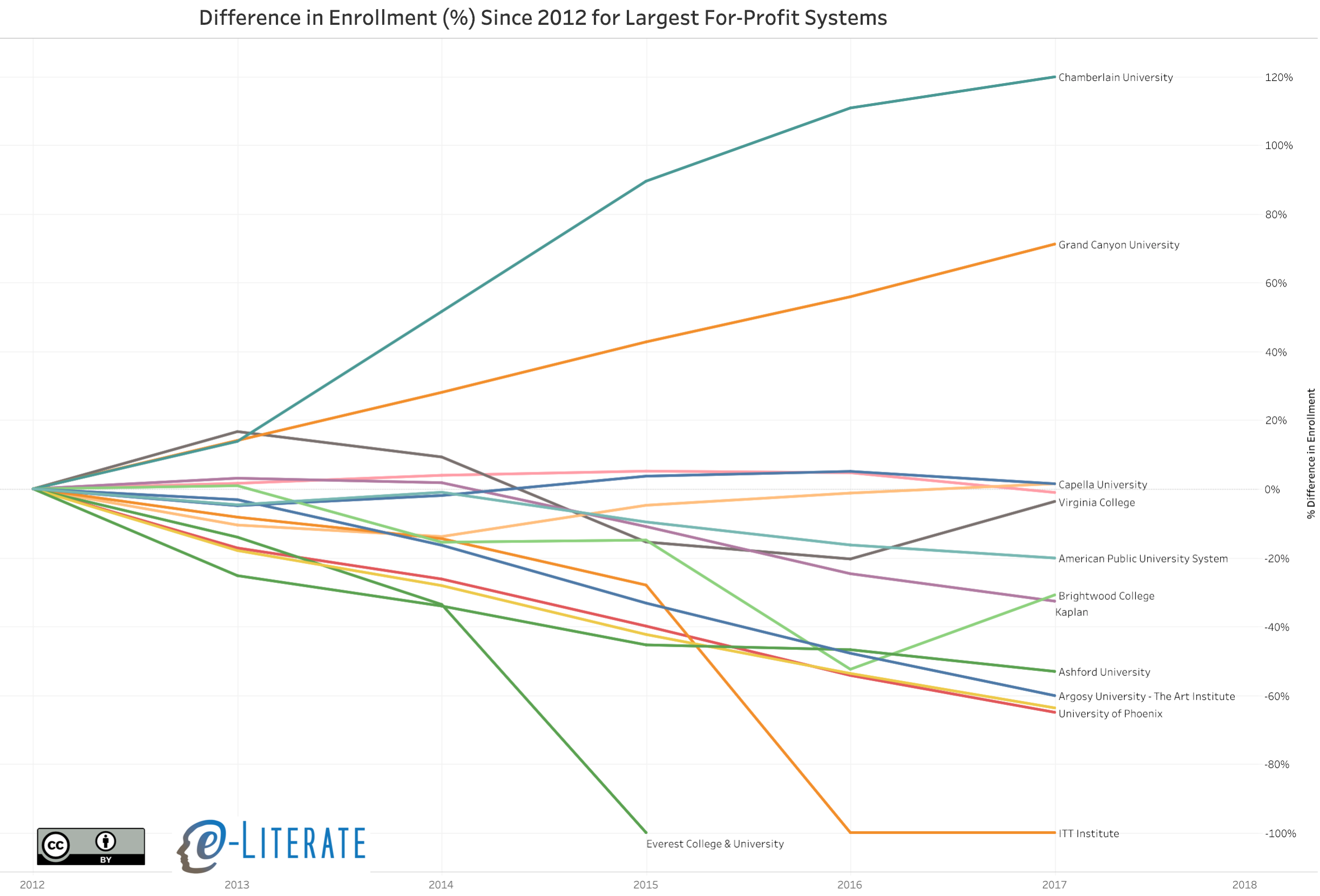
    The chart below shows differences from the Fall 2012 IPEDS enrollment report (grad + undergrad) for the 13 largest degree-granting systems as of that date, running through the Fall 2017 report (the most recent data available). I’ve added notes to show the various changes in ownership, control, and status for these systems – converting to non-profit status with a for-profit operating entity, merging of institutions, sale of institutions as with DeVry, going bankrupt withy full shut-down of systems, or taking the company private as with the U of Phoenix. Click on image for full size version.

    Largest for-profits - changes from 2012

    Some notes:

    • To read the chart properly, note that Chamberlain University had almost 20,000 more students in Fall 2017 than they had in Fall 2012, while DeVry University had roughly 50,000 fewer students in that same time period;
    • Seen together, it is startling the extent of changes in ownership, control and status among these former high-flying for-profit systems;
    • The only significant growth for these large systems came from Grand Canyon University and Chamberlain;
    • The changes to Virginia College and Brightwood College are not that significant; and
    • By far the largest decrease in enrollment has been the University of Phoenix.

    While that view shows enrollment changes in total numbers, it is also useful to see relative changes for these same systems since 2012 to take into account the different enrollment sizes of the systems.

    Some notes:

    • To read the chart properly, note that Chamberlain University grew roughly 120% from Fall 2012 to Fall 2017, while DeVry University shrank more than 60% in that same time period;
    • In percentage terms, Chamberlain’s growth exceeds Grand Canyon University’s, which surprised me, but it seems to be leveling off;
    • Likewise, in percentage terms, DeVry University’s decline is roughly the same as the University of Phoenix’s;
    • Virginia College and Brightwood College actually grew from Fall 2016 – Fall 2017; and
    • We can see the shutdown of Corinthian Colleges (Everest) and ITT with 100% declines (ITT reported data in 2016 and 2017 even with no students).

    Let’s focus on just the four brands mentioned in last month’s stories – DeVry University & Chamberlain University for Adtalem, and Virginia College and Brightwood College for ECA.

    With this view, Adtalem’s strategy of selling DeVry while keeping Chamberlain makes a lot of sense, even if several years late and if they essentially gave away DeVry.

    ECA’s shut down, however, is not easily explained by the data. Unlike ITT and Everest, Virginia College and Brightwood College were not in enrollment free fall, and in fact there was instead recent enrollment gains getting them roughly back to 2012 levels. So why such an abrupt shutdown of ECA? The answer seems to lie with how the Department of Education and its accreditor handled recent troubles, based on IHE reporting.

    The shutdown follows years of declining enrollment for the chain. More recently, the privately held company scrambled to turn around its troubled finances by closing about a third of its campuses and pursuing a corporate overhaul through a court-approved receivership. But ECA continued to be dogged by creditors after falling behind on payments and rent for many campus locations. In October the company filed a lawsuit, which was later dismissed, against the U.S. Department of Education in an attempt to maintain its access to federal student aid.

    In an email to campus employees Wednesday morning, ECA CEO Stu Reed said that the Department of Education had added new restrictions on its access to Title IV student aid. And on Tuesday night, the Accrediting Council for Independent Colleges and Schools suspended the colleges’ accreditation. Those steps meant the company couldn’t secure the additional capital needed to operate its campuses, he said.

    I do not have enough knowledge to judge whether the ED should have shut off access to financial aid at the time that they did, but it does appear that students are paying the price despite signs that the schools were making significant enrollment gains. From the news coverage, there were significant outcomes issues beyond financial health of the parent company, but to my knowledge, this is a new situation among for-profit colleges in having a shut down despite very recent enrollment gains.

  • Grand Canyon Education Acquires Orbis: We have new segment of OPM market

    Grand Canyon Education Acquires Orbis: We have new segment of OPM market

    Nine months ago we wrote about the new movement for the companies formerly know as “for-profits” in the education space to convert the actual schools into non-profit entities and declare their intent for parent companies to become a new form of Online Program Management (OPM) providers. Kaplan University, Grand Canyon University, Ashford University (Bridgepoint Education) all made similar declarations, but the problem was that each one was a single-client OPM – serving only their supposedly independent non-profit schools. That’s not much of a new market segment.

    Today the movement became real as Grand Canyon Education announced their agreement to buy Orbis Education Services for more than $362 million.

    Grand Canyon Education, Inc. (NASDAQ: LOPE), a publicly traded shared services partner dedicated to serving colleges and universities, announced today that it has entered into a definitive agreement to acquire Orbis Education Services, LLC, an education services company that supports healthcare education programs for 17 regionally accredited universities across the United States (“Orbis Education”), for $362.5 million in cash. The transaction is expected to close during the first quarter of 2019, subject to customary closing and regulatory conditions.

    The acquisition combines the strengths of two of the nation’s most innovative service providers in higher education in an effort to align their expertise and better address a nationwide shortage in licensed healthcare professionals.

    “This is a natural extension of what Grand Canyon Education is already doing as an education services partner,” said Brian Mueller, GCE’s CEO. “We are very impressed with the quality of nursing and healthcare education that Orbis Education’s client institutions are providing. GCE can help grow that by providing investment capital and advanced technologies with behind-the-scenes support that will help University partners accomplish their goals and increase the number of licensed healthcare professionals they educate with the same high-quality outcomes.

    While they use the phrase “education services partner” instead of OPM, Grand Canyon in one move became a competitive provider worth watching. This news is significant.

    The large for-profit chains all developed scalable processes for the same functions that OPM vendors provide for non-profit schools – marketing & recruitment, course & curriculum development, technology platform & data analysis, and student support & retention services – and the basic idea of this market change is for the for-profit parent companies to provide these same services for other non-profit schools. With the Orbis acquisition, Grand Canyon will pick up 17 partner institutions.

    Orbis Education is a niche-market full-service OPM provider serving pre-licensure healthcare programs (mostly nursing) and was founded in 2003. Parter institutions include Concordia University, Northeastern University, Marquette University and Mercer University.

    In a broader sense, this acquisition follows the Wiley acquisition of Learning House for $200 million announced this fall. We’ll need to update our graphics, but the OPM market is profitable and growing, but it is also messy and chaotic. OPM vendors are in a battle to have the financial strength and customer scale to survive the chaos and grow in an expensive model.

    For those keeping track, Pearson paid $650 million for EmbanetCompass in 2012, and Wiley paid $220 million for Deltak, also in 2012. Hmm, something about that year . . .

    We’ll follow this story and others like it while sharing information on the likely impacts on the overall OPM market. For now the biggest issue is establishing that this for-profit-turned-OPM segment is real.