e-Literate

Present is Prologue

Category: Pedagogy

  • Personalized Learning Explainer: Teaching to the Back Row

    Phil and I are pleased to share our first animated explainer on personalized learning:

    If it feels like a commercial that could have been produced by a textbook publisher or ed tech vendor, that is entirely intentional. We hope that they will actively promote this video (and the successor that we will be publishing in the next couple of weeks). We are giving them tools they will (hopefully) want to use that move the focus away from product bells and whistles and toward teaching challenges. This attempt at jujitsu is worth some unpacking.

    (more…)

  • Personalized Learning at Law Schools

    I recently had the honor of speaking at the CALI (Center for Computer-Assisted Legal Instruction) conference. I was invited by one of my early heroes, John Mayer. When I first arrived on the ed tech blogging scene, John was already here, doing stuff. He inspired me.

    Anyway, you may or may not know that law schools are currently experiencing an enrollment crisis. As a result, they are accepting students who are below their normal standards. These students are, unsurprisingly, not doing as well (on average) as their predecessors. So I ask the question: Is the problem that the students are “worse,” or is it that nobody is actually teaching law school students, and that the ones being admitted could succeed if only somebody taught them?

    Here’s the video of the keynote, if you’re interested:

  • We’re Giving a Course on Personalized Learning Next Month

    Working with our good friends at ELI, we’re going to be offering a three-session synchronous course called Personalized Learning: Finding the Model That Fits Your Institution July 6th through 20th. As you know, we’re still in early days for personalized learning. Most campus communities are still trying to figure out what it is and what it’s good for—if they’re aware of it at all as a group. Plus, one size most emphatically does not fit all. The goal of the course is to help participants sharpen their own ideas for appropriate ways to facilitate exploration of the topic at their own institutions.

    The format will be highly participatory, especially in the second and third sessions. Phil and I expect that we will all learn a lot from each other.

    Join us!

  • What Homework and Adaptive Platforms Are (and Aren’t) Good For

    I was delighted that we are able to publish Mike Caulfield’s post on how ed tech gets personalization backwards, partly because Mike is such a unique and inventive thinker, but also because he provided such a great example of how “personalized learning” teaching techniques are different than adaptive content and other product capabilities.

    The heart of his post is two stories about teachable moments he had with his daughters. In one, he helped his middle school-aged daughter understand why an Iranian author was worried that people in the Western world have harmful stereotypes of Iranians. In the other, he helped his high school aged-daughter see how her knowledge of the history of rocket science could be useful in answering a question she was asked about Churchill’s Iron Curtain speech. Mike’s stories show truly significant learning of the kind that changes students’ perspectives and, if we’re lucky, their lives. It is not just personalized but deeply personal. He was able to reach his daughters because he understood them as humans, well beyond the boundaries of a list of competencies they had or had not mastered within the disciplines they were studying.

    For now and the foreseeable future, no robot tutor in the sky is going to be able to take Mike’s place in those conversations. This is the kind of personal teaching that humans are good at and robots are not. But neither are the tools we have today useless for this sort of teaching. Vendors, administrators, and faculty alike have broadly misunderstood their role and potential. In this post, I’m going to talk about both how these tools are useful for the kind of education that Mike cares about (and I care about) as well as, perhaps more importantly, why we are so prone to getting that role wrong.

    (more…)

  • We Have Personalization Backwards

    [Note – an earlier version of the first half of this post was first published at Mike’s Hapgood site. We asked him to make some alterations for the e-Literate audience and republish here. – ed]

    Indie Rock and Donald Trump

    I drive my oldest daughter to high school every day. She goes to a magnet STEM school in the district that’s on the campus where I work. I’ve been brainwashing her into liking indie rock one car ride at a time using carefully planned mix CDs.

    Last week she tells me I need to put more Magnetic Fields songs in the mix. Why? I ask.

    “Physics homework.” she says.

    It turns out that there’s a number of principles of physics that she remembers through a complex set of associations she’s developed referencing indie rock songs. I don’t pretend to get them all, but the 69 Love Songs hit “Meaningless” plays an apparently crucial role.

    Later that day, my youngest daughter is asking me about the book Persepolis, a book about growing up Iranian during and after the 1979 Islamic Revolution. The author of that book spends the preface talking about the reasons she wrote it, and how she felt the understanding of her native country of Iran was too narrow, and in a way, too exotic. My daughter tells me that she doesn’t quite get what the author is talking about. After all, there’s a lot of fundamentalism in the early parts of the book — and people really are in a revolution in 1978, so what are we getting wrong in the West?

    I know that this daughter, a middle schooler, has had some stress about Donald Trump. She has people in her class who like him, and she can’t understand why when he’s so mean. It worries her.

    I ask her if Trump gets elected, how would she feel if everyone assumed all Americans were like Donald Trump. Well, we wouldn’t be, she says.

    Oh, she says.

    We Have Personalization Backwards

    (more…)

  • The Battle for “Personalized Learning”

    b310d293c6f55fb023505a60a993f9ee965fd824d48deb31d21fa7b5b9bc00a8

    So here we go again. Another terminology war. First there was the battle for open. Then the battle for MOOCs. Somewhere in there was the battle for edupunk.

    I stay out of terminology wars because, even though they are often about very real and important issues, the emphasis on finding a single correct definition tends to distract rather than focus the conversation.

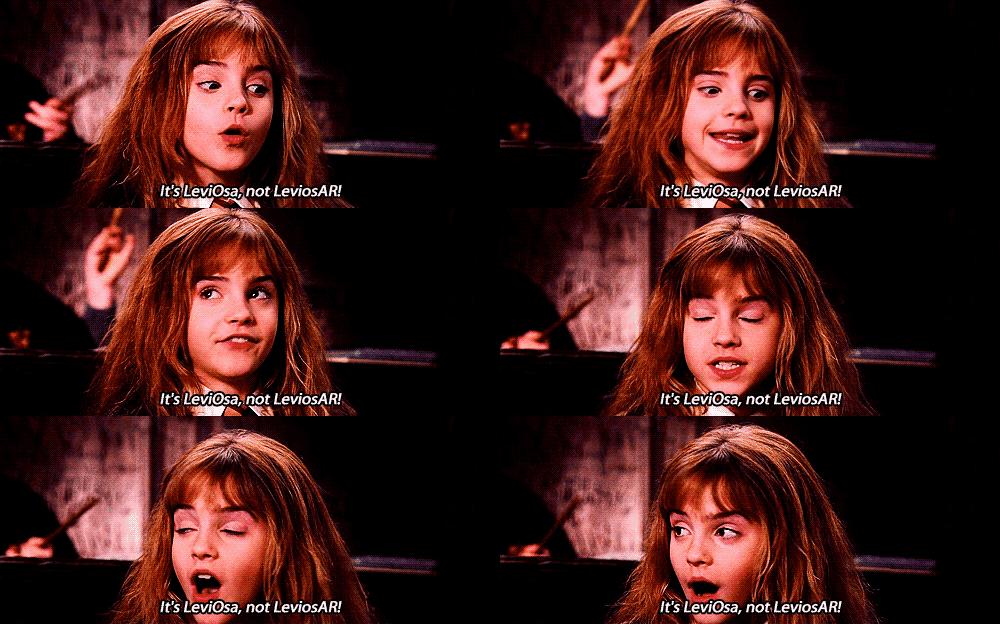
    It’s a different with “personalized learning” because there is no fight over its meaning right now. Rather, it seems to have no specific meaning at all. Sometimes it is used interchangeably with “adaptive learning.” But not always. And not exactly. More often it means, roughly, “robot tutor in the sky.” Shorter version: “WHEEEEEE!!!” Or maybe, “Wingardium leviosa!”

    1430253590-hermione-granger-harry-potter-wingardium-leviosa

    Phil and I have decided to claim this prime piece of linguistic real estate. We are asserting squatters’ rights.

    (more…)

  • No Filters: My ASU/GSV Conference Panel on Personalized Learning

    ASU’s Lou Pugliese was kind enough to invite me to participate on a panel discussion on “Next-Generation Digital Platforms,” which was really about a soup of adaptive learning, CBE, and other stuff that the industry likes to lump under the heading “personalized learning” these days. One of the reasons the panel was interesting was that we had some smart people on the stage who were often talking past each other a little bit because the industry wants to talk about the things that it can do something about—features and algorithms and product design—rather than the really hard and important parts that it has little influence over—teaching practices and culture and other messy human stuff. I did see a number of signs at the conference (and on the panel) that ed tech businesses and investors are slowly getting smarter about understanding their respective roles and opportunities. But this particular topic threw the panel right into the briar patch. It’s hard to understand a problem space when you’re focusing on the wrong problems. I mean no disrespect to the panelists or to Lou; this is just a tough nut to crack.

    I admit, I have few filters under the best of circumstances and none left at all by the second afternoon of an ASU/GSV conference. I was probably a little disruptive, but I prefer to think of it as disruptive innovation.

    Here’s the video of the panel: