e-Literate

Present is Prologue

Category: Pedagogy

  • Historical Survey Of Competency-Based Education

    I have previously written a primer on competency-based education (CBE) using SPT Malan’s seminal article as the basis for understanding the key elements. Chris Mallett, formerly associate provost at Western Governors University (WGU) and currently VP for online programs at Northeastern University, has just posted a broader historical survey on CBE that is well worth reading. His extensive first-hand knowledge of the development of CBE in higher ed adds another reason to read the article.

    In “What’s old is new again . . . a CBE long read”, Chris traces the origins of CBE back further than does Malan.

    The earliest American competency-based education initiatives are said to have emerged through the development of the training programs used to quickly prepare soldiers, airmen, and others who were needed in support of the nation’s efforts in World Word II (Joyce, 1971). The ability to deliver “precise and rapid training which considered the learner chiefly in terms of his capacity to respond to the training” was of paramount concern at the time (Joyce, 1971, p. 21). According to Gagne (as cited in Joyce, 1971), training programs deployed for these purposes were developed in four phases: (more…)

  • Personalized Learning vs. Adaptive Learning

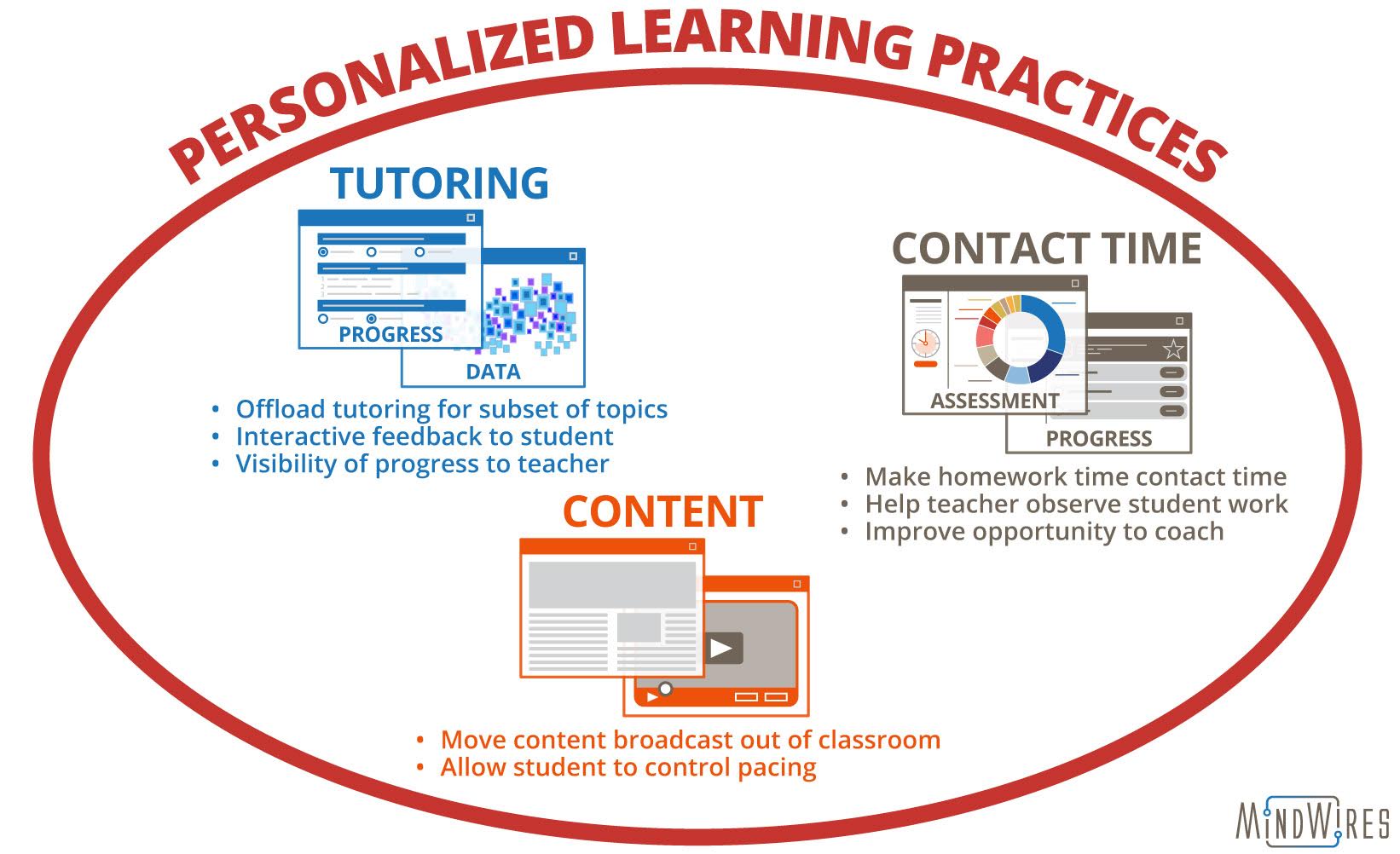
    In our recent EDUCAUSE Review article, Phil and I defined personalized learning as a set of technology-supported practices that help undepersonalize teaching. The three general practices that we identified are as follows:

    1. Moving content broadcast out of the classroom: Even in relatively small classes, a lot of class time can be taken up with content broadcast such as lectures and announcements. Personalized learning strategies often try to move as much broadcast out of class time as possible in order to make room for more conversation. This strategy is sometimes called “flipping” because it is commonly accomplished by having the teacher record the lectures they would normally give in class and assign the lecture videos as homework, but it can be accomplished in other ways as well, for example with reading-based or problem-based course designs.
    2. Turning homework time into contact time: In a traditional class, much of the work that the students do is invisible to the teacher. For some aspects, such as homework problems, teachers can observe the results but are often severely limited by time constraints. In other cases, such as comprehension of assigned readings, the students’ work is invisible to the teacher and can be observed only indirectly and with significant effort. Personalized learning approaches often allow the teacher to observe the students’ work in digital products, so that there is more opportunity to coach students. Further, personalized learning often identifies meaningful trends in a student’s work and calls the attention of both teacher and student to those trends through analytics.
    3. Providing tutoring: Sometimes students get stuck in problem areas that don’t require help from a skilled human instructor. Although software isn’t good at teaching everything, it can be good at teaching some things. Personalized learning approaches can offload the tutoring for those topics to adaptive learning software that gives students interactive feedback while also turning the students’ work into contact time by making it observable to the teacher at a glance through analytics.
    ERO Graphic 1

    Personalized learning is a set of things that you do, not a set of things that you buy. Products can support or enable personalized learning practices, but they are not “personalized learning products.” And in fact, once you have products that support personalized learning practices, that’s actually when the hard work begins. OK, so you moved content broadcast out of the classroom. Now what are you going to do with class time? Students get some benefit from having course content that they can review multiple times at home, but most of the big gains typically come from the teacher reclaiming class time for more high-value direct and interactive work with the students.

    On the other hand, adaptive learning is a label that applies to products. Further, adaptive learning products can support all of the practice areas of personalized learning. They enable teachers to move content broadcast outside of class time, they make homework time into contact time through analytics, and they provide some tutoring function. “Adaptive” tends to provoke a lot of discussion around the latter of the three practice areas. See the piece I wrote for the American Federation of Teachers if you want a primer on the strengths and limitations of adaptive learning products as tutors. But as often as not the first two capabilities, neither of which is dependent on adaptive algorithms, are the ones that enable the biggest gains in personalized learning teaching practices. “Courseware” is a set of products that, when designed well and used properly, can enable faculty to move content broadcast out of the classroom and make homework time content time. Adaptive courseware adds the tutoring element while also, if done well, increasing the value of that homework contact time by providing better feedback through more targeted analytics.

  • Defining Personalized Learning

    As many of you know, Phil and I have been exploring the topic of “personalized learning” for the past year, trying to figure out what the heck it means and what it’s really good for, separate from the hype. We’ve boiled down the idea into the beginnings of a framework, which we’ve just had published in EDUCAUSE Review. The central focus is to think of “personalized learning” as a set of technology-supported teaching practices that un depersonalize teaching. While we’re exploring that, we also dive into the question of why hype happens, why the hype cycle exists, and how we can try to kill it.

    You can read it here. 

  • Making Lab Sections Interactive: More evidence on potential of course redesign

    Two weeks ago Michael and I posted an third article on EdSurge that described an encouraging course redesign for STEM gateway courses.

    In our e-Literate TV series on personalized learning, we heard several first-hand stories about the power of simple and timely feedback. As described in the New York Times, administrators at the University of California, Davis, became interested in redesigning introductory biology and chemistry courses, because most of the 45 percent of students who dropped out of STEM programs did so by the middle of their second year. These students are the ones who typically take large lecture courses.

    The team involved in the course-redesign projects wanted students to both receive more individual attention and to take more responsibility for their learning. To accomplish these goals, the team employed personalized learning practices as a way of making room for more active learning in the classroom. Students used software-based homework to experience much of the content that had previously been delivered in lectures. Faculty redesigned their lecture periods to become interactive discussions.

    (more…)

  • Personalized Learning and the Teacher

    A few weeks ago, Jonathan Rees wrote a post calling out that, no matter what potential of so-called “personalized learning” for improving student outcomes, there is a potential—and a temptation—for it to be abused as a method of lowering (labor) costs in a way that also lowers educational quality and effectiveness. This is a serious and realistic concern, particularly as long as personalized learning is framed as a product rather than a set of teaching strategies.

    Phil and I have addressed this concern head-on in our latest piece on EdSurge. I suppose a battle over the meaning of the term was inevitable; why should this one be any different from all the others? There is an enormous disconnect between the way the term is used in product marketing and ed tech circles and the way it is actually applied in the real world in cases places it actually works. I have seen a number of cases in which personalized learning, as an educational strategy, produces good results for students. But every single one of those cases has had one or more good educators leading the charge, thinking hard about how to better serve the students. At its best, personalized learning is an effort to identify those classroom and institutional practices that are depersonalizing, and use technology as an aid to teaching strategies and support processes that can replace those practices with something more humane. Perhaps we should call it “undepersonalized learning.”

    As such, true personalized learning should be labor-friendly in important ways. It should put a premium on skilled educators and make a strong case for increased investment in professional development and teaching-friendly tenure and promotion practices. That doesn’t mean it will always be job-preserving. The focus should be on students and agnostic with respect to student/teacher ratios. It is possible to achieve a more humane and personal education at scale. Sometimes. With a lot of thought and iteration. But I have seen no evidence to suggest that personalized learning technologies improve outcomes significantly without good teachers at the helm, and plenty of evidence suggesting that they don’t.

  • Is Open Education a Movement?

    Phil and I had a wonderful time co-keynoting the OpenEd 2015 conference. It was a hoot.

    Here is the spectacular graphic depiction of the keynote done by Tracy Kelly from BC Campus:

    And here is the post-keynote conversation that we had with the Virtually Connecting gang:

    There have also been some other interesting virtual conversations growing around the conference, first over Twitter and now in the blogosphere. Some of the ones worth reading that I have seen so far include those from Maha Bali, Clint Lalonde (parts one and two), Robert Farrow (who also captures some of the tweets), and Robin DeRosa.

    Phil and I approached our keynote as analysts because we figured that’s probably the main value that we have to offer. We wouldn’t presume to tell people what open education “should” be about, but given any particular “should,” we’re pretty good at thinking through how to achieve it. For my part of the talk I used the analogy of building the climate action movement because the open education community often speaks of itself in the language of a movement and because I happen to have some experience in that area. And if you read some of the posts I mentioned above, you will indeed see varying degrees of movement language.

    But there is an underlying question that really should be addressed explicitly: To what extent is it accurate or useful to think of open education as a movement?

    (more…)

  • New Column At EdSurge

    Starting today, Michael and I are publishing a three-post series on personalized learning at EdSurge. Depending on how that goes, we could end up providing a regular column there.

    The first post today is titled “Why Personalized Learning Matters to a New Generation of College Students”.

    As we talk to the people on the front lines of these differentiated instructional approaches—students, faculty and staff with real-world experiences, both good and bad—the most significant theme that emerged was the challenge of helping students that come to class with wildly different starting knowledge and skill levels. Personalized learning should be seen as an effort for institutions to directly support students across the spectrum.

    EdSurge

    We’re excited to be working with EdSurge, helping them expand their coverage of higher education and helping us to share analysis and e-Literate TV content with a broader audience.

    You can read the whole article here.