Earlier this month Ben Thompson from Stratechery wrote a post, analyzing SAP’s $8 billion acquisition of Qualtrics, that provides insight into the shift in value proposition of the academic LMS. The SAP explanation along enterprise software lines shows the broader shift of enterprise software extending the view of the internal operations of an organization to also include a deeper view of the end users of an organizations offerings – students in the case of the LMS.
Thompson describes how SAP was founded in the 1970s and has a dominant position in Enterprise Resource Planning (ERP) systems that use central databases to provide customers with “a ‘real-time’ view of the state of their company” – essentially showing what the company is doing from an internal view. Customer Relationship Management (CRM) products emerged in the 1990s with the rise of ubiquitous PCs and the emerging Internet, tracking interactions with a company’s customers across time and across multiple locations – essentially showing a view of who the customers are and their interactions. Thompson then describes the challenge that modern companies face.
Fast forward another 20 years and the world has dramatically shifted yet again: not only are computing devices and Internet access ubiquitous, but critically, that ubiquity is not confined to businesses: customers, the ultimate endpoint of any business, are today just as connected as the employees of any large enterprise.
This can be a rather frightening proposition for large businesses: look no further than social media, where seemingly every week some terrible story about a company with poor customer service goes viral; there are an untold number of similar sob stories shared instantly with friends and family.
This same trend applies in education, with students being just as connected as faculty and staff of a college or university.
There are millions of complaints every day about disappointing customer experiences. This is called the experience gap. Businesses used to have time to sort this out, but in today’s unforgiving world, the damage is immediate, disruption is imminent. This has shifted the challenge from a running a business to guaranteeing great experiences for every single person.
Qualtrics provides a survey tool along with a sophisticated set of analytics and reporting tools based on this data – the key for SAP to understand consumer experiences. What is crucial, however, is not the standalone capabilities of Qualtrics, but the combination, again described by SAP’s CEO [emphasis added]:
To win in the experience economy there are two pieces to the puzzle. SAP has the first one: operational data, or what we call O-data, from the systems that run companies. Our applications portfolio is end-to-end, from demand chain to supply chain. The second piece of the puzzle is owned by Qualtrics. Experience data, or, X-data. This is actual feedback in real-time from actual people. How they’re engaging with a company’s brand. Are they satisfied with the customer experience that was offered. Is the product doing what they expected? What do they feel about the direction of their employer?
Think of it this way: the O-data tells you what happened, the X-data tells you why it happened.
This view of enterprise software navigating the larger trends of ubiquitous technology and connectivity, leading from the what to who to why, provides clarity on many of the trends we see in the ed tech world.
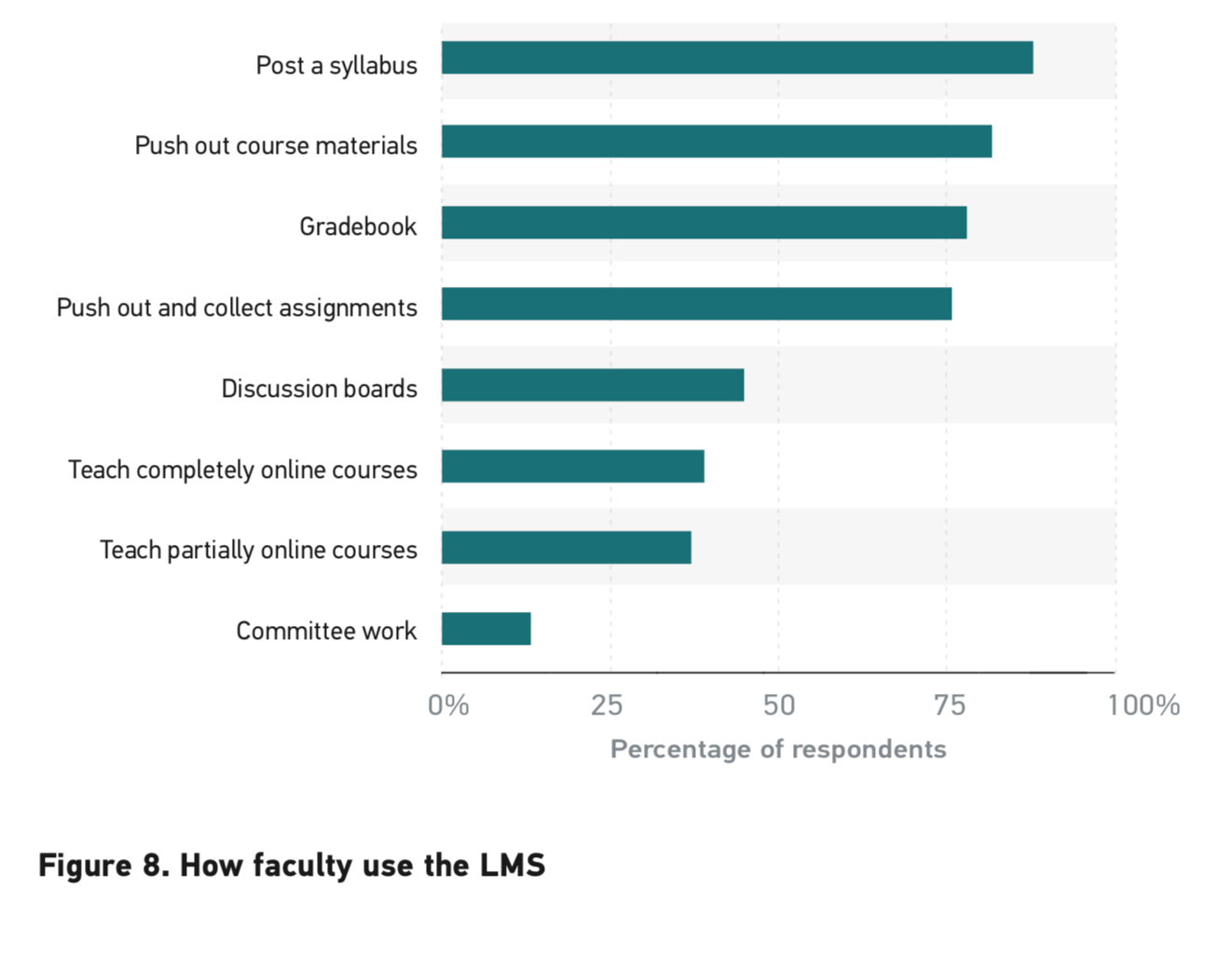
In education, the Learning Management System (LMS) was originally and more accurately called a Course Management System, and it has historically been focused on the management of courses, primarily through announcements to class, rosters, grade book, distribution of syllabus and course content, and submission of student work. Consider this figure from the ECAR Study of Faculty and Information Technology, 2017 that mirrors several other studies in its results:
While the modern LMS has advanced in many ways – particularly around usability, interoperability, and system reliability – the common usage of the this ERP-of-the-classroom has remained fairly steady. The dominant usage is managing the what of courses.
The LMS provides tools to manage communications – a view of the who of courses – through inbox, discussion boards, announcements, and various conferencing apps, but of these the dominant usage is through announcements. One way communication from faculty to students. The tools are there but not the reality of holistic views of interactions with students.
The shift in education from running a course to guaranteeing great experiences for students, to bastardize the SAP explanation, is much like the move towards experience management referred to in the Stratechery article. The movement is in its infancy, and it is likely to be measured in terms of decades, not years. Michael referred to this move in his most recent post.
If you’re a regular e-Literate reader, you know we have a macro thesis that the higher education sector is in the early stages of an evolution from having a philosophical commitment to student success toward having an operational commitment to student success. In other words, colleges and universities are starting to approach student success systematically, not as the natural by-product of hiring good faculty but as something that every student-facing aspect of the institution needs to be optimized for.
When you talk about student success, and great experiences, you have to go well beyond the official production of course content and grades and rosters. It doesn’t just matter what grades students get, it matters whether each student is learning, whether and when they get frustrated, and how often they’re engaging in the class. This gets to learning analytics and formative assessments and opportunities for students to quickly get help.
None of this is new, per se, and we’ve even seen attempts at alternative learning platforms to address this richer ecosystem. Consider the learning platforms designed initially to support competency-based education (CBE) such as Motivis Learning (spun out of Southern New Hampshire University’s College for America) or Sagence Learning (formerly FlatWorld Knowledge). These systems ((Disclosure: SNHU and Motivis were past subscribers to our LMS Market Analysis service.)), often called Learning Resource Management (LRM) systems, are designed to “see a holistic view” of students and “track student engagement”. They are designed to achieve the stated goals of SAP to combine operational data and tools along with experience data and tools.
We’ll get into more detail in future posts, but the category often labeled as adaptive courseware platforms are another example of next-generation systems that are designed to capture both operational data and experience data. These systems blur the boundaries between content and platforms and have the advantage of combining the two into a common design, which should allow deeper instrumentation of student activity during the learning process.
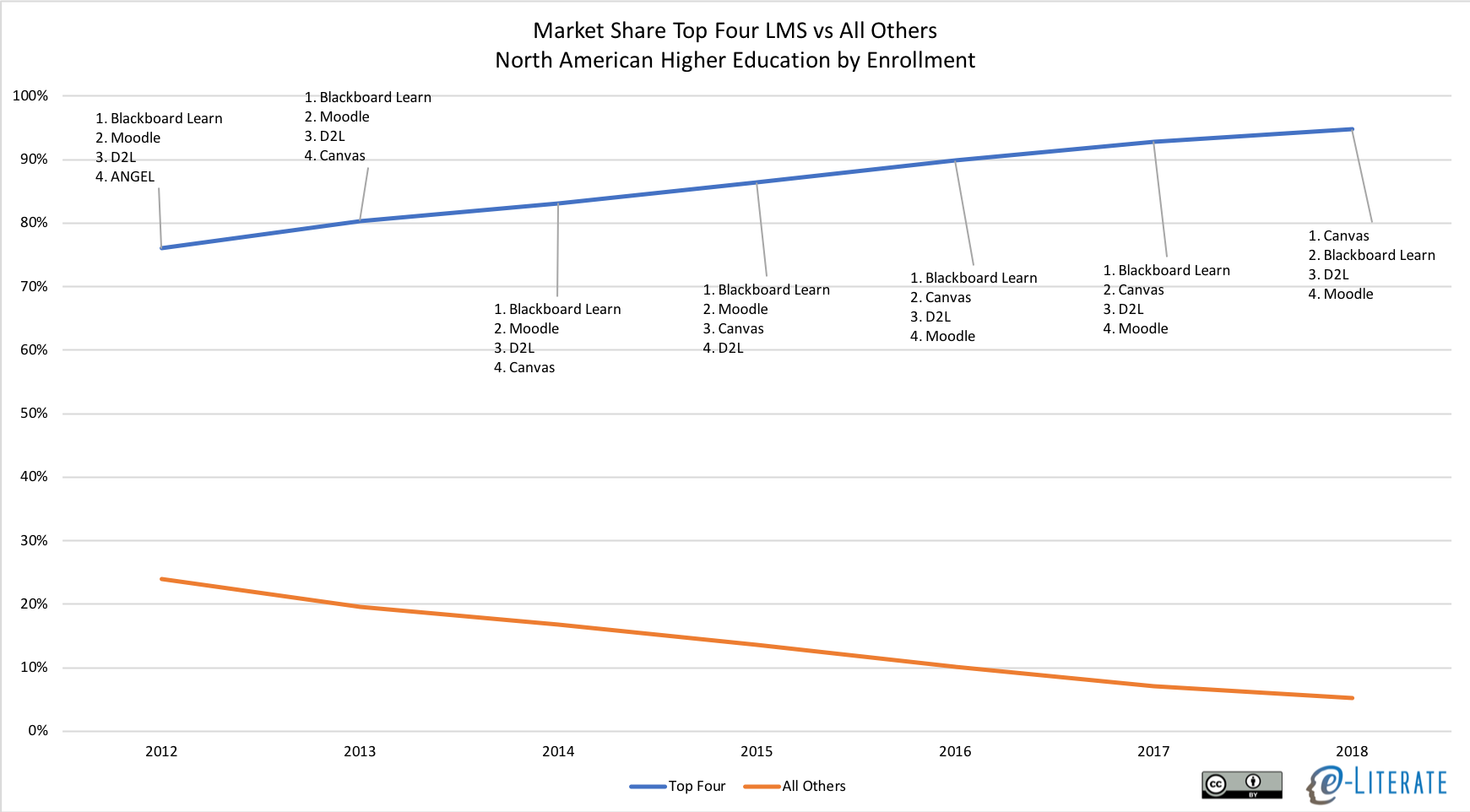
These examples get to the common question of whether the LMS will survive and exist in 10 years. The original LMS concept was designed around a course, not the learner, and most usage is administrative in nature, not learning activities. Shouldn’t next-generation systems like LRMs overtake the LMS market, as these companies expand beyond just CBE programs (see this post for context)? Well, the data do not show signs of this movement, and in fact the LMS market has been consolidating around just four solutions for institutional adoption – Canvas, D2L, Blackboard, and Moodle.
In the meantime, most of the LMS vendors have been adding functionality, whether through extension of their platforms or strategic integrations with third party tools, that seeks to provide views of the student experience. Learning analytics and reporting capabilities, mastery learning additions, federated sharing of student activity data.
One reason for the persistence of the primary LMS is that the LRM and courseware markets are not the ERP market. There are no SAPs in these worlds that already have ubiquitous usage. According to the Stratechery article “SAP is at the center of 77% of transactions worldwide”. The LRM typically starts out in a new CBE program with dozens, or maybe hundreds of students.
What is dominant in higher education circles? The LMS. It is one of the few ed tech solutions used in a majority of courses across online, blended, and face-to-face modalities. What the market appears to be doing is waiting for solutions that build on top of the LMS, or even extend the LMS itself, rather than replacing the LMS. And one of the main reasons is that the LMS has already been accepted as the enterprise system for academic usage, with operational data and tools managing the what of courses. It may be that over time alternative learning platform models will build up enough market share to become a credible threat to change the broader LMS market, but the signs so far are not encouraging for those vendors.
Qualtrics proved to be so valuable ($8 billion) because it could augment the ubiquitous SAP. SurveyMonkey, by contrast, went public as a standalone company and is worth far less ($1.8 billion, still a respectable number).
Looking into the future, the LMS will have to provide useful analytics on student outcomes, learning, and experiences along the way. Shifting from mostly running a course to guaranteeing great experiences for students. Whether this happens within the LMS of the future or as third-party augmentations of the LMS, and whether this happens with the current top four vendors or a different set, is not known. But the move to combine operational and experience data and tools is a trend we should expect to see over the next decade, both in ERP systems like SAP and in the academic LMS market.
If you’re a regular e-Literate reader, you know we have a macro thesis that the higher education sector is in the early stages of an evolution from having a philosophical commitment to student success toward having an operational commitment to student success. In other words, colleges and universities are starting to approach student success systematically, not as the natural by-product of hiring good faculty but as something that every student-facing aspect of the institution needs to be optimized for.
There is no road map for making this transformation and a number of formidable obstacles to it. First, academia was simply never designed for this purpose. The civilizational goal of empowering every human to live up to her or his potential via access to higher education is very new. Much newer than higher education system itself. In fact, it’s almost a thousand years newer. The University of Bologna in Italy, which is the world’s oldest university in continuous operation, was founded in 1088. The Morrill Land Grant Act, which created the first public universities in the United States, was passed in 1862. The G.I. Bill passed in 1944. Pell grants were created as part of the Higher Education Act in 1965. In 2018, achieving the as yet unrealized ambition of access to higher education regardless of income is very much a live political discussion. Just this month, the Sacramento Bee reported on a poll showing that 58% of Californians view college affordability as “a big problem,” with another 25% saying it is “somewhat of a problem.”
Even newer is the idea that we should not only be giving universal access to higher education but also taking responsibility to ensure that, once students have access, the institution is maximizing their chances of success (as opposed, for example, to the much older and still much more common idea of elitist “weeder” programs that filter for the “best” by failing out most). The deep structure of academia, from its governance to its professional training to its funding structure to its culture, is the evolutionary product of serving different missions than the one which we are now asking it to serve.
Second, even if we agree to embrace the mission of universal access and affirmative responsibility for student success in higher education writ large, how that plays out is very different at, say, Stanford, Loyola Marymount, UC Berkeley, Cal State Chico, and Los Angeles City College. The requirements for access are different. The definitions of and requirements for success are different.
And then their are the students, each of whom comes with her own definition of success, life goals, strengths, needs, and life context.
This is a hard problem. One that drives a lot of our work and our thinking. In a series of posts, I’m going to try to lay out what that shift looks like in a variety of academic contexts, how a successful shift across the sector would impact the future various ed tech product categories, and how the Empirical Educator Project (EEP) is intended to foster a methodology for empowering that shift.
In this first case study, I decided to start with the California Community Colleges Online Education Initiative (OEI). ((Disclosure: CCC OEI is a consulting client of ours.)) In fact, much of the structure of this post is drawn from an analysis we wrote on their behalf for the California State Legislature. I’m interested in extracting some generalizable lessons from OEI’s design. It’s important to be clear that the story I’m telling here is compatible with but not quite the same as OEI’s official position as represented in the report that they submitted to the legislature. OEI is also an interesting place to start this post series because, as we will see, it operates in an extreme environment that makes it particularly instructive.
This is a story about the whole being greater than the sum of its parts. OEI has put together a number of pieces that other institutions also have put in place, either individually or in various combinations. But they have done so with larger strategic vision for the future of California Community Colleges firmly and consistently in mind. It is also the story of a work in progress. California OEI has some impressive early successes under its belt. But it is also a hugely ambitious effort with much still to achieve. (Its in-process merger and rebranding with California Virtual Campus (CVC) is one example of forward-looking plans that I will touch on later in this post.)
The California Community Colleges is the largest system of higher education in the nation, with 2.1 million students attending 115 colleges. Our colleges provide students with the knowledge and background necessary to compete in today’s economy. With a wide range of educational offerings, the colleges provide workforce training, basic courses in English and math, certificate and degree programs and preparation for transfer to four-year institutions.
That’s a lot of students and a lot of colleges. One more college than last year, in fact. The legislature just approved the creation of a 115th campus (which will be virtual). California Community Colleges cover a lot of ground—literally as well as metaphorically. If you were to drive from College of the Siskiyous, which is about an hour south of the Oregon border, to Imperial Valley College which is about 20 minutes from the Mexico border, you would have to travel over 820 miles. They serve the top 100% of students. A lot of ground indeed.
There’s one word you won’t find in that rather dramatic description of California Community Colleges: “system.” Many state college and university systems are pretty big on local control, but California Community Colleges takes that principle to an extreme. For example, despite being a program intended to serve the entire system, OEI is run out of the Foothill-De Anza Community College District (after winning a competitive grant) because the Chancellor’s Office of California Community Colleges is more or less forbidden the legislature from running it centrally. California’s legislators are fiercely protective of the autonomy of their home districts. And as far as I know, OEI has negligible power to compel campuses to do anything.
In that environment, how do you help the entire 2.1-million-student, 115-campus, 820-mile-long “system” move together toward better operational excellence in enabling student success?
Academics tend to bristle at terms like “business drivers” and “business processes” when applied to academia, and there are good reasons to be cautious about using them. I’m applying the terms narrowly here because terms like “sustainability” are less effective at focusing people’s thinking about the machinery of balancing budgets. At the end of the day, colleges and universities need to take in as much money as they spend in order to keep fulfilling their mission. If you want to think clearly about how the sustainability machine works, then business is not a terrible metaphor. People have a basic, intuitive sense of what kind of machine a business is. The same sort of machinery is obscured the moment you start using words like “university” or even “institution” (or “sustainability”).
What do businesses (or sustainability machines) need? Money. There are a number of ways to have more money. One is to spend less of it. So one of OEI’s first moves was to offer to pay for the campus’ LMS, thus relieving each campus of the need to spend that money. LMS licensing may be an insignificant expense for an R1 university with a big endowment, but for a community college, it matters. There is no wiggle room in the budget. Hard choices have to be made—choices that impact student access and student success. We found anecdotal evidence that campuses have been using the money freed up by OEI’s LMS subsidy to invest in student success.
Our courses are much improved. In one year we have had 75% of current online instructors are fully certified. Almost 80 additional faculty are in process of being certified. We have approved 46 online course sections and reviewed or are currently review this semester another 35-40 courses. Without the resources from OEI and @one, we could not have made this happen.
– Faculty Senate Curriculum Chair, College of the Desert
Funding that would be used for [the common course management system] can be redirected to training for faculty who need extra help learning HOW to teach online.
– Dean, Business, Technology, and Career Technical Education, Ohlone College
Part of the people/resources that Coastline was able to shift, include our new Faculty Success Center, whose staff was able to create a new online course template in Canvas that helps faculty design a quality course. In addition, we were able to devote trainers to help faculty learn to use [the common course management system]. In this environment, our Academic Senate then felt comfortable mandating training for online instructors, something we never had before. I believe all this would not have happened if we had to pay for the [the common course management system] license….
So, continued state/OEI support for the…license will be critical for us to continue to train/support faculty and disseminate the use of these [OEI support] apps and support services….
One thing we were able to do, due to the free license, is pay all District faculty a stipend for the completion of [course management system] training.
– Associate Dean, Distance Learning, Coastline Community College
So just saving the campuses more money, by itself, led to actions by at least some campuses invested in improving their operational excellence at enabling student success. But that was really just the beginning. First, to get the subsidy, the campuses had to agree to do certain things. One of which was to adopt the same LMS. There were reasons for this, which I’ll get to shortly. For now, consider the likelihood of getting that many resource-strapped community colleges to migrate LMSs. How hard would it be? How long would it take?
All 114 campuses signed the contract agreeing to move to the common LMS, and many moved quickly to implement. In fact, the migration proceeded so far ahead of schedule that OEI had to go back to the legislature and request additional funding to cover the unanticipated extra subsidies. Saving these campuses money was a powerful motivator. And, as we’ll see, OEI accomplished a lot more than meets the eye with this one seemingly prosaic move of subsidizing an important but work-a-day piece of enterprise software.
How else can businesses make more money? By doing a good job of aligning their investments with their business opportunities. A grocery store doesn’t want to overstock with produce that will spoil on the shelves. But it also doesn’t want to run out of that produce when there’s high demand. And demand is variable. Demand for produce the week before Thanksgiving is likely to be different than the week after.
Colleges have an inventory management problem too. Sometimes courses are under-enrolled; other times they are over-enrolled. Both represent money problems to the campuses. One of the reasons that OEI wanted all the colleges on the same LMS—not just the same brand, but the same instance—was to create a course exchange. Balancing course “inventory” in a single community college is tough. Room availability, instructor availability, changes in the job market and economy, and the unpredictability of part-time student enrollments all work against you. But balancing “inventory” across 114 community colleges is less hard (once you can figure out how to get it to work in the first place). One campus may be over-enrolled in macroeconomics, but chances are pretty good that one of the 113 other campuses is under-enrolled in the same course. If you can get enough campuses to put enough courses on the online course exchange, then you can solve a “business” problem for all of the campuses. And the more courses there are on the exchange, the more valuable it becomes to the campuses. Thus, colleges have incentives to create courses for the exchange, and the more courses that are created, the more incentive the colleges have to utilize the exchange.
You could tell this same story from a student access perspective. Over-enrolled courses prevent students from taking them in a timely way. If the course is required, this could force them to delay graduation (and a full-time or better paying job), take on additional unneeded courses in order to qualify for financial aid, take extra financial aid from the state and federal governments, take up an enrollment space that might have gone to other students, and increase the risk that they will not graduate. Under-enrolled courses risk cancellation, with many of the same knock-on effects. I don’t mean to neglect or downplay this portion of the story.
But the focus on business incentives lets us think more clearly about the machinery of the institution itself. Which, in turn, helps us to think clearly about how that machine works and how it can be tuned. OEI designed a machine to drive operational excellence at enabling student success across the largest community college system in the country. And it runs on only positive incentives because. This design constraint immediately rules out copying some of the most frequently cited examples of innovative universities which, through one mechanism or another, can exert varying degrees of top-down control. At ASU, President Michael Crow has an unusually strong hand to play within a reasonably traditional structure of faculty shared governance. (Ithaka S+R has some interesting and revealing interviews of some of ASU’s top leaders that give some hints about how that governance works.) Western Governors University is more extreme; there is no faculty senate and no shared governance. SNHU’s Paul LeBlanc has tried a combination of strategies, working with with the faculty senate on governance of the traditional college while separating out their College of Online and Continuing Education (COCE) and running it in a way that is only loosely coupled to the shared governance of the rest of the university. Like many universities and systems, OEI cannot redesign the machine from the top down. so thinking about the live-or-die campus sustainability incentives that could be used to drive collective action has been a central principle that influenced the rest of OEI’s design.
Creating the infrastructure
The desire to move all campuses in the system to one LMS wasn’t just for the sake of contracting convenience. It accomplished a variety of goals. First, it became a foundational layer of software infrastructure for rolling out other system-wide capabilities and services, from plagiarism detection to online tutoring to faculty training and help resources. Having everybody on the same instance of the same platform—cloud-hosted Instructure Canvas—made it much easier to do this. In the old world, where campuses were on a hodgepodge of different self-hosted and vendor-hosted LMSs, the best the system could have accomplished would have been common contracting. It would still be up to each campus to integrate and support the tools and services. After all, the way a tool looks and works in Moodle can be different than in Brightspace. Centralized support would have been a nightmare. And remember, these campuses are very tight on resources. Supporting add-on tools and services is costly to them.
In addition, sharing one LMS made it easier for OEI to create faculty training that could be shared across the system, and for campuses to do the same. As with system-wide licensing for LMS-connected tools and services, it’s not impossible to do this in a system with different LMSs. But the added friction makes it less likely to happen. I’m going to use the “B” word again: academia needs to think about business processes. Once again, stripping away the culture- and mission-inflected language lets us see the machinery more clearly. A business process is the way in which a business accomplishes something that is important for the business. For example, how does a business make sure that all its employees have up-to-date software, including critical ones like system updates and the latest anti-virus software? Sure, they could leave that to the individual employees to do. We’ve all updated our software on our personal computers; it can be done. But how likely is it that everyone will do so in a fashion that is timely, reliable, and consistently correct? And what work are all those employees not getting done while they are wrestling with software updates? It’s better to develop a business process for pushing out those updates from a central IT group so that employees don’t have to worry about them. Likewise, there are effiency benefits to centrally rolling out and support services for 115 campuses than to have each campus IT support person duplicate the effort. From a perspective of strengthening the business drivers that hold the group together, all of these benefits can be boiled down to saving money by providing additional capabilities with reduced cost to on-campus resources (in direct licensing fees, support staff time, or both). As we have already seen, the campuses tend to invest the money they’ve saved in enhancements that are specific to their local needs and that benefit their students.
The common LMS also helps with the over- and under-enrollment problem. Having all course exchange courses on a single instance of a common LMS made it easier both to provide more data to the campuses that would help them with their planning and to reduce friction in expanding the course exchange. If everybody is using the same system, that’s one less thing for faculty and students to learn, less help desk support, and more productive support (for both course delivery and course design) because the OEI staff don’t have to try to accommodate multiple flavors of learning environments.
Of course, there are trade-offs, the biggest one being autonomy. In OEI’s case, for example, all the campuses had to agree to use the same LMS rather than choosing their own. Anyone who has run a campus LMS selection process knows it can be an exercise in delicate diplomacy. Imagine doing the same with 114 campuses. As we’ll see, OEI turned this challenge into an opportunity. I’ll have more to say about that in the next section.
Anyway, once you start seeing infrastructure as the structure “underneath” (i.e., “infra-“) that supports business processes, two things immediately start to happen. First, your definition of success changes. You can no longer declare victory just because you successfully installed the software and got people to start using it. You have to start looking at whether it successfully enabled or improved the business processes you were intending to support.
Our Professional Development Coordinator is encouraging the creation of Pro Dev workshops in [common course management system] Canvas, such as health and wellness (“dealing with difficult people”), how to create Open Educational Resources, how to use [Student Learning Outcomes] for better teaching, and a lecture on science and its assumptions. What is developed at Butte can be instantly shared with other schools, and vice versa. I see a renaissance of Pro Dev opportunities!
– Technology Mediated Instruction coordinator, Butte College
The second thing that happens when you start thinking in terms of business processes is you identify new problems as well as rethinking and reprioritizing old ones. For example, OEI is in the process of revamping (and merging brands with) California Virtual Campus (CVC). Why? CVC exists today. It’s a web-based catalog of online courses students can across the California Community Colleges and California State University System, which is many more than the handful of OEI exchange courses. As of 2017, CVC included 23,445 online courses and 1,376 degree programs. So it’s big. If you think of infrastructure as a thing to have, then you might think of CVC as a massive success.
But if you think about CVC as the structure underneath that supports the critical business process of students finding, (wisely) selecting, and registering for online courses across the many campuses represented in the CVC course catalog, then you start to develop different metrics for success. And if you also think about the back-end process of making sure the right institutions get the registration information, tuition, and transcript information (respectively), then CVC becomes both a critical priority and a tough piece of infrastructure to build well, particularly across so many different campuses that are not all migrated to a single instance of common Student Information System (SIS) software. If students fail to register for online courses that they need because the process is too cumbersome, or if they don’t get properly credited by their home institutions after taking an exchange course, that is bad for the long-term health of both the students and their institutions. This is what it really means to say that some infrastructure is “mission-critical.” CVC is a big catalog with lots of courses, but it does not yet do a great job of fulfilling its mission-critical role of helping students find, register for, get credit for, and pay for their courses. Each of those is a business process that CVC should support. And the number of courses in the catalog tells us very little about how well the software is supporting those processes for the students and the campuses.
If you think about infrastructure in this way, then your communications to your stakeholders will also change. Here’s an explainer video they had us create for them in order to help communicate that message to the various campus folks:
(Source video: https://youtu.be/1DdlaIZYiDI)
Why was this so important to communicate? OEI could have gone to their constituents with a message of “Here’s a bunch of great free stuff for you!” Instead, they chose a much more challenging message to communicate; one about the ripple effects of having shared infrastructure. That wasn’t an obvious choice.
If you’ve read any one of a million articles on how to succeed with any major campus-wide initiative, you will have read the cliché about how important it is to “get buy-in.” Most of the time, “getting buy-in” is interpreted as “handling objections” or “reducing resistance.” It is an obstacle to get past. But the video above shows that the OEI leadership has interpreted the term differently. You only communicate to your stakeholders in this way if you believe that buy-in is infrastructure.
Fostering a culture
In our consulting work, we facilitate LMS selection processes reasonably often. The more forward-thinking institutions view these processes as opportunities. How often do you get to gather a group of faculty and other academic stakeholders from across your institution in one room and have them talk to each other about how they teach and what they need to serve their students well? A search for a product like an LMS can become a rare opportunity for focused, intensive, purpose-driven community-building. Yes, it lowers resistance, enabling people who might not be happy with the final decision to at least feel like they were heard. But it also begins to foster familiarity and dialog that can help foster a broader and more lasting community of purpose. When you’re trying to build such a community across 114 campuses as part of an ambitious and completely voluntary system-wide effort, taking that view of LMS selection is even more important. Needless to say, it wasn’t easy. Or seamless. That said, both during the selection process and and afterward when communicating the results, OEI worked toward building affirmative buy-in—not just lowering resistance but increasing the sense of goodwill and common purpose. For example, the selection committee was near unanimous in its selection, with the sole dissenter acknowledging the importance of what the committee was doing together and supporting the final decision.
The program design elements I’ve described so far helped OEI to foster increased organizational alignment at two levels across campuses. The campus executives who are responsible for financial health and sustainability of their campuses are aligned through infrastructure subsidization and the course exchange. In 2018, the state legislature decided to augment the initiative with an additional $35 million funding. California Community Colleges has chosen to invest that extra money capacity-building. In particular, the money will go toward grant programs intended to enable the campuses to launch more online courses on the OEI-CVC infrastructure, thus further strengthening this alignment while aiming to serve more students effectively. The common infrastructure and the culture-building process around it has helped to build a culture among the academic and technical support staff across campuses. The hoped-for consequence is that improvements on one campus will travel more quickly and easily to others:
I now know that I can ring up any other [Distance Education] Coordinator and we’ll be speaking the same “language” regarding the use, training, and administration of the [course management system]. I’m also really looking forward to faculty being able to share ideas and resources via Commons.
– Director of Distance Education, Santa Rosa Junior College
Building a similar sort of sharing network among the faculty in the system is an even larger challenge. The culture-building work has been ongoing work for years now, but one can acknowledge all the hard work and progress to-date while still also recognizing that this is a huge project that has barely begun. Certainly, having common resources and common platform supported by OEI has provided a boost, as has the inclusion of faculty voices in the OEI planning process. The augmentation grants, which will likely include instructional design support, represent another opportunity. But to me, one of the most interesting vectors for culture-building is the course exchange course quality rubric. Every course on the exchange has to be evaluated against a rubric of evidence-backed effective online teaching practices. As the pace at which exchange courses are developed increases, OEI will not be able to keep up with demand to evaluate these courses using central staff. So they are creating a peer reviewer mechanism in which faculty on the campuses are trained on the rubric and presumably compensated to review courses that are candidates for the exchange.
This opportunity fascinates me. We know that faculty who go through an expert-supported course redesign process often experience intellectually deep and emotionally moving shifts in their teaching strategies. Is the same true when faculty are trained reviewers of their colleagues’ redesigned courses? What effect will simply exposing faculty to more and different course designs have? How will their role as reviewers and critiquers shape or enhance that effect? Can a continuously improved and updated rubric become a vector for sharing new research-supported processes across the system on an ongoing basis? Will the impact be broad and deep enough to foster new kinds of intra- and inter-campus faculty dialogs about the scholarship of teaching and learning (SoTL)? Will these cultural changes help to foster alignment around continuous operational improvement for enabling student success? This is the last mile problem of higher education. Operational excellence at student success cannot be achieved unless it is infused in the daily operations in individual classrooms. That requires affirmative faculty buy-in, support, training, and embedding in a culture that invites them into the larger conversation.
This is highly reminiscent of the cultural transition that doctors had to make from the mid-Nineteenth through the mid-Twentieth Century. In the 1840s, one could begin practicing as a physician with no medical training at all, just as one can start practicing as professor with no pedagogical training today. Doctors learned medicine from whomever they happened to train with and whatever they read in the newspaper ads about cures and treatments ranging from early antiseptics to leeches and literal snake oil, with no easy way to distinguish them. There were no major conferences or respected, peer-reviewed journals. There were no standards for quality research or convincing evidence. There were a handful of teaching hospitals and medical colleges of wildly varying quality that touched only a small minority of practicing physicians. All of these institutions, all of this social infrastructure, needed to be built and bought into by physicians before antiseptics could be differentiated from snake oil, the signal separated from the noise, regarding “progress” or “innovations” that might help their patients’ welfare.
OEI has accomplished some remarkable early successes in an extremely challenging context. But the degree to which they are able to move 114 California community colleges toward better support of student success as a group may well depend on the ability of the social infrastructure they are creating to reach faculty, be embraced by them, and and foster a culture in which academics collaborate differently and more intensively in their day-to-day work of helping students to succeed, one student at a time.
I’m going to be facilitating an Empirical Educator Project-relevant panel at OLC today at 11:15 AM in Oceanic 1, followed by an EEP and EEP-curious meetup at Soomo booth (#226) at 12:15 PM in the Expo Center. The rest of this post is just a little extra information on each of the SoTL work of the panel participants’ home institutions, for those who attend the session.
CMU Eberly Center
At the intersection of faculty research, teaching, and service, the Eberly Center supports Teaching as Research. We help faculty answer compelling research questions regarding which teaching strategies are more effective at promoting learning, increasing engagement, and enhancing the learning environment. Our services provide the tools and expertise to help instructors develop research questions and study designs, identify valid and reliable data sources, analyze and interpret educational data, and present and publish research results. Read more about our research processes and findings in this site:
Support is provided by the UCF Faculty Center for Teaching and Learning and the Research Initiative for Teaching Effectiveness. RITE assists faculty, free of charge, with any SoTL activity within the research design to dissemination continuum.
CTU
CTU is a career-focused university encouraging the use of educational technology and SoTL research in the areas of professional scholarship and adaptive learning. Faculty (including adjunct faculty) can apply for funding through an internal website and faculty are encouraged to share their research and scholarship work with the university. Additionally, research collaboration with other institutions is supported and encouraged as demonstrated by the work with CTU and UCF.
I’m going to be facilitating an Empirical Educator Project-relevant panel at OLC today at 11:15 AM in Oceanic 1, followed by an EEP and EEP-curious meetup at Soomo booth (#226) at 12:15 PM in the Expo Center. The rest of this post is just a little extra information on each of the SoTL work of the panel participants’ home institutions, for those who attend the session.
CMU Eberly Center
At the intersection of faculty research, teaching, and service, the Eberly Center supports Teaching as Research. We help faculty answer compelling research questions regarding which teaching strategies are more effective at promoting learning, increasing engagement, and enhancing the learning environment. Our services provide the tools and expertise to help instructors develop research questions and study designs, identify valid and reliable data sources, analyze and interpret educational data, and present and publish research results. Read more about our research processes and findings in this site:
Support is provided by the UCF Faculty Center for Teaching and Learning and the Research Initiative for Teaching Effectiveness. RITE assists faculty, free of charge, with any SoTL activity within the research design to dissemination continuum.
CTU
CTU is a career-focused university encouraging the use of educational technology and SoTL research in the areas of professional scholarship and adaptive learning. Faculty (including adjunct faculty) can apply for funding through an internal website and faculty are encouraged to share their research and scholarship work with the university. Additionally, research collaboration with other institutions is supported and encouraged as demonstrated by the work with CTU and UCF.
For a couple of years now, we’ve been saying that higher education is at the beginning stages of a long transition from a philosophical commitment to student success toward an operational commitment to it. In other words, colleges and universities are beginning to grapple in earnest with how to rewire themselves so that their culture and processes are deliberately optimized and continuously tuned to support their students in getting the best education possible. This is a profound shift. It will require major changes to the ways in which academia works and the ways in which ed tech designs and markets its products. It will be very hard and take a long time. But the drivers of this change are in place.
Recently, I wrote about how our concept of Empirical Education has built into it a theory of change. The implication is that it has the backbone for a methodology of change. Our work as both analysts and consultants shown us that the increasingly aligned strategic priorities throughout the sector, when combined with the knowledge that is scattered across it, can be distilled down into a powerful yet flexible methodology for system change in education analogous to Design Thinking or one of the Agile software development methodologies. It can be a set of processes, built on a fairly small set of fundamental principles but supported by a lot of detailed craft knowledge and a rich ecosystem of supporting tools. It can be owned by no-one, although there would likely be some premiere practitioners of it. Colleges and universities could use it to redesign themselves to be more student-centric and, in the process, also more educator-centric. Product and service companies could design their offerings around it and compete based on their ability to help their academic customers better implement it.
This sense of possibility has been the animating impulse behind the Empirical Educator Project (EEP). We started with only a hazy idea of what we were building. Over the last twelve months of working with academics and ed tech product people, some aspects have become clearer. I have grown more confident in the potential of the idea even as I have grown more overwhelmed with clearer understanding of the size of the undertaking.
I am going to articulate my latest thinking about it in this post.
The time is now
There is a saying among consultants that potential clients won’t hire a consultant until and unless they both realize that they have a serious problem and come to accept that it is not a problem they can solve on their own. That holds equally true for a wide range of difficult changes that require help or cooperation, from coping with an addiction to building a functioning government to changing an institution. Higher education has been an incredibly stable system. As in, remarkably consistent over a period of about a thousand years. Historians of education tend to write about changes that take place over decades or half-centuries. There has been a looming question of whether such a slow-changing institution can adapt to such fast-changing times. Unsurprisingly, this debate has been raging for a few decades now, with relatively little sector-wide change to show for it. Is the system terminally rigid, or is it in a state of punctuated equilibrium that will shift in an appropriately dramatic amplitude once it reaches an inflection point?
I believe the latter is the case, and I believe that we are at that inflection point. Access-oriented institutions—particularly publicly funded ones—have already been under pressure for some time now to show better outcomes for students in terms of rough measures like graduation rates and time to graduation, as well as some more meaningful but difficult measures popping up on the margins such as employment and career success. On the other end of the spectrum, the elite institutions whose brands have popularly defined excellence in education for the last century or more are starting to realize that they need to adjust to changing student expectations if they are going to continue to be considered the gold standard for the next century or more. The MOOC craze was complex and problematic, but it woke the elites up to the potential for use of technology-enabled approaches to enhance their teaching practices rather than detract from it, even as their students show up on campus with increasingly high expectations for the kinds of access to knowledge, interactive experiences, and high-touch communication that technology can enable. And in the middle, private universities with decent regional reputations and tuitions that approach those of Ivy League schools are increasingly under pressure to justify their tuition with something of more permanent value to students than climbing walls and dining halls. More and more, the buzz is about innovative partnerships with employers, or about learning analytics, or about student success systems supporting better guidance counseling. In other words, we are seeing colleges and universities grope toward approaches that enable them to more reliably support student success. And they are looking for help to do it.
The focus of that previous paragraph is primarily on undergraduate education, but it also increasingly applies to graduate education. We sometimes see this problem manifest itself in financial terms, where it gets somewhat obscured by the current conversations around Online Program Management (OPM) companies. Universities often launch career-oriented graduate programs such as MBAs and MSWs because (a) they are looking for more revenue to make their institutions more sustainable, (b) online programs can scale without scaling costs like real estate and physical classrooms, and (c) they know there is a market of people who are inclined to sign up for online graduate programs that can fit with their work and family schedules while also giving them credentials that will help them advance in their career ambitions. But as the online MBA market gets saturated, universities increasingly have to find differentiators. And they can’t use climbing walls or dining halls. In the end, the only effective and durable differentiator for an online career-oriented graduate degree program is its effectiveness at helping the students achieve their goals. In this space, the immediate university driver is revenue and the immediate student goal is career advancement. So the sector tends to view this change narrowly. But if you zoom out a little, it becomes clear that the trend with graduate programs and OPMs is just one particularly clear example of where the academic institution’s financial sustainability issues are driving it toward a sharper operational focus on its mission.
Let’s turn now to the educational vendors, who are also at an inflection point across product categories. All of these companies—curricular materials providers, LMS vendors, SIS vendors, analytics vendors, and so on—they are all looking to move up the value chain and argue that their products can directly, meaningfully, and provably impact student outcomes. ((I am use phrases like “student outcomes” and “student success” interchangeably and broadly for the purposes of this post, even though I know that they can have different connotations.)) They have to, because most of the major ed tech product categories are either in danger of commodifying or in danger of failing (in the case of established product categories) to achieve meaningful market penetration (in the case of new ones).
The textbook companies hit the wall first. As students increasingly found ways to avoid buying new books (or any books), the textbook publishers raised their prices, which started a vicious cycle of reduced sell-through followed by price increases followed by further reduced sell-through followed by further price increases. This was ultimately unsustainable, particularly since the internet has made obtaining basic factual information and focused educational supplements—think YouTube—easily obtainable and free. Increasingly, publishers had to make the case that their content is somehow better than the commodity content. But better how? For a long time, the “better” publishers worked on was instructor convenience. But there’s only so far that slides, extra problem sets, and auto-graded homework can compensate for the vicious pricing cycle, particularly since the commodity materials get more organized and feature-rich over time. Eventually, the major publishers came to the conclusion that the only sustainable “better” they could shoot for is more educationally effective.
Pearson was the first out of the gate with a massive push for “efficacy.” ((Disclosure: Pearson is a sponsor of EEP.)) They have bet and are still betting the company on that strategy. But as I have written about here before, the fundamental problem is that products can’t really be “efficacious” in and of themselves unless the educators in whose class the materials are being used (a) agree with the efficacy goals that have been defined by the product developers and (b) change their teaching to work with the educational strategies designed into the products. More fundamentally, the educators have to trust the research claims of the vendors in order to even think about the product-defined efficacy goals, much less adjust their teaching strategies. Pearson’s original articulation of efficacy failed to account for any of this. They have since adjusted their course, and other curricular materials developers—most notably McGraw-Hill Education and Macmillan among the larger players—have followed suit by also focusing more on encouraging faculty to buy into research-backed teaching practices and then, having obtained that buy-in, show how their products support and implement those practices. ((Disclosure: McGraw-Hill Education is a sponsor of EEP and subscriber to our Trusted Advisor market analysis service. Macmillan is a sponsor of EEP.)) But for all their good efforts—and they are generally, good, honest efforts—these vendors are pushing string. Most academics will never take them seriously as a source of advice for considering deep and scary changes to their teaching practice.
Meanwhile in the LMS space, the developed markets have saturated and are stabilizing. New adoptions appear to be down. There are many developing markets to plumb, but they are slow and expensive to develop. So LMS vendors too have been trying to move up the value chain by talking more and more about student success. D2L has focused for some time now on the course design process and has been adding tools to its portfolio like LeaP, which is a tool for recommending personalized supplemental curricular materials. ((Disclosure: D2L is a sponsor of EEP and a subscriber to our LMS market analysis service.)) Blackboard has gone so far as to promote themselves as “your partner in change,” to the point of deprecating their flagship LMS project as “not enough.” ((Disclosure: Blackboard is a sponsor of EEP and a subscriber to our LMS market analysis service.))
And yet, the LMS companies face the same uphill battle with credibility that the textbook publishers do. By and large, academics are not going to look to their LMS providers for guidance on how to change their teaching practices. The same goes for the upstart product categories like learning analytics. Vendors will struggle to convince academics to change their teaching practices, but their products will mostly fail to demonstrate meaningful learning impact until the academics adopt practices that take full advantage of the products. All these vendors need to climb a wall of credibility with academics, but they can’t do it unless somebody throws them a rope. (Companies with significant faculty-facing service components have the best chance of swimming upstream, but that’s another post for another time.)
All the institutions in the sector—all types of colleges and universities, all types of ed tech vendors—have realized that they have a problem and are starting to realize that they can’t solve it on their own. They recognize that the core problem is that colleges and universities need to get much better at supporting student success, however their particular students may define it. They all want to get there and are starting to look to each other for help. But they don’t know how, and most of them can’t do it alone.
There’s only one stakeholder group in this picture that has not gone through the process of seeing that they have a deep problem and accepting that they need help solving it yet. Have you spotted who they are?
The people who can actually solve the problem
While the shift in incentives has reached a tipping point for the institutions, the same cannot be said for the faculty. Their graduate training is largely unchanged. Their tenure and promotion criteria are largely unchanged. The rewards and accoutrements of professional accomplishment are largely unchanged. Faculty have been given no reason to change; therefore, they don’t. Everybody knows this is true.
Or not. There are several vital aspects of this story which everybody “knows” that are either misleading or flat out wrong.
First, faculty do change. Anybody who has significant experience with the development of online learning programs or other course redesign efforts has seen it happen. They have faculty say that their experience in the redesigned class has changed the way they teach in other classes. They have watched skeptical faculty turn into preachers of the gospel. There are converts. Despite a dearth of incentives and a plethora of disincentives, despite uneven support, despite the fact that most will earn no glory for it on the other side of the closed doors of their respective classrooms, faculty do embrace pedagogical change when they have the right sorts of experiences that enable them to see the benefits.
Where are these amazing faculty members? They are everywhere and nowhere. They tend to be invisible on their home campuses, although if you ask around in different departments, you might be lucky enough to catch sight of one or three. (Or a dozen.) They have often learned the hard way that there is little benefit and significant pain involved with preaching on their home campuses, so many of them keep quiet and quietly work their magic in their own classrooms. If you want to see them in numbers, you usually have to go to one of the conferences where they congregate. I am going to one this week. One of the main activities of the participants will be crying on each other’s shoulders about how under-appreciated and under-resourced their efforts are on their respective home campuses.
It is also untrue that incentives for faculty to excel in their teaching craft remain rare. It’s still early days, but there are green shoots everywhere. Most of the time, we only hear about a small number of schools that are doing remarkable things. Arizona State University, Southern New Hampshire University, and Western Governors University, over and over again. If you’re a little more knowledgeable, you might have heard about work at University of Central Florida or Georgia State University. And if you’re paying attention to formal scholarship, you might a little about work coming out of places like Carnegie Mellon University, Duke, and Stanford. We could look a little further down the publicity pyramid at places like the University of Maryland Baltimore County. You very likely haven’t heard about the amazing work happening at diverse schools ranging from James Madison University to Coppin State University. I wouldn’t have known anything about the accomplishments of either of these institutions if I hadn’t stumbled upon them through my various travels in this very odd job of mine.
And because the news tends to focus on a few exceptional institutions, it also focuses on three contributors to success that are among the hardest to change: leadership, governance, and money. It is simply not true that the only institutions making real change have once-in-a-generation presidents, an iron grip on the faculty, and/or tons of funding. We see innovation everywhere. And everywhere it happens, it happens because institutions are finding new ways to draw on their most precious yet plentiful resource: their faculty.
There is an old term of art that deserves reviving and refreshing: the scholarship of teaching and learning (SoTL). SoTL is often seen as a grassroots effort by faculty who care about teaching to wrap it in the cloak of academic validity. If the only way that excellence in teaching will be valued by the institution is to get it into peer-reviewed journals, then let’s find a way to get it into peer-reviewed journals. In the past, institutions generally didn’t take the bait. Many treated SoTL as a pat on the head to faculty who were slaving away carrying the heaviest teaching and advising loads. “Here, you care about this teaching stuff. Have a workshop. You can pretend what you’re doing is scholarship for a while. And we’ll give you a certificate!”
That is changing. More and more institutions are realizing that faculty aren’t the problem; they are the solution. But that grassroots energy that comes from SoTL and other faculty empowerment efforts must be aligned with institutional efforts through support, incentives, and research. More and more institutions are making that connection. For example, here’s a graphic illustration of the dynamic, taken directly from Georgetown University’s Designing Our Future(s) web site:
Here are some lessons learned from Georgetown’s white paper about the progress the initiative has made so far:
A few core rules for this innovation work have emerged. First, every project has to push against some structural constraint (the 15-week semester, the credit hour, the nine-month calendar, etc.) and test variations of it. Second, projects cannot be idiosyncratic or depend on the particular interests of one talented faculty member; they have to be pilots from which we can generalize and which we might apply to other scenarios or problems. Lastly, we only fund a Red House project for one year (or the equivalent); after that, if a project is to survive, it has to be absorbed into the curriculum and faculty workload.
Beyond these basic rules we have also learned some valuable lessons about the viability of experimental and creative curricular work in a culture designed for deliberative shared governance and slow change:
We developed strong stakeholder involvement as part of our iterative design process—one that frequently included associate deans, the registrar, compliance officers, and financial aid representatives—early in each project’s development. Likewise, we communicated well and regularly with our board, alumni, and donors
We do not give ourselves as good a grade on continuous communications with faculty. Early on there were many open invitations and speaker events, and a drumbeat of updates. As the work became more intense and demanding, we focused inward, and neglected to continue to reach back out to this important community. We learned it is absolutely critical to spiral communications outward, and to be as inclusive and open as possible, especially as the work takes specific shape within a core group.
Very early on we should have established a formal faculty review and approval process for Red House pilots. We assumed we would work within the Curriculum Committee approval structures, long established for important reasons, but which do not in the end benefit a research and development initiative. Last year, a Designing the Future(s) Advisory Committee was created, with the sole mission of approving and monitoring innovation projects. This system is now working very well; it might have accelerated progress if it had been instituted earlier.
These are very early lessons, and they are somewhat Georgetown-specific. But it’s easy to see some more general principles emerge that could be useful across a wide range of educational and cultural contexts. And some of the most fascinating and remarkable changes are happening at institutions that you never read about, including some that have traditional faculty governance, few financial resources, and leaders who are extraordinary in the “normal” sense that many committed, hard-working, people-oriented academic leaders are in colleges and universities of all shapes and sizes.
I am going to write about some specific examples of this sort of organizational alignment in upcoming posts. For now, I want to spend a little time on the characteristics of a good methodology.
Toward a methodology of Empirical Education
When I think about general methodology that can be adopted and adapted across a wide range of contexts, the two models that come to mind immediately are Agile software development and Design Thinking. I’ll focus on Agile (and particularly Scrum) for the moment because I know it better, but as far as I can tell, the same basic principles apply to Design Thinking.
First, the methodology should be designed to unleash the creativity of the knowledge workers involved in the critical processes. All too often, we take really smart people and put them in a strait jacket of process. We tend to design our mission-critical processes to get us predictable results, often by controlling the human element through various management techniques. The problem arises when we ask for predictable results in an unpredictable environment, having handicapped the very smart people who are best able to minimize the problems that arise out of unforeseen circumstances while maximizing the benefits of unforeseen opportunities. There is no knowledge work I know of that has more frequent and dramatic unforeseeable challenges and opportunities than education. We wrap a lot of process around education, but it’s not the right kind of process to promote excellence by getting the most out of talented educators, just as using Gantt charts was not the right sort of process to promote excellence in software development by getting the most out of talented engineers.
At the same time, empowering knowledge workers is not the same thing as letting them do whatever they want. I have been in an Agile software development environment where the engineers interpreted Agile to mean that they decide everything. The results were not good. All Agile methods that I am familiar with have multiple roles, with each role having certain authority and responsibilities. These roles are designed to be mutually supportive, and the success or failure is very much a success or failure of the entire team and its teamwork. This is a big cultural change for many institutions, where “academic freedom” has come to be used reflexively as a shield from any demands, sometimes because some of those demands are unreasonable or unwise. There has to be a well-defined process by which student success is understood to be the collaborative responsibility of the academic team, working together as an ensemble.
These two basic principles—empowering individuals and working as teams—can generally be captured in a fairly small number of rules and roles, regardless of the flavor of Agile being practiced. And most Agile teams that get them right will function adequately while getting more satisfaction from their work—under relatively unchallenging circumstances. They may even feel that they are doing Agile well. But then there is a whole world of craft that is all about handling context-specific challenges. How do you balance functional versus non-functional requirements? How do you prioritize aging aspects of the software, a.k.a. “technical debt”? How do you manage large projects that require many Agile teams? How do you deal with extrinsic constraints on release timing (like the start of an academic term)? Agile practitioners can always improve their craft, both as individuals and as teams. Entire industries of tools and consulting have grown up around supporting excellence in that craft.
Which is utterly unlike the way in which the industries that surround education function (or fail to function) today. There is a reason for that. An industry designed to promote operational excellence of knowledge workers cannot succeed in absence of a shared understanding among the knowledge workers about what operational excellence looks like. Agile software development is a craft with a lot of consensus around the principles, a track record of results, and enough expert practitioners that knotty problems, along with their solutions, can be shared fairly efficiently across a very large and loosely organized profession. There is a lot of debate too, which is the sign of a healthy ecosystem of knowledge workers advancing the leading edge of their craft. But that debate occurs within the context of a common understanding that is woven into the culture. Practitioners in those debates are rewarded with recognition of their expertise and contribution to the field. And their employers love having these experts and reward them appropriately because their excellence at creatively applying and innovating with the methodology advances institutional goals.
With that cultural substrate in place, a tool or service vendor can come in and say, “We help you solve X sort of problem in your Empirical Education process,” and the prospective customers will, understand what is being offered, be capable of evaluating its utility, and place (monetarily quantifiable) value on that utility. That’s what we need for learning analytics, adaptive learning, or just about any whizzy, trendy ed tech thingamabob you can think of or will be thought of.
Most or all of the elements for a methodology of operational excellence in education exist in the world today. They need to be gathered, distilled, and refined into a learnable, repeatable, and adaptable practice. That is the outcome we aspire to achieve in collaboration with the participants in the EEP, not to mention support from the collective wisdom and will of higher education writ large.
Moving forward
As I wrote earlier, I will be blogging about relevant examples we are seeing, on both the institutional side and the vendor side, in the coming days. And EEP will soon be announcing the first release of some tools that can help form a foundational layer of the institutional infrastructure for Empirical Education. In the meantime, if you are going to be at the Online Learning Consortium Accelerate conference, I will be moderating an EEP-relevant panel discussion of SoTL on Thursday at 11:15 AM in Oceanic 1. From there, some of us will head to the exhibition hall, where we will have an EEP meet-up at the Soomo booth (#226) at 12:15 PM. You don’t have to be a member of the current EEP cohort to join us; the EEP-curious are welcome.
One of our longest-running series of posts is on the prospects and status of Blackboard’s Learn Ultra, the user experience redesign and move to the cloud of the world’s second-most-used (behind Moodle) and highest-revenue-producing academic LMS. It is fashionable to claim the LMS is dead or passé, yet this product category remains the centerpiece of educational technology at colleges, universities, and K-12 districts. To understand Learn Ultra is to understand much of the overall LMS market.
2012: Blackboard acquires Moodlerooms, and one benefit was the see of a cloud-based platform strategy.
2014: Blackboard prematurely announced Learn Ultra (new user experience) and Learn SaaS (move to the cloud).
2015: Learn Ultra is already a year late (more realistically, the BbWorld14 announcement was wildly unrealistic), but the University of Phoenix selects Learn Ultra as its next-generation learning platform.
2016: Blackboard switches CEOs, admits that Learn Ultra is still not ready, and struggles with a major messaging problem around the transition.
2017: No coverage – maybe we got tired of lack of not having customers to talk to.
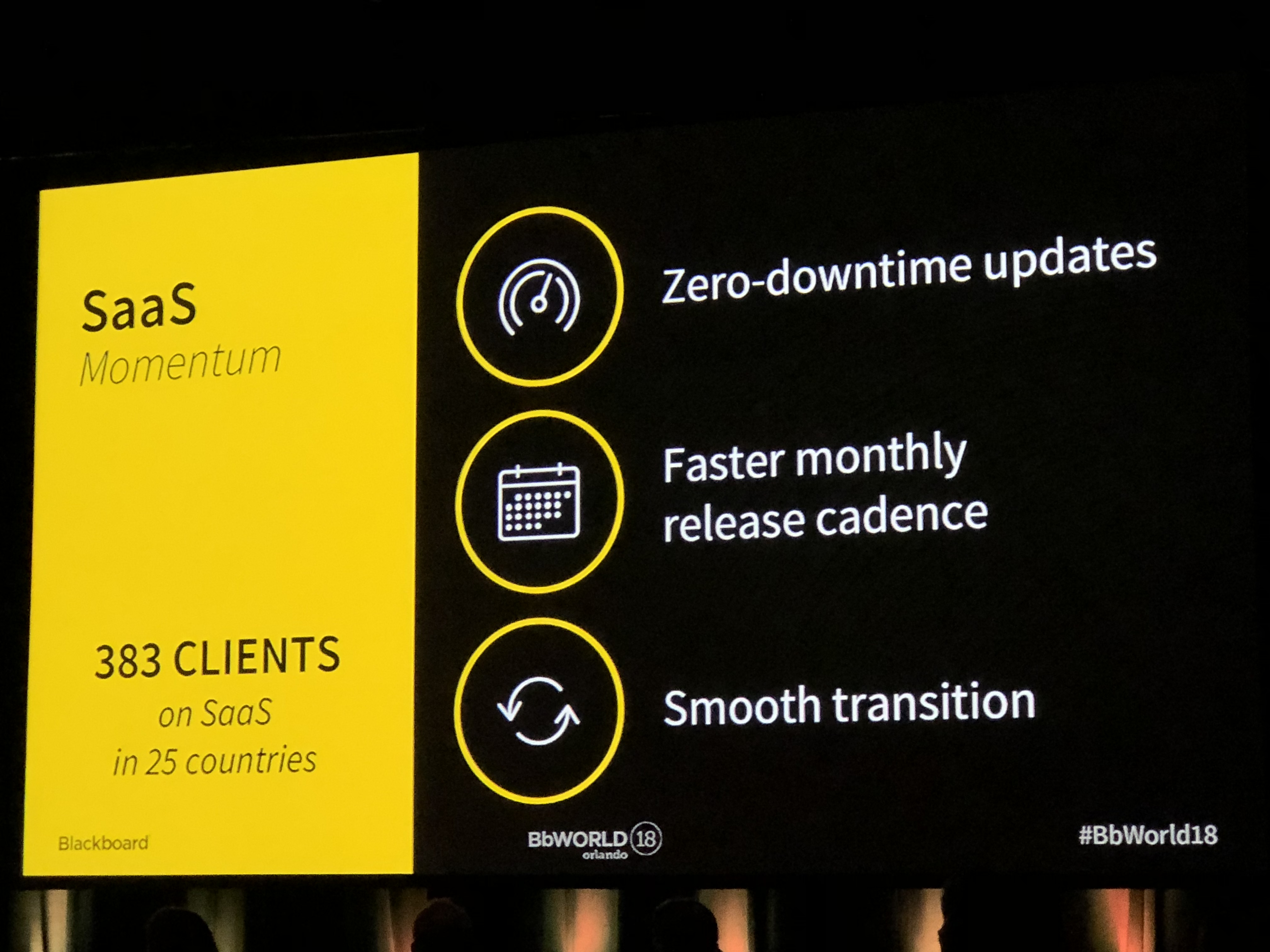
2018: Blackboard makes Learn Ultra the core of its message at its users conference BbWorld18.
(Note: It might be easier to view this as a full page timeline instead of the embed within this post.)
What we have been asked multiple times, by institutions, by investors, by other ed tech companies: is Learn Ultra ready, and does it matter? The unsurprising answer to both questions is a qualified and somewhat confusing it depends. To describe a little further, Learn Ultra’s Base Navigation is ready, but the Course View is not ready for meaningful adoption; furthermore, Learn Ultra is important to Blackboard’s future, but we think SaaS is more important to its present.
Is It Ready?
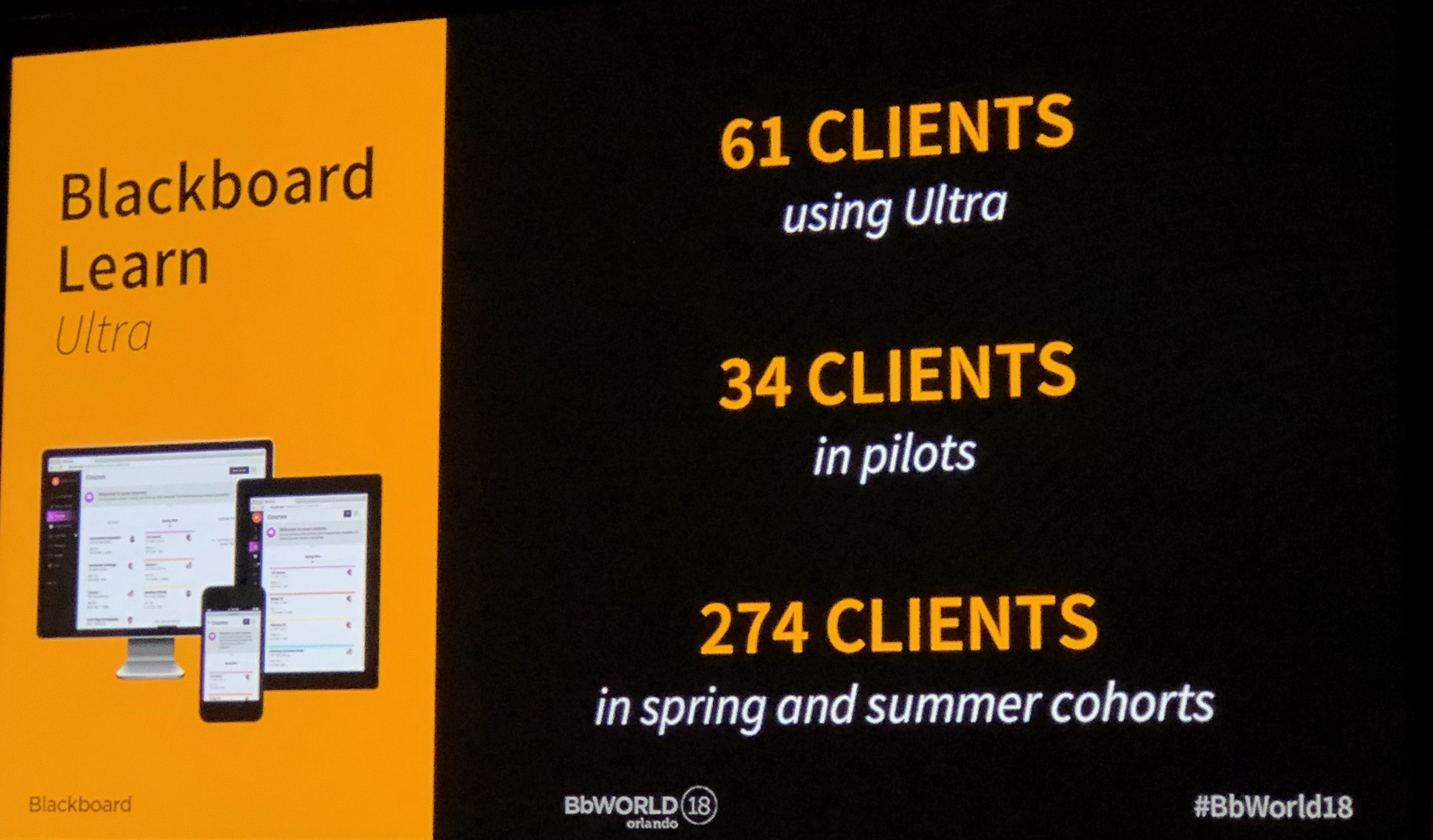
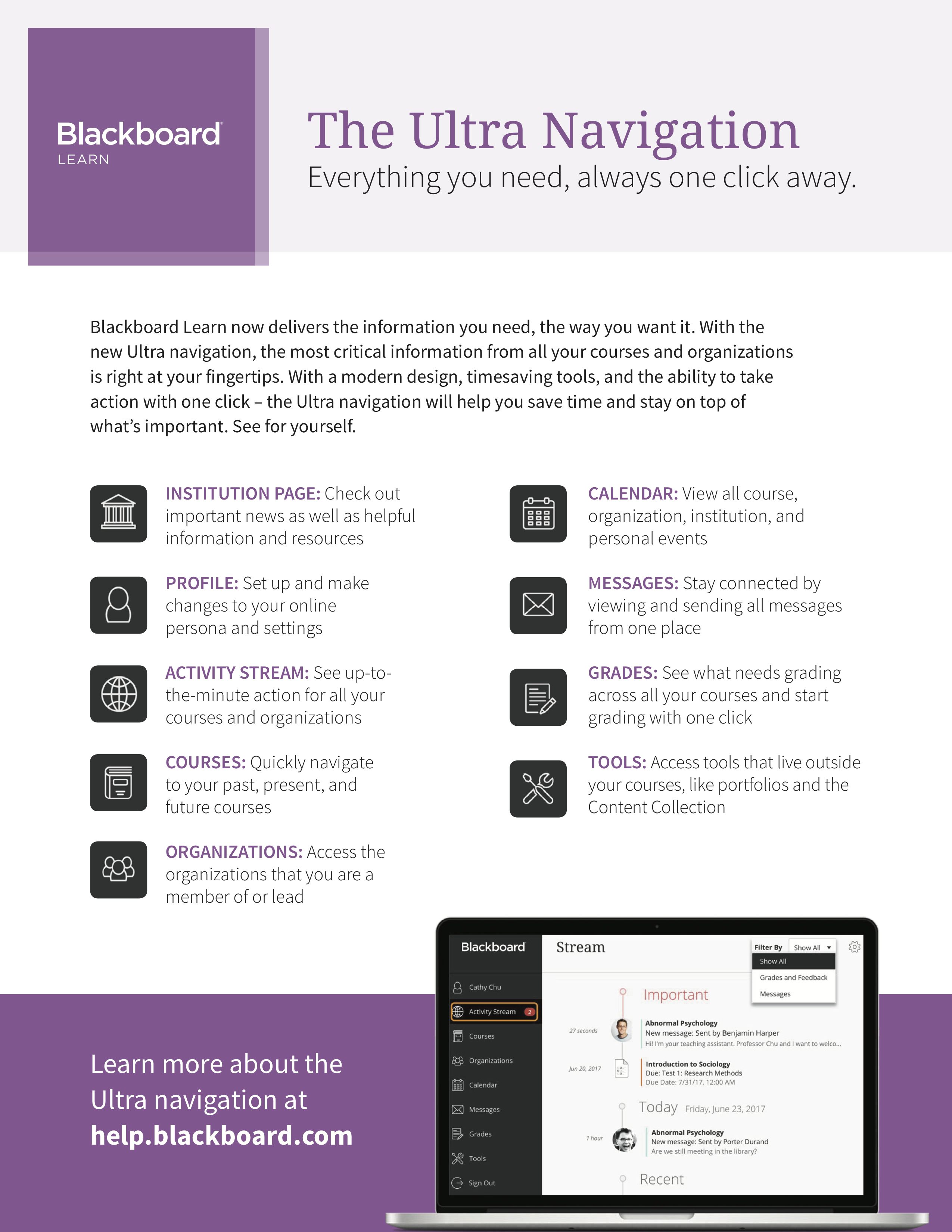
To ask this question requires an understanding of terminology, as we first described in this post. Blackboard1 is pushing the metric that there are 61 or 62 Learn Ultra customers “in production” or “using Ultra”, yet we have found very few that use, or even plan to use, Learn Ultra as their primary, institution-wide LMS. What gives? What became quite clear at this year’s BbWorld 18 users conference is that when Blackboard says in production, what they mean is that the LMS administrator has enabled the Ultra navigation, which uses the new Ultra user experience framework as the landing page / dashboard with activity feed that users see before entering a specific course. The company calls this Base Navigation, but at this point every course can be configured to be in the Original Experience or the Ultra Experience. Thus, enabling the possibility of running a course in Ultra counts as in production (note that Blackboard now lists 91 clients on Ultra).
Once a school has enabled Learn Ultra Base Navigation, they could choose to move exclusively to Ultra (e.g. the University of Phoenix, Northwest Florida State College, and a few others), or they could choose to keep all courses in Original (e.g. Northeastern State University), or they could choose to have some courses in Ultra and some in Original (used by the majority of schools investigating Ultra). This last mode is known as Dual Course mode, and even Blackboard executives seemed surprised to find out that the vast majority of schools putting Ultra in production are in fact running in Dual Course. For many of these schools, there are no definitive plans to move exclusively to Ultra.
Upon re-reading this description, I believe that I should give more credit than just describing a landing page and base navigation. The cross-course functionality is and has been a long-term goal of Ultra, as we described as early as 2016.
Creating a brand for a set of design goals is inherently fraught. Let’s look at two examples of how it makes communication of Blackboard’s strategy tricky for them. First, there’s mobile. Blackboard came out last year with a mobile app called Bb Student. It provides students with that activity stream view across courses and, of course, it’s mobile-first. (In fact, it’s mobile-only at the moment.) Furthermore, the company has made the product available for both traditional 9.x customers (which at this point is pretty much everybody) and their SaaS customers. People inside the company feel like they should be getting more credit for delivering on two major design goals (mobile first and stream-based activity views) as well as for delivering it to customers on the 9.x platform (which was more significant of a technical achievement than is immediately obvious).
This is not a matter of Blackboard moving the goal posts, per se, and it is probably more accurate to say that Ultra cross-course functionality enabled by Base Navigation is ready and showing some benefits.
The challenge is that this move is not sufficient to make a material change in Blackboard’s company prospects. At best, Learn Ultra Base Navigation without usage of Course View will slightly slow down the rate of customers defecting for another LMS. For Learn Ultra to matter and to make Learn newly competitive, they need customers to also use Course View as the primary choice at their institution, and that usage by-and-large is not ready outside of a handful of schools.As an example from BbWorld18, Belmont University presented their experience moving to Learn SaaS (the important issue in the present, and a predecessor for adopting Ultra) and to “the Ultra Experience”. But after we asked a question about faculty adoption of the Ultra Course Experience, the administrator clarified that there are no courses running Ultra – all they have done is enable the Ultra base navigation, and they do not expect to do any course migrations for at least another year. This full adoption of Learn Ultra might become important in the future, but it is not driving decisions today.
Does It Matter?
Given that we’ve been asking for three entire years whether Learn Ultra is ready, one obvious follow-up question is whether it matters any longer. I do think the question matters as Blackboard is pinning their corporate turnaround on Learn Ultra as the core piece, and this message was heavily promoted at BbWorld 18.
This messaging makes some sense in that we consider it unlikely that Blackboard can gain significant numbers of new clients (those moving from another LMS to Blackboard Learn, beyond a dozen or fewer schools) without Learn Ultra. Learn Original Experience has too much baggage and is too dated to compete with Canvas or Brightspace by D2L, at least in North America. The company’s new Learn LMS clients are largely the University of Phoenix and ANGEL contract conversions.
To be fair, the exceptions include several schools in North Dakota (migrating from Moodle) as well as Northwest Florida State College (migrating from D2L). But even with NW Florida State, they based their decision on Learn Ultra.
Based on interviews with clients arranged by Blackboard, and based on our own connections at BbWorld, what we consistently heard during dozens of interviews and from listening to panel discussions was that Learn Ultra Course View makes sense primarily for programs or schools that have not been on Blackboard Learn before. Bb Learn clients seem to have too many expectations of needing the same functionality they had before, pushing Ultra to be largely feature-compatible with Original and thus losing some of its simplicity in the process. When the Illinois Institute of Technology migrated from Learn self-hosting to SaaS, which enabled them to explore Ultra, they chose one program and a handful of faculty that were willing to jump into Learn Ultra, but for almost all others they are sticking with the Original Course View for the time being. The soonest they would expect moving primarily to Learn Ultra at the Course View would bet 3-5 years from now. You can hear the same dynamic in a recent Rod’s Pulse Podcast (shared under CC-BY-NC-SA license and also available at Inside Higher Ed), with Rod Murray interviewing Rob McCunney about their school (University of the Sciences) and its migration to SaaS and Ultra. It is a fascinating first-hand description of their experiences. Please note that they use use the terms Traditional and Original interchangeably.
R Murray: We turned on the SaaS in January, but we really kept the Original Experience until July. In mid-July we flipped the switch to turn on the Ultra Experience. Now again for those of you are not as familiar with the way Blackboard works, that wasn’t changing the course format. They were still traditional courses, but you know all those tabs and modules disappeared, and we ended up with a new base navigation in Blackboard, which they called the Ultra Experience. So that was a major change, and we do have some summer sessions, but we felt this was the least painful way to turn it on. We didn’t want to wait till August just before our fall students came back.
In terms of turning on the Ultra Experience, what were some of the major issues that you saw, that you were concerned with?
R McCunney: Besides the fact that we lost the tabs and modules, so we kind of rolled out OneCampus as Rod said, I think one of the major things that that I noticed wasn’t really even on the admin side, it was just getting people used to something that was completely different as soon as they logged in to that institution page. Where’s my stuff, where is my modules? It just looks completely different than what they’re used to, and there’s some stuff missing, and we replaced it. We put stuff in other areas, and we communicated that, but that was probably the biggest hurdle. Just what is this, what is this Blackboard Ultra that you’re changing me to? And at that point, in July we only changed basically the institution page. Your average user, once they get into their course they didn’t notice anything different, but that initial freak out of here I don’t know where my form is. We told them a dozen times where it is, but it’s somewhere else. That was probably one of the major hurdles, and I didn’t anticipate that as being a big as an issue as it was. I thought there was going to be more nuts and bolts issues, which there were very few of those for the most part.
R Murray: Right now of course we don’t have that many students here in the summer, so the real test will be in another week or so when students come back and really start. We all start kicking the tires, even on the traditional courses within the Ultra Experience.
[snip]
R Murray: The next big change that we have to live through has to do with converting courses to the Ultra course view. Now here at our university we certainly didn’t do it en masse, we went to play with it for at least this term and maybe next. But there are some courses that we decided made a lot of sense to convert to the Ultra course view. Those schools that those courses that are brand new, especially online courses that are brand new, it made sense to develop them directly in the [Ultra] course view.
Schools are trying out the Ultra Experience in terms of the landing page and cross-course functionality, but by-and-large they are very cautious jumping into the Ultra Course View where most of the functionality resides.
Based on this situation, we believe that the migration to Learn SaaS might be a better indicator – at least in the short run – than Ultra adoption of whether a school plans to stick with Blackboard. When a school moves to Learn SaaS, they all tend to sign contract extensions for 1 – 3 years or at least internally plan no LMS migrations for more than 1 – 3 years. And the migration to Learn SaaS does not suffer from the vague terminology issues – a school either uses Learn deployed on SaaS (through AWS) or they don’t.
383 clients on Learn SaaS as of BbWorld 18 is good progress and easy to understand. This issue is what likely matters more to Blackboard clients today and for the next few years, but in the long run the company needs Learn Ultra to be accepted – including at the course level – in order to become more competitive and pick up new clients.
In the end, Learn Ultra is partially ready and does matter, more so in the future, but the Learn SaaS migration matters much more today. This answer is a real improvement over the situation a year ago and even from the beginning of this year, but it is still a far cry from a simple yes and yes answer that Blackboard would like to have.
This year’s D2L Fusion conference in Houston carved out a space somewhere between the carnival atmosphere of InstructureCon in Keystone and the subdued feel of BbWorld in Orlando (note: we plan another post on each of these conferences to share more details of our observations). This was the perfect note to hit for where D2L is in its evolution as an educational technology company. A number of things seem to be falling in place for D2L ((Disclosure: Blackboard, Instructure, D2L, and Schoology are subscribers to our LMS Market Analysis service. Blackboard, Instructure, D2L, and Pearson are sponsoring participants in our Empirical Educator Project.)) with its LMS product, but we will have to see if the recently expanded management team will be able to address the ongoing challenges that D2L faces with customer experience and expectations.
Like Blackboard and Instructure, D2L is in the middle of a transition partially driven by financial considerations. In D2L’s case, the issue is that the two rounds of $165 million aggregate funding in 2012 / 13 lead to expectations of larger market gains. In August of 2017 we shared that “D2L is on a roll, racking up significant client wins in higher education, and the company shows real signs of change in its ability to truly listen to and empathize with customers.” Two months ago we described D2L’s concerted effort to move customers to the cloud and some promising improvements surfacing in the new Daylight user experience. Despite these improvements, however, D2L has lost some marquee customers such as the University of Wisconsin system to offset some of the wins, and the company has remained steady or made slight gains in North America, European and Latin American LMS market share.
At D2L Fusion, our goal was to get a better read on how actual customers and prospects are reacting to the cloud deployment move and streamlined user experience that we have observed. A second goal we had was to get a better sense of whether D2L will be able to improve its customer service and delivery on promises made to customers.
Reactions to Cloud and User Experience
From customers we spoke to at D2L Fusion, the value of the move to the cloud as well as user experience improvements have provided breakthroughs. On the cloud front, D2L now has upwards of 98% of their customer base either hosted through Amazon Web Services (AWS) or in the company’s data centers. According to a company spokesperson, 55% of what they describe as cloud implementations are hosted by AWS, the remainder by D2L in their leased data centers. All new implementations moving forward will be hosted by AWS and by fall 2019 D2L estimates that nearly all implementations will be on the AWS infrastructure. This will be a significant achievement for a legacy on-premises software provider to make this transition. From our June post:
D2L has long worked on managed hosting options, but in late 2013 the company introduced Continuous Delivery where software releases are pushed to customers incrementally, such that customers would jointly run the latest versions of Brightspace, their LMS. This move is important, as one primary benefit of cloud deployment is to remove the explosion of software configurations and versions that make it expensive and difficult to diagnose and fix bugs and to release new features.
At Fusion 2018 we saw a continuation of this strategy, and we heard largely positive reception from customers and prospects, and we are not hearing the grumblings from customers as was evident in late 2016 / early 2017. We should also note that this move to the cloud is more aggressive than that being made by Blackboard and Learn SaaS, but more on that in a future post.
As for the new user experience and recent changes in product design, it’s useful to first establish context for what’s been happening internally at D2L. About three years ago D2L brought in a new chief operating officer, Cheryl Ainoa, and a new VP of Product, David Koehn. One of their goals was to turn the product development process on its head and, drum roll, put the users first. This means engaging with users, listening to users, understanding their problems and viewing them as partners in the effort to deliver better software. It also means solving the small things that annoy users on a daily basis and shifting away from feature releases as the key metric of progress. For companies that have been engaged in agile methodology and iterative development, this likely sounds basic. For D2L, it was a fundamental cultural shift in how development is done. At this year’s Fusion, we are seeing concrete signs that change has taken root both with the company and with customers.
Daylight Experience is the name for D2L’s redesign of its streamlined user interface. When it was first announced in early 2017, we were somewhat skeptical as the initial changes were evident in different fonts and cleaner look-and-feel but not significant improvements in the workflow for faculty and students.
As time goes on and we see more advanced demos, our view is changing. The Daylight Experience does have some real improvements not just in look-and-feel but in fewer and more intuitive clicks to get the same job done. A major focus on the Emerald Release this summer (in time for D2L Fusion users conference) is more fully encouraging usage of the activity stream for higher ed clients (this feature was initially targeted at K-12 market but has been adapted for colleges and universities).
The product showcase slide that arguably got the most enthusiastic response from the crowd was the one that focused on the small changes that users had been clamoring after for years – things like “Due Dates in Manage Dates Tool”, “Fixed Headers in Grades”, “Learning Groups”.
These are not sexy, headline-making announcements, but they matter to users. D2L has long been viewed as a platform for people and institutions that like to have a lot of control over how to configure and run an LMS; however, the breadth and complexity of options often came at the expense of an intuitive user experience. While D2L has had a solid product for a sub-set of the market for years, they have had difficulty being viewed as ‘intuitive’ or ‘easy to use’, at least since the advent of Canvas and the resultant change in user expectations. The streamlined design afforded by the Daylight Experience, and the progressive disclosure of more advanced features, could change this situation if they’re able to get it in front of potential customers for a serious look.
Customer Experience and Expectations
On the second question regarding customer service and delivery on promises there are several reasons to be upbeat, but also reason for concern. Several new customers we spoke with, from Europe, Latin America and North America, all spoke about “partnership” as being a key reason for their choosing D2L over the competition. During lengthy procurement processes, these institutions got the sense that D2L was eager to engage and work with them to achieve their goals with broad service offerings as well as an eagerness to shape product development to suit these new clients.
That said, D2L has a mixed record on follow through. A number of sources we have spoken with over the past 6-12 months have discussed a pattern of the company over-promising and under-delivering when it comes to implement promised changes. For example, these sources have told us they went into the relationship with this same expectation of a partnership, of having a voice in product direction, only to find out they are having trouble getting D2L staff to respond in a timely manner. It is not clear yet on how prevalent these concerns are, but we do believe they will need to be addressed in order for D2L to make material changes in overall market share.
D2L has made two key hires in recent months, seemingly in recognition of potential market opportunities as well as persistent internal challenges. One targets growth, the other customer satisfaction. Puneet Arora, a former sales executive with several SaaS companies, has been brought in as chief revenue officer, and April Oman, a veteran customer success executive with a number of enterprise software companies, has been added as as Senior VP of Customer Experience. Arora is new to the education space but seems to be asking a lot of the right questions, and his task is to grow the user base in a meaningful way. Expect to see some changes in how D2L positions itself and who they try to sell to, shifting the balance away from administrators and towards faculty and student end users. Oman’s role is a new one and speaks to the need to develop a stronger relationships and partnerships with customers. This will be critical as D2L tries to establish themselves as much more than a software solution and as they attempt to improve customer experience.
Better Position but Needing Results
The center of gravity of D2L’s executive team is more diffuse than it used to be. Much of the longer-tenured leadership of D2L is based out of the Kitchener, Ontario home office: John Baker, CEO; Nick Oddson, CTO; Melissa Howatson, CFO; Jeremy Auger, SVP Strategy; and Ken Chapman, VP of Market Research. Ainoa, Koehn, Arora, and Oman (the new hires), however, are all in the Bay Area in California, and Tracy Strauss, SVP Marketing, is out of Los Angeles. There seems to be a deliberate approach to finding new ways of thinking from a broader field of expertise.
D2L appears to have largely revamped its approach to product development that is more responsive to customer needs, and is putting resources into building partnerships. Yet they have not made the market gains envisioned after winning the Blackboard patent wars and then raising two large rounds of financing. We still see a two-horse race for new implementations (LMS product switches) in higher education, largely shared between Canvas and D2L, but the second horse that is looking better than it used to still needs to make further adjustments and run faster.