I’ll be giving a talk at the OpenSUNY conference tomorrow (Thursday) at 4:00 PM. The title of the talk is “Everything Old is New Again: What You Taught the OPM Companies.” But it’s about a lot more than that. SUNY was my first gig in higher education, after doing stints in K12 and corporate e-Learning, so it’s going to be a bit of a homecoming for me. I’ll be sharing some lessons learned over the intervening 14 years—for me and for them.
Moodle unveiled its new product, Moodle Workplace, at the the Learning Technologies conference in London three weeks ago. While the open source Moodle LMS has been used by companies and organizations for employee training for years (approximately 40% of Moodle implementations worldwide according to this 2015 interview), Workplace represents a new approach for Moodle’s usage of open source deployment.
Based on an email interview with Moodle Pty Ltd (aka Moodle HQ) CEO and founder Martin Dougiamas, Moodle Workplace is a “a series of well-written plugins that sit cleanly on top of the standard core distribution” and is being released under an open source GPL license. The plugins add functionality to:
Create training paths;
Create departmental structures and reporting;
Automate enrollment, certificates and other back end processes; and
Customize reporting and report delivery.
From first reading, the Workplace functionality is a subset of the features available in other products, notably Totara Learning. That solution is also based on Moodle core, although Totara forked its code base more than three years ago. ((At the time of the fork, Totara management also predicted Moodle was planning to offer the market ‘Moodle for Workplace’.)) Workplace appears to be a solid, if somewhat unremarkable platform for organizational training delivery which can provide compliance tracking, learning pathways, and other business-focused features. For organizations looking to add training features to existing stock Moodle, Workplace should offer an easier migration path than Totara.
The bigger news is the change in the distribution and business model as described by Dougiamas.
We are restricting distribution to Moodle Partners for now so that we can give more value back to our Moodle Partners who invested time and money into it.
Similar to Totara’s business model, there are limitations put on the Moodle Partners to prevent modification or distribution of the code. By providing Workplace only as a SaaS solution, Moodle is using the same distribution loophole in the GPL. ((For those unfamiliar with the peculiarities of open source licensing, Moodle and Workplace are released under the General Public License (GPL). The GPL requirement to release the source code ONLY applies if you are providing someone a copy of the binary. Providing software as a service does not constitute “distribution” under the GPL. This is how Google, Amazon, Facebook and all the other major internet players can build on open source, but not release their source code.)) The upshot is that if a company or organization wants to use Moodle Workplace, they have to work through a Moodle Partner and cannot download and install the software for free.
The business model around Moodle Workplace is clearly a departure from the norm for Moodle, where the core GPL code is available to anyone, anytime, for free. But it is not clear whether this change in model for Workplace is a limited play or has broader applications that may impact education markets. In our interview, Dougiamas directly addressed our question on whether we should expect similar changes to Moodle core:
No, we remain intensely committed to developing and improving Moodle core as a GPL product with the same license, open source practices and active community as now.
He further stated:
Our team developing Workplace have been contributing features (the more general ones) into core at the same time, and the plan is that any Workplace features that also supports sectors like Higher Ed or schools will always be migrated into core this way.
So, what are educational institutions to make of the new business model around Moodle Workplace? We’re not entirely sure at this point. At a minimum, it would appear to be an attempt to better monetize the large installed base – a move to satisfy investors and to replace the Blackboard revenue after cancellation of their Moodle Partner agreement. At a more strategic level, it could be an attempt to stay competitive with peers, particularly SumTotal and Totara, who are going after the corporate learning space.
If Workplace is successful, it will create a new revenue stream for Moodle HQ, potentially accelerating the development of the core educational product. A Moodle Partner we interviewed for this piece claimed they were already seeing increased lead generation from the announcement. The small and medium business (SMB) market is larger and generally has faster sales cycles than the education market, which could drive partner revenue and cash flows. The partners who are able to create sales momentum in both spaces and find their product / market niche are likely to see some accelerated growth. If this is successful, Moodle HQ should capture additional revenue and accelerate the product and service roadmap. This move directly addresses the issue Michael raised in the Fall about the termination of the Blackboard contract and revenue stream.
For Moodle, everything rides on their ability to grow alternative sources of revenue. The company has been touting newer offerings such as MoodleCloud, MoodleNet, LearnMoodle, and MoodleServices. Since we don’t have any external evidence that these are material sources of revenue for the company, and since the company itself has not shared numbers that we can independently evaluate, it’s very hard to tell what their chances are. Moodle has a huge installed base, which gives the project a lot of momentum. But the company that drives most of the core platform development has a business model that has not aged well and is in the process of diversifying into business models that are as yet unproven. I remember enough physics to know that momentum and acceleration are not the same thing. I think the risks are probably greater for Moodle Pty. than they are for Blackboard. But both sides of the equation bear watching.
Moodle Workplace as a monetization strategy seems to be a stronger bet than the previous offerings.
The risk for education institutions, however, is that the Workplace development roadmap pulls resources from making investments in core Moodle necessary to keep pace with better-funded rivals. At worst case, Workplace fails to find a market niche and position itself in a crowded field. The opportunity cost of investing in Workplace vs other potential investments in the core education product and cloud services could end up having larger knock on effects downstream.
What we have observed over the past 6 – 9 months is an increased customer focus by Moodle HQ, acknowledging the importance of market messaging (e.g. first-time presence at EDUCAUSE, announcing Workplace at London conference) and better understanding and satisfying business needs of revenue-generating Moodle Partners. The jury is still out on how these changes will impact financial sustainability and competitiveness of Moodle in education markets, but there is little doubt that there are changes in behavior.
In the end, this is another example of corporate financial health issues having an outsized impact on the LMS market in 2018 – 2019. And one that bears watching, coming from the LMS provider with the world’s largest installed base.
Update 3/6: Changed naming throughout to Moodle HQ instead of Moodle Pty to reflect more accurate and common usage. Also edited footnote about ‘Moodle for Workplace’ prediction to remove the implication of Moodle Workplace being a copy of Totara code.
My last post was called “Is Ed Tech Hype in Remission?” It was about—surprise!—the interesting phenomenon of ed tech hype seemingly fading for the moment. I started the post by apparently breaking a little news. Civitas, the learning analytics company, had announced a new round of investment. A close examination of the details, coupled with some information from our sources, indicated that the company likely took a hit in valuation in that round. Since student success analytics has been a hyped product category, I used that bit of news as a jumping off point. And I used the phrase “fire sale” to characterize the downward valuation, although I was fairly clear that I didn’t even have enough information to confirm that it is a downward valuation. In and of itself, this downward valuation, if true—I’m fairly confident that it is—is mainly of interest to investors. I brought it up as an indicator the hype cycle in action rather than a signal of Civitas’ impending doom.
There were lots of interesting and nuanced reactions in the comments thread on the post, on Twitter, and on LinkedIn. Elsewhere, the reaction has been different. There was some press coverage, some of which was good, and some less so. These are pretty nuanced issues. The easy part of the story to cover is not about the hype cycle or how to think about solving education’s hard problems but about whether Civitas is doing awesome or terribly. Customers, ex-customers, and of course, competitors have plenty to say about that. Sales reps for Civitas’ competitors are already out on the streets, weaponizing that post.
Look, we have a sharp rhetorical style here on e-Literate. That isn’t going to change. We want to be clear, and we want to hold actors in this space accountable. But we also try to be nuanced. So here’s a tip for you: If you get a sales rep quoting us ripping one of their competitors, make sure you read the whole post. If it was primarily about holding that competitor accountable as a bad actor, that’s fair game. On the other hand, if it was an en passant observation made in the context of a larger discussion that wasn’t especially critical of the company—like my last post—then the use of our comment is more a reflection on the sales rep than of the company we were commenting on.
Civitas has a lot of mindshare in the student success platform market category. That market category was overvalued, not mainly because of anything Civitas said or did but because higher education and ed tech investors alike have had a tendency to look for technological magic bullets. In fact, Civitas has sometimes actively resisted that hype trend, even to the point of choosing a name that can be interpreted to mean “community.” The only choice they made that I focused on in my post was their decision to market themselves as a software platform. Which was part of my point. One reason a company inclined to name itself “Civitas” might focus on selling itself as a platform company is because the market (and funders) can only make sense of them as a technological magic bullet. It’s a systemic problem.
This wasn’t what I intended to write about, but it happens to fit perfectly with the main subject of the follow-up post I was planning to write. It was on my mind to say something about another sharp section of that post:
One could argue that we hit peak ed tech hype in 2012. The Year of the MOOC. Remember how there were only going to be 10 universities in the world, and only one lecture for every subject, given by the very best lecturer in the world? Remember how everyone was going to get a Stanford education for free?
Yeah. Good times.
Since then, the hype cycles have been shorter and less intense. Sure, there was the whole adaptive learning bubble (or “personalized learning,” as it is inaccurately called), but a lot of that was the knock-on effect of a flood of Gates Foundation money. I never got the sense that there were many True Believers in adaptive learning as a magic bullet. There are still some True Believers in learning analytics, but it’s a small group. In fact, the OER True Believers club may now be larger than the learning analytics club.
Mostly, people seem to be approaching all of these things—learning analytics, adaptive learning, OER, inclusive access, etc.—with a little more sobriety. These developments are all getting attention, but not a lot of hype (though not always for lack of trying). The general attitude among educators and institutions seems to be more like, “Huh. So that’s a thing now. Good to know. What can I do with it?”
Gone are the days—at least for now—when provosts or presidents emerged from their offices all across the country and proclaimed, almost in unison, “Hear ye, people! I hath spake with the good people from Coursera, and they have shared with me the miracle of recording lectures in four-camera studios and giving away the courses for free. Huzzah! Huzzah! Let us be fruitful and make MOOCs with great haste!”
Ouch.
It’s true that some of the stuff that happened around MOOCs was objectively dumb. Phil has a good run-down of the research from both now and then. There were schools that rushed into projects and people—most infamously, Sebastian Thrun—who displayed astonishing hubris. Many of the people at the heart of MOOC mania, whether or not they were actively or intentionally participating in the hype, were really, really smart, and some of them had the best of intentions. I never got to know Thrun or Anant Agrawal—I’ve briefly met them both—but I’ve spent some significant time with Coursera’s Daphne Koller and Andre Ng. I like them both. A lot. In fact, I worried that the two of them, but especially Andrew, were too idealistic and too focused on doing good in the world to hold onto the reins of power in a VC-owned company with the kind of growth expectations that were put on Coursera. (I was probably right.)
And the truth is that, in 2018, universities are still building, delivering, and experimenting with MOOCs. Students are still learning from the courses, and we are still learning from the form. There was and is nothing wrong with experimenting with MOOCs to see what we can learn about new ways to reach new students or better serve some of the students we reach today. Just as there is nothing wrong with experimenting with student success analytics to see what we can learn about new ways to identify students who need help sooner or find new ways to help them (or to enable them to help themselves).
But why does experimentation come with the insanity so often? Why were MOOCs accompanied by MOOC madness?
I don’t know for sure, and I suspect that the full answer is complex and related to pre-rational aspects of our thought processes as they evolved over millions of years. But here’s one simple and obvious part of the answer: 160,000. That’s roughly how many students took an early MOOC in artificial intelligence offered by Sebastian Thrun and Peter Norvig. It’s no coincidence, I think that the four founders of the pioneering MOOC organizations—Thrun, Agrawal, Koller, and Ng—are all computer scientists. For one thing, they all could do the math fairly quickly to recognize how long it would take them to reach that many students via more conventional means.
You probably should be knocked a little bit off your axis by the notion of reaching 160,000 students all over the world with one class, particularly if you are an idealistic educator. We live at the first moment in history when it is conceivable to enable every human being to have access to education equal to their intellectual potential. That is what “160,000” represents. The possibility of a new mission for higher education and the potential dawn of a new era for humanity. So yeah, some people lost their minds for a while.
It turns out that reaching all of those potential students effectively is not so simple, and doing so in a way that is organizationally sustainable is even harder. Heck, we haven’t even figured out how to fund educating all the people in our own states here in America. How are we going to fund educating everyone in the world? I’m not saying it can’t be done. I’m saying that we should have known it wouldn’t be so easy. And we should have known that video lectures wouldn’t be the answer. (Yes, yes, I know, many of us did. The point is, people lose perspective sometimes. I have over 15 years of blog posts on this site, so if anyone wants to point out times when I did, I’m sure they could find plenty of examples.)
This is not a sufficient explanation for the ed tech hype cycle. I could list other subjects of hype that were…shall we say, not as understandably inspiring of irrational exuberance. But it’s a place to start. Educators typically want to do good. That includes educational professionals who happen to work for for-profit companies, by the way. In order to do so, they often have to deal with organizational psychology, business process management, budgets, politics, market forces, and a whole host of confusing and interacting systems that human minds are not very good at modeling. So we tend to latch onto simpler, and often shinier, explanations. Technology will save us. Evil companies are killing education. Education need to be disrupted.
But the thing about chasing the hype is that it is exhausting and expensive. After a while, it wears you down. That’s what I think we’re in now. A period of exhaustion. We have enough people who have been burned enough times in rapid succession, and who are trying to solve enough serious and immediate problems, that they just can’t afford to be burned chasing the next shiny thing right now. They have to focus on solving the hard problems, because those are the real problems that just might move the needle for their respective institutions. That’s good news for almost everyone, from the students, to the faculty, to the universities, to the ed tech companies that want to do the right thing.
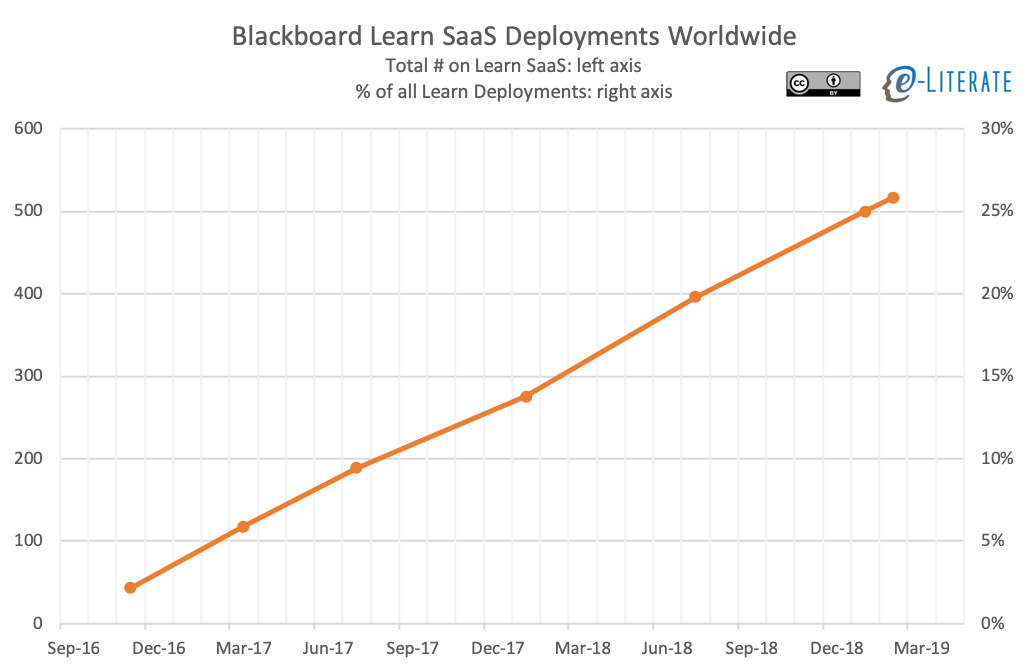
In last week’s post on Blackboard, I shared the roughly linear progression of migration of the Learn LMS to a software-as-a-service (SaaS) model – a move that we believe is more important than is the Learn Ultra user experience. If you take into account percentages of total Learn deployments, you see that Blackboard has roughly 25% of Learn clients on SaaS after starting in late Fall 2016, increasing by approximately 10% per year. ((Each point is taken from Blackboard public release of information either directly to us at e-Literate or in press releases.))
Blackboard is not the only LMS company migrating to the cloud, however, and D2L ((Disclosure: D2L and Blackboard and Instructure are all subscribers to our LMS Market Analysis service.)) has taken a more aggressive bet on SaaS for their Brightspace LMS platform (also based on AWS), as described in Summer 2018.
While we heard grumblings from multiple clients during the transition – especially through early 2017 – D2L clearly made some hard choices and and is aggressively moving to the cloud, not just as an option, but as their primary delivery model. According to David Koehn, VP of Product Management at D2L:
All new Brightspace implementations are on AWS cloud;
Virtually all current Brightspace implementations use Continuous Delivery; and
Approximately 50% of current customers are already on the AWS version of cloud deployment; and
By the end of 2018, a large majority of customers will be on cloud deployment.
Last Fall I spent time at D2L’s Kitchener, Ontario headquarters getting an update on the company’s progress on a number of initiatives. D2L executives described that all but roughly a dozen Brightspace clients are now on SaaS deployment, and by the end of 2019 they should be fully a SaaS platform company.
Why is percentage of total deployments important? Two reasons are that the move to 100% SaaS deployment enables the movement to a single version of code, dramatically simplifying regression testing and enabling more rapid development of new designs, while also taking advantage of modern technology stacks. As described in the Summer 2018 post:
David Koehn also pointed out that the real driver for the AWS cloud move by D2L is to enable a redesign of the user experience [branded Daylight] and to provide improved scalability and reliability. In other words, the cloud deployment is a means to the Daylight end.
The downside, of course, is that pure SaaS deployments largely leads to a reduction in customization capabilities. Companies like D2L and Blackboard that are moving from an enterprise model to a cloud model are betting that they can build in appropriate configuration options (rather than customized code) and leverage third-party integrations to overcome this challenge. But to get the full advantage of SaaS, a company needs to do the entire move.
I further spent some time in London and had the opportunity to talk with D2L’s London-based leadership team that covers EMEA and Latin America regions. D2L leaders in London presented a transparent and honest appraisal of the company’s current market position in Europe and Latin America, and where they see the biggest opportunities. For starters, D2L acknowledged that Instructure’s system-wide wins for the Canvas LMS in the Nordic countries had largely blocked opportunities for expansion in that region. Other areas, however, have been much more promising. They are doing well particularly in the Benelux countries (Belgium, Netherlands and Luxembourg) with Ghent University in Belgium being an example of a recent, large (45,000 student) implementation. There have been important wins in the UK and Ireland, and activity in Spain seems to be picking up some momentum. Germany continues to be a challenging place to get a foothold partially due to university funding that favors in-house staff maintaining open source systems.
In Latin America, D2L was open about cutting back investment in the region in 2017, particularly in Brazil, largely due to economic uncertainties and limited growth opportunities. They now see activity picking up in the region and have been investing to take advantage of the market potential.
In both Europe and Latin America, the provision of professional services beyond the LMS platform, as well as willingness to add requested features, appears to be a differentiator for D2L, especially in comparison to Instructure. D2L has shown a much greater willingness to roll up their sleeves and collaborate on instructional design, course building, and online pedagogy using internal staff, almost in an Online Program Enablement model. It surprised me during my Fall HQ visit to see just how well-established is the content creation team that helps schools redesign courses and even design front-end web sites for online programs. We have heard similar messages from D2L customers and even from a consulting firm that works directly with Canvas and Brightspace customers.
To a degree, none of this post is different from our Summer 2018 coverage other than updating on progress, so why has D2L not made more of a market share increase in the past year? I suspect there are three reasons. One is that D2L has done a better job updating their product line and introducing new services than they have done in fixing issues with current customers, particularly around data and analytics. During my Fall HQ meetings, when the D2L team was describing their new data and analytics approach called the Brightspace Data Platform, I pointed out that while this appears to be an improved approach, it does not acknowledge that D2L has been touting its data and analytics capabilities for years. There are leftover frustrations from customers based on previous attempts that did not match client expectations.
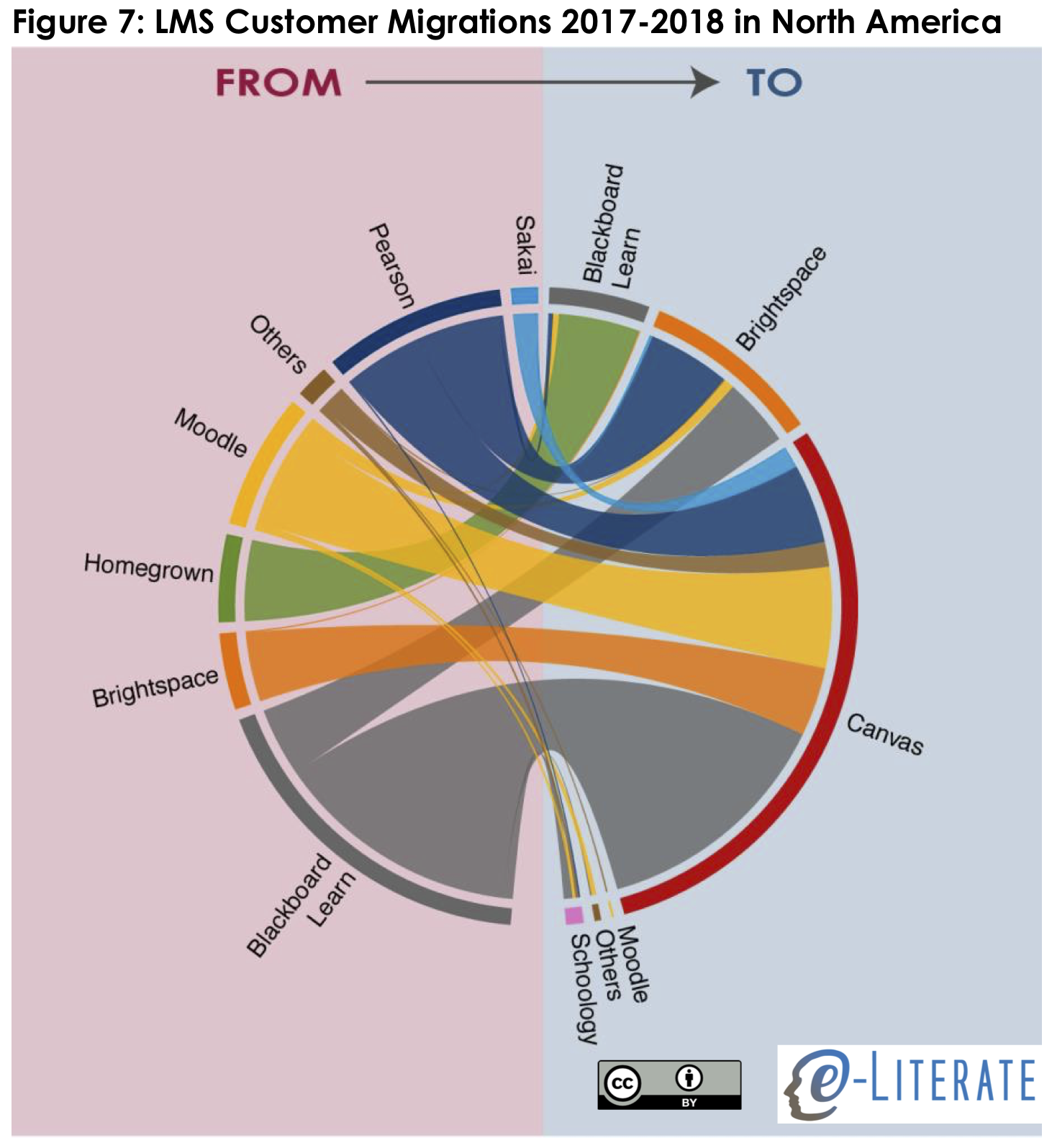
The second reason is Instructure. While D2L is in a solid second place for new implementations worldwide (schools migrating from one LMS to another), they have also lost a number of clients in North America – almost all to the Canvas LMS. In our recent LMS Market Analysis report, we showed a transition graphic with higher ed LMS migrations from 2017 – 2018.
The third reason is that it is very difficult to be a third competitor in terms of customer mindshare. The academic LMS market has tended to have a narrative of a major competitor and an upstart. Blackboard and WebCT in the early and mid 2000s, Blackboard and Moodle in the late 2000s, and Blackboard and Canvas through much of the 2010s. It is difficult for a company like D2L to break through this narrative and be top of mind for institutions from day one of an evaluation.
While D2L has challenges in market position and introduction of a new data and analytics approach, they are completing the transition to a SaaS platform company and focusing on flexibility and services.
Last Wednesday, there was an announcement about an investment in Civitas Learning that appeared to escape the notice of the educational press. Even EdSurge and Education Dive, which are both pretty good about covering the investment side of ed tech, seem to have missed it.
And at first blush, it’s easy to see why. The press release reads like a generic funding round that was successfully closed:
Civitas Learning today announced a significant growth investment from Francisco Partners, alongside current education and impact investors including Rethink Education, SJF Ventures, and Lumina Foundation. The Austin-based company pioneered the use of advanced data science, design thinking, and machine learning to inform initiatives and improve student outcomes.
That’s the meat. The rest of the press release is the usual anodyne quotes from the CEO and investor, fun facts about the company, and so on. Blah blah blah.
But there’s more here than meets the eye. First, Francisco Partners is not a venture capital fund. It’s a private equity firm. If Civitas were experiencing enough success to raise a growth round of funding, then a PE firm with no obvious experience in higher education would not be a conventional candidate for a funder. And we at e-Literate have seen no evidence that Civitas is, in fact, growing in a way that would justify a next round of investment. We haven’t heard about any new Civitas customers in quite a while (though we’ve heard about some customer losses and some grumbling among their current customer base). A quick perusal of their press pages doesn’t show any announcements of big customer wins either. It does reveal an announcement of a partnership with recruiting and retention company Ruffalo Noel Levitz, which is interesting and which I’ll return to later in this post.
Put all this together, and the deal looks more like a fire sale than a growth round. We have some information from sources familiar with the deal which supports this inference, although we do not have enough independent sources to confirm it yet.
I have no major beef with Civitas on the fundamentals of what they’re trying to do. But the buzz they generated, the valuations they got from investors, and the cool kids’ club that seemed to hover around them for a while are all symptomatic of a company that, whatever the soundness of its fundamental aspirations may be, was hyped by the markets and the press. The bubble may be deflating now.
A smart friend commented to me the other day that there are fewer of these lo-how-the-mighty-have-fallen stories than there used to be. I think this is a profound observation. Something has been shifting in the ed tech markets over the past five years or so. The ed tech hype cycle seems to have at least partially and temporarily burnt itself out. While I have no illusions that hype cycle is dead, or that it will stay relatively dormant, the quality and intensity of it is definitely different than it was five or six years ago. And that change may be a visible symptom of some more fundamental changes that are happening in the educational landscape.
Remember the days?
Remember the days when EDUCAUSE was partly a kind of fashion show? I could always go there and come away with a good blog post about that year’s ed tech darling. One year it might be open source LMSs. (Did you blink? Ah, too bad. It was a sight to see.) The next year it might be Pearson’s OpenClass. (Remember that?) Or Knewton. (Yes, they do still exist. I checked.) But there was a moment about six or seven years ago—I remember talking to Josh Kim about it at the time—when the theme of EDUCAUSE became that there was no theme. It has stayed that way ever since.
That wasn’t the end of hype. It shifted to other places. The fashion show moved to SxSWedu for a few years. And online. And in the mainstream press.
One could argue that we hit peak ed tech hype in 2012. The Year of the MOOC. Remember how there were only going to be 10 universities in the world, and only one lecture for every subject, given by the very best lecturer in the world? Remember how everyone was going to get a Stanford education for free?
Yeah. Good times.
Since then, the hype cycles have been shorter and less intense. Sure, there was the whole adaptive learning bubble (or “personalized learning,” as it is inaccurately called), but a lot of that was the knock-on effect of a flood of Gates Foundation money. I never got the sense that there were many True Believers in adaptive learning as a magic bullet. There are still some True Believers in learning analytics, but it’s a small group. In fact, the OER True Believers club may now be larger than the learning analytics club.
Mostly, people seem to be approaching all of these things—learning analytics, adaptive learning, OER, inclusive access, etc.—with a little more sobriety. These developments are all getting attention, but not a lot of hype (though not always for lack of trying). The general attitude among educators and institutions seems to be more like, “Huh. So that’s a thing now. Good to know. What can I do with it?”
Gone are the days—at least for now—when provosts or presidents emerged from their offices all across the country and proclaimed, almost in unison, “Hear ye, people! I hath spake with the good people from Coursera, and they have shared with me the miracle of recording lectures in four-camera studios and giving away the courses for free. Huzzah! Huzzah! Let us be fruitful and make MOOCs with great haste!”
Don’t get me wrong; there are still presidents and provosts emerging from their offices and making pronouncements. But I’m seeing a lot less of it than I used to. The fever seems to have passed and left some antibodies in its wake.
The one area in the market where I see something approaching hype, which I would characterize more as “intense interest coupled with a lot of hand-wringing,” is in the Online Program Management (OPM) space.
It’s worth asking why this is so.
Operational excellence is the new hotness
I have an optimistic and a pessimistic take on why ed tech hype is cooling and focusing at the moment. The optimistic take is that the sector is finally learning that there are no magic bullets. There used to be a lot of frantic effort generated by of fear of being left behind. That fear is now balanced by a healthy fear of wasting time, energy, and reputation that could be better invested. The pessimistic take is that, as a wider swath of institutions faces the existential threat of financial insolvency, they don’t have cycles to waste on trying to do cool things. They need to be focused on effective things. When an elite liberal arts school like Hampshire College is teetering on the edge of extinction, you know that #*@!& is getting real. There is likely some truth to both of these takes, which tend to feed each other.
What do OPMs do for universities? The simplistic first-approximation answer is that they enable the schools to generate more live-and-thrive revenue by generating more enrollments. How do they do this? Again, the first-approximation answer is that they provide operational excellence at building, launching, and filling new online degree and certificate programs. The good ones can do it quickly, efficiently, and with decent quality levels relative to the current baseline of quality in online learning. And if you believe that the OPM solution category is partly defined by revenue sharing (which I do), then true OPM offerings include a financing service, which enables the schools to get more programs up more quickly (albeit potentially at a higher long-term cost).
This value proposition is a far cry from robot tutors in the sky that can semi-read your mind. It’s less sexy, more grounded, and more strategic.
This shift toward practical operational services is mirrored by shifts in the capital markets such as the recent Civitas development. I have always felt that the potentially fatal flaw in Civitas was that it should have been a service company but chose to position itself as a platform company in order to compete for capital. VCs love platforms because they can grow very big without adding the cost of a lot more humans to run them. You know, like Google and Netflix. If you want to get a lot of money from VCs, it helps a lot to look like a platform company (although I get the sense that’s beginning to change in the education investment space).
If you want a picture of what Civitas could have been (and maybe should have been) in an alternate universe, then look at EAB. It’s positioned as a service company with some tech. Its big-picture value proposition to customers is basically operational excellence at recruiting and retaining students. Because the EAB management never had to raise venture capital, they were free to be what they needed to be in order to support their customers. They didn’t have to pretend to have a magic platform. They could be some very smart people who have some useful skills at improving end-to-end student success and who have some software that helps with that (which might also be a more honest description of Civitas).
I doubt that Civitas’ valuation is that high, particularly after this latest cash infusion. Their partnership with Ruffalo Noel Levitz is particularly interesting in this context. What do you get when you combine Civitas with a recruiting and retention services company? A more service-oriented offering that looks a little more like EAB—and a little more like an OPM or an Online Program Enabler (OPE).
Maybe now, with a more realistic valuation, a more service-oriented value proposition, and hopefully some patient capital, Civitas can realize its potential. I’m not making any predictions, but this feels like a course correction which both reflects the current realities in higher education and has the potential to bring the company more in line with those realities.
Operational excellence at supporting student success is the Next Big Thing
So colleges and universities are getting more focused on developing and supporting solid online programs that serve untapped student needs well enough to generate reliable additional revenue for the institutions. There are whole product categories of companies that are succeeding by providing various kinds of operational support for this growing focus. The variations among the commercial offerings are diverse and fast-growing enough that it is creating some confusion in the market, but a lot of that naturally comes with rapid growth and the bare-knuckled competition it engenders among vendors.
The nascent area that shows major yet poorly defined potential for growth is in helping universities improve the baseline for (online and on-premise) student success, whether that means college completion, career advancement, or something else. I see a lot of innovation at individual institutions and from individual vendors that gets at pieces of this problem. But the sector still lacks end-to-end methodologies for restructuring our colleges and universities to optimize themselves for this purpose and continually improve at it. Learning analytics are cool. But you know what’s really cool? Students who graduate, on time, for less money, and whose education enables them to live better lives.
That’s the next frontier in higher education. It’s a hard one, and there won’t be any magic bullets that “fix” or “disrupt” all of education. But there will be large gains in significant pockets. Universities were not designed to serve this primary purpose with excellence and efficiency in a 21st-Century world. They do surprisingly well given that fact, but we will discover some big opportunities for gains similar to the ones we see when we put an electric drive train into a conventional automobile.
“Guess what? All that up-and-down with the cylinders, all firing at exactly the right millisecond, and then the gears and contraptions to turn the up-and-down into round-and-round? Gone. Oil changes? Gone. You have a battery, you have electric motors directly attached to wheels, you have absurd amounts of torque, and very few moving parts to wear out. The power goes straight to the wheels. All that internal combustion stuff did a great job for the last 100 years, but we can propel our wheeled vehicles with more efficiency and less complexity now.”
We will discover opportunities to rethink and return to first principles in higher education. They won’t be tech-only; the machines we are talking about are the universities themselves, and the changes will be ones of process at least as much as of tech. These changes won’t work everywhere equally well to solve all educational problems. But the fact that colleges and universities have not been consciously and continuously optimized for their new role (and sustainability needs) means that we will find many gaps where simple changes will make outsized differences.
This is already happening in many individual places. You will likely find at least one such story on any given week reading Inside Higher Ed or EdSurge. What we haven’t seen a lot of yet is a knitting together of the individual innovations into a methodology for operational excellence at supporting end-to-end student success. EAB is one harbinger of things to come in that regard.
Mark my words: The institutions that figure out how to do make this transformation, and the companies that figure out how to support it, will tend to thrive in the long term. In my entire career, the only thing I’ve ever found that has come close to living up to its hype is a good education.
Before I move on to my next case study in academic institutions moving toward operational excellence at supporting student success, I want to revisit a section toward the end of my last post on the California Community Colleges Online Education Initiative (OEI). I was looking at the alignment that has to be achieved at various levels in the academic organization in order to encourage all the stakeholders to embrace this collective mission, with all the changes to their day-to-day work and even professional identities it would entail. Much of the piece is about the work that had been done so far to get alignment at various levels within the administration. But toward the end of the piece, I speculated a bit on potential opportunities for fostering faculty alignment through a course peer review process using a common rubric:
[T]o me, one of the most interesting vectors for culture-building is the course exchange course quality rubric. Every course on the exchange has to be evaluated against a rubric of evidence-backed effective online teaching practices. As the pace at which exchange courses are developed increases, OEI will not be able to keep up with demand to evaluate these courses using central staff. So they are creating a peer reviewer mechanism in which faculty on the campuses are trained on the rubric and presumably compensated to review courses that are candidates for the exchange.
This opportunity fascinates me. We know that faculty who go through an expert-supported course redesign process often experience intellectually deep and emotionally moving shifts in their teaching strategies. Is the same true when faculty are trained reviewers of their colleagues’ redesigned courses? What effect will simply exposing faculty to more and different course designs have? How will their role as reviewers and critiquers shape or enhance that effect? Can a continuously improved and updated rubric become a vector for sharing new research-supported processes across the system on an ongoing basis? Will the impact be broad and deep enough to foster new kinds of intra- and inter-campus faculty dialogs about the scholarship of teaching and learning (SoTL)? Will these cultural changes help to foster alignment around continuous operational improvement for enabling student success? This is the last mile problem of higher education. Operational excellence at student success cannot be achieved unless it is infused in the daily operations in individual classrooms. That requires affirmative faculty buy-in, support, training, and embedding in a culture that invites them into the larger conversation.
Unpacking this a bit, what does it really mean to build a culture of operational excellence in supporting student success? What kind of change would be necessary at the individual level to achieve change at the organizational level?
Organizational learning
There is a useful concept in organizational psychology called “double-loop learning.” I’ll give a simple example of a non-academic organization first to make the concept clear. Suppose your company manufactures smartphones. You want supply to match demand almost exactly as possible. If you manufacture too many phones, then you will sink expense into building units that will sit on the shelves and fairly quickly become obsolete. But if you manufacture too few, then you won’t have phones to sell at the moments that people need to buy them, thus encouraging them to buy a different (more available) phone instead. In a single-loop model, you have one lever to pull, which is how many phones you produce at a given time. It’s a like a thermostat: If the room is too cold, then turn on the furnace. If the room is warm enough, then turn off the furnace. If there are not enough phones on the shelves, then turn up production. If there are too many phones on the shelves, then turn down the production line.
The problem is that there’s a significant lag between when the order is given to produce more phones and when they arrive on the shelves. During that time period, demand can change. Maybe by the time the new phones the company produces during a period of high demand actually land on the shelves during the beginning of a recession, or right after a competitor releases their hot new model. The single-loop, thermostat-like model doesn’t work very well.
Of course, the people who run the company are smart enough to know this, so they come up with all sorts of work-arounds. They build warehouses to hold excess phones near where they are built, since holding onto the phones that way is cheaper than shipping them halfway across the world and negotiating with the retail stores that are selling them and may want to ship excess inventory back. They build sophisticated forecasting models that account for factors such as the economy and competitor behavior, so the chances of them being badly wrong are reduced. These are all work-arounds to a fundamental problem regarding the costliness of being wrong in your demand forecasts. And this is exactly the way manufacturers of all kinds of complex items, including smartphones, used to operate in the old days.
But then somebody somewhere questioned a fundamental premise that drove so much effort and activity: Does it have to take so long from the time the company order new products to be manufactured until those products reach the retail shelves? Maybe there’s some part that often holds up the whole product; if we could only use a different part, or make the part ourselves, then we could get rid of a lot of the delays. Maybe the places where those component parts come from are farther away from our factory than they need to be; if we could just get them to move closer, then we could cut down on the lags. Maybe we have extra steps in our manufacturing process, or use outdated equipment; if we could only make some updates, then we can shorten the lag. And maybe if we do all of these things, as well as more generally finding and making changes anyplace where the process bogs down, then maybe we don’t have to put products on shelves at all. Maybe we can get the delay between order and manufacture short enough that we could start manufacturing the device when the consumer orders it and get it assembled and shipped fast enough that the consumer would tolerate the delay.
This is double-loop learning. Organizations not only use processes that allow them to make adjustments but also regularly examine the assumptions behind those processes that may be unnecessarily getting in the way of achieving organizational goals. We assume that we have to develop processes to mitigate bad product demand forecasts because we assume that those costs will be high because, in turn, we assume that manufacturing the product will take a long time once we decide to do it. But what if we’re wrong?
Double-loop thinking is a reasonably simple concept to understand but very hard to execute well and consistently. In the smartphone manufacturer example, think about all the many kinds of assumptions in the way things had always been done that would have to be identified, questioned, and replaced with a better-designed alternative. Particularly in the early days, when there weren’t models to copy or lessons learned elsewhere, no one person who could see all the changes that would have to be made. There would be many people across the organization—in manufacturing, product design, contract negotiation, shipping, retail relations, and so on—who would each be able to spot an individual sub-optimization in her daily work experience. And then more people would have to be involved in designing a solution to each sub-optimization, including accounting for all the ripple effects across other aspects of the organization. It would be an all-hands-on-deck sort of affair. Everyone would be needed to find problems, identify potential solutions, check those solutions for side-effects, and then implement them well.
Double-loop learning in academia
Now think about a few of the many questions that are starting to be asked about the operating assumptions about the education-related processes of colleges and universities:
Why must students stay in a course for a set number of weeks, regardless of how quickly or slowly they are capable of learning the material?
Why are students only able to register for and start a course at most a couple of set times in the year?
Why some very common teaching modalities based on the default assumption that all students learn roughly the same way and encounter roughly the same rough spots?
Why do we define the minimum math literacy for a college degree as basic algebra rather than, say, statistics?
We do we believe that professorial training requires at least five years of deep disciplinary education and at most one course in pedagogical education?
Why do faculty gain job security through research excellence far more than through teaching excellence?
Why do we assume that students know and understand everything they need to do from the moment they receive their college acceptance to the moment they arrive on campus for the start of their first semester of class?
Why do we assume we can know when individual students are in trouble and need help from the academic institutions when no employee of that institution sees the student for more than a few hours in the week—at most—and there is no good mechanism for sharing concerns and observations among the people who have contact with that student?
Think about the people who were in a position to spot each of these assumptions. Think about all the people required to design, troubleshoot, and implement alternatives that arise out of questioning the assumptions. If we want to reliably create student-ready colleges, then we need to be able to identify many unwarranted assumptions and design many alternative ways of doing things in ways that will deeply affect the ways in which academic institutions—and the people employed by them—work. To change everything, you need everyone. That specifically includes faculty.
A rubric as a vector for change
Way back in late 2013, I wrote about Pearson using a rubric to try to catalyze this sort of broad-based organizational shift in (critical) thinking: ((Pearson is a sponsor of e-Literate’s Empirical Educator Project.))
So if you’re the CEO of major textbook publisher and you want to unite the entire 45,000-employee company around a plan to transform the way the company does business, what do you do? Surprisingly, Pearson’s CEO John Fallon’s answer was, “I’ll create a rubric.”
I’m not going to analyze Pearson’s rubric in detail here…. I’ll say this much about it: It’s nothing special. It’s not bad, but it’s not genius either. There are plenty of flaws and limitations you could find if you worked at it and applied it broadly enough. There is no magic in it.
But here’s the thing: There is neverany magic in a rubric. The magic, when there is any, happens from the norming conversations that the rubric engenders. It happens when one colleague says to another, “What do you mean by ‘quality of evidence’?” Or “I scored that course a 2 on effectiveness. Why did you think it was a 4?” To the degree that the Effectiveness Framework proves to have any magic for Pearson, it will be in the norming conversations that it engenders across the company. Like our hypothetical Berkeley president, Fallon is working with diverse groups within an institution that has a culture of independence and Balkanization. Some of this is for good reason; conversations about effectiveness in chemistry education should look very different from conversations about effectiveness in fine arts education. Some of the fractiousness is about lack of a common culture and language necessary to discuss what otherwise arecommon challenges. And some of it is just human territoriality and self-interest. The first two challenges might be addressed by having a deep and wide ongoing norming conversation about a rubric that is general enough to cover a wide range disciplines and products but focused enough to provoke important discussions. The goal is for that conversation to become the basis for a new culture. The third challenge might be addressed by reinforcing that culture through your HR and other business practices.
Since I wrote that post, Pearson has developed a set of rubrics for evaluating whether a given product supports research-backed learning design principles. They have rolled those rubrics out to every product team and trained their product teams on how to use them. They have released them under a Creative Commons license and are. (For more on both the resource itself and Pearson’s interest in working with academics to make them more useful to academia, see the talk given by Pearson’s Global Head of Efficacy and Reach at last year’s Empirical Educator Project summit.) So Pearson continues to use what is essentially an academic strategy, not that different from the one being rolled out by California OEI, to build a double-loop culture around designing educational content and software functionality that are more effective at impacting student outcomes.
The rubric development, training, and norming processes are necessary but not sufficient. As I suggest in that last sentence of the Pearson post quote, other organizational processes need to be put in place as well in order to get the desired effect. It would be easy to get faculty thinking that the new practices are baked into the rubric, and as long as everybody is aligned with them, you’re good. The organization goes through the double-loop, but only until the norming process is complete. This is, in fact, what happens in many colleges and universities that adopt course quality rubrics. The institution has to mindfully employ the rubric updating, retraining, and renorming processes as methods for collaborative innovation. The rubric needs to be designed at a high enough level that it invites discussion and thought rather than rote implementation. The processes around it need to be collaborative rather than broadcast-only. And many other processes—like compensation for time invested or rewards for innovation, to take a couple of obvious examples—need to be created or modified to support and dovetail with the rubric processes.
There are lots of organizations that implement course quality rubrics. Enough that we should be able to start gathering stories and effective practices for using them to foster continuous organizational improvement. If anyone has a good example, please let me know.
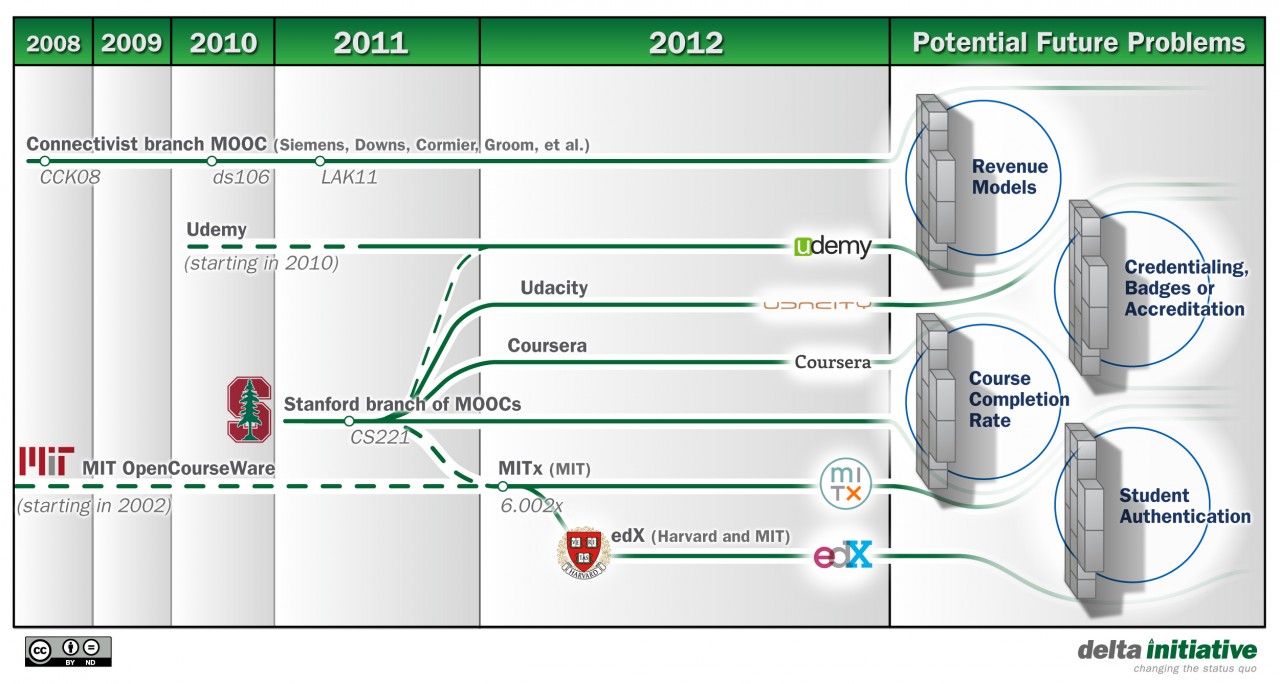
In mid 2012 during the midst of MOOC mania, I wrote a post noting that we should pay attention to future generations of the concept and that there were four barriers that the MOOC vendors would have to overcome to have any long-lasting impact.
Given this short timeline and the nature of investment-backed educational experiments, I think the real focus should be on whether and how MOOCs or successor models build on current scalability and openness while overcoming these four barriers.
Six years later, it is becoming increasingly clear that the next-generation model for MOOCs in higher education is to become a form of Online Program Management (OPM) providers, including the near-term focus on master’s degrees. The OPM market has demonstrated revenue models (tuition revenue sharing mixed with fee-for-service), the end credential is the already-accepted degree, course completion rates are higher for paying and matriculated students, and degree programs have methods for student authentication. In other words, the MOOC-based OPM model is the next-generation designed to address these challenges.
The shift into the OPM market has been documented in a series of posts in July of 2017, March, April, and May of 2018; and from Dhawal Shah from Class Central . In the May e-Literate post:
The picture one gets is of a chaotic market that is not for the faint of heart, and one that will likely see further consolidations and category changes. 2U, for its part, has been successful partially due to a niche strategy where they go after elite master’s programs and mostly avoid direct competition or engagement with the rest of the market. And recently we have started to see the MOOC providers become OPM providers – where the primary revenue for Coursera and FutureLearn are based on revenue sharing with online programs, albeit with lower sharing rates and with very different marketing approaches. In other words, there seems to be several efforts to enter into the same OPM race, but if possible to avoid being in the mainline rev-share OPM market.
Last week Julia Stiglitz from GSV Advisors, in their first podcast episode, interviewed Coursera CEO Jeff Maggioncalda who joined the company summer 2017. This interview gives the clearest view yet of Coursera’s emerging business model, and by extension it helps explain the new subset of MOOC-based OPM that includes FutureLearn, edX, and Udacity as vendors. ((Outside of Georgia Tech legacy contract, Udacity has moved to corporate professional development market, which is a different approach to same problem.)) I think that the media narrative of tuition revenue-sharing vs. fee-for-service OPM models is overblown, especially since there is a spectrum in that respect more than a binary choice of OPM vendor types. What the MOOC-based OPM entry introduces is a more fundamental characteristic of how traditional institutions develop online programs – namely low-cost vs. full-cost online degrees.
The first note from the interview is that the Coursera of 2018 is not the Coursera of 2012. While Maggioncalda still shows aspects of that old-time MOOC belief system, his approaches are very much rooted in focusing Coursera on a solid business model. And the difference shows. The second note is that 2U’s success in the OPM market and a successful IPO had a big influence on Coursera’s shift. [Emphasis added in transcript]
Julia: You know when you first joined. You spent some time looking at Coursera’s strategy, and really digging in and looking at the different businesses that Coursera had, and one of them that you were particularly attracted to, and you have put increased attention on here at Coursera is the online degrees business. What was it about online degrees that excited you?
Jeff: Yeah. This is sort of I think another good example of what good entrepreneurs have to do, is you have to have feedback loops; you need to get information from multiple sources to understand the nature of a problem so that you can come up with solution. The nature of an opportunity so you can develop a strategy to go after it. It’s really actually pretty simple. I came in – you were on the team, too, we did a lot. We call them deep dives. We went all through the business model, and there’s a great book Business Model Generation that really, to me, gives a nice framework for saying this is what a business model is. It is a target customer. It is a value proposition and offering that solves their needs. It’s a set of channels of how you acquire those customers. It’s a servicing models of how you service the models. Internally it’s the key activities and resources you bring to bear on that. It’s the partners that you work with. It’s the financial revenues and costs, and is your competition. So and that’s the framework. And we stepped through every one of those. I wrote 250 questions across that business model that we as an executive team went through. You know step by step by step, so that everybody learned the nature of our business. And what became very obvious is we had a few things that nobody else really has.
We had 36 million learners, at the time it was 25 million. 25 million learners from all around the world. That’s a pretty big asset. We had university partners. Now there are competitors out there like LinkedIn Learning, previously Lynda, like PluralSight, like SkillSoft. You know there’s YouTube, there’s Khan Academy – there’s a lot of content out there. You were one of the ones who told me in one of those early meetings, “Hey we’re worried that content, generic content, might become a commodity.” Well, we don’t want to play a commodity game. So what is it about my partners that’s super distinctive? Well our partners are universities, and they’re not just the universities, they’re the best universities in the world, and they’re spread around the world. So you say, well I’ve got a resource that almost no one has, which is this network of universities. Right now they’re publishing MOOCs, and there’s something special about MOOCS, but MOOCs are a little more susceptible to that commoditization just as MOOCs. But what was not very susceptible to commoditization are degrees. So that’s OK. We have an asset nobody else has, and what they do really well is degrees, and they still have market sizing. How big is the market for degrees? 1.5 trillion dollars. Okay, well that’s a pretty big opportunity. And then you say, what’s the likelihood that that industry could be transformed due to technology . . . You know, some industries it’s easier to transform, others, it’s harder. The provision of education is absolutely set up nicely to be enhanced, transformed by technology.
I think Uber and Lyft were really smart when they said “you know on-demand transportation, called a taxi, it’s a big market, but it’s a broken product. And if we just do some sort of digital view of this kind of redesign what on-demand transportation looks like, it’ll be a much bigger market.” I’m looking at degrees, I’m not saying it’s broken altogether, but if you look at the student debt out there, you look at the the lack of access, and you look at how inconvenient it is for people to have to stop their lives – especially for master’s degrees – quit their job, move their family, pay hundreds of thousands of dollars, forfeit their income. That’s a broken product. So I thought we got partners who are really good, and a massive economic opportunity, and a product that is just ready to be dramatically improved by technology, and so I thought this is pretty good. We should go after this. By the way we also had 2U trading at like a 12 times forward multiple. So clearly Wall Street loved the idea of online degrees, and 2U’s been doing great. They’re growing really rapidly, so there’s a data point out that says, hey this company is doing really, really well; We should be able to do pretty well here, too.
Julia: Could you share a little bit about what this redesign looks like? Because the online degrees aren’t new. You know 2U is doing them. And before 2U there were a whole set of online degree providers that were out there, so why is what Coursera is doing different?
Jeff: Yeah I think it’s a few things. The number one, I would say, is quality. When I say quality, I mean the quality of the credential. So a lot of people have spent a lot of money on for-profit college degrees that just don’t have very good credential value, they’re not recognized in the job market. You pay a lot of money, you don’t get much back for it. One of the reasons that people pay so much for the top universities is that those types of degrees means something in the job market. There have been a lot of online degrees out there, from universities, that charge a lot and don’t get you very far. Our partners happen to be the best universities in the world, with the highest credential value in the world. When these degrees come online, and these degrees online are the same degrees as on campus, you’re getting something as a credential that’s extremely valuable. That should have a very high ROI. Because we’re doing it online the cost is often less than half. So it’s a top quality credential at half the price. Same credential you get on campus.
Different Assumptions on Tuition
There’s a lot of useful insight in the full interview, but I’d like to call out the fundamental question that gets raised about online education with this market view. Should online degrees from traditional universities cost the same as face-to-face offerings, or should they cost significantly less?
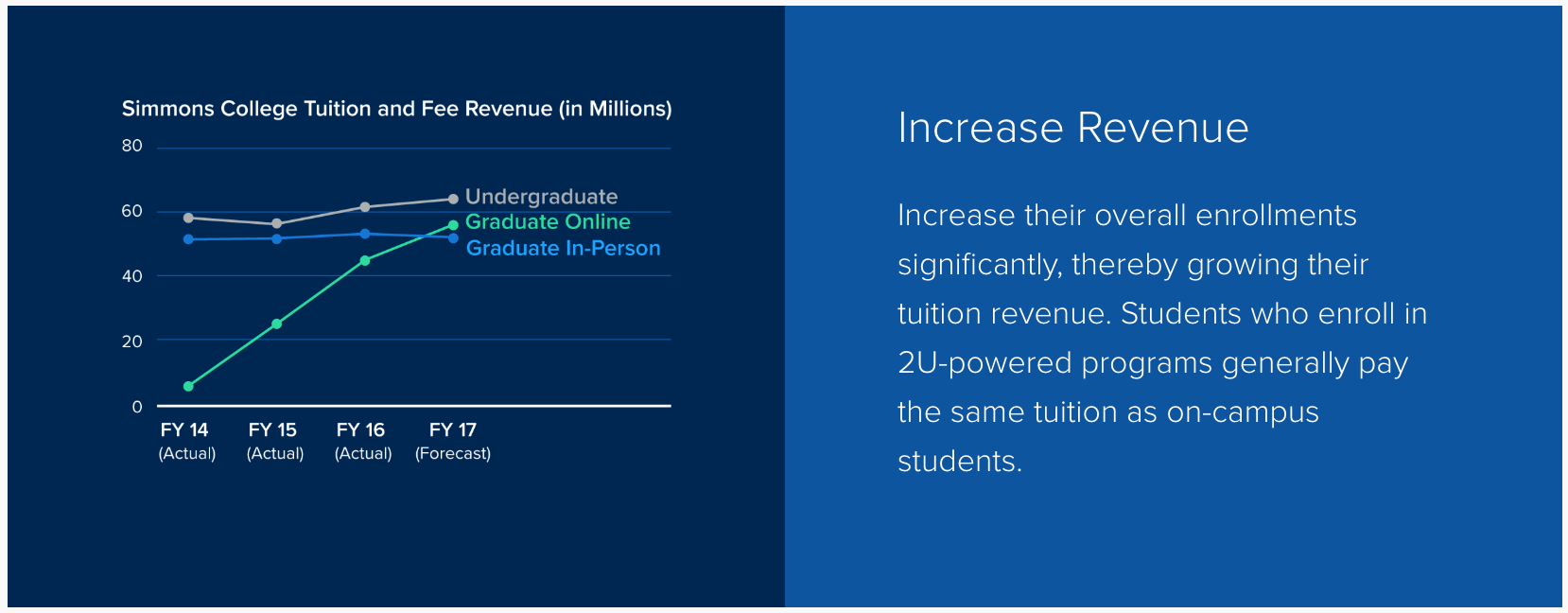
For full-service revenue-sharing segment of the OPM market, some core assumptions are built on the assumption of high revenue share percentages and full-priced online degrees. 2U is probably the best-known and arguably the most successful OPM company, and like Coursera they target elite institutions as partners. In 2U’s website under “Our Approach” they describe how their online programs typically charge the same as on-campus programs.
Most of the full-service revenue-sharing segment of the OPM market is similar in its view, whether from Pearson, Wiley, Academic Partnerships, or others – relying on consistent tuition as for online programs, and if there are lower prices they tend to be marginally lower. ((Disclosure: 2U and Pearson are sponsoring participants in our Empirical Educator Project.)) The Coursera approach is in direct contrast with this view, based on the interview as well as several of their online degree programs. There are arguments for either approach. With full-cost tuition, the idea is that the online degree gives at least as much value to students as the face-to-face, or on-campus, degree, and therefore students will be willing to pay the same. With low-cost tuition, the idea is that while students get the same value, “because we’re doing it online” the costs should necessarily be lower. Online infrastructure and marginal costs are much lower than investment in physical facilities. The point here is that this is a fundamentally different set of assumptions.
For most, the initial appeal of the program was certainly the price tag. Illinois’ iMBA costs a fraction of a degree from an elite school, where the median cost is roughly $171,000 and can break the $200,000 mark at the far end of the scale. Illinois’ own residential two-year MBA costs more than $100,000. Arshad Saiyed, executive director of online programs at the Gies College, acknowledges that the low cost brought the program to many prospective students’ attention — but says the iMBA has kept students around through a combination of high-quality instruction and successful community building.
Different Assumptions on Student Recruiting
For OPM full-service vendors, the largest expense is typically marketing and sales – i.e. recruiting potential qualified students. The predominant approach to OPM student recruitment has been based on digital marketing – advertising and outreach on social media platforms, search engine placement, digital advertisements in articles. With the MOOC-based OPM subset of the market, there is now an alternative approach based on having a multi-sided platform model. Coursera views their 36 million registered learners as an asset – a natural base of potential students for online degrees that can be reached without external advertising. In addition, the original aim and design of large-scale MOOCs is based on ability to easily sign up new learners for low- or no-cost, with the opportunity to move these students into higher-cost credentials and degrees over time, not requiring full financial commitments from students up front. While a Coursera or FutureLearn might use digital marketing for recruitment, that is not their primary method.
Different Assumptions on Course Size
Related to the above assumptions, in 2U’s case the class size is small – typically 10 – 20 students leveraging the platform’s design around small discussion groups, using both synchronous and asynchronous learning. This 2018 article about Washington University’s two programs partnering with 2U partially describes this approach.
But what is it like for student to pursue a graduate degree in law fully online? How could a pre-recorded lecture support the active teaching that’s integral to discipline? After all, watching a video isn’t the same as participating in a conversation. To support such engagement, 2U created a new tool.
“Through building an online LLM [master’s of law] program with Washington University in St. Louis, we learned how to design one of the most important tools we provide today: the bidirectional learning tool, or BLT,” said Chip Paucek, co-founder and CEO of 2U. “Socratic-style teaching is fundamental to all law curriculum and coursework. As such, it was imperative for us to design a way to conduct Socratic-style group discussions for Wash U once we signed their online LLM program.
“What we didn’t realize is that while we were developing a software tool to help solve the challenge of teaching the Socratic method online, we were simultaneously creating a way to facilitate discussion-based learning in an asynchronous environment that would eventually be used in all of our future partner programs.”
The approach that 2U and Wash U Law conceived relies upon the ingenious integration of asynchronous and synchronous course components. Instead of lecturing from a podium, faculty address small groups of student actors. At key points, the instructor breaks the fourth wall and addresses the online student, who is prompted to answer without the benefit of knowing how his or her peers have responded. In other words, students can’t piggyback like they might in an in-person class.
After responding, online students can review one another’s answers. They might be prompted to answer follow-up questions, or they might be asked to come to the next live class prepared to defend whatever position they’ve chosen. The preparatory work that might otherwise happen during an in-person class is accomplished in advance through the pre-recorded sessions, enabling faculty to make better use of live, synchronous time.
In contrast, consider a Class Central interview with Maggioncalda when talking about scaling and its challenges.
I think about systems. As the system gets bigger, where would the bottlenecks emerge? My sense is that the bottlenecks will emerge in live sessions and in grading. That’s my guess. The grading, I’m actually not so concerned about because I think the ability to automate grading at scale will become pretty good. The live sessions get tricky. From a technology perspective, I’m not that worried about it. It’s the professor’s time and attention. My thought is it’s going to be a little bit like pyramid, where the number of hours that the main professor puts in won’t really change. If you think about how medical systems have worked, a doctor is in the system, but the number of minutes and hours that a doctor spends [with each patient] becomes an increasingly smaller portion of the total time [during which medical treatment is being delivered]. I think it will probably be somewhat similar for education. The size of the classes could be big, let’s say 10,000. But that will be broken into sections of say 50. And each of those sections has an expert who’s probably not the professor. Also, there will be a lot more collaborative learning among the peers in the class. If you think about it, a lot of learning does actually happen among the folks in a class. The expert just dispensing wisdom is not the way most learning happens. I call it “high engagement learning at scale.” A major piece of high engagement learning at scale is utilizing your classmates to provide a highly valuable learning experience.
Coursera is pursuing a path to enable high enrollments in low-cost programs, and they view their challenge to balance scale and student engagement, with class sections of ~50 students.
Good Enough vs. Better Enough
In twoposts recently, Michael described a battle in the digital curricular materials market. Focusing on Cengage Unlimited in the first one, he described this dynamic.
Make no mistake; this is a potential inflection point in the curricular materials market. There is a war raging between curricular materials that are “good enough,” meaning that the lower price has a bigger impact on student outcomes than any differences in the quality of more expensive alternatives, versus “better enough,” meaning both instructors and students believe the product makes a sufficient difference in student outcomes that the more expensive product is worth the premium. Cengage is betting the farm on “good enough” beating out “better enough” and, win or lose, their bet could cause tectonic shifts in how curricular materials are developed, purchased, and used. It will have implications for inclusive access, adaptive courseware, textbook companies, textbook authors, and the landscape of options available to students and teachers.
Elaborating in the second post:
The distinction I’m trying to make between two strategies is a little tricky. I’m not arguing that Cengage, for example, thinks that their products aren’t great or that they think all anybody needs is the cheapest PDF possible. And on the other hand, “better enough” no longer means better editing or better production values, which is the way that textbook publishers used to position themselves against OER (and still do sometimes, although that reflex is beginning to fade). Rather, it’s about improving student outcomes.
What we are seeing in the OPM market, with the introduction of MOOC-based degrees, is a new battle. MOOC providers and its partner institutions, represented by Coursera, betting on “good enough”; and 2U and its partners betting on “better enough”. Like the curricular materials market, the product is based on student outcomes, which wraps in the value of the credential coming from the university along with the academic and administrative experience enabled by the company. Coursera obviously believes in the quality of their experience, and their partners have some programs that are not deeply discounted, but their market position is based on the program price being the compelling feature for students, including free or low-cost on-ramps. 2U understands that students are seeking more cost effective options, which was one driver behind creating the short-course segment with the acquisition of GetSmarter, but their market position is based on quality of experience and value of credential being the compelling feature for students. But the difference in approaches is stark and significant.
While there is likely room in the market for both approaches, the Coursera of 2018 (and not the Coursera of 2012) deserves careful observation to understand future trends with online degrees. Win or lose, their bet on low-cost online degrees will have big implications in the market.