e-Literate

Present is Prologue

Category: Strategy & Change Management

  • The CWiC Framework: Context around Courseware

    Update: I got feedback that it wasn’t clear the embedded video was a three-video playlist, so I have broken them out individually.

    We have a new case study up in which we interview members of the Courseware in Context (CWiC) framework advisory committee about their work:


    The focus isn’t so much on the framework itself as on the project goals and, somewhat less directly, it’s sustainability model. We’ve seen repeated failures in the market to create selection tools for curricular materials or edtech products. (Some of us are old enough to remember EduTools.) The committee members are very thoughtful about the missing element, which is context. There are, in CWiC advisory committee member Tanya Joosten’s words, “a million” different contextual variables, from classroom implementation to support to individual student needs. CWiC is an attempt to take a traditional product selection tool model and enrich it enough to account for all these contextual variables.

    The committee members seem acutely aware of how big of a challenge this could be, which is part of what makes these interviews so interesting. At our recent Empirical Educator Project summit, René Kizilcec (whose research we have featured here on e-Literate) made a fascinating comment, which is that we education “desperately needs” a “science of context.” The CWiC folks are trying infuse the output we currently have from the beginnings of that science into what is essentially a tool for selection and procurement. Will it work? I don’t know. The committee members are pretty clear about the size of the challenge. But it’s the right direction.

    The Empirical Educator Project (EEP) attempts to take on the other side of René’s phrase. What would it mean to have a science of context? Who would the scientists be? What cultural institutions would we need to form a consensus around what a science of context would look like such that people who care about it could cooperate on it more effectively, and such that it would attract the funding it needs to be carried out? What business process support tools, including but not limited to procurement tools, do we need to implement a science of context, and how would implementation provide input back to the scientific research? These are the questions that EEP attempts to answer. Will it work? I don’t know. But I feel confident that it’s the right direction.

  • If At First You Don’t Succeed, Try To Be An OPM: Conversion of for-profits and MOOCs

    If At First You Don’t Succeed, Try To Be An OPM: Conversion of for-profits and MOOCs

    Two weeks into March, this has already been a busy month already for the transformation of for-profits and MOOCs. For-profit universities are in a race to become nonprofit by separating academic programs from behind-the-scenes services, and MOOCs are focused primarily on monetization and moving beyond free and open courses. The common thread tying these messy transitions together is the move to become new forms of Online Program Management (OPM) providers.

    Best Way to Make Money? Go Nonprofit

    Arguably the biggest news was March 5th when the Higher Learning Commission (HLC), the regional accreditor, approved the Kaplan University / Purdue University deal to create Purdue Global. This was the final approval step as Purdue acquires Kaplan, leaving Kaplan University, leaving Graham Holdings (Kaplan’s parent company) to serve as a single-client OPM provider.

    The following day Grand Canyon University announced that it had received approval from HLC to convert into a nonprofit institution. As described in their press release, the remaining for-profit company will become an OPM, even if they choose not to use that name [emphasis added]:

    As part of the transition, GCE will sell certain academic-related assets to a non-profit entity that will carry the Grand Canyon University name. Following the sale, GCE will operate as a third-party provider of educational and related services to GCU and potentially, in the future, to other universities. The structure is similar to that at hundreds of non-profit universities in the country that outsource services to third-party providers.

    And yesterday, Bridgepoint Education announced that they were formally seeking to convert Ashford University into a nonprofit in a similar deal as Grand Canyon. At least they are more direct about the OPM tie-in as described at Inside Higher Ed yesterday.

    Bridgepoint will continue on as an online program management (OPM) provider — a booming space in higher education. The company will negotiate with Ashford to enter into a shared services agreement, with Bridgepoint likely handling data management, course management software and services, technology, and financial aid processing for the nonprofit university.

    “As an OPM, Bridgepoint Education will bring years of technological and academic innovation and intellectual property development to other colleges and universities that desire to serve students through online education programs,” Schray said in a written statement.

    In an interview here at e-Literate when Purdue and Kaplan announced their acquisition plans last April, Trace Urdan (now at Tyton Partners) described the market forces involved in some of these moves.

    • Non-profit entities – both public institutions and private non-profit institutions – “wanting to get into the adult market and the online market”. This is the big push behind the Online Program Management (OPM) market, kick-starting these non-profits into online programs targeting adult education.
    • For-profit entities “feel like they are being burdened by being for-profit”. One part of this is the regulatory burden from the Department of Education and even accreditors. But there is also a marketplace burden as non-profits like Southern New Hampshire University keep growing enrollments while for-profits are dropping.
    • There is a “the investor enthusiasm for the services model” with OPMS, “and this is a model that investors love – it gives you access to the growth in online education, affiliation with strong brands, and it’s more or less free from the regulatory hostility” of the for-profit sector.

    Beyond the market forces, however, there is another underlying factor affecting these moves. As described by legal team at Cooley Education:

    So, why did this happen? First, and most obviously, we are in a different regulatory environment – at least as far as the federal Department of Education is concerned. In late 2017, the Department of Education dropped its opposition to for-profit conversions vehemently articulated by then-Secretary John King, most recently approving the sale of South and Argosy Universities and the Art Institutes owned by Education Management Corporation to a nonprofit created by the Dream Center Foundation. This change in federal policy shifted the emphasis on approvals back to the accreditors and the states.

    At the accreditor level, the politics may be less important in understanding the outcome than the process. At about the same time that Kaplan-Purdue was first announced, HLC began working on revising its policies and procedures to establish new benchmarks by which such transactions would be measured. HLC made two significant changes: it updated its procedures for review of Change of Control transactions and, in a politically astute move, also established a policy that Department of Education approval must be obtained before HLC acts on a change of control application, thus insulating itself from second-guessing in Washington. (HLC’s change was telegraphed in late 2016 when it deferred acting on the sale of the parent of the University of Phoenix to a private equity group pending prior ED approval.)

    Significantly, HLC now has relatively clear guidance governing what is needed for OPM relationships and for-profit conversions.

    How Do We Make Money? The Answer Is Simple – Volume

    Meanwhile Coursera announced their plans to further focus on the monetization of supporting online degrees, as described at EdSurge on March 5th.

    These days, though, many MOOC platforms are courting the traditional higher-ed market they once rebuked, often by hosting fully-online masters degrees for colleges and universities. And today, one of the largest MOOC providers, Coursera, announced it’s going one step further in that direction, with its first fully online bachelor’s degree.

    Coursera is not alone here – most notably Georgia Tech and Udacity launched an online master’s of computer science in 2013. In a related move, edX has begun its work supporting online master’s degrees through its MicroMasters program, and FutureLearn – spun out of the Open University of the UK – supports multiple degree programs.

    While the Coursera news focused on the new bachelor’s program, the bigger news was the expansion its graduate programs as described at Inside Higher Ed.

    Online education platform Coursera has set a goal of offering 15 to 20 degree programs by the end of 2019. The company took another step toward that goal Wednesday, announcing new degree offerings from the University of Illinois at Urbana-Champaign and France’s HEC Paris.

    “This is our coming-out party for online degrees on Coursera,” Nikhil Sinha, Coursera’s chief business officer, said in an interview.

    FutureLearn announced their own expansion of online degrees last month.

    For the MOOC providers, their move into the OPM space seems to be driven by their leverage of current registered learners as a marketing channel, as described in a separate IHE article.

    Roughly half of the students in Coursera’s current degree programs took one of the open online courses first, essentially enabling students to “try these degrees before they buy them,” Maggioncalda says. So not only do students have a chance to see how they like a professor, or how well they perform, before enrolling in the for-credit program, but Coursera also asserts that it can drive down the cost of acquisition of students by tapping into its 31 million users.

    Coursera’s institutional partners “share a certain percentage of the learner fee with us in exchange for distribution to our world of learners, and the whole delivery of the system on our platform,” Maggioncalda says.

    New OPM Models

    Two years ago we described how the OPM market has evolved beyond its full-service tuition revenue-sharing origins to add unbundled service offerings – not to replace the previous model but to augment it. What we are now seeing are two new models within the OPM market becoming much more clear: the remnants of for-profit conversions into nonprofit status, and MOOCs supporting online degree programs. Both of these models are driven by markets that need to move beyond their origins as well. A lot of changes happening in the education space.

  • Courseware Without A Silver Bullet: Focusing on faculty enablement

    Courseware Without A Silver Bullet: Focusing on faculty enablement

    In a 2016 post on “Personalized Learning vs. Adaptive Learning”, Michael contrasted the former as a set of technology-enabled teaching practices with the latter as a project label [emphasis added].

    On the other hand, adaptive learning is a label that applies to products. Further, adaptive learning products can support all of the practice areas of personalized learning. They enable teachers to move content broadcast outside of class time, they make homework time into contact time through analytics, and they provide some tutoring function. “Adaptive” tends to provoke a lot of discussion around the latter of the three practice areas. See the piece I wrote for the American Federation of Teachers if you want a primer on the strengths and limitations of adaptive learning products as tutors. But as often as not the first two capabilities, neither of which is dependent on adaptive algorithms, are the ones that enable the biggest gains in personalized learning teaching practices. “Courseware” is a set of products that, when designed well and used properly, can enable faculty to move content broadcast out of the classroom and make homework time content time. Adaptive courseware adds the tutoring element while also, if done well, increasing the value of that homework contact time by providing better feedback through more targeted analytics.

    One problem, of course, is that many advocates end up presenting adaptive learning as a silver bullet, focusing on supposed magical tutoring capabilities and ignoring the messy but valuable work of enabling faculty to improve their own courses. As we will see, it is not a safe assumption that all vendors like this label or set of assumptions.

    In the first episode of this series we explored the challenge of going beyond pilots and deploying systems at scale. In the second episode we explored the importance of increased visibility as an important benefit of course redesign. In this episode we explore the challenge of silver bullets – what happens when a company has no intention of being labeled as “adaptive learning” but has been described that way? Realizeit is not the only company dealing with this same issue, and it is important for educators to understand how a company defines itself and the problems their products are designed to solve. ((This post is not meant to endorse Realizeit’s platform over other companies’ platforms. We are focusing on institutional perspectives and lessons to be learned. Realizeit is one of our sponsors of the Empirical Educator Project.))

    (source: https://youtu.be/xPWBoMhP_yU)

    This post is part of our e-Literate TV series, which is funded in part by the Bill & Melinda Gates Foundation. The findings and conclusions (or views) contained within are those of the authors and do not necessarily reflect positions or policies of the Bill & Melinda Gates Foundation.

  • The Purgatory of Ed Tech Transformation Initiatives

    The Purgatory of Ed Tech Transformation Initiatives

    Doug Lederman at Inside Higher Ed wrote an excellent article describing the trajectory and demise of the “failed $75 million experiment” of the University of Texas System’s Institute for Transformational Learning (ITL).

    Starting in 2011, the Texas system invested nearly $100 million in the institute ($23 million remains unspent) to try to drive digital technologies into the approaches its campuses use to reach, educate and graduate students. Over five years, the institute helped several UT campuses launch distinctive new academic programs and developed three core pieces of technology that, among other things, deliver online learning and students’ transcript information via the blockchain. But its total revenue over the five years: $1 million, The Texas Tribune reported.

    Critics have derided that output as paltry given the investment and questioned whether the money could have been better spent. Advocates for the institute say it was the sort of necessary and worthwhile experiment that higher education institutions undertake all too rarely, even as they acknowledge a set of miscalculations that — along with political and cultural circumstances in part beyond its control — contributed to its undoing.

    Among those missteps, according to numerous people who worked closely with the institute, were a tendency to approach campus faculty members with arrogance rather than as partners, and a lack of clarity from the start about the endeavor’s goals and business plan. Those were compounded by a problem that afflicts many educational technology efforts, whether funded by Silicon Valley investors or campus leaders: too little patience for what is almost always a long, drawn-out process of adoption and proof.

    It’s worth reading the whole article, and sprinkled throughout are quotes from faculty and staff from the University of Texas system – ITL’s natural customer base – about overly optimistic claims, inability to understand or listen to its stakeholders, and real or perceived arrogance. I observed similar reactions when on the UT Austin campus for a video case study in Fall 2016 about their attempts to reinvent the large lecture class. When I asked about the overlap or collaboration with ITL on what seemed to be a perfect fit for that group’s objectives, I got eye rolls and comments about ITL being irrelevant for campus-based innovation efforts. Regardless of how that situation arose, the point is the same – there seems to have been a real breakdown of communication and trust between ITL and UT campus educators, despite the fact that “some of the work done by the institute has been divested to the various UT campuses.”

    ITL was not alone as a failed, or at least abandoned, initiative to transform education based on innovative ed tech, and there is a theme in general of focusing more on the supposed tech-based innovation rather than the issue of cultural change and understanding social barriers (and this includes a culture’s view on whether the innovation is worth adopting). This is not a new subject, and similar challenges from a vendor standpoint led to the 2014 post “Pilots: Too many ed tech innovations stuck in purgatory”, an adaptation of which forms the second half of this post.

    The general interest on dealing with the social change issues around real adoption of innovative education approaches – as well as the associated culture required to test theories, honestly assess results, and make continuous improvements in teaching practices – is what has led us at e-Literate to work on the Empirical Educator Project that Michael described a few weeks ago.

    Despite the billions of dollars invested and provided in grants over the past several years, the vast majority of ed tech is used in only a small percentage of courses at most campuses. ((I’m not arguing against faculty prerogative in technology adoption and for a centralized, mandatory approach, but noting the disconnect.)) Most ed tech applications or devices have failed to cross the barriers into mainstream adoption within an institution. This could be due to the technology not really addressing problems that faculty or students face, a lack of awareness and support for the technology, or even faculty or student resistance to the innovation. Whatever the barrier, the situation we see far too often is a breakdown in technology helping the majority of faculty or courses.

    Diffusion of Innovations – Back to the basics

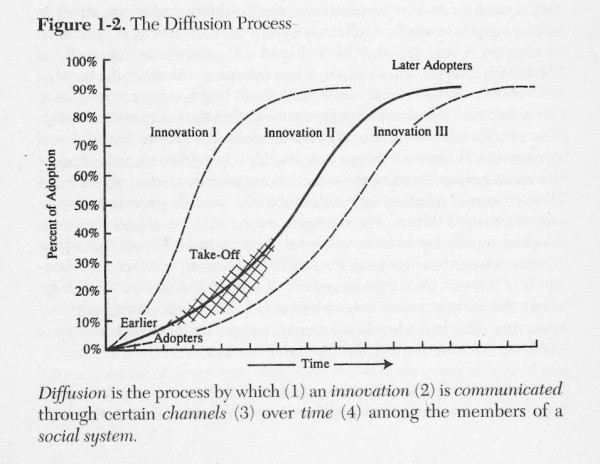
    Everett Rogers wrote the book on the spread of innovations within an organization or cultural group in his book Diffusions of Innovations. Rogers’ work led to many concepts that we seem to take for granted, such as the S-curve of adoption:

    Source: The Diffusion of Innovations, 5th ed, p. 11
    Source: The Diffusion of Innovations, 5th ed, p. 11

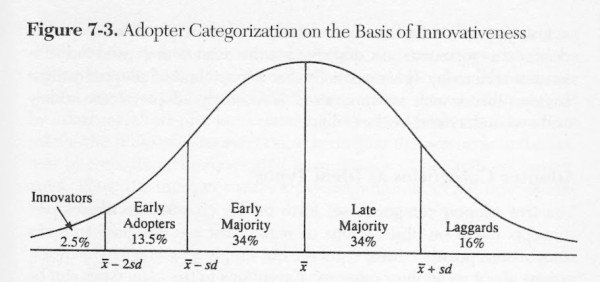
    leading to the categorization of adopters (innovators, early adopters, early majority, late majority, laggards), and the combined technology adoption curve.

    Source: The Diffusion of Innovations, 5th ed., p. 281
    Source: The Diffusion of Innovations, 5th ed., p. 281

    But Rogers did not set out to describe the diffusion of innovations as an automatic process following a pre-defined path. The real origin of his work was trying to understand why some innovations end up spreading throughout a social group while others do not, somewhat independent of whether the innovation could be thought of as a “good idea”. From the first paragraph of the 5th edition:

    Getting a new idea adopted, even when it has obvious advantages, is difficult. Many innovations require a lengthy period of many years from the time when they become available to the time when they are widely adopted. Therefore, a common problem for many individuals and organizations is how to speed up the rate of diffusion of an innovation.

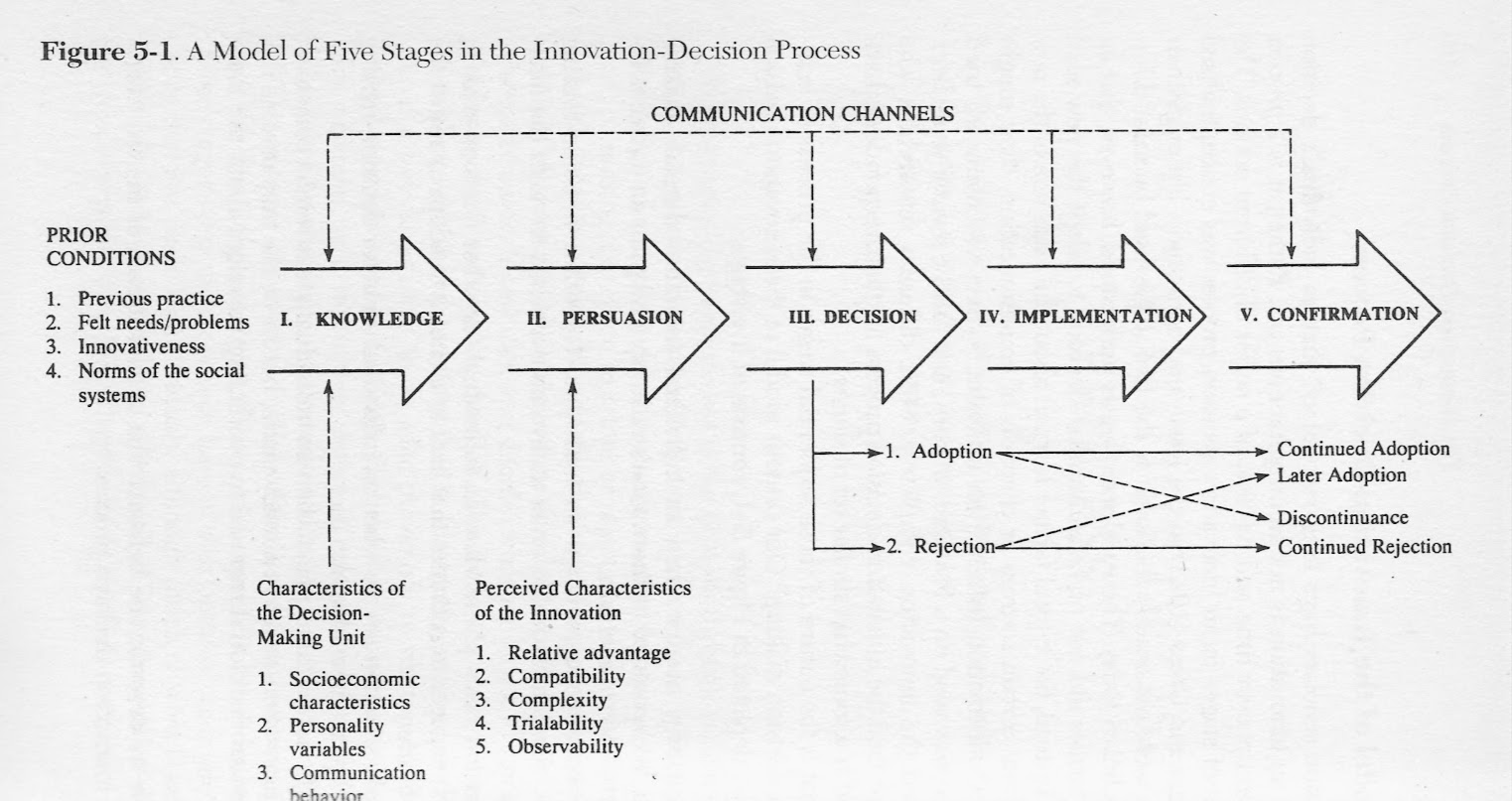
    Rogers defined diffusion as “a special type of communication in which the messages are about a new idea” (p. 6), and he focused much of the book on the Innovation-Decision Process. This gets to the key point that availability of a new idea is not enough; rather, diffusion is more dependent on the communication and decision-process about whether and how to adopt the new idea. This process is shown below (p. 170):

    Source: The Diffusion of Innovations, 5th ed., p. 170
    Source: The Diffusion of Innovations, 5th ed., p. 170

    What we are seeing in ed tech transformation initiatives in most cases, I would argue, is that the new ideas (applications, products, services) are stuck the Persuasion stage. There is knowledge and application amongst some early adopters in small-scale pilots, and there are good motivations in general from transformation groups like ITL and vendors, but majority of educators either have no knowledge of the innovation or are not persuaded that the idea is to their advantage, and there is little support or structure to get the organization at large (i.e. the majority of faculty for a traditional institution, or perhaps for central academic technology organization) to make a considered decision. It’s important to note that in many cases, the innovation should not be spread to the majority, either due to being a poor solution or even due to organizational dynamics based on how the innovation is introduced.

    The Purgatory of Transformation

    This stuck process ends up as an ed tech purgatory – with promises and potential of the heaven of full institutional adoption with meaningful results to follow, but also with the peril of either never getting out of purgatory or outright rejection over time.

    Ed tech innovators can often be too susceptible to being persuaded by simple adoption numbers such as 1,100 institutions or total number of end users (millions served), or by new the promise of ideas that look great on paper, but meaningful adoption within an institution – actually affecting the majority of faculty or courses – is necessary in most cases before there can be any meaningful results beyond anecdotes or marketing stories. The reason for the extended purgatory is most often related to people issues and communications, and the ed tech market (and here I’m including transformation initiatives, vendors, consultants, and campus support staff and faculty) has been very ineffective in dealing with real people at real institutions beyond the initial audience for an idea.

    As Larry Cuban stated in his commentary about Larry Berger’s “confession” that the engineeriomy model of personalized learning is flawed (also covered here at e-Literate):

    First, those confessing their errors about solving school problems seldom looked at previous generations of reformers seeking major changes in schools.They were ahistorical. They thought that they knew better than other very smart people who had earlier sought to solve problems in schooling.

    Second, the confessions seldom go beyond blaming their own flawed thinking (or others who failed to carry out their instructions) and coming to realize the obvious: schooling is far more complex a human institution than they had ever considered.

    Finally, few of these confessions take a step back to not only consider the complexity of schooling and its many moving parts but also the political, social, and economic structures that keep it in place (see Audrey Watters here). As I and many others have said often, schools are political institutions deeply entangled in American society, culture, and democracy. Keeping the macro and micro-perspectives in sight is a must for those seeking major changes in how teachers teach or how schools educate. Were that to occur the incidence of after-the-reform regret might decrease.

    Cover image credit: Ludovico Carracci [Public domain], via Wikimedia Commons

  • Visibility As A Benefit: Ole Miss and UCF share their stories on courseware usage

    Visibility As A Benefit: Ole Miss and UCF share their stories on courseware usage

    In an article Michael and I wrote for EDUCAUSE Review in 2016, we described our view of personalized learning as “a family of teaching practices that are intended to help reach students in the metaphorical back row”. One of the key practices focused on gaining increased visibility into student coursework.

    These same automated homework tools can also give teachers an easy view into how their students are doing and create opportunities to engage with those students. “Analytics” in these tools are roughly analogous to your ability to scan the classroom visually and see, at a glance, who is paying attention, who looks confused, who has a question.

    With the usage of digital courseware to provide the homework tools, this focus on visibility into the learning process can apply across the entire course. What are different schools learning in this area?

    As part of our e-Literate TV series of video case studies, we had a chance this fall to interview several institutions that are focusing on the benefit of increased visibility into student learning by usage of digital courseware based on interviews at the Realizeit users conference. ((This post is not meant to endorse Realizeit’s platform over other companies’ platforms. We are focusing on institutional perspectives and lessons to be learned.))

    In the first episode we explored the challenge of going beyond pilots and deploying systems at scale. In this second episode I interview representatives from the University of Mississippi and the University of Central Florida, asking them to describe their experiences and focus on the issue of increased visibility.

    (source: https://www.youtube.com/watch?v=_FuIQgtvO-k)

    We’ll share one more set of interviews from this conference in the coming weeks.

    This post is part of our e-Literate TV series, which is funded in part by the Bill & Melinda Gates Foundation. The findings and conclusions (or views) contained within are those of the authors and do not necessarily reflect positions or policies of the Bill & Melinda Gates Foundation.

  • Digital Courseware at Scale: APUS and Bay Path University share their stories

    Digital Courseware at Scale: APUS and Bay Path University share their stories

    Several years ago I wrote a post titled “Pilots: Too many ed tech innovations stuck in purgatory”, where I used Everett Rogers’ Diffusion of Innovations framework to explore why we have plenty of pilots but not very many large-scale adoptions of ed tech innovations.

    What we are seeing in ed tech in most cases, I would argue, is that for institutions the new ideas (applications, products, services) are stuck the Persuasion stage. There is knowledge and application amongst some early adopters in small-scale pilots, but majority of faculty members either have no knowledge of the pilot or are not persuaded that the idea is to their advantage, and there is little support or structure to get the organization at large (i.e. the majority of faculty for a traditional institution, or perhaps for central academic technology organization) to make a considered decision. It’s important to note that in many cases, the innovation should not be spread to the majority, either due to being a poor solution or even due to organizational dynamics based on how the innovation is introduced.

    This stuck process ends up as an ed tech purgatory – with promises and potential of the heaven of full institutional adoption with meaningful results to follow, but also with the peril of either never getting out of purgatory or outright rejection over time.

    Accordingly, we have more information about institutions with quite a few pilots around digital courseware, but there is not much information about colleges or universities implementing at scale. What are the problems to be solved for large-scale adoption, and what lessons can be learned (both positive and negative)?

    As part of our e-Literate TV series of video case studies, we had a chance this fall to interview several institutions that are dealing with this challenge – deploying courseware at scale – based on interviews at the Realizeit users conference. ((This post is not meant to endorse Realizeit’s platform over other companies’ platforms. We are focusing on institutional perspectives and lessons to be learned.)) In a future episode we’ll describe more directly what Realizeit’s platform is and is not, but to start, let’s get a sense of the institutional perspective.

    In this first episode I interview representatives from American Public University System (APUS) and Bay Path University, asking them to describe their programs. APUS has redesigned more than 1,600 courses based on active learning, as well as new competency-based programs, and Bay Path is applying courseware broadly across the entire institution.

    (Video source: https://youtu.be/hUySDzoz_gE)

    We’ll share additional interviews from this conference in the coming weeks.

    This post is part of our e-Literate TV series, which is funded in part by the Bill & Melinda Gates Foundation. The findings and conclusions (or views) contained within are those of the authors and do not necessarily reflect positions or policies of the Bill & Melinda Gates Foundation.

  • Top Hat Marketplace: What is it and should we care?

    Top Hat Marketplace: What is it and should we care?

    When Top Hat announced their latest round of financing a year ago ($22.5m), I admit to having been skeptical, or more accurately cynical, about their stated purpose. The company was primarily known for its mobile and laptop-based classroom response system, but now it is claiming to be a digital content company.

    Top Hat, the Canadian education technology startup, completed a new round of funding to give it more firepower to go after textbook publishers like Pearson Plc. [snip]

    Top Hat is one of a handful of startups trying to find ways to disrupt the traditional textbook publishing industry, dominated by companies like Pearson, Cengage Learning Inc. and McGraw-Hill Education Inc., which is owned by Apollo Global Management LLC. All of these firms have added digital educational materials to their range of products, but the transition has been rocky.

    Then in the summer the company announced their new Marketplace.

    The Top Hat Marketplace answers the urgent need of professors and instructors to easily find and create educational content that is interactive, easily customizable and much more affordable for students than conventional textbooks. The educational content in the Top Hat Marketplace breaks the slow-paced publishing model by allowing educators to provide one another instant feedback. This collaborative community-sourced model means that the Marketplace’s content is continually being updated and improved upon.

    We at e-Literate have been covering the long-running and messy transition to digital curricular materials, including the search for new business models for content companies. But the announcements from Top Hat, to me at least, had the feel of a company pivot leveraging big, bad publishers as the bait for naive investors. Quite often it feels like the official greeting of ed tech entrepreneurs has either been “we’re going to beat Pearson” or “we’re going to beat Blackboard”. Top Hat and its products do not neatly fit into typical categories, but this may mean that we’re seeing a new model emerge, or at least a modernized and serious attempt to establish the self-publishing model.

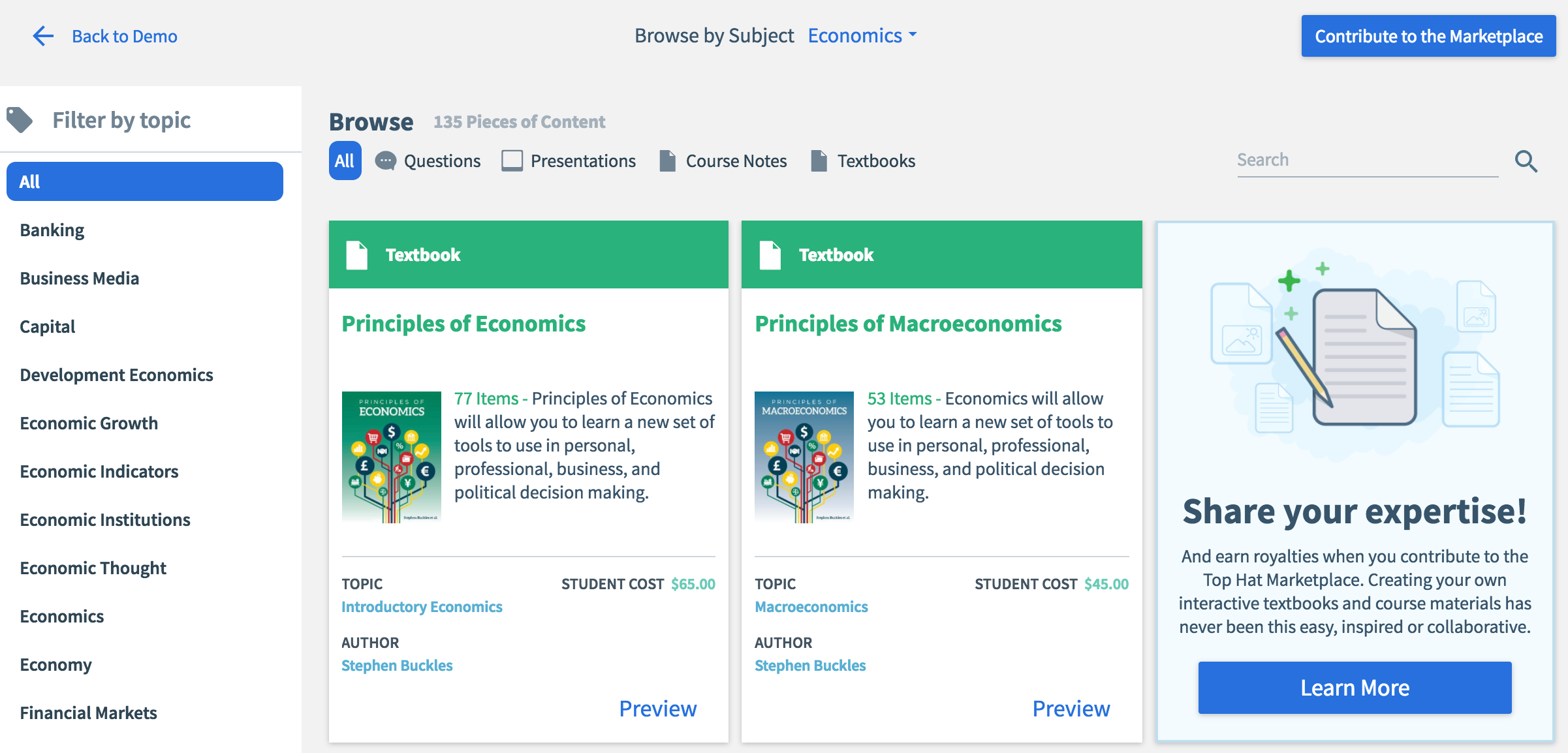
    The Marketplace provides a series of textbooks and ancillary material, (course notes, question packs, presentations, etc) that instructors can browse, adopt, modify, and share with students either as mandatory or recommended resources. Students pay fees between $0 and roughly $65 for the materials. A spokesperson for Top Hat clarified a recent change:

    As we’ve already discussed, 90% of the content in the Top Hat Marketplace is free for instructors and students to use. However, by the end of January, students no longer need to use the Top Hat engagement app to access this content—meaning, students will no longer need to pay the per-term app fee to use free textbooks and content.

    Other than reasonably low prices, nothing noteworthy so far. What is unique is that there are two primary sources for the content – self-publishing by instructors and open education resources (OER) from OpenStax. As described in the press release this summer:

    “We leveraged our existing relationship with educators already using our classroom engagement tools to test and launch the Marketplace,” said Mike Silagadze, co-Founder and CEO of Top Hat. “The Marketplace finally puts educators — the people at the forefront of learning — in charge of their course materials.
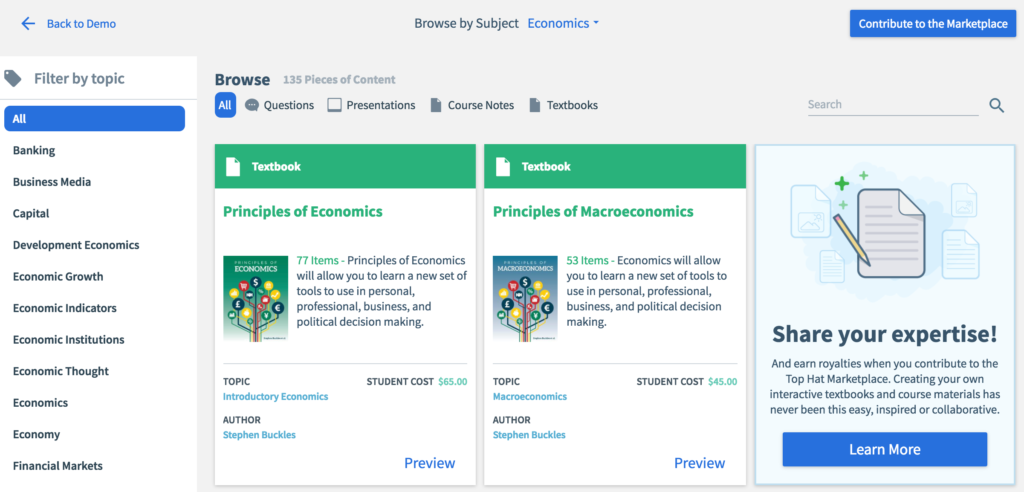
    Screen shot of economics materials

    The Marketplace has been designed as a self-publishing platform for educators designed around collaboration tools called Textbook. I interviewed Demian Hommel, senior instructor of geography at Oregon State University, and his experience helps explain the path that Top Hat is taking from classroom response systems to content marketplace. Hommel is an “an advocate for place-based and experiential education, service learning, and research-informed teaching” and has used the classroom response system for several terms. In the meantime, he has wanted to create a geography textbook but did not want to go through the traditional publishers. Since he already knew of Top Hat, when they announced Textbook and the Marketplace Hommel decided that he wanted to go with the self-publishing route.

    Hommel’s interest in publishing models does not seem to be driven by financial considerations, at least for himself, as he said he is not sure how well Top Hat will be able to scale usage of the Marketplace. One big driver for self-publishing was the interest in keeping the textbook current in a changing world of geography. Hommel views the Marketplace as providing a convenient platform enabling active learning techniques and the ability to control and update his textbook over time.

    There is another differentiator in how Top Hat provides content – the remarkably easy method to enable instructors to modify content, whether in the authoring process or as customizations to content that instructors choose to adopt. Basically, if you can author a post in Medium, you could create and modify content in the Top Hat platform.

    Consider Hommel’s Geography textbook. Here I have added the book to my course and hit edit in one section. By placing the cursor between text and an interactive text discussion prompt, then choosing the pop-up “Add” icon, I get the choice to add any of the following elements:
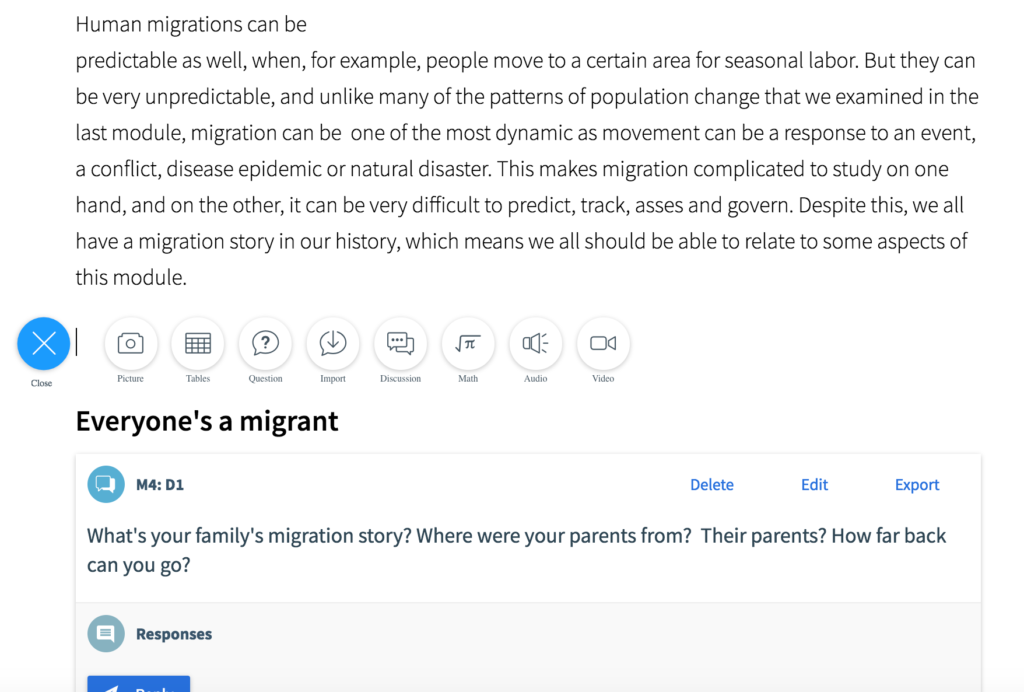
    Editing a textbook

    This is the same interface as originally used to author the textbook. Beyond the ease of editing (customizing for my class, adding my content) is the apparent ease of accepting updates from the content author, based on a new feature introduced in a limited trial in September. The instructor sees a notification about updated content, reviews the updates, and (if all works out) decides whether to update while maintaining any customizations made by instructor.
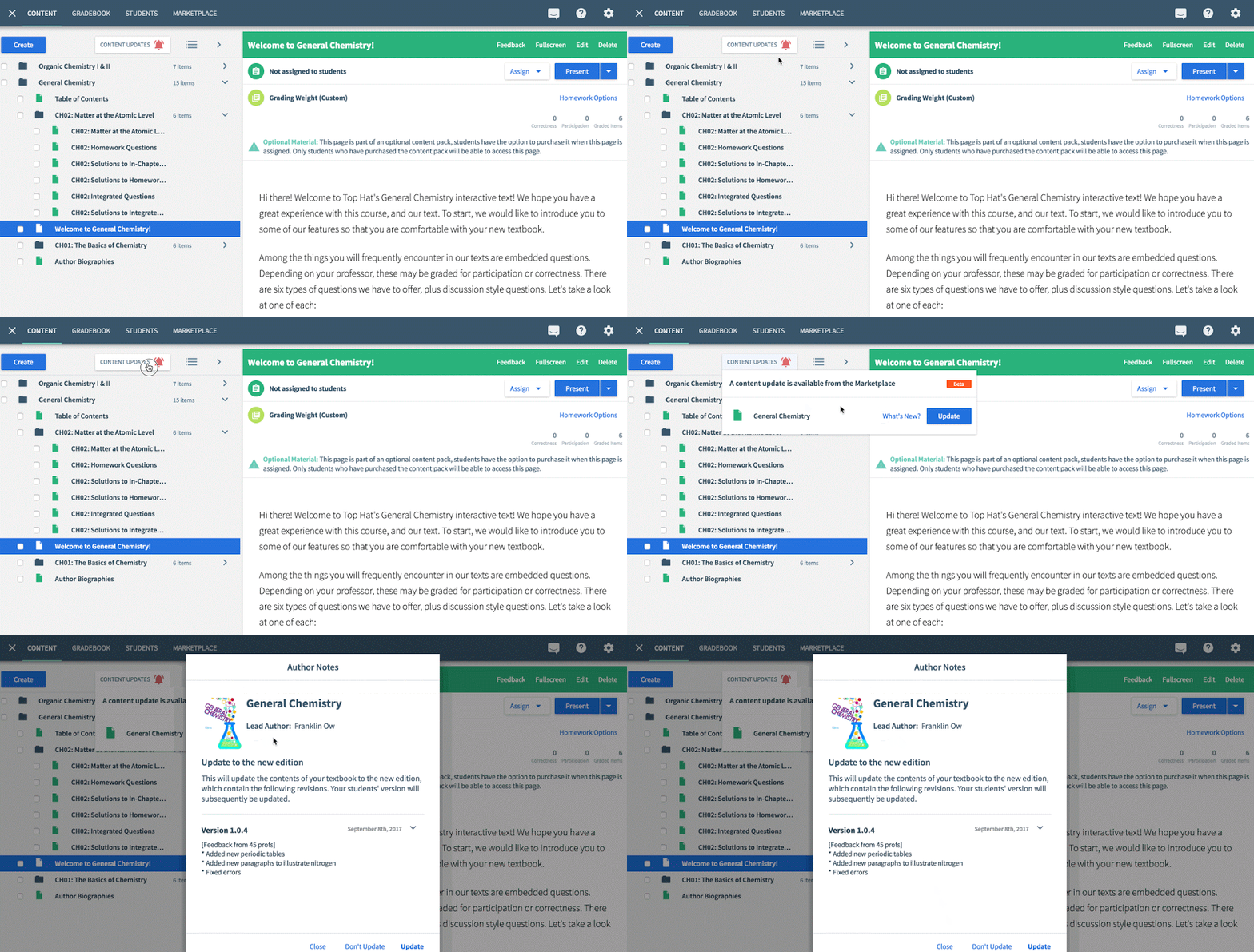
    Method to accept revisions

    The functionality also promises to allow an instructor to review and adopt  customizations made by others who are working on the same base content.

    This is not an easy problem to solve, but if Top Hat is able to resolve how to deal with conflicting updates and local customizations, the intuitive user experience could change how faculty members and course designers collaborate and update content.

    Top Hat does have some real challenges in establishing themselves as a full-fledged content provider. One was mentioned by Hommel, when he pointed out the lack of broad awareness of the Marketplace amongst faculty even at his university. Top Hat is known for its classroom response and presentation systems, and with the Marketplace acting as a two-sided market, it needs sufficient supply of self-publishing content and sufficient numbers of adopting instructors.

    CEO Mike Silagadze response when I asked him about the adoption challenge is that the Classroom adoption, which they claim to be used “at 75% of North America’s leading colleges and universities and reaches millions of students”, has established Top Hat’s direct relationship with thousands of faculty members. In this way, they are betting that Demian Hommel is a model – aware of company through Classroom, interested in textbook usage based on self-publishing model, and willing to extend their personal usage of the company’s products.

    One other challenge is that it is not a done deal that self-publishing has sufficient demand on the content creation side. Are there enough instructors in a broad array of disciplines who want to invest the time and effort to create textbooks without a clear model of possible financial reward? This is the bet that Top Hat is making, that the market can grow to the point that there are reasonable clear answers on financial rewards. And there is the hope that there are enough Demian Hommels who are willing to make these commitments without financial drivers.

    I do not know if this product will take off, but if it does the Marketplace would establish a viable self-publishing model for faculty willing to work within the Top Hat platform. Over the past year in particular, the landscape of digital curricular materials is adding new models, and the Marketplace is worth watching.

    There is also an OER angle based on Top Hat’s marketing and the OpenStax partnership, which I’ll describe further in another post.

    Update 1/8: Corrected timing on change to student access and fees.