
e-Literate

Present is Prologue

Category: Recommended Reading

  • Recommended Reading: ED Clarifies Its Intent on State Authorization Reciprocity

    Recommended Reading: ED Clarifies Its Intent on State Authorization Reciprocity

    Last year Russ Poulin from WCET and I wrote an essay for Inside Higher Ed (also published at e-Literate) describing and countering attempts by the Century Foundation and other activists who were arguing against the State A

    A coalition of consumer groups, legal aid organizations and unions object to the state of New York joining an agreement that would change how colleges offering distance education courses in the state would be regulated. As coalition members asserted in an Inside Higher Ed article, the state would be ceding its authority to other states. Students would be left with no protection from predatory colleges and it would make it easier for “bad actors to take advantage of students and harder for states to crack down on them.”

    That all sounds ominous. It would be, if it were true.

    The story has taking a series of dramatic turns. First, New York state did join SARA. But in a surprise move in the final regulatory language from the Department of Education (ED), they included language proposed by the Massachusetts AG and supported by the Century Foundation that appeared to undermine the concept of reciprocity. Most analysts and insiders, including WCET and SARA themselves came to the same conclusion that Massachusetts’ AG did – SARA and the concept of reciprocity agreements would not survive as long as the regulation survived. In a surprise move, however, anonymous staffers at ED called Russ Poulin (the person to follow on this subject), letting him know that their intent is not at all to undermine SARA. (more…)
  • Recommended Reading: Realistic Hopes for a Genuine Science of Learning

    Recommended Reading: Realistic Hopes for a Genuine Science of Learning

    Keith Devlin is a professor of mathematics at Stanford who has taken a keen interest in mathematics education. He is particularly interested in how people learn and what constitutes effective teaching. As a side note, e-Literate interviewed Keith as part of the MOOC Research Initiative in 2013. ((Disclosure: Our e-Literate TV series of video case studies and explainer videos is funded by a grant from the Bill & Melinda Gates Foundation.)) In his response to a question posed by the Edge last year, “2016: What do you consider the most interesting (recent) scientific news? What makes it important?”, Devlin argues that learning researchers are in the early, but momentous, stages of establishing a genuine science of learning. What has made this possible now is the application new research techniques enabled by the internet and online learning technologies:

    “The problem that has traditionally beset learning research has been its essential dependence on the individual teacher, which makes it near impossible to run the kinds of large scale, control group, intervention studies that are par-for-the-course in medicine. Classroom studies invariably end up as studies of the teacher as much as of the students, and often measure the effect of the students’ home environment rather than what goes on in the classroom.”

    (more…)

  • Recommended Reading: A Digital Chief from Publishing Talks Anonymously

    Recommended Reading: A Digital Chief from Publishing Talks Anonymously

    A recently published article in Digiday provides an insider view of ongoing tensions that are still playing out in the world of publishing. The interviewee speaks to the challenges of running two parallel businesses, one that’s in decline but still generating cash, another that is growing but requiring significant investment, and the internal conflicts that are inherent to that dichotomy.

    “It creates a real clash because of how these competing business models play out on a daily basis. Everything from salary disparities to space or resource allocation. If you’re throwing resources at a problem to make it move faster — that generates huge resentment from people whose resources are being chopped to slow losses. It creates a “them and us” situation which isn’t helpful.”

    In the educational publishing sector, most publishers recognized the need to transition to digital several years ago. That recognition, however, doesn’t make it so overnight. It’s a difficult slog, fraught with strategic, operational and human challenges.

  • Recommended Reading: Times Higher Education (THE) Reports on Student Views of Blended Learning

    Recommended Reading: Times Higher Education (THE) Reports on Student Views of Blended Learning

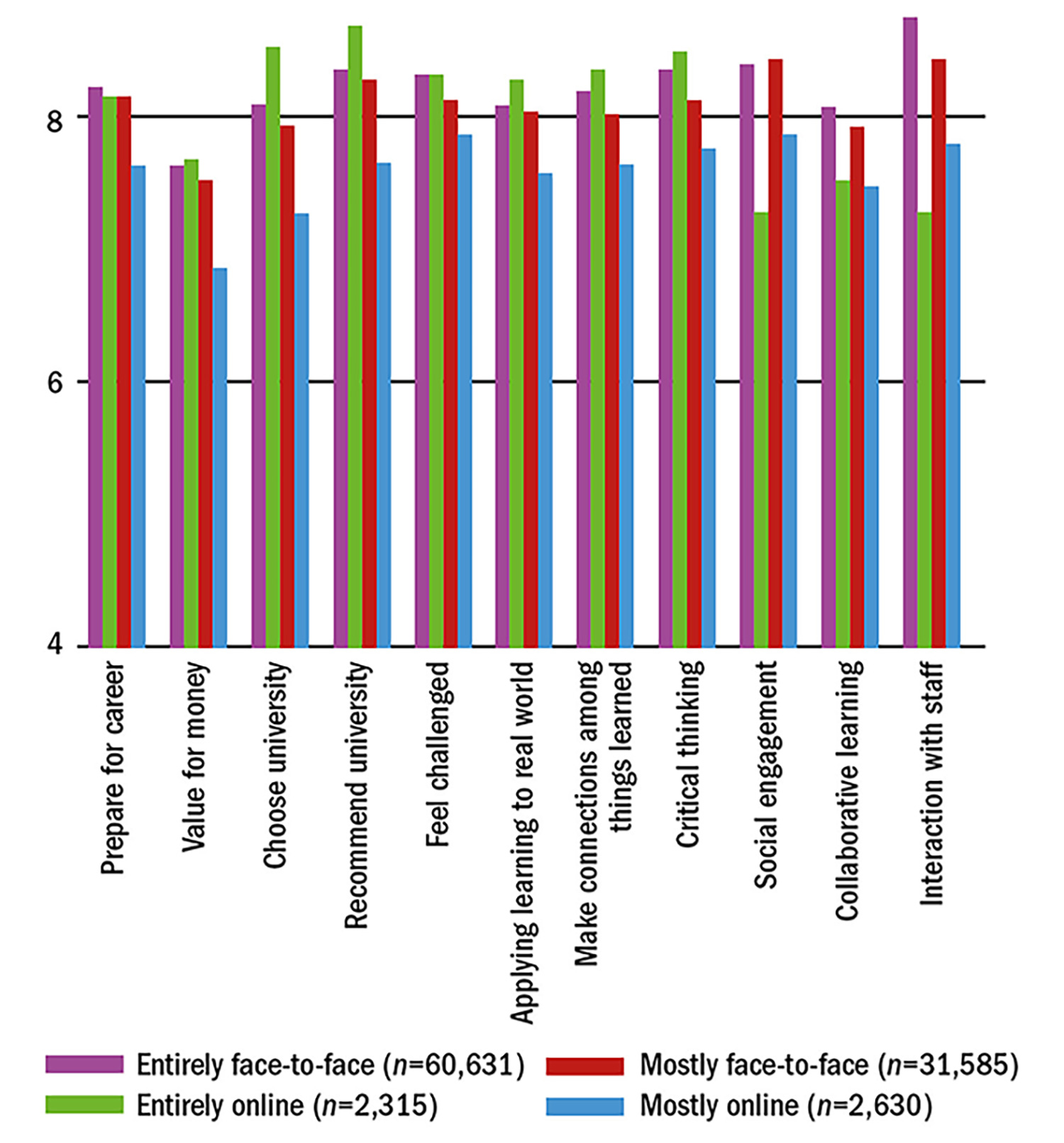
    Citing in-house research that surveyed over 100,000 students in the United States, THE reported late last week (see article) that students in exclusively face to face courses and students in exclusively online courses tended to give higher marks to their programs than those students taking blended courses that combine face to face learning with online learning. The report suggests that there is something about the design, implementation or execution of blended learning that is leading to lower overall satisfaction among students across several metrics that were tracked. For those universities pursuing some form of blended learning, and the list is growing every day, the THE report provides a launching point for new conversations around what is working and what isn’t working on their campuses.

    Blended learning is in its early stages and measurement and analysis are key factors that can drive improvement. As Mike Sharples, chair in educational technology at the UK’s Open University states in the article, “…the survey results do not show that ‘blended learning is a failure,’ but either that universities do not yet know ‘how to blend properly’ or that ‘there is a difference between what students say they like and what they do better at.” More data is needed, but this is an important conversation to be having.

    Snapshot of data from THE article.
    Snapshot of data from THE article.

  • Recommended Reading: “Why Udacity and EdX Want to Trademark the Degrees of the Future—and What’s at Stake for Students”

    In his recent article in EdSurge, Jeff Young (formerly of the Chronicle) profiles an emerging fringe world of post-secondary education where “Nanodegrees,” “MicroMasters,” and “MicroDegrees” are proliferating. Companies like Udacity and edX are looking to stake out territory in this emerging market and trademarking new degree types is one way they’re attempting to do that. Earlier branding efforts were meant to establish legitimacy across the board for this type of mini-degree or credential, but now the branding (and accompanying trademarking) seem to be an effort to signal quality and raise barriers to entry for other providers looking to enter the space. In order for this strategy to be successful, the timing has to be just right. Too soon and the category fails to establish itself, too late and and the category is awash in competition of uneven quality. The risk here could be that the incumbents are pulling the trigger too soon.

  • Instructure’s Current Market Position

    With the proliferation of so many privately funded educational technology companies, the quarterly earnings call of a publicly traded company like Instructure is a rare opportunity to get a detailed look at company performance and hear directly from executive leadership as they respond to analysts’ questions. Sometimes those responses can be guarded, at other times very frank. Regardless of which, it’s almost always very revealing.

    During Monday’s third quarter earnings conference call with Instructure we saw the company showing considerable confidence in their current market position and trajectory for the next couple of years. Quarterly revenues of $30.1M are up 44% over Q3 last year. Of that $25.8M (86%) is recurring revenue from subscriptions, the remaining $4.3 is derived from professional services.  In the domestic higher education market, CFO Steve Kaminsky cited research from e-Literate and MindWires that attributes a win rate of 77% to the Canvas LMS when it comes to new implementations and said that he expects that number to remain consistent over the next few years. With a current market share of 17-20% in the U.S. and Canadian higher education markets, Instructure said that they are expecting Canvas to gain another 10-30% of the market over the next 2-3 years. See Instructure’s full third quarter financial report here(more…)

  • Recommended Viewing: Learning Analytics Webinar on Caliper and xAPI

    If you follow learning analytics closely, you may be aware that there are two learning analytics standards—Caliper and xAPI—that appear competitive with each other at a casual glance. A webinar hosted by the Apereo Foundation between Anthony White, who is deeply involved with Caliper in the IMS working group on behalf of the University of Michigan, and Aaron Silvers, who works on xAPI through the Data Interoperability Standards Consortium (DISC), had an hour-long conversation about how the two standards relate to each other.

    The Apereo news page where I found the video gives a disclaimer about the views of the presenters being solely their own, which sounds like a standard thing but leapt out at me as being a little odd in this context. I’ve heard second-hand rumblings that the growth of these two standards has re-envigorated the periodic diplomatic negotiations between the two standards bodies about how they should be working together (some of which is actually confirmed in the video), so I suspect that more than the usual care is being taken to make the conversation officially unofficial. Still, it’s really helpful to hear two practitioners who are familiar with the respective specifications talk about the details, if you’re into that sort of thing.

    https://www.youtube.com/watch?v=W5Y5oN9z6Z0&feature=youtu.be