e-Literate

Present is Prologue

Category: Curricular-Materials

This category includes digital curricular materials, including adaptive learning, assessments, OER, etc.

  • Announcing Argos Education

    Announcing Argos Education

    Those of you who have been paying close attention to my LinkedIn profile have known that something has been up with me. I have quietly been working with friends and colleagues toward building a start-up. As we have been building the company, we have been collecting a group of Angel investors who are, almost universally, people we respect and turn to for advice. We’ve been very lucky that way.

    Yesterday WGU Labs announced that they are our first institutional investor. I am deeply satisfied that our we are starting off with support from a fund that is affiliated with an access-oriented university. It sets the tone for who we want to be and what we want to accomplish.

    This post is the first in a series about what Argos Education is. The truth is that I’ve been writing about aspects it for a while without mentioning the startup angle. My post series about the open-source collaboration on a courseware platform between Carnegie Mellon University’s OLI group and Arizona State University’s ETX group was about the software and the collaboration that forms the heart of Argos. If you’re impatient with the meandering Feldstein style and want to get a concise summary of what we’re up to, one of our Angel investors, the wise-beyond-his-years Matt Tower, has written up his own thesis about us. Matt is far more succinct than I am.

    Here on e-Literate, I feel compelled to tell the story e-Literate-style. This first entry will be a very personal one. I’ve been lucky to have long-time readers who have traveled my EdTech journey with me for as long as sixteen years. I’m going to take some time to explain how this latest change fits into that journey. You won’t learn much about what Argos actually does in this installment, but if you’re an e-Literate reader, you’re used to my George R. R. Martin style. I promise you, The Winds of Winter is coming and it won’t suck like the TV show.

    Argos is very personal to me. It has to be. I walked away from a very comfortable consulting practice during my peak earning years to take on a level of risk and hard work that frankly don’t make sense at this stage in my life. The reason I’m doing it is that I believe I have a once-in-a-lifetime opportunity to make an impact. If it succeeds, it will be the culmination of everything I’ve tried to accomplish in my professional life. Beyond my wildest dreams.

    So today I’m going to write about the personal mission and values that led me to this step as well as how it will affect my continuing work here on e-Literate and on the Empirical Educator Project. Later posts in this series will delve more deeply into Argos’s mission goals and how we aspire to accomplish them.

    I believe in teachers

    If there’s one statement that has guided my life choices, including the co-founding of Argos and even a major reason why I fell in love with my wife, it’s that I believe in teachers. This is not a bromide. It means something very specific and nuanced to me.

    I grew up in a family of educators. Both my parents and both of my sisters are in the family business. My father, who is my role model in many ways, was an elementary school principal for much of my life. To this day, the highest compliment he can pay to person is to call them “a good teacher” or “a real teacher.” When he says that, he is making a holistic statement about the person’s character, values, intelligence, and skills. Real teachers change people’s lives, not just through their inspiration and dedication but also through their acuity and ability to solve complex problems. Dad reveres reading teachers for their diagnostic skills. I come from a family of real teachers and aspire to live up to their excellence and accomplishments.

    When I went to college, I thought I wanted to teach philosophy. My very first week at Rutgers, I met a senior who was a philosophy major and, importantly, had a very impressive beard to prove his bona fides. He told me he was interested in something called “cognitive science.” I had never heard of it before but instantly decided that was what I wanted to study. Since Rutgers didn’t have a cognitive science major, I made my own unofficial one. In philosophy, I gravitated to courses in topics like epistemology, philosophy of mind, and philosophy of science. Outside of my (official) major, I took a lot of courses in linguistics, cognitive psychology, cognitive anthropology, and any other subject I could find that seemed related. I even managed to talk my way into a couple of graduate courses that were genuinely interdisciplinary studies of cognitive science frontiers at the time, like learnability theory.

    At first, I thought I was doing it to acquire knowledge of the subjects I would teach. But the more time I spent sitting in graduate classes, the more I realized that I wasn’t passionate about studying how humans learn. No, I wanted to apply that knowledge. My studies were my way of figuring out how to be a real teacher.

    I have always been deeply troubled by the lack of recognition of the skill and knowledge required to teach well. I still remember vividly how a well-meaning advisor at Rutgers reacted when I told her I wanted to be a teacher.

    “Well, we need good teachers, but you’re too smart to be a teacher,” she said.

    I was too stunned to respond, but I thought, “Who do you want teaching your kids, lady? Who do you want to be in the room with them when they get stuck or when it turns out they have an undiagnosed learning problem? Or are going through a personal or developmental crisis? Do you think that any idiot can do diagnose and help your kid and 25 others simultaneously in one class?” To this day, it make my blood boil to think about it. And yet, she was just saying what so many people think. She was trying to help me fulfill my potential. In her world, smart people couldn’t possibly make full use of their intelligence by becoming teachers.

    That lack of understanding of teachers as skilled professionals is endemic to our society. It infects the way we talk about, think about, and implement EdTech. While I take every opportunity I can to mock the former CEO of Knewton’s statement that his product was a “robot tutor in the sky that can semi read your mind,” the truth is that he mostly just said the quiet part about EdTech ambition out loud. Sometimes our society seems more ready to entrust the education of its youth to unproven and poorly understood technological gadgets than it is to trust human educators. When people talk about products or strategies that are “learner-centric,” they often implicitly or even explicitly denigrate the role of the educator. So-called “personalized learning” products are often designed to do end runs around the teachers.

    This attitude is by no means confined to the start-up world. I’ve heard smart, well-intentioned people working at highly influential organizations talk about “instructor-proofing” courses with technologically enhanced content.

    Some of the most robust longitudinal findings we have confirms the personal experience that’s so pervasive it’s become a cliché: real teachers change lives. To accept those finding while believing also believing that educators cannot be trusted to decide how to teach their students…I don’t know how you square those two beliefs. I don’t know what teaching is in a world in which both of those statements are true. I don’t know what teachers would actually do.

    I believe many college instructors are—and/or aspire to be—”real teachers”

    There’s a popular notion that most college instructors don’t really want to teach or care about their teaching. I will write more about the evidence base that contradicts this in a future post, but for now, just think about it for a minute. Most professors found their career path because some teacher or teachers sparked their passion. Ask a few. They can usually tell you who it was. They had an encounter with somebody who set their lives on a new course.

    That course will have them spending the greater portion of their week…teaching. Very few of even the most talented, elite young professors are able to avoid teaching between six and ten courses every year for at least their first five years (if they’re lucky) until they get tenure. The overwhelming majority of college professors are destined to spend the overwhelming majority of their professional time teaching for their entire careers. And even the ones who are elite enough to be able to spend more of their time researching went through the crucible of teaching. Working really hard for mediocre to lousy pay relative to their level of education. Do you believe that the majority of people who are willing to endure seven years of graduate school to become college instructors genuinely dislike the main job they know they’re going to be spending a large percentage of their lives doing?

    Or let’s approach this from another angle. If you’re reading this, there’s a good chance that you have a weird job which is hard to explain. Maybe you’re in EdTech. Maybe you’re a venture capitalist. Or an administrator. Or a learning scientist. You’re probably not a police officer or family doctor. You don’t have a job that most people know a lot about and can picture what you do without you having to explain it. My family mostly doesn’t understand what I do for a living despite us all trying really hard to remedy that situation. I have mostly given up trying to explain it and they have mostly given up asking about it. That’s true with many of my friends, too. Including close ones. When I find somebody who actually gets my explanation and is hungry to learn more, it’s the best feeling in the world. It’s crack cocaine for geeks.

    When you’re a college instructor, you have an opportunity in every class to inspire students the way that you were inspired to dedicate your life studying bugs or irrational numbers of some long-dead poet. You get to let your freak flag fly. Students are self-selecting. They come to you. Sometimes it’s to fulfill a graduation requirement, but even then, you have a window of opportunity. You spend a lot of time carefully crafting your 15-week journey with them to invite them into your world.

    Again: We know from solid longitudinal research that educators who genuinely want to share that passion for their subject with their students improve students wellbeing for the rest of their lives against a variety of measures, including financial, physical, mental, and social metrics. But if you’re a college professor, you don’t need to read the Gallup-Purdue research to know this. Somebody already changed your life. That’s how you ended up in that classroom. Now you have a chance to be that person who changes people’s lives.

    Are there college instructors who hate teaching or just don’t care about it? Sure. Name me one profession in which nobody hates their job. There’s no reason to believe that college instructors are worse than average on this score.

    On the other hand, there’s plenty of reason to believe that college instructors are actively discouraged from caring about their teaching by their institutions. At an elite university I know that offers one—one!—course in effective pedagogy for all graduate students, they have to deal with potential enrollees being told by their graduate advisors that “every minute you spend not working on their dissertation is a minute they spend harming your career.” We know about the pressure to publish and research for tenure and promotion even at institutions that pull in fairly little grant money and are primarily teaching institutions. We know that college instructors are not trained to teach, not supported well in their teaching duties, and not rewarded for their excellence in teaching.

    This is finally beginning to change for reasons that have to do with the changing nature of college and university funding sources. Worcester Polytechnic Institute has pioneered the tenured position for non-research teaching faculty. I don’t believe they will be alone in this for long. Again, this is a topic for another post. The point for today is that if you want college to be more student-centric, then you have to make it more teacher-centric. I’m not talking about pandering to faculty and letting them do whatever they want in the classroom. I’m talking about cultivating the sense that their excellence and accomplishments as educators should be part of their professional identities that they promote rather than hide in order to advance in their profession and in the eyes of their peers.

    And let’s please cut the crap about the word “teacher” being “too K12.” That just perpetuates the problem. If we want our college instructors to teach well, then they have to think of themselves as ones who teach. As teachers. We should embrace that term with pride.

    I continue to work in higher education because I believe that it is full of real teachers, in the way my father means it, whose potential is underdeveloped and underutilized.

    EdTech is about education, not technology

    Given the above, I have always believed that that the principal value of EdTech is to enable, promote, and disseminate the craft and science in teaching. When I first starting designing educational software, it forced me to think consciously about teaching moves that I made instinctively in the classroom. They didn’t work the same online. I had to rethink some, abandon others, and invent some new ones. I learned to control my craft better. The name of this blog, “e-Literate,” was meant to be self-deprecating. I considered myself to be illiterate in using technology for teaching. That was a good thing. I was raised to believe that ignorance is an opportunity to learn, which is one of the best things in the world.

    Later, when I helped college teachers learn to teach online, I saw it help them become more mindful of their craft the way it had helped me. This, by the way, is further evidence of my point of view about college instructors. Ask a handful what they learned when they were forced to teach online during COVID. The ones with thoughtful, interesting answers—and I guarantee you will find some—have some natural teaching ability.

    EdTech could and should be a vector to enable, test, refine, and propagate effective teaching practices. And yet, we almost never think about it that way. Run through your head the list of EdTech product categories you know of. It might be a short list or a long one, depending on your role and experience. It doesn’t matter. However long your list is, think about the product categories in it. How many can you say put meaningful emphasis on the priorities I’ve articulated here? How many are good at it? And on the other hand, how many actively undermine teaching skill by trying to replace educator judgment rather than improve it? Or by focusing on solving other problems, making the exercise of the educator’s teaching craft problem harder in the process?

    I care about EdTech because I care about improving education. And one of the best ways I know of to do that is to improve teaching.

    Teaching in isolation is a bad idea

    My first year teaching middle school, I used to go into the teachers room and ask for help with my latest challenge. In the early months, this would happen at least once a week. Later that year, one of the veterans there told me she thought I was brave for doing that. I thought that was a weird thing to say. I needed help solving a problem. There was help in the teachers room. I got help. Problem solved. How did bravery play into it?

    Oh yeah. Because we’re somehow supposed to know what we’re doing. This is even more true in higher education than it is in K12. As a college instructor, even though nobody has ever given you a single lesson in how to teach, you’re just supposed to know. These are scholars who spend their lives exploring the edges of the known in their respective disciplines. But somehow there isn’t supposed to be anything new for them to learn in teaching. If they admit their ignorance, they fear it will reflect poorly on them.

    I remember toward the end of my first year teaching, I went back to my favorite high school teacher. Mrs. Galligani. She asked me how it was going. I told her I was a terrible teacher. She asked me why I thought that. I gave her a twenty-minute litany of everything I had done wrong. I mean, everything. She just nodded sympathetically and listened until I wound myself down.

    Finally, she said, “You’re going to be great.”

    “How can that possibly be true?” I asked. “I just told you a million things I did that were obviously wrong.”

    “Michael, she said, “All first-year teachers are bad. The good ones know it. I worry about the ones who tell me that everything is going great. Teaching is hard.”

    That fear that you’re a terrible teacher is a core barrier to change. It’s not that college educators don’t care about their teaching. It’s that there’s so much fear and shame.

    The irony is that, once you get past that, real teachers love to share. Remember, crack cocaine for geeks? It’s a wonderful feeling to find somebody who understands the challenges you choose to grapple with and an even better one to find somebody who wants to help. Or somebody who wants your help. I started the Empirical Educator Project partly on this belief: If I could just get people talking, great things would happen. And they did. Argos Education would not exist were it not for the spirit of academic collegiality and collaboration between some friends at Carnegie Mellon, some friends at ASU, and some friends at Unicon, none of whom knew each other at the beginning but all of whom are friends with each other now.

    So…what’s the point already?

    You’ve read all this way and I still haven’t told you what Argos Education is. I could give you some slogans. A sample of the 10,000,000 different elevator pitches we’ve tried.

    It’s a floor wax AND a dessert topping!

    The short version is that we’re bringing all the values I articulated above to rethinking curricular materials and, more holistically, course design. I’m gonna do me and tell this story my way. There will be more posts in the coming days.

    For now, there are two points to keep in mind. First, everything you’ve learned about me in the past 16 years of e-Literate posts is relevant to Argos Education. This isn’t a pivot. It’s not a sellout. It’s a culmination. It’s a big bet on everything I believe in. If you keep that in mind, then my narrative about the company will make more sense.

    Second, Argos will let me keep doing what I do. I will keep writing e-Literate. It will not change into a company blog. I will write about the big themes of my current work, as I always have. And I will write about other things, as I always have. I will be inviting some of my great colleagues to write occasional posts about e-Literate–appropriate topics here as well. You’ve already met my co-founder and dear friend Curtiss Barnes. My other teammates are also brilliant.

    If you want to read Argos-specific posts and updates, I and my colleagues will eventually be blogging at the Argos web site. We don’t have much there yet, but if you enter your email in the signup form on the site we’ll keep you updated.

    This week’s Blursday Social will also be a chat about Argos. So you can come to that if you’re curious. Sign up here.

    The Empirical Educator Project (EEP) is also still very much a thing. Consider Argos to be a permanent sponsor of it now. We’ll have a big announcement coming up in less than two weeks. It will evolve, as it should, but the mission goals are the same and I’m as committed to it as ever.


  • The Chegg Situation is Worse Than You Think

    The Chegg Situation is Worse Than You Think

    Forbes just ran with an article entitled “This $12 Billion Company Is Getting Rich Off Students Cheating Their Way Through Covid“.

    Ouch.

    It’s obviously an unsympathetic portrait. At one point, the author quotes Chegg CEO Dan Rosensweig as saying,

    “You live in Silicon Valley, and everybody is a billionaire, and you’re not. Everybody goes public and at least has the one moment where their stock goes up—and yours didn’t.” It got so bad, he said, “I had a moment of sucking my thumb in bed.”

    Chegg CEO Dan Rosensweig

    While that quote may be cringe-inducing—and was taken from a long interview with Rosensweig that had plenty of cringe-inducing moments—the CEO’s fixation on his status is beside the point. The real damning passages were ones like this one:

    A 2020 George Washington University graduate who is applying to grad school says she tried to use Chegg the way company executives say it was intended, “more as an instructional tool.” But her mechanical physics course was very tough. “I felt like a moth drawn to a flame,” she says about chegging her physics homework at the last minute. “When it’s nearly midnight, why not use Chegg just to finish the assignment?” 

    “This $12 Billion Company Is Getting Rich Off Students Cheating Their Way Through Covid,” Forbes

    And this one:

    It’s doubtful that [Chegg’s new anti-cheating feature called] Honor Shield will dent students’ chegging. Already many professors and instructors have given up the fight. At UCLA, physics lecturer Joshua Samani says that he believes “an astonishingly large portion” of his students have used Chegg to cheat on his exams and quizzes. But he doesn’t try to catch them. “If you’re spending your time attempting to battle Chegg, you’re going to lose,” he says. 

    “This $12 Billion Company Is Getting Rich Off Students Cheating Their Way Through Covid,” Forbes

    If we’ve reached the point where “to chegg” is considered to be a legitimate verb in the English language, that’s another indication of just how widespread the problem is.

    Forbes author Susan Adams gets to the crux of the problem in the last paragraph of the piece:

    It’s unreasonable to lay all the blame for cheating at the feet of Chegg, of course. Human nature is at fault, especially when studying from home makes it much harder to get caught. Constant social media exposure to political leaders who make a virtue out of dishonesty doesn’t help either. But Chegg has weaponized the temptation and is cashing in on students’ worst instincts. Our arsenal of digital tools and global connectivity should be deployed to transform education for the better. Instead, Chegg is using them to outsource cheating to India. That is a tragedy.

    “This $12 Billion Company Is Getting Rich Off Students Cheating Their Way Through Covid,” Forbes

    There’s a lot to unpack here. First, the “weaponizing” of “temptation” is a familiar refrain in social media stories in general these days. And it’s a thorny problem. Chegg has not one but at least two major competitors in the homework help space which are notably valued at over a billion dollars each. Adams mentions Course Hero ((Disclosure: Course Hero is a sponsor of the Empirical Educator Project)) but misses Quizlet. Each of these companies operates a little differently and each tries in different ways and with different levels of apparent earnestness to address the charge that they are “weaponizing temptation.” It’s hard for any company to fight against sliding down that slippery slope—particularly when, as Adams points out, that slope is profitable for the companies. All of the broader debates about the promise and perils of an internet filled with user-generated content and driven by the desires of the masses apply here.

    But there is one major difference between Chegg and its two unicorn competitors in the homework support business that I want to call out. Course Hero and Quizlet both rely on student-generated content (and, to a certain degree, on educator-generated content). Adams correctly points out that Chegg is different but is not entirely correct when she asserts that Chegg gets its homework answers primarily by outsourcing homework answers to India.

    In fact, Chegg got many of its homework problem answers by licensing them directly from the textbook publishers.

    Yes, you read that correctly.

    Multiple sources at multiple textbook publishers have told me that their companies licensed the instructor’s edition homework problem answers to Chegg. My sourcing is not comprehensive enough to assert that all the major publishers did this. But I know for a fact that many of them did. It’s an open secret in the textbook publisher world.

    To be clear, these are old contracts. The people inside the publishers who talk about them now are generally not the ones who signed them but rather the people who have to deal with the mess created by them. These deals were bad for the publishers. They reduced the value of the textbooks. The bit of money that they got from Chegg was not worth the devaluation of the core products. I doubt that the contracts will get renewed when they expire.

    All that said, the fact remains that the publishers sold the textbooks to students…and then sold the homework answers to Chegg so that Chegg could sell those to students as well.

    That’s still not the worst of it

    But let’s not lose sight of the big picture. We have at least three companies worth at least a billion dollars each that are in the business of “homework help” which, as currently structured, has moral hazards. The most valuable of these companies was actively aided in achieving its dominant position by the publishers, who sold homework problem answers to the company without thinking through the consequences.

    Buried in the Forbes article is yet another link in the chain of profits from academic dysfunction:

    Throughout the pandemic, schools have spent millions on remote proctoring, a controversial practice in which colleges pay private companies like Honorlock and Examity to surveil students while they take tests. The proctoring outfits lock students’ Web browsers and watch them through their laptop cameras. Critics say the services invade students’ privacy. Test takers have reportedly urinated at their desks, fearing they will be accused of cheating if their camera catches them getting up to go to the bathroom.

    Although most students Forbes interviewed say remote proctors make them too scared to cheat on exams, several note that they chegg their online exams regardless of whether or not they’re proctored. “As long as you’re not using the school’s Wi-Fi, you won’t get caught,” says a sophomore at a large state school.

    “This $12 Billion Company Is Getting Rich Off Students Cheating Their Way Through Covid,” Forbes

    To sum up:

    • Publishers, after selling expensive textbooks to students, sold the answers to the homework questions in those expensive books to Chegg.
    • Chegg sells the answers to the questions to the students, who often use them to cheat.
    • To combat this problem, universities pay for proctoring software, which is apparently more effective at preventing students from going to the bathroom than it is at preventing cheating.
    • To add insult to all of this injury, “to chegg” is now apparently a verb in the English language. We will all have to live with that linguistic violence.

    Professor Frankenstein, you’ve created a monster

    A common response to all of this is, “Hey, students are going to cheat. We fight it as best we can.” To which I reply by quoting Steve Jobs on why he thought the iTunes Music Store would beat out Napster-style piracy:

    We believe that 80% of the people stealing stuff don’t want to be, there’s just no legal alternative.  So we said, ‘Let’s create a legal alternative to this.’  Everybody wins.  Music companies win.  The artists win. Apple wins. And the user wins, because he gets a better service and doesn’t have to be a thief.

    Steve Jobs

    I believe the Georgetown student in the Forbes article who said she didn’t set out to cheat but felt pressured into doing so by her anxieties about her course. In fact, I think that scenario is more common than not. Chegg did not create that anxiety. We can debate the degree to which they deliberately exploit it, but the source of the anxiety comes from somewhere else.

    I want to return to the word “outsourcing” because, while the degree to which Chegg is “outsourcing cheating to India” is an open question, outsourcing is definitely part of the problem. Specifically, universities have created the conditions in which many professors are motivated to outsource homework questions to textbook publishers. This is where the problem starts. Everyone is using the same outsourced questions, which enables cheating at scale.

    In and of itself, that would not break the homework process (as opposed to high-stakes exams) were it not for the second problem. Instructors are not trained in how to use and grade these questions to decrease the likelihood of cheating. The homework questions could be used to help students feel prepared for higher-stakes exams. In other words, they could be used to lower the student test-taking anxiety that drives them toward cheating. Using the homework effectively requires having some skill at creating a class participation-style grading scheme and a willingness to spend some real time going over the homework, showing the students why doing the work helps them. When properly positioned, homework should feel to students like something that helps them learn and succeed. Since instructors are not trained in the skills necessary to position it this way, many create conditions in which the assignments raise the students’ anxiety, which increases the likelihood that students will cheat.

    We should not be OK with billion-dollar companies whose success is built on an arms race between cheating and surveillance that is driven by student anxiety. Nor, to follow the metaphor to its logical conclusion, should we place sole responsibility on the arms dealers for causing war.

    In 2020, the United States budgeted roughly 100 times as much for the Defense Department as it did for the State Department. As a country, we spend 100 times more on fighting wars than on preventing them. These decisions are made by elected officials who represent their constituents. At some level, the priorities, and the responsibility for them, flow back to us. Likewise, the spending priorities on these products and the responsibility for those priorities flow back to academics and academic institutions. These companies are solving problems that are partly created by the ways in which academia chooses to work. How much money does the average college spend on EdTech products relative to instructor professional development in pedagogy? How much larger does that disparity get when we include the money that students pay as they deal with the consequences of this imbalance?

    It’s easy to paint the corporations as the villains here. None of these product categories—textbooks, homework sites, or proctoring products—are particularly well regarded in academia. But the more important question is, “Why do these companies and business deals exist in their current form?” Remember, product/market fit is like a key in a lock. These companies have unlocked literally billions of dollars’ worth of services that academics tend to view as problematic at best and illicit at worst. What are the conditions that encourage the widespread and highly monetizable temptation for students to slide from seeking help into cheating? Who, exactly, is outsourcing what to whom? And what are the knock-on consequences?

    Young Frankenstein

    If you listen to the whole of the Rosensweig interview quoted in that Forbes article, you’ll hear a guy who is not an educator. He’s a businessman who wanted to make money solving some problem related to education. And yes, he wanted to feel like he was helping students in the process. We can scoff at that all we want, but the fact is that students go to Chegg seeking help. They pay for that help, which they believe they need and are not getting from their academic institution. We can choose to be cynical about the companies, and even about the students. Or we can improve academic practices and challenge Mr. Rosensweig to make his money by providing services that actually help students to learn.

  • There’s a Layer in Between Learning Content and Learning Analytics

    This post is the third in a series about the collaboration on a new courseware platform between Carnegie Mellon University’s Open Learning Initiative (OLI) and Arizona State University’s Center for Education Through eXploration (ETX). (The web version of this post has a clickable table of contents up at the top.) I’ll be writing about the platform periodically on a variety of topics ranging from nuts-and-bolts questions like what features it will have by when all the way to very broad and deep topics like architecture, interoperability standards, and hoped-for impacts on the educational ecosystem. As a reminder, I’ll also be holding a Blursday Social webinar with OLI’s Norman Bier and ETX’s Ariel Anbar on this Thursday, 2/4 at 4 PM ET.

    Today I want to review a fundamental aspect of the collaboration that I discussed in my previous post in this series from a slightly different angle. Not too long ago, I had a conversation about this angle with a new friend. After we had waded into it for a while, she said to me, “Everybody wants to talk about content and learning analytics. You’re saying that there’s a layer in between.”

    Exactly. She expressed it perfectly.

    And yet, two aspects about that moment surprised me.

    First, even though I have been writing about this idea almost since I started this blog in 2005 and have involved in the design of multiple EdTech systems that rely on this principle, I had never thought about it in quite the way she had put it before she said it. Second, I don’t think she had either. For context, my new friend is a PhD candidate in experimental psychology who is only weeks away from defending her dissertation at Carnegie Mellon University. She has a history in EdTech that is as long as mine. Furthermore, she had to be working with this concept directly and intimately, given the subject of her dissertation. And yet, her formulation of this idea also seemed novel to her as she expressed it to me in that moment.

    If I am still finding new ways to wrap my head around this concept, and she is too, then chances are good, Dear Reader, that previous blog posts I’ve written about the topic have failed to fully communicate the idea to you as well. So I’m going to take another go at it in this post. First I’m going to talk about what, generally speaking, we mean by “in between” and then about why it’s important for us to understand the layer that’s “in between” learning content and learning analytics.

    Meaning is the meat of the sandwich

    Imagine I handed you a piece of paper with “8429971043” written on it. Take a moment and try to imagine contexts in which that act would make sense to you. What might that number mean? Why would I be giving it to you? Sketch out a few stories in your head.

    Now instead, imagine I handed you a piece of paper with “(842) 997-1043” written on it. What stories are you writing in your head now? Did I give it to you printed on a little piece of cardboard at the beginning of a business meeting? Scrawled on a napkin in a bar?

    Now go back and reread those last two questions. Notice how much insight you were able to extract from the context embedded in the questions once you recognized that string of numbers as a phone number, as opposed to just a string of ten digits.

    Without the meaning of the number, you had the content, and you were trying to perform your analytics, but you were severely limited. The enabling layer in the middle is the idea of a phone number. Given just a little bit of punctuation, your brain transformed a random string of numbers into a thing in the world that you can do something with. It also enabled you to extract new information value out of other contextual information, like the kind of paper the number was written on or the location in which the paper was exchanged.

    There was a moment in the history of software when computing machines were given this layer in the middle for phone numbers. On one day, a phone number in an email wasn’t clickable (or tappable). The next day, it was. Clicking on it now offers you several predictable options. Would you like to associate this number with a person in your address book? Would you like to dial it now?

    Software developers deal with this “in between” layer all the time. They call it an “information model.” Consider, for example, the address book which stores the phone number that you clicked on. It has an information model that knows that phone numbers can belong to people. It knows that people can also have email addresses, physical addresses, company affiliations, and other things. Emphasis is on things. John Smith isn’t just a string of letters; it’s the name of a person. (842) 992-1043 isn’t just a string of numbers, spaces, and punctuation marks; it’s John Smith’s phone number.

    Information models represent meaning, including relationships between things (such as the relationship between John Smith and his phone number). Software architects work very hard to replicate the relevant ways in which we parse and store meaning in our heads to perform tasks that are relevant to the software being built. Suppose John Smith lives in Europe, where phone numbers have different numbers of digits. Suppose he writes his phone number as 842.992.1043. Suppose he has multiple phone numbers which he uses for different purposes in different locations. An information model has to capture all of these nuances. It’s hard work, but it’s a well understood process. Software developers do it all the time. They are constantly mapping bits of the human world into their software.

    For some reason, humans seem to struggle when thinking about how to map learning and teaching in this way. Even experienced and formally trained humans who think about it all the time struggle with it. We could chalk that up to how incredibly complex the human mind is. And there’s something to that. Learning is comprised of an incredibly complicated and varied array of processes. I’m going to write about that problem and its implications for, say, adaptive learning in a future post. But I don’t think that’s the whole story because even basic building blocks seem hard for us to wrap our heads around.

    Hard, but not impossible. Let’s give it a try.

    The pedagogical meaning in the middle

    Imagine you’re in a literature class studying The Odyssey. Your professor asks you the name of Odysseus’ dog. You may have one of two common reactions to this question. One is to try to come up with a thoughtful answer. The other is to roll your eyes in frustration. The reaction you have is related to the meaning you believe is attached to the name of Odysseus’ dog. If the name has no meaning—if it’s the Greek equivalent of “Spot” or “Rex”—then you might roll your eyes because you don’t think this question is has value relative to its purpose, which is to help you understand The Odyssey. The instructor’s question is a thing that is supposed to have a use. Specifically, it is supposed to help you learn—or show what you have already learned—about the literature. You expect it to fulfill one or both of those functions. You expect that the question, answer, and purpose for asking are all related to each other and to The Odyssey. This is the information model in your head that drives your interactions with your instructor. When your instructor asks you a question that doesn’t lead to an answer that helps you better understand the literature, then you get frustrated. It’s a little like being asked to memorize a phone number without knowing whose phone number it is or why you need to know it.

    When we are designing a lesson, either in software or in an old-fashioned, human-to-human class, we are (consciously or unconsciously) drawing on this information model.

    A basic information model for teaching and learning

    Let’s see how this works with some more interesting questions about Odysseus’ dog. Suppose your instructor asked you, “Why does the author write about the dog at all? What is the function of the dog in the story?” That feels like meaningful question. If you’ve read The Odyssey, you may remember that the dog only appears in one scene and dies almost immediately. It’s not like the dog (whose name is “Argos,” by the way) is a major character in the story. It shows up exactly once, at a moment in the story that is very dramatic for reasons that seem completely unrelated to the dog dying. What’s that about?

    Now let’s try a similar mental exercise to the one we tried with the phone number. Imagine your instructor asking that question in different contexts. What would it mean if she gave you the question to think about before you read the passage? How would the meaning of the question—or maybe more more precisely, how would the purpose of the question change if your instructor asked that question in class discussion after you had already read the passage? How would it function differently if the question came as an essay exam question after the class discussion?

    In context, we can answer these questions fairly easily. The instructor is asking the student a question about a work of literature that is intended to stimulate or test the student’s understanding of some specific aspect of the literature. We can judge the nuances regarding stimulating versus testing understanding based on the context. That is our tacit information model. And yet, both educators and software developers, and even experts who study learning, can struggle to hold onto the model in the general case.

    This is an important problem to solve if we want to improve education in general and EdTech in particular.

    Making tacit educational knowledge explicit

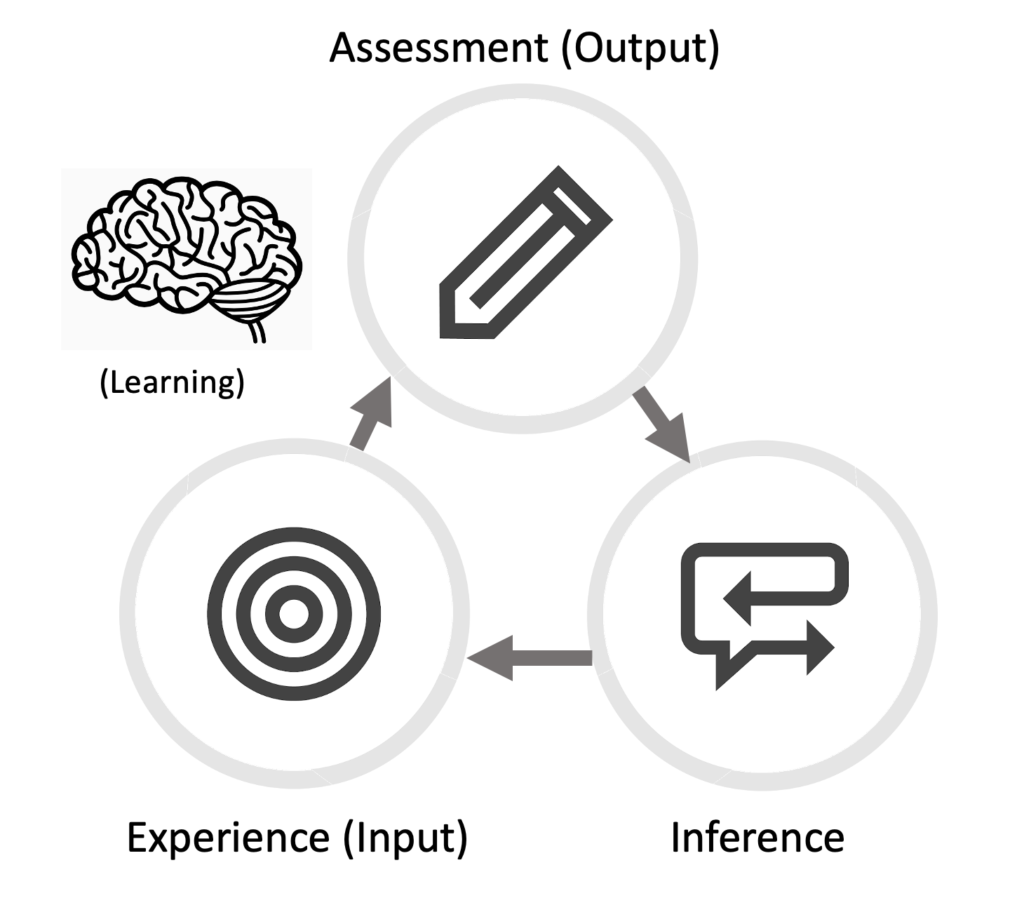
    As humans, we have an enormous amount of experience with learning through questions or challenges. Why is there a dog in that scene? How do I calculate how steep a hill is? Why are my scrambled eggs so runny? What is the guitar chord in that song I love? What will happen if I lick a frozen flag pole? We try to answer these questions. The emphasis is on try. We learn by doing (even if the thing we are doing is in our heads, like imagining what might happen if we lick that frozen flag pole). If we don’t get the answer we’re looking for the first time, we may try again or try something else. These are goal-directed learning feedback loops. As animals, we understand these loops instinctively. It’s an essential part of what makes us human. One translation of the sapiens part of homo sapiens is “one who knows.” This knack for knowing is how humans survive as a species. For example, I want to believe that most people who lick frozen flagpoles once don’t do it again. On the other hand, people who are serious about making good scrambled eggs may experiment repeatedly with pan heat, scrambling technique, and other elements. Each of these, in turn, produces a question that leads us to construct a goal-directed learning feedback loop. “What if the eggs are runny because I’m not getting them scrambled evenly enough?” And so we try again.

    Teaching is the craft of creating, optimizing, and sequencing goal-directed feedback loops that help learners learn. But because these loops are so intuitively available to us, we often don’t think explicitly about what we’re doing. Many of us don’t have a clear mental model for a fundamental task that we perform all the time. Even those of us who do can struggle to keep that model in our conscious minds and continue to refine it. It’s hard to refine your model if you can’t keep it front-of-mind as you’re testing it. And it’s really hard to translate it into a software information model.

    In my personal view, one of the most exciting goals of the OLI/ETX collaboration is the opportunity to work on this challenge of making a broad swathe of our tacit knowledge about educational processes explicit. On the software architecture side, the exercise of translating the very different learning experiences supported by OLI and Smart Sparrow into a common information model describing goal-directed learning feedback loops helps us generalize. I believe we are searching for the language of educational DNA.

    Let’s take that analogy seriously. In actual DNA, all of life in its infinite variety and complexity is encoded using just four letters in strands of DNA. I believe we can describe the basic, universal building blocks that encode learning in all its infinite variety and complexity. Of course, knowing those building blocks does not unlock all the secrets of life or learning by itself. But it’s a pretty big step in the right direction. An ambitious but achievable intermediate goal would be to be able to create and test any style of effective courseware design, including adaptive learning designs, using a single information design and architecture.

    The more important aspect of this aspiration is on the human side. If we can create a system that helps both educators and students translate the teaching and learning knowledge they apply instinctively into an explicit model, see the benefits that doing so gives them in terms of extracting more meaning out of educational contexts, and practice translating their tacit knowledge about teaching learning into explicit knowledge, that would be transformative. We would become better teachers and learners because we would be translating teaching and learning from arts to crafts and, when possible, to science.

    To sum up, I believe the software that is emerging from the collaboration between OLI and ETX can help educators and students become more effective at learning about teaching and learning while simultaneously creating an architecture that can implement almost any style of courseware on the market today and some that aren’t on the market yet. It can accomplish both of these goals by baking a model for the basic building block of teaching and learning—the goal-directed feedback loop—into every aspect of the platform, from the user experience to the deep architecture. This, in turn, will enable other capabilities that I will write about in future posts.

    If you want to talk about this (or any other aspect of the project), come to the Blursday Social webinar with OLI’s Norman Bier and ETX’s Ariel Anbar on this Thursday, 2/4 at 4 PM ET.

  • Announcing a Lesson-level Interoperability Standards Effort

    I’m delighted to announce a project aimed at making it easier to share interactive digital content at the lesson level as well as to establish baseline educational analytics for digital curricular materials. I’m tempted to call this a “courseware” interoperability effort, but its potential application is broader than that term would imply to some folks. For example, the work could support well-structured content in LMSs.

    This effort is consistent in philosophy with my recent “Content as Infrastructure” post series as well as the post of a version of my IMS talk on interoperability, learning analytics, and pedagogical intent. One of the main outputs of the project will be a white paper, released as an Empirical Educator Project (EEP) contribution, describing the standards proposal that is ultimately developed and its value to education. The project also dovetails very nicely with both previously announced and as-yet-unannounced EEP projects, and I’m very excited about the work.

    The idea for the work both grew out of and is funded through a grant from the U.S. Department of Education (ED) to develop “active OER.” In the course of the grant planning process, ASU professor and grant PI Ariel Anbar came to the conclusion that the grant would have a much broader impact if the content being developed were interoperable. He consulted with ED, and they agreed that interoperability would potentially increase the impact of the resources related to the grant. So a small fragment of the grant budget was carved off to test the viability of building a coalition that can make useful progress on proposed standards definitions that are both practically useful and likely to be adopted. At the moment, my work as a facilitator is the main budget expense for the project.

    Business and mission goals

    We had a kick-off meeting of a small group in late October. (More on who was in it, why they were chosen, and how we hope to expand later in this post.) Here are the notes I captured on the goals and ambitions for impact:

    • Reduce platform lock-in for any interactive courseware content, particularly interactive OER content, which will support the following:
      • Increase the quality of existing OER content by enabling the preservation of learning design
      • Increase the supply of interactive OER content by creating a clear and achievable interoperability standard for content developers
      • Increase the availability and value of OER content for value-added platform and service providers by lowering the cost of goods involved in converting the currently available “flat” OER resources into interactive lessons with effective learning design 
      • Enable educators to more easily mix and match interactive content at the lesson level
      • Enable the development of an ecosystem of non-OER content that could be licensed at the lesson level
    • Enable lesson-level, cross-platform, cross-content learning analytics which will support the following:
      • Data-based continuous improvement of learning content, regardless of its source
      • Baseline student learning analytics capabilities that will enable institutions to monitor student progress in an apples-to-apples way across lessons, products, and courses
      • Student- and instructor-facing analytics that will help them analyze how well their respective learning and teaching strategies impact outcomes
    • A vision for implementation and ecosystem development that incentivizes participation for a wide range of commercial and non-commercial value-added participants in order to:
      • Lower the barrier to adoption for courseware platforms by assuring customers that any content they develop or use will not be locked into the licensed platform
      • Lower the cost-of-goods and availability of high-quality pre-existing content for value-added OER curricular materials product and service providers
      • Enable micro-licensing models for commercial content vendors that develop high-value lesson-level content
      • Lower the barrier for non-profit organizations and consortia to create interactive content that is competitive in functionality and measurable quality with baseline student and teacher expectations for commercial courseware

    I’ll provide more of my personal take on these goals in a subsequent post, but there is consensus in the group that we should be working toward a set of goals that are good for everyone—students, instructors, institutions, and value-added content and platform providers.

    Functional and technical goals

    Consistent with the posts I linked to at the top of this one, we’re going to start by identifying questions that educators and students would want to answer about student progress, effectiveness of content design, and effectiveness of learning intervention. Our default atomic unit for this work is the “lesson.” Our starting point for identifying this set of questions will be the ones that the participating implementors have identified as ones that their users/adopters/customers want to answer, but I expect that we’ll expand from that base over the two-year life of the initial project.

    Once we know what questions we want to answer, then we will identify the metadata for the content that is needed to answer those questions. For example, which learning objective(s) does this assessment question assess? Is the assessment formative or summative? That sort of thing. No firm decisions have been made about how this would work on the technical level, but the basic idea is that the pedagogical intent of the learning design would be captured in some machine-readable form.

    Technically, we’d like to build on as much existing standards infrastructure as possible and propose developing as little new work as possible. While the project, as a piece of a larger ED grant, does not have a formal affiliation with an interoperability standards body, I am pleased to say that IMS Global and its CEO, Rob Abel, have been highly encouraging and offered technical support to the group as we think through the effort. IMS has a lot of the infrastructure that would be needed for the effort already baked into its existing specifications. It makes all the sense in the world to try to re-use or extend standards that are already developed and adopted.

    Ultimately, the group will produce a set of recommendations for interoperability standards along with a rationale for those recommendations. The hope and intention are that these recommendations will be taken up and carried forward by the appropriate bodies at the end of the project and that the participants will continue to work together on implementation.

    More on process and risk management

    Standards development is a tricky business. You want to get to an “everybody in the pool” moment, but at the same time, you can’t win everybody over by promising to boil the ocean. So we thought a lot about how to get this process rolling and balance different risks over time.

    At my suggestion, we started by inviting in just a few of the many implementors who ultimately should be at the table. Two—Carnegie Mellon University’s Open Learning Initiative and Lumen Learning—are long-time and active participants in the OER world. While this effort will be helpful to more than just OER, the primary purpose of the grant is for the development of (inter)active OER, so we wanted representatives who could speak to the needs and nuances of the OER ecosystem. The two other implementors we invited—Smart Sparrow and CogBooks—are courseware platform implementers that both work extensively with ASU already. Smart Sparrow is also playing a major role in this OER grant since Ariel has chosen its Inspark Education network to help manage the grant and is building the content on the Smart Sparrow platform. Also, CMU, Lumen, and Smart Sparrow have all been participants in EEP. In addition to the implementers and ASU, we had representatives from Scottsdale Community College and ED at the kick-off meeting.

    This is a small enough group with enough interconnections that we have a good chance of making progress on scoping goals without excessive amounts up-front diplomacy required but diverse enough that we would get different opinions and perspectives. It’s a good group for getting started and for testing the basic idea that what we want to accomplish is doable within a reasonable period of time. Ultimately, however, the project will need more and different folks to be involved if it going to result in broadly implemented interoperability standards. The starting group of four implementer participants is going to work toward a letter they all can sign onto that says they are committing in principle to implement any standards that ultimately flow out of this effort. The value in their commitment at this early stage is to decrease the risk of other implementors who may want to join but are skeptical that the effort will produce results. In parallel, the project is seeking additional funding that would enable us to support the participation of more stakeholders—educators, platform implementers, content developers, and standards committees (and possibly students as well).

    It is early days for this work. So far, the group has only met once. There is still a lot to do and a lot to be figured out. But I am hopeful that we can both develop useful recommendations for advancing interoperability standards and pioneer some new ways of working together on productive EdTech collaboration in the process.

  • The Crumbling of the OpenEd Coalition

    At the OpenEd conference this week, David Wiley made an announcement that was more significant than it may have sounded. Before I attempt to further characterize or analyze it, I think you should read it for yourself in its entirety, copied here from David’s blog: ((Disclosure: David is an employee of Lumen Learning, a sponsor of the Empirical Educator Project.))

    In 2003 I invited a small group of about forty people interested in open content and open courseware to Logan, Utah. Since then, this annual meeting has grown year after year to where we are today – 850 people interested in everything from open educational resources and open educational practices to sustainability and social justice. This annual conference has been a remarkable forum for the community to meet, share ideas, and foster collaborations, and the conference community is larger and more diverse than ever before. 

    With that growth comes change. That little meeting I convened 15 years ago has evolved organically in a way that has served the community fairly well. However, as currently constituted, the conference does not leverage all the energy, enthusiasm, passion, and leadership ability in our increasingly large and increasingly diverse community. And so the time has come for us to reconsider, as a community, how we wish to organize ourselves, learn from each other, and collaborate with one another. 

    In order to make the necessary space for that conversation, this year’s Open Education Conference is the last I plan to organize. As of this Friday afternoon the conference will be adjourned indefinitely. This is not a call for another person or organization to come forward to keep the same conference running the same way into the future. 

    Rather, it’s a call to reset and start over. To go back to the drawing board – as a community – and critically examine all of our assumptions about conferences, to grapple with a range of ideas about how we want to learn from and collaborate with each other, and to talk frankly about our end goals and guiding values. And when something like a consensus starts to emerge, the community can choose what to do next. To borrow a phrase, this is an opportunity to revise and remix what is, honestly, a very traditional academic conference, into something – or some things – far better.

    This reimagining must be owned by the community. It must be driven by the community. And it would be inappropriate for me to try to facilitate that process beyond extending a brief invitation. And so I invite all of you to use the breaks, lunches, dinners, and other free time you have here in Phoenix to engage in this critical reimagining and to explore with one another the possible shapes future meetings of our community – or communities – might take. I expect this will be a difficult, messy, and at times even painful process. But most things worth doing are.

    On a personal note, I want to thank the hundreds of people who have made the conference incredible over the years by presenting, reviewing proposals, convening sessions, volunteering at the information desk, and in countless other ways. Thank you to our Program Committees. Thank you to our sponsors. Thank you to Utah State University, Brigham Young University, BCcampus, and Lumen Learning for serving as the conference’s fiscal agents and logistics leads over the years. Most of all, thanks to each of you. Thank you for giving a bit of yourself to this community, for building each other up, and for moving the work forward. And, as always, thank you for everything you do for students.

    David Wiley

    I was at the conference for the first day and heard a range of different reactions to the news. Some said it was no big deal and that characterizing it as essentially a changing of the guard of the leadership:

    I think the framing of the conference as “ending” was not the best choice of wording. Really, the founder stepped down, that’s all. It’s new beginning for more diverse & inclusive model. And I say this as some1 who was participating in #oer since 2003 #opened19 #notgoinganywhere

    @lpetrides

    Others expressed more concern about the nature of the handoff from David to the next steward than Lisa did, but the fundamental view was the same.

    In my opinion, these reactions miss an underlying dynamic that makes this change more serious and difficult to patch over than it may appear on the surface. OpenEd was always at least partly an exercise in coalition politics. The attendees were a mix of people coming with different primary and secondary goals that overlapped enough for them to make common cause. That coalition has crumbled. In fact, it has been crumbling for some time. The idea that this conference could have been neatly handed off to some new steward as-is assumes that OpenEd is is otherwise tenable as-is. I don’t believe that is true.

    This is not ultimately about David Wiley or even Lumen Learning stepping away from organizing the conference (although the loss of an organization willing to manage an 850-person conference is a significant blow). My conversations with various OpenEd participants this week provided ample confirmation to me that there continue to be long-standing and deepening fractures within the OpenEd coalition, even though many of the participants are either not fully aware of them or not seeing how consequential they are in terms of how people may think about future convenings.

    I am by no means suggesting that OER or “open education”—whatever that is—is itself in danger of ceasing to exist. OpenEd is the only conference I know of that fell apart in a year when it had record attendance. If anything, OER adoption appears to be accelerating. In fact, I believe it is precisely OER’s success and growth that may have pushed this long-simmering problem to its breaking point. That growth has caused the balance of power within the coalition shifted in ways that created tensions among coalition members. Ultimately, those tensions proved insurmountable. The center did not hold.

    The OpenEd conference as we know it is dead. It may come back in some form, possibly even next year, and possibly even with the same name. But it won’t be the same coalition with the same focus and balance of interests. It won’t be the same OpenEd. That is neither necessarily bad nor necessarily good. But whether it is good, bad, or indifferent, it is a fact.

    This was foreseeable—and foreseen

    The OpenEd coalition has long consisted of (at least) three different groups with three different primary goals:

    1. Increase access to education by lowering cost of curricular materials
    2. Increase quality of education by increasing quality of curricular materials
    3. Promote values of education by fostering autonomy for educators and agency for learners

    Many—possibly most—of the OpenEd participants would likely say that they support all three of these goals. (I certainly do.)

    That’s good. Overlapping priorities are a critical success factor in building coalitions. But it’s not everything. Depending on how you interpret and rank these three priorities, your beliefs about strategy and values could be quite different. And there have long been signs that, in fact, there were very serious tensions among the views and priorities of the coalition members.

    In 2015, Phil Hill and I gave a joint keynote at the OpenEd conference in Vancouver. The theme of our talk was precisely that OpenEd was a brittle coalition that could fracture if the coalitional challenges were not addressed. Phil, in his part, talked about the challenge and opportunity that faculty surveys about OER demonstrated. There was a lot to be accomplished. My half of the talk was about my experience as a climate activist and how hard it is to build a coalition that holds together and accomplishes its goals over time (hint hint).

    Here are some of the questions that I encouraged the conference participants to discuss:

    • What is your goal?
    • What is your theory of change?
    • What is your strategy?
    • Who do you have to convince?
    • What are your obstacles?
    • What power do you have?
    • Who are your natural allies?
    • Who is persuadable?
    • What is your best message?
    • Who are you willing to let win?
    • What are you willing to give up?

    At the time, Mike Caulfield noted on Twitter that the question about who you are willing to let win was a particularly important one.

    Fast forward to a couple of weeks ago. A fight broke out about the planned conference programming that was bad enough to have caught the attention of the Chronicle:

    Less than two weeks before its 16th annual meeting, the Open Education Conference has canceled one of its keynote panels — “The Future of Learning Materials” — after facing a backlash on social media.

    The panel, which had been scheduled for November 1, was slated to include representatives from Cengage, McGraw-Hill, Lumen Learning, and Macmillan, all for-profit publishing companies, as well as the managing director of OpenStax, a nonprofit. It was supposed to explore the potential role of traditional commercial entities in the future of open education resources.

    “That role could be anything from ‘no role’ to ‘deeply committed participant,’” David Wiley, a member of the program committee and a co-founder of Lumen Learning, said in an email. Of the more than two dozen speakers and panels nominated for keynotes, the future panel was one of the top vote-getters on the program committee, he added.

    But the reaction to the panel highlighted the often contentious relationship between advocates for open education resources and commercial publishers, as open resources expand in the learning-materials market. The outcry also raised broader questions about the politics of providing platforms to those with opposing views and social media’s tendency to amplify outrage. Many open-ed advocates pushed back against the framing of the panel and objected to elevating profit-seeking entities with a keynote and prescreening questions audience members could ask.

    The conference’s program committee, comprising Wiley and 11 others involved in open education, said the decision to cancel had stemmed from “toxic behavior” on Twitter, adding that committee members had received “abusive and harassing” direct messages. Two panelists withdrew, according to a statement, and potential replacements declined to participate because of the tone of the discussion on Twitter. But some in the open-education community, both those who had pushed back against the panel and those who had stayed out of the discussion, said they did not see anything particularly troubling in the public posts.

    Wiley declined to share copies of the direct messages that committee members had received, or to comment on their nature. Several committee members and panelists did not respond to requests for comment.

    A Conference on Open Education Invited For-Profit Publishers to a Keynote. Then the Objections Began.

    To be clear, this latest episode is a symptom of the crumbling coalition rather than the cause of it. Phil and I saw this kind of tension—and occasional acrimony—as far back as 2015, which is what caused us to warn about it. Here’s one quote from the Chronicle article which marks one end of the spectrum of disagreement:

    In conjunction with the statement announcing the panel’s cancellation, the programming committee also released all of the questions that had been submitted to the panel. Of the 56 questions submitted, many were directed only toward the for-profit panelists and could be quite pointed. “Why should open-education advocates and OER publishers listen to the opinions of the commercial publishers, whose greed has directly caused the current textbook-cost crisis?” said one question.

    Others took the position that, while they were open in principle to commercial publishers participating, some of those entities did not meet key standards for good behavior and good will:

    Rajiv Jhangiani, associate vice provost for open education at Kwantlen Polytechnic University, in British Columbia, published a blog post outlining how he thought commercial entities had engaged with open education maliciously in the past, and how many of them were trying to improve how they work with the field.

    “While this may seem like a tricky balance, I see it as quite straightforward to criticize openwashing” — marketing as open education without offering a fully open product — “by a commercial player while also recognizing positive developments from the same actor,” Jhangiani wrote. “You see,” he wrote later in the post, “I do want to have these discussions with commercial players. I am interested in a diverse and healthy commons, and I take no joy in skewering for-profit actors publicly when they perpetrate harm and lie to advance their bottom line.”

    While it is not a 100% match, OpenEd coalition members’ views of this sort of question—who they are willing to let win (and under what circumstances)—tend to correlate with primary goals. On one end of the spectrum, those who see OER as a particularly effective tool for achieving their primary aim of improving quality of curricular materials (and therefore student outcomes) are likely to be most tolerant of commercial vendors whose tactics they don’t always agree with but who may contribute in multiple ways to improving student outcomes, both through OER and through other means. On the other end, coalition members with different primary goals tend to be least tolerant of the commercial vendors and less forgiving of their perceived bad behavior, in part because these advocates tend to hold a theory of change that is tied to correcting power imbalances. For example, the claim that the publishers’ “greed has directly caused the current textbook-cost crisis” entails the beliefs that the publishers have had all the power to control prices and that correcting the fundamental problem requires taking away power from the publishers. Different primary goals or different theories of change may lead people to different conclusions about who they are willing to let win under which circumstances.

    Making matters more difficult, as OER moved from a fringe interest to a more mainstream trend, the balance of attendees at OpenEd has changed from a high percentage individual contributors who sometimes felt alienated from the decision-making processes in their home institutions toward a higher percentage of participants who came precisely to advance institutional initiatives. As is often the case in coalitional politics, it is impossible to completely separate the political from the personal. People attending OpenEd come with both their professional responsibilities and their personal convictions, which tend to be deeply enmeshed among people who are passionate about what they do for a living. As the coalition came under increasing tension from the changing mix in priorities, personal tensions were also bound to increase.

    While I did not follow the public fight about the panel on Twitter and have no inside information about any private messages that were exchanged, Phil and I had both seen enough similar behavior by 2015 to have been concerned about whether this group would hold together over the long haul.

    What may come next

    As I have tried to say throughout this post, the current situation is not a signal of OER’s failure but rather a side effect of its success. Note that none of the three priorities I listed at the top of this post included “OER are intrinsically good and an end in themselves.” Even folks who tend to believe that openness is an important value that leads to other good things—and I count myself as one of those people—argue that a Creative Commons license is an end in itself. An open content license or, more broadly, a bias toward openness of various types can be useful in accomplishing a wide range of goals. And because interest in using OER has increased across a range of people who are pursuing different goals, it is no longer adequate to talk about “open education” and “open pedagogy” as nebulous things that we don’t all need to define and explicitly agree on because it is somehow obvious that we all agree enough. That simply isn’t true anymore, to the degree that it ever was true in the first place.

    The OpenEd conference as we know it is dead because it represents a coalition that has, at least for the moment, crumbled under the weight of its own growth and diversification. What comes next will almost certainly be one or more attempts to either reconstitute the old coalition or build new ones—or, most likely, both.

    I think it more likely than not that somebody will run a conference next year that will be called “OpenEd.” I also think it more likely than not that there will be one or more conferences—regional, national, and/or international—that attempt to build a new coalition that aligns more closely with one or more factions rather than trying to reconstitute the same blend as OpenEd as it has existed to-date. The efforts that succeed will be the ones that embrace the task of coalitional politics and develop a strategy that both recognizes the real differences among participating factions and develops an explicit strategy to attract and retain a coalition that can maintain alignment over time.

    There will doubtlessly be OpenEd participants who passionately disagree with this analysis, and some who may even be angry over it. Unfortunately, that is new to neither OpenEd nor e-Literate. A public platform is a blunt instrument. Sometimes the only way to both ethically and effectively get a message across in a venue like a blog is to be plain spoken and independent-minded at the risk of offending friends.

    The OpenEd coalition fell apart this week. It is not the end of OER or open education. But there are multiple paths leading forward from here. Finding the one that maximizes opportunities to do good will depend on the degree to which future coalition members are willing to take a hard look at what went wrong and learn from failures.

  • The MOOC-Courseware Convergence

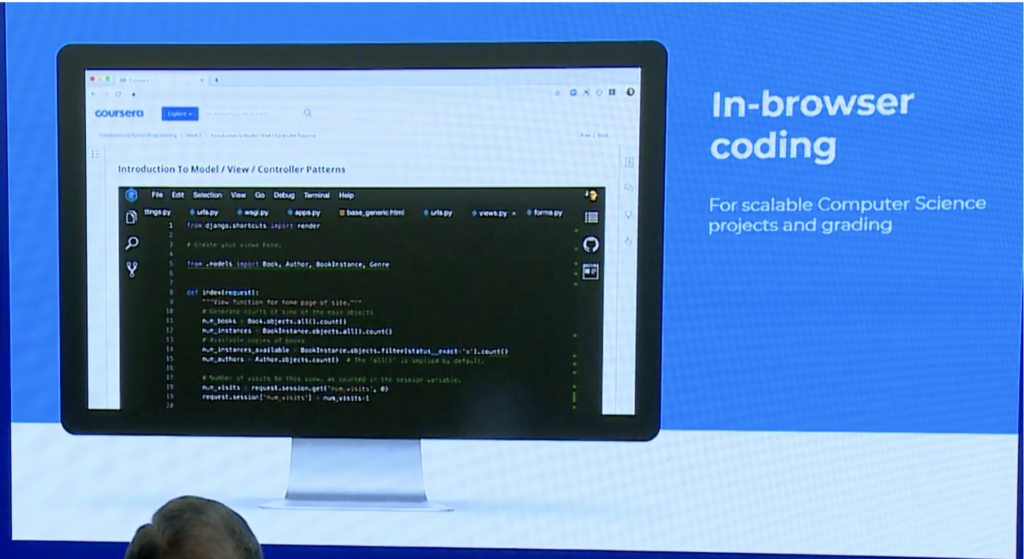
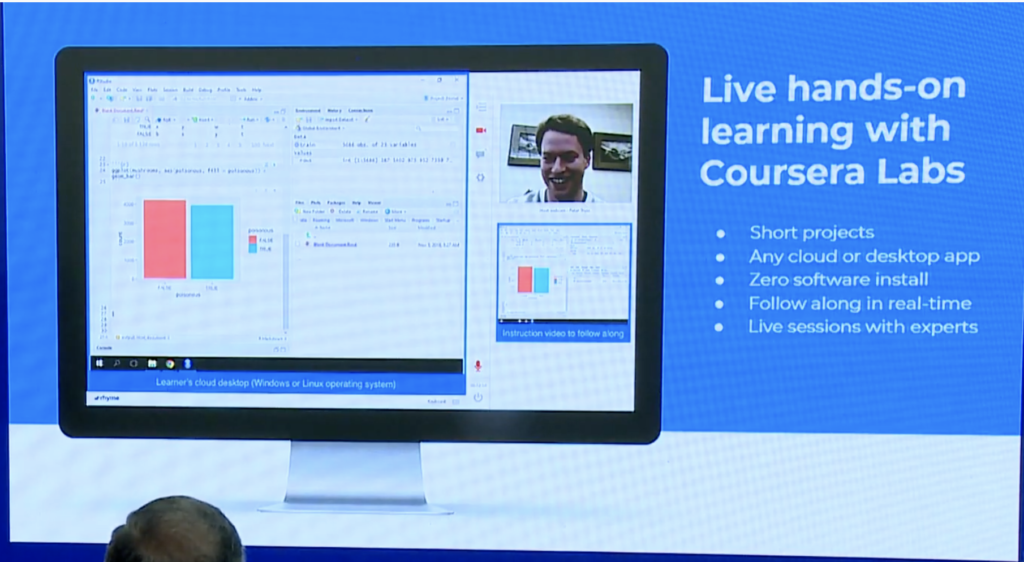
    Now that Coursera for Campus—which I have occasionally erroneously referred to as “Coursera for Schools” in previous blog posts—has been launched, we have some more information about what it’s really about. (I’ll embed the launch video at the bottom of the post, but if you’d rather go straight to it, you can find it here.) I think it’s significant and portends significant trends in the sector.

    Before we get to that, let’s get one item of business out of the way related to my previous posts. As IBL Education notes, Coursera CEO Jeff Maggioncalda said, “Coursera for Campus is not a full-featured LMS. We expect many universities to stay on their LMSs.” IBL News further notes, “According to the company, Coursera for Campus’ LMS is designed to supplement the existing Canvas, Blackboard and Moodle systems.” [Emphasis in original.]

    So Coursera for Campus isn’t LMS play, at least for the foreseeable future. I was pretty harsh on Coursera’s SVP of Enterprise Leah Belsky for her disruption language, but as I’ll get into later in this post, this kind of category mistake is actually quite easy to make and one that other courseware providers have made.

    Because that is exactly what Coursera has explicitly become with their Courseware for Campus offering: a courseware provider. The less obvious part is that MOOC design and courseware design have been converging for some time now. Their increasing similarities in instructional affordances have been masked by the differences in the business models of their parent companies. And even less obvious is that the Venn diagram of courseware companies and OPM companies is starting to overlap significantly.

    “A 21st-Century textbook”

    In the launch presentation, Maggioncalda called Coursera for Campus, in part, a “21st-Century textbook.” Take that seriously. These are MOOCs repurposed as curricular materials. And it’s really not that big of a leap. Remember that the pedagogical model of the xMOOC course generally doesn’t require heavy participation from the instructor. Some instructors do participate heavily, while others, less so. A lot of instructor energy goes into course design and lecture video production. The actual live support could be from the instructor, but it also could be from TAs, or it could be self-study. Or, in the case of Coursera for Campus, it could be a different instructor. From its inception, the design model of xMOOCs began decoupling faculty course design from faculty course delivery.

    There is some messiness, of course. The biggest challenge in terms of textbook-like may be the lecture videos. Faculty may not love having some other personality featured as the star of the show. But there are two mitigating factors to that. First, Coursera’s design staff is likely guiding faculty toward authoring instructionally sound videos, which would tend to reduce the total amount of talking head content in any given course. Second, textbook-provided commercial courseware, which is still often written by star authors in their field, now also features talking heads. Here, for example, is the Cengage MindTap introductory video for Economics, by author Greg Mankiw:

    Greg Mankiw’s head, talking

    “But,” you may be thinking, “MOOCs are not designed like courseware.” One of my Twitter followers made a comment to the effect that at least courseware has an instructional design philosophy, unlike xMOOCs.

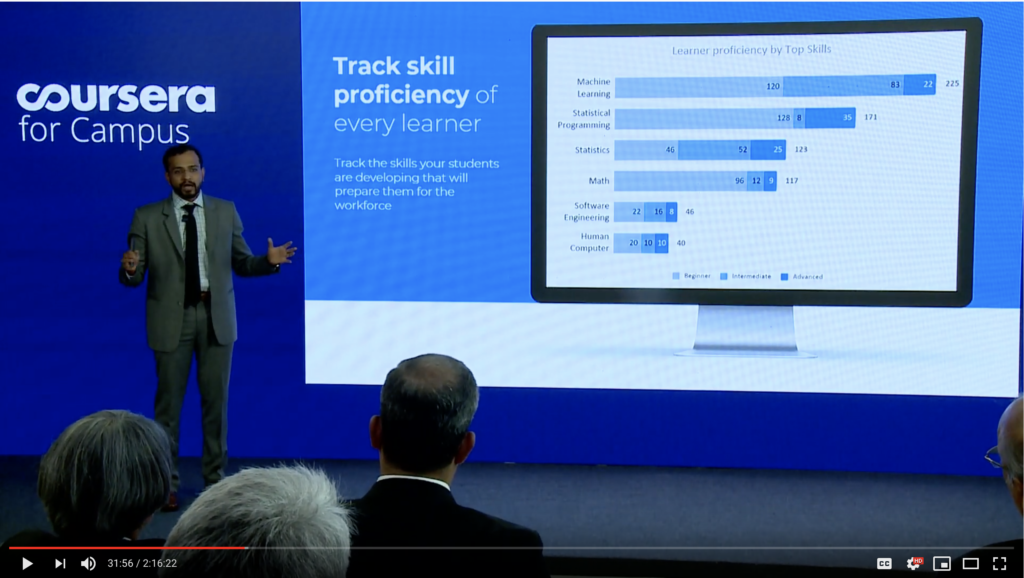
    That person is mistaken, and here is the proof:

    These analytics are only possible with backward design

    During the launch presentation, a Coursera executive made the statement that “any of the courses that have been authored on Coursera come with an out-of-the-box analytics platform.” If those analytics look anything like the picture above—and I would bet money that they do—then the courses have been built on a backward design philosophy like the one I have been describing in my recent post series on content as infrastructure.

    This shouldn’t be surprising. As I wrote repeatedly throughout that series, almost every professionally designed course uses that design pattern. And Coursera is known for having strong professional course design support.

    (I’m telling you, folks. That content pattern is the revolution of our time.)

    Update: Matthew Rascoff has reminded me to acknowledge that the professional course designers on campuses play large and critical roles in the design of these courses. The larger point is that, on both sides of the fence, there are trained, professional course designers who are applying this design pattern.

    While I haven’t looked at their catalog myself in quite some time, I would not be surprised at all if many of their offerings stack up pretty well against commercial courseware titles. For one thing, while xMOOCs have a bad reputation for anemic social interaction relative to other course models, they probably have more social interaction designed into them than many commercially published courseware titles.

    Courseware platforms vs LMSs

    It’s easy to get confused about the boundary between a courseware platform and an LMS. I know because I have worked on and consulted on both. The LMS companies inevitably start thinking, “Damn, there are so many courses that get delivered through our platform, and so much money made on selling them. And guess what? Everything that faculty build and deliver through our product is a course! The textbook publishers keep rebuilding what we’ve already built. Badly. I mean, have you seen their grade books? Why can’t we be the platform and get a cut of all that money?”

    So they try to displace the publishers. And they fail. Every time.

    The textbook publishers, meanwhile, start thinking, “Damn, our customers really hate their LMSs. We’ve built all these LMS features, and they keep asking for more. I mean, we’ve already built a grade book. Wow, that was painful. Why can’t we be the platform and get a cut of all that money?”

    So they try to displace the LMS companies. And they fail. Every time.

    Here’s the critical difference:

    LMS developers have to optimize for a wide range of faculty preferences, teaching styles, and teaching conditions. They have to accommodate every grading scheme imaginable. They have to handle huge classes and tiny classes. They have to deal with face-to-face, online, and blended. Constructivist, lecture, and whatever else. That’s why they spend so much time adding grade book micro-features and then optimizing the usability to handle all those micro-features without being totally overwhelming.

    Courseware developers, in contrast, have to optimize for the content. If the subject is software development, then you need an interactive code editor and test engine. If it’s accounting, then you need a test engine that looks like a spreadsheet. If it’s chemistry, then you need a molecule visualizer and manipulator.

    Which side of the divide do MOOC platforms land on? Here are a couple of slides from the Coursera on Campus launch:

    In-browser coding!
    Virtual labs!
    Data science notebooks!

    These subject-specific affordances, plus competency-based analytics, were the platform highlights of the Coursera for Campus presentation. Not the grade book that can do anything. Not the test engine that can provide any kind of feedback. Not announcements or an event feed. This was all about courseware.

    “But wait,” you say. “Courseware for Campus lets faculty author their own courses. Isn’t that different?”

    Yes. And no.

    Way back the better part of a decade ago, when I was at Cengage working on the MindTap platform, the company debated whether to open it up to customers and license it without content. (“We can disrupt the LMS!”) In the end, there were two major barriers. First, as a print-centric company in the midst of a transition, the authoring tools were not remotely faculty-friendly. And second, as a publisher whose bread and butter came from royalties, there was a fear of cannibalization of the business.

    Coursera has neither of those problems. It was born as a two-sided market, which means that it never owned the content to begin with and always had an incentive to make authoring as easy as possible. It may have taken some time to fully realize that vision, but we were destined to arrive where we are now.

    Further, as textbook publishers increasingly move away from celebrity franchises and toward fee-for-service contracts with their authors, they will have motivation to make similar moves. McGraw-Hill Education doesn’t advertise it widely, but they have been licensing the authoring platform for SmartBooks for several years now. Authoring support can work with a courseware platform as long as the range of course expectations for delivery models can be constrained. And MOOC courseware fits the bill. It’s a genre.

    Coursera for Campus is a harbinger of the future, not for the LMS industry but for the textbook industry. And they are an early mover with certain advantages in their business model.

    The courseware/OPM convergence

    One critical element that I don’t want to lose in all of this is the implications for the OPM market. Let’s not forget that (a) Coursera has been pushing into that market aggressively and successfully and (b) that market has been under massive pressure and upheaval lately. 2U has been the canary in the coal mine, having lost roughly four fifths of its market value since the beginning of the year. ((Disclosure: 2U is a 2019 sponsor of EEP.))

    To be clear, I think there’s some noise obscuring the signal. Two of the reasons why 2U took such a big hit are that the stock got way ahead of itself and some self-interested players have been extraordinarily successful at generating FUD around the market category in general.

    That said, there is no question that the hype around selling an infinite number of $40K masters degrees has met its demise. There are two barriers to OPM growth, which is another way of saying that there are two barriers to conventional online degree growth, and they have both proven formidable barriers to crack. The obvious one is cost. The less obvious one is geography. It turns out that, even in an era when people can take courses from anywhere in the world, they will tend to take them from their local institution or not at all. For all the talk of “national universities” and “mega universities,” it’s not clear that such beasts really exist. For the most part, big universities have proven exceptionally good at soaking up every ounce of demand for education in their local areas. So the next sustainability play is not so much about reaching students far away as it is about serving students you already reach for 40 years rather than for four.

    And interestingly, that is essentially the pitch that the Coursera executives made about Coursera for Campus—even when they were pitching in India. They weren’t making the pitch that the American stereotype would have predicted, of reaching the rural millions. They were talking about lifelong learning. Skilling and reskilling. From an OPM perspective, this pitch gives the company with the large catalog of low-cost and constantly refreshed inventory a competitive advantage.

    That said, there was definitely a bit of hand waving going on regarding completion rate. The Coursera executives talked about University of Illinois’ degree program as having over a 90% completion rate as if that remarkable achievement could be solely attributed to the fact that it was a degree program. I suspect there are some hard-working support staff at the University of Illinois who might quibble with that clean of a causal analysis. I don’t think the Coursera folks are directionally wrong, and I don’t think they were intentionally misleading, either. But I do think that they oversimplified, and that running a highly successful program at scale with a 90%+ degree completion rate entails a lot more than just handing out a piece of sheep skin at the end. The reason I bring this up is not because I want to snark on Coursera but because the part that is being glossed over represents a number of support areas that OPMs compete on (and that more traditional OPMs and OPEs pride themselves on excelling at).

    The gap between “MOOC” the course model and “MOOC” the courseware model is very much an open question in terms of student success. The MOOC courseware model, particularly as implemented into affordable degrees at scale delivery models by pioneers like Georgia Tech and University of Illinois, are creating an alternative delivery model that could start putting pressure on OPMs supporting more traditional models. Coursera on Campus, in addition to creating an additional revenue stream for the company and putting pressure on courseware providers, potentially ups the ante in the OPM market. But we need to look to those universities which are pioneering affordable degrees at scale to understand the service gaps, marketing gaps, and cost differences between MOOC courseware and the totality of what they are doing in order to understand the what it would take to replicate their success.

    In the meantime, consider the implications of the Coursera on Campus model for the future of companies like Pearson and Wiley, which own both courseware and OPM divisions, or McGraw-Hill Education, which has begun experimenting with opening up its platform for content authoring by customers. ((Disclosure: Pearson is a 2019 sponsor of the Empirical Educator Project.)) It’s not necessarily all bad, but it is a potential accelerant to change that is already in the wind.

    It’s a wild, wild, wild, wild world, my friends.

    Here’s the full launch event for your viewing pleasure:

  • MOOC Die-Off Coda

    In response to my last post, my friend Matthew Rascoff tweeted,

    https://twitter.com/mzrascoff/status/1180303464951250944

    Matthew makes some valid points, both here and further down in that thread. So I thought it would be worthwhile to take a moment to clarify a couple of the finer points of my post.

    First, I absolutely agree that there is a long-running narrative of “MOOCs are dead” that is not productive. My intention wasn’t to reiterate that narrative but rather to say that, given the very evolution of what is “coming next” that Matthew is interested in, the term “MOOC” itself has become meaningless. Design and usage of “MOOCs” have fragmented in really substantial ways as people have learned and tried new things. To call Georgia Tech’s Affordable Degrees at Scale, ASU’s Global Freshman Academy, and the new Coursera on Campus initiative all “MOOCs” or “MOOC-based” is to paper over the critical differences among them that are exactly the experimental factors that we should be attending to. Of these three programs, only Global Freshman Academy was something close to what I would call a MOOC in the original sense.

    The point isn’t to get into an academic debate (in the pejorative sense) over a term definition but rather to understand that there are very different kinds of experiments being run. The success or failure of one of these tells us very little about the prospects of the other two. When we call everything a MOOC, we obscure the differences among the experimental conditions and the possible reasons for the different results that are coming in from them. There are lots of interesting experiments happening on MOOC platforms right now. I’m not sure how to tell what works and what doesn’t because we’re not using precise language to disambiguate among the experiments. Die-offs are part of evolution, and we’re trying to understand the process of natural selection.

    Second and somewhat separately, I have a bugaboo about the term “disruption” being casually thrown about by ed tech companies. Disruptive innovation is a theory of change. We have lots of data about how the LMS market in particular changes—or doesn’t. At one point, Moodle was supposed to be a disruptive innovator. At another point, OpenClass was supposed to be the disruptive innovator. Both competed against non-consumption with a cheaper, simpler solution. Both got soundly beaten in developed markets by Instructure Canvas and, later, by other commercially hosted cloud-based solutions. There is no particular reason to believe that disruptive innovation works as a theory of change in the LMS market.

    Further, if you’re going to claim to be ready to “disrupt” a product category, then you damned well better have good understanding of the needs of the customers in that product category. It’s a matter of respect. There is a long history of vendors failing to show proper care in this regard, which in turn has created trauma and fostered dysfunction on the part of universities going through a procurement process. Those universities tend to develop a cynicism which, at its worst, manifests as a corrosive political nihilism in their approach to picking a product.

    Vendors have a responsibility to the sector to be humble. I don’t have any problem at all with Coursera’s ambitions for their Coursera at School offering, at least as far as I understand them. I do have a problem with the way that their executive characterized those ambitions in the EdSurge article. I think the language of disruption is both counter-productive for Coursera and harmful to the kind of conversations we want to foster in general about evaluating innovative offerings. As I said in my original post, it is long past time for companies serving the education market to strike that word from their public vocabularies.

    In general, I am spending less time picking at vendor language in this new incarnation of e-Literate, as I try to focus on incentivizing good behavior rather than punishing bad behavior. That especially applies to vendors using unfortunate but relatively inconsequential language. What Coursera is doing is generally much more important that what they are saying about what they are doing. That said, there are times when patterns of language use are genuinely harmful and need to be called out, not to punish a bad actor but to put a halt to counter-productive behavior that retards progress in the sector. This is one of those times.