e-Literate

Present is Prologue

Category: Curricular-Materials

This category includes digital curricular materials, including adaptive learning, assessments, OER, etc.

  • Some Notes On Lumen Learning’s $3.75 million Funding Round Led By Follett

    Some Notes On Lumen Learning’s $3.75 million Funding Round Led By Follett

    Today’s biggest ed tech news was Lumen Learning – co-founded by David Wiley and Kim Thanos and focused on getting deeper adoption of OER in higher education – and their new round of funding. And this news goes beyond pure investment, as Follett, the large campus retailer that “serve[s] over half of the students in the United States, and work with 80,000 schools as a leading provider of education technology, services and print and digital content”, led the funding round.

    First up a disclosure: Lumen Learning is a client of MindWires (the consulting side of e-Literate, or our capitalistic alter ego), and we have had a consulting relationship with Lumen for almost 18 months. We mostly don’t blog about our consulting work, and I do not plan to describe our advice to them, but we are not neutral observers on this one.

    As described in the press release:

    Follett will offer Lumen Learning’s OER solutions to more than 1,200 colleges and universities where Follett manages course materials delivery. Given Follett’s ongoing mission to improve access and affordability for students, the company has invested in Lumen Learning to help fund future growth and expansion of OER courseware.


    (more…)

  • Cengage and OER Podcast Series: Two steps forward and one step back

    Cengage and OER Podcast Series: Two steps forward and one step back

    Last fall I wrote about Cengage, one of the big three publishers for higher education, sponsoring and releasing a survey on Open Education Resources (OER). The survey headline:

    Open Educational Resources (OER) in higher education have the potential to triple in use as primary courseware over the next five years, from 4 percent to 12 percent, according to a survey of more than 500 faculty by Cengage Learning. In addition, the use of OER for supplemental learning materials may nearly quadruple in size, from 5 percent to 19 percent.

    But the hidden headline could have been viewed by skeptics as “a publisher fully interested in OER – what’s the catch?”. As time goes on, it is looking more and more like there is no catch other than Cengage promoting OER and trying to understand the nature of OER internally while sharing those lessons. Today’s news is that on the company’s OER resource page they have launched a new podcast series titled “Journey to OER”.

    (more…)

  • Understanding Learning Science and Its Value to Educators

    Understanding Learning Science and Its Value to Educators

    simon-header

    In a world where we are constantly barraged with product claims about “learning science,” most educators have very little sense of what that really means and how it is relevant to what they do. I was lucky enough to be able to hear from and interview some actual academic learning sciences last year at Carnegie Mellon University’s Simon Initiative. The trip itself was paid for by CMU—I was part of a group of “media fellows”—and the video production was paid for by a grant from the Bill & Melinda Gates Foundation. The result was a trio of interview videos that I’m particularly pleased to share. (more…)

  • Improved NAU Student Success in Subsequent Courses After Math Emporium

    Improved NAU Student Success in Subsequent Courses After Math Emporium

    Last week I published three e-Literate TV episodes on Northern Arizona University and their suite of initiatives aimed at helping first-year (and often first-generation) students. In those videos, NAU staff made some interesting claims, in particular that they are seeing improved student performance in subsequent courses after students take one of their modified emporium math courses in the Lumberjack Mathematics Center.

    (YouTube playlist: http://bit.ly/etv_NAU)

    (Video source specific claim: http://bit.ly/NAU_SMCclaim)

    (more…)

  • Northern Arizona University: Modified math emporium for first-year students

    Northern Arizona University: Modified math emporium for first-year students

    In episode 1 of our e-Literate TV case study on Northern Arizona University, we gave a broad overview of the suite of initiatives (primarily) targeted at helping first-year students amidst the tensions coming from growing enrollments. ((Disclosure: Our e-Literate TV series of video case studies and explainer videos is funded by a grant from the Bill & Melinda Gates Foundation.)) In episode 2 we covered their advising and student support, including work with IPASS initiative. In this episode we look at their modified math emporium approach leveraging the Lumberjack Mathematics Center.

    Math emporia have a mixed reputation, occasionally described as “the place where all the non-math majors are generally sent to virtually teach themselves subjects” or that “we’ve outsourced jobs for professors to a bunch of students on hourly wage”. Yet studies have shown positive results in many cases. Just saying there is an emporium approach doesn’t tell you much – some are run well with plenty of support for students, and some leave students on their own with poor support. So it is useful to see a specific case. How has NAU implemented a math emporium approach, what does it look like, what support is provided, and what are the results? NAU has implemented a modified emporium, and they have invested in a new facility to support this model.

    (Video source: https://youtu.be/A1GLmGri1So)

    (more…)

  • Northern Arizona University: Their work in student support and IPASS initiative

    Northern Arizona University: Their work in student support and IPASS initiative

    In episode 1 of our e-Literate TV case study on Northern Arizona University, we gave a broad overview of the suite of initiatives (primarily) targeted at helping first-year students amidst the tensions coming from growing enrollments. ((Disclosure: Our e-Literate TV series of video case studies and explainer videos is funded by a grant from the Bill & Melinda Gates Foundation.)) In this episode we look outside of the classroom to see how they’re approach advising and student support.

    As we mentioned yesterday, NAU has a rapidly growing enrollment and has a large percentage of students (more than 40% of incoming freshman) that are first-generation. These students do not have a long-history of academic success, and they typically do not have a family support system in place to help them understand what to expect in college and how to succeed. First-generation students tend to come from lower-income families and have a greater tendency to work 20+ hours per week on top of their college studies. We even documented last year how first-generation students tend to spend more on textbooks. Simply put, for schools attracting high percentages of first-generation students, there is an even greater need to provide support and advising structures in place to help them acclimate to college life and studying requirements. And even guidance on how to manage their degree and career plans.

    This is the context to understand the challenges NAU faces as they have changed their approach to advising and student support.

    (Video source: https://youtu.be/0uuogTI_IRY)

    (more…)

  • Northern Arizona University: A suite of initiatives to help first and second-year students

    Northern Arizona University: A suite of initiatives to help first and second-year students

    As part of our e-Literate TV series of case studies, we had a chance this fall to interview faculty and staff at Northern Arizona University about, well, a lot of stuff. ((Disclosure: Our e-Literate TV series of video case studies and explainer videos is funded by a grant from the Bill & Melinda Gates Foundation.)) Rather than highlighting a specific program or course redesign, NAU has invested in and implemented a suite of initiatives focused on improving student learning and success by rethinking the experience of (mostly) first-year students.

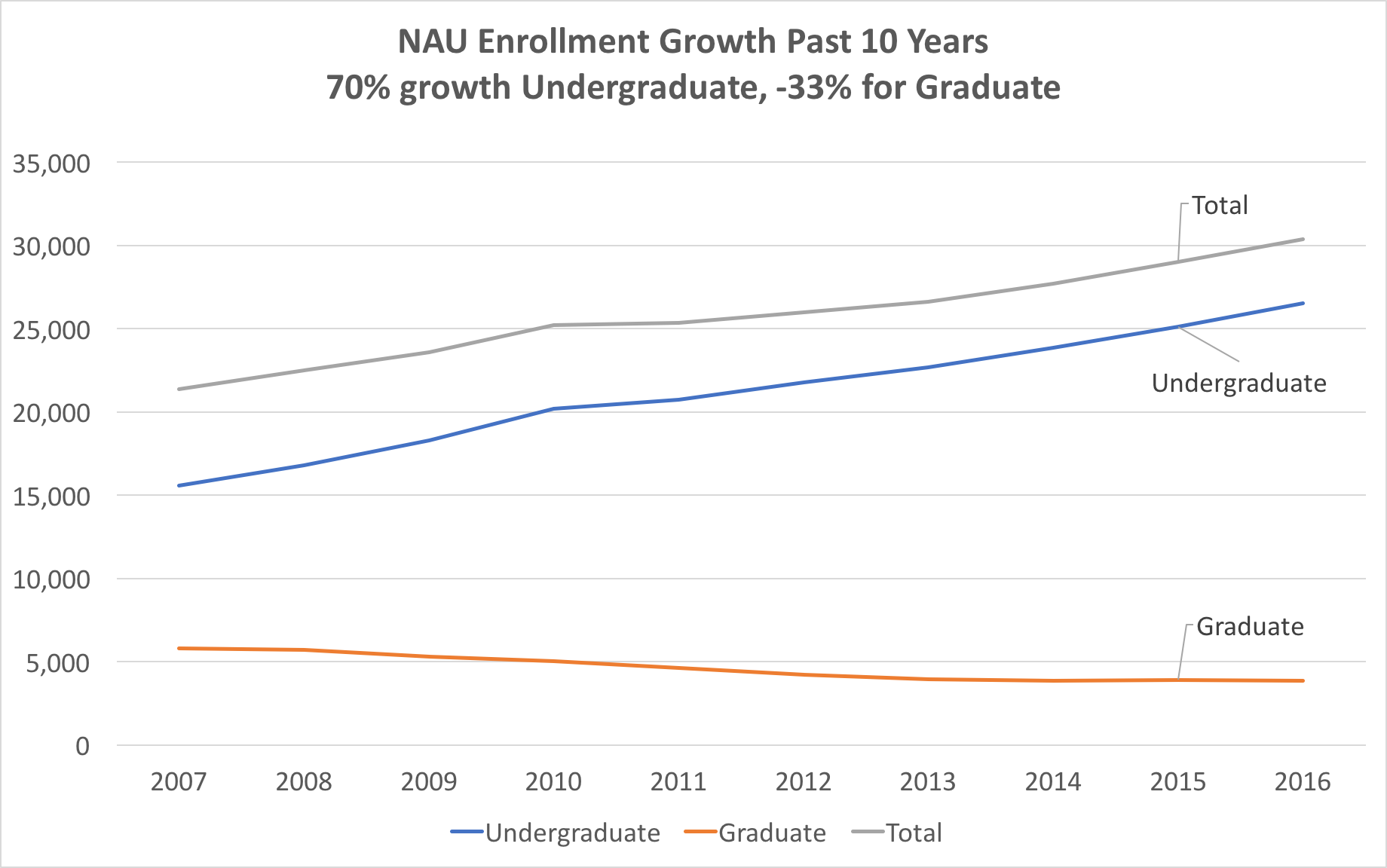
    The core challenge NAU faces is to make these student-facing changes while facing growing enrollment, particularly for full-time undergraduate students.

    enrollment-growth-level
    (more…)