
e-Literate

Present is Prologue

Category: LMS & Learning Platforms

Everything you want to know about Learning Management Systems and whatever comes after them.


  • Reuters: Blackboard up for sale, seeking up to $3 billion in auction

    As I was writing a post about Blackboard’s key challenges, I get notice from Reuters (anonymous sources, so interpret accordingly) that the company is on the market, seeking up to $3 billion. From Reuters:

    Blackboard Inc, a U.S. software company that provides learning tools for high school and university classrooms, is exploring a sale that it hopes could value it at as much as $3 billion, including debt, according to people familiar with the matter.

    Blackboard’s majority owner, private equity firm Providence Equity Partners LLC, has hired Deutsche Bank AG and Bank of America Corp to run an auction for the company, the people said this week. [snip]

    Providence took Blackboard private in 2011 for $1.64 billion and also assumed $130 million in net debt.

    A pioneer in education management software, Blackboard has seen its growth slow in recent years as cheaper and faster software upstarts such as Instructure Inc have tried to encroach on its turf. Since its launch in 2011, Instructure has signed up 1,200 colleges and school districts, according to its website.

    This news makes the messaging from BbWorld as well as their ability to execute on strategy, particularly delivering the new Ultra user experience across all product lines – including the core LMS – much more important. I’ll get to that subject in the next post. (more…)
  • Giving D2L Credit Where Credit Is Due

    Michael and I have made several specific criticisms of D2L’s marketing claims lately culminating in this blog post about examples based on work at the University of Wisconsin-Milwaukee (UWM) and California State University at Long Beach (CSULB).

    I understand that other ed tech vendors make marketing claims that cannot always be tied to reality, but these examples cross a line. They misuse and misrepresent academic outcomes data – whether public research-based on internal research – and essentially take credit for their technology “delivering results”.

    This week brought welcome updates from D2L that go a long way towards addressing the issues we raised. As of Monday, I noticed that the ‘Why Brightspace? Results’ page now has links to supporting material for each claim, and the UWM claim has been reworded. Today, D2L released a blog post explaining these changes and admitting the mistakes. D2L even changed the web page to allow text selection for copy / paste. From the blog post: (more…)

  • Unizin Perspective: Personalized learning’s existence and distance education experience

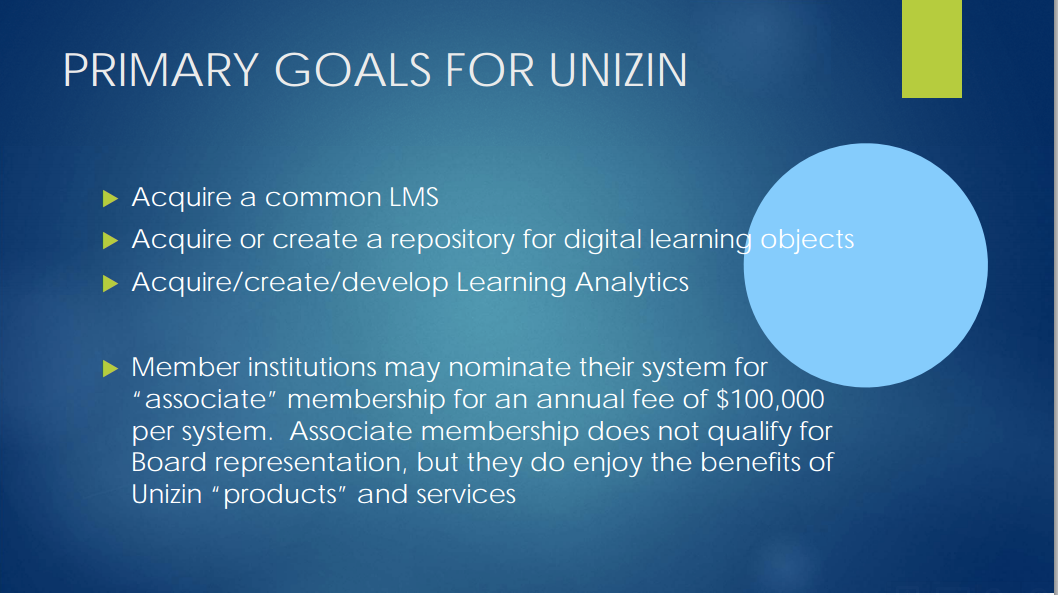
    By reading the Unizin pitch for the State University System of Florida shared yesterday, we can see quite a few claims about the (potential) benefits to be provided by the consortium. “Make sure that the universities were not cut out of [distance ed] process”; “Secure our foothold in the digital industry”; “Promote greater control and influence over the digital learning ecosystem”; Provide “access to the Canvas LMS at the Unizin price”; Provide “access to tools under development, including a Learning Object Repository and Learning Analytics”; Provide “potential for cooperative relationships to ‘share’ digital instruction within and across the consortium”.

    I want to pick up on University of Florida provost Joe Glover’s further comment on Learning Analytics, however.

    The third goal for Unizin is to acquire, create, or develop learning analytics. Some of the learning management systems have a rather primitive form of learning analytics. Unizin will build on what they have, and this will go from very mechanical types of learning analytics in terms of monitoring student progress and enabling intrusive advising and tutoring; all the way up to personalized learning, which is something that really does not exist yet but is one of the objectives of Unizin.

    (more…)

  • Unizin Offering “Associate” Membership For Annual $100k Fee

    Alert unnamed readers prompted me after the last post on the Unizin contract to pursue the rumored secondary method of joining for $100k. You know who you are – thanks.

    While researching this question, I came across a presentation by the University of Florida provost to the State University System of Florida (SUSFL) seeking to get the system to join Unizin under these new terms. The meeting was March 19, 2015, and the video archive is here (first 15 minutes), and the slide deck is here. The key section (full transcript below):

    Associate Membership FLSUS (more…)

  • Instructure Is Truly Anomalous

    Phil started his last post with the following:

    I’m not sure which is more surprising – Instructure’s continued growth with no major hiccups or their competitors’ inability after a half-decade to understand and accept what is at its core a very simple strategy.

    Personally, I vote for Door #1. As surprising as the competition’s seeming sense of denial is, Instructure’s performance is truly shocking. After five years, I continue to be surprised by it. It’s not just how well they are executing. It’s that they seem to defy the laws of physics in the LMS market. We had no reason to believe that any LMS company could rack up the numbers they are showing—in several different areas—no matter how well they execute.

    (more…)

  • Instructure: Accelerating growth in 3 parallel markets

    I’m not sure which is more surprising – Instructure’s continued growth with no major hiccups or their competitors’ inability after a half-decade to understand and accept what is at its core a very simple strategy. Despite Canvas LMS winning far more new higher ed and K-12 customers than any other vendor, I still hear competitors claim that schools select Canvas due to rigged RFPs or being the shiny new tool despite having no depth or substance. When listening to the market, however, (institutions – including faculty, students, IT staff, academic technology staff, and admin), I hear the opposite. Canvas is winning LMS selections despite, not because of, RFP processes, and there are material and substantive reasons for this success.

    The only competitor I see that seems to understand the depth of the challenge they face is Blackboard. Other LMS solutions are adding “cloud” options or making incremental improvements to usability, but only Blackboard is going for wholesale changes to both its User Experience (UX) and cloud hosting architecture. Unfortunately, I question whether Blackboard will be able to execute this strategy, but that is a story for another post.

    Like last year’s post about InstructureCon, I believe that the company growth chart ((The chart shows the number of clients, which is essentially the number of contracts signed with institutions, school districts, or statewide systems adopting either Canvas or Bridge LMS products.)) gives a lot more information than just “gosh, we’re doing well”. (more…)

  • Unizin One Year Later: View of contract reveals . . . nothing of substance

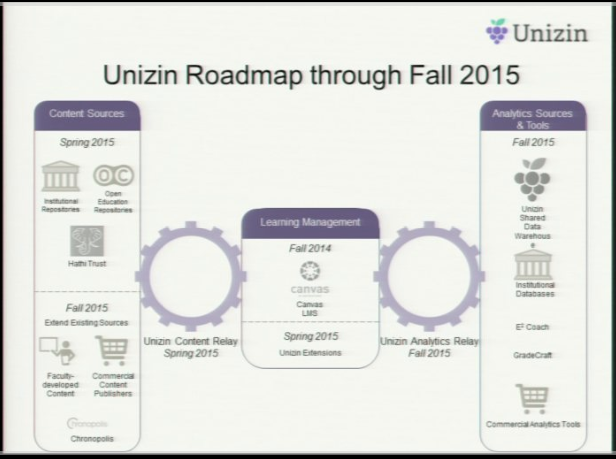
    I’ve been meaning to write an update post on Unizin, as we broke the story here at e-Literate in May 2014 and Unizin went public a month later. It’s one year later, and we still have the most expensive method to get the Canvas LMS. There are also plans for a Content Relay and Analytics Relay as seen in ELI presentation, but the actual dates keep slipping.

    Unizin Roadmap

    e-Literate was able to obtain a copy of the Unizin contract, at least for the founding members, through a public records request. There is nothing to see here. Because there is nothing to see here. The essence of the contract is for a university to pay $1.050 million to become a member. The member university then has a right (but not an obligation) to then select and pay for actual services. Based on the contract, membership gets you . . . membership. Nothing else. (more…)