At this year’s Ellucian users’ conference #elive15, one of the two big stories has been that Ellucian acquired the Helix LMS, including taking on the development team. I have previously described the Helix LMS in “Helix: View of an LMS designed for competency-based education” as well as the subsequent offer for sale in “Helix Education puts their competency-based LMS up for sale”. The emerging market for CBE-based learning platforms is quickly growing, at least in terms of pilot programs and long-term potential, and Helix is one of the most full-featured, well-designed systems out there. (more…)
Category: LMS & Learning Platforms
Everything you want to know about Learning Management Systems and whatever comes after them.
-
Back To The Future: Looking at LMS forecasts from 2011 – 2014
At today’s Learning Analytics and Knowledge 2015 conference (#LAK15), Charles Severance (aka Dr. Chuck) gave the morning keynote organized around the theme of going back in time to see what people (myself and Richard Katz primarily) were forecasting for education. By looking at the reality of 2015, we can see which forecasts were on track and which were not. I like this concept, as it is useful to go back and see what we got right and wrong, so this post is meant to provide some additional context particularly for LMS market. Chuck’s keynote also gives cover for doing so without seeming too self-absorbed.
But enough about me. What do you think about me?
I use the term forecast since I tend to describe patterns and trends and then try to describe the implications. This is different than the Katz video which aimed to make specific predictions as a thought-provoking device.
Pre-2011
I introduced the LMS squid diagram in 2008 as a tool to help people see the LMS market holistically rather than focusing on detailed features. Too much of campus evaluations then (and even now) missed the big picture that there were only a handful of vendors and some significant market dynamics at play.
A 2009 presentation, by the way, was the basis for Michael and me connecting for the first time. Bromance. (more…)
-
Slides and Follow-up From Faculty Development Workshop at Aurora University
Today I facilitated a faculty development workshop at Aurora University, sponsored by the Center for Excellence in Teaching and Learning and the IT Department. I always enjoy sessions like this, particularly with the ability to focus our discussions squarely on technology in support of teaching and learning. The session was titled “Emerging Trends in Educational Technology and Implications for Faculty”. Below are very rough notes, slides, and a follow-up.
Apparent Dilemma and Challenge
Building off of previous presentations at ITC Network, there is an apparent dilemma:
- One one hand, little has changed: Despite all the hype and investment in ed tech, there is only one new fully-established LMS vendor in the past decade (Canvas), and the top uses of LMS are for course management (rosters, content sharing, grades). Plus the MOOC movement fizzled out, at least for replacing higher ed programs or courses.
- On the other hand, everything has changed: There are examples of redesigned courses such as Habitable Worlds at ASU that are showing dramatic results in the depth of learning by students.
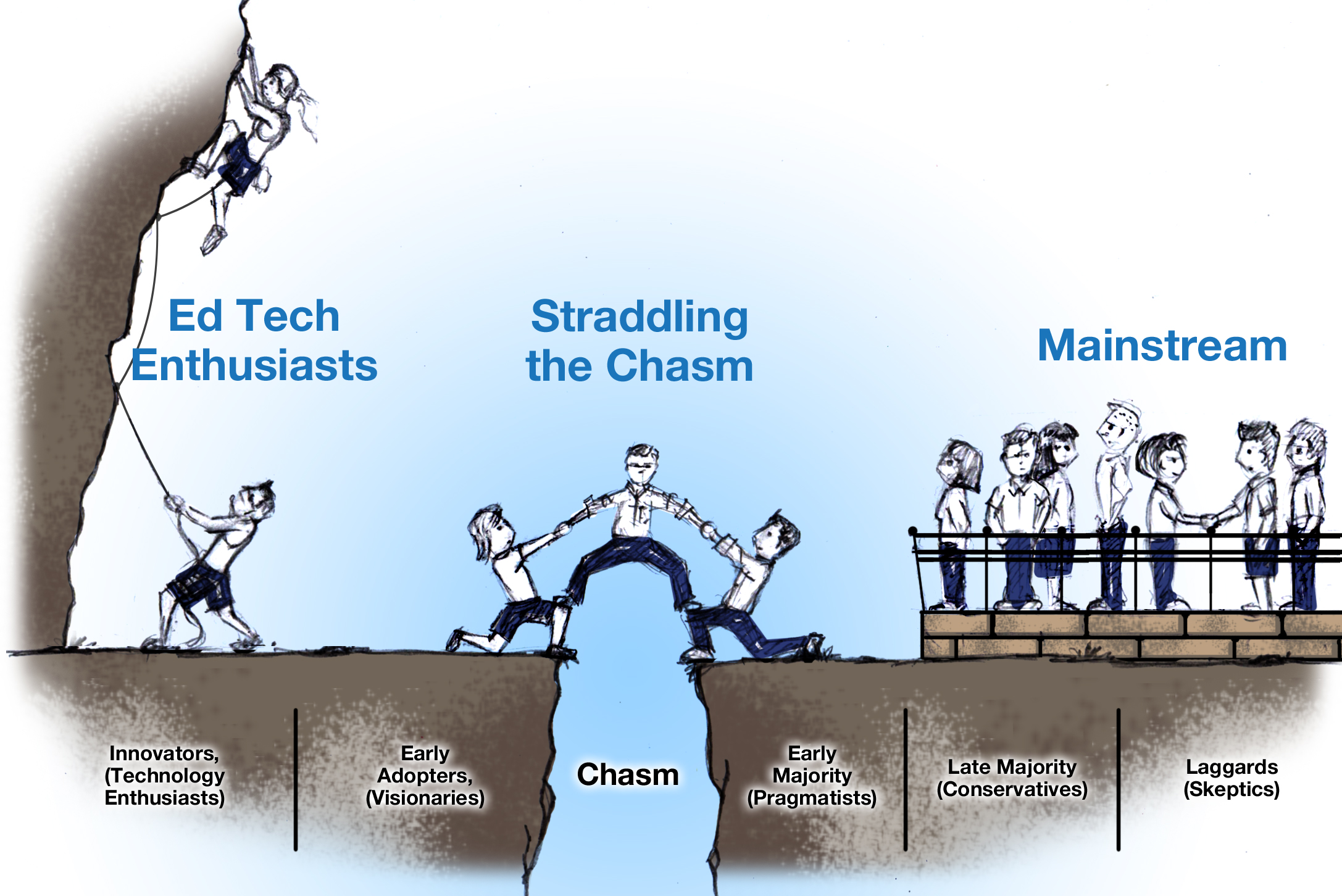
The best lens to understand this dilemma is Everett Rogers’ Diffusions of Innovations and the technology adoption curve and categories. Geoffrey Moore extended this work to call out a chasm between Innovators / Early Adopters on the left side (wanting advanced tech, OK with partial solutions they cobble together, pushing the boundary) and Majority / Laggards on the right side (wanting full solution – just make it work, make it reliable, make it intuitive). Whereas Moore described Crossing the Chasm for technology companies (moving from one side to the other), in most cases in education we don’t have that choice. The challenge in education is Straddling the Chasm (a concept I’m developing with a couple of consulting clients as well as observations from e-Literate TV case studies): (more…)
-
Brian Whitmer No Longer in Operational Role at Instructure
Just over a year and a half ago, Devlin Daley left Instructure, the company he co-founded. It turns out that both founders have made changes as Brian Whitmer, the other company co-founder, left his operational role in 2014 but is still on the board of directors. For some context from the 2013 post:
Instructure was founded in 2008 by Brian Whitmer and Devlin Daley. At the time Brian and Devlin were graduate students at BYU who had just taken a class taught by Josh Coates, where their assignment was to come up with a product and business model to address a specific challenge. Brian and Devlin chose the LMS market based on the poor designs and older architectures dominating the market. This design led to the founding of Instructure, with Josh eventually providing seed funding and becoming CEO by 2010.
Brian had a lead role until last year for Instructure’s usability design and for it’s open architecture and support for LTI standards.
The reason for Brian’s departure (based on both Brian’s comments and comments from Instructure statements) is based on his family. Brian’s daughter has Rett Syndrome: (more…)
-
Blueprint for a post-LMS, Part 4
In part 1 of this series, I talked about some design goals for a conversation-based learning platform, including lowering the barriers and raising the incentives for faculty to share course designs and experiment with pedagogies that are well suited for conversation-based courses. Part 2 described a use case of a multi-school faculty professional development course which would give faculty an opportunity to try out these affordances in a low-stakes environment. In part 3, I discussed some analytics capabilities that could be added to a discussion forum—I used the open source Discourse as the example—which would lead to richer and more organic assessments in conversation-based courses. But we haven’t really gotten to the hard part yet. The hard part is encouraging experimentation and cross-fertilization among faculty. The problem is that faculty are mostly not trained, not compensated, and otherwise not rewarded for their teaching excellence. Becoming a better teacher requires time, effort, and thought, just as becoming a better scholar does. But even faculty at many so-called “teaching schools” are given precious little in the way of time or resources to practice their craft properly, never mind improving it.
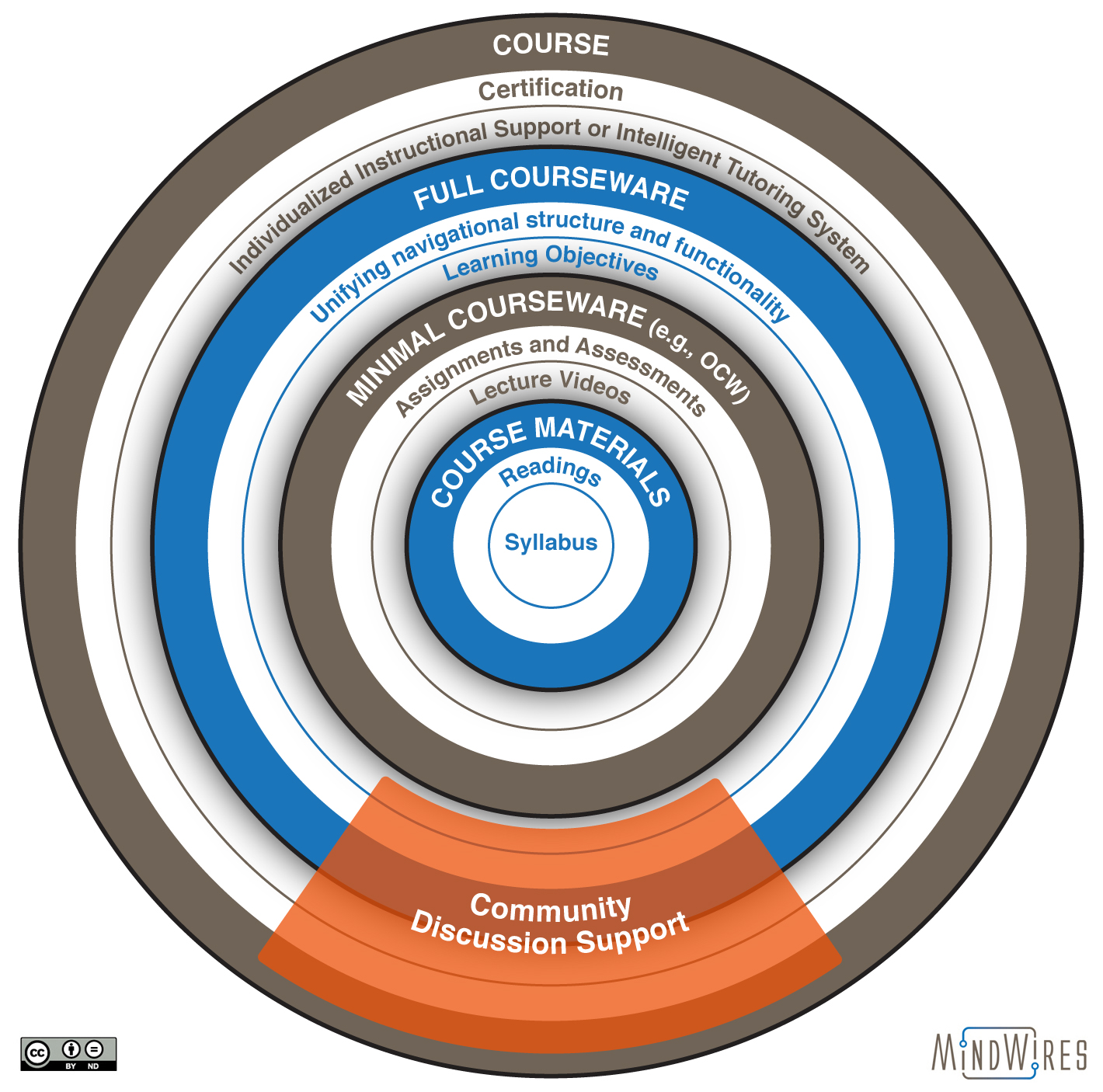
The main solution to this problem that the market has offered so far is “courseware,” which you can think of as a kind of course-in-a-box. In other words, it’s an attempt to move as much as the “course” as possible into the “ware”, or the product. The learning design, the readings, the slides, and the assessments are all created by the product maker. Increasingly, the students are even graded by the product.
This approach as popularly implemented in the market has a number of significant and fairly obvious shortcomings, but the one I want to focus on for this post is these packages are still going to be used by faculty whose main experience is the lecture/test paradigm. ((Of course, I recognize that some disciplines don’t do a lot of lecture/test (although they may do lecture/essay). These are precisely the disciplines in which courseware has been the least commercially successful.)) Which means that, whatever the courseware learning design originally was, it will tend to be crammed into a lecture/test paradigm. In the worst case, the result is that we have neither the benefit of engaged, experienced faculty who feel ownership of the course nor an advanced learning design that the faculty member has not learned how to implement.
One of the reasons that this works from a commercial perspective is that it relies on the secret shame that many faculty members feel. Professors were never taught to teach, nor are they generally given the time, money, and opportunities necessary to learn and improve, but somehow they have been made to feel that they should already know how. To admit otherwise is to admit one’s incompetence. Courseware enables faculty to keep their “shame” secret by letting the publishers do the driving. What happens in the classroom stays in the classroom. In a weird way, the other side of the shame coin is “ownership.” Most faculty are certainly smart enough to know that neither they nor anybody else is going to get rich off their lecture notes. Rather, the driver of “ownership” is fear of having the thing I know how to do in my classroom taken away from me as “mine” (and maybe exposing the fact that I’m not very good at this teaching thing in the process). So many instructors hold onto the privacy of their classrooms and the “ownership” of their course materials for dear life.
Obviously, if we really want to solve this problem at its root, we have to change faculty compensation and training. Failing that, the next best thing is to try to lower the barriers and increase the rewards for sharing. This is hard to do, but there are lessons we can learn from social media. In this post, I’m going to try to show how learning design and platform design in a faculty professional development course might come together toward this end.
-
Blueprint for a post-LMS, Part 3
In the first part of this series, I identified four design goals for a learning platform that supports conversation-based courses. In the second part, I brought up a use case of a kind of faculty professional development course that works as a distributed flip, based on our forthcoming e-Literate TV series on personalized learning. In the next two posts, I’m going to go into some aspects of the system design. But before I do that, I want to address a concern that some readers have raised. Pointing to my apparently infamous “Dammit, the LMS” post, they raise the question of whether I am guilty of a certain amount of techno-utopianism. Whether I’m assuming just building a new widget will solve a difficult social problem. And whether any system, even if it starts out relatively pure, will inevitably become just another LMS as the same social forces come into play.
I hope not. The core lesson of “Dammit, the LMS” is that platform innovations will not propagate unless the pedagogical changes that take advantages of those changes also propagate, and pedagogical changes will not propagate without changes in the institutional culture in which they are embedded. Given that context, the use case I proposed in part 2 of this series is every bit as important as the design goals in part 1 because it provides a mechanism by which we may influence the culture. This actually aligns well with the “use scale appropriately” design goal from part 1, which included this bit:
Right now, there is a lot of value to the individual teacher of being able to close the classroom door and work unobserved by others. I would like to both lower barriers to sharing and increase the incentives to do so. The right platform can help with that, although it’s very tricky. Learning Object Repositories, for example, have largely failed to be game changers in this regard, except within a handful of programs or schools that have made major efforts to drive adoption. One problem with repositories is that they demand work on the part of the faculty while providing little in the way of rewards for sharing. If we are going to overcome the cultural inhibitions around sharing, then we have to make the barrier as low as possible and the reward as high as possible.
When we get to part 4 of the series, I hope to show how the platform, pedagogy, and culture might co-evolve through a combination of curriculum design, learning design, platform design, prepared for faculty as participants in a low-stakes environment. But before we get there, I have to first put some building blocks in place related to fostering and assessing educational conversation. That’s what I’m going to try to do in this post.