e-Literate

Present is Prologue

Category: Ed Tech

The “Ed Tech” category includes posts about educational technology products themselves, including LMSs and other learning platforms, adaptive learning and other digital curricular materials products, learning analytics, and educational apps of all types. It also includes technical aspects of ed tech products, especially interoperability.

  • Announcing Argos Education

    Announcing Argos Education

    Those of you who have been paying close attention to my LinkedIn profile have known that something has been up with me. I have quietly been working with friends and colleagues toward building a start-up. As we have been building the company, we have been collecting a group of Angel investors who are, almost universally, people we respect and turn to for advice. We’ve been very lucky that way.

    Yesterday WGU Labs announced that they are our first institutional investor. I am deeply satisfied that our we are starting off with support from a fund that is affiliated with an access-oriented university. It sets the tone for who we want to be and what we want to accomplish.

    This post is the first in a series about what Argos Education is. The truth is that I’ve been writing about aspects it for a while without mentioning the startup angle. My post series about the open-source collaboration on a courseware platform between Carnegie Mellon University’s OLI group and Arizona State University’s ETX group was about the software and the collaboration that forms the heart of Argos. If you’re impatient with the meandering Feldstein style and want to get a concise summary of what we’re up to, one of our Angel investors, the wise-beyond-his-years Matt Tower, has written up his own thesis about us. Matt is far more succinct than I am.

    Here on e-Literate, I feel compelled to tell the story e-Literate-style. This first entry will be a very personal one. I’ve been lucky to have long-time readers who have traveled my EdTech journey with me for as long as sixteen years. I’m going to take some time to explain how this latest change fits into that journey. You won’t learn much about what Argos actually does in this installment, but if you’re an e-Literate reader, you’re used to my George R. R. Martin style. I promise you, The Winds of Winter is coming and it won’t suck like the TV show.

    Argos is very personal to me. It has to be. I walked away from a very comfortable consulting practice during my peak earning years to take on a level of risk and hard work that frankly don’t make sense at this stage in my life. The reason I’m doing it is that I believe I have a once-in-a-lifetime opportunity to make an impact. If it succeeds, it will be the culmination of everything I’ve tried to accomplish in my professional life. Beyond my wildest dreams.

    So today I’m going to write about the personal mission and values that led me to this step as well as how it will affect my continuing work here on e-Literate and on the Empirical Educator Project. Later posts in this series will delve more deeply into Argos’s mission goals and how we aspire to accomplish them.

    I believe in teachers

    If there’s one statement that has guided my life choices, including the co-founding of Argos and even a major reason why I fell in love with my wife, it’s that I believe in teachers. This is not a bromide. It means something very specific and nuanced to me.

    I grew up in a family of educators. Both my parents and both of my sisters are in the family business. My father, who is my role model in many ways, was an elementary school principal for much of my life. To this day, the highest compliment he can pay to person is to call them “a good teacher” or “a real teacher.” When he says that, he is making a holistic statement about the person’s character, values, intelligence, and skills. Real teachers change people’s lives, not just through their inspiration and dedication but also through their acuity and ability to solve complex problems. Dad reveres reading teachers for their diagnostic skills. I come from a family of real teachers and aspire to live up to their excellence and accomplishments.

    When I went to college, I thought I wanted to teach philosophy. My very first week at Rutgers, I met a senior who was a philosophy major and, importantly, had a very impressive beard to prove his bona fides. He told me he was interested in something called “cognitive science.” I had never heard of it before but instantly decided that was what I wanted to study. Since Rutgers didn’t have a cognitive science major, I made my own unofficial one. In philosophy, I gravitated to courses in topics like epistemology, philosophy of mind, and philosophy of science. Outside of my (official) major, I took a lot of courses in linguistics, cognitive psychology, cognitive anthropology, and any other subject I could find that seemed related. I even managed to talk my way into a couple of graduate courses that were genuinely interdisciplinary studies of cognitive science frontiers at the time, like learnability theory.

    At first, I thought I was doing it to acquire knowledge of the subjects I would teach. But the more time I spent sitting in graduate classes, the more I realized that I wasn’t passionate about studying how humans learn. No, I wanted to apply that knowledge. My studies were my way of figuring out how to be a real teacher.

    I have always been deeply troubled by the lack of recognition of the skill and knowledge required to teach well. I still remember vividly how a well-meaning advisor at Rutgers reacted when I told her I wanted to be a teacher.

    “Well, we need good teachers, but you’re too smart to be a teacher,” she said.

    I was too stunned to respond, but I thought, “Who do you want teaching your kids, lady? Who do you want to be in the room with them when they get stuck or when it turns out they have an undiagnosed learning problem? Or are going through a personal or developmental crisis? Do you think that any idiot can do diagnose and help your kid and 25 others simultaneously in one class?” To this day, it make my blood boil to think about it. And yet, she was just saying what so many people think. She was trying to help me fulfill my potential. In her world, smart people couldn’t possibly make full use of their intelligence by becoming teachers.

    That lack of understanding of teachers as skilled professionals is endemic to our society. It infects the way we talk about, think about, and implement EdTech. While I take every opportunity I can to mock the former CEO of Knewton’s statement that his product was a “robot tutor in the sky that can semi read your mind,” the truth is that he mostly just said the quiet part about EdTech ambition out loud. Sometimes our society seems more ready to entrust the education of its youth to unproven and poorly understood technological gadgets than it is to trust human educators. When people talk about products or strategies that are “learner-centric,” they often implicitly or even explicitly denigrate the role of the educator. So-called “personalized learning” products are often designed to do end runs around the teachers.

    This attitude is by no means confined to the start-up world. I’ve heard smart, well-intentioned people working at highly influential organizations talk about “instructor-proofing” courses with technologically enhanced content.

    Some of the most robust longitudinal findings we have confirms the personal experience that’s so pervasive it’s become a cliché: real teachers change lives. To accept those finding while believing also believing that educators cannot be trusted to decide how to teach their students…I don’t know how you square those two beliefs. I don’t know what teaching is in a world in which both of those statements are true. I don’t know what teachers would actually do.

    I believe many college instructors are—and/or aspire to be—”real teachers”

    There’s a popular notion that most college instructors don’t really want to teach or care about their teaching. I will write more about the evidence base that contradicts this in a future post, but for now, just think about it for a minute. Most professors found their career path because some teacher or teachers sparked their passion. Ask a few. They can usually tell you who it was. They had an encounter with somebody who set their lives on a new course.

    That course will have them spending the greater portion of their week…teaching. Very few of even the most talented, elite young professors are able to avoid teaching between six and ten courses every year for at least their first five years (if they’re lucky) until they get tenure. The overwhelming majority of college professors are destined to spend the overwhelming majority of their professional time teaching for their entire careers. And even the ones who are elite enough to be able to spend more of their time researching went through the crucible of teaching. Working really hard for mediocre to lousy pay relative to their level of education. Do you believe that the majority of people who are willing to endure seven years of graduate school to become college instructors genuinely dislike the main job they know they’re going to be spending a large percentage of their lives doing?

    Or let’s approach this from another angle. If you’re reading this, there’s a good chance that you have a weird job which is hard to explain. Maybe you’re in EdTech. Maybe you’re a venture capitalist. Or an administrator. Or a learning scientist. You’re probably not a police officer or family doctor. You don’t have a job that most people know a lot about and can picture what you do without you having to explain it. My family mostly doesn’t understand what I do for a living despite us all trying really hard to remedy that situation. I have mostly given up trying to explain it and they have mostly given up asking about it. That’s true with many of my friends, too. Including close ones. When I find somebody who actually gets my explanation and is hungry to learn more, it’s the best feeling in the world. It’s crack cocaine for geeks.

    When you’re a college instructor, you have an opportunity in every class to inspire students the way that you were inspired to dedicate your life studying bugs or irrational numbers of some long-dead poet. You get to let your freak flag fly. Students are self-selecting. They come to you. Sometimes it’s to fulfill a graduation requirement, but even then, you have a window of opportunity. You spend a lot of time carefully crafting your 15-week journey with them to invite them into your world.

    Again: We know from solid longitudinal research that educators who genuinely want to share that passion for their subject with their students improve students wellbeing for the rest of their lives against a variety of measures, including financial, physical, mental, and social metrics. But if you’re a college professor, you don’t need to read the Gallup-Purdue research to know this. Somebody already changed your life. That’s how you ended up in that classroom. Now you have a chance to be that person who changes people’s lives.

    Are there college instructors who hate teaching or just don’t care about it? Sure. Name me one profession in which nobody hates their job. There’s no reason to believe that college instructors are worse than average on this score.

    On the other hand, there’s plenty of reason to believe that college instructors are actively discouraged from caring about their teaching by their institutions. At an elite university I know that offers one—one!—course in effective pedagogy for all graduate students, they have to deal with potential enrollees being told by their graduate advisors that “every minute you spend not working on their dissertation is a minute they spend harming your career.” We know about the pressure to publish and research for tenure and promotion even at institutions that pull in fairly little grant money and are primarily teaching institutions. We know that college instructors are not trained to teach, not supported well in their teaching duties, and not rewarded for their excellence in teaching.

    This is finally beginning to change for reasons that have to do with the changing nature of college and university funding sources. Worcester Polytechnic Institute has pioneered the tenured position for non-research teaching faculty. I don’t believe they will be alone in this for long. Again, this is a topic for another post. The point for today is that if you want college to be more student-centric, then you have to make it more teacher-centric. I’m not talking about pandering to faculty and letting them do whatever they want in the classroom. I’m talking about cultivating the sense that their excellence and accomplishments as educators should be part of their professional identities that they promote rather than hide in order to advance in their profession and in the eyes of their peers.

    And let’s please cut the crap about the word “teacher” being “too K12.” That just perpetuates the problem. If we want our college instructors to teach well, then they have to think of themselves as ones who teach. As teachers. We should embrace that term with pride.

    I continue to work in higher education because I believe that it is full of real teachers, in the way my father means it, whose potential is underdeveloped and underutilized.

    EdTech is about education, not technology

    Given the above, I have always believed that that the principal value of EdTech is to enable, promote, and disseminate the craft and science in teaching. When I first starting designing educational software, it forced me to think consciously about teaching moves that I made instinctively in the classroom. They didn’t work the same online. I had to rethink some, abandon others, and invent some new ones. I learned to control my craft better. The name of this blog, “e-Literate,” was meant to be self-deprecating. I considered myself to be illiterate in using technology for teaching. That was a good thing. I was raised to believe that ignorance is an opportunity to learn, which is one of the best things in the world.

    Later, when I helped college teachers learn to teach online, I saw it help them become more mindful of their craft the way it had helped me. This, by the way, is further evidence of my point of view about college instructors. Ask a handful what they learned when they were forced to teach online during COVID. The ones with thoughtful, interesting answers—and I guarantee you will find some—have some natural teaching ability.

    EdTech could and should be a vector to enable, test, refine, and propagate effective teaching practices. And yet, we almost never think about it that way. Run through your head the list of EdTech product categories you know of. It might be a short list or a long one, depending on your role and experience. It doesn’t matter. However long your list is, think about the product categories in it. How many can you say put meaningful emphasis on the priorities I’ve articulated here? How many are good at it? And on the other hand, how many actively undermine teaching skill by trying to replace educator judgment rather than improve it? Or by focusing on solving other problems, making the exercise of the educator’s teaching craft problem harder in the process?

    I care about EdTech because I care about improving education. And one of the best ways I know of to do that is to improve teaching.

    Teaching in isolation is a bad idea

    My first year teaching middle school, I used to go into the teachers room and ask for help with my latest challenge. In the early months, this would happen at least once a week. Later that year, one of the veterans there told me she thought I was brave for doing that. I thought that was a weird thing to say. I needed help solving a problem. There was help in the teachers room. I got help. Problem solved. How did bravery play into it?

    Oh yeah. Because we’re somehow supposed to know what we’re doing. This is even more true in higher education than it is in K12. As a college instructor, even though nobody has ever given you a single lesson in how to teach, you’re just supposed to know. These are scholars who spend their lives exploring the edges of the known in their respective disciplines. But somehow there isn’t supposed to be anything new for them to learn in teaching. If they admit their ignorance, they fear it will reflect poorly on them.

    I remember toward the end of my first year teaching, I went back to my favorite high school teacher. Mrs. Galligani. She asked me how it was going. I told her I was a terrible teacher. She asked me why I thought that. I gave her a twenty-minute litany of everything I had done wrong. I mean, everything. She just nodded sympathetically and listened until I wound myself down.

    Finally, she said, “You’re going to be great.”

    “How can that possibly be true?” I asked. “I just told you a million things I did that were obviously wrong.”

    “Michael, she said, “All first-year teachers are bad. The good ones know it. I worry about the ones who tell me that everything is going great. Teaching is hard.”

    That fear that you’re a terrible teacher is a core barrier to change. It’s not that college educators don’t care about their teaching. It’s that there’s so much fear and shame.

    The irony is that, once you get past that, real teachers love to share. Remember, crack cocaine for geeks? It’s a wonderful feeling to find somebody who understands the challenges you choose to grapple with and an even better one to find somebody who wants to help. Or somebody who wants your help. I started the Empirical Educator Project partly on this belief: If I could just get people talking, great things would happen. And they did. Argos Education would not exist were it not for the spirit of academic collegiality and collaboration between some friends at Carnegie Mellon, some friends at ASU, and some friends at Unicon, none of whom knew each other at the beginning but all of whom are friends with each other now.

    So…what’s the point already?

    You’ve read all this way and I still haven’t told you what Argos Education is. I could give you some slogans. A sample of the 10,000,000 different elevator pitches we’ve tried.

    It’s a floor wax AND a dessert topping!

    The short version is that we’re bringing all the values I articulated above to rethinking curricular materials and, more holistically, course design. I’m gonna do me and tell this story my way. There will be more posts in the coming days.

    For now, there are two points to keep in mind. First, everything you’ve learned about me in the past 16 years of e-Literate posts is relevant to Argos Education. This isn’t a pivot. It’s not a sellout. It’s a culmination. It’s a big bet on everything I believe in. If you keep that in mind, then my narrative about the company will make more sense.

    Second, Argos will let me keep doing what I do. I will keep writing e-Literate. It will not change into a company blog. I will write about the big themes of my current work, as I always have. And I will write about other things, as I always have. I will be inviting some of my great colleagues to write occasional posts about e-Literate–appropriate topics here as well. You’ve already met my co-founder and dear friend Curtiss Barnes. My other teammates are also brilliant.

    If you want to read Argos-specific posts and updates, I and my colleagues will eventually be blogging at the Argos web site. We don’t have much there yet, but if you enter your email in the signup form on the site we’ll keep you updated.

    This week’s Blursday Social will also be a chat about Argos. So you can come to that if you’re curious. Sign up here.

    The Empirical Educator Project (EEP) is also still very much a thing. Consider Argos to be a permanent sponsor of it now. We’ll have a big announcement coming up in less than two weeks. It will evolve, as it should, but the mission goals are the same and I’m as committed to it as ever.

  • The EdX Aftermath

    The EdX Aftermath

    I’ve been asked by a few different people to write about the EdX purchase by 2U. More specifically, I’ve been urged to write about what should happen next with Open EdX.

    I’ll be honest. I don’t really care much about Open EdX in and of itself. I’m far more interested in the ramifications of the sale on public-good collaboration in higher education. I think Harvard and MIT have done significant damage to the landscape and to themselves. They have an opportunity to repair some of the damage (though I doubt they will do so). And I believe 2U has an opportunity to step up and make public-good contributions in ways that they have not so far.

    Trust lost

    My sources inside these institutions, particularly MIT, tell me there’s quite a bit of internal upset and foment over the transaction. I suspect that this internal reaction is what the two universities were responding to in their series of vague missives about all the good they’re going to do with the money in the weeks following the announcement. I don’t get the sense that the administration has a grip on how much external reputational damage they have done, particularly with other institutions that had put their time and money into EdX. Sooner or later, that will come back to bite them.

    MIT and Harvard betrayed their commitment to their partners and to the ostensibly public-good mission of EdX. In the process, they burned through an enormous amount of social capital among their peer institutions. Well, MIT did. Harvard, whose endowment hit an historic high of $41.9 billion in 2020, has never been known for its generosity. ((While I’m sure I’ll get some angry comments from Harvard folks about this or that philanthropic initiative by the university, the institutional reputation is what it is.)) MIT, on the other hand, has gotten a lot of mileage out of their “save the world” efforts. There was, for example, this 2001 New York Times piece about how, through the magic of OpenCourseWare (OCW), anyone in the world could “audit an MIT class” for free. (I have used OCW but do not consider myself to be MIT-educated. I’m modest that way.) A bit more than a decade later, MIT made roughly the same claim—to the same acclaim—with MITx, which became part of EdX.

    I don’t fault MIT for setting lofty ambitions and failing to achieve them. While I find their braggadocio and their ability to suck all the air out of the room to be annoying and occasionally damaging, that’s not the main issue here either. Nor do I find the sale of EdX to 2U to be overly problematic in and of itself.

    No. It’s the hypocrisy.

    The creation of EdX was positioned as a direct response to those dirty, grubby capitalists from Stanford who were going to privatize higher education with Coursera. EdX, in contrast, was to be a non-profit. It was a public good. Universities that paid into Coursera were paying fees to a vendor. Those that paid into edX were donating to the cause of keeping education pure.

    It turns out that the other participating universities, after getting less input and worse customer service as “partners” in EdX than they would have gotten as Coursera customers, find the noble organization they contributed to…was sold to become part of Coursera’s most direct for-profit competitor. Even partners who were more pragmatic than mission-minded in their participation are angry. If EdX was effectively a start-up that was sold for a profit, then dues-paying universities were investors. Where’s their cut?

    MIT and Harvard promise to use their enormous profit from the EdX sale to do great things for the world. Maybe they’ll make it possible for everyone in the world to have a free MIT education for a third time. Whatever they announce next is as likely to be met with eye rolls as with fanfare. And if it requires other universities to put cash in, I strongly suspect that most prospective partners will clutch their wallets tightly and back away.

    OK, so what should happen next? How can MIT and Harvard fix what they’ve broken? How can 2U step up and be a good citizen here?

    Well, I have some thoughts….

    Incubate Open EdX in the Apache Foundation

    MIT and Harvard have said they will use the profits from the EdX sale to steward and improve Open EdX. I don’t believe them and you shouldn’t either. Neither university cared about Open EdX even before the sale. It was a passion project from inside the organization. These “stewards” need an outside auditor who can ensure the software is being managed in a way that protects its future. Apereo, the higher education-specific open-source foundation, doesn’t have the juice to hold Harvard and MIT accountable. It has to be Apache.

    The Apache Foundation has a formal incubation process through which many open-source projects have passed and many more have failed to pass. It is designed to ensure a healthy open-source community and governance practices. MIT and Harvard should take a portion of their profits and endow a small foundation whose job is to steward the code through the Apache incubation process. This Open EdX Foundation would not be charged with deciding the future of the software. Rather, it should be charged with shepherding the software through the incubation process. The initial board could consist of former EdX members and Open EdX contributors. MIT and Harvard should not have undue influence or control. Once the software has passed through incubation—which is usually a multi-year process—then a new board should be elected from the community to chart its future.

    Separately, MIT and Harvard could take the rest of their profits and create an educational research grant-giving body focused on improving global education and educational equity. MIT and Harvard faculty and staff would be permanently disqualified from receiving grant dollars from the foundation. A credible board of academic experts and NGO leaders would oversee the distribution of funds.

    If they’re serious about fixing their reputational damage, then not one single penny of the profits from the EdX sale will go to MIT and Harvard. They will want to remove all doubt that they mean what they say about applying their windfall toward the public good. There cannot be the slightest hint of conflict of interest. Only then will ongoing initiatives such as OpenCourseWare as well as new ones that may emerge from these institutions be freed of the taint that their universities have created.

    2U’s Opportunity

    Interestingly enough, 2U has the opportunity to come out of this looking like the most civic-minded entity in the transaction. At a minimum, 2U is more likely to treat MOOC-publishing universities better than they were treated as EdX “partners.” Providing good customer support is hard even in a well-functioning organization. It’s impossible in an organization that is constantly thrashing about for a sustainability model while pretending it’s not a business. So 2U can clearly improve the situation on that front.

    But that’s table stakes. 2U has to treat their new EdX partner schools well because they don’t want to lose them. The company has a potential opportunity to do more on two fronts.

    First, they should try not to do a hard fork of Open EdX and should instead push to help create and participate in the Apache project. Lots of big, profitable companies actively participate in open-source these days. In fact, many are major contributors. To be clear, I’ve yet to see evidence that 2U is capable of this particular sort of collaboration. It takes a specific kind of cultural DNA to work with a community on something this mission-critical to your business. 2U’s strength is in controlling everything end-to-end in order to deliver on all the details for their partners. That strategy has often but not always served them well. They have an opportunity to step up here and try something different. Particularly in the area of learning platforms, they might benefit from collaborating with the academic community.

    Second, 2U should take up the flag of educational research. For a long time now, I have wanted to see 2U engage its partners in true learning science-based continuous improvement. I haven’t seen anything significant come out of the company in this regard. That made me sad but I accepted it. Not every company will do this. More recently, though, 2U has started making noises—at least on LinkedIn—about how their course design process is based on “learning science.”

    If I were still writing e-Literate in cop-on-the-beat mode, I would have gone after that bit of PR puffery immediately. If a company chooses not to prioritize research, OK. I get it. But don’t trumpet a framework that somebody on your team put together based on a layperson’s reading of the research literature and invoke “learning science.” That’s actively harmful. Based on 2U’s public record to date, I have seen no evidence that the company’s course design approach is actually informed by learning science in any meaningful way.

    2U did hire Gallup to conduct an outcomes study. I put a lot of stock in Gallup’s work for this sort of thing and give 2U credit for engaging in that kind of audit. But that’s not the same as baking learning science into their course design process.

    The EdX acquisition gives the company a new opportunity. The staff that is coming over with the transaction includes at least one bona fide learning scientist. Further, 2U’s Chief Learning Officer, Luyen Chou, came from the single most effective company at integrating learning science at scale into their product development: Pearson. For all its flaws, Pearson was deadly serious about that work and did a lot right. (Unfortunately, because Pearson did a lot else wrong, that good work often got buried.) Luyen has seen the publisher’s efficacy work up close and knows what a serious effort looks like.

    2U has an amazing setup to work with. My goodness, their partners run multiple identically taught sections multiple times a year. They have the kind of opportunity to conduct real controlled experiments that Pearson could only have dreamed about. And now they also have a platform that enables them to conduct research at scale. It even comes with an existing community of academic learning science researchers.

    I’m talking, of course, about Open EdX.

    The real potential for Open EdX—for all parties involved—is to grow a more vital community of applied learning science to improve education.

    Let’s please have genuine, more imaginative university/private partnerships

    I’m speculating here, but I suspect the reason that MIT and Harvard put themselves into a position where their most logical move with EdX was one that made them hypocrites is that they simultaneously did and did not want to be in business in the first place. The world knew next to nothing about Stanford-style MOOCs at the time that EdX came out. If memory serves, there had been a grand total of about three in the world, all out of Stanford, all in computer science. One enrolled 100,000 students. Yes, that was shocking. Yes, it certainly seemed like an opportunity to have an educational impact at scale.

    And yes, there probably would be some way to monetize all those eyeballs. That’s what Coursera believed, that’s what Udacity believed, and although they may have been careful about who they said it in front of, that must have been what at least some critical stakeholders at MIT and Harvard believed. So the two universities were going to launch a not-quite-a-business. If one course could attract 100,000 students in its first iteration, how many students did they expect to serve? Millions a year at the very least. Did MIT and Harvard have any reason to believe that they could run a cloud-based business serving millions of users across the globe every year?

    No, they did not. That’s not what universities excel at.

    Worse, it turns out that the best way to monetize MOOC eyeballs is the same way that Google does: by advertising stuff. Try this: Search the internet for the most recent article you can find about the costs and profitability of MOOC programs. I bet you won’t find anything more recent than 2015. Why is that? Because with a few exceptions, MOOCs aren’t profitable. From a business perspective, they are an effective marketing expense for selling other online programs. Students who enroll in a MOOC tell the MOOC provider what they’re interested in learning about. Maybe somebody who takes a MOOC on AI will want to pay for a certificate or a degree. To make money off of MOOCs, you need to be in a position to sell other types of educational experiences at a scale that is far larger than MIT and Harvard. You need a sophisticated, multi-level, multi-supplier marketplace.

    Since MIT and Harvard were never going to build that kind of a business, EdX was never going to be sustainable for them. If it was going to have a future, it was going to be at a company like 2U, which helps universities sell online education programs that can make money. Selling EdX to a large OPM was both a highly logical move and a complete betrayal of everything they originally claimed to have stood for (and against).

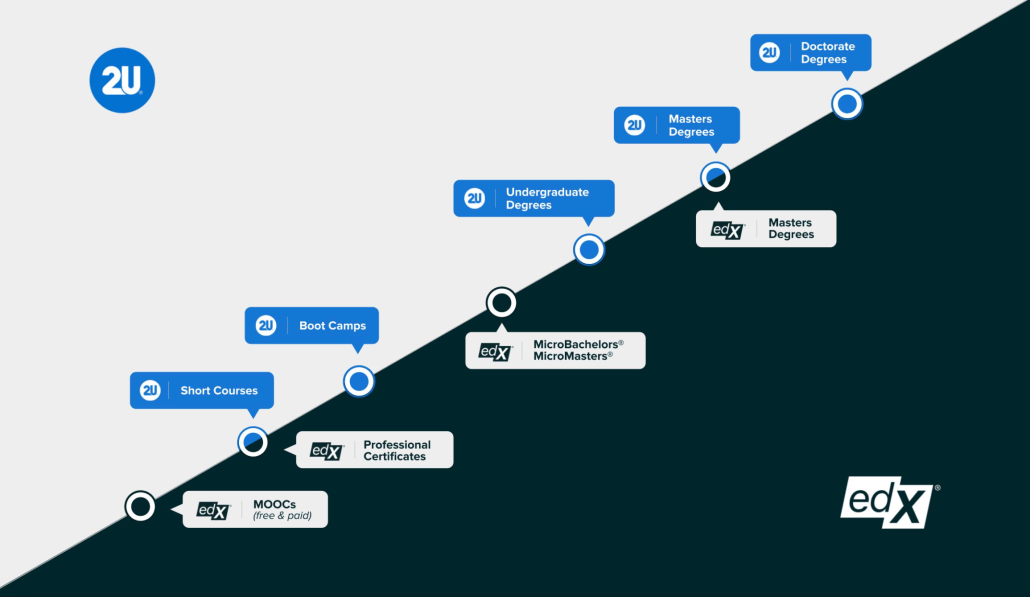
    2U’s sales and marketing ladder (h/t Phil Hill)

    The irony is so thick you can cut it with a knife. OPMs came into being in the first place precisely because universities with neither the start-up capital nor the skillset wanted to build large revenue-generating online programs. The classic model was to turn everything over to the OPM in return for half of the (new) revenues. The first OPMs grew out of LMS hosting companies like Embanet. (This was back in the days before cloud-hosted LMSs.) An acquaintance who worked at one of these companies back then called it the “deans gone wild” period.

    The hosting company would get approached by a dean who would say, “Hey, I want to build an online graduate program but I don’t know how to do that. Can you do it for me?”

    “Uh…suuuuuure. We can, um, do…that.”

    “Great! One more thing. My president doesn’t know I’m doing this and I don’t have any money.”

    “Oh. Uhhh…I guess we could…hmm…we could cover the up-front costs. In return, we’d need to take, say, 50% of the revenues for 10 years. OK?”

    “Deal!”

    That’s not an exaggeration. It’s more or less the way that the OPM industry came to be.

    In the early days, some universities didn’t even provide faculty. All they supplied was their brand. And as you might imagine, the results were often pretty bad, educationally, financially, and reputationally.

    Over time, OPMs slowly improved as the market became more competitive and high-profile failures drove universities to provide more oversight. 2U made its name by taking the product category upscale. Programs they helped create generally made money and provided educational experiences that their customers’ faculty senates would sign off on. In the process, the company was able to sell its services to more prestigious universities and build deeper institutional relationships. Since then, OPMs have diversified their business models quite a bit, to the point where it’s hard to make any generalizations about them.

    But these two polar paradigms, represented respectively by the origins of EdX and the origins of the OPM product category, are the two dominant models we have for driving the digital transformation of education. Neither works very well. Either the university acts like a business and often (but not always!) fails or the university outsources its functions and often (but not always!) gets heartburn from the deal at some point. I can point to examples of one, the other, or both happening with LMSs, SISs, and digital textbooks, to name a few EdTech product categories. Each situation was different because the contexts were different. But the models and the mindset continue to drive thinking about EdTech.

    We can do better than this. We need new models.

    I’ve beaten up on MIT and Harvard pretty hard here, but the main mistake they made was when they founded EdX in the first place. It was a knee-jerk reaction, laced with hubris, that was overwhelmingly likely to end up in one of two ways: obscurity or controversy. If these universities are genuinely worried about the future of education, whether their concern is unbridled commercialization or impact at scale, then they need to be better, smarter stewards. Their reaction to the imminent formation of Coursera could have been more thoughtful, realistic, and strategic. Their effort to clean up the mess they’ve made still can be.

  • Blursdays Restart with John Whitmer (9/2) and Michael Berman (9/9)

    Blursdays Restart with John Whitmer (9/2) and Michael Berman (9/9)

    After taking most of August off, Blursdays are back!

    Today we’ll be visiting again with our friend John Whitmer. John, as you may know, is a guru on various topics from AI to learning analytics to efficacy studies. He’s currently at the Federation of American Scientists, where he gets to consult on all kinds of interesting projects. Before that, he worked at ACT, Blackboard—where he was affectionately referred to as “Dr. John”—and the Cal State System. I’m interested in talking to John about how we should think about AI in EdTech. This is part of a larger conversation I want to cultivate around goals, guardrails, and guidelines that should ultimately lead to some institutional policy and practice recommendations.

    RSVP for John’s session on 9/2 at 4 PM ET.

    Speaking of the Cal State system, next week we’ll have Michael Berman, CIO of that hallowed university system. Michael is a classic example of a Blursday guest that you absolutely should know but may not if you don’t hang in the right circles. He has had a wide range of experiences that give him great perspective. And he’s fun to talk to. I’m curious to get his perspective on this “new normal” that we’re all trying to anticipate, but the conversation could go anywhere.

    Michael Berman

    RSVP for Michael’s Blursday session on 9/9 at 4 PM ET.

    The 9/16 Blursday is going to be a surprise. If you’ve been paying close attention to my comings and goings (and my LinkedIn feed) you may have some intimation of what it’s going to be about.

    That’s all I’m gonna say.

  • Textbook and Chill?

    A Simple, Post-Consumer Model for (Real) Education

    Education is an interactive experience.

    The wave of consumerization of education is arguably several decades old now. To my view, there are two prevailing themes of that consumerization: 1) the idea of student-customer who is therefore “always right” and deserves guarantees of certain outcomes like employability and ROI, and 2) the idea that knowledge is a consumer-good.

    Certainly, we have seen significant changes in the attitude institutions take toward their students with respect to life goals like employability. My own alma mater now offers an incredibly robust set of programs that start early in the college experience-including internships, sponsored projects, and career counseling. A stark contrast to the sparse, non-proctored library of leaflets and files during my time there.

    But it is the second theme that I want to address here, because I believe we are at an important inflection point in the industry.

    Knowledge As Consumer Good

    One thing I learned early on in my tenure at publishers is that students will only spend money on curricular materials that they believe will help them get the grade they want. The patterns were extremely clear and consistent: first years tended to buy new versions of all recommended materials, and that behavior shifted with time and experience to be more selective and price sensitive. Over the last decade, the entire pattern has changed with reduced information asymmetry and changing student preferences.

    More used, more digital, less cost, please.

    The early efforts by Chegg and Amazon to make a hyper-efficient market for used textbooks generated marketplaces of used and rental textbooks, both physical and digital. Since then, those markets have evolved into something vastly different, while they continue to offer those textbooks. On-demand “homework help”, access to reams of essays and other “aids” for getting the grade I want are the dominant value propositions.

    Inevitably, the primary producers of those textbooks made moves to offset the real economic and product model threat posed by those markets. Branded rental programs and early online shopping sites have now given way to all-you-can-read subscription services, modeled not so loosely after Disney+, Netflix, Spotify, and other media aggregators.

    All of these strategic and tactical moves, some by disruptors, others by incumbents, focus on the idea that learners are consumers. From a certain product-market-fit perspective, it’s spot on: price, selection, on-demand, any device, anywhere.

    And it is highly transactional in nature, it ends with distribution.

    Textbook and chill, bro.

    Is That Good Enough?

    The trend toward consumerization begs several questions:

    What are we trying to learn?

    How are we going about it?

    What are we learning about how we are going about it?

    And I’ve got more questions:

    Could we do it better?

    Could we do it more cost effectively?

    We can, we should, we must.

    A Post-Consumer Model for Education

    Here is my simple proposal for a Post-Consumer Model for Education:

    Instructor Led

    Education is an interactive experience. Live educators help guide and curate the learner through the process. Asynchronous video is great for mass distribution, and it is not an adequate substitute for the real thing. Blending the fantastic affordances provided with digital tools and live/hybrid instruction creates greater value for both the learner and the educator.

    New Models for Assessment

    Education is an interactive experience. Research is increasingly convincing about massive gains made by learners who engage in project-based, experiential, and authentic learning and assessment. Online robo-graded homework is great for mass distribution, it has also lost the battle against the “study aid” sites. It is increasingly easier and cheaper to create newer, for more effective kinds of learning and assessment models at scale. Educators should have broad access to use them.

    Intentional Design

    Education is an interactive experience. The burst of demand for instructional/learning designers on campuses and in corporate settings is a powerful indicator that the existing courses and design models are lacking. Designing pure-play and hybrid digital learning experiences in ways that specifically engage the learner and provide the educator the powerful advantages of data-informed teaching create far more value than your typical off-the-shelf and rigid courseware.

    Agile Design

    Education is an interactive experience. It should not be sufficient to claim victory with a well-designed digital learning experience. We live in an age where many industries and business focus on rapid upcycle to improve their goods and services. Yet the learning industry seems stuck on 4+ year course redesign and textbook revision cycles. Designing digital learning experiences specifically to conduct A/B testing and upcycling at least term to term should be the new normal.

    Measurable Across the Learner Journey

    Education is an interactive experience. It should not be sufficient to capture assessment grades from various digital interactions, especially those “aided” by “study sites”. Incredible amounts of learner activity data are exhausted into the ether in the existing learning experiences on campus today. Learners move from their LMS, to a variety of disconnected digital experiences, with little coherence or understanding of the learning moments being captured. If we want to achieve scaled improvement in how we deliver digital teaching and learning, we need to design, deliver, and measure across the entire learning journey.

    A Dialogue and Collaboration

    We are interested in your thoughts and ideas for how we can collectively progress the art and science of technology-enabled teaching and learning. Please contribute here and stay tuned for much more discussion and interaction!

  • AI, Cheating, and Faking It

    The reaction to my last post—AI, Cheating, and the Future of Work—was mixed. Some readers who have data science backgrounds seemed to like it and think it’s funny. Folks from outside that circle tended to shrug and move on.

    The thing is, my analogy between cheating and artificial intelligence was meant to be taken both seriously and literally. For a layperson, one good way to think about artificial intelligence (AI) and particularly machine learning (ML) is to make analogies to cognitive shortcuts that humans use. Like all analogies, this one is imperfect. But it’s a helpful first approximation.

    Have you ever been in a conversation where you only half understood what was being talked about? Maybe the room was noisy. Maybe the other person had a heavy accent. Maybe the subject was one that you didn’t understand as well as the other person.

    Perhaps, for whatever reason, you decided not to let on that you were only getting bits of the conversation. Maybe you didn’t want to embarrass yourself. Or the other person. Maybe you didn’t want to interrupt the conversational flow. Or you could have believed you had understood enough to make fairly confident guesses at the gaps in your understanding.

    How did you manage to keep up your side of the conversation? What strategies did you employ? Usually, we’re drawing on whatever context we can. Who is this person? What is the general topic of the conversation? Why are you talking about it? What might this person know about it? What is the person’s body language telling you about the reaction they expect? (“Is this the punchline of a joke? Should I laugh?”)

    We can be very good at faking understanding in various situations. Except when we aren’t. Sometimes we guess hilariously and/or disastrously wrong. You’ve probably been on the other side of such a conversation and suddenly been surprised when the person you are talking to responds with a non sequitur or a wildly inappropriate reaction.

    This is one way to think about what ML and AI algorithms do. They fake understanding by employing strategies that make inferences from available information and context. Of course, I anthropomorphize the algorithms when I say they “fake understanding.” It would be more accurate to say they “simulate” understanding. But even that’s not right, especially in ML. These algorithms are designed by humans to implement problem-solving strategies. Some of the strategies look a lot like the ones that humans use while others look almost nothing like human cognitive strategies. Regardless, when we try to apply these algorithms to produce human-like results in a problem-solving situation, the output can seem similar to humans faking it or students cheating. Particularly with AI chatbots, we can see a mix of uncanny accuracy and bizarre mistakes.

    Credit: Chatbot Life

    This explanation is not deep enough to help educators make judgments about when and how to trust specific ML- and AI-based tools. To do that, they would need to understand a bit about the specific strategies that a given tool is employing, the kinds of mistakes it is prone to make, and the educational impact of those potential mistakes.

    But it does provide a starting point. If we’re going to continue using the phrase “artificial intelligence” in a layperson’s context, then we need to start finding analogies that laypeople can understand. Humans cheating or otherwise faking understanding seems like one good place to start.

  • AI, Cheating, and the Future of Work

    AI, Cheating, and the Future of Work

    The Times Higher Education (THE) is out with a piece titled “Does AI Spell the End of Education?” The promotional blurb explains further,

    Artificial intelligence will soon be able to research and write essays as well as humans can. So will genuine education be swept away by a tidal wave of cheating – or is AI just another technical aid that teaching and assessment will evolve to take account of? John Ross reports[.]

    Does AI Spell the End of Education?

    This is an excellent article. I don’t mean that it is insightful or well-written. While it has its moments, overall, it’s an unenlightening mess wrapped in clickbait packaging. It is not good writing or good journalism.

    But it is a near-perfect illustration of how the popular representations of both artificial intelligence (AI) and cheating can be harmful. ((The THE article also completely elides the difference between artificial intelligence (AI) and its cousin machine learning (ML). This is forgivable because the reader doesn’t need to understand the difference for the purpose of the piece. I’m not going to delve into the distinction in this blog post for the same reason. But I’m aware there is one. When I refer to AI, please read that as shorthand for the larger family of AI and ML techniques.))

    It also shows a way for educators to understand AI better because AI and cheating sometimes work in similar ways. I will explain the parallel in this blog post. In the process, I will also argue that framing cheating in the context of “academic integrity” is harmful. And I will argue that all of these misunderstandings are counterproductive to preparing students for the future of work.

    People who cheat are not “cheaters”

    As you’ve probably figured out by now, I’m going to treat the THE article harshly. I’ll try my best to avoid the oh-so-tempting cheap shots. (The original working title for my post was “Does AI Spell the End of Education Journalism?”) The deeper problem at the heart of this article deserves serious treatment. I’m going to argue that “Does AI Spell the End of Education” is an example of journalistic “cheating.” In the process, I’m going to take a somewhat unconventional position on what it means to “cheat.” That position is relevant not only to how AI is used in the classroom but also to how we should think about AI and knowledge work and to how we should think about so-called “academic integrity.” 

    As part of that reframing, I want to be very careful to separate judgments about the writing from ones about the article’s writer, John Ross. I don’t know the man. I also don’t know the assignment he was given that led to him producing this article. I have no opinion of him as a writer or a human being. I only have opinions about the quality of this piece and the writing process that led to it. 

    I define “cheating” as “engaging in behaviors that are intended to facilitate passing without learning.” This definition avoids passing a blanket judgment on the person engaging in the behavior. It doesn’t accuse them of lacking “academic integrity.” It simply identifies behaviors that facilitate students getting good grades—which in the workplace we might call “scoring well on key performance indicators (KPIs)—without actually doing the hard thought work necessary to complete the assignment as intended. Any scoring system can be gamed. People game scoring systems for all kinds of reasons. One might be pressure. Perhaps a student wants to learn but needs to pass. Or a journalist wants to write an insightful piece but needs to complete a hugely ambitious assignment with an unrealistic deadline or word count limit. Sometimes we engage in sloppy or lazy shortcuts not because we are sloppy or lazy people but because we feel forced to do so by the circumstances. Whether in the classroom or the workplace, our primary focus should be on reducing the incentives to game the scoring system rather than on punishing “cheaters” for their lack of “integrity.” 

    From here forward, I will distinguish between John Ross, the human author of “Does AI Spell the End of Education?”, and the mental algorithm he employed to write this piece, which I will call Journobot 2000. These two are not the same. John Ross may very well be a smart guy. Journobot 2000 is a set of mental shortcuts that John Ross employed to avoid the hard work of thinking and learning when writing parts of his article. It does not understand AI, cheating, or the teaching of writing. It is capable of assembling passages about such topics in ways that sound coherent. It can even fool some intelligent readers into thinking that its output reflects some understanding of these topics. But Journobot 2000 does not understand anything. It is simply a sophisticated pattern-matching algorithm that can copy/paste in interesting ways and employs a souped-up thesaurus to rephrase sentences. 

    Journobot 2000 is a cheating strategy. It enables a writer under pressure to produce an article that sounds coherent without forcing that writer to invest the time necessary to understand the subject. When students employ Journobot 2000—which many do—they do not learn. When knowledge workers do the same, they do not perform useful knowledge work. 

    Knowledge work and learning are the same. Knowledge workers solve novel problems. How do they do that? By learning. Learning, in turn, requires thinking. Shortcuts that reduce drudge work are fine, but ones that reduce thought work are dangerous if your work requires you to think and learn.

    Writing as collage

    Journobot 2000 has assembled a series of quotes and facts related to the topics of AI, writing, and/or cheating in some combination. Before we analyze how it does this, let’s look at a few of the individual quotes from interviewees that appear in the article. I’ve arranged these out of order from their placement in the article for a specific reason. Think about each of these passages on its own and consider which issue or issues each speaker is concerned about. 

    I’ll provide fairly extensive quotes from every person to provide the flavor of their concerns. The first passage quotes Lucinda McKnight, a senior lecturer in pedagogy and curriculum at Deakin University:

    “How do we prepare teachers to teach the writers of the future when we’ve got this enormous fourth industrial revolution happening out there that schools – and even, to some extent, universities – seem quite insulated from?” McKnight asks. “I was just astonished that there was such an enormous gap between [universities’] concept of digital writing in education and what’s actually happening out there in industry, in journalism, business reports, blog posts – all kinds of web content. AI is taking over in those areas.”  

    McKnight says AI has “tremendous capacity to augment human capabilities – writing in multiple languages; writing search engine-optimised text really fast; doing all sorts of things that humans would take much longer to do and could not do as thoroughly. It’s a whole new frontier of things to discover.”

    Moreover, that future is already arriving. “There are really exciting things that people are already doing with AI in creative fields, in literature, in art,” she says. “Human beings [are] so curious: we will exploit these things and explore them for their potential. The question for us as educators is how we are going to support students to use AI in strategic and effective ways, to be better writers.”  

    And while the plagiarism detection companies are looking for more sophisticated ways to “catch” erring students, she believes that they are also interested in supporting a culture of academic integrity. “That’s what we’re all interested in,” she says. “Just like calculators, just like spell check, just like grammar check, this [technology] will become naturalised in the practice of writing…We need to think more strategically about the future of writing as working collaboratively with AI – not a sort of witch-hunt, punishing people for using it.”

    Does AI Spell the End of Education?

    That’s interesting. I agree with some of McKnight’s comments and have questions about others. For example, there’s an enormous difference between writing search-engine-optimized (SEO) text really fast and writing informative and well-written SEO text really fast. What is the relationship between the tool and the knowledge worker here? I have an SEO tool in my blog. It hates my writing. The feeling is mutual. If I followed its recommendations slavishly, I would have many more people coming to my site and many fewer reading it. 

    For now, the takeaway is that McKnight is interested in teaching students about how they might use AI text generation tools in the workplace. Let’s save further exploration of this line of thinking for later in this piece.

    The next person in the article whose concerns I’d like to explore is Dr. Jesse Stommel, Digital Learning Fellow and Senior Lecturer of Communication and Digital Studies at the University of Mary Washington. Stommel is concerned about anti-plagiarism software. Here is how he is quoted: 

    “They have data about student writing,” he says. “They have data about how student writing changes over time because they have multiple submissions over the course of a career from an individual student. They have data where they can compare students against one another and compare students at different institutions.”  

    The next step, Stommel argues, is the development of an algorithm that can capture “who my students are, how they grow, if they’re likely to cheat. It’s like some dystopic future that is scarily plausible, where instead of catching cheaters, you are suddenly trying to catch the idea of cheating. What if we just created an algorithm that can predict when and how and where students might plagiarise, and we intercede before they do it? If you’ve seen Minority Report or read Nineteen Eighty-Four or watched Metropolis, you can see the dystopic place that this will ultimately go.” 

    Does AI Spell the End of Education?

    Stommel is focused here on student data privacy, which can be a critical issue of certain applications of both AI and non-AI EdTech. While I don’t agree with his assessment regarding the plausibility of his nightmare scenario, I completely agree with the concern he is highlighting and would like to see it unpacked and explored. I could easily write an entire long post explaining which fears are realistic and why or why not. Notice, though, the concern Stommel expresses here isn’t about text generation tools or even AI specifically.  

    The third quote from the article that I’d like to highlight is from Andrew Grauer, CEO of Course Hero. He said,

    “I’ve got a blinking cursor on my word processor. What a stressful, inefficient state to be in!” he says. Instead, he could use an AI bot to “come up with some kind of thesis statement; generate some target topic sentences; [weigh up] evidence for a pro and counter-argument. Eventually, I’m getting down to grammar checking. I could start to facilitate my argumentative paper.”

    Does AI Spell the End of Education?

    This, too, is interesting and worth exploring. When is this sort of support scaffolding that helps students learn, and when is it a crutch that helps them avoid learning? I did write about this topic as part of a larger post on scaling the digital seminar and could easily write more about it. 

    Grauer’s quote does seem related to McKnight’s. They’re both interested in how AI can scaffold writing. When John Ross interviewed people for the article that would eventually be named “Does AI Spell the End of Education?”, he did seem to probe his interviewees to foster a genuine dialog on this aspect of the article. He even introduces a quote from Turnitin’s Chief Product Officer Valerie Scheiner that acts as connective tissue between the two others. Here’s her relevant passage: 

    Turnitin is now using AI to give students direct feedback through a tool called “Draft Coach”, which helps them avoid unintentional plagiarism. “‘You have an uncited section of your paper. You need to fix it up before you turn it in as a final submission. You have too much similarity [with a] piece on Wikipedia.’ That type of similarity detection and citation assistance leverages AI directly on behalf of the student,” [Scheiner] says.

    But the drawing of lines is only going to get more difficult, she adds: “It will always be wrong to pay someone to write your essay. But [with] AI-written materials, I think there’s a little more greyness. At what point or at what levels of education does using AI tools to help with your writing become more analogous to the use of a calculator? We don’t allow grade-three students to use a calculator on their math exam, because it would mean they don’t know how to do those fundamental calculations that we think are important. But we let calculus students use a calculator because they’re presumed to know how to do those basic math things.”

    Schreiner says it is up to the academic community, rather than tech firms, to determine when students’ use of AI tools is appropriate. Such use may be permissible if the rules explicitly allow for it, or if students acknowledge it.

    Does AI Spell the End of Education?

    This seems to be a direct response to McKnight’s quote while nodding at some of the ethical issues raised elsewhere the piece. The most interesting part of “Does AI Spell the End of Education?” is the tension—and arms race—between text generation tools and plagiarism detection tools. 

    But the piece never quite manages to fully focus on this dilemma. It’s weirdly fragmented. There’s a one-sentence reference to “word spinners,” which are text paraphrasers that can be used to disguise plagiarism. But Ross never follows up on this angle, despite the fact that it fits perfectly with the dialog on text generation he’s assembled with the quotes from McKnight, Grauer, and Scheiner. Instead, he just supplements that one-sentence mention with a link to an article about word spinners on Turnitin’s web site. And then there’s Stommel’s quote, which is stuck in the middle of the piece and doesn’t seem directly related to the rest of the narrative. Student data privacy is not raised either before or after. The quote is just…there. 

    Why?

    The answer is that John Ross, the human writer, cheated. This article seems like the result of a reporter who has interviewed a range of experts on the topic of AI in education as part of an effort to understand and report on the issues.

    But it isn’t. 

    Several interviewees told me that they were interviewed months ago on topics other than AI and the teaching of writing. One of them, Jesse Stommel, went on record for me on this topic. He told me that he was originally interviewed about Turnitin’s acquisition of one of its competitors. While he does not object to authors using his quotes in other articles, he said, “[M]y quotes were not direct reflections on AI.” In fact, AI did not even come up in his interview. 

    When read with this in mind, the article makes much more sense. The most coherent parts of the writing were on threads that would have fit in the context of an article on Turnitin and anti-plagiarism software. The parts that get messy are precisely those where John Ross’s original research on a Turnitin story did not line up well with the purported topic of the article. For example, Stommel’s quote would have fit more naturally in the anti-plagiarism software piece because he was voicing concern about how anti-plagiarism software uses student data. 

    When John Ross decided to use some of the material from his original, never-published piece on Turnitin, he could have gone back to Stommel and asked him for questions that would have been directly relevant to the AI article. But he didn’t. Why not? I don’t know. Maybe he was lazy. Maybe he was under time pressure. Maybe his editors wanted something particular from him. I’m not going to judge the human being based on one article.

    But I am going to judge his work on the article itself. For whatever reason, Ross fired up Journobot 2000. Rather than conducting further research, he took what he had already from a piece on another topic. He rearranged the pieces to look like they had always been intended to be parts of an article on AI. Journobot did so by following a simple pattern that I’ll analyze in the next section. 

    This is remarkably like the strategy students take of plagiarizing an essay on a similar topic to the one they’ve been assigned and then rearranging it to try and make it fit. The only difference is that he was plagiarizing himself. The problem here isn’t taking somebody else’s thoughts and claiming them as your own. It’s claiming to have thought about and analyzed a topic when you haven’t.

    When students do this sort of thing, we call it “cheating.” It results in them failing to think and learn. When journalists do it, we call it “lazy journalism.” It results in messy articles that fail to enlighten the reader. More generally, when knowledge workers do it…well, we don’t have a specific name for it, but it results in low-quality work. 

    In data science, we call it “artificial intelligence.”

    What cheating looks like

    Journobot 2000 does not understand the relationship between Jesse Stommel’s data privacy concern and AI. It’s matching two kinds of patterns. First, since this is an article on a controversial topic, it represents controversy by alternating between quotes with positive sentiment scores and ones with negative sentiment scores. It’s simulating point/counterpoint. John Ross, the human journalist, could have chosen to leave out the hyperbolic end of Stommel’s quote and focused instead on the underlying concern. Journobot 2000 likely found that quote to fit its pattern-matching algorithm precisely because of the ending, which expresses a strong negative sentiment about something related to the topics at hand. It also knows how to write transitional phrases so that one passage appears related to the next.

    Speaking of which, Journobot 2000 knows that anti-plagiarism software, AI, cheating, and writing are related topics. It organizes the quotes in ways that show relatedness among the topics. Because it doesn’t really understand the topics the same way humans do, a careful reader can see the seams where the piece doesn’t really hold together. But a casual reader might not notice that Stommel’s quotes have been spackled into places where they only loosely fit with the analysis that comes before or after. He’s not really part of the dialog in the same way that some of the others were. 

    Likewise, there’s that largely unutilized reference to word spinners. In an article about Turnitin, the topic might have only made sense to mention as one of many aspects concerning the company and its acquisition of a competitor. But in an article about AI potentially ending education, word spinners should have received significant attention. John Ross might have seen that and researched accordingly. Journobot 2000 did not make the connection.

    Let’s pick up on a couple of the threads missed by Journobot 2000 to get a sense of the article that could have been if John Ross had applied the same level of attention that the archeological evidence in his published piece suggests he put into the original, unpublished version.

    Articles written by actual machines

    Let’s start with the wonders of machines writing articles. You have almost certainly read articles written by a machine. For example, if you follow stocks, you may have already learned to recognize the articles written by bots. Imagine a massive drop in the stock price of a biotech stock because they had bad clinical trial results. You might read a perfectly well-written financial news story in your inbox, telling you all about the technical indicators on the stock price, complete with a headline suggesting the article will provide insight as to whether to buy or sell…but no mention whatsoever of the news that drove the price move. The technical analysis is data-driven and seems perfectly cogent. The writing has just a dash of colorful language, suggesting the barest hint of a simulated authorial voice. If you didn’t know about the news, it would seem normal. But it’s not really a financial analysis news piece. It’s a data analytics report written in narrative form with a formulaic headline tacked on the top. The machine doesn’t really understand the topic it’s writing about. 

    In this example, there may be little to no actual artificial intelligence involved in the writing. A human might have written a template covering the topic of a certain type of stock movement. The software fills in the data. It has been provided with a handful of colorful phrases to substitute for different common phrases. “The stock took a nosedive.” “The stock tanked.” “The stock plummeted.” These can be interchanged randomly to create the appearance of an author behind the piece.

    Genuine AI can generate original writing using a family of techniques called Natural Language Processing (NLP). A particular product called GPT-3 produced by a company called OpenAI is getting most of the buzz right now, but there are others. It can produce uncanny writing. By which I mean writing that falls in the uncanny valley. It’s writing that seems sort of human but not quite. The result is weird and sometimes creepy. (To get a delightful sense of just how weird and creepy, read Janelle Shane’s blog AI Weirdness. And then read her book, You Look Like a Thing and I Love You: How Artificial Intelligence Works and How It’s Making the World a Weirder Place.)

    A recent article on NextWeb, “Don’t mistake OpenAI Codex for a programmer,” is illustrative. It’s all about how the Microsoft-owned Github software repository platform took a highly customized version of GPT-3 and trained it to write computer code. The idea is that if GPT-3 can learn English, then it should be able to learn Javascript. Programming languages are languages, after all.

    A good part of the article is devoted to the No Free Lunch Problem, “which means that generalization comes at the cost of performance. In other words, machine learning models are more accurate when they are designed to solve one specific problem. On the other hand, when their problem domain is broadened, their performance decreases.” Even an enormous, computationally expensive, state-of-the-art AI program like GPT-3 is mediocre at performing a wide range of tasks. Developers invest enormous time and energy tuning it to do one thing really well. And even then, “really well” isn’t always…um…all that well. Here’s the money quote from the piece:

    In their paper, the OpenAI scientists acknowledge that Codex “does not sample efficient to train” and that “even seasoned developers do not encounter anywhere near this amount of code over their careers.”

    They further add that “a strong student who completes an introductory computer science course is expected to be able to solve a larger fraction of problems than Codex-12B.”

    Don’t mistake OpenAI Codex for a programmer

    While I don’t know how much money Microsoft spent on developing Codex, I’m confident it cost at least several orders of magnitude than the typical EdTech AI. And yet, it can’t match a first-year computer science undergraduate. 

    Why not? The piece goes into some technical detail, but it boils down to the fact that today’s AI still has some sharp limitations relative to humans when it comes to problem-solving. It can’t hold as many relevant facts in its “head” as we can. It doesn’t match patterns in the same way. It’s not as good at catching nuances of meaning in language and relationships among ideas. While the progress being made in AI today is miraculous, it’s not biblically so. It’s not magic. If one of the most expensive and technologically advanced algorithms in human history can’t match a first-year college student, then we should probably let go of the breathless hyperbole about AI “ending education” for a while.  

    Rather than employing Journobot 2000, John Ross could have engaged his full human faculties as a learner, thinker, and knowledge worker to engage with the purported topic of his article. He has many of the raw ingredients for something genuinely interesting. But he didn’t take the time to follow the threads.

    Word spinners are another example. 

    Spinning words

    John Ross’s article mentions “word spinners”—tools that rewrite sentences using AI—as cheating tools to get around plagiarism detectors. But it doesn’t name any or explore the topic in detail. The most he does is link to an article about word spinners on Turnitin’s website (which is probably another artifact of the original article). 

    In the absence of John Ross’s due diligence, I conducted a little of my own by employing an advanced AI research tool called Google. It turns out not all word spinners are the same. For example, Rewriter Tools Article Spinner all but explicitly advertises itself as a tool that is designed for cheating:

    Today, almost everything is done online – including work assignments, student essays, and anything else you can think of. As a result, a large amount of written work also has to be done online.

    The problem is that so much has already been written about pretty much everything, that creating completely new and unique content is quite difficult. Not to forget, also time-consuming and rather tiring, too. As a result, many people get confused and frustrated while trying to create unique content.

    Do you want to create original, fresh content but are pressed for time? Rewriting a document to make it unique is not always an easy task. This is why we present you with Article Spinner – the perfect to help you create fresh content in very little time.

    Probably some bot

    Ladies and gentlemen, welcome to the future of knowledge work! Papers that are badly rewritten by a tool created by a bad writer because thinking is too hard and who has original ideas anymore anyway?

    The future of work?

    On the bright side, their search engine optimization algorithm must be good because this text put them near the top of my search results page. 

    Quillbot, on the other hand, positions itself as a tool that helps writers tune their language to their audience:

    Your words matter, and our paraphrasing tool is designed to ensure you use the right ones. With 3 free modes and 4 premium modes to choose from, QuillBot’s paraphraser can rephrase any text in a variety of different ways, guaranteeing you find the perfect language, tone, and style for any occasion. Just enter your text into the input box, and our AI will work with you to build the best paraphrase from the original piece of writing.

    A slightly more sophisticated bot

    Is that better than Article Spinner? I think it may be worse. First, it appears to be more sophisticated at rephrasing other people’s work. When McKnight talks about the Fourth Industrial Revolution and AI helping humans do their jobs better, I don’t think she means AI helping college students take pieces written by somebody else and paraphrasing them in varied ways to pass a plagiarism detector. 

    Siri, make this plagiarized essay sound more friendly.

    Second, again, I’m having a hard time coming up with legitimate use cases that aren’t just shortcuts to avoid thinking. I use a grammar checker that makes style suggestions—more on that momentarily—but it doesn’t wholesale rewrite for me. Instead, it highlights choices that I can make as a knowledge worker. Quillbot calls itself a “paraphraser.” (Side note: Judging from the text on both sites, I’m guessing that “paraphrase” may be a good SEO term for both products.) Maybe there are some legitimate uses for a tool that can quickly paraphrase a longer document. If I write a follow-up post to this one, I may try using it on a previous post to see if anything useful comes out. 

    Then there are grammar checkers, which are mentioned but—again—never explored in “Does AI Spell the End of Education?” I use Grammarly Premium regularly. In fact, I am using it right now. It helps me catch mistakes and write clearer, punchier prose. Even though I am a pretty good writer, Grammarly improves almost everything I write (when I use it). But it is only useful to me because I know when—and why—I should ignore or overrule its suggestions. If I were to ask students in a writing class to use it, I would have to teach them to do the same. The problem is that I don’t know how Grammarly works. I can’t teach students how to anticipate all the mistakes it might make. 

    This is particularly true with students who have language patterns that Grammarly might not anticipate. For example, second-language learners whose native language is Chinese or Russian may write English sentences that drop certain types of words (like articles or pronouns), mix up verb tenses, mess up idiomatic expressions, and change the word order. And even fluent second-language learners may make mistakes that the grammar checker won’t diagnose correctly when the writers are stressed, such as when they are trying to express difficult ideas while writing under time pressure. In combination, these problems could confuse a grammar checker and cause it to make a bad suggestion. 

    As a result, I would have to think hard about whether, when, and how to use Grammarly as a teaching tool, even if I believed it would help most students improve their writing the majority of the time. As a writing teacher, my job isn’t to get students to produce better writing. It’s to teach them how to be better writers. As a writer, while I use Grammarly to help me edit my text more quickly and effectively, I also use it to help me make mindful decisions about when to break the rules. Good writers balance clarity against expressiveness all the time. Sometimes I override Grammarly not because its suggestion is wrong but because I have chosen to write a more challenging sentence to read to communicate a challenging idea more effectively. 

    I would have liked to read a researched article on this topic. I suspect John Ross could have written it. Journobot 2000 cannot.

    The bottom line

    The future of work is knowledge work. Knowledge work and learning are the same. Therefore, if we want to prepare students for the future of work, we need to teach them how to think and learn. Cheating is behavior intended to achieve a passing grade without learning. Cheating is bad because it leaves students ill-prepared for the future of work (not to mention for life). Tools or strategies that help knowledge workers (including students) avoid mindless work are probably good more often than not. Tools or strategies that help knowledge workers avoid thought work are probably bad. More often than not. 

    “Does AI Spell the End of Education?” raised (but did not explore) authentic assessment as one way out of the cheating problem. While I’m a fan of authentic assessment, the article itself is proof that it is not a panacea. Because it is, in fact, an authentic assessment of John Ross’s writing. As a writing portfolio artifact, the piece shows that the author could pass, i.e., get his article published, without learning anything new about the promise and perils of AI in education. 

    Many decent educators have faced the challenge of trying to break students out of algorithmic behaviors that have enabled them to pass without learning, whether the behavior is writing a robotic five-paragraph essay or memorizing physics equations without understanding them. If cheating is the set of behaviors designed to succeed without learning, then these behaviors, which have been taught to students as perfectly appropriate, are cheating just as much as copying somebody else’s answer is. It matters in the classroom, it matters in the workplace, it matters in the home, and it matters in the ballot booth. I hope the next article I read about AI and cheating will be about applying AI to solve that problem. 

  • Is the edX Acquisition a Big Deal?

    Is the edX Acquisition a Big Deal?

    I’ve been inundated with questions regarding what I think about 2U’s acquisition of edX. What do I think? I’ve been struck by how much less I care about this deal today than I would have a few years ago. That change is entirely due to my change in focus rather than external circumstances. e-Literate used to be, in part, an EdTech industry analysis site for its own sake. While I still do some EdTech industry analysis, I’m much more focused on how EdTech influences the direction of the education sector as a whole, particularly with regard to becoming more effective at sustainably helping more students. Due to that shift in perspective, the edX acquisition moves from “a huge deal” to “somewhat interesting” for me.

    How much you should care about the edX acquisition depends on what you care about. So I’m going to write about that.

    Who cares about the edX acquisition?

    You can learn a lot about whether you, personally, should care about the acquisition by looking at who else cares and why. It’s a little early to answer this question entirely; I’m asking around at the moment. But we do have some early obvious answers.

    MIT and Harvard

    First of all, MIT and Harvard care. On one hand, edX was a money loser. Most EdTech companies are. They lose money for a very long time and then only become slightly profitable. Investors can be OK with this if “slightly profitable” is also “reliably profitable.” They can take a long view, in a way. I say “in a way” because many types of investors that put money into an EdTech company on its way to profitability sell their stakes long before their investments achieve their goal. As long as a critical mass of investors believe that these companies will eventually be profitable, then one investor may well be willing to buy a stake in an unprofitable company from another.

    On the other hand, universities aren’t in that game in the same way. As far as I’ve been able to piece together, edX was rushed out the door to get ahead of the imminent launch of Coursera. It wasn’t a strategy. It was a reaction. It was also a money loser. According to Tech Crunch, “The institutions, of course, have thrown in a cumulative $80 million in donations into edX to keep the operation free.” That’s a surprisingly shallow and naive assessment from a publication that’s all about tech companies. ((I also think their contribution number is low, but it’s hard to find hard data.)) First, edX fees to students (or lack thereof) have more or less aligned Coursera’s. Second, both edX and Coursera are two-sided markets. While edX ultimately makes its money off of student purchases, it does so via a revenue share agreement with the universities, which, once again, is not terribly different from Coursera’s revenue share agreement. The basic idea in both cases is to be the Amazon of MOOCs. Get everyone to sell everything through your storefront. Collect a small dollar amount (but a large percentage) of each transaction as your fee. Attract enough customers so that the small dollar amounts add up over time. To the degree that edX had a business plan beyond “do whatever Coursera does,” this was it. It wasn’t obvious that edX would be an asset they would ultimately sell. Their external justifications for edX were always mission-related. Since I have only been able to gather fragments of information about their internal deliberations over the year, I’ll take them at their word on that. I don’t know the degree to which they understood that their commitment entailed losing money every year for the long haul.

    When 2U swooped in, that gave MIT and Harvard an opportunity to get out of that money trap, declare victory, and make a handsome return on their investment. If Tech Crunch’s numbers are right, then the two universities made 10X on their 9-year investment. Is that good? It depends on your perspective. VCs generally look to make a 10X return in five years, and I suspect that those numbers may be less ambitious in EdTech specifically. For MIT and Harvard, I suspect it was a massive unexpected windfall that got rid of some problems and created some opportunities for them.

    2U

    Obviously, 2U wouldn’t have forked over $800 million—in cash—if they didn’t think edX would be a big deal for them. Why? Phil Hill writes:

    Coursera’s market value is roughly 18 times its annual revenue whereas 2U’s is roughly 4. These are rough numbers, but I believe 2U’s leadership believes it an command an increased value as this deal completes. Note that I am not predicting stock prices here, just showing the potential change in market perception.

    Three Charts that Help Explain the 2U/edX Acquisition

    But that only pushes the question back a level. Why do investors think that Coursera is so much more valuable than 2U? The short answer is that one of the most expensive parts of an OPM business—and Coursera definitely is an OPM, as this transaction demonstrates—is marketing for new students. Investors believe both Coursera’s and 2U’s claims that owning a MOOC business helps lower the marketing costs for their core OPM businesses. 2U’s public estimates are that they can save 15% on marketing costs. I’m somewhat skeptical of this claim but I’m also not a financial analyst, so I’ll take it at face value.

    2U has a handful of other potential business justifications, most of which I won’t break down here because, again, it’s not the focus of my writing anymore. I’ll briefly share a few of them, not because they’re the most important but because they’re illustrative and easy to explain succinctly. First, 2U has always aspired to transform the entire education sector by bringing it online. However you may feel about that aspiration—I recognize that feelings tend to run very hot about OPMs—owning a major MOOC platform gives the company’s aspiration more depth.

    All roads lead to….

    Second, edX reaches a lot of students in a lot of countries. The international EdTech market has been a long time coming, but it’s finally arrived. edX greatly expands 2U’s international footprint by some measures, which once again gives them a good story to tell.

    And this brings me to the final advantage I’ll point out in this post. 2U has always been about telling a compelling narrative about the future. One of Chip Paucek’s previous ventures was a company that had comedians explain educational concepts on a television show. He understands how to build a story. He knows how to hit the beats. When WeWork was at peak hype, he made a deal with WeWork. When code academies were red hot, he bought one of the hottest code academies. Given Coursera’s recent success in the markets, it makes sense that he would look to make the biggest, boldest MOOC move possible.

    To be clear, I’m not saying that the CEO of this publicly traded company made these deals solely or primarily to spin a good story. I’m simply pointing out that Chip has a method for responding to market changes. If he believes that getting into a particular business is good for 2U, he will not make his move by quietly dipping his toe in the water. He’s going to jump in with both feet and make a big splash in the process. The edX acquisition fits with that method.

    2U’s and edX’s university partners

    While it’s too early to make pronouncements with any confidence, early reactions I’ve heard indicate that 2U’s university partners are pretty happy with the transaction while edX’s university partners are pretty unhappy. For 2U’s partners, they already decided to go with the big publicly traded corporation that, for better and worse, is heavily associated with revenue-sharing deals. Now they can do MOOCs with the same company. This deal gives them nothing but upside. On the other hand, many edX partners specifically went with edX because they did not want to deal with the for-profit Coursera. Yes, edX had its revenue-sharing agreement too, but it was a non-profit run by universities. That made it feel different for some.

    2U may have to deal with some of the kind of backlash that Blackboard did when it bought other LMS companies—particularly Moodle support companies. They may lose some universities. Then again, 2U is definitely not Blackboard. Especially Blackboard circa 2012 (although, ironically, edX was formed the same year Blackboard acquired Moodlerooms). 2U built its business by winning over faculty senates. Also, while the company may lose some edX customers, it may gain some by cross-selling to its existing customer base. It’s hard to say how all this will play out, net-net. All I can say with confidence right now is that people at the edX schools I’ve talked to so far are understandably nervous.

    Who doesn’t care

    I doubt students will even notice. I take that as one strong indicator of how I should feel. It’s not clear to me that Coursera has done anything edX hasn’t and that would or should concern students. I could be wrong; I haven’t looked closely at this aspect. (Please correct me in the comments section if you know something I don’t.) Further, I have no reason to believe that 2U’s behavior will be worse than Coursera has been.

    MOOCs strike me as a relatively low-risk corner of EdTech for heavy corporate involvement. My sense is that, if 2U sees edX primarily as a way of making marketing dollars go further, then they have a vested interest in keeping students happily engaged. Yes, they’ll use student data to target them for marketing, but if you are shocked by that, then you should maybe take a look at all free products that you use (possibly including the email service that you are reading this blog post through). As long as the MOOCs are transparent about what they’re doing, it’s probably OK in that particular market. In fact, those particular learners may want to receive targeted ads about other learning opportunities.

    The ways in which I care

    In and of itself, I’m indifferent to this deal. I’m not opposed to revenue-share OPMs in general or 2U in particular. (This is an outdated argument anyway since the major OPMs generally offer non-revenue-sharing arrangements of various flavors these days.) At first blush, I don’t see any big harm to students or institutions in it. (I reserve the right to change my mind in either direction as I learn more.) Since xMOOCs have not turned out to be the end of academia as we know it, either in the revolutionary sense or the armageddon sense, I’m inclined to feel mildly positive toward an arrangement that gives a major provider a sustainable path forward. MOOCs are one more arrow in the quiver as we try to offer everyone in the world the opportunity to fulfill their potential through education. I’m not going to turn my nose up at that. I like the folks I know at both edX and 2U. While I don’t always agree with them, I’d like to see them make a contribution with their new venture. I’ll wait and see and wish them well.

    Beyond that, I mostly care about two aspects that I haven’t seen talked about much in any of the coverage. First, there’s the open-source code. While I frankly think the early iterations of OpenEdX were embarrassingly bad and improved over time to “surprisingly OK given how embarrassingly the foundations were,” I do think there is value in maintaining an open-source MOOC platform. I am skeptical that 2U has the DNA necessary to steward an academic open-source community. I know how good 2U can be at working with academics and I also know what it’s like to steward an academic open-source software community. These two things are not the same.

    Second and more importantly, I’m worried about the loss of research. Thanks to the efforts of researchers like Justin Reich and Rene Kizilcec, edX has been one of very few public testbeds we have for conducting credible learning efficacy research at scale. 2U, in contrast, has done nothing visible in the area of learning science. They’ve started talking about it in the past year or two, but frankly, if e-Literate were still doing the cop-on-the-beat thing, I probably would have shredded them about it by now. In 2021, there is absolutely no excuse for any EdTech company of 2U’s (or Coursera’s) size and scale not to be engaging actively with academics in serious applied learning science and contributing to our collective knowledge. If 2U can spend $800 million—in cash—for a MOOC organization that loses money every year, the company can surely afford to invest one-half of one percent of that every year in a credible program to advance the state of knowledge and literacy in effective teaching practices. And now that they own a platform for conducting such research at scale, the onus on them has only increased.

    The same goes for MIT and Harvard, by the way. Despite the excellent work of a few researchers, and despite the rhetoric of the institutions at the time that edX was launched, one reason we have not gotten more and better research out of edX is that the platform, incredibly, was poorly designed for educational research. How did MIT build a platform for massive-scale learning in 2012 and fail to think about what sorts of educational data and metadata they would need to facilitate research? What does that tell us about the real priorities behind the initial push to production? It’s a mystery.

    I’m not particularly interested in the vague promises of two rich universities to do good in the world with their $700 million windfall from a non-profit that was supposed to educate the whole world. I’d like to see a credible plan this time, including a theory of change.