e-Literate

Present is Prologue

Category: Ed Tech

The “Ed Tech” category includes posts about educational technology products themselves, including LMSs and other learning platforms, adaptive learning and other digital curricular materials products, learning analytics, and educational apps of all types. It also includes technical aspects of ed tech products, especially interoperability.

  • Canvas Network – Are the LMS and MOOC Markets Colliding?

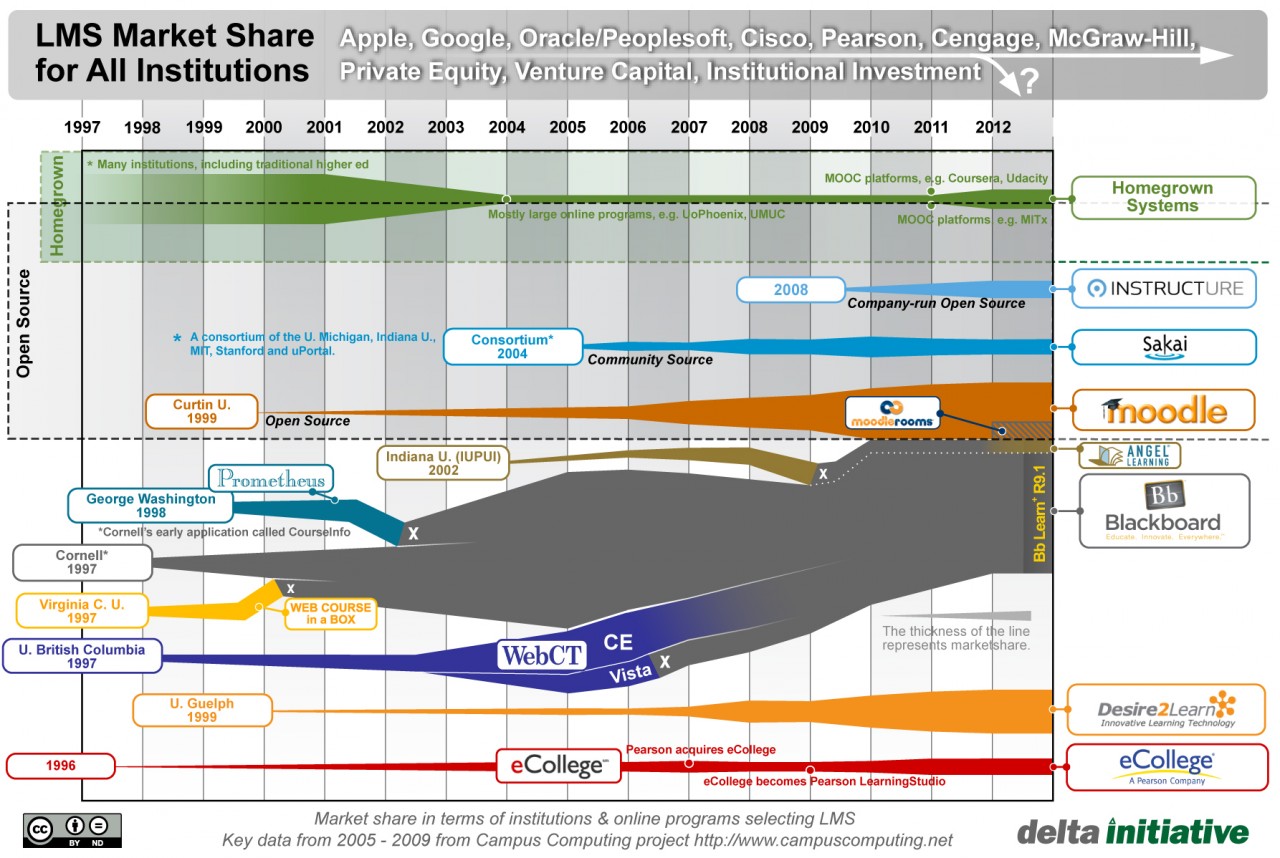
    Six weeks ago I posted a new graphic on the LMS market which included MOOCs in the same view as traditional LMS solutions.

    In the comments to the post there was an interesting note from Josh Coates (Instructure CEO) in response to whether MOOCs should be so closely aligned with the LMS market:

    i agree with you [fellow commenter Bob Puffer] that MOOCs aren’t the same thing as an LMS and should be accounted for differently.

    With the recent news of the Coursera / Antioch partnership as well as Instructure’s release of the Canvas Network, I believe we are starting to see the LMS market overlap with the MOOC market, although I do not see them completely merging. After offering to fix Josh’s broken shift key, I’d like to explore the prospects for the Canvas Network to compete in the MOOC marketplace.

    (more…)

  • Going to EDUCAUSE

    I’ll be at EDUCAUSE this week, on my last hurrah with members of my Cengage crew.

    See you there!

  • Everybody Wants to MOOC the World

    You may have seen this week’s announcement from Instructure of their new Canvas Network to support MOOCs and other open courses. Blackboard has already been dipping its toe in this water, having had Curtiss Bonk run a MOOC on CourseSites. I also find it significant that Blackboard (somewhat awkwardly) made an attempt to remind the market of this fact on the same day as Instructure’s announcement. I predict that “MOOC” will reach the same level of hype at this year’s EDUCAUSE conference that “open” did last year.

    But hype aside, it’s worth asking what it means for the traditional LMS players to be marketing themselves as platforms for MOOCs and other open courses.

    (more…)

  • Kuali: A Primer for Community Source Administrative Systems in Higher Ed

    I was recently invited to attend a user conference – Kuali Days in Austin, TX – and was struck by the disconnect between Kuali’s relatively low profile and the excitement expressed by the institutional representatives attending the conference. Before getting to any analysis of Kuali and its prospects, however, I need to lay out the basics to help me keep the terminology straight.

    My focus in consulting and writing is on educational technology – those systems that directly impact a student’s educational needs. While there are a range of administrative systems within the Kuali portfolio of projects, I will place more emphasis on those systems which are closer to the student experience.

    Based on interviews at the conference, the core value that Kuali provides are:

    • Administrative systems designed for specific needs (for higher education, by higher education); and
    • Dramatically lower hard costs for administrative systems.

    What is the Kuali Project and Foundation?

    In 2004, a group of technologists were looking to collaborate on a shareable Financial System based on a homegrown system designed at Indiana University. Within the CIC (a forum for technology collaboration mostly amongst the former Big 10 schools), there were several discussions about the nature of sharing. Even though the source code and design would be shared, who would own the software and intellectual property? Who would manage common development? These questions led to the concept of a third-party organization.

    The Kuali Project was created in early 2005 based on founding partners Indiana University, The University of Arizona, the University of Hawaii, Michigan State University, San Joaquin Delta Community College, Cornell University, NACUBO and the rSmart Group.

    (more…)

  • Is Higher Education Ready For Rapid Evolution of xMOOCs?

    Recently I wrote a post arguing that xMOOCs such as Coursera, edX and Udacity will likely evolve and that “while the current examples of massive online courses are interesting, the real potential of MOOCs will be revealed in future generations.”

    Today Antioch College announced that it is creating a new MOOC-for-credit partnership with Coursera. The key points as summarized by Tony Bates (via Inside Higher Ed article):

    This article reports on an interesting deal signed between Coursera and Antioch University. Antioch is a well-established private university with campuses in four different states, with around 4,000 mainly adult students. Under this deal:

    • Antioch University will pay Coursera for the rights to offer MOOCs from 33 universities for credit as part of its third year undergraduate program, focusing particularly on students transferring in from community colleges (the fourth year will be on campus)
    • Antioch will charge a lower tuition fee for these courses (closer to community college fee levels than public universities’)
    • Antioch will assign a faculty member to provide learner support for Antioch-registered students in each MOOC-based course, with about 20 students per instructor (as for on-campus classes)
    • Students will take an exam at the end of each course for credit from Antioch
    • Coursera will pay rights to the universities contributing MOOC courses to Antioch.

    (more…)

  • Romney and Obama Education Advisors On Higher Education

    OPINION

    Regardless of who is elected president, there will be a significant impact on higher education. The focus will be on supporting academic majors that immediately contribute to the economy—measured by starting salary, supporting students who can complete a degree-program, increasing access only for those who can afford the cost of higher education, and expanding “accountability.” Both presidential candidates promise reducing the cost of education. Both believe immediate implementation of technology—specifically online learning—will achieve learning efficiency.

    (more…)

  • Postscript to CEO Transition at Blackboard

    There are three additional management changes at Blackboard not mentioned in my recent post – two announced over the past week and one announced in April. These changes are worth noting as they further back up the point that Blackboard is in turnaround mode.

    What should we expect from the future Blackboard? I believe the best way to understand future changes at Blackboard is to view the CEO transition as the latest move in a corporate turnaround – and an unsurprising move .

    The additional management changes:

    • Bob Alcorn – chief architect of the Learn product line since 2007, lead architect and designer of Building Blocks, lead developer of CourseInfo, and original member of the Blackboard team – has left the company and will be replaced by David Ashman.
    • Siegfried Behrens resigned his position of Global Manager of US Education for Microsoft and joined Blackboard in the new position of President of Global Sales.
    • In April Bill Davis became the new CFO, replacing John Kinzer.

    There seems to be fairly significant management changes going on, and I would expect more to come once Jay Bhatt is fully in place as the new CEO.

    Update: I should clarify that Bob Alcorn’s departure is significant news, but he left for a new opportunity, not directly from a management shake-up.