e-Literate

Present is Prologue

Category: Ed Tech

The “Ed Tech” category includes posts about educational technology products themselves, including LMSs and other learning platforms, adaptive learning and other digital curricular materials products, learning analytics, and educational apps of all types. It also includes technical aspects of ed tech products, especially interoperability.

  • New Visual From LISTedTECH Shows LMS Market By New Implementations

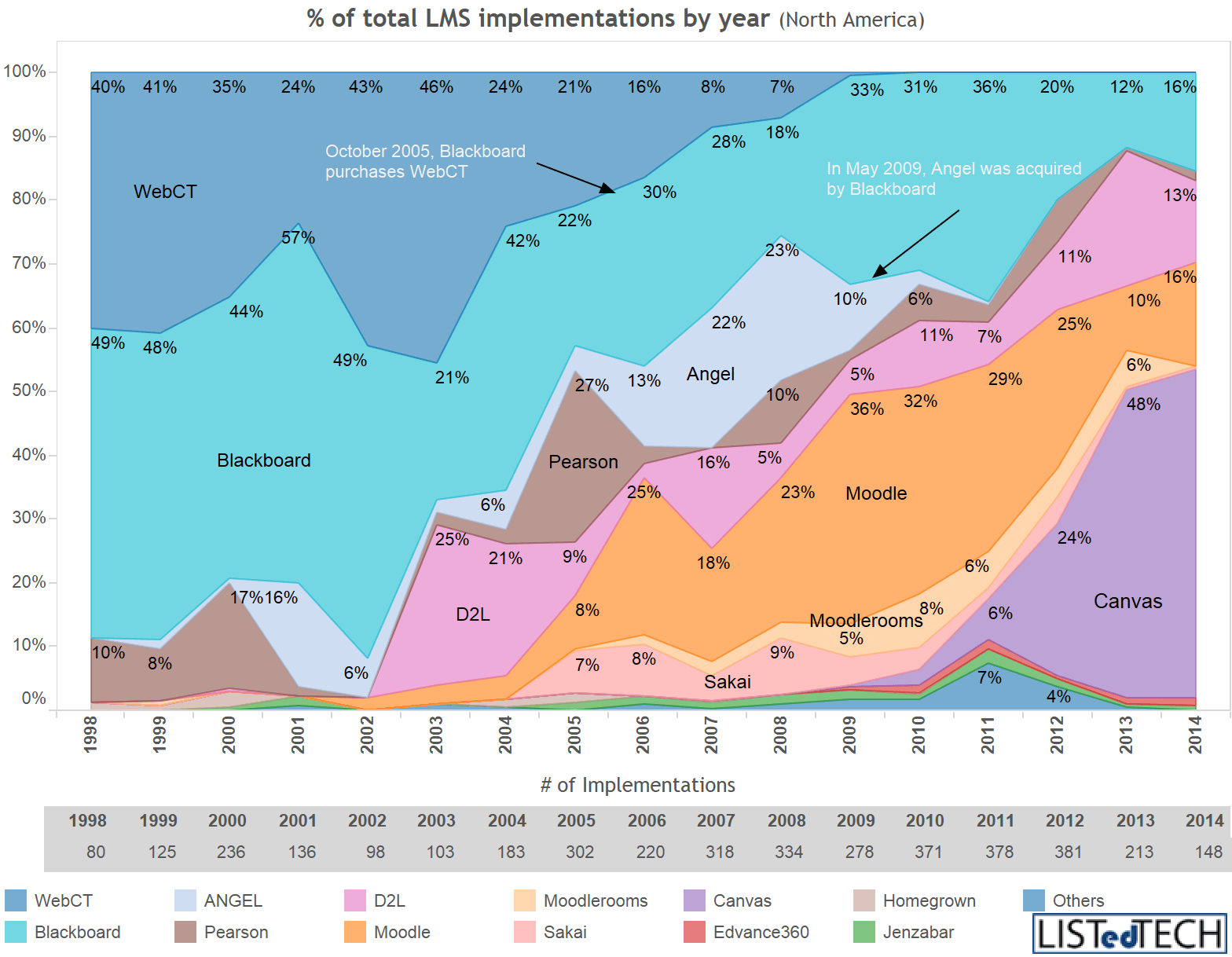
    Justin Menard and his team at ListEdTech have produced a great new visual on the LMS market in North America. Using his wiki-based data with 4,000+ institutions, he shows the percentage of LMS implementations per year (scaled to 100% for each year). While we are used to seeing LMS market share in terms of number or percentage of institutions using each LMS as primary system, this view highlights the dynamics of the market – which systems are getting adopted. See original post for full chart and additional description.

    LMS-Providers-Market-Share-by-Year1

    A few notes: (more…)

  • Rapid Fire Feedback from #WCET15

    ed. We welcome Sasha Thackaberry with this post summarizing observations at last week’s WCET conference in Denver. We met Sasha while consulting at Cuyahoga Community College (Tri-C) and were impressed with her breadth of knowledge. We’ve asked her to provide her own take on the WCET conference.

    It was my first time at the WCET Annual Meeting in Denver. I was extremely fortunate to attend and thrilled to present with Luke Dowden, whom I met for the first time at the conference. To hang on to some of the great learning, I wanted to create a brief recap of the conference and some thoughts on the next evolution of edtech in higher ed.

    One theme that emerged from the conference was that higher education is moving beyond an era of traditional online courses and programs toward a more simultaneously disaggregated and integrated future. This evolution is creative, messy, and occurring on multiple fronts, with the twin drivers of tightening budgets and the need for college-ready graduates propelling new models of learning and teaching. Individual and highly specialized innovations are converging to create entirely new ecosystems of learning, both pedagogically and architecturally.

    The overall tenor of the conference was future-forward. Not focused on limitations, instead the sessions and keynotes centered around a common theme: We can rebuild it. We have the technology…. We can make it better, stronger, faster, (and cheaper.)

    1. We’re beyond “traditional online courses.” (more…)

  • Interview with Josh Coates, CEO of Instructure, on today’s IPO

    Instructure, maker of the Canvas (higher ed and K-12 markets) LMS and Bridge (corporate learning market) LMS, held their Initial Public Offering today. Prior to the IPO, Wall Street analysts focused on the company’s growth, its large losses, and the challenges of the education market. The company was priced on the lower end of its range ($16.00), and closed up 12.5% at $18.00.

    This IPO and its lead up have been highly watched, particularly given the rapid growth in ed tech investments and questions on whether there are real businesses to emerge based on the investments. I had the opportunity to interview CEO Josh Coates today. What follows is an edited version of the interview, focusing mostly on how Instructure’s IPO will impact education markets and existing customers. I tried to capture as much of the Q&A verbatim as was feasible, but treat the answers below as a paraphrase.

    Q. What are your impressions on how the IPO has gone so far?

    A. The market in general has been a blood bath [ed. Dow down 585, or 3.3%, for the week], but we’re doing well so far. Given market conditions right now, we’re pleased as punch. We priced in range [ed. $16 – $18], and the market responding well. We’re really focused as a company 6-12 months down the road, but it is nice to get this IPO feedback. (more…)

  • Data To Back Up Concerns Of Textbook Expenditures By First-Generation Students

    David Wiley has added to the conversation ((My initial post, Mike Caulfield response, Bracken Mosbacker, my response to Mike, Mike follow-up)) over use of data on college textbook pricing and student spending patterns with “The Practical Cost of Textbooks”. The key argument is to go beyond prices and spending and look at the most direct measure of asking students themselves how textbooks costs have impacted them. He then looks at the Florida Virtual Campus surveys (also included in my post), concluding:

    What impact does the cost of textbooks have on students? Textbook costs cause students to occasionally or frequently take fewer courses (35% of students), to drop or withdraw from courses (24%), and to earn either poor or failing grades (26%). Regardless of whether you have historically preferred the College Board number or the student survey number, a third fact that is beyond dispute is that surveys of students indicate that the cost of textbooks negatively impacts their learning (grades) and negatively impacts their time to graduation (drops, withdraws, and credits).

    And yes, we need to do something about it.

    Amen. Surveying over 18,000 students, the FVC surveys are quite important and should be on everyone’s radar.

    More Out Of Data

    (more…)

  • What Schoology’s Venture Funding Means for the LMS Market

    LMS vendor Schoology just raised $32 million in Series D venture capital funding, bringing the total that they’ve raised to just over $57 million. If you’ve never heard of them, that’s because they have mostly been focused on K12, where they are doing very well. But they have turned their attention to US higher ed recently. They had a surprisingly big presence at EDUCAUSE, where CEO Jeremy Friedman told me that they are prepared to make an aggressive push. Their ability to get major funding was probably helped by Instructure going to market, and possibly by the leak that Blackboard is putting itself on the block as well. I don’t generally take money guys too seriously in their ability to predict ed tech, but they may be lucky on this one. I think there may be an opening the US higher ed LMS market for a new entrant.

    LMS selection for schools often works a little like the selection process that high school students typically go through when picking a college. Students looking at colleges usually have a favorite going in. Maybe their friends are going there. Or their big brother or sister. Or maybe they just heard that it’s cool. But they don’t apply to just one college, in case it doesn’t work out for one reason or another. So they have a second tier of schools that might be OK too. Generally, they don’t know much about your favorite school going in and they know even less about the “might be OK” schools. Depending on how cautious they are, they might throw in one or two “safety” schools that they really don’t want to go to but that they feel (or their parents feel) should be included for the sake of completeness.

    Likewise, colleges and universities frequently go into an LMS evaluation process with a favorite. Because the selection is generally done by a committee of stakeholders rather than just one person, there might be conflicting opinions on what the favorite is. But more often than not, there is a nascent majority or a consensus opinion about the likely winner, at least among the core selection committee. Back in the early to mid-aughts, the default favorite was usually Blackboard because it was considered to be the safe alternative that everybody was using. When Blackboard faltered, the favorite began to split between D2L and Moodle—and occasionally Sakai, particularly for larger public universities—with type of school and geography having a big influence on which one was likely to be the frontrunner. These days, the schools that Phil and I talk to report Instructure as the starting frontrunner at least four times out of five, across school types or geographies.

    But LMS selection processes still need their “might be OK” candidates. For one thing, most of them are mandated by policy or by law to do a real multi-vendor evaluation. And most evaluation committees genuinely do want to look at alternatives. Just because they have a sense going in of which alternative is most likely to be the best doesn’t mean that they are closed-minded. The trouble is that there aren’t many alternatives that selection committees feel hopeful about these days. Increasingly, Sakai and Moodle aren’t even making it to the serious evaluation stage in US higher ed evaluations; and even when they do, they are often treated like safety schools. Blackboard never fully recovered from reputational damage done under Michael Chasen and their failure to deliver on Ultra this year was a huge setback. At the moment, they are being treated like a safety school as often as not. If Ultra slips further—and maybe even if it doesn’t—they could start losing significant numbers of customers again. And we haven’t run into many schools that are particularly excited about D2L either. Probably the best I can say for them is that they are the least likely of the LMS companies that are not Instructure to be dismissed out-of-hand.

    I think there’s an opportunity for a new entrant to get a fair hearing from selection committees that want a real horse race but aren’t excited about any of the incumbents. Ironically, the rise and success of Instructure has probably reduced risk aversion among schools to go with a scrappy start-up. I don’t know if Schoology is going to be the one that gets a foothold in the market because of this opening, but their timing is definitely good.

  • Asking What Students Spend On Textbooks Is Very Important, But Insufficient

    Mike Caulfield responded to my post on data usage to understand college textbook expenditures. The core of my argument is a critique of commonly cited College Board data. That data originating from financial aid offices leads to the conclusion that students on average either spend or budget $1,200 per year with that number rising, while there is more reliable data originating from students showing the number to be half that amount and dropping.

    In Mike’s response post yesterday, he generally agreed with the observation but is concerned that “readers of that piece are likely to take away the wrong conclusion from Phil’s figures (even if Phil himself does not)”. There is a risk that people see the lower numbers and conclude the “crisis is overblown”, leading to this observation:

    If we’re looking to find out if prices for some set of goods are too high, then by definition we cannot look at what people are spending as a reliable gauge, because one of the big effects of “prices too high” is that people can’t afford what they need.

    If you don’t pay attention to this you get in all sorts of tautologies.

    In the specific world of textbooks, Mike considers the lower-cost method of renting used textbooks, noting:

    So which figure do we use here? The chances of getting everything you need as a rental are low. Sure, you could be the super-prepared student who knows how to work the system and get them *all* as rentals — but not every student can be first in line at the bookstore. And the ones at the back of the line — guess their socio-economic class and first generation status?

    This is an important issue, and I appreciate Mike’s understanding that I am not arguing that college textbook pricing is an overblown crisis. I agree that the crisis is real and that the hardest-hit are likely low socio-economic class and first generation students.

    But let’s move past these agreements and drop the gloves. (more…)

  • Instructure Dodges A Data Bullet

    Last week’s EDUCAUSE conference was relatively news free, which is actually a good thing as overall ed tech hype levels have come down. Near the end of the conference, however, I heard from three different sources about a growing backlash against Instructure for their developing plans for Canvas Data and real-time events. “They’re Blackboarding us”, “the honeymoon is over”, “we’re upset and that is on the record”. By all appearances, this frustration mostly by R1 institutions was likely to become the biggest PR challenge for Instructure since their 2012 outage, especially considering their impending IPO.

    The first complaint centered on Instructure plans to charge for daily data exports as part of Canvas Data, which Instructure announced at InstructureCon in June as:

    a hosted data solution providing fully optimized data to K-12 and higher education institutions capturing online teaching and learning activity. As a fundamental tool for education improvement, the basic version of the service will be made available to Canvas clients at no additional cost, with premium versions available for purchase.

    What that last phrase meant was that monthly data access was free, but institutions had to pay for daily access. By the EDUCAUSE conference, institutions that are part of the self-organized  “Canvas R1 Peers” group were quite upset that Instructure was essentially selling their own data back to them, and arguments of additional infrastructure costs were falling flat. (more…)