
e-Literate

Present is Prologue

Category: Ed Tech

The “Ed Tech” category includes posts about educational technology products themselves, including LMSs and other learning platforms, adaptive learning and other digital curricular materials products, learning analytics, and educational apps of all types. It also includes technical aspects of ed tech products, especially interoperability.

  • The University As Ed Tech Startup: UMUC, Global Campus, Texas, and SNHU roll their own

    Today the University of Maryland University Campus (UMUC) announced its plans to spin off their Office of Analytics into a separate for-profit ed tech company.

    The University System of Maryland Board of Regents today approved a University of Maryland University College (UMUC) plan to spin off its Office of Analytics into a new company, HelioCampus, that will provide business intelligence products and services to universities nationwide. [snip]

    The new company will provide a foundational analytics platform and data analysis services. This comprehensive offering will include all the tools needed to support or jumpstart an analytics program. HelioCampus will host a secure platform in the cloud that will include flexible data models and best-in-class visual analytics to accelerate analysis.

    The technology will be complemented by a team of higher-education and business-intelligence experts. Each institution will be assigned a dedicated analyst that will partner with key stakeholders to interpret the data and highlight key trends.

    The Chronicle quotes two UMUC execs – CIO Pete Young (staying at UMUC) and VP for Analytics Darren Catalano (leaving UMUC to become HelioCampus’ chief executive). It is worth noting, as Stephen deFilipo did on Twitter, that both Pete Young and Darren Catalano come from Rosetta Stone. (more…)
  • College Scorecard Problem Gets Worse: One in three associate’s degree institutions are not included

    Late yesterday I posted about the Education Department (ED) new College Scorecard and how it omits a large number of community colleges based on an arbitrary metric.

    In particular, the Education Department (ED) is using a questionable method of determining whether an institution is degree-granting rather than relying on the IPEDS data source. In a nutshell, if an institution awarded more certificates than degrees, then it is not labeled as “predominantly awarded 2-year or 4-yeard degrees” and therefore excluded.

    I am not quite confident that the explanation for the vast majority of missing schools is based on this finding. In short, if an institutions awards more certificates than degrees, ED removes them from the public-facing website even if they are technically degree-granting institutions.

    Originally it appeared this situation encompassed 17% of all community colleges, but further analysis shows it to be more significant. (more…)

  • Is Moodle “Bigger than Martin”?

    In his recent post on why Moodle matters, Phil wrote,

    For a large portion of our readers who deal mostly with US higher education, it could be easy to dismiss Moodle as an LMS and an idea past its prime.[…]And yet no other academic LMS solution comes close to Moodle in terms of worldwide deployments and learners enrolled.

    Likewise, if you’re not embedded in the Moodle community, you may not know how central Moodle creator Martin Dougiamas is to that project, or even know who he is. And yet, he is huge. I can name maybe a handful of people who are relatively widely known and respected in educational technology. I can name only a few who are admired and even beloved. I can name very few indeed who are not working for universities (although that’s changing a little, now that Jim Groom and David Wiley have both joined commercial ventures). Within the circle that knows him, Martin’s many admirers have been fiercely loyal to and protective of him, trusting him absolutely to steer Moodle the product, Moodle the community, and Moodle the brand. When you add to that the size of Moodle’s adoption footprint, one can make the case that Martin Dougiamas is one of the most consequential figures in the history of educational technology.

    Which is why it is so remarkable that Phil and I are hearing, for the first time ever, from a number of different, independent sources, the phrase, “Moodle is bigger than Martin now.” It is another indicator that Moodle is reaching an inflection point.

    (more…)

  • College Scorecard: An example from UMUC on fundamental flaw in the data

    Russ Poulin at WCET has a handy summary of the new College Scorecard produced by the Education Department (ED) and the White House. This is a “first read” given the scorecard’s Friday release, but it is quite valuable since Russ participated on an ED Data Panel related to the now-abandoned Ratings System, the precursor to the Scorecard. Russ describes the good, the “not so good”, and the “are you kidding me?” elements. One area in particular highlighted by Russ is the usage of the “dreaded first-time, full-time completion rates”:

    I knew this would be the case, but it really irks me. Under current data collected by the Department’s IPEDS surveys. They the group on which they base their “Graduation Rate” as: “Data are collected on the number of students entering the institution as full-time, first-time, degree/certificate-seeking undergraduate students in a particular year (cohort), by race/ethnicity and gender; the number completing their program within 150 percent of normal time to completion; the number that transfer to other institutions if transfer is part of the institution’s mission.”

    This rate has long been a massive disservice to institutions focused on serving adults and community colleges. Here are some example rates: Empire State: 28%, Western Governors University: 26%, University of Maryland University College: 4%, Charter Oak Colleges: no data, and Excelsior College: no data.. The problem is that these numbers are based on incredibly small samples for these schools and do not reflect the progress of the bulk of the student body.

    I won’t quote data for community colleges because they are all negatively impacted. They often serve a large number of students who are not “first-time” or define “success” in other ways.

    I know that they are working on a fix to this problem in the future. Meanwhile, who atones for the damage this causes to these institution’s reputation. This data display rewards colleges who shy away from non-traditional or disadvantaged students. Is this what we want?

    Russ is not the only one noting this problem. Consider this analysis from Friday [emphasis added]: (more…)

  • Release of Analysis Episode for e-Literate TV Series on Personalized Learning

    Today we are thrilled to release the the final episode in our new e-Literate TV series on “personalized learning”. In this series, we examine how that term, which is heavily marketed but poorly defined, is implemented on the ground at a variety of colleges and universities. While today’s episode is the final one released due to its analysis of what we learned in the five case studies, it was designed to be used as an introduction to the series.

    We have deliberately held back from providing a lot of analysis and commentary within each case study – letting faculty, students, administrators and staff speak for themselves – but in today’s episode we share some of the key lessons we learned. We had a variety schools profiled in the series, and our analysis addresses the commonalities and differences that we saw. You can see the analysis episode at this link or in the embed below.

    Controls

    Introduction: What Did We Learn In Our Personalized Learning Series?

    (more…)

  • Why Moodle Matters

    For a large portion of our readers who deal mostly with US higher education, it could be easy to dismiss Moodle as an LMS and an idea past its prime. Market data from Edutechnica shows that since 2013 the number of adopting US institutions has hit a plateau, but the total number of students served (number of institutions using Moodle as primary LMS scaled by enrollment) has actually decreased. Gone are the days of UCLA, LSU, Athabasca, North Carolina Community Colleges, UNC Charlotte and other high-profile Moodle selections from the late 2000s. ((Disclosure: I helped UCLA with their LMS selection.)) Pop quiz: name the last significant LMS decision process in US higher ed that selected Moodle as a replacement for another system.

    . . .

    And yet no other academic LMS solution comes close to Moodle in terms of worldwide deployments and learners enrolled. Even if you’re a US college or university, consider several reasons why Moodle matters.

    Most Common LMS For Small Schools

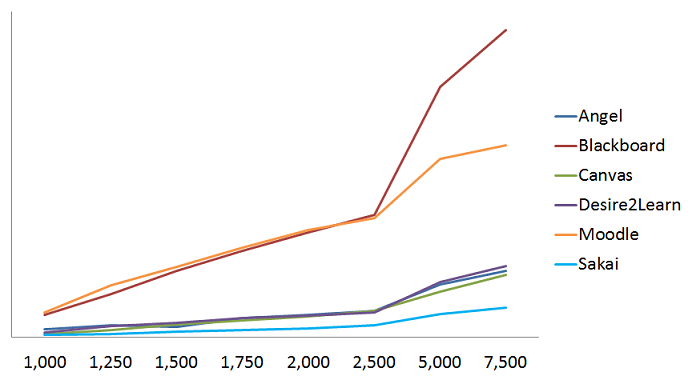
    Again using Edutechnica data (this time from early 2014), for US institutions with enrollments of 2,500 FTE or less Moodle is the market leader, surpassing Blackboard Learn.

    Edutechnica Spring 2014 Small

    Most Prevalent LMS In The World Based On Self-Reported Data

    (more…)

  • Breaking: Totara LMS Forks From Moodle And Changes Relationship

    What interesting timing. Just as I published my interview with Martin Dougiamas, I was notified that Totara LMS, a Moodle derivative aimed at the corporate learning market, has forked from Moodle and is changing its relationship with the Moodle Community. From their newsletter released today (Sept 3 Australia time):

    The relationship between Totara and Moodle is changing

    We have made the carefully considered decision that from 2016 Totara LMS will no longer be in lockstep with Moodle. This will free the team at Totara Learning to focus on big leaps forward in usability and modernising the framework for our enterprise customers.

    Further down, Richard Wyles wrote an additional post explaining the fork, starting with his long-term relationship with Moodle. He then explains:

    Why are we forking?

    From 2016 onwards we will no longer be in lockstep. Totara LMS will progressively diverge from its Moodle foundations. (more…)